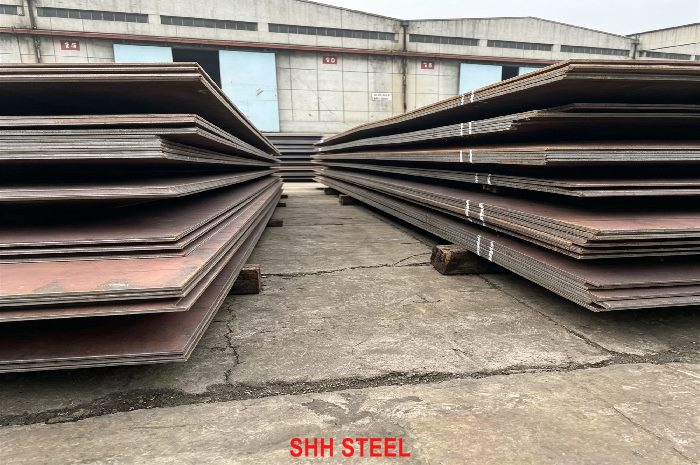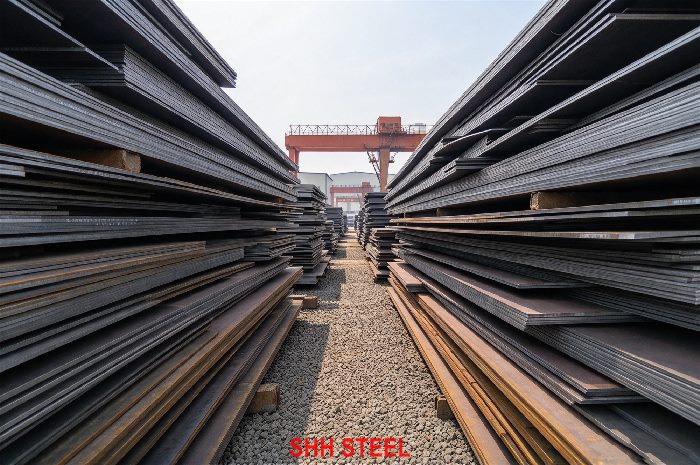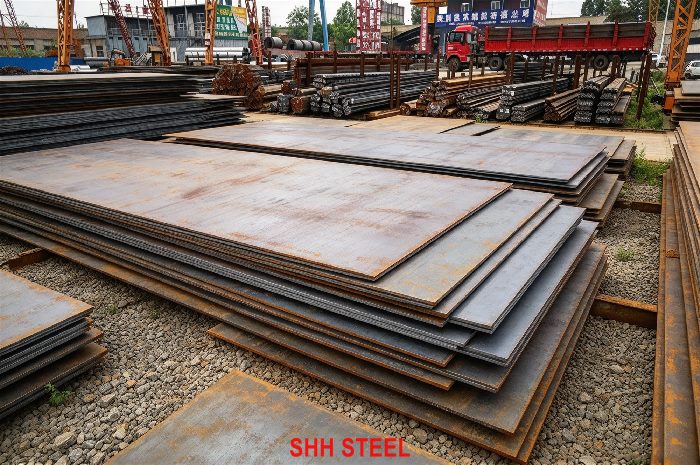
GB/T 19879 Q235GJC Building Steel Plate Supplier
What is GB/T 19879 Q235GJC Building Steel Plate?
Q235GJC, also written Q235GJ-C or Q235 GJC, is hot-rolled steel plate for building structures. Q means yield, 235 is the minimum yield strength in MPa, GJ (gao jian) marks high-performance building steel, and C is the quality grade: Charpy V-notch impact at 0°C, at least 47 J.
The GJ rules are what the structural engineer is paying for. Q235GJC sets a maximum yield as well as a minimum, holds the yield ratio at 0.80 or lower, caps carbon equivalent by thickness and keeps phosphorus and sulfur low. The frame then yields where the designer expects.
C grade is chosen for cold regions, exposed members, or when the code asks for 0°C toughness. The chemistry is the same as Q235GJB; only the test temperature changes.
GB/T 19879-2023 replaced GB/T 19879-2015 on 1 April 2024. Q235GJ chemistry, CEV, yield ratio and 47 J carry over; yield is now reported as ReH and delivery codes are renamed. Sister grades and the B-grade page are listed under GB/T 19879, including Q235GJB building steel plate.
SHH STEEL (Shanghai Shenghonghe Import & Export Co., Ltd.) is a steel manufacturer and exporter and global steel mill sourcing partner, mill-direct, China origin. We ship Q235GJC cut to size with an EN 10204 3.1 or 3.2 certificate.
Material Specification
| Specification element | Requirement | SHH STEEL compliance |
|---|---|---|
| Plate standard | GB/T 19879-2023 Q235GJC (GB/T 19879-2015 when the drawing names it) | Confirmed |
| Thickness for Q235GJ | 6 mm – 150 mm | Confirmed |
| Yield strength | 235 MPa min; 235–345 MPa window above 16 mm | Confirmed |
| Yield ratio | ≤ 0.80 | Printed on MTC |
| Quality grade | C, Charpy V at 0°C, KV2 ≥ 47 J, longitudinal | Confirmed |
| Delivery condition | AR, CR, NR or N (2023 codes) | As ordered |
| Through-thickness | Z15, Z25 or Z35 to GB/T 5313 | As ordered |
| Dimensions | GB/T 709-2019, thickness tolerance Class B | Confirmed |
| Chemistry report | Heat analysis + CEV; product analysis on request | Confirmed |
| Certificate | EN 10204 3.1 or 3.2 | As ordered |
Grades often confused with it are GB/T 1591 Q355C, EN 10025-2 S235J0 and ASTM A36. None of them carries the GJ yield cap or yield-ratio rule.
Chemical Composition: Heat Analysis and Product Analysis
GB/T 19879 controls chemistry twice. The heat (ladle) analysis is taken from the melt and must meet Table 1 of the standard. The product analysis is taken from the finished plate and may sit slightly outside Table 1, by the permitted deviations of GB/T 222. Both are valid acceptance checks, but they are not the same number.
Table 1 below is the heat analysis for Q235GJC. Columns on the right show where the other quality grades differ.
Table 1. Heat (ladle) analysis, GB/T 19879-2023 Table 1, %
| Element | Q235GJC heat analysis (%) | Q235GJB / Q235GJC | Q235GJD / Q235GJE |
|---|---|---|---|
| C, max | 0.20 | 0.20 | 0.18 |
| Si, max | 0.35 | 0.35 | 0.35 |
| Mn | 0.60 – 1.50 | 0.60 – 1.50 | 0.60 – 1.50 |
| P, max | 0.025 | 0.025 | 0.020 |
| S, max | 0.015 | 0.015 | 0.010 |
| Als, min | 0.015 | 0.015 | 0.015 |
| Cr, max | 0.30 | 0.30 | 0.30 |
| Cu, max | 0.30 | 0.30 | 0.30 |
| Ni, max | 0.30 | 0.30 | 0.30 |
| Mo, max | 0.08 | 0.08 | 0.08 |
| V + Nb + Ti, max (if combined) | 0.15 | 0.15 | 0.15 |
Notes to Table 1. Total aluminium (Alt ≥ 0.020%) may replace acid-soluble aluminium. If Al, V, Nb or Ti is added alone or together at 0.015% or more, the minimum aluminium does not apply. These limits are the same in the 2015 and 2023 editions.
B and C grades share one chemistry column. D and E grades tighten carbon to 0.18%, phosphorus to 0.020% and sulfur to 0.010% because they are tested at −20°C and −40°C.
Table 2. Product analysis limits for Q235GJC, GB/T 19879 clause 7.1.4 with GB/T 222-2025 Table 1, %
| Element | Heat limit (%) | Permitted deviation, GB/T 222 | Q235GJC product analysis limit (%) |
|---|---|---|---|
| C | ≤ 0.20 | +0.02 | ≤ 0.22 |
| Si | ≤ 0.35 | +0.03 | ≤ 0.38 |
| Mn | 0.60 – 1.50 | ±0.06 | 0.54 – 1.56 |
| P | ≤ 0.025 | +0.005 | ≤ 0.030 |
| S | ≤ 0.015 | +0.005 | ≤ 0.020 |
| Als | ≥ 0.015 | −0.003 | ≥ 0.012 |
| Cr | ≤ 0.30 | +0.05 | ≤ 0.35 |
| Cu | ≤ 0.30 | +0.05 | ≤ 0.35 |
| Ni | ≤ 0.30 | +0.05 | ≤ 0.35 |
| Mo | ≤ 0.08 | Not listed in Table 1 | Agree in contract (see note) |
| V, Ti (each, if added) | — | +0.02 / −0.01 | Heat value + 0.02 |
| Nb (if added) | — | ±0.005 | Heat value ± 0.005 |
How to read Table 2. The deviation band is picked by the upper limit in Table 1. For Mn the upper limit is 1.50%, inside the 0.80–1.70% band, so ±0.06% applies to both ends. For one heat, an element may deviate in one direction only, never above the maximum and below the minimum at the same time.
Mo has no entry in GB/T 222 Table 1. We report it, and if a product limit is needed it is written into the contract. V+Nb+Ti is a heat-analysis sum; the deviations apply to each element, not to the sum.
GB/T 222-2025 replaced GB/T 222-2006 on 1 December 2025. The C, Si, Mn, P, Cu, Cr and Ni deviations above did not change; the new edition split sulfur into its own sub-classes and adds aluminium, nitrogen and calcium rows.
Z-grade plate is cleaner. GB/T 5313-2023 limits sulfur by heat analysis:
| Z grade | Heat sulfur, max (%) | Reduction of area, avg / single (%) |
|---|---|---|
| Z15 | 0.010 | 15 / 10 |
| Z25 | 0.007 | 25 / 15 |
| Z35 | 0.005 | 35 / 25 |
CEV and Pcm are always worked out from the heat analysis, not the product analysis. SHH STEEL prints the heat values used, and adds a product-analysis column on request. This is building steel, not boiler chemistry such as GB/T 713 Q345R in GB/T 713.
Mechanical Properties
Values below follow Table 3 and Table 5 of GB/T 19879-2023 for Q235GJ. Tensile specimens are transverse; Charpy specimens are longitudinal.
| Thickness | Upper yield ReH (MPa) | Tensile Rm (MPa) | Yield ratio, max | Elongation A, min |
|---|---|---|---|---|
| 6 – 16 mm | ≥ 235 | 400 – 510 | 0.80 | 23% |
| > 16 – 100 mm | 235 – 345 | 400 – 510 | 0.80 | 23% |
| > 100 – 150 mm | 215 – 325 | 380 – 510 | 0.80 | 23% |
The 2015 edition used lower yield ReL and split the middle band: 235–345 MPa for >16–50 mm and 225–335 MPa for >50–100 mm. Write the edition on the order so the mill tests to the right table.
| Test | Q235GJC requirement |
|---|---|
| Charpy V-notch, longitudinal | 0°C, KV2 ≥ 47 J, average of 3 |
| Single value | One value may fall below 47 J, not below 70% of it |
| Sub-size specimens | Thin plate tested at 7.5 mm or 5 mm width, reduced values |
| 180° bend | D = 2a up to 16 mm; D = 3a above 16 mm |
| Through-thickness (≥ 15 mm) | Z15, Z25 or Z35 to GB/T 5313, when ordered |
Density for theoretical weight is 7.85 g/cm³.
Q235GJC vs Q235B and Q235C: Why Buildings Specify GJ Steel
Q235B and Q235C under GB/T 700 have the same 235 MPa yield on paper. They are cheaper and easy to find. So why does a structural drawing say Q235GJC?
Because the seismic code cares about what the plate does after it yields. Ordinary Q235 can come out of the mill at 330 MPa or more with a yield ratio near 0.85. That plate is stronger than designed, which sounds good but moves plastic hinges into the welds and columns. GJ steel holds the yield inside a 110 MPa window and keeps the ratio at 0.80 or lower.
| Property | Q235B (GB/T 700) | Q235C (GB/T 700) | Q235GJC (GB/T 19879) |
|---|---|---|---|
| Yield upper limit | None | None | 345 MPa above 16 mm |
| Yield ratio limit | None | None | ≤ 0.80 |
| Thickness effect on yield | Drops to 215 MPa and below | Same | 235 MPa held to 100 mm |
| C, max | 0.20% | 0.17% | 0.20% |
| P / S, max | 0.045 / 0.045% | 0.040 / 0.040% | 0.025 / 0.015% |
| Impact | +20°C, 27 J | 0°C, 27 J | 0°C, 47 J |
| CEV limit | None | None | 0.34% to 50 mm |
| Z15–Z35 option | Rare | Rare | Standard option |
Q235GJC can replace Q235C. Q235C cannot replace Q235GJC. If a supplier offers Q235C paper for a GJ line item, the yield cap, ratio and CEV have not been tested.
For members that only need strength, ordinary plate is fine. For 355 MPa without the GJ rules, the general choices are GB/T 1591 Q355C and GB/T 1591 Q355D.
Q235GJB, Q235GJC, Q235GJD or Q235GJE: Which Quality Grade?
| Grade | Impact temperature | Energy, min | C / P / S max (%) | Typical use |
|---|---|---|---|---|
| Q235GJB | +20°C | 47 J | 0.20 / 0.025 / 0.015 | Heated interiors, mild climates |
| Q235GJC | 0°C | 47 J | 0.20 / 0.025 / 0.015 | Cold regions, exposed frames |
| Q235GJD | −20°C | 47 J | 0.18 / 0.020 / 0.010 | Severe winters, thick welded nodes |
| Q235GJE | −40°C | 47 J | 0.18 / 0.020 / 0.010 | Arctic and low-temperature sites |
Strength, yield ratio and CEV do not change from B to E. Only the impact temperature and the D/E chemistry move. Pick the letter from the lowest service temperature.
For a cross-check on European drawings, EN 10025-2 S235J0 is tested at 0°C and EN 10025-2 S235J2 at −20°C, both at 27 J. For higher strength in the same family, Q355GJ sits next in GB/T 19879 building structure plates.
Equivalent Material Grades
No foreign grade copies every GB/T 19879 rule. JIS G3136 SN400C is the closest: it also limits yield range and yield ratio and is built for through-thickness loading. Others match strength level only.
| Designation | Region | Standard | Notes |
|---|---|---|---|
| Q235GJC | China | GB/T 19879 | Grade on this page |
| SN400C | Japan | JIS G3136 | Closest counterpart; 0°C impact, Z-direction requirement built in |
| JIS G3106 SM400C | Japan | JIS G3106 | 0°C impact; no yield-ratio rule |
| EN 10025-2 S235J0 | Europe | EN 10025-2 | 0°C, 27 J; strength comparison |
| EN 10025-2 S235JR | Europe | EN 10025-2 | +20°C, 27 J |
| ASTM A36 | USA | ASTM A36 | About 250 MPa yield; no impact or ratio limit |
| ASTM A709 Grade 36 | USA | ASTM A709 | Bridge grade; impact by zone |
| DIN 17100 St37-3 | Germany | DIN 17100 (withdrawn) | Legacy name on old drawings |
| ASTM A283 Grade C | USA | ASTM A283 | Lower strength; not a substitute |
European projects add through-thickness by EN 10164 Z15/Z25/Z35 to EN 10025-2 plate. SHH STEEL dual-certifies to ASTM A36/A36M or JIS G3106 only when the order names both books and both tables pass.
Weldability
Q235GJC is easy to weld. GB/T 19879 requires CEV, calculated from the heat analysis and printed on the certificate:
CEV = C + Mn/6 + (Cr + Mo + V)/5 + (Ni + Cu)/15
Pcm = C + Si/30 + Mn/20 + Cu/20 + Ni/60 + Cr/20 + Mo/15 + V/10 + 5B
| Thickness | CEV, max (%) | Pcm, max (%) |
|---|---|---|
| ≤ 50 mm | 0.34 | 0.24 |
| > 50 – 100 mm | 0.36 | 0.26 |
| > 100 – 150 mm | 0.38 | 0.27 |
In the 2023 edition plate ships against CEV; Pcm replaces it only for TMCP plate by contract. Thin plate normally needs no preheat. Thick column plate, high restraint or cold sites follow the qualified WPS.
Typical consumables are E43-class low-hydrogen electrodes and wires, or E70xx types. Shops work to GB 50661 or AWS D1.1. A WPS from ASTM A36 or ASME SA36 is a fair start; recheck it against actual CEV and thickness.
Heat Treatment and Delivery Condition
GB/T 19879-2023 lists four delivery conditions for Q235GJ: hot rolled (AR), controlled rolled (CR), normalizing rolled (NR) and normalized (N). The 2015 edition wrote WAR, WCR and N. The condition is agreed in the contract.
Most Q235GJC up to about 50 mm ships CR or AR. Thick or Z35 plate is often normalized.
Q235GJC is not quenched and tempered. QT plate belongs to GB/T 16270, such as GB/T 16270 Q460C. European comparisons are EN 10025-3 S275N in EN 10025-3 and EN 10025-4 S275M in EN 10025-4.
Test batches are one heat, thickness and condition, up to 60 t.
Dimensions
Usual Q235GJC supply range from SHH STEEL:
- Thickness: 6 mm – 150 mm; most orders 8 mm – 100 mm
- Width: 1500 mm – 3000 mm standard; wider by mill confirmation
- Length: 3000 mm – 12000 mm; longer by enquiry
- Edge: mill edge or cut edge
- Weight: theoretical, on the mean of maximum and minimum thickness, 7.85 g/cm³
Column flanges, stiffeners, base plates and gussets are cut to drawing. Rolled sections for the same frame are under steel beam profiles and steel structural profiles.
Tolerances
GB/T 19879-2023 sends dimensions and shape to GB/T 709-2019. Thickness tolerance is Class B by default: fixed minus 0.30 mm, plus by thickness and width. Class C (zero minus) is available by agreement.
| Nominal thickness (mm) | Width ≤ 1500 mm | Width > 1500 – 2500 mm |
|---|---|---|
| > 8 – 15 | −0.30 / +0.80 | −0.30 / +1.00 |
| > 15 – 25 | −0.30 / +1.00 | −0.30 / +1.20 |
| > 25 – 40 | −0.30 / +1.10 | −0.30 / +1.30 |
| > 40 – 60 | −0.30 / +1.30 | −0.30 / +1.50 |
| > 60 – 100 | −0.30 / +1.50 | −0.30 / +1.80 |
| > 100 – 150 | −0.30 / +2.10 | −0.30 / +2.50 |
Flatness and width follow GB/T 709. EN 10029 or ASTM A6 tolerances are possible if written on the order.
Supplementary Requirements
Q235GJC already fixes strength, yield ratio, CEV and 0°C impact. Anything more goes on the purchase order.
- Edition: GB/T 19879-2023 or -2015. Never write only Q235.
- Product analysis: ask for a second chemistry column checked to GB/T 222.
- Through-thickness: add Z15, Z25 or Z35, e.g. Q235GJCZ25.
- Ultrasonic testing: GB/T 2970 and class, or EN 10160 / ASTM A578.
- Delivery condition: write N if AR is not acceptable.
- Tolerance: Class C for zero minus.
- Inspection: EN 10204 3.2 with SGS, BV, TÜV or a named inspector.
Q235GJC Price Factors and How to Order
A Q235GJC price per ton is a base price plus extras. The extras explain most gaps between quotes.
| Cost driver | Effect on price |
|---|---|
| GJ grade over Q235B/C | Grade extra for cleaner steel, yield control and CEV |
| Thickness | Thin and very thick plate carry size extras; 10–60 mm is usually cheapest |
| Z15 / Z25 / Z35 | Desulfurization, plate-by-plate Z test and UT; Z35 costs most |
| Normalized delivery | Furnace time and longer lead time |
| UT class | Stricter classes raise reject risk and cost |
| Width and length | Over 3000 mm wide or 12 m long needs mill confirmation |
| Quantity per size | Mill rolling minimums per size; small lots come from stock or combined rolling |
| Inspection and cutting | 3.2 witness, profile cutting, blasting and priming are quoted per item |
To get a firm quote in one round, send:
- Grade and edition, e.g. Q235GJCZ25 to GB/T 19879-2023
- Thickness × width × length and pieces or tonnes
- Delivery condition, UT standard and class
- Certificate type and inspector
- Destination port and Incoterm
We quote plate price, extras and freight line by line, so you can compare like with like. Need the +20°C version instead? See Q235GJB building steel plate.
Applications
| Sector | Typical Q235GJC components |
|---|---|
| High-rise towers | Box column plates, H-column flanges, transfer girders |
| Long-span roofs | Trusses, space-frame nodes, stadium and terminal roofs |
| Seismic frames | Beam-to-column plates, brace gussets, link plates |
| Industrial buildings | Crane girders, base plates, mezzanines in unheated halls |
| Public works | Railway stations, exhibition centres |
C grade earns its place where steel sees winter outdoors or is erected in cold weather. Thick node plates loaded through their thickness add Z25 or Z35.
It is the wrong plate for 345 MPa design (GB/T 1591 or Q355GJ), for pressure equipment (pressure vessel steel plates) or for bare exposed steel (weathering steel plates). North American bridges use ASTM A709 or ASTM A572 Gr.50 under ASTM A572.
Supply Capability
SHH STEEL sources Q235GJC from first-line building-steel mills, including Wuyang (Wugang), a drafting mill of GB/T 19879, plus Hanye, Xinyu, Shougang and Angang when size requires.
- Certificates: EN 10204 3.1 standard; 3.2 with third-party witness
- Tests: tensile, 0°C Charpy, bend, Z test to GB/T 5313, UT to GB/T 2970, product analysis
- Processing: CNC plasma and flame cutting, bevelling, drilling, shot blast and primer
- Terms: FOB Shanghai, CFR, CIF; TT, LC or TT + LC
- Marking: steel-stamped and paint-marked with grade, heat, size and mill
Global Delivery and Markets
SHH STEEL ships GB, ASTM, ASME, EN, DIN and JIS plate to the United States, Europe, the Middle East, Southeast Asia, Africa and South America. Q235GJC mostly goes to EPC contractors building Chinese-code projects abroad.
Lead time: stock sizes about 5–7 days; mill rolling about 30–45 days; Z35 or 3.2 inspection adds about 1–2 weeks. Sea time from Shanghai is about 7–12 days to Singapore and 28–35 days to Rotterdam.
Why Choose SHH STEEL
SHH STEEL is a steel manufacturer and exporter and global steel mill sourcing partner, mill-direct, China origin. For Q235GJC that means real GJ plate at mill price, not relabelled Q235C.
Before shipment we check four lines on every certificate: yield inside the GJ window, yield ratio ≤ 0.80, CEV inside the thickness band, and 0°C impact at 47 J or more. If one fails, the plate does not ship as GJ.
We also tell buyers when they are over-specifying. If the frame needs 355 MPa, we quote Q355GJ or GB/T 1591 Q355NC; if it does not need GJ rules, we say so. Browse more carbon steel plates and structural steel plates.
FAQ
-
What is Q235GJC steel?
- Q235GJC is high-performance building structure steel plate to GB/T 19879. It has 235 MPa minimum yield, a yield cap of 345 MPa above 16 mm, a yield ratio of 0.80 or less, CEV limits and Charpy impact of at least 47 J at 0°C. GJ stands for gao jian, high-performance building steel.
-
What is the difference between Q235GJC and Q235B?
- Q235B (GB/T 700) only sets a minimum yield and 27 J at +20°C. Q235GJC (GB/T 19879) adds a maximum yield, a 0.80 yield ratio limit, CEV limits, lower P and S, and 47 J at 0°C. Q235GJC can replace Q235B or Q235C, but not the other way round.
-
What is the ASTM or EN equivalent of Q235GJC?
- There is no exact equivalent. The closest is JIS G3136 SN400C, which also caps yield and yield ratio. EN 10025-2 S235J0 and ASTM A36 match strength only; they have no yield cap or ratio limit, so they are not direct substitutes.
-
What does Q235GJCZ25 mean?
- Q235GJCZ25 is Q235GJC plate with Z25 through-thickness properties to GB/T 5313: average reduction of area at least 25%, no single value below 15%, heat sulfur 0.007% max, and each plate tested. Z grades apply to plate 15 mm and thicker and resist lamellar tearing.
-
What is the difference between heat analysis and product analysis?
- Heat (ladle) analysis is taken from the molten steel and must meet the standard's table. Product analysis is taken from the finished plate and may exceed the table by the deviations in GB/T 222, for example +0.02% carbon or +0.005% phosphorus. CEV is always calculated from the heat analysis.
-
Is GB/T 19879-2015 still valid?
- No. GB/T 19879-2023 replaced GB/T 19879-2015 from 1 April 2024. Q235GJ chemistry, CEV, yield ratio and 47 J impact are unchanged, but the 2023 edition uses upper yield ReH, new thickness bands and AR/CR/NR/N delivery codes. Older drawings may still name 2015, so state the edition on the order.
Conclusion
Q235GJC steel plate to GB/T 19879 is building structure plate with 235 MPa yield, a capped yield window, a 0.80 yield ratio limit and 47 J impact at 0°C. It shares its chemistry with Q235GJB but adds 0°C toughness for cold or exposed frames. It is not GB/T 700 Q235C, and it is not GB/T 1591 Q355C under GB/T 1591.
SHH STEEL supplies Q235GJC with heat analysis, CEV, yield ratio and impact on an EN 10204 3.1 or 3.2 certificate, and adds a product analysis checked to GB/T 222 when you need it. Z15, Z25 or Z35, UT to GB/T 2970, Class B or C tolerance, cutting and blasting are available.
We ship from Shanghai to buyers worldwide. Browse the full GB/T 19879 range or other high strength low alloy plates.
Send the edition, quality letter, Z level and size list; we confirm mill, lead time and price in one reply. Contact SHH STEEL for a mill-direct quotation on Q235GJC building steel plate.
Quality Steel Needed? Inquire for Offers
Related Products