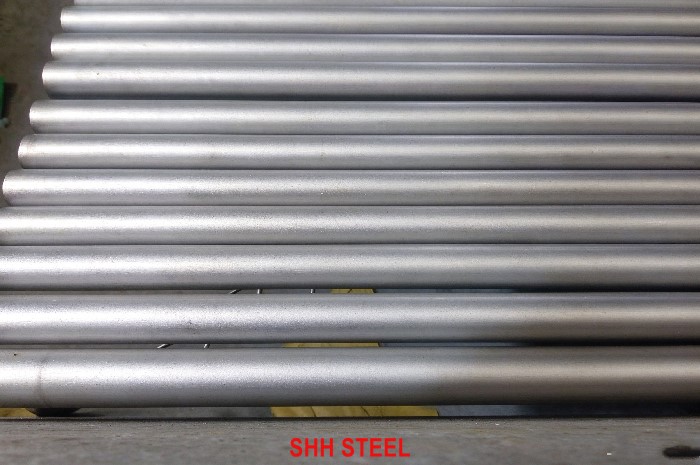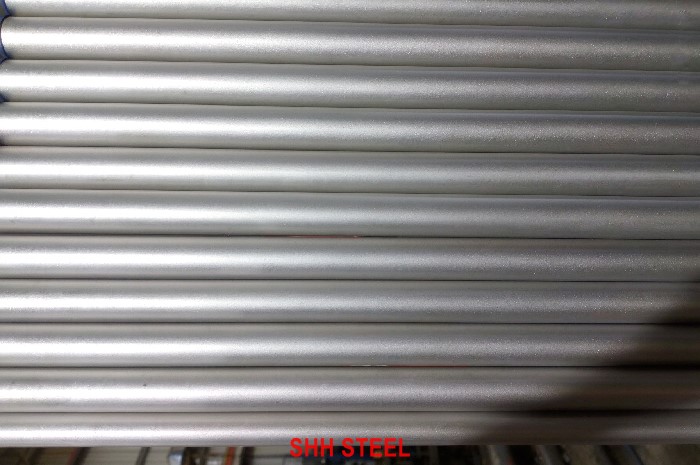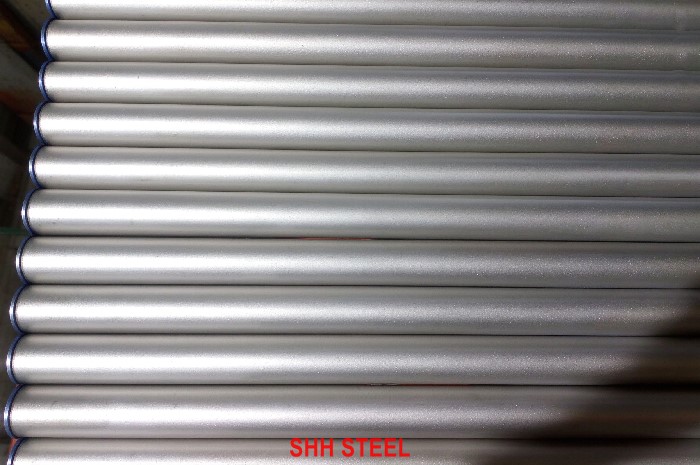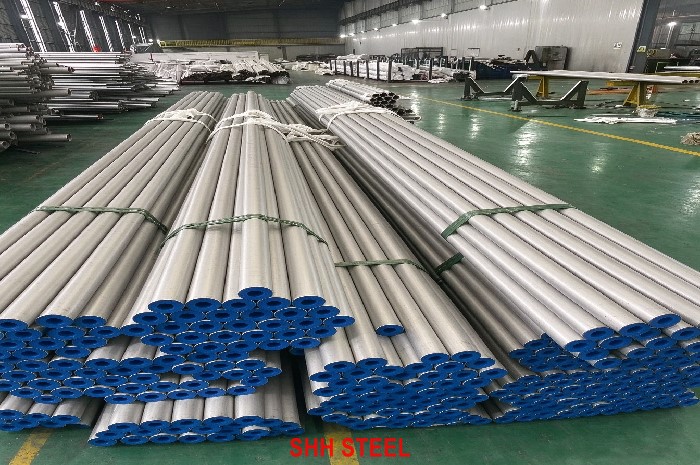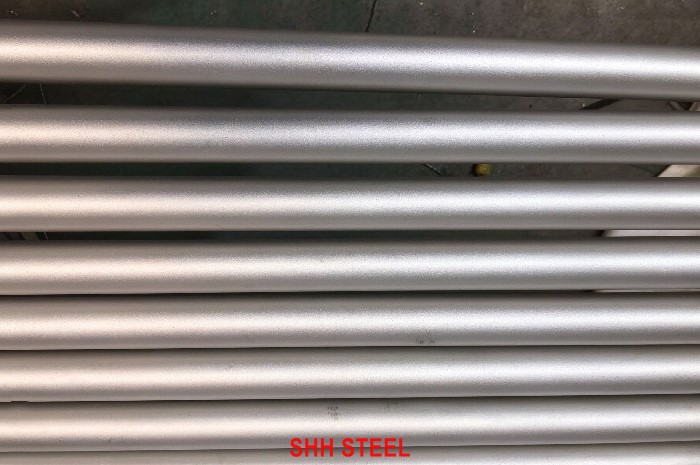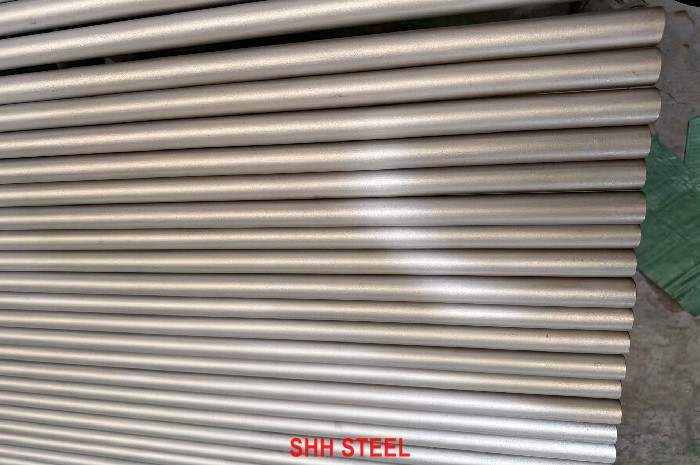
ASTM A213 UNS S30432 Stainless Steel Tube
What is ASTM A213 UNS S30432 Stainless Steel Tube
ASTM A213 / A213M lists UNS S30432 among the austenitic stainless grades that carry no common TP letter — the UNS number uniquely identifies the alloy on the chemistry and tensile tables. Commercially the grade is known as Super304H or 18Cr-9Ni-3Cu-Nb-N: a copper- and niobium-bearing, nitrogen-strengthened austenitic developed for high-temperature boiler and superheater service where creep-rupture strength and steam oxidation resistance matter more than the general corrosive framing used for ordinary TP304. Melt chemistry includes carbon 0.07–0.13%, chromium 17.0–19.0%, nickel 7.5–10.5%, copper 2.5–3.5%, niobium 0.30–0.60%, nitrogen 0.05–0.12%, plus controlled aluminum and boron. Table 4 sets a higher room-temperature floor than TP304H — 86 ksi [590 MPa] tensile and 34 ksi [235 MPa] yield — with hardness max 219 HBW / 230 HV or 95 HRB.
SHH STEEL can supply ASTM A213 UNS S30432 stainless steel tube as seamless cold-finished and hot-finished product in the usual boiler and superheater OD × wall / BWG band, shipped with EN 10204 3.1 mill test certificates that report the full Cu–Nb–N–Al–B chemistry set and the Table 4 tensile/hardness results. Dual A213 / SA-213 marking is available only when the purchase order asks for both independent standards. Browse high-temperature austenitic sisters on the A213/A213M hub.
Shop names such as Super304H, SUPER304H, or 18Cr-9Ni-3Cu-Nb-N do not replace UNS S30432 on the MTC or stencil. Compare with A213 TP304H, A213 TP347H, A213 TP321H, and A213 TP310HCbN before treating any H-grade as interchangeable. A213 is seamless tube only — cold-finished versus hot-finished is the process choice, not a WLD/HCW manufacturing type.
Chemical Composition of A213 UNS S30432
UNS S30432 chemistry is denser than a standard 18-8 row. Melting analysis is mandatory; product analysis applies only when ordered through A1016 / A480 A1.1. Copper-rich precipitation and Nb–N interactions are intentional for creep strength; aluminum and boron sit in narrow controlled bands. Nitrogen analysis method is by agreement (Footnote B). There is no TP grade letter — order and mark by UNS S30432.
The tables below reproduce the melt limits from the public A213 stainless chemistry table and product-analysis limits from A480 Table A1.1 tolerances applied to those melt bands. Confirm the ordered edition before treating secondary catalogues as acceptance text.
Melting analysis (heat / ladle analysis)
| Element | UNS S30432 melting analysis |
|---|---|
| Carbon (C) | 0.07 – 0.13 |
| Manganese (Mn) | ≤ 1.00 |
| Phosphorus (P) | ≤ 0.040 |
| Sulfur (S) | ≤ 0.010 |
| Silicon (Si) | ≤ 0.30 |
| Chromium (Cr) | 17.0 – 19.0 |
| Nickel (Ni) | 7.5 – 10.5 |
| Molybdenum (Mo) | … (no requirement) |
| Nitrogen (N) | 0.05 – 0.12 |
| Niobium (Nb) | 0.30 – 0.60 |
| Copper (Cu) | 2.5 – 3.5 |
| Aluminum (Al) | 0.003 – 0.030 |
| Boron (B) | 0.001 – 0.010 |
Source: ASTM A213/A213M stainless chemistry table for UNS S30432 (public htpipe A213 PDF excerpt). Mn ≤1.00, Si ≤0.30, P ≤0.040, and S ≤0.010 are tighter than ordinary TP304H rows — do not paste a TP304H chemistry block onto an S30432 certificate.
Product analysis — A480/A480M Table A1.1 tolerances applied
| Element | Melting | Tolerance (A480 A1.1) | Product analysis limit |
|---|---|---|---|
| Carbon (C) | 0.07 – 0.13 | 0.01 under / over | 0.06 – 0.14 |
| Manganese (Mn) | ≤ 1.00 | 0.03 over | ≤ 1.03 |
| Phosphorus (P) | ≤ 0.040 | 0.010 over | ≤ 0.050 |
| Sulfur (S) | ≤ 0.010 | 0.005 over | ≤ 0.015 |
| Silicon (Si) | ≤ 0.30 | 0.05 over | ≤ 0.35 |
| Chromium (Cr) | 17.0 – 19.0 | 0.20 under / over | 16.80 – 19.20 |
| Nickel (Ni) | 7.5 – 10.5 | 0.10 under / 0.15 over | 7.40 – 10.65 |
| Nitrogen (N) | 0.05 – 0.12 | 0.01 under / 0.02 over | 0.04 – 0.14 |
| Niobium (Nb) | 0.30 – 0.60 | 0.05 under / over | 0.25 – 0.65 |
| Copper (Cu) | 2.5 – 3.5 | 0.10 under / over | 2.40 – 3.60 |
| Aluminum (Al) | 0.003 – 0.030 | 0.005 under / over (practice) | 0.000 – 0.035 (confirm A480 edition) |
| Boron (B) | 0.001 – 0.010 | edition-dependent microalloy tolerance | confirm A480 edition if contractual |
Read Cu, Nb, N, and C first: copper supports Cu-rich precipitate strengthening in creep service; niobium and nitrogen refine and strengthen; carbon 0.07–0.13% is an intentional H-like floor/ceiling, not an L-grade story. Versus A213 TP304H, S30432 adds Cu–Nb–N–Al–B and tightens Mn/Si/S. Versus A213 TP347H, niobium sits in a fixed 0.30–0.60% band rather than a carbon-multiple formula alone, and copper is a primary alloying addition.
When product analysis is ordered, use the A480 path above and put any tighter Cu, Nb, or S ceiling on the purchase order before the heat is selected. Aluminum and boron product tolerances are edition-sensitive — label them UNCERTAIN until the ordered A480 edition is confirmed.
Mechanical Properties of A213 UNS S30432
ASTM A213 Table 4 sets UNS S30432 tensile acceptance at 86 ksi [590 MPa] tensile strength and 34 ksi [235 MPa] yield strength (0.2% offset), with elongation 35% minimum in 2 in. or 50 mm and hardness max 219 HBW / 230 HV or 95 HRB. Those numbers sit above TP304H’s 75/30 ksi / 192 HBW pair and reflect the Cu–Nb–N strengthening design of the grade. Room-temperature Table 4 is still only the acceptance floor — creep-rupture design data for USC boiler tubing come from the project’s material allowable tables, not from inventing numbers on this page.
| Property | UNS S30432 requirement (Table 4) |
|---|---|
| Tensile strength, min | 86 ksi [590 MPa] |
| Yield strength (0.2% offset), min | 34 ksi [235 MPa] |
| Elongation in 2 in. or 50 mm, min | 35% |
| Hardness, max | 219 HBW / 230 HV or 95 HRB |
Source: ASTM A213/A213M Table 4 for UNS S30432 (public specification PDF excerpt). Mechanical property requirements do not apply to tubing smaller than 1/8 in. [3.2 mm] ID or thinner than 0.015 in. [0.4 mm] wall. Flattening and flaring tests apply on a lot basis beside tension and hardness.
Do not accept a TP304H certificate as S30432 clearance — copper, niobium, nitrogen, and the higher tensile/hardness pair must all match. For Nb-stabilized H-grade without the Cu–N package, open A213 TP347H; for fine-grained 347 variants see A213 TP347HFG.
Dimensions and Tolerances
Dimensional supply for ASTM A213 UNS S30432 remains tube language — OD × min wall (or average wall) and BWG / gauge — aimed at boiler and superheater bundles rather than B36.19 pipe schedules. Usual A213 sizes run from about 1/8 in. [3.2 mm] ID to 5 in. [127 mm] OD with min wall about 0.015–0.500 in. [0.4–12.7 mm]; other diameters by agreement when all other requirements are met. State wall basis on the PO before tooling is set.
OD and wall variations follow ASTM A1016/A1016M. Cold-finished routes hold tighter OD; hot-finished routes allow wider windows. Cold-finished average wall is often summarized as ±10%; minimum-wall product follows A1016 minimum-wall tables. Confirm edition rows for the size and finish ordered.
| Item | Typical A213 UNS S30432 dimensional practice |
|---|---|
| Product form | Seamless only (cold-finished or hot-finished) |
| Usual size band | ~1/8 in. [3.2 mm] ID to 5 in. [127 mm] OD; wall ~0.015–0.500 in. [0.4–12.7 mm] |
| Wall basis | Minimum wall (default) or average wall when specified |
| OD / wall tolerances | Per ASTM A1016/A1016M for finish route and size |
| Length | Boiler / superheater cut lengths; mill random by agreement |
| Secondary note | B36.19 schedules only as a buyer cross-reference, not the primary callout |
Put bend form, end preparation, and any shot-blast or pickling preference on the enquiry with the metallurgical notes. Minimum wall is first-class under A213 regardless of how specialized the chemistry is.
Equivalent Grades
UNS S30432 is often sold under proprietary trade names; none of those names replace the UNS designation on an A213 certificate. Approximate wrought or EN designations may exist in commercial literature, but the governing ASTM product standard for this article is A213 / A213M with UNS S30432 chemistry and Table 4 tensile rows.
| Designation | Notes |
|---|---|
| ASTM A213 / A213M UNS S30432 | Governing ASTM seamless boiler / superheater tube product standard for this article |
| UNS S30432 | Unique identifier — no TP letter in the A213 table |
| ASME SA-213 UNS S30432 | Separate ASME Code Book adoption — dual-mark only when the PO asks |
| Super304H / SUPER304H (commercial) | Trade name for the Cu–Nb–N alloy family — not a substitute for UNS marking |
| Related H-grade sisters | A213 TP304H, A213 TP347H — different chemistries, not drop-in equals |
Dual A213/SA-213 marking is a PO option. Do not treat Super304H catalogue sheets as the ASTM acceptance text without matching the ordered edition’s S30432 row.
Heat Treatment and Delivery Condition
UNS S30432 under ASTM A213 is furnished solution treated at a minimum of 2000 °F [1100 °C] — notably hotter than the 1900 °F [1040 °C] row used for TP304 / TP304H — then water quenched or rapidly cooled. That higher solution temperature (Table 3 in the public PDF excerpt) is intentional for dissolving Cu–Nb-related phases before quench. Skipping or under-cooling the anneal can leave a structure that fails both hardness and creep-oriented expectations even when ladle chemistry looked correct.
Cold-finished versus hot-finished remains a process/dimensional route, not a substitute for the 2000 °F anneal. Delivery condition for SHH STEEL S30432 is solution annealed and pickled (or bright annealed by agreement), with the actual anneal temperature and quench method stated on the EN 10204 3.1 certificate. Straightening, cutting, and end finishing follow heat treatment.
Grain-size columns for S30432 show no mandatory ASTM grain-size number in the public Table 3 excerpt used here (ellipsis / no requirement in that column), unlike TP304H’s ASTM No. 7 or coarser rule. If a project specification adds a grain-size Supplementary Requirement, write it onto the PO rather than assuming H-grade grain-size language transfers automatically from TP304H.
Corrosion Resistance
S30432 is framed for high-temperature steam oxidation and creep-oriented boiler service, not as a chloride-pitting upgrade over TP316. Copper and niobium serve strength and microstructural stability in steam service; they are not molybdenum. In wet chloride-bearing exchangers, do not select S30432 as a substitute for A213 TP316L or higher-Mo grades.
Intergranular corrosion after fabrication is a different conversation from steam oxidation: carbon 0.07–0.13% is intentional for creep strength, so as-welded wet-service IGC resistance is not the grade’s selling point. ASTM A213 does not publish a corrosion-rate table for S30432. When a project invokes a specific oxidation or IGC test, put that Supplementary Requirement on the purchase order.
Applications of A213 UNS S30432 Tube
UNS S30432 is ordered for advanced boiler and superheater tubing — especially USC and high-efficiency fossil units — where Cu–Nb–N austenitic creep strength and steam oxidation resistance justify the chemistry premium over TP304H. It is not the default grade for general corrosive HX duty.
| Application area | Typical use of S30432 tube | Selection note |
|---|---|---|
| USC / advanced boiler superheaters | Seamless tube where Super304H-class creep and oxidation framing is specified | Confirm design metal temperature and Code allowables |
| Reheater / final superheater sections | High steam-side metal temperature service | Compare TP347H / TP347HFG if Nb-stabilized H-grade without Cu is specified |
| Replacement / retrofit programs | Matching existing Super304H installations | Mark and certify UNS S30432, not a trade name alone |
| General corrosive HX | Usually not the first choice | Open TP304 / TP316L family instead |
| Wet chloride service | Not selected for Mo-style pitting resistance | Use Mo or duplex/superaustenitic grades |
Stay on the A213/A213M hub for H-grade and specialty austenitic sisters rather than mixing pipe product standards into boiler-tube acceptance.
Weldability
S30432 tube is welded with matching or near-matching Cu–Nb–N austenitic consumables qualified for Super304H-class base metal; fabricators should not assume ER308H alone automatically matches the Cu–Nb–N deposit chemistry the OEM procedure requires. Heat input, interpass, and any post-weld heat treatment belong to the boiler code WPS, not to A213. Matching welding consumables are commercially available for this alloy family — specify them on the fabrication package.
Because A213 product is seamless, inspection language focuses on each-length hydro or NDE, tube-to-header joint quality, and any contractual creep or oxidation tests on the base metal. For Nb-stabilized H-grade without copper, open A213 TP347H rather than forcing S30432 into a different chemistry story.
Surface Finishes
Standard mill delivery for ASTM A213 UNS S30432 is solution annealed (2000 °F [1100 °C] min) and pickled. Bright annealing or special OD/ID finishes are commercial call-outs. Boiler tube often ships with a workmanlike pickled finish suitable for steam-side service; cosmetic polish is uncommon unless the PO asks.
End preparation for header welding or expanding should be ordered with finish so receiving inspection shares one acceptance language. SHH STEEL stencils UNS S30432 and heat-treatment data as standard requirements; special grind or passivation remain extras.
Inspection and Testing
Base ASTM A213 testing for UNS S30432 includes full melt analysis (C, Mn, P, S, Si, Cr, Ni, N, Nb, Cu, Al, B), tension to the Table 4 86/34 ksi floors, hardness to the 219 HBW / 95 HRB maximum, flattening and flaring on a lot basis, and hydro or NDE of each length. Manufacturer choice of hydro versus NDE applies unless the PO fixes the method.
| Option | Purpose |
|---|---|
| Product analysis | Confirms Cu–Nb–N–Al–B on finished tube |
| Agreed nitrogen analysis method | Locks Footnote B method |
| Project grain-size / creep documentation | Only when Supplementary Requirements or OEM specs add them |
| Minimum vs average wall | States wall basis |
| Fixed hydro or NDE / EN 10204 3.2 | Removes manufacturer option / witnessed testing |
Ask the mill to map lot identity so the full microalloy set and the higher hardness/tensile pair clearly belong to the bundle received.
Packaging and Shipping
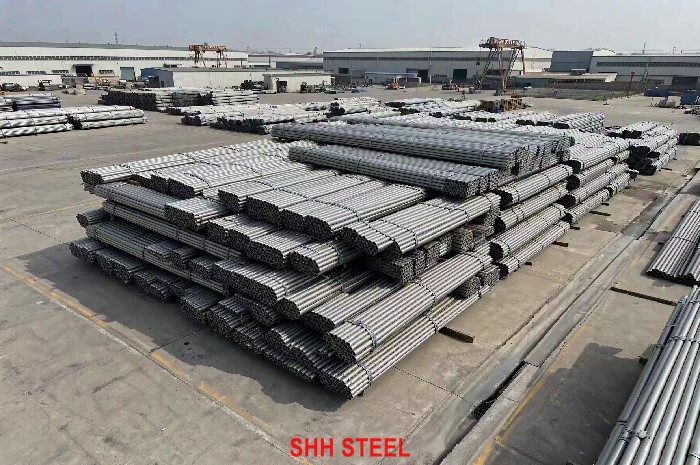
S30432 tube leaves SHH STEEL bundled, end-protected, and tagged with ASTM A213, UNS S30432, OD × wall (or BWG), heat number, and PO reference. Boiler cut lengths and any bent forms need transit protection appropriate to the bend radius and leg length. Export packing follows the Incoterms on the acknowledgement — FOB, CFR, CIF, EXW, or other agreed terms.
Project color coding, bilingual marks, and inland routing should appear on the enquiry with the metallurgical notes so dispatch does not invent a second marking language after the MTC is printed.
Why Choose SHH STEEL
SHH STEEL treats ASTM A213 UNS S30432 as a Cu–Nb–N specialty austenitic with a 2000 °F solution anneal and an 86/34 ksi Table 4 floor — not as a renamed TP304H. Certificates show the full microalloy set; dual A213/SA-213 marking appears only on request; trade names never replace the UNS stencil.
If the datasheet only needs H-grade carbon and grain size without copper, we open A213 TP304H. If Nb-stabilized H-grade without Cu is specified, we open A213 TP347H / A213 TP347HFG. Wet chloride duty steers to the Mo family on the A213/A213M hub. Lead times mix mill schedules with any near-term lengths we can honestly offer — no fake Super304H warehouse tonnages.
Cut-to-length, third-party inspection, and special finishes are defined extras. The tube on site should match the UNS callout the boiler engineer wrote.
Supply Capability
SHH STEEL can supply ASTM A213 UNS S30432 stainless steel tube against the edition and finish route on your enquiry. Capability and Stock / Available sizes below frame boiler/superheater enquiries for this Cu–Nb–N grade.
| Item | SHH STEEL capability for UNS S30432 |
|---|---|
| Standard | ASTM A213 / A213M (dual SA-213 marking on request) UNS S30432 |
| Product form | Seamless only — cold-finished and hot-finished |
| Size | Typical OD × min wall (or average wall) in the A213 usual band; other diameters by agreement |
| Wall / gauge | Minimum wall or average wall; BWG / gauge accepted |
| Length | Boiler / superheater cut lengths; mill random by agreement |
| Finish | Solution annealed 2000 °F [1100 °C] min and pickled; bright anneal by agreement |
| Testing | Tension (86/34 ksi), hardness (max 219 HBW / 95 HRB), flattening, flaring, hydro or NDE; full Cu–Nb–N–Al–B chemistry on MTC |
| Documents | EN 10204 3.1; third-party / 3.2 on request |
| Trade terms | FOB / CFR / CIF / EXW and other agreed Incoterms |
Stock / Available sizes
S30432 is typically mill-scheduled rather than a deep commodity stock grade. The sizes below are representative boiler/superheater OD × wall / BWG enquiry targets; treat them as a supply map, not a published tonnage list.
| Item | Typical stock / enquiry range for UNS S30432 |
|---|---|
| Outside diameter | 31.8, 38.1, 42.4, 44.5, 50.8, 57.0, 63.5, 76.2 mm (and other boiler ODs on enquiry; through the usual A213 ~5 in. [127 mm] band) |
| Wall / BWG | Boiler-class min-wall and BWG 7–16 class walls; heavier walls by agreement |
| Common OD × wall examples | 38.1 × 3.5 mm; 42.4 × 3.5 mm; 50.8 × 4.0 mm; 57.0 × 4.0 mm; 63.5 × 4.5 mm — illustrative superheater sizes, confirm min vs average wall |
| Length | Boiler cut lengths per drawing; random mill lengths on enquiry |
| Special | Non-standard OD/wall, dual A213/SA-213, third-party witness, OEM supplementary tests — confirm before heat reservation |
Send OD × wall, wall basis, quantity or cut list, marking (A213 or dual A213/SA-213), and any OEM Supplementary Requirements on one enquiry. We confirm Cu–Nb–N–Al–B chemistry, 2000 °F anneal, and Table 4 86/34 ksi without inventing fake Super304H SKUs. Sisters A213 TP304H, A213 TP347H, and A213 TP310HCbN sit on the same hub.
FAQ
-
Is ASTM A213 the same as ASME SA-213 for UNS S30432?
- No. ASTM A213 / A213M is the ASTM International product specification; ASME SA-213 / SA-213M is the separate ASME Code Book adoption. Dual-mark A213/SA-213 tube only when the purchase order asks for both independent standards on the stencil and MTC. Chemistry and tensile floors align closely for a given referenced edition, but the documents remain separate.
-
Does A213 UNS S30432 have a TP grade letter?
- No. In the A213 stainless chemistry table, S30432 is listed under footnote C — there is no common TP designation; the UNS number uniquely identifies the alloy. Order, stencil, and certificate language should say UNS S30432 (or ASME SA-213 UNS S30432 when dual-marked), not a invented TP304Cu label.
-
Is Super304H the same as ASTM A213 UNS S30432?
- Super304H / SUPER304H is the commercial trade name commonly used for the 18Cr-9Ni-3Cu-Nb-N alloy family that A213 lists as UNS S30432. Trade-name catalogue sheets are useful for application framing, but the MTC and stencil must carry the ASTM grade / UNS designation for the ordered edition. Do not accept a trade name alone as ASTM acceptance text.
-
S30432 vs TP304H — when do I need the Cu–Nb–N grade?
- Order UNS S30432 when the boiler or superheater datasheet specifies Super304H-class chemistry (Cu 2.5–3.5%, Nb 0.30–0.60%, N 0.05–0.12%), the 2000 °F [1100 °C] solution anneal, and the higher Table 4 86/34 ksi / 219 HBW floors. Order TP304H when H-grade carbon 0.04–0.10% and grain-size No. 7 or coarser are enough without the Cu–Nb–N package. They are not drop-in substitutes.
-
What heat treatment does A213 require for UNS S30432?
- Solution treatment at a minimum of 2000 °F [1100 °C] with water quench or other rapid cool — hotter than the 1900 °F row used for TP304/TP304H. Both cold-finished and hot-finished seamless tube follow that requirement. Ask the mill to state the actual anneal temperature and quench method on the EN 10204 3.1 certificate.
-
What are the Table 4 tensile and hardness numbers for S30432?
- Table 4 requires minimum tensile strength 86 ksi [590 MPa], minimum yield 34 ksi [235 MPa], minimum elongation 35%, and maximum hardness 219 HBW / 230 HV or 95 HRB. Those sit above TP304H’s 75/30 ksi / 192 HBW pair. Design creep allowables still come from the project’s Code tables, not from inventing rupture numbers on a product page.
-
Does A213 require a grain-size number for UNS S30432?
- In the public Table 3 heat-treatment excerpt used for this pack, S30432 shows no mandatory ASTM grain-size number (ellipsis / no requirement in that column), unlike TP304H’s ASTM No. 7 or coarser rule. If an OEM specification adds grain-size language, write it onto the purchase order as a Supplementary Requirement rather than assuming TP304H grain-size transfers automatically.
-
Is S30432 seamless-only under A213?
- Yes. ASTM A213 covers seamless tube only — there is no WLD or HCW manufacturing type under this product standard the way ASTM A312 describes pipe. For UNS S30432 the process choice is cold-finished versus hot-finished seamless tube, plus the 2000 °F [1100 °C] solution treatment and Table 4 testing of the ordered edition. If you need welded stainless pipe, that is a different product standard and a different steelspecs page family.
-
Minimum wall vs average wall — which should I order for S30432?
- Order minimum wall when the boiler datasheet assumes a guaranteed minimum thickness after tolerance. Order average wall only when the PO explicitly allows it. Specialty Cu–Nb–N chemistry does not change the need to name wall basis before the mill selects A1016 tolerance tables.
-
Can S30432 replace TP316L in chloride service?
- No as a product-standard claim. Copper and niobium in S30432 serve high-temperature strength and microstructural stability in steam service; they are not molybdenum for chloride pitting. For wet chloride exchangers open TP316L or higher-Mo grades on the A213 hub rather than stretching a Super304H-class boiler tube into seawater duty.
-
Can you dual-certify A213 and SA-213 UNS S30432?
- Yes when the purchase order requests both independent standards on the stencil and MTC. Dual marking with TP304H is not automatic — the Cu–Nb–N chemistry and higher tensile/hardness pair do not collapse into a TP304H row. Spell the required marking and any OEM extras on the enquiry so the heat is selected correctly.
Conclusion
ASTM A213 UNS S30432 is the Cu–Nb–N austenitic seamless tube grade for advanced boiler and superheater service when Super304H-class chemistry, a 2000 °F [1100 °C] solution anneal, and Table 4 floors of 86/34 ksi with hardness max 219 HBW / 95 HRB are specified. SHH STEEL supplies cold-finished and hot-finished seamless tube in the usual OD × wall / BWG band, documented on EN 10204 3.1 certificates with the full microalloy set — and dual SA-213 marking only when the order asks. For sister H-grades and specialty austenitics, start from the A213/A213M hub, then send OD × wall, wall basis, and marking requirements so we can align mill availability to the UNS callout.
Contact: admin@steelspecs.com
Quality Steel Needed? Inquire for Offers
Related Products