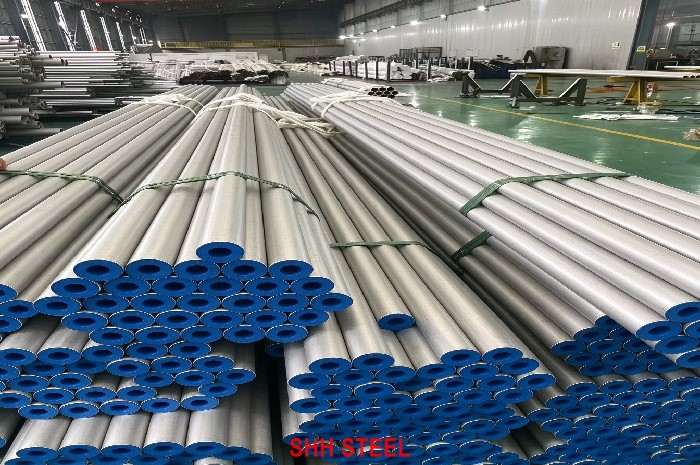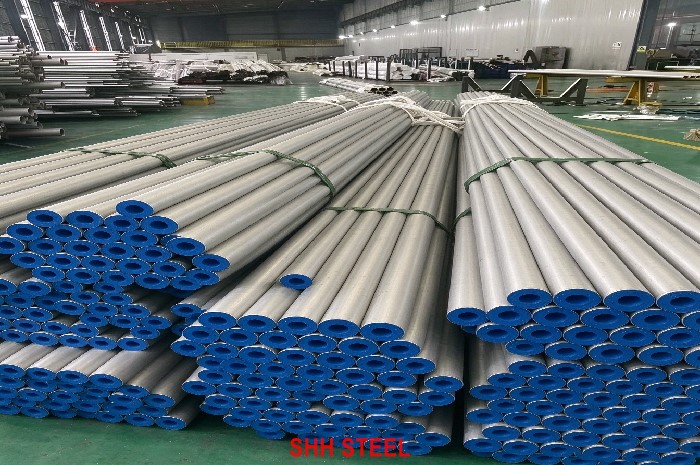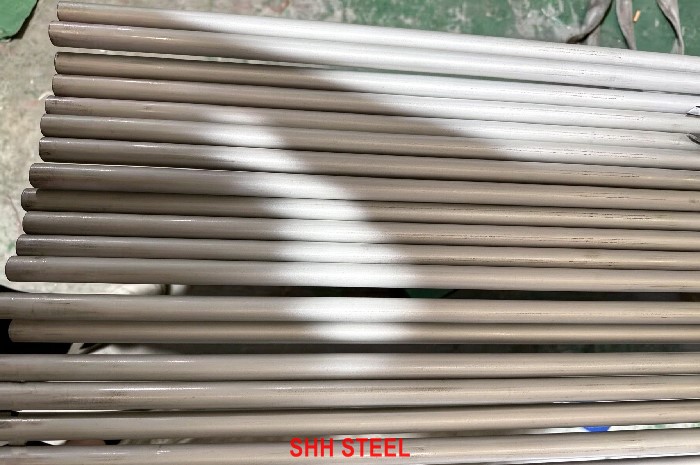
ASTM A213 TP310HCb Stainless Steel Tube
What is ASTM A213 TP310HCb Stainless Steel Tube
ASTM A213 / A213M covers seamless ferritic and austenitic alloy-steel boiler, superheater, and heat-exchanger tubes. Grade TP310HCb / UNS S31041 combines the H-grade carbon band with niobium stabilization on the 310 Cr–Ni windows: melting carbon 0.04–0.10%, chromium 24.0–26.0%, nickel 19.0–22.0%, niobium 10×C–1.10%, and ASTM grain size No. 7 or coarser on the heat-treatment lot. That package exists when creep-oriented carbon/grain-size controls and Cb/Nb IGC resistance must travel together on 25Cr–20Ni seamless tube — not as a casual dual stamp of A213 TP310H plus A213 TP310Cb.
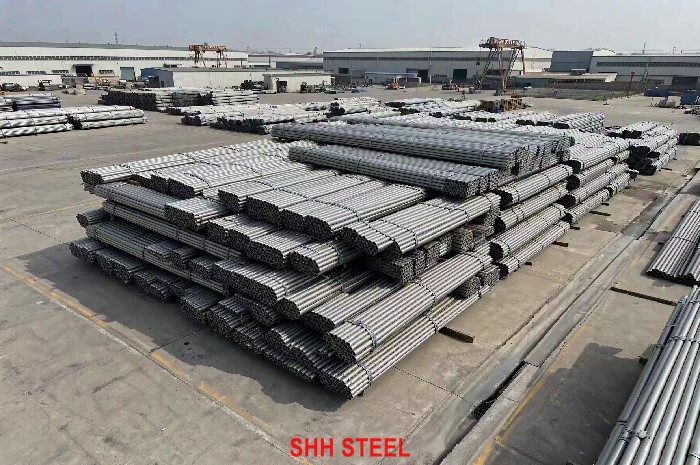
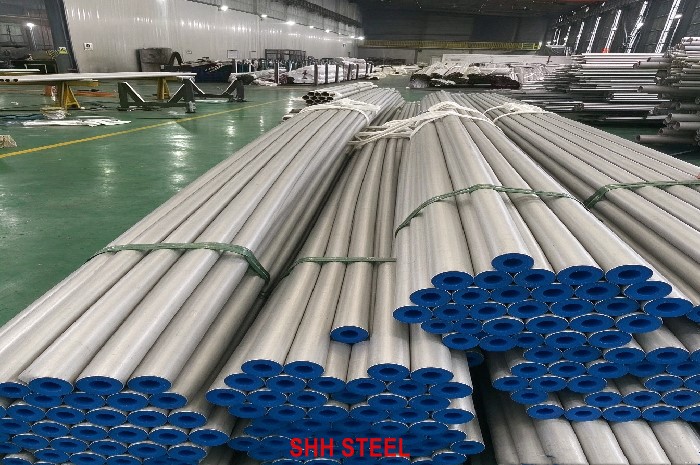
SHH STEEL can supply ASTM A213 TP310HCb stainless steel tube as seamless cold-finished and hot-finished product in the usual boiler, furnace, and heat-exchanger OD × wall / BWG band, shipped with EN 10204 3.1 mill test certificates that report ladle chemistry including niobium, Table 4 tensile and hardness, and the E112 grain-size result. Dual A213 / SA-213 marking is available only when the purchase order asks for both independent standards. Browse 310-family grades on the A213/A213M hub.
Shop names such as 310HCb, 310HNb, S31041, or “H-grade stabilized 25-20” do not replace the ASTM grade on the MTC. Sister grades under the same ASTM standard include A213 TP310S, A213 TP310H, A213 TP310Cb, A213 TP309HCb, and A213 TP347H. A213 covers seamless tube only — cold-finished versus hot-finished is the process choice, not a WLD/HCW manufacturing-type letter.
Chemical Composition of A213 TP310HCb
Two chemistry layers matter for TP310HCb under ASTM A213. Melting analysis is mandatory for every heat; product analysis on finished tube applies only when Supplementary Requirement wording or the purchase order invokes it through ASTM A1016/A1016M, with tolerances typically from ASTM A480/A480M Table A1.1. Reviewers should check three lines together: the 0.04–0.10% carbon band, the Nb 10×C–1.10 formula, and the 24–26 / 19–22 Cr–Ni windows — missing any one of those means the heat is not TP310HCb.
The tables below reproduce the melt limits for TP310HCb / UNS S31041, the product-analysis limits from A480 Table A1.1, and a short snapshot against TP310H and TP310Cb. Values are maximum unless a range or formula is shown; ellipsis (…) means no requirement.
Melting analysis (heat / ladle analysis)
| Element | TP310HCb (UNS S31041) melting analysis |
|---|---|
| Carbon (C) | 0.04 – 0.10 |
| Manganese (Mn) | ≤ 2.00 |
| Phosphorus (P) | ≤ 0.045 |
| Sulfur (S) | ≤ 0.030 |
| Silicon (Si) | ≤ 1.00 |
| Chromium (Cr) | 24.0 – 26.0 |
| Nickel (Ni) | 19.0 – 22.0 |
| Molybdenum (Mo) | … (no requirement) |
| Nitrogen (N) | … (no requirement) |
| Niobium (Nb / Cb) | 10×C – 1.10 |
Source: ASTM A213/A213M stainless chemistry table for Grade TP310HCb / UNS S31041 (public mill / specification PDF excerpt — htpipe A213 table text / _ref_a213.txt). Confirm the ordered edition on the purchase order. Stainless table number is edition-dependent (Table 2 later / Table 1 older).
Product analysis — A480/A480M Table A1.1 tolerances applied
| Element | Melting | Tolerance (A480 A1.1) | Product analysis limit |
|---|---|---|---|
| Carbon (C) | 0.04 – 0.10 | 0.01 under / over | 0.03 – 0.11 |
| Manganese (Mn) | ≤ 2.00 | 0.04 over | ≤ 2.04 |
| Phosphorus (P) | ≤ 0.045 | 0.010 over | ≤ 0.055 |
| Sulfur (S) | ≤ 0.030 | 0.005 over | ≤ 0.035 |
| Silicon (Si) | ≤ 1.00 | 0.05 over | ≤ 1.05 |
| Chromium (Cr) | 24.0 – 26.0 | 0.25 under / over | 23.75 – 26.25 |
| Nickel (Ni) | 19.0 – 22.0 | 0.15 under / 0.20 over | 18.85 – 22.20 |
| Niobium (Nb) | 10×C – 1.10 | 0.05 under / over on max; min remains formula-tied | max ≤ 1.15; heat-analysis 10×C floor not relaxed — confirm A480 path if contractual |
H vs Cb vs HCb snapshot
| Element | TP310H (S31009) | TP310Cb (S31040) | TP310HCb (S31041) |
|---|---|---|---|
| C | 0.04 – 0.10 | ≤ 0.08 | 0.04 – 0.10 |
| Nb (Cb) | … | 10×C – 1.10 | 10×C – 1.10 |
| Grain size | No. 7 or coarser | no mandate | No. 7 or coarser |
| Cr / Ni | 24–26 / 19–22 | 24–26 / 19–22 | 24–26 / 19–22 |
TP310HCb is not “TP310H with optional Nb” and not “TP310Cb with optional H marking.” Both the carbon band and the niobium formula are mandatory on the melt, and grain size No. 7 or coarser is mandatory on the heat-treatment lot. When only stabilization without the H package is required, stay on A213 TP310Cb; when only H-grade carbon/grain-size without Nb is required, stay on A213 TP310H.
When product analysis is ordered, finished tube may read C 0.03–0.11%, Mn ≤2.04%, P ≤0.055%, S ≤0.035%, Si ≤1.05%, Cr 23.75–26.25%, and Ni 18.85–22.20%, with Nb max ≤1.15 under typical A480 over-tolerance on the 1.10 ceiling. Put any tighter project floors on the purchase order before heat selection.
Mechanical Properties of A213 TP310HCb
ASTM A213 Table 4 sets the room-temperature tensile acceptance floor for TP310HCb at 75 ksi [515 MPa] tensile strength and 30 ksi [205 MPa] yield strength (0.2% offset), with elongation of 35% minimum in 2 in. or 50 mm — the same room-temperature pair as TP310H and TP310Cb. Hardness maximum is 192 HBW / 200 HV or 90 HRB. The HCb mechanical distinction in the product standard is the grain-size requirement: ASTM No. 7 or coarser per heat-treatment lot, alongside chemistry that already includes both the carbon band and niobium.
| Property | TP310HCb requirement |
|---|---|
| Tensile strength, min (Table 4) | 75 ksi [515 MPa] |
| Yield strength (0.2% offset), min (Table 4) | 30 ksi [205 MPa] |
| Elongation in 2 in. or 50 mm, min (Table 4) | 35% |
| Hardness, max (Table 4) | 192 HBW / 200 HV or 90 HRB |
| Grain size | ASTM No. 7 or coarser (per heat-treatment lot) |
Source: ASTM A213/A213M Table 4 for TP310HCb / UNS S31041 and H-grade grain-size language (public specification PDF excerpt — htpipe A213 heat-treatment table showing grain-size column “7” for TP310HCb). Mechanical property requirements do not apply to tubing smaller than 1/8 in. [3.2 mm] ID or thinner than 0.015 in. [0.4 mm] wall.
A complete TP310HCb release package reports tensile, hardness, niobium, carbon band, and grain size together. Omitting grain size or Nb turns an HCb certificate into an incomplete surrogate for TP310H or TP310Cb.
Dimensions and Tolerances
Dimensional supply for ASTM A213 TP310HCb is tube language — OD × wall (minimum or average) and BWG / gauge — covering boiler, furnace, and heat-exchanger sizes rather than leading with ASME B36.19 pipe schedules. Usual A213 sizes run from about 1/8 in. [3.2 mm] ID to 5 in. [127 mm] OD with min wall about 0.015–0.500 in. [0.4–12.7 mm]; other diameters by agreement. Creep-range and furnace datasheets almost always assume minimum wall — state wall basis on the purchase order.
OD and wall variations follow ASTM A1016/A1016M as invoked by A213. Cold-finished tubes commonly hold tighter OD; hot-finished tubes allow wider windows. Confirm exact rows for the OD and finish on the ordered edition.
| Item | Typical A213 TP310HCb dimensional practice |
|---|---|
| Product form | Seamless only (cold-finished or hot-finished) |
| Usual size band | ~1/8 in. [3.2 mm] ID to 5 in. [127 mm] OD; wall ~0.015–0.500 in. [0.4–12.7 mm] |
| Wall basis | Minimum wall (default for boiler / superheater / furnace) or average wall when specified |
| OD / wall tolerances | Per ASTM A1016/A1016M for finish route and size |
| Length | Cut lengths for boiler / furnace / HX bundles; mill random by agreement |
| Secondary note | B36.19 schedules only as a buyer cross-reference |
Put cut list, design metal temperature, stabilization (S2) needs, and end preparation on the enquiry. Minimum wall remains first-class for HCb tube the same way it does for other A213 H grades.
Equivalent Grades
Equivalence language around 310HCb often tries to assemble the grade from separate H and Cb nicknames. ASTM A213 Grade TP310HCb / UNS S31041 is the governing designation for this article; near-chemistry plate or cast forms are not automatic A213 substitutes.
| Designation | Notes |
|---|---|
| ASTM A213 / A213M Grade TP310HCb | Governing ASTM seamless boiler / HX tube product standard for this article |
| UNS S31041 | Unified number in the stainless chemistry table |
| ASME SA-213 TP310HCb | Separate ASME Code Book adoption — dual-mark only when the PO asks |
| Related H-grade | A213 TP310H — H-grade carbon/grain-size without Nb |
| Related Cb grade | A213 TP310Cb — Nb stabilization without H-grade carbon floor |
| Related 309HCb | A213 TP309HCb — same H+Cb pattern on lower Cr–Ni windows |
| Related plate | A240 / SA240 flat product in the 310 family — order plate and tube under their own standards |
Dual A213/SA-213 marking is a purchase-order option. Compare TP310H and TP310Cb on their own pages before assuming a mixed nickname equals TP310HCb on the MTC.
Heat Treatment and Delivery Condition
TP310HCb under ASTM A213 is furnished solution treated at a minimum of 1900 °F [1040 °C], then quenched in water or cooled rapidly by other means. That Table 3 heat-treatment row carries Footnote H and the ASTM grain-size requirement of No. 7 or coarser for the heat-treatment lot. Footnote H warns that a solution-treating temperature above 1950 °F [1065 °C] may impair resistance to intergranular corrosion after subsequent sensitizing exposure in the indicated grades; when the purchaser specifies it, a lower-temperature stabilization or resolution anneal shall follow the higher-temperature solution anneal prescribed in the table.
Cold-finished versus hot-finished is a process and dimensional route, not a substitute for the anneal, the grain-size check, or any ordered stabilizing hold. Delivery condition for SHH STEEL TP310HCb is solution annealed and pickled (or bright annealed by agreement), with anneal temperature, quench method, niobium result, and E112 grain-size result on the EN 10204 3.1 certificate.
Supplementary Requirement S2 (stabilizing heat treatment) explicitly lists TP310HCb among the grades that shall be given a stabilizing treatment after the solution anneal when the purchaser specifies S2. Write S2 onto the purchase order when the datasheet requires that post-solution stabilizing hold — do not assume base A213 includes it automatically for every HCb shipment. Full temperature/time wording is edition text — confirm on the ordered edition.
Corrosion Resistance
TP310HCb is built for high-temperature oxidation resistance from 24–26% Cr / 19–22% Ni, plus niobium stabilization against intergranular corrosion, plus H-grade carbon/grain-size controls for creep-oriented lists. Molybdenum remains a no-requirement ellipsis — wet chloride pitting framing still belongs with A213 TP316L or higher-Mo grades.
Footnote H and optional S2 exist because stabilized H grades can lose IGC resistance if solution temperatures run too high without a subsequent stabilizing or resolution step. Put A262 Practice E and/or S2 on the purchase order when the project requires demonstrated IGC performance rather than chemistry-and-grain-size assurance alone. Sulfidation and carburizing atmospheres still need process-specific review.
Applications of A213 TP310HCb Tube
Buyers specify ASTM A213 TP310HCb when a single seamless tube grade must satisfy creep-range H-grade carbon and grain-size rules, niobium stabilization for weld-heat or cyclic IGC control, and 25Cr–20Ni oxidation resistance. Typical placements include high-temperature superheater and furnace coils with heavy fabrication welding, radiant sections with cyclic thermal exposure, and Code-driven lists that name HCb explicitly.
Do not assemble HCb by dual-stamping unrelated heats of TP310H and TP310Cb. When only one of those stories is required, order A213 TP310H or A213 TP310Cb instead. SHH STEEL quotes OD × wall / BWG against the combined chemistry, grain-size, and optional S2 requirements on the datasheet.
| Service theme | Why TP310HCb is considered |
|---|---|
| Creep-range + welded furnace coils | C 0.04–0.10 + grain size 7 + Nb 10×C–1.10 |
| High-temperature HX with IGC concern | Stabilization + 24–26 / 19–22 oxidation resistance |
| S2-specified stabilizing after solution | TP310HCb listed under Supplementary Requirement S2 |
| Not primary for wet chlorides | No Mo requirement — use Mo grades instead |
Weldability
TP310HCb welds with austenitic practices using matching or near-matching Nb-bearing 310H / 25-20 fillers when stabilized deposit chemistry is required. The intentional carbon floor and niobium stabilizer both belong in procedure qualification — treat the grade as HCb base metal, not as generic 310S.
For tube-to-tubesheet and coil welding in creep-range service, confirm project limits on grain size, A262, and any mandatory S2 stabilizing treatment of the base metal before welding or after final heat treatment as the datasheet directs. Repair welding, when permitted, follows A1016/A1016M as invoked by A213.
Surface Finishes
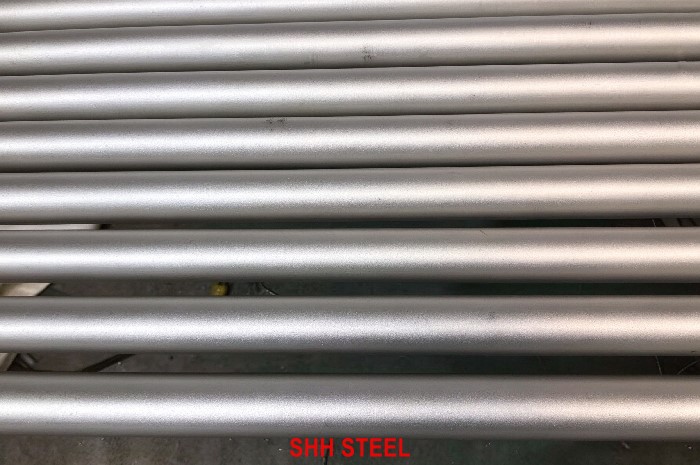
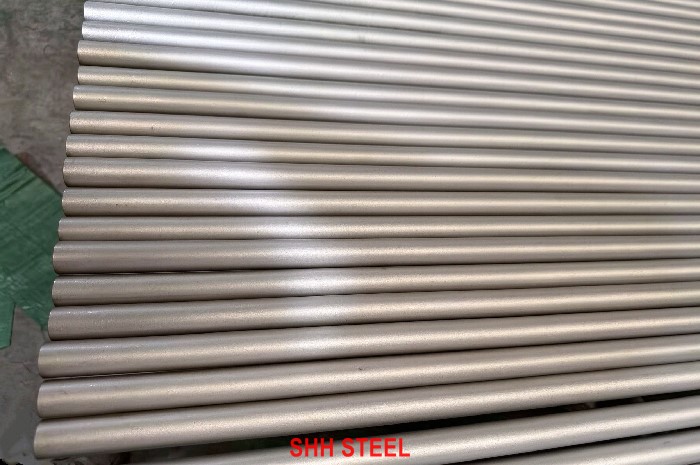
Standard delivery for ASTM A213 TP310HCb from SHH STEEL is solution annealed and pickled. Bright annealed finishes are available by agreement when process-side roughness requires them.
State finish together with OD × wall, end preparation, and whether S2 stabilizing is ordered. Grain-size and niobium reporting on the MTC are independent of pickled versus bright surface.
Inspection and Testing
Lot testing for ASTM A213 TP310HCb follows tension, hardness, flattening, and flaring under A213 / A1016, plus ASTM grain-size determination (E112) for the heat-treatment lot. Chemistry verification must include carbon band and niobium formula compliance. NDE follows the ordered edition and purchaser supplements.
EN 10204 3.1 certificates from SHH STEEL report ladle chemistry with Nb, Table 4 tensile and hardness, heat-treatment condition, and grain-size result. When S2 or A262 Practice E is ordered, those results or statements appear as specified. Dual A213/SA-213 marking and third-party witness are available when written into the enquiry. A certificate missing Nb or grain size is not a complete TP310HCb release package.
Packaging and Shipping
TP310HCb tubes ship in capped or plugged bundles with weather protection matched to the route. Cut lengths for boiler and furnace bundles are labeled by heat and size; export packing uses cases or steel-frame crates when required.
Marking includes ASTM A213, grade TP310HCb / UNS S31041, size, heat number, and SHH STEEL identification. Dual SA-213 marking appears only when the purchase order requests it. Packing lists track the same heat numbers shown on the EN 10204 3.1 certificates, including grain-size lot identity where applicable.
Why Choose SHH STEEL
SHH STEEL treats ASTM A213 TP310HCb as a combined H+Cb specification product: carbon band, niobium formula, Cr–Ni windows, Table 4 floors, and grain size No. 7 or coarser are checked together before a heat is offered. Quotations state OD × wall / BWG, wall basis, finish route, S2/A262 options, and whether dual A213/SA-213 marking is required.
We refuse nickname assemblies that stamp TP310H or TP310Cb as HCb without the missing controls. EN 10204 3.1 documentation includes both Nb and E112 grain size. Compare sisters on the A213/A213M hub before freezing the boiler or furnace tube list.
Supply Capability
SHH STEEL supplies ASTM A213 TP310HCb seamless stainless steel tube in cold-finished and hot-finished routes across the usual boiler, furnace, and heat-exchanger OD × wall / BWG band. Capability below is an enquiry range — not a frozen warehouse SKU or tonnage claim.
| Capability | SHH STEEL practice for TP310HCb |
|---|---|
| Product form | Seamless cold-finished and hot-finished tube |
| Standards | ASTM A213 / A213M; dual SA-213 when PO asks |
| Size band | Typical within ~1/8 in. ID to 5 in. OD; other diameters by agreement |
| Wall basis | Minimum wall or average wall as specified |
| Documentation | EN 10204 3.1 MTC with Nb + grain-size result; S2 / A262 / third-party witness on request |
| Trade terms | FOB / CFR / CIF / EXW and other agreed Incoterms |
Stock / Available sizes
SHH STEEL quotes TP310HCb against a stock-and-mill enquiry range rather than a frozen SKU/tonnage list. Representative OD × wall / BWG combinations for boiler, furnace, and heat-exchanger tube appear below.
| Item | Typical stock / enquiry range for TP310HCb |
|---|---|
| Outside diameter | 19.05, 25.4, 31.8, 38.1, 42.4, 50.8, 60.3, 76.2 mm (and other boiler/HX ODs on enquiry; through the usual A213 ~5 in. [127 mm] band) |
| Wall / BWG | BWG 10–18 class walls and metric min-wall equivalents; heavier walls by agreement |
| Common OD × wall examples | 25.4 × 2.11 mm; 31.8 × 2.77 mm; 38.1 × 2.77 mm; 42.4 × 3.56 mm; 50.8 × 3.05 mm; 60.3 × 3.91 mm — illustrative, confirm min vs average wall |
| Length | Cut lengths for boiler / furnace / exchanger bundles; bends and random mill lengths on enquiry |
| Special | Non-standard OD/wall, bright anneal, dual A213/SA-213, S2 stabilizing, A262 Practice E, third-party witness — confirm before heat reservation |
Send OD × wall (or BWG), wall basis, finish route, quantity or cut list, marking (A213 or dual A213/SA-213), and S2 / A262 / grain-size notes on one enquiry. We confirm C 0.04–0.10%, Nb 10×C–1.10%, Cr 24–26% / Ni 19–22%, Table 4 75/30 ksi, and ASTM grain size No. 7 or coarser without inventing fake warehouse codes. Sisters A213 TP310H, A213 TP310Cb, and A213 TP309HCb sit on the same hub.
FAQ
-
Is ASTM A213 the same as ASME SA-213 for TP310HCb?
- No. ASTM A213 / A213M is the ASTM International product specification for seamless boiler, superheater, and heat-exchanger tubes; ASME SA-213 / SA-213M is the separate ASME Code Book adoption. Dual-mark only when the purchase order asks for both names on the stencil and MTC. Chemistry, tensile floors, grain-size, and S2 rules align closely for a given referenced edition, but the standards remain independent.
-
Does ASTM A213 TP310HCb include welded or HCW tube?
- No. ASTM A213 covers seamless boiler, superheater, and heat-exchanger tubes only. There is no WLD or HCW manufacturing-type letter under A213. Cold-finished versus hot-finished describes the seamless process route and dimensional tolerances — not a welded product form. Order welded stainless pipe under a different product standard when that form is required.
-
What is the chemistry of ASTM A213 TP310HCb?
- Melting analysis for TP310HCb / UNS S31041 is C 0.04–0.10%, Mn ≤2.00%, P ≤0.045%, S ≤0.030%, Si ≤1.00%, Cr 24.0–26.0%, Ni 19.0–22.0%, Nb 10×C–1.10%, with Mo and N as no-requirement ellipses. Confirm the ordered A213 edition. Carbon band and niobium formula are both mandatory — neither is optional on an HCb heat.
-
TP310HCb vs TP310H — what does the Cb add?
- Both grades share C 0.04–0.10%, 24–26 / 19–22 Cr–Ni, Table 4 75/30 ksi, and grain size No. 7 or coarser. TP310HCb adds the niobium stabilizer band 10×C–1.10% and carries Footnote H / S2 stabilizing language when those options are invoked. Order HCb when IGC stabilization is required together with the H package; order TP310H when Nb is not part of the datasheet.
-
TP310HCb vs TP310Cb — what does the H add?
- Both grades share 24–26 / 19–22 Cr–Ni and Nb 10×C–1.10%. TP310Cb uses C ≤0.08% without a mandatory grain-size number. TP310HCb holds carbon in 0.04–0.10% and requires ASTM grain size No. 7 or coarser. Order HCb when creep-oriented carbon/grain-size controls sit with stabilization; order TP310Cb when stabilization without the H package is enough.
-
Why does A213 require grain size No. 7 or coarser for TP310HCb?
- The coarse-grain requirement supports elevated-temperature / creep-oriented behavior expected from H-grade austenitic boiler tube, including the HCb row. ASTM No. 7 or coarser is determined per heat-treatment lot. A tensile-and-Nb MTC that omits grain size is incomplete for TP310HCb acceptance — ask for the E112 result on the EN 10204 3.1 certificate.
-
What is Supplementary Requirement S2 for TP310HCb?
- S2 requires a stabilizing heat treatment after the solution anneal for listed grades when the purchaser specifies S2. The public A213 excerpt lists TP310HCb among those grades. Temperature of the stabilizing treatment is agreed between purchaser and vendor and is lower than the initial solution anneal. Write S2 onto the PO when required — base A213 does not apply it automatically to every HCb shipment.
-
What does Footnote H mean on the TP310HCb heat-treatment row?
- Footnote H states that a solution-treating temperature above 1950 °F [1065 °C] may impair resistance to intergranular corrosion after subsequent sensitizing conditions in the indicated grades. When specified by the purchaser, a lower-temperature stabilization or resolution anneal shall follow the higher-temperature solution anneal. Coordinate Footnote H concerns with any ordered S2 stabilizing treatment on the purchase order.
-
Does Table 4 set a hardness limit for TP310HCb?
- Yes. Table 4 lists hardness maximum 192 HBW / 200 HV or 90 HRB with 75 ksi tensile, 30 ksi yield, and 35% elongation. Hardness, grain size, and niobium chemistry all belong on the release package — none replaces the others for HCb boiler tube.
-
What heat treatment does A213 require for TP310HCb?
- Solution treatment at a minimum of 1900 °F [1040 °C], water quench or other rapid cool, ASTM grain size No. 7 or coarser, with Footnote H guidance on high solution temperatures. When S2 is specified, a subsequent stabilizing heat treatment is required. Delivery is solution annealed and pickled unless bright anneal is agreed.
-
Minimum wall vs average wall for A213 TP310HCb — which should I specify?
- Boiler, superheater, and furnace datasheets almost always expect minimum wall. Average wall is allowed when the purchase order says so, with A1016/A1016M tolerances for that basis. State wall basis on the enquiry rather than relying on pipe schedule numbers as the primary A213 wall story.
-
Is TP310HCb a good choice for chloride-rich cooling water?
- Not as a primary chloride strategy. Molybdenum is a no-requirement ellipsis on TP310HCb, so wet chloride pitting resistance is not the grade’s design story. Use Mo-bearing grades for chloride-rich cooling; reserve TP310HCb for high-temperature oxidation plus H-grade plus Nb-stabilization duty.
Conclusion
ASTM A213 TP310HCb / UNS S31041 is the H-grade niobium-stabilized 24–26% Cr / 19–22% Ni seamless stainless steel tube for boiler, furnace, and heat-exchanger service when creep-oriented carbon/grain-size controls and Cb/Nb stabilization must travel together on the 25Cr–20Ni oxidation step. SHH STEEL supplies cold-finished and hot-finished seamless tube in the usual OD × wall / BWG band, solution annealed at 1900 °F [1040 °C], tested to Table 4 75/30 ksi and hardness limits, with niobium and ASTM grain size No. 7 or coarser reported on EN 10204 3.1 certificates — S2 stabilizing and dual SA-213 marking only when the purchase order asks.
Contact: admin@steelspecs.com
Quality Steel Needed? Inquire for Offers
Related Products