ASME SA213 TP310MoLN Stainless Steel Tube
What is ASME SA213 TP310MoLN Stainless Steel Tube
ASME SA-213 / SA-213M is the ASME Boiler and Pressure Vessel Code Book adoption of the seamless ferritic and austenitic alloy-steel boiler, superheater, and heat-exchanger tube product text. On Code-stamped vessels, exchangers, and registered piping systems that invoke the ASME adoption by name, the governing product standard for this grade is SA-213 — not a catalogue synonym and not an automatic dual stamp with the ASTM sister. Buyers who need seamless tube for urea-stripper, nitric-process, or other high-Cr Mo+N heat-exchanger duty under that Code Book name order against SA213/SA213M.
Grade TP310MoLN / UNS S31050 is the low-carbon molybdenum-and-nitrogen 25Cr–22Ni austenitic row inside that SA-213 stainless chemistry family. Four melt lines separate it from ordinary 310S before any tensile check begins: carbon capped at 0.025% (tighter than classic L ≤0.035%), molybdenum 2.00–3.00%, nitrogen 0.10–0.16%, and a raised nickel window of 21.0–23.0% against chromium 24.0–26.0%. Silicon ≤0.40% and phosphorus ≤0.020% are also tighter than the classic 310S row, so a heat that only “looks like 310 with a little Mo” is not TP310MoLN under SA-213.
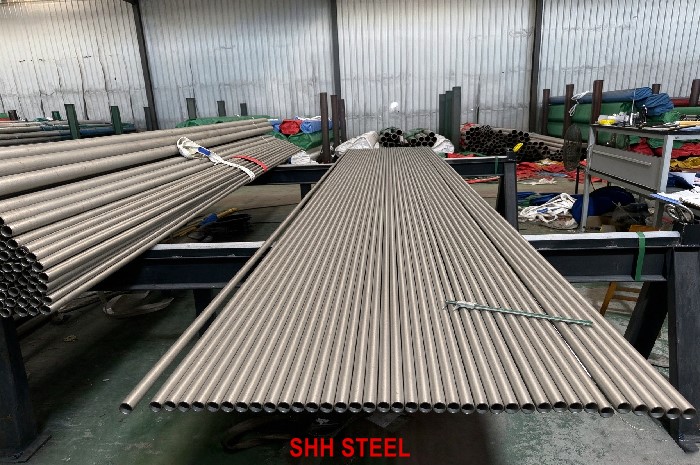
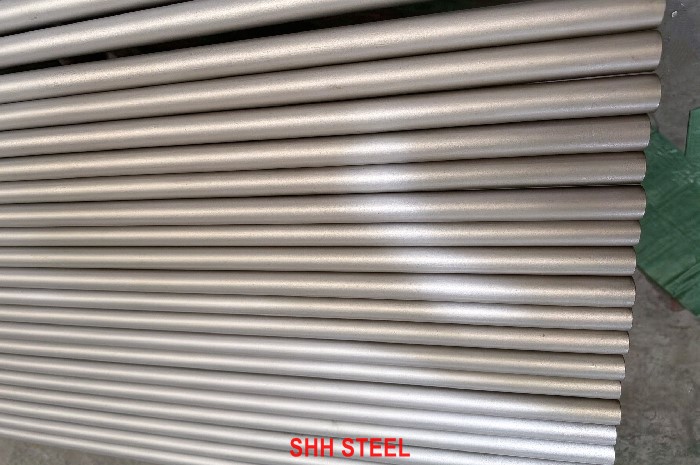
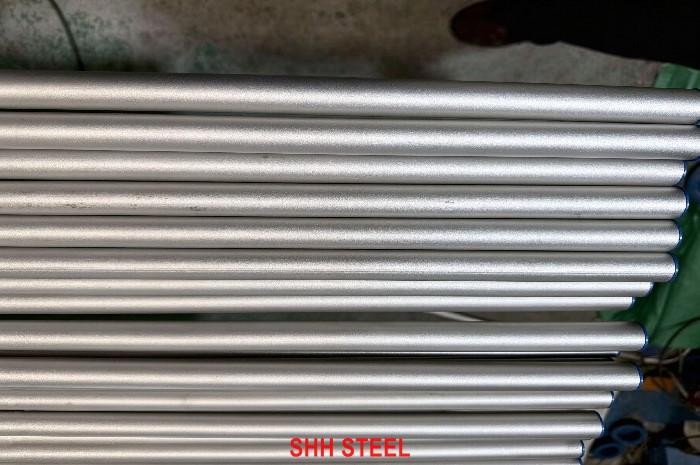
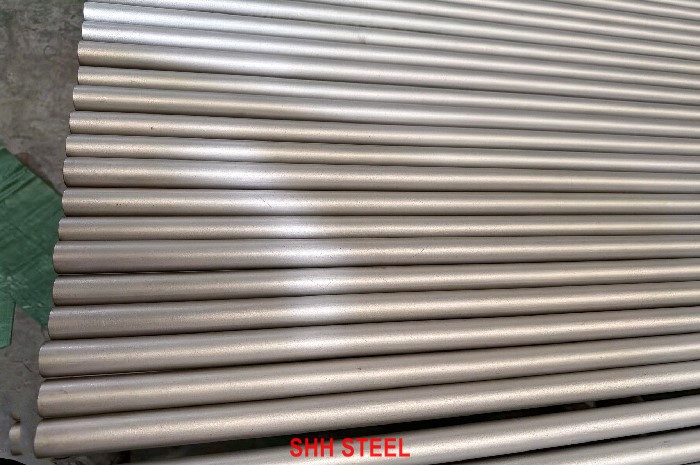
SHH STEEL can supply ASME SA213 TP310MoLN as seamless cold-finished and hot-finished tube in the usual OD × wall / BWG band for boiler, superheater, and heat-exchanger service, with EN 10204 3.1 mill test certificates that report Mo and N inside the grade windows and the wall-class tensile row that applies. Dual SA-213/A213 marking is added only when the purchase order asks for both names on the stencil and the certificate — the live twin page is A213 TP310MoLN.
Commercial name maps often shorten the grade to “310MoLN,” “25-22-2,” or “S31050 tube.” Those shop names are useful for RFQ triage, but the purchase order should still carry ASME SA-213 Grade TP310MoLN / UNS S31050, wall basis (minimum or average), OD × wall or BWG, finish route, and any Supplementary Requirements. Sister SA213 pages that buyers cross-check on the same Code Book spine include SA213 TP310S, SA213 TP310MoCbN, and SA213 TP316N when the Mo+N band is wanted at a lower Cr–Ni level. This pack covers seamless tube only — there is no Manufacturing Types (SML / WLD / HCW) section because SA-213 for this product form is seamless.
Chemical Composition of SA213 TP310MoLN
Two chemistry layers matter for TP310MoLN under ASME SA-213. Melting analysis is mandatory for every heat; product analysis on finished tube applies only when Supplementary Requirement wording or the purchase order invokes it through the general requirements (commonly ASTM A1016/A1016M), with tolerances typically taken from ASTM A480/A480M Table A1.1. Reviewers should lock carbon ≤0.025%, Mo 2.00–3.00%, N 0.10–0.16%, and Ni 21.0–23.0% / Cr 24.0–26.0% before anything else — those four lines are what make the heat S31050 rather than a Mo-doped 310S.
UNCERTAIN: exact SA-213 / A213 edition year for the digits below; stainless chemistry table number (older editions Table 1, later editions often Table 2); nitrogen analysis method Footnote B wording; A480 product-tolerance digits applied to the C ≤0.025 / P ≤0.020 / Ni 21–23 bands from sister A480 practice — confirm the ordered edition before treating secondary catalogues as acceptance text.
Melting analysis
| Element | TP310MoLN (UNS S31050) melting analysis |
|---|---|
| Carbon (C) | ≤ 0.025 |
| Manganese (Mn) | ≤ 2.00 |
| Phosphorus (P) | ≤ 0.020 |
| Sulfur (S) | ≤ 0.030 |
| Silicon (Si) | ≤ 0.40 |
| Chromium (Cr) | 24.0 – 26.0 |
| Nickel (Ni) | 21.0 – 23.0 |
| Molybdenum (Mo) | 2.00 – 3.00 |
| Nitrogen (N) | 0.10 – 0.16 |
| Niobium (Nb / Cb) | … (no requirement) |
The melt table above is the acceptance chemistry for every heat of SA213 TP310MoLN. Carbon at ≤0.025% is intentionally tighter than ordinary L-grade 0.035% ceilings, which is why mill certificates that only show “L carbon” without the 0.025% cap are not enough. Molybdenum and nitrogen must both land inside their windows; nickel sits one step higher than classic 310S (19–22), and silicon / phosphorus are deliberately leaner than the S31008 row.
Product analysis (when required)
| Element | Melting | Tolerance (A480 A1.1) | Product analysis limit |
|---|---|---|---|
| Carbon (C) | ≤ 0.025 | 0.005 over | ≤ 0.030 |
| Manganese (Mn) | ≤ 2.00 | 0.04 over | ≤ 2.04 |
| Phosphorus (P) | ≤ 0.020 | 0.005 over | ≤ 0.025 |
| Sulfur (S) | ≤ 0.030 | 0.005 over | ≤ 0.035 |
| Silicon (Si) | ≤ 0.40 | 0.05 over | ≤ 0.45 |
| Chromium (Cr) | 24.0 – 26.0 | 0.25 under / over | 23.75 – 26.25 |
| Nickel (Ni) | 21.0 – 23.0 | 0.15 under / 0.20 over | 20.85 – 23.20 |
| Molybdenum (Mo) | 2.00 – 3.00 | 0.05 under / 0.10 over | 1.95 – 3.10 |
| Nitrogen (N) | 0.10 – 0.16 | 0.01 under / 0.02 over | 0.09 – 0.18 |
Product analysis is not an automatic second chemistry on every tube. When the purchase order or a Supplementary Requirement invokes it, the A480 A1.1 tolerances above widen the melt windows into the product limits shown. Mo and N product bands still have to clear the grade intent — a tube that drifts Mo below 1.95% or N below 0.09% on product check is outside the ordered S31050 product window.
Snapshot vs sister grades
| Element | TP310S (S31008) | TP310MoLN (S31050) | TP316LN (S31653) |
|---|---|---|---|
| C | ≤ 0.08 | ≤ 0.025 | ≤ 0.035 |
| Cr | 24.0 – 26.0 | 24.0 – 26.0 | 16.0 – 18.0 |
| Ni | 19.0 – 22.0 | 21.0 – 23.0 | 10.0 – 13.0 |
| Mo | … | 2.00 – 3.00 | 2.00 – 3.00 |
| N | … | 0.10 – 0.16 | 0.10 – 0.16 |
| Si | ≤ 1.00 | ≤ 0.40 | ≤ 1.00 |
Against SA213 TP310S, MoLN keeps the high chromium band but raises nickel, adds Mo+N, and tightens C/Si/P — it is not a dual stamp of 310S. Against SA213 TP316N and other 316-family Mo+N rows, chromium–nickel sit far lower than MoLN’s 24–26 / 21–23 windows, so oxidation and high-temperature strength behavior diverge even when nitrogen bands overlap. For the inverted Cr–Ni Mo+Nb+B sister, see SA213 TP310MoCbN.
Mechanical Properties of SA213 TP310MoLN
ASME SA-213 sets wall-class tensile floors for TP310MoLN rather than a single 75/30 ksi row. For wall thickness t ≤ 0.25 in. [6 mm], minimum tensile strength is 84 ksi [580 MPa] and minimum yield (0.2% offset) is 39 ksi [270 MPa]; for t > 0.25 in. [6 mm], the floors drop to 78 ksi [540 MPa] tensile and 37 ksi [255 MPa] yield. Elongation remains 25% minimum in 2 in. or 50 mm on both wall classes, and hardness is capped at 217 HBW or 95 HRB. Name the wall class on the purchase order so the mill certificates the correct Table 4 row.
| Property | t ≤ 0.25 in. [6 mm] | t > 0.25 in. [6 mm] |
|---|---|---|
| Tensile strength, min (Table 4) | 84 ksi [580 MPa] | 78 ksi [540 MPa] |
| Yield strength (0.2% offset), min (Table 4) | 39 ksi [270 MPa] | 37 ksi [255 MPa] |
| Elongation in 2 in. or 50 mm, min (Table 4) | 25% | 25% |
| Hardness, max (Table 4) | 217 HBW or 95 HRB | 217 HBW or 95 HRB |
Those wall-dependent tensile numbers are why a datasheet that only quotes “84 ksi MoLN” without wall class is incomplete for thicker HX or stripper tube. Hardness at 217 HBW / 95 HRB sits between ordinary 192 HBW 316-family caps and the 256 HBW high-strength 310HCbN / MoCbN rows — useful when reviewing mill certificates that might otherwise be confused with a higher-Nb sister. Public heat-treatment excerpts used for this pack do not print a mandatory ASTM grain-size number for S31050 the way H-grades do; do not invent a No. 7 clause on the MTC unless the ordered edition or PO requires one.
Flattening, flaring, and reverse-bend tests follow the SA-213 / general-requirements path for austenitic seamless tube of the ordered size. Hydrostatic testing or nondestructive electric testing is selected per the specification and purchase order; neither replaces chemistry or the wall-class tensile check. When dual-marking to ASTM is ordered, the mechanical floors still have to clear the SA-213 acceptance text named on the Code job — see also A213 TP310MoLN.
Dimensions and Tolerances
Dimensional supply for ASME SA213 TP310MoLN is tube language — outside diameter × wall thickness (minimum wall or average wall) and, commercially, BWG / gauge — not ASME B36.19 pipe schedules as the primary size story. The sizes usually furnished under SA-213 run from about 1/8 in. [3.2 mm] inside diameter to 5 in. [127 mm] outside diameter, with minimum wall from about 0.015 to 0.500 in. [0.4 to 12.7 mm]; tubing with other diameters may be furnished when all other requirements of the specification are met.
Because Table 4 tensile floors change at 0.25 in. [6 mm] wall, state both wall basis (minimum or average) and nominal wall on the purchase order for MoLN. Urea-stripper and nitric-process exchanger datasheets almost always assume a minimum-wall reading; remaining wall after process-side attack is often a design input. Outside-diameter and wall variations follow the general requirements invoked by SA-213 (commonly ASTM A1016/A1016M). Cold-finished tubes commonly hold tighter OD control; hot-finished tubes allow wider OD and wall windows.
| Item | Typical SA213 TP310MoLN dimensional practice |
|---|---|
| Product form | Seamless only (cold-finished or hot-finished) |
| Usual size band | ~1/8 in. [3.2 mm] ID to 5 in. [127 mm] OD; wall ~0.015–0.500 in. [0.4–12.7 mm] |
| Wall basis | Minimum wall (default for many HX / stripper datasheets) or average wall if PO says so |
| Wall-class note | Table 4 tensile row changes at t = 0.25 in. [6 mm] — name nominal wall on the PO |
| OD / wall tolerance | Per general requirements (commonly A1016/A1016M) for the ordered finish |
| Length | Straight random / cut-to-length; U-bend or coil forms by agreement |
BWG / gauge callouts are accepted on enquiry when the buyer’s exchanger drawing still speaks in gauge, but the mill certificate should still show OD and wall in inch or millimetre units that match the ordered wall class. Cut lengths, U-bends, and polished ID finishes are commercial options on top of the SA-213 dimensional rules — they do not replace minimum-wall discipline or the wall-class tensile row.
Equivalent Grades
Equivalence language around TP310MoLN tube is often looser than a Code or urea-plant purchase order can afford. ASME SA-213 Grade TP310MoLN / UNS S31050 is the governing designation for this article; catalogue nicknames such as 25-22-2 or 310MoLN describe the family but do not replace the Code Book grade name, the Mo+N windows, or the wall-class tensile floors.
| Designation | Notes |
|---|---|
| ASME SA-213 / SA-213M Grade TP310MoLN | Governing ASME Code Book seamless boiler / HX tube product standard for this article |
| UNS S31050 | Unified number in the stainless chemistry table |
| ASTM A213 TP310MoLN | Separate ASTM product specification — dual-mark only when the PO asks |
| Related 310S | SA213 TP310S — same Cr band, lower Ni, no Mo/N, C ≤0.08 |
| Related Mo+Cb+N | SA213 TP310MoCbN — inverted Cr–Ni, Nb+B, higher tensile, 2100 °F anneal |
| Related 316N | SA213 TP316N — Mo-bearing 316-family with nitrogen; Cr–Ni far below MoLN |
| Related plate | A240 / SA240 flat product in related families — order plate and tube under their own standards |
When a datasheet says only “310MoLN or equivalent,” ask which standard, which UNS, which wall class, and whether Nb/B chemistry (MoCbN) was actually intended. Plate ordered under A240 / SA240 in a related chemistry does not automatically qualify as SA-213 tube, and tube cut from plate is outside this product form. For non-Code purchase against the ASTM twin, use A213 TP310MoLN and keep SA-213 as the Code Book name when the vessel stamp requires it.
Heat Treatment and Delivery Condition
TP310MoLN under ASME SA-213 is furnished in the solution-treated condition with water quench or other rapid cool, as required for austenitic grades. Public SA-213 / A213 PDF excerpts used as the chem/mech source for this pack print TP310MoLN in the chemistry and Table 4 mechanical tables, but do not print a dedicated S31050 heat-treatment temperature line between S31042 and S31060 in the heat-treatment table — treat the exact minimum solution temperature and any grain-size column entry as UNCERTAIN pending the ordered edition.
Confirm the heat-treatment table row for TP310MoLN / S31050 on the purchase order before freezing anneal-temperature language on the mill certificate. Do not silently borrow the 1900 °F [1040 °C] classic-310 line or the 2100 °F [1150 °C] MoCbN line without edition confirmation. Cold-finished versus hot-finished is a process and dimensional route, not a substitute for the solution anneal.
Delivery condition for SHH STEEL TP310MoLN is solution annealed and pickled (or bright annealed by agreement), with anneal practice, quench method, molybdenum, nitrogen, and the wall-class tensile result reported on the EN 10204 3.1 certificate. Straightening, cutting, and end finishing come after the anneal; they do not replace it. If the purchaser orders stabilizing or sensitization-related Supplementary Requirements, those holds are additional to — not instead of — the solution treatment required by the ordered edition.
Corrosion Resistance
TP310MoLN’s combination of high chromium, raised nickel, molybdenum, and controlled nitrogen is why buyers move into this row for urea-stripper, nitric-acid, and other oxidizing process exchangers where ordinary 316LN Cr–Ni is too lean and classic 310S lacks Mo+N. The ≤0.025% carbon ceiling supports resistance to sensitization-related intergranular attack after welding or process-side heat exposure when fabrication practice is sound.
Molybdenum 2–3% improves resistance to localized attack in process fluids that carry chlorides or reducing species better than non-Mo 310S, but it does not make MoLN a duplex or superaustenitic substitute. Nitrogen in the 0.10–0.16% band supports strength and helps austenite stability; it is not a license to ignore PREN-based selection rules when the process stream is severely pitting-active. For chloride-pitting service that exceeds MoLN’s intended window, stewards usually step to higher-alloy SA213 rows or nickel alloys rather than hoping nitrogen alone will carry the design.
Honest selection still needs process chemistry, temperature, and weld procedure on the table. TP310MoLN is not automatic insurance against condensation-side acid attack, chloride stress-corrosion cracking at elevated temperature, or wrong-grade substitution with MoCbN. When the circuit is creep-oriented USC boiler duty needing Nb+N H-grade strength, look at SA213 TP310HCbN instead of forcing MoLN into a creep datasheet it was not written for.
Applications of SA213 TP310MoLN Tube
Because TP310MoLN pairs high-Cr oxidation resistance with Mo+N and a very low carbon ceiling, it shows up on urea-stripper and related high-pressure process exchangers, nitric-acid condensers and coolers, and other Code or near-Code heat-exchanger circuits where 25Cr–22Ni chemistry is specified by name. Superheater and boiler tube use is less common than process HX, but SA-213 still covers the product form when the datasheet calls the grade under the Code Book adoption.
Typical enquiry patterns ask for seamless cold-finished tube in heat-exchanger OD × minimum-wall sizes, sometimes with ID polish, U-bends, or tight length tolerance for bundle replacement. Hot-finished seamless route remains available when wall and OD favor that process. Buyers replacing an existing S31050 bundle should match wall class carefully so the Table 4 tensile row on the new certificate lines up with what the original design assumed.
Sister-grade steering matters on mixed RFQs. If the drawing only needs classic 25Cr–20Ni without Mo+N, SA213 TP310S is the simpler row. If the process needs Mo at 316-family Cr–Ni rather than 25Cr–22Ni, SA213 TP316 or SA213 TP316N is usually the more available path. If the chemistry on the old MTC shows Nb and boron with inverted Cr–Ni, the live grade is SA213 TP310MoCbN, not MoLN.
Weldability
TP310MoLN tube welds with matching or near-matching high-Cr Mo-bearing austenitic filler selected for the process environment and the fabricator’s WPS. The ≤0.025% carbon ceiling is an advantage for as-welded intergranular-corrosion resistance compared with higher-carbon 310 rows, but heat input, interpass temperature, and post-weld cleaning still matter on urea and nitric equipment where contamination or heat-tint can start local attack.
Tube-to-tubesheet joints on stripper and process exchangers need procedures that respect the Mo+N chemistry rather than defaulting to a generic 308/309 playbook without engineering review. Autogenous orbital welds are common on thin-wall HX tube; thicker wall or attachment welds may need filler. Do not assume a 316LN WPS automatically covers S31050 — Cr–Ni and silicon windows differ enough that procedure qualification should name TP310MoLN / S31050.
When the purchase order requires corrosion testing after welding (for example ASTM A262 practices by agreement), state the practice and acceptance on the order. Solution annealing after fabrication welding is a design/WPS decision, not an automatic SA-213 delivery condition for the mill-supplied straight tube. Dual-marked SA-213/A213 heats use the same weldability conversation; the standard name on the stencil does not change filler selection.
Surface Finishes
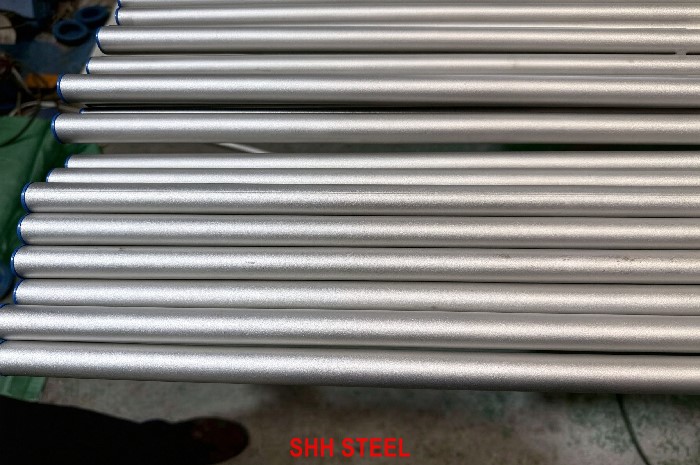
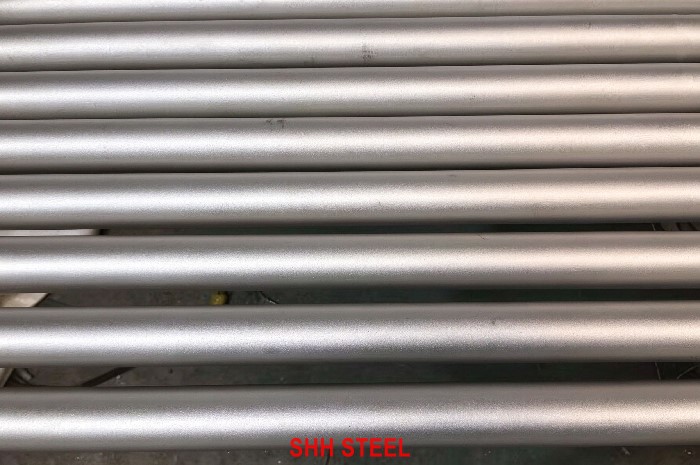
Standard mill delivery for ASME SA213 TP310MoLN is solution annealed and pickled, leaving a clean matte finish suitable for most heat-exchanger and process-tube duty. Bright annealing under protective atmosphere is available by agreement when the OD appearance or downstream polish steps favor a brighter starting surface.
Heat-exchanger and urea-equipment buyers sometimes specify ID polish, controlled OD polish, or both for fouling or inspection reasons. Those finishes are commercial additions on top of the SA-213 delivery condition — they do not replace chemistry, wall-class tensile, or anneal practice. Paint, oil, and heavy rust protection are usually unnecessary on pickled stainless; end caps and dry packaging matter more for export tube.
Surface residuals from forming oils or bend lubricants should be cleaned before the tube enters nitric or urea service. If the order includes U-bends, confirm whether bend regions stay as-bent pickled or receive additional local conditioning. SHH STEEL notes the ordered surface route on the packing list and keeps it consistent with the MTC finish description.
Inspection and Testing
Base ASME SA-213 testing for TP310MoLN includes heat analysis (with molybdenum and nitrogen reported inside the grade windows), tension tests to the wall-class mechanical-table floors, hardness tests to the 217 HBW / 95 HRB cap, and flattening / flaring (or equivalent) tests required for the ordered size. Hydrostatic testing or nondestructive electric testing follows the specification path selected on the purchase order.
Because MoLN has two tensile rows, the certificate should show which wall class was used for acceptance. Reviewers comparing certificates across heats should not average 84 ksi and 78 ksi results or treat a thick-wall 78 ksi heat as failing an 84 ksi thin-wall expectation. When product analysis is ordered, Mo and N product limits apply in addition to melt chemistry.
Supplementary Requirements — corrosion tests, stricter NDE, positive material identification, or third-party witness — are available when the enquiry names them. EN 10204 3.1 is the default document set SHH STEEL issues; 3.2 witness is arranged when the PO requires it. For dual SA-213/A213 orders, both standard names appear on the stencil and certificate only if the PO asked for that dual mark.
Packaging and Shipping
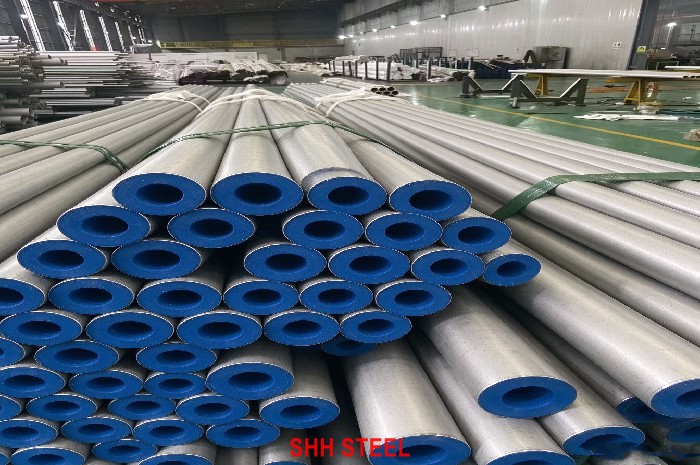
TP310MoLN tube leaves SHH STEEL bundled, capped or end-protected, and tagged for export or domestic delivery according to the length mix and bend form on the order. Bundle tags repeat the ASME SA-213 grade, UNS S31050, heat number, size, and wall basis so receiving crews can match the EN 10204 3.1 certificate without opening every bundle.
Export packing uses seaworthy bundling with moisture protection appropriate for pickled stainless; wooden cradles or steel-framed bundles are selected by length and destination. U-bend sets are segregated and marked by radius and leg length when the order is a bundle replacement. Marking and stenciling follow SA-213 requirements and any dual-mark text the purchase order adds — including a short reference to A213 TP310MoLN only when dual ASTM marking was ordered.
Why Choose SHH STEEL
SHH STEEL treats ASME SA213 TP310MoLN as a Code Book product standard with enforceable low-carbon Mo+N chemistry, wall-class tensile floors, hardness, heat-treatment, and marking rules — not as a catalogue nickname for “310 with molybdenum.” Enquiry review checks C ≤0.025%, Mo, N, Ni 21–23, wall basis, and the correct Table 4 row before a mill heat is released against the order.
That discipline matters on urea and nitric equipment where wrong-grade substitution (classic 310S, 316LN, or MoCbN) can pass a casual visual check and still fail chemistry or tensile review. We keep SA-213 and A213 as independent standard names, add dual marking only on request, and put Mo + N + wall-class tensile on the 3.1 certificate so inspectors are not left reconstructing the grade from a generic 310 stencil.
Buyers working across the SA213 stainless tube family can move from this MoLN page to SA213 TP310S, SA213 TP310MoCbN, SA213 TP310HCbN, or the hub SA213/SA213M without leaving the Code Book spine. Non-Code twins stay on the ASTM series when that is what the PO actually names.
Supply Capability
SHH STEEL can supply ASME SA213 TP310MoLN stainless steel tube against the edition and finish route named on your enquiry. The capability table below summarizes the sizes, finishes, and documents we regularly quote for this MoLN grade, followed by the Stock / Available sizes map buyers ask for when they need a quick sense of what to enquire against for urea-stripper, nitric-process, and high-Cr Mo+N heat-exchanger tube.
| Item | SHH STEEL capability for TP310MoLN |
|---|---|
| Standard | ASME SA213 / SA213M (dual A213 marking on request) |
| Grade | TP310MoLN / UNS S31050 |
| Product form | Seamless only — cold-finished and hot-finished |
| Size | Typical OD × min wall (or average wall) in the SA-213 usual band; other diameters by agreement |
| Wall / gauge | Minimum wall or average wall; BWG / gauge callouts accepted; name wall for Table 4 class |
| Length | Cut-to-length for HX / stripper / process bundles; U-bend by agreement |
| Documentation | EN 10204 3.1 MTC with Mo + N + wall-class tensile; A262 / third-party witness on request |
| Trade terms | FOB / CFR / CIF / EXW and other agreed Incoterms |
Stock / Available sizes
SHH STEEL quotes TP310MoLN against a stock-and-mill enquiry range rather than a frozen SKU or tonnage list. Representative OD × wall / BWG combinations for heat-exchanger, urea-stripper, and process tube are listed below as an enquiry map — confirm live availability, wall class, and cut lengths on the RFQ. Other diameters and average-wall orders are accepted when all SA-213 requirements are met.
| OD (in.) | Typical wall / BWG enquiry band | Notes |
|---|---|---|
| 1/2 – 3/4 | BWG 16–12 / ~0.065–0.109 in. | Common small HX / instrument take-off sizes |
| 1 – 1-1/2 | BWG 14–10 / ~0.083–0.134 in. | Process exchanger and condenser tube |
| 2 – 2-1/2 | 0.120 – 0.250 in. min wall | Heavier HX / stripper wall; check Table 4 class at 0.25 in. |
| 3 – 4 | 0.180 – 0.300 in. min wall | Larger process / reboiler tube by agreement |
| Up to 5 | Per datasheet min or avg wall | Upper usual SA-213 OD; other diameters by agreement |
Send OD × wall (or BWG), wall basis, quantity, finish route, any U-bend schedule, and whether dual A213 marking is required. SHH STEEL returns mill capability, document set, and lead time against ASME SA213 TP310MoLN / UNS S31050 — not a generic 310 substitute.
FAQ
-
Is ASME SA-213 the same as ASTM A213 for TP310MoLN?
- No. ASME SA-213 / SA-213M is the ASME Code Book adoption of the seamless boiler, superheater, and heat-exchanger tube grade text; ASTM A213 / A213M is the separate ASTM International product specification. Chemistry, wall-class tensile, and hardness floors align closely for a given referenced edition, but they remain two independent standards. Dual-mark SA-213/A213 tube only when the purchase order asks for both names on the stencil and MTC.
-
Does ASME SA213 TP310MoLN include welded or HCW tube?
- No. This SA213 product page covers seamless boiler, superheater, and heat-exchanger tube only. SA-213 for the austenitic grades discussed here is a seamless tube product form; welded (WLD) and hot-finished continuous-welded (HCW) manufacturing-type labels from pipe standards are not used as product-form options on this pack. If your datasheet actually needs welded stainless pipe, that is a different product standard family.
-
What is the UNS number and chemistry focus of ASME SA213 TP310MoLN?
- UNS S31050. The melt lines buyers check first are carbon ≤0.025%, chromium 24.0–26.0%, nickel 21.0–23.0%, molybdenum 2.00–3.00%, nitrogen 0.10–0.16%, silicon ≤0.40%, and phosphorus ≤0.020%. Those windows — not a shop nickname — define TP310MoLN under SA-213. Product analysis, when ordered, applies A480 A1.1 tolerances on top of the melt limits.
-
TP310MoLN vs TP310S — which SA213 tube should I order?
- Order TP310MoLN when the datasheet needs Mo 2–3%, N 0.10–0.16%, Ni 21–23, and C ≤0.025% on a 24–26% Cr base. Order TP310S when classic 25Cr–20Ni without Mo/N and with C ≤0.08% is enough. They are not dual stamps: a 310S heat cannot be remarked as MoLN because molybdenum, nitrogen, nickel floor, and carbon ceiling will not match.
-
TP310MoLN vs TP316N — can Mo+N 316-family tube replace MoLN under SA213?
- No. TP310MoLN sits at Cr 24–26 / Ni 21–23 with C ≤0.025%, Mo 2–3%, N 0.10–0.16%, and Si ≤0.40%. TP316N and other 316-family Mo+N grades sit at much lower Cr–Ni even when nitrogen is present. Oxidation resistance, high-temperature strength, and urea/nitric practice diverge. Interchange only with engineering approval — not by molybdenum or nitrogen coincidence.
-
Why does SA213 TP310MoLN have two tensile rows?
- Table 4 sets 84 ksi [580 MPa] tensile / 39 ksi [270 MPa] yield for wall t ≤ 0.25 in. [6 mm], and 78 ksi [540 MPa] / 37 ksi [255 MPa] for thicker wall, with 25% elongation and hardness max 217 HBW or 95 HRB on both classes. Name nominal wall and wall basis on the purchase order so the mill certificates the correct row. A single “84 ksi” note without wall class is incomplete for MoLN.
-
What heat treatment does ASME SA-213 require for TP310MoLN?
- Solution treatment with rapid cool is required for austenitic SA-213 grades, but the public PDF excerpt used for this pack does not print a dedicated S31050 temperature line between S31042 and S31060 — treat the exact minimum anneal temperature and any grain-size column entry as UNCERTAIN pending the ordered edition. Confirm the heat-treatment table row on the PO before freezing MTC anneal language; do not silently copy 1900 °F or 2100 °F from sister grades.
-
Is there a mandatory ASTM grain-size number for SA213 TP310MoLN?
- Public heat-treatment excerpts used here do not show a mandatory ASTM No. 7 (or other) grain-size requirement for S31050 the way H-grades such as TP310H or TP310HCbN do. Do not invent a grain-size clause on the certificate unless the ordered SA-213 edition or the purchase order requires one. If your project specification adds E112 grain size, state it explicitly on the RFQ.
-
Minimum wall vs average wall — which should I order for SA213 TP310MoLN?
- Most urea-stripper and heat-exchanger datasheets assume minimum wall; average wall is used only when the purchase order says so. Because MoLN tensile floors also change at 0.25 in. [6 mm], state both wall basis and nominal wall. SA-213 usual sizes run about 1/8 in. ID to 5 in. OD with min wall about 0.015–0.500 in.; other diameters by agreement. Prefer OD × wall / BWG language over B36.19 pipe schedules.
-
Is TP310MoLN automatically the right grade for urea service under SA213?
- Often it is specified for urea-stripper and related high-pressure process exchangers, but “urea” on a drawing is not a substitute for checking C ≤0.025%, Mo, N, Ni 21–23, wall class, and weld procedure. Some circuits specify other 25Cr–22Ni variants or different product forms. Confirm the UNS and standard name on the datasheet before assuming every urea tube enquiry is S31050.
-
Can you dual-certify ASME SA-213 and ASTM A213 TP310MoLN?
- Yes, when the purchase order asks for dual SA-213/A213 marking and the heat meets both named editions. They remain independent standards — dual marking is a documentation and stencil choice, not proof that the names are synonyms. SHH STEEL places both names on the stencil and EN 10204 3.1 certificate only when the PO requires that dual mark; otherwise SA-213 stands alone for Code Book jobs.
Conclusion
ASME SA213 TP310MoLN / UNS S31050 is the low-carbon molybdenum-and-nitrogen 24–26% Cr / 21–23% Ni seamless stainless steel tube grade for Code boiler, superheater, and heat-exchanger service when urea-stripper, nitric-process, or other high-Cr Mo+N duty needs C ≤0.025%, Mo 2–3%, N 0.10–0.16%, and wall-class tensile floors of 84/39 or 78/37 ksi. SHH STEEL supplies cold-finished and hot-finished seamless tube in the usual OD × wall / BWG band with EN 10204 3.1 MTCs that report Mo, N, and the correct Table 4 wall class. For sister grades on the same Code Book spine see the links above, or start from SA213/SA213M. Enquire with OD × wall, wall basis, quantity, and document needs at admin@steelspecs.com.
Quality Steel Needed? Inquire for Offers
Related Products