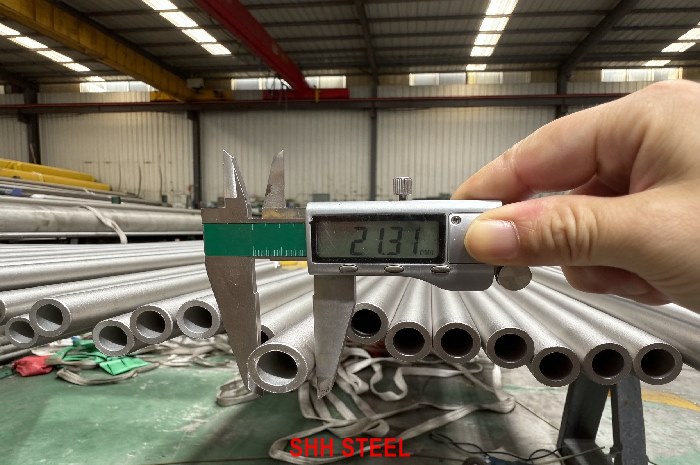
JIS G3463 SUS316TiTB Stainless Steel Tube
What is JIS G3463 SUS316TiTB Stainless Steel Tube
JIS G3463 covers both seamless and welded stainless tube for process, utility, condenser and heat-exchange duties. Inside that standard, SUS316TiTB is filed as austenitic. JIS G3463 SUS316TiTB is for buyers who want molybdenum and titanium stabilisation on the same HX tube — not a warehouse swap for SUS316LTB. Buyers working Japanese boiler and HX packages should treat SUS316TiTB as a governed product symbol under G3463, with Table 3 chemistry and Table 4 tensile floors enforced on the same heat. This paragraph is locked to SUS316TiTB duty: Ti-stabilised Mo austenitic for sensitisation-prone HX joints and polythionic-lean chemical coolers.
From pierce/draw or weld-and-anneal through marking and bundle protection, SHH STEEL can produce JIS G3463 SUS316TiTB for the sizes and tests on your RFQ. Application sketch: refinery HX with polythionic risk, chemical coolers with mid-temperature holds, and welded bundles where L grades are not preferred. Size and test clarity on the RFQ lets SHH STEEL lock the correct Table 1 symbols for SUS316TiTB before production starts. Corrosion framing beside SUS316TiTB: stabilisation fights weld decay; Mo still carries the chloride story within the 316 family.
On the floor people shorten marks; in QA they must not. SUS316TiTB under JIS G3463 carries specific Table 3 windows and Table 4 floors that a loose “316Ti” note will not enforce. Caution: Ti minimum is chemistry-linked to carbon — confirm Ti on the MTC; solution-treat temperature differs from plain 316. Keep isometric notes, tubesheet specs, and the mill acknowledgement aligned on SUS316TiTB so informal alias language cannot reopen the carbon or molybdenum window after melt. This paragraph is locked to SUS316TiTB duty: Ti-stabilised Mo austenitic for sensitisation-prone HX joints and polythionic-lean chemical coolers.
Superheater, condenser and corrosive HX duties all sit in G3463’s scope statement; still match the alloy to the medium. For SUS316TiTB, that means: Ti-stabilised Mo austenitic for sensitisation-prone HX joints and polythionic-lean chemical coolers. Nearby marks: SUS316TB, SUS316LTB, SUS321TB, SUS347TB. Document the medium, design temperature, and weld map beside the SUS316TiTB line item so sister-grade swaps are engineering decisions rather than purchasing shortcuts. Size practice for SUS316TiTB remains seamless cold-finished common; stabilisation anneal by agreement when ordered.
Inside this JIS G3463 series, compare SUS316TB, SUS316LTB, SUS321TB, SUS347TB. Hub: JIS G3463. ASTM/ASME related product pages (not interchangeable by default): A213 TP316Ti, ASTM A213.
Chemical Composition of JIS G3463 SUS316TiTB
For SUS316TiTB, the melt ticket has to show Table 3 compliance — C ≤0.08, Si ≤1.00, Mn ≤2.00, P ≤0.040, S ≤0.030, Ni 11.00–15.00, Cr 16.00–18.00. Optional alloying footnotes in the standard still forbid blurring grade identity. Corrosion framing: stabilisation fights weld decay; Mo still carries the chloride story within the 316 family.
Where Mo, Cu, Ti, Nb or N appear, they are intentional levers for SUS316TiTB, not optional marketing. Confirm them on the MTC line-by-line. Role: Ti-stabilised Mo austenitic for sensitisation-prone HX joints and polythionic-lean chemical coolers. If a purchaser specification tightens phosphorus, sulphur, or residual elements beyond Table 3, SHH STEEL will confirm melt feasibility for SUS316TiTB before the order is acknowledged. This paragraph is locked to SUS316TiTB duty: Ti-stabilised Mo austenitic for sensitisation-prone HX joints and polythionic-lean chemical coolers.
| Grade | C | Si | Mn | P | S | Ni | Cr | Mo | Ti |
|---|---|---|---|---|---|---|---|---|---|
| SUS316TiTB | ≤0.08 | ≤1.00 | ≤2.00 | ≤0.040 | ≤0.030 | 11.00–15.00 | 16.00–18.00 | 2.00–3.00 | ≥5×C% |
Mechanical Properties of JIS G3463 SUS316TiTB
Do not confuse Table 4 tube tensile floors with plate or tube standards that share the 316Ti / UNS S31635 alias. For SUS316TiTB under G3463 expect Rm min 520 N/mm², proof stress min 206 N/mm², elongation min 35% (OD ≥20 mm, No.11/12), verified per heat/lot rules in tensile sampling clauses. Tensile sampling follows tensile sampling clauses for the ordered test unit of SUS316TiTB, and retests follow retest clauses when a result sits under the Table 4 floor. Corrosion framing beside SUS316TiTB: stabilisation fights weld decay; Mo still carries the chloride story within the 316 family.
| Grade | Rm min (N/mm²) | Proof stress min (N/mm²) | A OD≥20 mm No.11/12 min (%) | A 10≤OD<20 mm No.11 min (%) | A OD<10 mm No.11 min (%) |
|---|---|---|---|---|---|
| SUS316TiTB | 520 | 206 | 35 | 30 | 27 |
Ambient values from JIS G3463 Table 4 for SUS316TiTB. Heat treatment (Table 2): 920 °C min, rapid cool (stabilisation 850–930 °C may be ordered). Elongation reductions apply for walls under 8 mm on No.12 pieces. For heat-exchanger tube the purchaser may designate an upper tensile limit (Table 4 min + 200 N/mm²) when necessary.
Manufacture of JIS G3463 SUS316TiTB Tube (Seamless and Welded)
Both seamless and welded SUS316TiTB are legitimate under JIS G3463. Pick S when the design pressure, wall, or NDT plan favours a pierced/drawn route; pick A, L, or E when welded economics fit and the weld procedure is qualified. Finish symbols S-H/S-C/A/A-C/E-C ride with the process mark on the tube stencil. Seamless and welded options remain available for SUS316TiTB; the acknowledgement repeats the Table 1 symbols so production cannot silently change route after the PO is firm. Keep the SUS316TiTB caution visible here: Ti minimum is chemistry-linked to carbon — confirm Ti on the MTC; solution-treat temperature differs from plain 316.
Welded SUS316TiTB needs weld-bead work or as-welded finish called out (as-welded vs cold-finished welded) so NDT and corrosion expectations match. Heat treatment: 920 °C min, rapid cool (stabilisation 850–930 °C may be ordered). Austenitic heats take solution annealing with rapid cooling; hot-finished seamless may omit separate solution treatment when hot-worked and rapidly cooled in-line under the Table 2 note, unless the purchaser forbids it.
Hydrostatic testing or NDT (eddy current / ultrasonic per JIS G 0582/0583) replaces or accompanies pressure proof as the order states. Manufacture stays honest to the seamless or A/L/E welded choice. Size: seamless cold-finished common; stabilisation anneal by agreement when ordered. Hydrostatic pressure or NDT class for SUS316TiTB is frozen with the size list so quality planners can book the correct benches before the tube is cut to length. Size practice for SUS316TiTB remains seamless cold-finished common; stabilisation anneal by agreement when ordered.
Dimensions and Tolerances for JIS G3463 SUS316TiTB
Out-of-table OD×wall combinations are by agreement — still under the same grade symbol SUS316TiTB. Duty: Ti-stabilised Mo austenitic for sensitisation-prone HX joints and polythionic-lean chemical coolers. Tolerance class follows the process route ordered for SUS316TiTB, and out-of-table diameters are accepted only with a written dimensional agreement on the same acknowledgement. Application context for SUS316TiTB stays refinery HX with polythionic risk, chemical coolers with mid-temperature holds, and welded bundles where L grades are not preferred.
Ovality, wall eccentricity (where applicable), and weld bead height limits are part of dimensional tolerance clauses — not optional cosmetics. Size reminder: seamless cold-finished common; stabilisation anneal by agreement when ordered. Fixed lengths and multiple cut lengths for SUS316TiTB are protected at the ends so bevel geometry and ID cleanliness survive inland and ocean transit. This paragraph is locked to SUS316TiTB duty: Ti-stabilised Mo austenitic for sensitisation-prone HX joints and polythionic-lean chemical coolers.
Equivalent Grades for JIS G3463 SUS316TiTB
European EN tube/tube numbers and ASTM marks may sit near 316Ti / UNS S31635, yet hydrostatic, NDT and heat-treatment text diverge. Keep SUS316TiTB as the governing symbol unless a written dual-cert plan exists. Caution: Ti minimum is chemistry-linked to carbon — confirm Ti on the MTC; solution-treat temperature differs from plain 316.
Heat Treatment and Delivery Condition for JIS G3463 SUS316TiTB
Hot-finished seamless austenitics may use in-line rapid cool in lieu of a separate solution treatment under Table 2 note (a) unless the purchaser forbids it. Confirm for SUS316TiTB. Band: 920 °C min, rapid cool (stabilisation 850–930 °C may be ordered). Recorded furnace charts for SUS316TiTB should support the Table 2 temperature claim on the certificate, including quench or cool method where the family requires rapid cooling. This paragraph is locked to SUS316TiTB duty: Ti-stabilised Mo austenitic for sensitisation-prone HX joints and polythionic-lean chemical coolers.
Grain-size testing applies where the standard requires it for specific H grades — state any extra metallographic demand on the PO for SUS316TiTB. Field heat treatment of SUS316TiTB after hot bending must chase the same family practice, or the corrosion file should formally accept the as-bent condition. This paragraph is locked to SUS316TiTB duty: Ti-stabilised Mo austenitic for sensitisation-prone HX joints and polythionic-lean chemical coolers.
Corrosion Resistance of JIS G3463 SUS316TiTB
Medium, temperature, crevice geometry and weld condition decide whether SUS316TiTB is enough. Summary: stabilisation fights weld decay; Mo still carries the chloride story within the 316 family. Escalate via sisters SUS316TB, SUS316LTB, SUS321TB, SUS347TB when coupons fail. Coupon orientation, weld condition, and surface finish for SUS316TiTB belong in the corrosion test order so annex results can be compared to the installed bundle honestly. Application context for SUS316TiTB stays refinery HX with polythionic risk, chemical coolers with mid-temperature holds, and welded bundles where L grades are not preferred.
Surface finish and iron contamination control often matter as much as bulk chemistry on sanitary-lean duties for SUS316TiTB. Corrosion framing: stabilisation fights weld decay; Mo still carries the chloride story within the 316 family. If operating chlorides, temperature, or crevice geometry change after award, reopen the alloy choice for SUS316TiTB rather than relying on schedule thickness alone. This paragraph is locked to SUS316TiTB duty: Ti-stabilised Mo austenitic for sensitisation-prone HX joints and polythionic-lean chemical coolers.
Applications of JIS G3463 SUS316TiTB Tube
From utility rooms to process racks, SUS316TiTB shows up wherever Japanese boiler/HX specs want austenitic behaviour. Use list: refinery HX with polythionic risk, chemical coolers with mid-temperature holds, and welded bundles where L grades are not preferred. Spool fabricators should copy SUS316TiTB onto cut lists and WPS bases so warehouse substitutions cannot quietly introduce a different carbon or molybdenum window. Keep the SUS316TiTB caution visible here: Ti minimum is chemistry-linked to carbon — confirm Ti on the MTC; solution-treat temperature differs from plain 316.
If the only reason for SUS316TiTB is “we always used this alias,” reopen the corrosion file before repeating the order. Caution: Ti minimum is chemistry-linked to carbon — confirm Ti on the MTC; solution-treat temperature differs from plain 316. Commissioning teams benefit when the as-built dossier repeats SUS316TiTB beside heat numbers, linking isometric revisions to the same mill certificates. Size practice for SUS316TiTB remains seamless cold-finished common; stabilisation anneal by agreement when ordered.
Weldability of JIS G3463 SUS316TiTB
Automatic mill welds and manual field welds need different procedure packs, but both must respect SUS316TiTB chemistry. Guidance: 316Ti / Nb-stabilised fillers per WPS; avoid excessive heat input that coarsens grains. Procedure qualification for SUS316TiTB should use the same product form and wall class as production, including any bead-worked or as-welded finish that will ship. Weld-shop note tied to SUS316TiTB: 316Ti / Nb-stabilised fillers per WPS; avoid excessive heat input that coarsens grains.
Ferrite control on duplex SUS316TiTB and hot-crack control on high-Ni austenitics are procedure items, not afterthoughts. Guidance: 316Ti / Nb-stabilised fillers per WPS; avoid excessive heat input that coarsens grains. Consumable lot control and shielding-gas notes for SUS316TiTB stay with the WPS package so site crews cannot improvise fillers that under-alloy the joint. Application context for SUS316TiTB stays refinery HX with polythionic risk, chemical coolers with mid-temperature holds, and welded bundles where L grades are not preferred.
Surface Finishes for JIS G3463 SUS316TiTB
Welded tube may need bead dressing for flow or inspection; call that out rather than assuming mill habit. Size/finish context: seamless cold-finished common; stabilisation anneal by agreement when ordered. Roughness or polish callouts for SUS316TiTB must name OD, ID, or both; ambiguous “bright tube” language is clarified before finishing slots are booked. Size practice for SUS316TiTB remains seamless cold-finished common; stabilisation anneal by agreement when ordered.
Do not polish over unresolved weld defects — inspection comes before cosmetics on SUS316TiTB. Final visual standards for SUS316TiTB reject grinding burns, embedded free iron, and unrepaired weld undercut before bundles are closed. Weld-shop note tied to SUS316TiTB: 316Ti / Nb-stabilised fillers per WPS; avoid excessive heat input that coarsens grains Final visual standards for SUS316TiTB reject grinding burns, embedded free iron, and unrepaired weld undercut before bundles are closed. Use-case reminder for SUS316TiTB: refinery HX with polythionic risk, chemical coolers with mid-temperature holds, and welded bundles where L grades are not preferred.
Inspection and Testing for JIS G3463 SUS316TiTB
Third-party witness (SGS/TUV-style) is available when the project mandate requires it. Base acceptance still tracks G3463 for SUS316TiTB. Sampling plans for SUS316TiTB keep heat identity unbroken from melt through bundle tags, including any third-party hold points written into the purchase order. Weld-shop note tied to SUS316TiTB: 316Ti / Nb-stabilised fillers per WPS; avoid excessive heat input that coarsens grains.
Dimensional inspection against dimensional tolerance clauses tolerances closes the lot. Failures retest per retest clauses — they are not silently shipped. Role: Ti-stabilised Mo austenitic for sensitisation-prone HX joints and polythionic-lean chemical coolers. Non-conforming SUS316TiTB lengths are segregated and retested or rejected under retest clauses rather than reworked into unmarked stock. Corrosion framing beside SUS316TiTB: stabilisation fights weld decay; Mo still carries the chloride story within the 316 family.
Packaging and Shipping for JIS G3463 SUS316TiTB
Seaworthy packing is available for ocean legs — desiccant, VCI, and wrap specs by agreement. Grade mark SUS316TiTB stays visible on outer tags. Bundle tickets for SUS316TiTB repeat grade, heat, size, and quantity so receiving inspectors can match crates to the packing list without opening every wrap. Corrosion framing beside SUS316TiTB: stabilisation fights weld decay; Mo still carries the chloride story within the 316 family.
Container loading plans should keep heavy schedules from crushing thin-wall SUS316TiTB layers. Desiccant and wrap choices for SUS316TiTB follow the voyage length and storage climate stated on the shipping order, not a one-size export habit. Size practice for SUS316TiTB remains seamless cold-finished common; stabilisation anneal by agreement when ordered Desiccant and wrap choices for SUS316TiTB follow the voyage length and storage climate stated on the shipping order, not a one-size export habit. Order-line discipline for SUS316TiTB still points at role: Ti-stabilised Mo austenitic for sensitisation-prone HX joints and polythionic-lean chemical coolers.
Shortages or transit damage claims need photos against the packing list before installation starts — tag identity must still read SUS316TiTB. Claims handling for SUS316TiTB starts with tagged photos against the packing list so heat identity remains usable if replacement lengths are required. Size practice for SUS316TiTB remains seamless cold-finished common; stabilisation anneal by agreement when ordered.
Why Choose SHH STEEL
From RFQ clarification through MTC release, SHH STEEL treats SUS316TiTB as a governed product symbol, not a marketing synonym for 316Ti / UNS S31635. Role: Ti-stabilised Mo austenitic for sensitisation-prone HX joints and polythionic-lean chemical coolers. SHH STEEL can produce and supply SUS316TiTB against the OD × wall, process symbol, and test scope on your RFQ without swapping in an unstated sister grade.
Response time stays short because common SUS316TiTB enquiry sizes and document packs are already exercised on prior Japanese-spec orders. Use: refinery HX with polythionic risk, chemical coolers with mid-temperature holds, and welded bundles where L grades are not preferred. Ask for a written acknowledgement that names SUS316TiTB, the manufacture process/finish marks, and the Table 2 heat-treatment condition before melt. SHH STEEL can make SUS316TiTB to that written scope.
Supply Capability
Capability framing for SUS316TiTB: Japanese-spec HX tube product, dual-route manufacture, documented heats. Caution remains: Ti minimum is chemistry-linked to carbon — confirm Ti on the MTC; solution-treat temperature differs from plain 316. SHH STEEL can produce and supply cut lengths, bevels, and ordered annex tests for SUS316TiTB when the mill schedule allows.
| Item | Capability |
|---|---|
| Standard | JIS G3463 stainless steel tubes for boilers and heat exchangers |
| Grade symbol | SUS316TiTB |
| Product form | Seamless (S) and welded (A / L / E) tube; finishes S-H / S-C / A / A-C / E-C as marked |
| Delivery condition | solution annealed |
| Documents | Mill test certificate (JIS G 0415 / EN 10204 3.1 style as ordered) |
| Typical OD practice | 15.9–139.8 mm per standard Note 1; other by agreement |
| Wall / gauge | OD × wall / BWG-class HX gauges within Attached Tables; other by agreement |
Stock / Available sizes
Stock / Available sizes — treat published ranges as capability envelopes. Actual ex-stock pieces of SUS316TiTB change weekly; the reliable path is an OD × wall matrix on the enquiry. Duty: Ti-stabilised Mo austenitic for sensitisation-prone HX joints and polythionic-lean chemical coolers. SHH STEEL can supply alternate schedules and measured walls for SUS316TiTB once the design pressure and corrosion allowance are clear.
Repeat orders for SUS316TiTB go faster when prior heat records and accepted WPS numbers are referenced on the new RFQ. Role: Ti-stabilised Mo austenitic for sensitisation-prone HX joints and polythionic-lean chemical coolers. SHH STEEL can produce trial lengths of SUS316TiTB for procedure qualification before the bulk release when the project calendar needs it.
FAQ
-
What is JIS G3463 SUS316TiTB stainless steel tube used for?
- JIS G3463 SUS316TiTB is stainless tube for boiler and heat-exchanger service (superheater, HX, condenser, catalyser) — refinery HX with polythionic risk, chemical coolers with mid-temperature holds, and welded bundles where L grades are not preferred. Role summary: Ti-stabilised Mo austenitic for sensitisation-prone HX joints and polythionic-lean chemical coolers. It is a Japanese boiler/HX tube product standard mark, not an automatic ASTM A213 certificate.
-
Does JIS G3463 SUS316TiTB cover seamless and welded tube?
- Yes. Manufacture allows seamless and welded automatic-arc (A), laser (L), or electric-resistance (E) routes with finish marks such as S-H, S-C, A-C, or E-C. SHH STEEL can produce and supply either route for SUS316TiTB when the mill can meet the ordered size and tests. The title omits Seamless/Welded because JIS G3463 covers both manufacture routes — the PO must still name the process mark.
-
What heat treatment applies to SUS316TiTB?
- SUS316TiTB is delivered solution annealed under JIS G3463. Table 2 reference: 920 °C min, rapid cool (stabilisation 850–930 °C may be ordered). Stabilisation or other purchaser options, where allowed, must be written on the order. Certificate wording should match the treatment actually performed.
-
How does SUS316TiTB compare with sister grades SUS316TB, SUS316LTB, SUS321TB?
- SUS316TiTB is filed as austenitic. Typical sisters on the same RFQ are SUS316TB, SUS316LTB, SUS321TB. Design caution: Ti minimum is chemistry-linked to carbon — confirm Ti on the MTC; solution-treat temperature differs from plain 316 Pick the sister when the medium or strength floor outgrows this symbol rather than stretching wall alone.
-
What tests appear on the mill certificate for SUS316TiTB?
- Expect cast analysis (Table 3), room-temperature tensile results (Table 4), flattening/flaring as applicable, dimensions, hydrostatic or NDT as ordered, and every special annex test actually performed. SHH STEEL does not print surrogate inspection lines. Documents follow JIS G 0415 or EN 10204 3.1 style when specified.
-
Is 316Ti / UNS S31635 the same as ordering SUS316TiTB?
- No. 316Ti / UNS S31635 is a commercial / UNS cross-walk for body text. The purchase order should lock JIS G3463 and SUS316TiTB so cast limits, heat treatment, and process marks are unambiguous. Silent alias substitution is a common root cause of wrong MTCs.
-
What size range can SHH STEEL quote for JIS G3463 SUS316TiTB?
- SHH STEEL can produce and supply enquiry-oriented OD × wall bands for SUS316TiTB within the typical 15.9–139.8 mm OD practice, with measured walls by agreement. Size context: seamless cold-finished common; stabilisation anneal by agreement when ordered. Stock / Available sizes on this page is an RFQ map, not a frozen tonnage catalogue.
-
How should SUS316TiTB be welded?
- Shop guidance: 316Ti / Nb-stabilised fillers per WPS; avoid excessive heat input that coarsens grains. Mill heat treatment of seamless or welded tube does not replace a qualified WPS on fabricator joints or tube-to-tubesheet welds. For corrosive as-welded duty, confirm low-carbon, stabilisation, duplex ferrite control, or anneal practice as applicable. Caution: Ti minimum is chemistry-linked to carbon — confirm Ti on the MTC; solution-treat temperature differs from plain 316
-
When should I choose a duplex or higher-Mo grade instead of SUS316TiTB?
- Move when chloride pitting, crevice attack, or SCC risk exceeds what austenitic practice can defend for the temperature and stress state. Caution for this mark: Ti minimum is chemistry-linked to carbon — confirm Ti on the MTC; solution-treat temperature differs from plain 316 Sister pointers: SUS316TB, SUS316LTB, SUS321TB. SHH STEEL will not invent PREN marketing digits — bring the medium data.
-
Can SHH STEEL dual-certify JIS G3463 SUS316TiTB with ASTM A213 or ASME SA213?
- Dual documentation is possible only when chemistry and tests satisfy each standard on its own terms. An MTC that only cites JIS G3463 SUS316TiTB does not clear ASTM A213 acceptance by default. State both standards, sizes, and test scopes before melt.
-
What surface finishes are available for SUS316TiTB?
- Pickled after heat treatment is the usual HX tube supply. Bright anneal, grind, or polish finishes are by agreement and must state OD/ID scope. SHH STEEL can produce and supply the ordered finish for SUS316TiTB when the mill route supports it. Carbon-steel strapping never contacts the stainless OD.
Conclusion
JIS G3463 SUS316TiTB is stainless steel tube for boiler and heat-exchanger service — Ti-stabilised Mo austenitic for sensitisation-prone HX joints and polythionic-lean chemical coolers. SHH STEEL can produce and supply it in seamless or welded routes with the heat treatment, tests, and finishes named on your enquiry, documented on mill certificates. Sister grades often discussed alongside this mark include SUS316TB, SUS316LTB, SUS321TB. Related ASTM A213 pages share chemistry families but not Japanese acceptance text. Email admin@steelspecs.com with OD × wall, process mark, and medium notes to start the quote.
Quality Steel Needed? Inquire for Offers
Related Products