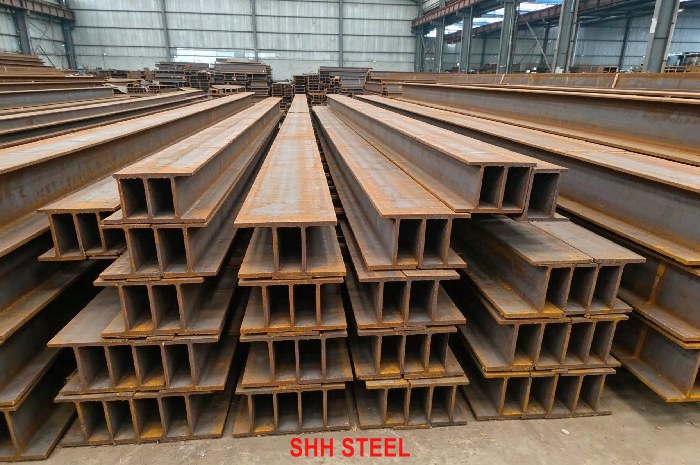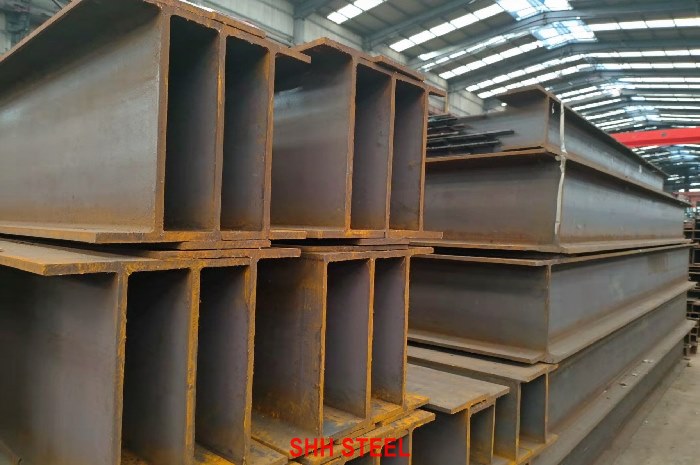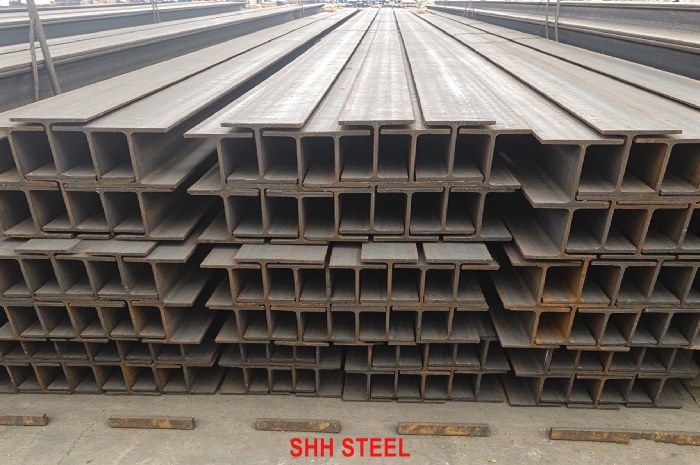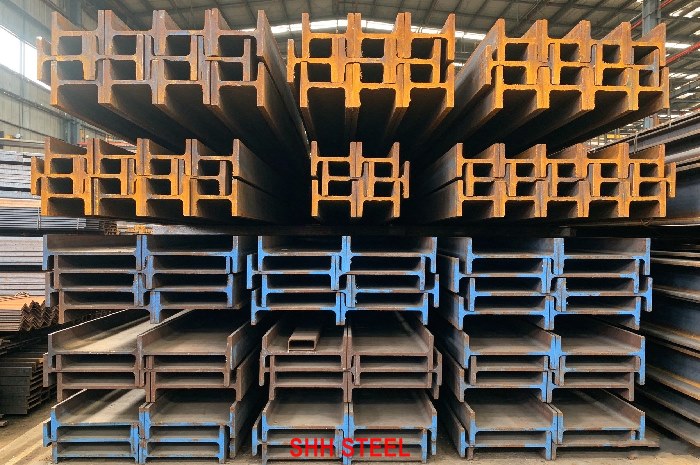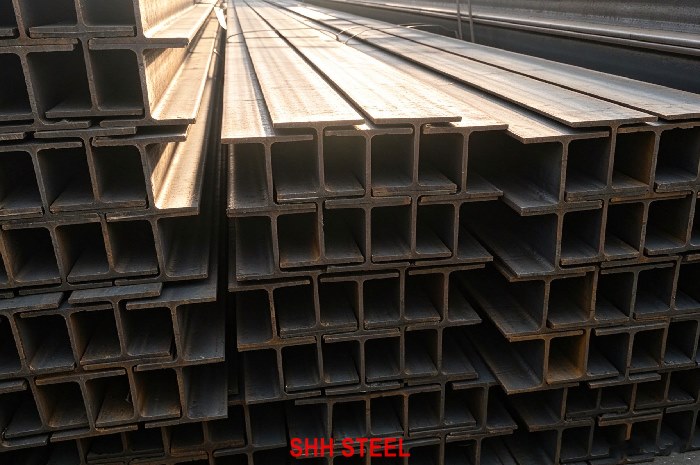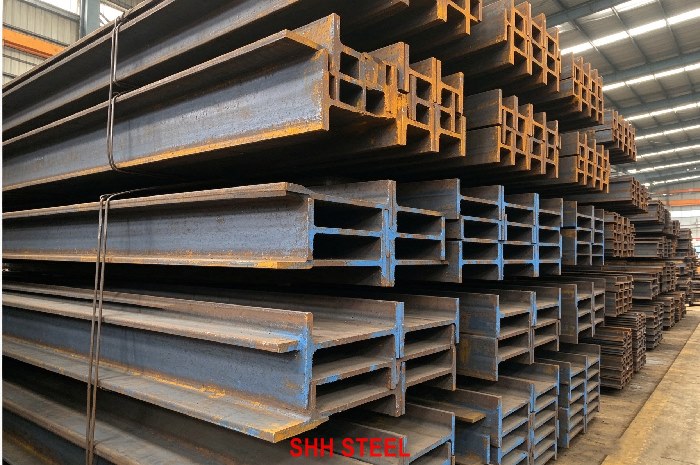
EN 10025-2 S355JR H-Beam
What is EN 10025-2 S355JR H-beam?
EN 10025-2 S355JR H-beam is a hot-rolled structural section supplied to the non-alloy structural steel grade S355JR (steel number 1.0045). The designation is read in three parts: S marks a structural steel, 355 is the nominal minimum yield strength in MPa for the thinnest tabulated thickness band, and JR is the impact quality, which requires a minimum absorbed energy of 27 J at +20 °C.
This page covers the grade in H-beam and related European I-section form, not plate. The same grade in plate form is already listed separately as EN 10025-2 S355JR steel plate. Chemistry and tensile requirements belong to the material standard, but the numerical limits and the test direction can differ between long products and wide flat products, so the plate page should not be used as a substitute data sheet for beams.
S355JR H-beams sit in the EN 10025-2 steel beam profiles category, under steel beam profiles and the broader steel structural profiles family. The usual European size series for this product are HE A (HEA), HE B (HEB) and IPE. HE M (HEM) and lighter or heavier IPE variants exist in the same family; they are noted below where they help with selection, but they are not a promise that every series is rolled in S355JR.
The grade is widely specified for building frames, industrial structures and general fabrication where a +20 °C impact test is accepted. It is not a fine-grain weldable grade such as S355N or S355NL, and it is not a pressure-vessel or nuclear safety material. If the project needs a lower impact test temperature, a different execution class, or a different shape system, that requirement should be stated on the enquiry rather than assumed from the letters “S355” alone.
Material, Dimensions and Tolerances for S355JR Sections
Orders for S355JR H-beams frequently mix three documents, and they should be named separately on the purchase order and on the inspection certificate:
- EN 10025-2 is the material standard. It sets the ladle-analysis limits, carbon equivalent, thickness-dependent yield and tensile ranges, elongation, and the JR impact requirement for non-alloy structural steels. The edition on the order (this article uses values published against EN 10025-2:2019) governs acceptance.
- EN 10365 is the dimensional standard for hot-rolled I and H sections. It collects the established European series, including IPE and the HE A, HE B and HE M family formerly listed under EU 53-62. The numbers in the size tables below are reference dimensions and theoretical masses for those series, not a rolling list for a particular mill or grade.
- EN 10034 is the tolerance standard for I and H sections. It covers depth, width, web and flange thickness, out-of-square, web off-centre, straightness and related shape and mass tolerances. Surface condition for sections is commonly specified to EN 10163-3; many section programmes cite class C, subclass 1, which should be confirmed when a tighter class is required.
A mill may roll a European HE or IPE shape and certify a different material standard, or roll a metric H or W-shape and certify S355JR, if that combination is in its programme and is properly documented. The certificate should still identify the material standard and edition, the grade, the shape standard and the size designation. Do not treat “S355JR H-beam” as if it automatically means an HEA section, and do not treat a Chinese or Japanese metric H designation as interchangeable with HEA or HEB of the same nominal depth.
Related shape systems used in export enquiries include GB/T 11263 for Chinese hot-rolled H-sections, JIS G 3192 for Japanese H-section dimensions, and ASTM A6 / A6M for American W-shapes listed under ASTM A992, ASTM A572 and ASTM A36 beam categories. British universal beams and columns (UB/UC) are a further European/British series. Typical mill-programme UB and UC designations commonly supplied in S355JR are tabulated with the HE A, HE B and IPE series below. Those rows are a commonly supplied standard mill series consistent with EN 10365 naming, not a claim that every official EN 10365:2017 row has been reproduced. If a historic or additional depth is required, state the designation standard and size on the enquiry.
S355JR H-Beam Sizes: HEA, HEB, IPE, UB and UC Reference Tables
The tables below give designation, depth h, width b, web thickness tw, flange thickness tf, root radius r, cross-sectional area A and theoretical mass per metre for the standard HE A, HE B and IPE series. Values are manufacturer-catalogue reference dimensions consistent with the established EN 10365 series (the HE A/B/M 100–1000 family is the former EU 53-62 series now collected in EN 10365; IPE is listed to EN 10365). Masses and areas are theoretical catalogue figures. They are intended for identification, estimating and drawing work. They are not a statement that every size is rolled in S355JR, nor that any one mill offers the full range.
Availability depends on the mill rolling programme and on certification of the ordered grade and options. Mid-range HE A, HE B and IPE sizes are the usual enquiry core. The lightest and the heaviest rows, and additional series such as HE M, HE AA, IPE A / IPE O / IPE V or IPE 750 variants, should be confirmed size by size. Do not read a blank cell as zero, and do not invent a missing radius or area; every row below includes r and A because both were printed in the source catalogue.
Two designation habits are in use for the wide-flange series. EN writing uses a space and a letter after the size number: HE 200 A, HE 200 B, HE 200 M. Trade writing often compresses this to HEA 200, HEB 200 and HEM 200. They name the same standard sections. IPE uses the series letters plus the nominal depth, for example IPE 300. The nominal depth is not always the actual depth: HE 300 A / HEA 300 has h = 290 mm, while HE 300 B / HEB 300 has h = 300 mm. From HE 320 upward the flange width of both HE A and HE B stays at 300 mm while depth increases. IPE sections are narrower parallel-flange I-beams, not square H-sections; IPE 300 is 300 × 150 mm, not 300 × 300 mm.
Theoretical mass is based on the published area. Catalogues for these series use the conventional steel density of 7.85 kg/dm³. Delivered mass may differ within the mass tolerance of EN 10034. Settlement should follow the method stated on the order (theoretical mass, weighed mass, or another agreed rule), not an informal average of the two.
HEA (HE A) series
HE A is the lighter wide-flange series: relatively thin flanges and, for a given designation number, a depth slightly below that number in most sizes. It is often chosen where a wide flange is needed with a lower mass per metre than the corresponding HE B. The table lists the standard HE A 100–1000 series (24 sizes).
HEB (HE B) series
HE B is the standard-weight wide-flange series. Up to HE 300 B the section is essentially square (h = b). Above that, width remains 300 mm and depth increases. Flanges are thicker than the matching HE A size, so the mass per metre is higher. The table lists the standard HE B 100–1000 series (24 sizes).
IPE series
IPE sections are parallel-flange I-beams with a narrower flange than HE A or HE B. They are widely used as floor beams and general framing members in European practice. The table lists the standard IPE 80–600 series (18 sizes). Lighter or heavier companions (IPE A, IPE AA, IPE O, IPE V) and additional IPE 750 × mass sizes appear in some rolling programmes; they are not included here because they are not the core IPE series and, for some of the 750 sizes, published root radii are not consistent between programmes.
Typical mill-programme universal beams (UB) and universal columns (UC) commonly supplied in S355JR are tabulated below. Designations follow the established EN 10365 / British universal naming (for example UB 610 × 229 × 125). The rows are a commonly supplied standard mill series, not a claim that every official EN 10365:2017 row has been reproduced or that any one mill rolls the full list in S355JR. Historic or additional depths can be reviewed on enquiry; they are not silently added to these tables. Masses are theoretical catalogue figures for identification, estimating and drawing work.
Universal beams (UB)
Swipe horizontally to view all dimensions.
Universal columns (UC)
Swipe horizontally to view all dimensions.
HE M (HEM) is the heavy series in the same HE family and may be considered when a thicker flange is required at a given depth. It is not tabulated above. Chinese HW / HM / HN sizes under GB/T 11263 and Japanese H sizes under JIS G 3192 use millimetre designations (for example H 300 × 300 × 10 × 15) and must be selected from those standards, not by matching the “300” in HEA 300, IPE 300 or UB 305.
S355JR Chemical Composition: Ladle Analysis and CEV
The figures below are ladle-analysis (heat-analysis) maxima for S355JR long products, as published in manufacturer section programmes against EN 10025-2:2019. They are limits, not typical ladle results. Product analysis may differ from ladle analysis by the deviations permitted in the ordered edition of the standard. Do not apply the flat-product table for this grade to H-beams without checking the long-product columns; phosphorus and sulphur maxima, in particular, are not always the same in the two product forms. The same caution applies when reading S355JR plate data beside this page.
Carbon equivalent is calculated as CEV = C + Mn/6 + (Cr + Mo + V)/5 + (Cu + Ni)/15. Special options for S275 and S355 in clause 7.2.5 of EN 10025-2:2019 can adjust the applicable limit and should be reviewed when they are invoked. Published maxima for S355JR in the section programmes used here are:
One manufacturer programme prints the third CEV band to 140 mm; a sections declaration of performance for the same grade prints 0.47% through 150 mm. For any flange or web thicker than that documented range, the CEV limit should be agreed against the ordered edition. These CEV figures describe weldability in the sense of the material standard; they are not a welding procedure.
If other alloying elements are added, they are to be reported on the inspection document. The table above does not invent limits for niobium, vanadium or titanium for S355JR; where a programme lists optional micro-alloying maxima, those values belong on the certificate when they are used, not as a default chemistry for this grade.
S355JR Mechanical Properties: Yield, Tensile and JR Impact
Mechanical properties of S355JR are thickness-dependent. The values below are minimums or ranges for long products as published in manufacturer section programmes against EN 10025-2:2019. Yield is the upper yield strength ReH. Elongation A is for a proportional gauge length L0 = 5.65√S0. For long products the standard generally specifies longitudinal test pieces unless the order states otherwise. These figures should not be mixed with the transverse elongation values used for wide flat products of the same grade.
In the table, the 470–630 MPa tensile range applies for 3 mm ≤ t ≤ 100 mm, and the 22% elongation value applies for 3 mm ≤ t ≤ 40 mm, as in the section programmes cited for EN 10025-2:2019.
For H-beams and IPE sections, the governing thickness for these bands is the relevant product thickness defined in EN 10025-2, commonly the flange thickness for the tensile and impact tests on sections. A HE 200 B flange is 15 mm, so it falls in the 355 MPa yield and 22% elongation band; a HE 600 B flange is 30 mm, so the minimum yield is 345 MPa. Always apply the band that matches the actual governing thickness of the ordered size, not the 355 MPa headline value.
The JR quality requires a minimum Charpy V-notch absorbed energy of 27 J at +20 °C, in the longitudinal direction. For sections with a nominal thickness greater than 100 mm, the cited section programmes state that the impact values shall be agreed. If the design specification needs 27 J at 0 °C or at −20 °C, the grade to nominate is S355J0 or S355J2, not S355JR. The strength table above is shared by those qualities; the impact temperature is not.
The mechanical table used here stops at 150 mm, which covers the flange thicknesses of the standard HE A, HE B and IPE series tabulated on this page. Thicker specials, if ever required, must be agreed to the ordered edition and are not given invented values here.
Delivery Conditions, Inspection and Identification
S355JR sections are commonly supplied in the as-rolled condition, often denoted +AR. Normalized or normalized-rolled delivery (+N) is an option under EN 10025-2 when the order requires it; it does not, by itself, change the JR impact temperature. The delivery condition should be written on the order and must appear on the inspection document.
European construction products may be placed on the market under the Construction Products Regulation with a declaration of performance and CE marking against the harmonized standard. Buyers outside that system still need a clear certificate trail. For export, an EN 10204 type 3.1 inspection document is the usual request; type 3.2 or a nominated third-party attendance can be added when the project specification requires it. The document should identify the standard edition, grade (S355JR / 1.0045), delivery condition, size designation and shape standard, heat number, ladle analysis, CEV, mechanical test results including the impact test temperature and values, and any agreed options (for example a silicon range for galvanizing, or impact testing on thickness greater than 100 mm).
Identification on the product follows the mill’s marking practice and the requirements of the ordered standard: typically the grade, mill identification and heat or piece reference, with additional marks when specified. Length is not fixed by EN 10365. Mills commonly roll these sections in fixed lengths in the region of 6–15 m; other lengths are a matter for the rolling programme and the order, not a standing supply list.
The same S355JR heat may also be rolled as channels or angles when those shapes are in the programme. Each shape still needs its own dimensional and tolerance standard (for example EN 10279 for channels and EN 10056 for angles) and should be ordered as a separate line.
Weldability, CEV and JR Toughness of S355JR Steel
S355JR is a weldable non-alloy structural steel when the carbon equivalent, thickness, joint design and hydrogen control are taken into account. The CEV limits in the chemistry section are the material-standard weldability requirement. They do not replace a welding procedure specification, welder qualification, or the execution standard used on the project (often EN 1090 for CE-marked structural work, or an equivalent project specification).
Preheat, heat input and consumable choice depend on thickness, joint restraint, combined thickness, and the hydrogen scale of the process. Guidance such as EN 1011-2 is commonly used to develop those parameters; this page does not prescribe a procedure. Thicker HE B or HE M flanges need more attention than a thin IPE web. If the order includes a restricted silicon and phosphorus range for subsequent hot-dip galvanizing, that chemistry should be known before welding and coating are planned, because it is an agreed option, not the default ladle table.
S355JR does not carry a guaranteed impact energy below +20 °C. Welded details that will see lower service temperatures, high restraint, or a demanding execution class are often specified in S355J0, S355J2, or a fine-grain quality such as S355N / S355NL. Changing the quality after fabrication is not a substitute for specifying it on the order.
Thermal cutting, weld-end preparation and later coating, where required, should be described on the enquiry so that edge quality, heat-affected zones and coating class can be reviewed against the specification. They are not implied by the grade name alone.
EN 10034 Shape Tolerances, Surface Class and Mass
Dimensional and shape tolerances for I and H sections are set by EN 10034, not by EN 10025-2 and not by the nominal size table. EN 10034 addresses section depth and width, web and flange thickness, out-of-square of the flanges, web off-centre, straightness, and mass deviation, among other checks. Length tolerance applies when a length is specified on the order. This article does not reproduce the millimetre tables from EN 10034; acceptance is against the edition named on the order.
The size tables on this page are nominal reference dimensions. A delivered HE 200 B will measure close to 200 × 200 × 9 × 15 mm, within those tolerances, not as a set of exact advertised millimetres. Out-of-square and web off-centre matter for end-plate connections and for fittings that assume a perfectly square H. If a project needs a tighter envelope than EN 10034, that is a special agreement, not the default.
Surface discontinuities are commonly specified to EN 10163-3. Section catalogues frequently cite class C, subclass 1 as the standard offering. Class A or B, or a different subclass, should be written on the order when required. Repair of surface defects, where permitted, follows the rules of that standard and of the material specification, and should be documented.
Mass tolerance is easy to overlook. The kg/m column is a theoretical mass. Weighed mass for a bundle or a piece may sit above or below that figure and still be within EN 10034. Commercial settlement should follow the contract: theoretical mass calculated from the catalogue or from measured dimensions, or weighed mass, as agreed. Mixing the two without a rule leads to avoidable disputes.
Applications and Service Limits
S355JR H-beams are used where a 355 MPa yield class and a +20 °C impact test are accepted by the design and execution specifications. Typical areas include:
- Building frames, industrial halls, platforms and general structural fabrication.
- Machinery and equipment frames, skids and support steelwork.
- Bridge, transport and infrastructure steelwork only when the specified toughness, execution class and fatigue details match this quality. Many bridge and outdoor specifications require J0, J2 or a fine-grain grade rather than JR.
- Wind-turbine and solar support structures when the project specification actually names S355JR (or an agreed equivalent) and the corrosion-protection system is defined.
- Coastal or marine-adjacent structures only with an appropriate coating or metallizing system and with a toughness quality that matches the service temperature. JR alone is not a marine or offshore grade.
S355JR is not specified here for pressure equipment, boilers, or nuclear safety-related components. Those applications use different product standards and qualification routes.
Corrosion protection is not provided by the grade name. Bare S355JR has no weathering-steel alloy design. Durability comes from the coating or fire-protection system specified for the project (paint, metallizing, or hot-dip galvanizing when the chemistry and processor are agreed). Fire resistance is a function of section factor, protection and the fire engineering design, not of the JR suffix.
When an enquiry lists mixed applications on one material take-off, the strictest specified toughness, certificate type and coating preparation should be identified line by line. A workshop hall beam and an exposed low-temperature girder should not be collapsed into a single “S355” description.
JR vs J0/J2: Comparing Grades and Section Series
S355JR, S355J0 and S355J2 share the same nominal yield class. The letters after S355 are the impact quality, not a strength upgrade. JR is 27 J at +20 °C, J0 is 27 J at 0 °C, and J2 is 27 J at −20 °C. K2, where specified, raises the energy requirement at −20 °C. An enquiry that writes only “S355” is incomplete. If the drawing or specification is silent, the quality must be confirmed before rolling or allocation; it should not default to JR without that confirmation.
HEA, HEB and IPE are different series in the same European system. They are not interchangeable at a given nominal depth. HEA 300, HEB 300, IPE 300, a Chinese H 300 × 300 and an American W12 all have a “300” or a roughly 12-inch depth in their names, but they differ in width, flange thickness, mass, section properties and tolerance standard. Substitution by nominal depth alone is not acceptable.
American W-shapes under ASTM A6, including those sold as A36, A572 or A992, are a separate dimensional system. Japanese H-sections follow JIS G 3192 and are often certified to JIS G 3101 or to JIS G 3106. Chinese hot-rolled H-sections follow GB/T 11263. Dual certification is possible only when the delivered piece meets every requirement of each named standard, including chemistry, mechanical tests, dimensions and tolerances. It is an agreed inspection outcome, not a typographical convenience.
Plate and section are different product forms. S355JR plate can be used to fabricate a welded H, but a welded plate girder is not a hot-rolled HE A or HE B section, and the tensile test direction and some chemical limits may follow the flat-product table. Keep the product form explicit on the order.
Near-Equivalents: Not Automatic Substitutes
The comparisons below are near-equivalents used for orientation. They are not a licence to substitute one grade for another on a contract, a drawing, or a mill certificate. Chemistry windows, deoxidation, impact temperature, thickness bands, product form and the dimensional standard all have to be checked. Where a project allows an alternative grade, the substitution should be written into the order and verified on the inspection document.
ISO 630 and other regional structural grades may also be offered as near-equivalents in some markets. They are omitted from the table where a precise, product-form-specific match was not verified for this article. If a buyer’s specification names one of those grades, it should be handled as its own line, not absorbed into S355JR by informal equivalence.
Sourcing S355JR H-Beams from SHH STEEL
SHH STEEL supplies S355JR H-beams as an export trading house, coordinating mill production and project procurement rather than presenting these sections as a captive mill brand. The useful part of that model, for this product, is the ability to align the material standard, the shape series and the inspection document before a rolling programme or an allocation is committed.
Structural sections can be sourced from established mills that SHH STEEL buys from, including Masteel (Ma’anshan Iron & Steel), Rizhao Steel, Laiwu (Shandong Steel Laiwu) and Tung Ho Steel. Those mills do not each roll every HEA, HEB or IPE size in S355JR. Masteel, Rizhao and Laiwu are active H-beam and IPE producers in the Chinese export supply; published programmes cover substantial mid-range HE and IPE sizes, with heavier or lighter ends confirmed size by size. Tung Ho’s public catalogues emphasize JIS/CNS and ASTM A6 shapes, with BS EN grades available to order, so European HEA/HEB/IPE coverage from that mill is confirmed per size rather than assumed as a full series. When a take-off spans more than one rolling programme, mixed procurement can be used so that each line is placed where it can actually be rolled and certified.
The same enquiry can cover European, American, British, Japanese, Australian and other designated systems, provided each line states the material standard and grade, the dimensional standard and size, the toughness quality, the delivery condition and the certificate type. That is how a list that mixes S355JR HEB, A992 W-shapes and metric H-sections stays controlled. The work is document and dimension coordination, not a claim that every system is interchangeable.
If the project also needs cutting to length, weld-end preparation, forming, shot blasting or a paint system, include that specification with the enquiry so it can be reviewed. Those processing steps are handled against the stated requirement; this page does not treat them as a standing in-house capability for every size, nor does it assume a hot-dip galvanizing route for beams unless the chemistry option and the processor are agreed. Export packing and container loading can be arranged to the packing list agreed for the shipment.
Typical enquiry support for this grade is practical: checking that JR is the quality actually specified, that HEA, HEB or IPE (or a different system) is the intended series, that EN 10025-2, EN 10365 and EN 10034 are named where they apply, and that options such as +N, a galvanizing chemistry, impact testing on thicker flanges, or third-party inspection are written down before production. Send the size list, specification and any processing notes; SHH STEEL will review them and quote against that package.
S355JR H-Beam FAQs
-
Can I replace an HEA section with an H-beam or W-shape of the same depth?
- No. HEA, HEB, IPE, Chinese metric H-sections and American W-shapes are different series with different widths, flange thicknesses, masses, properties and tolerance standards. HEA 300 has an actual depth of 290 mm and is not the same as HEB 300, IPE 300, H 300 × 300 or a W12. Select the section from the standard named on the drawing, or obtain a formal design change. Nominal depth alone is not a basis for substitution.
-
What is the difference between S355JR, S355J0 and S355J2?
- They share the same nominal yield class. The suffix is the impact quality: JR is 27 J at +20 °C, J0 is 27 J at 0 °C, and J2 is 27 J at −20 °C. An order that says only “S355” is incomplete. If the specification requires a lower test temperature, nominate J0 or J2 (or a fine-grain grade) rather than assuming JR.
-
Is S355JR the same as Q355B or ASTM A572 Grade 50?
- They are near-equivalents in yield class, not automatic substitutes. Q355B is specified to GB/T 1591 and is usually rolled to Chinese H sizes. A572 Grade 50 is an ASTM grade, commonly supplied as ASTM A6 W-shapes. Chemistry, impact practice, product form and the dimensional standard all differ. Dual certification is possible only when the delivered piece meets every requirement of each named standard. A992 is a W-shape grade of similar yield class and is not a drop-in name for a European S355JR HEA or HEB.
-
Do the HEA, HEB and IPE tables mean every size is available in S355JR?
- No. The tables are standard reference dimensions and theoretical masses for those series. Availability depends on the mill rolling programme and on certification of the ordered grade and options. Mid-range sizes are the usual enquiry core; the lightest and heaviest rows, and additional series such as HEM or IPE variants, should be confirmed size by size. SHH STEEL reviews the list against mill programmes rather than treating the table as an availability list.
-
Should I use theoretical mass or weighed mass for S355JR H-beams?
- The kg/m column is a theoretical mass based on the published area and the conventional density of 7.85 kg/dm³. Delivered mass may differ within the mass tolerance of EN 10034. Settlement should follow the method written on the order — theoretical mass, weighed mass, or another agreed rule — not an informal mix of the two.
-
Which standards should appear on the mill certificate?
- At least the material standard and edition (EN 10025-2), the grade S355JR (1.0045), the delivery condition, the size designation, and the dimensional and tolerance standards that apply (EN 10365 and EN 10034 for the European I and H series). The document should also report ladle analysis, CEV, mechanical tests including the JR impact test, and any agreed options such as +N, a galvanizing chemistry, or impact testing on thickness greater than 100 mm.
Request a Quotation for EN 10025-2 S355JR H-Beam
EN 10025-2 S355JR H-beam (steel number 1.0045) is a non-alloy structural section with 355 MPa minimum yield up to 16 mm and a 27 J longitudinal impact requirement at +20 °C. Nominate the size series (HEA, HEB, IPE or another agreed system) to EN 10365 or the relevant dimensional standard, and the tolerances to EN 10034 for I and H sections. The tables on this page are reference dimensions, not a rolling list. Send the size list, standard edition, certificate type and any processing or coating notes; SHH STEEL will review the package and quote accordingly.
Quality Steel Needed? Inquire for Offers
Related Products