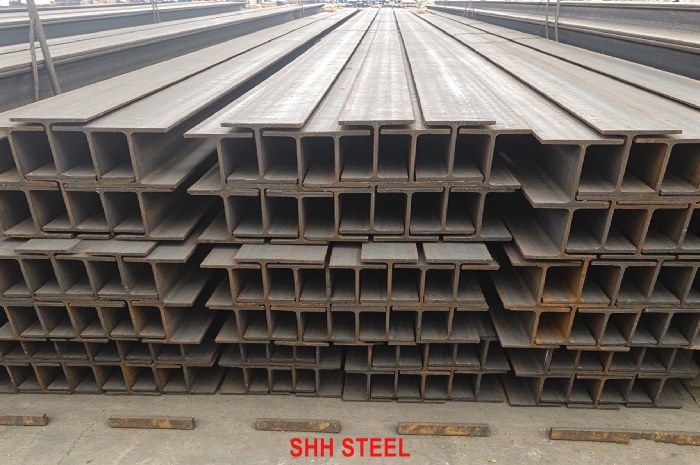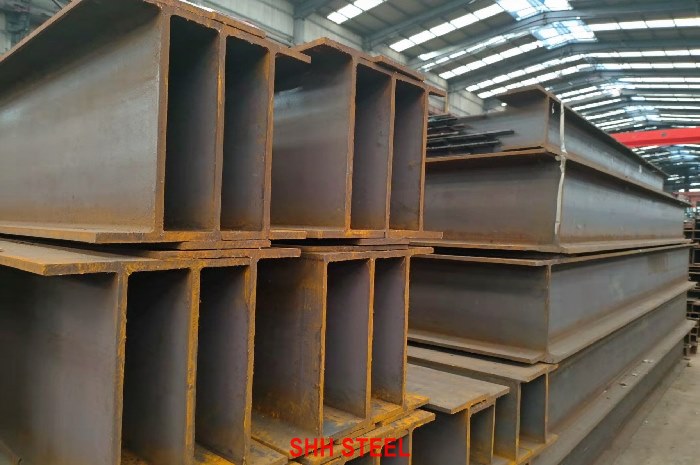
EN 10025-2 S355J0 H-Beam
What is EN 10025-2 S355J0 H-Beam?
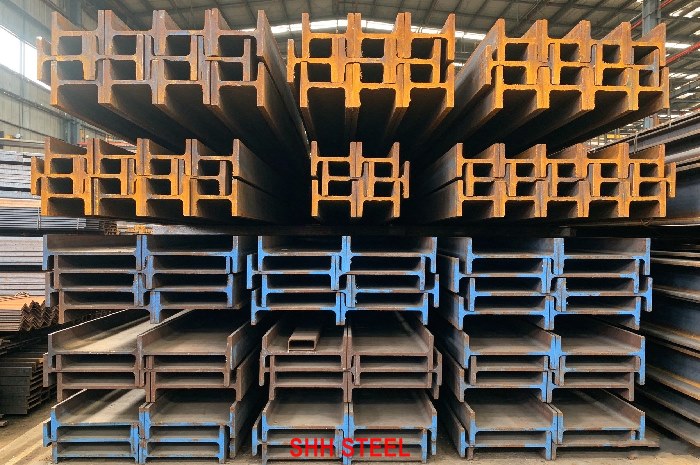
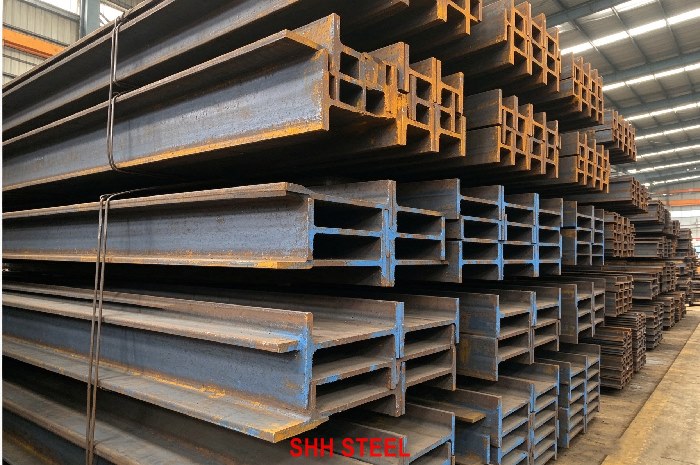
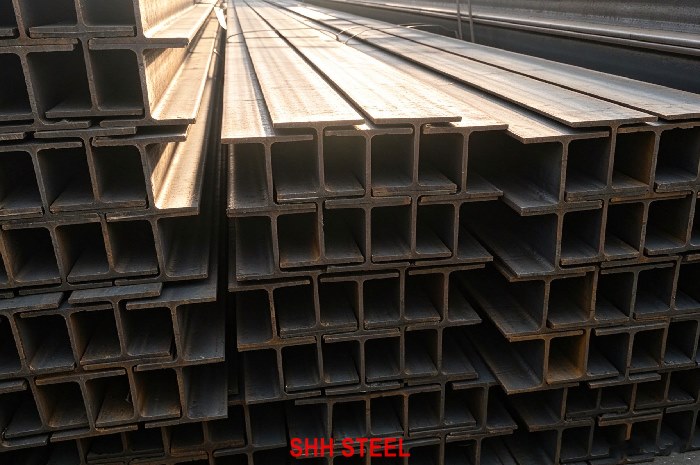
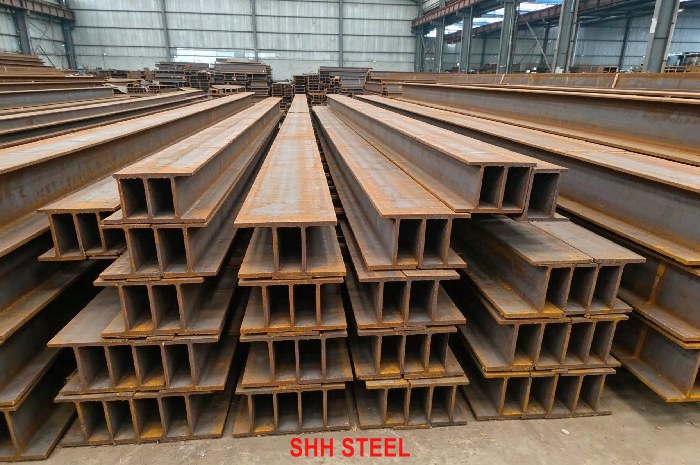
EN 10025-2 S355J0 H-beam is a hot-rolled I or H section in non-alloy structural steel S355J0 (steel number 1.0553). The material standard is EN 10025-2, the size standard is EN 10365, and the tolerance standard is EN 10034. The 355 MPa yield class is the same as S355JR, but the quality letter is not: J0 requires a 27 J Charpy V-notch test at 0 °C, not at +20 °C, and it uses a tighter carbon, phosphorus and sulphur table than JR.
This page is for the rolled section. The same EN 10025-2 grade in plate form is listed separately as EN 10025-2 S355J0 steel plate. Long-product tensile and impact tests are normally longitudinal unless the order says otherwise. Do not use the plate page as a beam data sheet, and do not confuse this grade with the weathering steels S355J0W and S355J0WP under EN 10025-5, which are a different standard.
These beams are filed under EN 10025-2 steel beam profiles in the steel beam profiles category of steel structural profiles. HE A (HEA), HE B (HEB) and IPE are the usual series; HEM, UB or UC may be furnished when specified and certified. The published S355JR H-beam page covers the +20 °C quality in the same yield class, not this 0 °C grade.
S355J0 is used for building and industrial frames when the specification requires a 355 MPa European grade and a 0 °C impact quality. It is not a weathering grade, not a pressure-vessel or nuclear safety material, and not a substitute for S355J2 when −20 °C is what the specification names.
Material, Dimensions and Tolerances for S355J0 Sections
The order and the inspection certificate should keep material, dimensions and tolerances distinct:
- EN 10025-2 is the material standard. This article uses ladle-analysis, carbon-equivalent and tensile values for S355J0 long products from EN 10025-2:2019. The edition named on the order governs acceptance.
- EN 10365 is the dimensional standard for hot-rolled I and H sections. The size tables below are reference dimensions and theoretical masses for the standard HE A, HE B and IPE series, not a mill rolling list.
- EN 10034 is the tolerance standard. Surface condition is commonly specified to EN 10163-3; the class should be confirmed when a tighter finish is required.
A documented special combination — for example S355J0 on a W-shape, or an HEA certified to a different material standard — is only valid if every requirement of each named standard is met. Matching a nominal 300 mm or 12 in depth is not a substitution.
S355J0 H-Beam Sizes: HEA, HEB, IPE, UB and UC Reference Tables
The tables list designation, h, b, tw, tf, r, area and theoretical mass for the standard HE A, HE B and IPE series under EN 10365. Use them to identify and estimate, not as a rolling programme for S355J0. Mid-range sizes are the usual enquiry core; light IPE rows and the HE 900–1000 range should be confirmed size by size.
HE 400 B / HEB 400 is a useful reminder that the number in the name is not a yield value: the section is 400 mm deep with a 24 mm flange, so the S355J0 minimum yield is 345 MPa, not 355 MPa. HE 200 B, with a 15 mm flange, remains in the ≤16 mm band at 355 MPa. IPE 400 is 400 × 180 mm with a 13.5 mm flange, still in that thinner band, and is not an H-section of 400 × 400 mm.
For a governing thickness greater than 100 mm, mechanical values shall be agreed and verified on the order. The 100–150 mm tensile row is the published long-product band; no mechanical limits beyond 150 mm are given here.
HE A (HEA) series
Wide-flange European H-sections, 24 sizes from HE 100 A to HE 1000 A.
Swipe horizontally to view all dimensions.
HE B (HEB) series
Heavier-flange European H-sections, 24 sizes from HE 100 B to HE 1000 B.
Swipe horizontally to view all dimensions.
IPE series
Parallel-flange I-beams, 18 sizes from IPE 80 to IPE 600.
Swipe horizontally to view all dimensions.
Typical mill-programme universal beams (UB) and universal columns (UC) commonly supplied in S355J0 are tabulated below. Designations follow the established EN 10365 / British universal naming (for example UB 610 × 229 × 125). The rows are a commonly supplied standard mill series, not a claim that every official EN 10365:2017 row has been reproduced or that any one mill rolls the full list in S355J0. Historic or additional depths can be reviewed on enquiry; they are not silently added to these tables. Masses are theoretical catalogue figures for identification, estimating and drawing work.
Universal beams (UB)
Swipe horizontally to view all dimensions.
Universal columns (UC)
Swipe horizontally to view all dimensions.
HEM can still be reviewed when it is named on the enquiry; a complete HEM table is not reproduced here. HW/HM/HN belong to GB/T 11263; W-shapes belong to ASTM A572 or ASTM A36 practice, not to these HEA, HEB, IPE, UB or UC rows.
S355J0 Chemical Composition (EN 10025-2 Ladle Analysis)
The figures below are ladle-analysis maxima for S355J0 long products in EN 10025-2:2019. They should not be copied from an S355JR table: JR allows 0.24% carbon and 0.040% phosphorus and sulphur, while J0 uses 0.20/0.22% carbon and 0.035% P and S. They are also not the chemistry of EN 10025-5 weathering grades.
S355J0 Carbon Equivalent
The carbon equivalent is calculated from the ladle analysis by CEV = C + Mn/6 + (Cr + Mo + V)/5 + (Cu + Ni)/15. The EN 10025-2:2019 maxima for S355J0 long products are:
The third band applies to nominal thicknesses greater than 40 mm and not more than 140 mm. For thicknesses above 140 mm, a carbon-equivalent limit is not tabulated here and must be agreed and verified on the order; no value is invented for that range. Clause 7.2.5 of EN 10025-2:2019 addresses special conditions for S355. If that clause is to be used, it should be named on the order; this page does not invent a raised CEV figure from it.
S355J0 Mechanical Properties: Yield, Tensile and 0 °C Impact
Tensile properties of S355J0 follow the same thickness bands as other S355 qualities in EN 10025-2:2019 for long products, with elongation based on L0 = 5.65√S0. For sections with nominal thickness greater than 100 mm, the mechanical values shall be agreed and verified on the order; the 100–150 mm row is the published long-product band and is not an invented extension. No mechanical limits beyond 150 mm are given here. Plate sampling is covered on S355J0 steel plate, not by this table.
What distinguishes J0 is the impact test: 27 J at 0 °C, not at +20 °C. For long products the test is normally longitudinal unless the order specifies otherwise. If the project needs 27 J at −20 °C, the grade to nominate is S355J2, not S355J0. If +20 °C is sufficient, the usual grade is S355JR, with its own chemistry table.
HE 200 B, with a 15 mm flange, remains at 355 MPa. HE 400 B, with a 24 mm flange, is 345 MPa.
Delivery Conditions, Inspection and Identification
S355J0 sections are commonly supplied as-rolled. The inspection document should show EN 10025-2 and its edition, the grade S355J0 (1.0553), the EN 10365 size designation, the EN 10034 edition used for tolerances, the delivery condition, the heat number, ladle analysis, the carbon equivalent, the tensile results, and the 0 °C impact result. A 0 °C test cannot be inferred from a JR certificate.
An EN 10204 type 3.1 document is the usual export request; type 3.2 or nominated third-party attendance can be added when the specification requires it. Identification follows the mill’s marking practice. Length is a matter for the rolling programme and the order, often in the region of 6–15 m.
Weldability and Surface Condition of S355J0 H-Beams
S355J0 is a weldable non-alloy structural steel when thickness, joint design and hydrogen control are taken into account. The CEV table above, including the step from 0.45% to 0.47% above 30 mm, is the starting point. The certificate values and a procedure suited to the thickness are the practical controls. This page does not prescribe a procedure or a preheat chart.
The as-rolled surface is mill scale. Blast, paint or galvanizing is an order option, not something implied by the J0 quality letter. Silicon is limited to 0.55% in this grade, which still needs to be reviewed against a galvanizing specification if a coating is planned. Surface quality for sections is commonly specified to EN 10163-3.
Cutting, weld-end preparation, forming or coating can be reviewed when the specification is sent with the enquiry. They are not assumed for every size.
EN 10034 Shape Tolerances and Theoretical Mass
Dimensional and mass tolerances for these I and H sections are those of EN 10034, not of EN 10025-2. This article does not reproduce the millimetre tolerance tables; acceptance is against the edition named on the order.
A delivered HE 400 B will measure close to 400 × 300 × 13.5 × 24 mm within those tolerances, not as a set of exact advertised millimetres. Out-of-square and web off-centre matter for end-plate connections. Settlement on theoretical or weighed mass should follow the contract.
Applications and Service Limits
S355J0 H-beams are used where a 355 MPa European grade and a 0 °C impact quality are specified:
- Building and industrial frames whose specification names S355J0 rather than S355JR or S355J2.
- Members that need a 0 °C test but do not require the −20 °C J2 quality or a weathering grade.
- Export packages that compare the grade with Q355C or with a 50 ksi American shape, provided each line keeps its own standard and shape system.
It is not specified here for pressure equipment, for nuclear safety-related components, or for structures that actually require EN 10025-5 weathering steel or a −20 °C test. Durability comes from the coating or fire-protection system, not from the J0 letter.
S355J0 Compared with S355JR, S355J2 and Weathering Grades
S355J0, S355JR and S355J2 share the 355 MPa yield class and the usual HEA, HEB and IPE series, but the impact temperature and the chemistry table change with the quality letter. JR is +20 °C with a 0.24% carbon maximum; J0 is 0 °C with 0.20/0.22% carbon and 0.035% P and S; J2 is −20 °C, fully killed, with 0.030% P and S. An enquiry that only says “S355 H-beam” is incomplete.
S355J0W and S355J0WP are EN 10025-5 weathering grades, not this product. ASTM A572 Grade 50 and Q355C are near-equivalents in a 345–355 MPa discussion only if the impact test, chemistry and shape standard are also satisfied. Dual certification requires every requirement of each named standard to be met on the delivered piece.
Near-Equivalents: Not Automatic Substitutes
The comparisons below are for orientation. They are not a licence to substitute one grade for another on a contract or an inspection certificate.
Sister beam pages in this series (S235JR, S275JR, S355J2) will be linked here once they are published. Until then, use the live category and plate links above, and the published S355JR H-beam page for the +20 °C quality in this yield class.
Sourcing S355J0 H-Beams from SHH STEEL
SHH STEEL supplies S355J0 H-beams as an export trading house, coordinating mill production and project procurement. For this grade the useful work is to keep the 0 °C impact quality and the J0 chemistry table from being fulfilled with a JR heat, to distinguish the grade from EN 10025-5 weathering steels, and to align the EN 10365 designation, EN 10034 tolerances and the inspection document before a rolling programme is committed.
Sections can be sourced from mills that SHH STEEL buys from, including Masteel, Rizhao Steel, Laiwu (Shandong Steel Laiwu) and Tung Ho Steel, among others when the programme matches the order. Those mills do not each roll every HEA, HEB or IPE size in S355J0. Mid-range sizes are the usual core; heavier HE rows and uncommon IPE variants are confirmed per line.
The same enquiry can also cover Chinese, American or Japanese designations, provided each line states its material standard, shape standard and size. If cutting, weld-end preparation, forming or a coating system is required, include that specification for review. Export packing and container loading can be arranged to the packing list agreed for the shipment.
S355J0 H-Beam FAQs
-
Is S355J0 the same as S355JR?
- No. Both are 355 MPa EN 10025-2 grades, often rolled as the same HEA, HEB or IPE sections, but J0 is tested at 0 °C and uses a tighter carbon, phosphorus and sulphur table than JR. A JR certificate does not demonstrate the J0 impact test or the J0 chemistry limits.
-
Is S355J0 the same as S355J0W?
- No. S355J0W and S355J0WP are weathering steels under EN 10025-5. They share a similar quality letter and test temperature, but they are a different standard with their own chemistry and corrosion-resisting requirements.
-
Why can the carbon maximum be 0.22% below 40 mm?
- The long-product table gives 0.20% carbon up to 40 mm, with a footnote that for nominal thickness greater than 30 mm the carbon maximum is 0.22%. That footnote applies inside the 16–40 mm band as well as above 40 mm. For thickness greater than 100 mm, carbon is subject to agreement.
-
Is the minimum yield always 355 MPa?
- No. 355 MPa applies only up to 16 mm. HE 400 B has a 24 mm flange, so the minimum yield is 345 MPa. For governing thicknesses greater than 100 mm, the mechanical values shall be agreed and verified on the order.
-
Which standards should appear on the inspection document?
- At least EN 10025-2 and its edition, the grade S355J0 (1.0553), the EN 10365 designation, the EN 10034 edition used for tolerances, the delivery condition, ladle analysis, the carbon equivalent, tensile results by thickness, and the 0 °C impact result.
Request a Quotation for EN 10025-2 S355J0 H-Beam
EN 10025-2 S355J0 H-beam is a non-alloy structural section with 355 MPa minimum yield up to 16 mm and a 27 J impact requirement at 0 °C. Nominate the HEA, HEB or IPE size to EN 10365, the tolerances to EN 10034, and the material to EN 10025-2:2019 (or the edition on the order). The tables are reference dimensions, not a rolling list. Send the size list, edition, certificate type and any processing notes; SHH STEEL will review the package and quote accordingly.
Quality Steel Needed? Inquire for Offers
Related Products