ASTM A213 TP317LM Stainless Steel Tube
What is ASTM A213 TP317LM Stainless Steel Tube
ASTM A213 / A213M covers seamless ferritic and austenitic alloy-steel boiler, superheater, and heat-exchanger tubes. Grade TP317LM / UNS S31725 is the Mo 4–5% step above A213 TP317L: melting carbon is capped at 0.03%, chromium stays at 18.0–20.0%, nickel rises to 13.5–17.5%, molybdenum moves into a 4.0–5.0% band, nitrogen is held at 0.20% maximum, and copper at 0.75% maximum. Table 4 still sets tensile at 75 ksi [515 MPa] / 30 ksi [205 MPa] with elongation 35% minimum and hardness max 192 HBW / 90 HRB — the same room-temperature pair as TP317L, so the intentional change is chemistry, not a higher tensile floor. Buyers who write “317LM HX tube” still need to name A213 on the purchase order so the mill applies the tube product standard together with the Mo 4–5% and higher-Ni checks.
SHH STEEL can supply ASTM A213 TP317LM stainless steel tube as seamless cold-finished and hot-finished product in the usual boiler and heat-exchanger OD × wall / BWG band, shipped with EN 10204 3.1 mill test certificates that report the full ladle chemistry — molybdenum inside 4.0–5.0%, nickel inside 13.5–17.5%, nitrogen and copper at or below their maxima — plus the Table 4 tensile and hardness results. Dual A213 / SA-213 marking is offered only when the purchase order asks for both independent standards. Browse the grade family on the A213/A213M hub.
Commercial shorthand such as 317LM, S31725, or “4–5 Mo HX tube” never replaces the ASTM grade on the MTC or stencil. Sister grades under the same ASTM standard include A213 TP317L, A213 TP317LMN, A213 TP317, A213 TP316L, and A213 UNS S31254. A213 covers seamless tube only — no welded or HCW manufacturing type — so cold-finished versus hot-finished is the process choice.
Chemical Composition of A213 TP317LM
Two chemistry layers matter for TP317LM under ASTM A213. Melting analysis is mandatory for every heat; product analysis on finished tube applies only when Supplementary Requirement wording or the purchase order invokes it through ASTM A1016/A1016M, with tolerances typically from ASTM A480/A480M Table A1.1. Four lines separate this row from TP317L: carbon drops to ≤0.03%; nickel rises to 13.5–17.5%; molybdenum steps into 4.0–5.0%; and nitrogen plus copper appear as explicit maxima (N ≤0.20%, Cu ≤0.75%) instead of ellipses. Chromium remains 18.0–20.0%. A heat that only clears Mo 3.5% and Ni 12% is still a 317L-family story, not TP317LM.
The tables below reproduce the melt limits for TP317LM / UNS S31725, the product-analysis limits from A480 Table A1.1 practice, and a short Mo / Ni / N snapshot against TP317L and TP317LMN. Later A213 editions place austenitic stainless grades in Table 2 (older editions used Table 1); confirm the ordered edition on the purchase order.
Melting analysis (heat / ladle analysis)
| Element | TP317LM (UNS S31725) melting analysis |
|---|---|
| Carbon (C) | ≤ 0.03 |
| Manganese (Mn) | ≤ 2.00 |
| Phosphorus (P) | ≤ 0.045 |
| Sulfur (S) | ≤ 0.030 |
| Silicon (Si) | ≤ 1.00 |
| Chromium (Cr) | 18.0 – 20.0 |
| Nickel (Ni) | 13.5 – 17.5 |
| Molybdenum (Mo) | 4.0 – 5.0 |
| Nitrogen (N) | ≤ 0.20 |
| Copper (Cu) | ≤ 0.75 |
Source: ASTM A213/A213M stainless chemistry table for Grade TP317LM / UNS S31725 (public mill / specification PDF excerpt — _ref_a213.txt / A213–13 table text). Confirm the ordered edition. Nitrogen analysis method is a matter of agreement (Footnote B) when the element is reported.
Product analysis — A480/A480M Table A1.1 tolerances applied
| Element | Melting | Tolerance (A480 A1.1) | Product analysis limit |
|---|---|---|---|
| Carbon (C) | ≤ 0.03 | 0.005 over | ≤ 0.035 |
| Manganese (Mn) | ≤ 2.00 | 0.04 over | ≤ 2.04 |
| Phosphorus (P) | ≤ 0.045 | 0.010 over | ≤ 0.055 |
| Sulfur (S) | ≤ 0.030 | 0.005 over | ≤ 0.035 |
| Silicon (Si) | ≤ 1.00 | 0.05 over | ≤ 1.05 |
| Chromium (Cr) | 18.0 – 20.0 | 0.20 under / over | 17.80 – 20.20 |
| Nickel (Ni) | 13.5 – 17.5 | 0.15 under / 0.20 over | 13.35 – 17.70 |
| Molybdenum (Mo) | 4.0 – 5.0 | 0.10 under / over | 3.90 – 5.10 |
| Nitrogen (N) | ≤ 0.20 | 0.01 over | ≤ 0.21 |
| Copper (Cu) | ≤ 0.75 | 0.03 over | ≤ 0.78 |
Mo / Ni / N snapshot — TP317L / TP317LM / TP317LMN
| Element | TP317L (S31703) | TP317LM (S31725) | TP317LMN (S31726) |
|---|---|---|---|
| C | ≤ 0.035 | ≤ 0.03 | ≤ 0.03 |
| Cr | 18.0 – 20.0 | 18.0 – 20.0 | 17.0 – 20.0 |
| Ni | 11.0 – 15.0 | 13.5 – 17.5 | 13.5 – 17.5 |
| Mo | 3.0 – 4.0 | 4.0 – 5.0 | 4.0 – 5.0 |
| N | … | ≤ 0.20 | 0.10 – 0.20 |
| Cu | … | ≤ 0.75 | ≤ 0.75 |
Read molybdenum and nickel first. A heat at 3.8% Mo fails the 4.0% floor even if carbon and nickel look right. Versus A213 TP317LMN, TP317LM treats nitrogen as a maximum (≤0.20%) rather than a mandatory 0.10–0.20% range, and keeps chromium at 18–20% rather than the wider 17–20% LMN window. Dual TP317LM/TP317L is not a meaningful path: the Mo and Ni bands do not overlap.
When product analysis is ordered, finished tube may read C ≤0.035%, Mn ≤2.04%, P ≤0.055%, S ≤0.035%, Si ≤1.05%, Cr 17.80–20.20%, Ni 13.35–17.70%, Mo 3.90–5.10%, N ≤0.21%, and Cu ≤0.78%. Put any tighter project molybdenum floor on the purchase order before the heat is selected.
Mechanical Properties of A213 TP317LM
ASTM A213 Table 4 sets the tensile acceptance floor for TP317LM / UNS S31725 at 75 ksi [515 MPa] tensile strength and 30 ksi [205 MPa] yield strength (0.2% offset), with elongation of 35% minimum in 2 in. or 50 mm and hardness max 192 HBW / 200 HV or 90 HRB. That is the same room-temperature pair as TP317L — nitrogen here is a maximum, not a strengthening range, so Table 4 does not step up to the 80/35 ksi floor used on mandatory-N sisters such as TP316N. Receiving checklists must not import an 80 ksi expectation from a 317LMN or A240 plate row onto an A213 TP317LM tube heat.
| Property | TP317LM requirement (Table 4) |
|---|---|
| Tensile strength, min | 75 ksi [515 MPa] |
| Yield strength (0.2% offset), min | 30 ksi [205 MPa] |
| Elongation in 2 in. or 50 mm, min | 35% |
| Hardness, max | 192 HBW / 200 HV or 90 HRB |
Source: ASTM A213/A213M Table 4 for UNS S31725 / TP317LM (public specification PDF excerpt — _ref_a213.txt; grade name prints as ellipsis beside S31725 in some OCR layouts). Mechanical property requirements do not apply to tubing smaller than 1/8 in. [3.2 mm] inside diameter or thinner than 0.015 in. [0.4 mm] wall. Flattening and flaring tests are also required on a lot basis.
A tensile-only MTC that omits molybdenum, nickel, or nitrogen is incomplete for TP317LM. When the datasheet also wants a mandatory nitrogen range and the higher tensile floor that often travels with it, open A213 TP317LMN rather than stretching a ≤0.20% N heat into an LMN story.
Dimensions and Tolerances
Dimensional supply for ASTM A213 TP317LM is tube language — OD × wall (minimum or average) and commercially BWG / gauge — not ASME B36.19 pipe schedules as the primary size story. Usual A213 sizes run from about 1/8 in. [3.2 mm] ID to 5 in. [127 mm] OD, with minimum wall about 0.015–0.500 in. [0.4–12.7 mm]; other diameters may be furnished when all other requirements are met. State min versus average wall on the purchase order — boiler and heat-exchanger datasheets almost always assume minimum wall.
OD and wall variations follow ASTM A1016/A1016M as invoked by A213. Cold-finished tubes commonly hold tighter OD control; hot-finished tubes allow wider windows. Confirm the exact A1016 rows for the OD and finish route on the ordered edition.
| Item | Typical A213 TP317LM dimensional practice |
|---|---|
| Product form | Seamless only (cold-finished or hot-finished) |
| Usual size band | ~1/8 in. [3.2 mm] ID to 5 in. [127 mm] OD; wall ~0.015–0.500 in. [0.4–12.7 mm] min (or average wall if PO says so) |
| Wall basis | Minimum wall (default commercial practice) or average wall when specified |
| OD / wall tolerances | Per ASTM A1016/A1016M for the finish route and size |
| Length | Cut lengths for HX / boiler bundles, or mill random lengths by agreement |
| Secondary size note | ASME B36.19 schedules only as a buyer-requested cross-reference — not the primary A213 callout |
Put the cut list, U-bend preference, and end preparation on the enquiry. Minimum wall remains a first-class A213 concept regardless of the Mo 4–5% chemistry.
Equivalent Grades
Equivalence language around 317LM tube often treats it as “317L with a little more Mo” or collapses it with nitrogen-bearing 317LMN. ASTM A213 Grade TP317LM / UNS S31725 is the governing designation for this article; EN and mill nicknames that point to similar Mo 4–5% chemistry families are not automatic substitutes on an A213 MTC.
| Designation | Notes |
|---|---|
| ASTM A213 / A213M Grade TP317LM | Governing ASTM seamless boiler / HX tube product standard for this article |
| UNS S31725 | Unified number in the stainless chemistry table |
| ASME SA-213 TP317LM | Separate ASME Code Book adoption — dual-mark only when the PO asks |
| Related Mo 3–4% L | A213 TP317L — Mo 3–4%, Ni 11–15, N ellipsis |
| Related N-range sister | A213 TP317LMN — Mo 4–5%, N 0.10–0.20, Cr 17–20 |
| Related superaustenitic | A213 UNS S31254 — Mo ~6%, separate UNS row |
| Related plate | A240 / SA240 flat product in the 317LM family — order plate and tube under their own standards |
Dual A213/SA-213 marking is a purchase-order option. Compare TP317L and TP317LMN on their own ASTM A213 pages before swapping Mo 4–5% tube inside an exchanger list.
Heat Treatment and Delivery Condition
TP317LM under ASTM A213 is furnished solution treated at a minimum of 1900 °F [1040 °C], then quenched in water or cooled rapidly by other means. The public heat-treatment table does not print a mandatory ASTM grain-size number for UNS S31725. That heat-treatment row applies to both cold-finished and hot-finished seamless tube. Elevated molybdenum and low carbon improve corrosion framing, but they do not replace the solution anneal.
Cold-finished versus hot-finished is a process and dimensional route, not a substitute for the anneal. Delivery condition for SHH STEEL TP317LM is solution annealed and pickled (or bright annealed by agreement), with anneal temperature, quench method, Mo, Ni, N, and Cu results on the EN 10204 3.1 certificate. Straightening, cutting, and end finishing follow heat treatment.
If a project datasheet asks for ASTM A262 Practice E, put that Supplementary Requirement on the purchase order rather than assuming base A213 includes it. For mandatory nitrogen-range lists with the higher tensile floor that often accompanies them, open A213 TP317LMN instead of stretching a ≤0.20% N heat.
Corrosion Resistance
TP317LM’s defining corrosion claim versus TP317L is the Mo 4.0–5.0% band paired with higher nickel (13.5–17.5%) and a low-carbon ceiling — a chemistry aimed at more aggressive chloride-leaning aqueous and acid-chloride services where Mo 3–4% is judged short. Nitrogen at ≤0.20% and copper at ≤0.75% are part of the grade row but are maxima, not the mandatory nitrogen strengthening range that defines TP317LMN. It is still not a duplex or 6% Mo superaustenitic substitute such as A213 UNS S31254.
ASTM A213 itself does not publish a corrosion-rate or PREN table for TP317LM; selection remains engineering judgment against fluid, temperature, velocity, and inspection philosophy. When a specification calls for ASTM A262 Practice E, write that Supplementary Requirement onto the purchase order so the test is contractual. SHH STEEL will not claim TP317LM equals S31254 in severe brine — those are separate grade rows.
Applications of A213 TP317LM Tube
Because TP317LM steps molybdenum into the 4–5% band with higher nickel and low carbon, it shows up in process heat exchangers and condensers where Mo 3–4% 317L is judged insufficient, chemical and pulp bleach circuits that historically named 317LM, and chloride-acid services that still sit inside austenitic selection rather than duplex or 6Mo. The table below pairs typical application areas with a selection note.
| Application area | Typical use of TP317LM tube | Selection note |
|---|---|---|
| Mo 4–5% process HX | Straight and U-bend tubes when Mo ≥4.0% is named | Confirm Mo floor and Ni 13.5–17.5% on MTC |
| Chloride-acid condensers | When TP317L Mo band is judged short | Still not a 6Mo / duplex substitute |
| Mandatory N-range lists | Usually prefer TP317LMN rather than TP317LM | N ≤0.20% max is not a 0.10–0.20% range |
| Mo 3–4% sufficient | Stay on TP317L / TP317 | Do not over-specify LM for ordinary 317L Mo lists |
| 6Mo superaustenitic | Open UNS S31254 on the same hub | Different Mo / N / Cu rows |
For Mo 3–4% L-grade open A213 TP317L; for mandatory N 0.10–0.20% open A213 TP317LMN; browse the rest on the A213/A213M hub.
Weldability
TP317LM tube welds with matching or overalloyed austenitic / nickel-base filler for tube-to-tubesheet joints so weld-metal molybdenum tracks or exceeds the 4–5% base-metal band. Common practice uses higher-Mo austenitic filler or Alloy 625-class overalloyed wire under a qualified WPS when the corrosion review will not accept a Mo step-down in the deposit. Heat input control, interpass limits, and post-weld cleaning remain the fabricator’s responsibility — A213 governs the seamless tube product, not the field or shop weld procedure.
Because A213 TP317LM is seamless, there is no mill longitudinal weld to radiograph the way welded pipe standards describe. Focus inspection language on tube integrity (hydro or NDE of each length), tube-to-tubesheet joint quality, and any contractual corrosion test on the base metal. If PREN after welding still falls short, changing the base metal to A213 TP317LMN or A213 UNS S31254 is usually a better move than relying on filler selection alone.
Surface Finishes
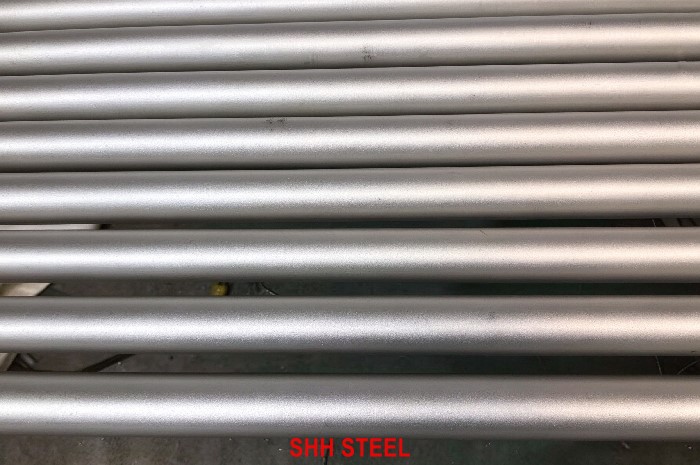
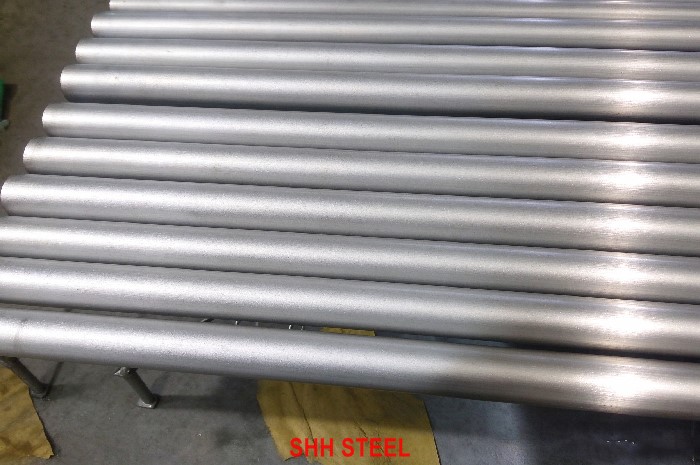
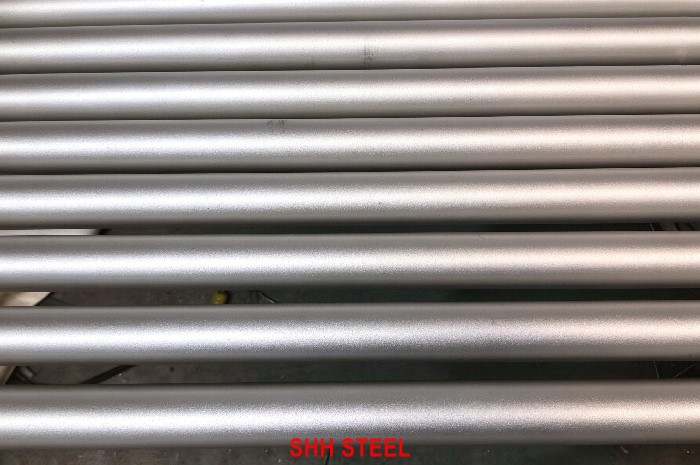
Standard mill delivery for ASTM A213 TP317LM is solution annealed and pickled, leaving a clean matte finish suitable for most boiler and heat-exchanger tube duty. Bright annealing under protective atmosphere produces a smoother reflective surface used on some clean-process lines and must be called out because it changes the heat-treatment route. Light polish or specified Ra on the bore or OD is a commercial operation on top of A213 product, not automatic with the grade stamp.
When a fouling-sensitive exchanger specification quotes an Ra maximum on the bore, put it on the tube purchase order with its own acceptance language. SHH STEEL stencils grade and heat treatment as standard requirements; polish and passivation after fabrication remain commercial extras unless the contract says otherwise. End preparation should be ordered together with finish so receiving inspection shares one acceptance language.
Inspection and Testing
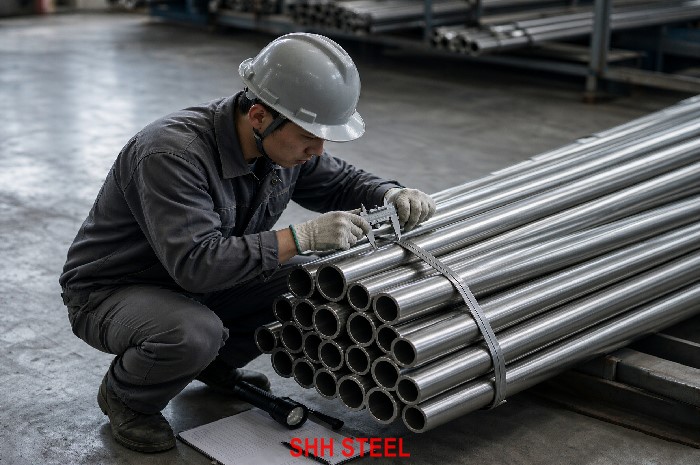
Lot testing for ASTM A213 TP317LM follows tension, hardness, flattening, and flaring under A213 / A1016. Chemistry verification must include carbon ≤0.03%, molybdenum 4.0–5.0%, nickel 13.5–17.5%, nitrogen ≤0.20%, and copper ≤0.75%. Tensile reporting must use the Table 4 75/30 ksi pair and 35% elongation — not an imported 80 ksi LMN or plate checklist. NDE follows the ordered edition — hydrostatic testing or non-destructive electric testing of each length is the usual A213 path unless the purchase order states otherwise.
EN 10204 3.1 certificates from SHH STEEL report ladle chemistry with Mo, Ni, N, and Cu, Table 4 tensile / yield / 35% elongation / hardness, and heat-treatment condition. When A262 Practice E is ordered, those results appear as specified. A certificate missing molybdenum or nickel is not a complete TP317LM release package.
Packaging and Shipping
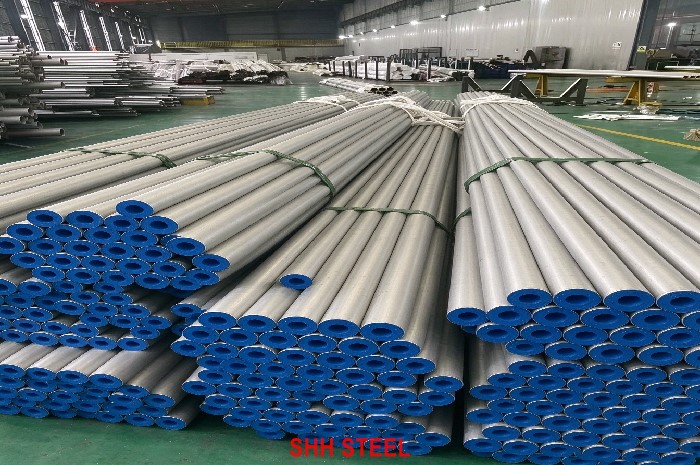
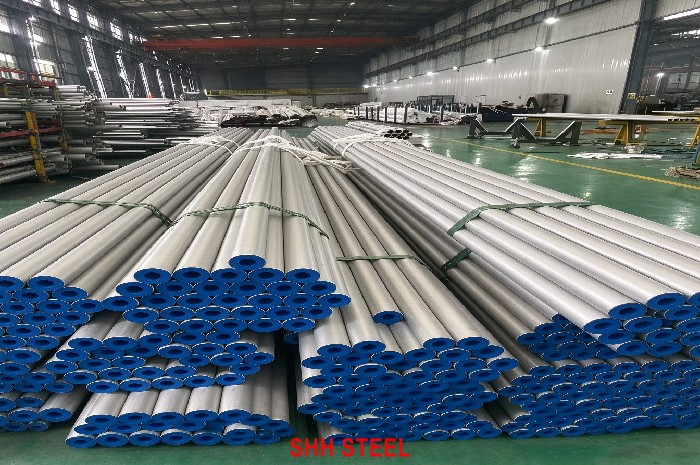
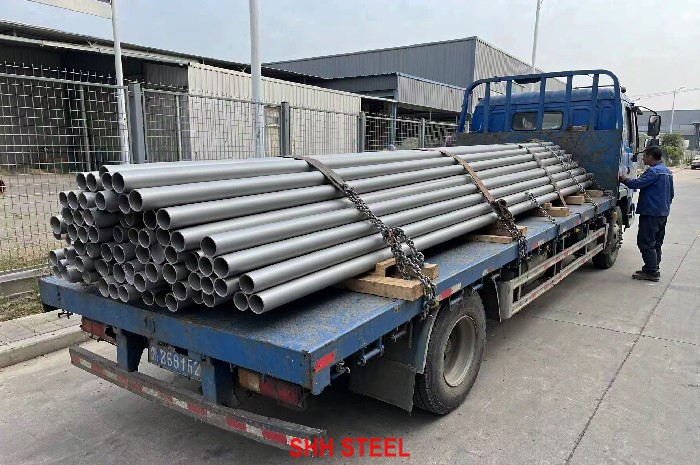
TP317LM tubes ship in capped or plugged bundles with weather protection matched to the route. Cut lengths for boiler and exchanger bundles are labeled by heat and size; export packing uses cases or steel-frame crates when required.
Marking includes ASTM A213, grade TP317LM / UNS S31725, size, heat number, and SHH STEEL identification. Dual SA-213 marking appears only when the purchase order requests it. Packing lists track the same heat numbers shown on the EN 10204 3.1 certificates so the Mo 4–5% and higher-Ni results stay tied to the shipped lengths.
Why Choose SHH STEEL
SHH STEEL treats ASTM A213 TP317LM as a Mo 4–5% specification product: C ≤0.03%, Mo 4.0–5.0%, Ni 13.5–17.5%, N ≤0.20%, Cu ≤0.75%, and Table 4 75/30 ksi with 35% elongation are checked together before a heat is offered. Quotations state OD × wall / BWG, wall basis, finish route, A262 options, and whether dual A213/SA-213 marking is required.
We refuse nickname assemblies that stamp TP317L as 317LM without clearing the 4.0% molybdenum floor and the higher nickel band, or that confuse N ≤0.20% max with the mandatory N 0.10–0.20% range on TP317LMN. EN 10204 3.1 documentation includes Mo, Ni, N, and Cu. Compare sisters on the A213/A213M hub before freezing the exchanger tube list.
Supply Capability
SHH STEEL supplies ASTM A213 TP317LM seamless stainless steel tube in cold-finished and hot-finished routes across the usual boiler, superheater, and heat-exchanger OD × wall / BWG band. Capability below is an enquiry range — not a frozen warehouse SKU or tonnage claim.
| Capability | SHH STEEL practice for TP317LM |
|---|---|
| Product form | Seamless cold-finished and hot-finished tube |
| Standards | ASTM A213 / A213M; dual SA-213 when PO asks |
| Size band | Typical within ~1/8 in. ID to 5 in. OD; other diameters by agreement |
| Wall basis | Minimum wall or average wall as specified |
| Documentation | EN 10204 3.1 MTC with Mo 4–5% + Ni 13.5–17.5% + N/Cu; A262 / third-party witness on request |
| Trade terms | FOB / CFR / CIF / EXW and other agreed Incoterms |
Stock / Available sizes
SHH STEEL quotes TP317LM against a stock-and-mill enquiry range rather than a frozen SKU/tonnage list. Representative OD × wall / BWG combinations for boiler and heat-exchanger tube appear below.
| Item | Typical stock / enquiry range for TP317LM |
|---|---|
| Outside diameter | 19.05, 25.4, 31.8, 38.1, 42.4, 50.8, 60.3, 76.2 mm (and other boiler/HX ODs on enquiry; through the usual A213 ~5 in. [127 mm] band) |
| Wall / BWG | BWG 10–18 class walls and metric min-wall equivalents; heavier walls by agreement |
| Common OD × wall examples | 25.4 × 2.11 mm; 31.8 × 2.77 mm; 38.1 × 2.77 mm; 42.4 × 3.56 mm; 50.8 × 3.05 mm; 60.3 × 3.91 mm — illustrative, confirm min vs average wall |
| Length | Cut lengths for boiler / exchanger bundles; bends and random mill lengths on enquiry |
| Special | Non-standard OD/wall, bright anneal, dual A213/SA-213, A262 Practice E, third-party witness — confirm before heat reservation |
Send OD × wall (or BWG), wall basis, finish route, quantity or cut list, marking (A213 or dual A213/SA-213), and Mo / Ni / N / A262 notes on one enquiry. We confirm C ≤0.03%, Cr 18–20% / Ni 13.5–17.5%, Mo 4.0–5.0%, N ≤0.20%, Cu ≤0.75%, and Table 4 75/30 ksi without inventing fake warehouse codes. Sisters A213 TP317L, A213 TP317LMN, and A213 UNS S31254 sit on the same hub.
FAQ
-
Is ASTM A213 the same as ASME SA-213 for TP317LM?
- No. ASTM A213 / A213M is the ASTM International product specification for seamless boiler, superheater, and heat-exchanger tubes; ASME SA-213 / SA-213M is the separate ASME Code Book adoption. Dual-mark only when the purchase order asks for both names on the stencil and MTC. Chemistry and tensile floors align closely for a given referenced edition, but the standards remain independent documents.
-
Does ASTM A213 TP317LM include welded or HCW tube?
- No. ASTM A213 covers seamless boiler, superheater, and heat-exchanger tubes only. There is no WLD or HCW manufacturing-type letter under A213. Cold-finished versus hot-finished describes the seamless process route and dimensional tolerances — not a welded product form. Order welded stainless pipe under a different product standard when that form is required.
-
What is the chemistry of ASTM A213 TP317LM?
- Melting analysis for TP317LM / UNS S31725 is C ≤0.03%, Mn ≤2.00%, P ≤0.045%, S ≤0.030%, Si ≤1.00%, Cr 18.0–20.0%, Ni 13.5–17.5%, Mo 4.0–5.0%, N ≤0.20%, and Cu ≤0.75%. Confirm the ordered A213 edition. Molybdenum’s 4.0% floor and the 13.5–17.5% nickel band are mandatory — a 3.8% Mo heat is still a 317L-family story, not TP317LM.
-
TP317LM vs TP317L — why step to Mo 4–5%?
- TP317L uses Mo 3.0–4.0%, Ni 11–15, N as an ellipsis, and C ≤0.035%. TP317LM raises Mo to 4.0–5.0%, Ni to 13.5–17.5%, adds N ≤0.20% and Cu ≤0.75%, and tightens carbon to ≤0.03%, while keeping the same Table 4 75/30 ksi and 35% elongation pair. Order TP317LM when the datasheet names the Mo 4–5% band; stay on TP317L when Mo 3–4% is sufficient.
-
TP317LM vs TP317LMN — what does the N letter change?
- Both share Mo 4–5%, Ni 13.5–17.5%, C ≤0.03%, and Cu ≤0.75%. TP317LM treats nitrogen as a maximum (≤0.20%) and keeps Cr 18–20%. TP317LMN requires nitrogen in a 0.10–0.20% range, widens chromium to 17–20%, and typically carries a higher tensile floor on tube and plate listings. Do not treat "LM" and "LMN" as interchangeable nicknames on the MTC.
-
Does Table 4 set a hardness limit for TP317LM?
- Yes. Table 4 for UNS S31725 lists hardness maximum 192 HBW / 200 HV or 90 HRB with 75 ksi tensile, 30 ksi yield, and 35% elongation. Hardness, molybdenum floor, nickel band, and nitrogen maximum all belong on the release package — none replaces the others for 317LM boiler or HX tube.
-
What heat treatment does A213 require for TP317LM?
- Solution treatment at a minimum of 1900 °F [1040 °C], water quench or other rapid cool. Delivery is solution annealed and pickled unless bright anneal is agreed. No mandatory ASTM grain-size number appears for UNS S31725 in the public heat-treatment table. Put A262 Practice E on the purchase order when IGC demonstration is contractual.
-
Minimum wall vs average wall for A213 TP317LM — which should I specify?
- Boiler and heat-exchanger datasheets almost always expect minimum wall. Average wall is allowed when the purchase order says so, with A1016/A1016M tolerances for that basis. State wall basis on the enquiry rather than relying on pipe schedule numbers as the primary A213 wall story.
-
Can I dual-certify TP317LM with TP317L on the same heat?
- No in any practical sense: the molybdenum bands do not overlap (TP317L max 4.0% versus TP317LM min 4.0% is a knife-edge that still leaves nickel mismatched — TP317LM needs Ni 13.5–17.5, not 11–15). Order the grade the datasheet names rather than forcing a dual from a PMI gun that only reads "about 4 Mo."
-
Why is tensile still 75/30 ksi on TP317LM instead of 80/35?
- ASTM A213 Table 4 for UNS S31725 prints 75/30 ksi with 35% elongation — the same room-temperature pair as TP317L — because nitrogen on TP317LM is a maximum, not a mandatory strengthening range. Receiving checklists copied from TP317LMN or A240 plate rows often expect 80/35 and incorrectly reject a heat that clears 75/30. Use the S31725 row on the ordered edition.
-
When should I step from TP317LM to UNS S31254?
- When the datasheet names approximately 6% molybdenum with the matching N and Cu bands of UNS S31254, not when a buyer simply wants "more Mo than 317L." TP317LM stops at Mo 4.0–5.0%. Open the S31254 page on the A213/A213M hub when that chemistry is required — it is a separate UNS row, not a nickname upgrade of TP317LM.
-
Does A213 require copper reporting on TP317LM?
- Yes. The stainless chemistry table lists Cu ≤0.75% for TP317LM / UNS S31725, so copper belongs on the ladle analysis and the EN 10204 3.1 certificate with molybdenum, nickel, and nitrogen. A certificate that only shows Cr–Ni–Mo without Cu (and N) is incomplete documentation practice for this grade row.
Conclusion
ASTM A213 TP317LM / UNS S31725 is the low-carbon Mo 4–5% seamless stainless steel tube for boiler, superheater, and heat-exchanger service when Mo 4.0–5.0% with Ni 13.5–17.5%, N ≤0.20%, and Cu ≤0.75% must sit above the TP317L Mo band. SHH STEEL supplies cold-finished and hot-finished seamless tube in the usual OD × wall / BWG band, solution annealed at 1900 °F [1040 °C], tested to Table 4 75/30 ksi, 35% elongation, and hardness limits, with Mo, Ni, N, and Cu reported on EN 10204 3.1 certificates — dual SA-213 marking only when the purchase order asks.
Contact: admin@steelspecs.com
Quality Steel Needed? Inquire for Offers
Related Products