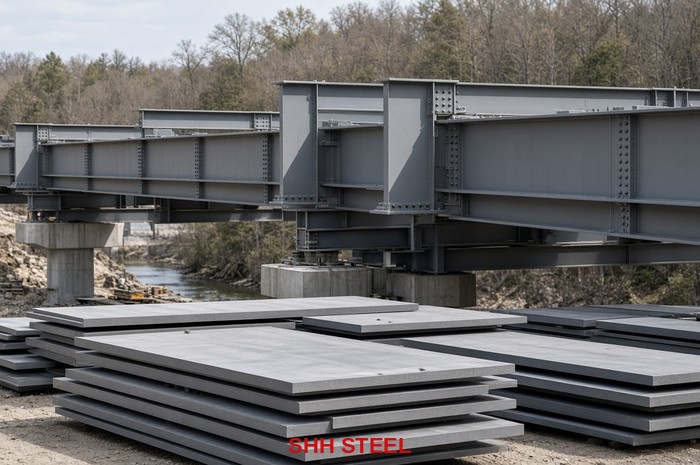
GB/T 714 Q370qNHF Weathering Bridge Steel Supplier
What is GB/T 714 Q370qNHF Weathering Bridge Steel?
Q370qNHF is weathering bridge structural steel to GB/T 714. In the standard’s own notation it is written Q370qFNH: Q for yield, 370 for the minimum yield in MPa, q for qiao (bridge), the quality letter, and NH for nai hou, weathering. The letter F means Charpy V-notch testing at −60°C.
Q370qNH is weathering plate for unpainted railway and highway bridges that need 370 MPa yield. Q370qNH shares the Q345qNH chemistry box and Pcm cap (≤0.22% to 50 mm) but proves 370 MPa yield and 510 MPa tensile. Fabricators qualified on Q345qNH move across with no change of consumables.
Q370qNHF (Q370qFNH) was defined in GB/T 714-2015. In the 2025 edition the Q370qNH level carries C, D and E only, so −60°C weathering plate at 370 MPa is now an agreed special requirement.
GB/T 714-2025 was published on 31 October 2025 and took effect on 1 May 2026. It replaces GB/T 714-2015 completely. The 2015 edition listed every weathering level in D, E and F; the 2025 edition lists Q345qNH, Q370qNH and Q390qNH in C, D and E, and keeps F only from Q420qNH upward.
SHH STEEL (Shanghai Shenghonghe Import & Export Co., Ltd.) is a steel manufacturer and exporter and global steel mill sourcing partner, mill-direct, China origin. We ship Q370qNHF cut to size with an EN 10204 3.1 or 3.2 certificate. Sister grades are listed under GB/T 714; other unpainted options are under weathering steel plates and EN 10025-5.
Material Specification
| Specification element | Requirement | SHH STEEL compliance |
|---|---|---|
| Standard | GB/T 714-2015 Q370qFNH, or GB/T 714-2025 Q370qENH + agreed −60°C test | Confirmed |
| Product | Single-rolled plate ≤150 mm; hot-rolled strip and cut plate ≤25.4 mm | Plate |
| Thickness with tensile values | Up to 150 mm for Q370qNH | Confirmed |
| Minimum yield ReL | 370 MPa ≤50 mm; 360 MPa >50–100 mm | Confirmed |
| Minimum tensile Rm | 510 MPa ≤100 mm (no upper limit in the standard) | Confirmed |
| Elongation A | ≥ 20% | Confirmed |
| Charpy V-notch | −60°C, energy agreed in the order, longitudinal | Confirmed |
| Weathering index | I ≥ 6.0 (Table 5, footnote c) | Calculated on MTC |
| Delivery condition | TMCP or TMCP + tempering | As ordered |
| Weldability index | Pcm (Table 8) | Printed on MTC |
| Ultrasonic testing | Plate >20 mm: GB/T 2970, Class II or better | Every plate |
| Through-thickness | Z15, Z25 or Z35 to GB/T 5313, when ordered | As ordered |
| Dimensions | GB/T 709 | Confirmed |
| Certificate | GB/T 247; EN 10204 3.1 or 3.2 | As ordered |
Grades often compared with Q370qNHF are ASTM A709 Grade 50W, ASTM A709 HPS 50W and EN 10025-5 S355K2W; the comparison below shows where they differ.
Chemical Composition: Heat Analysis and Product Analysis
For Q370qNHF we report heat analysis on every certificate and add a product analysis when the buyer asks for it. The two use different limits: heat values follow GB/T 714, product values add the GB/T 222 deviations.
Table 1 below is the heat (ladle) analysis for Q370qNHF from GB/T 714-2025 Tables 1, 5.
| Element | Q370qNHF heat analysis (%) | Note |
|---|---|---|
| C, max | 0.11 | |
| Si | 0.15 – 0.50 | Counts in I |
| Mn | 1.10 – 1.50 | Min 0.50% for coil only |
| P, max | 0.015 | Letter F |
| S, max | 0.006 | Letter F |
| Cu | 0.25 – 0.50 | Main weathering element |
| Cr | 0.40 – 0.70 | Weathering element |
| Ni | 0.30 – 0.40 | Weathering element |
| Mo, max | 0.20 | Changed in 2025 |
| Nb | 0.010 – 0.100 | Microalloy (see note) |
| V | 0.010 – 0.100 | Microalloy (see note) |
| Ti | 0.006 – 0.030 | Microalloy (see note) |
| Als | 0.015 – 0.050 | Alt 0.020–0.055% if total Al is used |
| N, max | 0.0080 | |
| B, max (residual) | 0.0005 | ≤0.0014% if C ≤0.06% |
| H, max (residual) | 0.0002 | |
| Weathering index I | ≥ 6.0 | Calculated from heat analysis |
Nb, V, Ti and Al may be added singly or together. Added singly, each must meet the range above; added together, at least one must reach its minimum and Nb + V + Ti ≤ 0.22%. Calcium treatment is required to control sulfide shape.
Table 2 is the product analysis: the limits a check analysis on finished plate is judged against. GB/T 714-2025 clause 7.1.3 calls up GB/T 222 for the permitted deviations.
| Element | Heat limit (%) | Deviation, GB/T 222-2025 Table 1 | Q370qNHF product analysis (%) |
|---|---|---|---|
| C | ≤ 0.11 | +0.02 | ≤ 0.13 |
| Si | 0.15 – 0.50 | ±0.05 | 0.10 – 0.55 |
| Mn | 1.10 – 1.50 | ±0.06 | 1.04 – 1.56 |
| P | ≤ 0.015 | +0.005 | ≤ 0.020 |
| S | ≤ 0.006 | +0.005 | ≤ 0.011 |
| V | 0.010 – 0.100 | +0.02 / −0.01 | ≤ 0.120 |
| Ti | 0.006 – 0.030 | +0.02 / −0.01 | ≤ 0.050 |
| Nb | 0.010 – 0.100 | ±0.005 (listed for 0.015–0.060%) | Above 0.060%: agree in contract |
| Cu | 0.25 – 0.50 | ±0.05 | 0.20 – 0.55 |
| Cr | 0.40 – 0.70 | ±0.05 | 0.35 – 0.75 |
| Ni | 0.30 – 0.40 | ±0.05 | 0.25 – 0.45 |
| Als | 0.015 – 0.050 | ±0.003 | Lower limit −0.003 (Table 1 row is for Al ≥0.015%; confirm) |
| Mo | ≤ 0.20 | Not listed in Table 1 | Agree in contract |
| N | ≤ 0.0080 | Listed only for 0.010–0.020% | Agree in contract |
How to read Table 2. Weathering bridge steel is normally classed as low-alloy steel, so Table 1 of GB/T 222 applies. Where the heat limit is a range, the deviation applies to both ends; for one heat, an element may deviate in one direction only.
Mechanical Properties
Tensile values follow Table 9 of GB/T 714-2025 for Q370qNH. Tensile specimens are transverse; round specimens are used above 40 mm. Where yield is not distinct, Rp0.2 replaces ReL.
| Nominal thickness | ReL min (MPa) | Rm min (MPa) | A min |
|---|---|---|---|
| ≤ 50 mm | 370 | 510 | 20% |
| > 50 – 100 mm | 360 | 510 | 20% |
| > 100 – 130 mm | 320 | 430 | 20% |
| > 130 – 150 mm | 320 | 430 | 20% |
Impact values follow Table 10, on longitudinal specimens, average of three:
| Letter / test temperature | KV2 ≤12 mm | KV2 >12 – 100 mm | KV2 >100 – 150 mm |
|---|---|---|---|
| F / −60°C | By agreement | by agreement | Not applicable |
One single value may fall below the required average, but not below 70% of it. Plate over 8 mm and under 12 mm is tested with 7.5 mm specimens (75% of the value); 6–8 mm plate with 5 mm specimens (50%). Plate under 6 mm is not impact tested.
180° bend test, transverse: mandrel D = 2a up to 16 mm and 3a above 16 mm; may be omitted when the mill guarantees it. Yield ratio is not mandatory. If the contract asks for it, Annex C recommends ReL/Rm ≤ 0.88 up to 12 mm and ≤ 0.85 above 12 mm for TMCP plate.
Q370qNHC / Q370qNHD / Q370qNHE: Which Quality Grade?
Q370qNHF was tested at −60°C under GB/T 714-2015. In the 2025 tables the Q370qNH level stops at E (−40°C); the table shows what is listed today.
| Grade | Test temp. | KV2 ≤12 mm | KV2 12–100 mm | KV2 >100 mm | P / S max (%) |
|---|---|---|---|---|---|
| Q370qNHC | 0°C | 80 J | 120 J | 55 J | 0.030 / 0.025 |
| Q370qNHD | −20°C | 80 J | 120 J | 47 J | 0.025 / 0.015 |
| Q370qNHE | −40°C | 80 J | 120 J | 31 J | 0.020 / 0.010 |
| Q370qNHF | −60°C | 2015 edition only | 2015 edition only | — | 0.015 / 0.006 (2025 Table 1, F) |
For Q370qNHF the 2025 table stops at E. A −60°C requirement can still be met: by certifying to the 2015 edition where the contract allows, or by ordering Q370qENH with a supplementary −60°C test and an agreed energy. Where higher strength is acceptable, Q420qNHF is a listed −60°C weathering grade.
Q370qNHF: What Changed from GB/T 714-2015 to GB/T 714-2025
Q370qNHF is the case where the edition matters most: the letter itself is not in the 2025 tables. The points below come from the foreword and tables of GB/T 714-2025.
- The weathering requirement changed: Table 5 now requires a corrosion index I ≥ 6.0, and the 2015 Annex C guide for assessing weathering resistance was deleted.
- A Pcm table for weathering steel (Table 8) was added.
- Annex A now gives reference bridge-site environments for unpainted use (chloride, SO₂ and time-of-wetness limits).
- Mo maximum for Q370qNH was changed (now ≤0.20%; 2015-based sources quote ≤0.10%).
- Q370qNH is now listed in letters C, D and E. The 2015 edition listed it in D, E and F.
- Yield values above 100 mm were added for Q370qNH (320 MPa for >100–130 mm).
- Tensile strength is now banded by thickness (e.g. lower minimum Rm above 100 mm) instead of one value.
- Impact energy is set by thickness band (≤12 mm, 12–100 mm, >100 mm) in Table 10.
- Yield ratio is no longer a clause value; it is agreed in the contract, with recommendations in informative Annex C.
If a drawing cites 2015 and the plate is made to 2025, get the designer’s written acceptance; tensile strength above 100 mm and the yield-ratio basis differ.
Q370qNHF vs ASTM A709 and EN 10025: Which Grade Matches?
Can Q370qNHF replace a US or European bridge grade, or the other way round? Strength can match; toughness rules differ in kind, not only in number.
| Property | Q370qNHF | ASTM A709 Grade 50W | ASTM A709 HPS 50W | EN 10025-5 S355K2W |
|---|---|---|---|---|
| Min. yield (MPa) | 370 (≤50 mm) | 345 | 345 | 355 (≤16 mm) |
| Tensile (MPa) | 510 min | 485 min | 485 min | 470 – 630 |
| Charpy | by agreement at −60°C (12–100 mm) | CVN by temperature zone and member type (T / F) | CVN by temperature zone; fracture-critical (F) levels | 40 J at −20°C |
| Weathering chemistry | Yes, I ≥ 6.0 | Yes | Yes | Yes |
ASTM A709 sets Charpy requirements by temperature zone (1, 2, 3) and by member type: non-fracture-critical (T) or fracture-critical (F). GB/T 714 sets one value per letter, so compare the A709 zone with the GB/T 714 test temperature, not grade with grade.
EN 10025-5 weathering grades are general structural steels without a bridge-specific toughness level of 120 J; they suit many bridges but are not a one-to-one match.
At −60°C, the by agreement required for Q370qNHF is a demanding figure; general structural grades rarely prove any toughness that cold. For the C, D and E letters GB/T 714 asks 120 J, several times the 27–40 J typical of GB/T 1591 plate.
Q370qNHF Atmospheric Corrosion Index I and Unpainted Bridges
GB/T 714-2025 Table 5, footnote c, requires every Q370qNHF heat to reach an atmospheric corrosion index I of at least 6.0, calculated from the heat analysis:
I = 26.01(%Cu) + 3.88(%Ni) + 1.20(%Cr) + 1.49(%Si) + 17.28(%P) − 7.29(%Cu)(%Ni) − 9.10(%Ni)(%P) − 33.39(%Cu)²
This is the same predictive formula used with ASTM G101 for ASTM A709 Grade 50W and ASTM A709 HPS 70W, which makes Chinese and US ASTM A709 weathering steel plates easy to compare with Q370qNHF.
| Worked example (our calculation) | Cu | Ni | Cr | Si | P | I |
|---|---|---|---|---|---|---|
| All weathering elements at their Table 5 minimum | 0.25 | 0.30 | 0.40 | 0.15 | 0.010 | 5.88 |
| Illustrative mid-range heat | 0.32 | 0.36 | 0.55 | 0.30 | 0.012 | 6.74 |
Note the first row: a heat that only just meets every Table 5 minimum can still fall short of I = 6.0. That is why we ask the mill to print I on every Q370qNHF certificate, not just the chemistry.
Where can the steel be left unpainted? Annex A of GB/T 714-2025 gives reference bridge-site conditions:
- Rural or urban atmosphere with annual chloride deposition ≤ 3 mg/(m²·d)
- Annual SO₂ deposition ≤ 24 mg/(m²·d)
- Time of wetness ≤ 5,256 h per year (temperature above 0°C and relative humidity above 80%)
- Coastal sites only if they meet the same limits; for marine atmospheres Annex D points to T/CISA 073
Detailing decides whether unpainted Q370qNHF works. Avoid ledges that hold water, seal box girders or ventilate them, keep deck joints watertight, and protect piers from rust run-off in the first years while the patina forms.
Welding Q370qNHF and Fatigue in Bridge Girders
GB/T 714-2025 clause 7.1.2 uses CEV for normalized, QT and TMCP steel with C >0.12%, and Pcm for weathering steel and TMCP steel with C ≤0.12%, both from the heat analysis:
CEV = C + Mn/6 + (Cr + Mo + V)/5 + (Ni + Cu)/15
Pcm = C + Si/30 + Mn/20 + Cu/20 + Ni/60 + Cr/20 + Mo/15 + V/10 + 5B
| Index | ≤50 mm | >50–100 mm | >100–130 mm |
|---|---|---|---|
| Pcm, Q370qNH (Table 8) | ≤ 0.22 | ≤ 0.24 | By agreement |
Preheat for Q370qNHF is set by the qualified welding procedure, from the actual index on the certificate, plate thickness, restraint and hydrogen level. Lower actual values than the table caps save preheat time on large girders. At −60°C, both weld metal and HAZ must prove toughness. Expect lower heat input, more passes and consumables qualified at −60°C.
Typical consumables for Q370qNHF: weathering-matched Ni-Cu consumables (AWS E8018-W2 type for 345–420 MPa), with higher-strength weathering wires for 460–500 MPa.
Fatigue. Welded details govern fatigue life in a bridge, and their fatigue strength is set by detail category, not by yield strength. Higher-strength plate can carry higher stress ranges only if detailing improves too.
Fatigue design follows JTG D64 (highway) and TB 10091 (railway) in China, EN 1993-1-9 in Europe and AASHTO LRFD in the US; fabrication commonly follows TB 10212, JTG/T 3650 or AWS D1.5.
Q370qFNHZ15, Z25 and Z35: Through-Thickness Plate for Bridges
On long-span bridges, Z25 or Z35 is common on node plates and anchor zones. The extra cost is in desulfurization, testing and a higher reject rate.
GB/T 714 adds the Z level to the end of the designation, for example Q370qFNHZ25. The test and acceptance follow GB/T 5313 and apply to plate 15 mm and thicker.
| Z grade | Heat sulfur, max (%) | Reduction of area, avg / single (%) |
|---|---|---|
| Z15 | 0.010 | 15 / 10 |
| Z25 | 0.007 | 25 / 15 |
| Z35 | 0.005 | 35 / 25 |
F chemistry limits S to 0.006%, which already meets the Z25 sulfur cap (0.007%). Only Z35 (S ≤0.005%) needs a further step.
Most bridges need Z on a small share of the tonnage. Mark it item by item on the cutting list rather than on the whole Q370qNHF order. Z options apply across the GB/T 714 bridge steel range.
Equivalent Material Grades
Annex B of GB/T 714-2025 lists foreign grades against each strength level. It is informative: it tells you which families are close, not that the plates are interchangeable.
| Standard | Grade(s) | Fit for Q370qNHF |
|---|---|---|
| ASTM A709 | ASTM A709 Grade 50W, ASTM A709 HPS 50W | Closest; lower yield |
| EN 10025-5 | EN 10025-5 S355K2W | Closest; lower yield |
| ASTM A588 | ASTM A588 Grade C | Similar chemistry family |
| GB/T 714 (painted twin) | Q370qE | Same strength, no weathering elements |
For weathering grades also compare the corrosion index basis. Q370qNHF requires I ≥ 6.0 by the formula above; check that the substitute is assessed on the same basis.
Q370qNHF Testing, UT and Certificate
A batch of Q370qNHF is one grade, one heat, one thickness, one rolling schedule and one heat-treatment condition, up to 60 t. Table 12 of GB/T 714-2025 sets the tests:
| Test | Frequency | Method |
|---|---|---|
| Heat analysis | 1 per heat | GB/T 20066; GB/T 4336 / GB/T 223 |
| Weathering index I | Calculated per heat | Table 5 formula |
| Tensile | 1 per batch | GB/T 2975 / GB/T 228.1 |
| Bend 180° | 1 per batch (may be waived if guaranteed) | GB/T 232 |
| Charpy V at −60°C | 3 specimens per batch | GB/T 229 |
| Through-thickness (Z) | 3 specimens per batch, when ordered | GB/T 5313 |
| Ultrasonic | Every plate >20 mm, Class II or better | GB/T 2970 |
| Surface and dimensions | Every plate | Visual and gauges |
Impact retest: if a set fails, three more specimens are taken from the same batch. The average of all six must meet the requirement; two values may be below it, but only one below 70%. At −60°C, mills may need trial heats before the production run; we agree the test plan before accepting the order.
Dimensions
Q370qNHF plate sizes we regularly ship:
- Thickness: 6 mm – 150 mm under GB/T 714 tensile tables; most orders 8 – 60 mm
- Width: 1500 – 4000 mm, depending on mill and thickness
- Length: 6000 – 18000 mm; longer by enquiry
- Edge: mill edge or cut edge
- Weight: theoretical, 7.85 g/cm³
Deck plate, webs, flanges, diaphragms and stiffeners are cut to drawing. For U-ribs and rolled sections on the same bridge, see steel beam profiles and steel structural profiles.
Tolerances
GB/T 714 does not set its own size tolerances; Q370qNHF follows GB/T 709. Other tolerance standards can be agreed in the contract (clause 7.6.2).
| Nominal thickness (mm) | Width ≤ 1500 mm | Width > 1500 – 2500 mm |
|---|---|---|
| > 8 – 15 | −0.30 / +0.80 | −0.30 / +1.00 |
| > 15 – 25 | −0.30 / +1.00 | −0.30 / +1.20 |
| > 25 – 40 | −0.30 / +1.10 | −0.30 / +1.30 |
| > 40 – 60 | −0.30 / +1.30 | −0.30 / +1.50 |
| > 60 – 100 | −0.30 / +1.50 | −0.30 / +1.80 |
| > 100 – 150 | −0.30 / +2.10 | −0.30 / +2.50 |
Bridge fabricators often ask for Class C (zero minus) on deck and flange plate so section properties are never under the design value. Wider plates follow the heavier GB/T 709 rows; we state them on the offer.
Q370qNHF Price Factors and How to Order
When you compare Q370qNHF offers, compare extras line by line. These are the items that move the price.
| Cost driver | Effect on price |
|---|---|
| Strength level Q370q | Higher levels need more alloy and tighter rolling control |
| Quality letter | Highest extra: −60°C testing, S ≤0.006%, limited mills |
| Weathering alloys | Cu, Cr, Ni additions and I-index control add a weathering extra |
| Delivery route | TMCP / TMCP+T |
| Thickness | Over 60 mm and under 10 mm carry size extras |
| Z15 / Z25 / Z35 | Low-sulfur heat, Z test, UT; Z35 costs most |
| Width and length | Over 3000 mm wide or 15 m long needs mill confirmation |
| Quantity per size | Mill minimums per heat and size |
| Inspection and processing | 3.2 witness, profile cutting, blasting, priming quoted per item |
To get a firm quote in one round, send:
- Grade, edition and Z level, e.g. Q370qFNHZ25 to GB/T 714-2025
- Thickness × width × length and pieces or tonnes
- Delivery route and UT class if beyond Class II
- Certificate type and inspector
- Destination port and Incoterm
We quote plate price, extras and freight line by line. Need another letter? See Q370qNHD, Q370qNHE.
Applications
| Sector | Typical Q370qNHF components |
|---|---|
| Unpainted highway bridges | Plate girders and box girders in rural and urban atmospheres |
| Railway bridges | Truss members, plate girders, bracing |
| Remote and mountain sites | Bridges where repainting access is difficult or costly |
| Urban viaducts | Exposed girders with architectural rust finish |
| Pedestrian bridges | Unpainted box sections |
The letter F suits Arctic and sub-Arctic bridges, high-latitude rail lines and owners who want the largest toughness margin for fracture-critical members.
Q370qNHF is the wrong plate for marine splash zones, tunnels, sites with heavy de-icing salt spray, or members that stay wet. There, use painted bridge steel or look at marine-atmosphere grades under T/CISA 073.
Supply Capability and Global Delivery
SHH STEEL sources Q370qNHF from first-line bridge-plate mills, including drafters of GB/T 714-2025 such as Ansteel, Valin Xiangtan, Jiangyin Xingcheng, Wuyang, Shougang and Xinyu.
- Certificates: EN 10204 3.1 standard; 3.2 with third-party witness (SGS, BV, TÜV or owner’s inspector)
- Tests: tensile, −60°C Charpy, bend, Z test, UT, product analysis, weathering index
- Processing: CNC plasma and flame cutting, bevelling, drilling, shot blasting and priming (or blasting only, for unpainted weathering steel)
- Terms: FOB Shanghai, CFR, CIF; TT, LC or TT + LC
- Marking: steel-stamped and paint-marked with grade, heat, size and mill, per GB/T 247
We ship GB, ASTM, EN and JIS plate to the Americas, Europe, the Middle East, Southeast Asia and Africa. Q370qNHF mostly goes to EPC contractors building bridges to Chinese codes abroad.
Lead time: about 45–60 days from mill rolling; Z35, F letter or 3.2 inspection adds about 1–2 weeks. Sea time from Shanghai is about 7–12 days to Southeast Asia and 28–35 days to North Europe.
Why Choose SHH STEEL
SHH STEEL is a steel manufacturer and exporter and global steel mill sourcing partner. We buy Q370qNHF mill-direct, China origin, and check every certificate before shipment.
Before shipment we check four lines on every Q370qNHF certificate: yield and tensile for the actual thickness band, Charpy at −60°C, the Pcm and weathering index, and UT results. If one fails, the plate does not ship as Q370qNHF.
For a legacy Q370qNHF drawing, we propose Q370qENH to GB/T 714-2025 with an added −60°C Charpy, or Q420qFNH if the designer accepts the higher grade.
We also tell buyers when another grade fits better. Neighbouring levels are Q345qNHF and Q390qNH. The painted counterpart is Q370qE. Browse more structural steel plates and high strength low alloy plates.
FAQ
-
What is Q370qNHF steel?
- Q370qNHF, written Q370qFNH in the standard, is a weathering bridge steel from GB/T 714-2015 with 370 MPa minimum yield and Charpy testing at −60°C. GB/T 714-2025 lists Q370qNH only in grades C, D and E, so new orders are certified to the 2015 edition or supplied as Q370qENH with an agreed −60°C test.
-
Is Q370qNHF still available under GB/T 714-2025?
- Not as a listed grade. GB/T 714-2025 Table 10 gives Q370qNH impact rows for C, D and E only. Plate meeting a −60°C requirement can still be made: either certified to GB/T 714-2015 where the contract allows, or as Q370qENH with a supplementary −60°C Charpy test and energy agreed in the order.
-
What is the yield strength of Q370qNHF?
- Q370qNHF has a minimum lower yield strength of 370 MPa up to 50 mm and 360 MPa from 50 to 100 mm, and 320 MPa from 100 to 130 mm (GB/T 714-2025 Table 9). Minimum tensile is 510 MPa up to 100 mm. There is no upper tensile limit in the standard.
-
What is the ASTM or EN equivalent of Q370qNHF?
- Close grades for Q370qNHF: No direct equivalent in Annex B / closest: ASTM A709 50W, HPS 50W / EN 10025-5 S355K2W. These are close families, not drop-in substitutes; compare yield at thickness, impact temperature and energy, and the weldability index before substituting.
-
What does the q mean in GB/T 714 bridge steel grades?
- The lowercase q stands for qiao, Chinese for bridge. In a grade such as Q420qD, Q means yield, 420 is the minimum yield in MPa, q marks bridge steel to GB/T 714 and D is the quality letter (−20°C Charpy). NH after the letter, as in Q420qDNH, marks weathering steel.
-
Does Q370qNHF weathering steel need painting?
- Not if the bridge site and details suit it. GB/T 714-2025 Annex A gives reference conditions for unpainted use: annual chloride deposition ≤3 mg/(m²·d), SO₂ ≤24 mg/(m²·d) and time of wetness ≤5,256 h per year. Marine splash zones and salt-sprayed members still need protection.
Conclusion
Q370qNHF to GB/T 714 is weathering bridge steel with 370 MPa minimum yield, Cu-Cr-Ni chemistry, a weathering index of at least 6.0 and −60°C Charpy as a 2015-edition grade, now supplied by agreement under GB/T 714-2025.
It sits between Q345qNHF and Q390qNH in the weathering range, with Q370qNHD and Q370qNHE as sister letters. For Q370qNHF, the deciding numbers on the certificate are yield at the actual thickness, Charpy at −60°C and the weldability index for the delivery route.
SHH STEEL ships Q370qNHF with heat analysis, weldability index and mechanical results on every certificate. Third-party inspection, product analysis and Z testing are added on request.
We ship from Shanghai to bridge builders worldwide. Browse the full GB/T 714 range or other weathering steel plates.
Contact SHH STEEL with your Q370qNHF requirements. We confirm the mill, delivery route, testing and price before you commit.
Quality Steel Needed? Inquire for Offers
Related Products