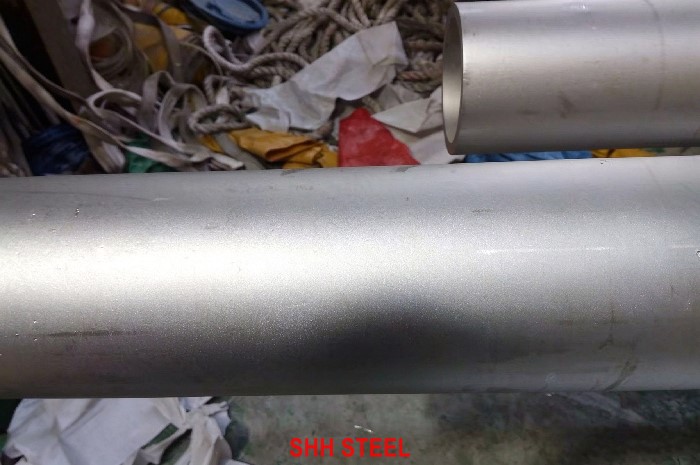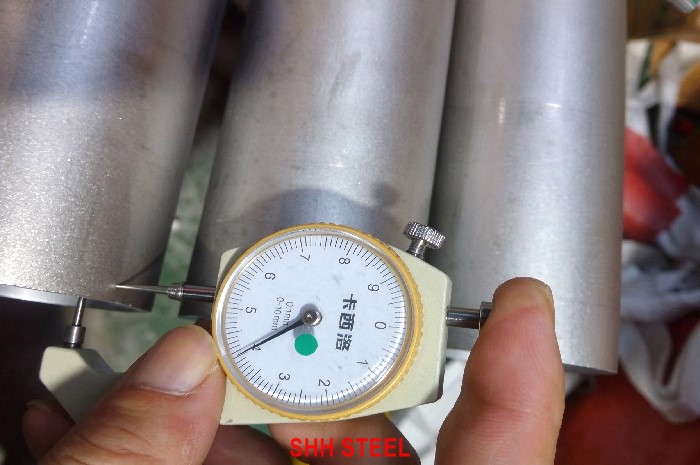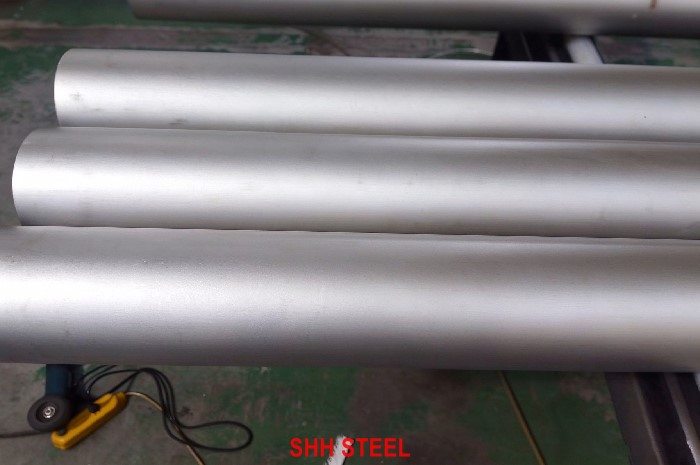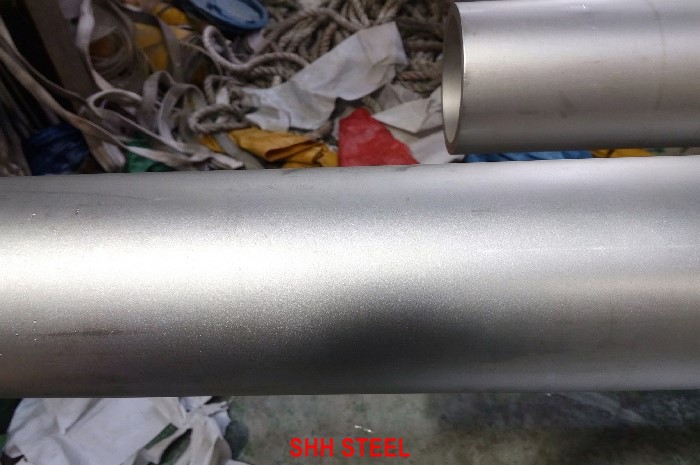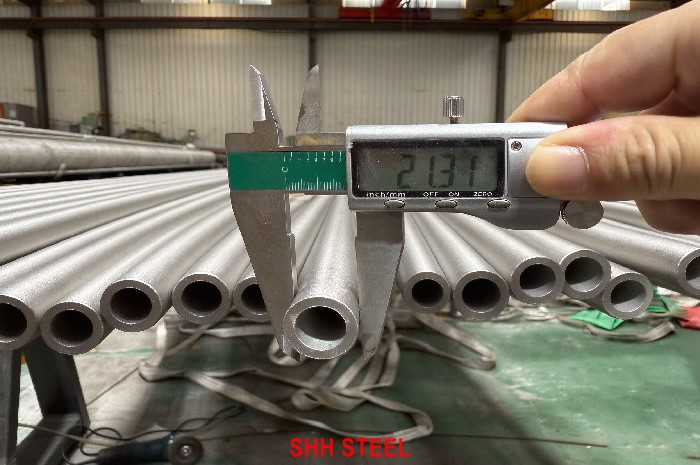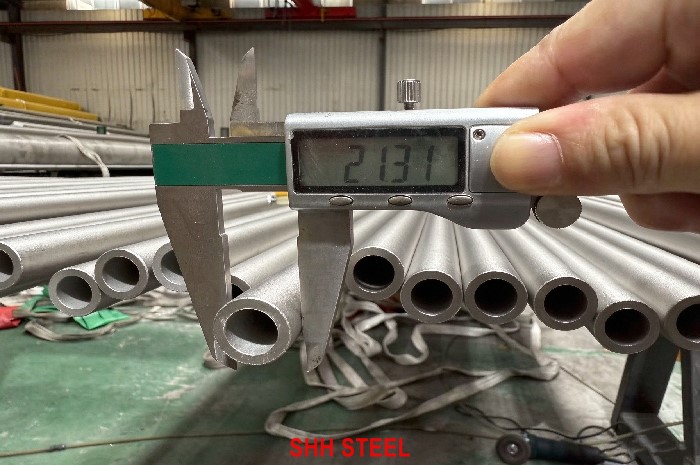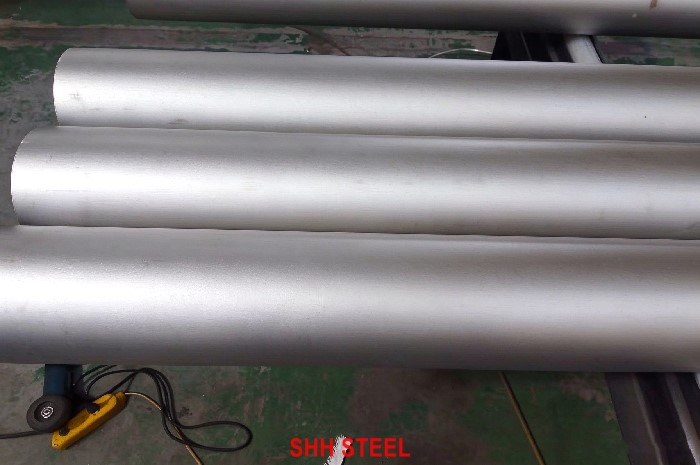
ASTM A312 TP304H Stainless Steel Pipe
What is ASTM A312 TP304H Stainless Steel Pipe
ASTM A312 / A312M is the ASTM product specification for seamless, welded, and heavily cold-worked austenitic stainless steel pipe. Grade TP304H is the H-version of 18-8 listed as UNS S30409: Table 1 sets carbon in a controlled 0.04–0.10% band (not merely a maximum), chromium 18.0–20.0%, and nickel 8.0–11.0%, and Table 5 requires an ASTM grain size of No. 7 or coarser. Those two controls — carbon floor plus coarse grain — are why TP304H is ordered for creep-range piping instead of ordinary A312 TP304.
SHH STEEL can supply ASTM A312 TP304H stainless steel pipe as SML, WLD, and HCW product in ASME B36.19 schedules and special OD/wall by agreement, with EN 10204 3.1 certificates that report the carbon band, the 75/30 ksi Table 4 tensile pair, the 1900 °F solution anneal, and the grain-size result per heat-treatment lot. Dual A312 / SA-312 marking is available only when the purchase order names that separate ASME standard. Browse related H grades and the rest of the family on the A312/A312M
Catalogues may say 304H or S30409; the stencil still needs ASTM A312 Grade TP304H. Sister pages buyers open on the same enquiry include A312 TP304 for standard carbon without grain-size control, A312 TP304L for as-welded low carbon (the opposite metallurgical idea), A312 TP316H when molybdenum is also required at temperature, and stabilized H grades such as A312 TP321H or A312 TP347H when polythionic or stabilization strategies dominate. For ASME Code Book wording, see the separate SA312 TP304H article — written to SA-312, not as a synonym of this ASTM page.
Manufacturing Types (SML / WLD / HCW)
TP304H may be supplied seamless, welded, or heavily cold-worked under ASTM A312, and the type must appear in the marking. Seamless is common on high-temperature pressure piping where owners prefer no longitudinal weld; welded and HCW routes are used when the code of record accepts them and the heat-treatment and grain-size controls are demonstrated on the weld and base metal alike.
H grades carry an extra process expectation: the ordered A312 edition requires reheating of H-grade pipe before the final quench (the familiar clause 6.2 discipline), so the carbon stays in solution and the grain-size requirement can be met on the heat-treatment lot. SHH STEEL states SML/WLD/HCW on the stencil and records the reheat anneal on the certificate. Wall is nominal unless S8 minimum wall is ordered; OD follows A999/A999M.
Do not mix TP304H pipe with random TP304 fittings on a creep-range isometric without checking whether the fittings are also H-grade or dual-certified — grain size and carbon floor are the whole point of the H callout.
Chemical Composition of A312 TP304H
TP304H chemistry under ASTM A312 is not “304 with a little more carbon.” Table 1 sets a carbon range of 0.04–0.10%, so both a floor and a ceiling apply on the melting analysis. Chromium and nickel match the TP304 bands (18.0–20.0% Cr, 8.0–11.0% Ni); manganese, phosphorus, sulfur, and silicon use the same maxima as TP304; molybdenum and nitrogen are no-requirement ellipses. Product analysis, when S1 is ordered, applies A480 Table A1.1 tolerances and widens carbon to a 0.03–0.11% product window.
The tables below give the Table 1 melt limits, the product-analysis limits, and a short carbon/nickel snapshot against TP304L and TP304 so the H-grade intent is obvious at a glance.
Melting analysis (heat / ladle analysis) — Table 1
| Element | TP304H (UNS S30409) melting analysis |
|---|---|
| Carbon (C) | 0.04 – 0.10 |
| Manganese (Mn) | ≤ 2.00 |
| Phosphorus (P) | ≤ 0.045 |
| Sulfur (S) | ≤ 0.030 |
| Silicon (Si) | ≤ 1.00 |
| Chromium (Cr) | 18.0 – 20.0 |
| Nickel (Ni) | 8.0 – 11.0 |
| Nitrogen (N) | … (no requirement) |
| Molybdenum (Mo) | … (no requirement) |
Product analysis — A480/A480M Table A1.1 tolerances applied to Table 1
| Element | Melting (Table 1) | Tolerance (A480 A1.1) | Product analysis limit |
|---|---|---|---|
| Carbon (C) | 0.04 – 0.10 | 0.01 under / over | 0.03 – 0.11 |
| Manganese (Mn) | ≤ 2.00 | 0.04 over | ≤ 2.04 |
| Phosphorus (P) | ≤ 0.045 | 0.010 over | ≤ 0.055 |
| Sulfur (S) | ≤ 0.030 | 0.005 over | ≤ 0.035 |
| Silicon (Si) | ≤ 1.00 | 0.05 over | ≤ 1.05 |
| Chromium (Cr) | 18.0 – 20.0 | 0.20 under / over | 17.80 – 20.20 |
| Nickel (Ni) | 8.0 – 11.0 | 0.10 under / 0.15 over | 7.90 – 11.15 |
Carbon and nickel snapshot — TP304L / TP304 / TP304H
| Element | TP304L (S30403) | TP304 (S30400) | TP304H (S30409) |
|---|---|---|---|
| C | ≤ 0.035 | ≤ 0.08 | 0.04 – 0.10 |
| Mn | ≤ 2.00 | ≤ 2.00 | ≤ 2.00 |
| Cr | 18.0 – 20.0 | 18.0 – 20.0 | 18.0 – 20.0 |
| Ni | 8.0 – 13.0 | 8.0 – 11.0 | 8.0 – 11.0 |
Heats that land inside both the TP304 maximum of 0.08% C and the TP304H range, and that meet grain size, can often dual-certify TP304/TP304H — useful when a plant wants one stock description for hot and warm services. Dual certification with TP304L is usually impossible because the L carbon ceiling fights the H carbon floor. Order what the creep calculation needs; do not assume dual marking.
SHH STEEL reports the actual carbon on the MTC inside the 0.04–0.10% band and will not substitute a standard TP304 heat that only scraped under 0.08% without meeting the H floor and grain-size rule.
Mechanical Properties of A312 TP304H
Table 4 tensile requirements for TP304H are 75 ksi [515 MPa] tensile and 30 ksi [205 MPa] yield minimum, with 35% / 25% elongation — the same room-temperature tensile pair as TP304. What distinguishes the H grade mechanically in the product standard is Table 5 grain size: ASTM No. 7 or coarser, determined per heat-treatment lot under the ordered edition’s clause referencing ASTM E112. Hardness is not given a maximum in Table 4.
| Property (A312 Table 4) | TP304H |
|---|---|
| Tensile strength, min | 75 ksi [515 MPa] |
| Yield strength (0.2% offset), min | 30 ksi [205 MPa] |
| Elongation in 2 in. or 50 mm (or 4D), min | 35% longitudinal / 25% transverse |
| Grain size (Table 5) | ASTM No. 7 or coarser |
| Hardness | No maximum in Table 4 |
Room-temperature tensile equality with TP304 is why dual 304/304H stock is attractive; elevated-temperature allowables in the design code, not Table 4 alone, are why the H grade exists. Flattening or bend tests and hydro or NDE of each length still apply. When reading certificates, check that grain size is reported for the heat-treatment lot — a tensile-only MTC is incomplete for TP304H.
Dimensions and Tolerances
Dimensional ordering for ASTM A312 TP304H follows ASME B36.19 for common NPS and schedules, with special OD/wall by agreement. OD variations reference ASTM A999/A999M; wall variations follow A312 Table 3. State nominal versus minimum wall (S8) on the PO.
| NPS designator | Over | Under |
|---|---|---|
| 1/8 – 2-1/2, all t/D | 20.0% | 12.5% |
| 3 – 18, t/D ≤ 5% | 22.5% | 12.5% |
| 3 – 18, t/D > 5% | 15.0% | 12.5% |
| ≥ 20 welded | 17.5% | 12.5% |
| ≥ 20 seamless, t/D ≤ 5% | 22.5% | 12.5% |
| ≥ 20 seamless, t/D > 5% | 15.0% | 12.5% |
Source: ASTM A312 Table 3; OD per A999/A999M. High-temperature lines often use Sch 40S and heavier; thin Sch 5S/10S still appear on low-pressure hot gas ducts — confirm t/D when applying the over-tolerance columns. Stock/enquiry size maps sit under Supply Capability without fake tonnage claims.
Equivalent Grades
TP304H equivalence claims need care because creep data and grain-size rules differ across product forms. This article is governed by ASTM A312 / A312M Grade TP304H / UNS S30409. Tube product under A213/SA-213 and plate under A240/SA-240 use the same grade name in different specifications — they are not pipe MTCs.
| Designation | Relationship |
|---|---|
| ASTM A312 / A312M TP304H | Governing ASTM pipe grade for this article |
| UNS S30409 | Unified number in Table 1 |
| ASME SA-312 TP304H | Separate ASME Code Book adoption — dual-mark only when the PO asks |
| ASTM A213 / ASME SA-213 TP304H | Same grade designation for boiler and heat-exchanger tubes (separate specification) |
| EN 1.4948 (X6CrNi18-10) | Commonly cited European heat-resisting counterpart; chemistry and creep data differ — review before substitution |
| JIS SUS304HTP | Commonly cited Japanese pipe counterpart; verify against JIS G3459 or G3463 |
EN 1.4948 and JIS SUS304HTP are commonly cited counterparts; confirm chemistry, grain size, and creep design data before any substitution. ASME SA-312 TP304H is the separate Code adoption — dual-mark on request, never treat as the same document as ASTM A312.
Heat Treatment and Delivery Condition
Table 2 lists TP304H explicitly at 1900 °F [1040 °C] minimum for both cold-finished and hot-finished pipe, with the H-grade reheat-before-quench requirement applied so solution treatment and grain-size control are real, not paperwork. Water quenching or rapid cooling follows the reheat. Delivery from SHH STEEL is solution annealed and pickled (bright annealed by agreement), with anneal temperature, reheat note, and grain-size result on the EN 10204 3.1 certificate.
Stabilizing heat treatments used on titanium- or niobium-bearing grades are not the TP304H route; if the process needs stabilization chemistry, open TP321H or TP347H instead of stretching 304H beyond its design intent. Straightening after anneal is controlled so cold work does not undermine the coarse-grain objective at the ends.
Corrosion Resistance
TP304H inherits the general corrosion behavior of the 304 family in oxidizing media, but it is not selected primarily for wet corrosion resistance. The higher carbon that helps creep strength also increases sensitization risk if the material dwells in the 800–1500 °F sensitizing range during fabrication or upset operation. Refinery polythionic acid stress corrosion strategies often prefer stabilized H grades (A312 TP321H, A312 TP347H) or carefully controlled procedures — discuss that with corrosion engineering rather than assuming 304H is automatic.
For chloride-rich wet service at moderate temperature, A312 TP304L or A312 TP316H/TP316L families are usually the better ASTM A312 starting points. SHH STEEL will not market TP304H as a universal corrosion upgrade over TP304; it is a high-temperature strength grade with known sensitization trade-offs.
Applications of A312 TP304H Pipe
TP304H is specified where design codes give credit for H-grade allowables in the creep range — power, refining, petrochemical, HRSG, and furnace piping. The table pairs sectors with the metallurgical reason for choosing H over standard 304.
| Sector | Typical TP304H use | Why the H grade |
|---|---|---|
| Power generation | Superheater and reheater headers, main steam and hot reheat links | Higher code allowables in the creep range |
| Refining | Heater outlet piping, transfer lines, hydrogen units | Creep strength; often with polythionic acid precautions |
| Petrochemical | Cracking furnace and high-temperature process lines | Strength and oxidation resistance |
| Heat recovery and HRSG | High-temperature sections of recovery systems | Coarse grain for creep resistance |
| Industrial furnaces | Hot gas ducting and radiant section piping | Oxidation resistance |
| Dual-use plants | Lines that run hot but also see cleaning cycles | Dual 304/304H certification on qualifying heats |
If the line is mostly cold or warm welded utility piping, A312 TP304 or A312 TP304L is usually enough. If molybdenum is required at temperature, open A312 TP316H. Keep the ASTM A312 grade name matched to the design allowable table the engineer actually used.
Weldability
ASTM A312 Table 6 lists ER308 / S30880 and W30840 for TP304H. Many high-temperature fabricators prefer 308H-type fillers to keep weld-metal carbon in an H-like band; that preference belongs in the WPS, not as an invented A312 mandate beyond Table 6. Heat input, interpass limits, and any post-weld heat treatment required by the construction code remain fabricator responsibilities.
Because sensitization and creep-ductility issues can appear in heavy-wall H-grade welds, procedure qualification should reflect the real thickness and service temperature. SHH STEEL can reference Table 6 on enquiry documents; filler supply is separate unless the contract bundles it.
Surface Finishes
Standard mill finish is solution annealed and pickled. Blasted-and-pickled or bright-annealed surfaces are available by agreement. Polished finishes are uncommon on high-temperature TP304H process lines but can be quoted for visible ducting; they remain commercial extras, not ASTM table requirements.
Marking priority for H-grade pipe is grade, type, heat number, and heat-treatment lot identification so grain-size traceability stays intact after painting or insulation at site.
Inspection and Testing
Base ASTM A312 testing for TP304H includes Table 1 chemistry with the carbon range, Table 4 tension tests, Table 5 grain size per heat-treatment lot, flattening or bend tests, and hydro or NDE of each length. Marking includes heat number and heat-treatment lot identification consistent with the ordered edition. Common Supplementary Requirements are summarized below.
| Option | Purpose |
|---|---|
| S1 product analysis | Confirms chemistry on finished pipe |
| S5 radiography | Weld integrity on WLD pipe |
| S7 intergranular corrosion | A262 Practice E after sensitizing treatment |
| S8 minimum wall | Wall interpreted as minimum rather than nominal |
| S9 weld decay | Compares weld and base-metal loss rates |
EN 10204 3.1 from SHH STEEL reports carbon, tensile, anneal, and grain size together. Third-party inspection or 3.2 is available when named on the enquiry. Incomplete certificates that omit grain size are rejected against a TP304H callout.
Packaging and Shipping
TP304H lengths are bundled, capped, and tagged with ASTM A312 grade, type, size, heat number, and heat-treatment lot reference. Export packing follows the Incoterms on the acknowledgement. High-temperature project orders often need heat-lot segregation inside the container so site stores do not mix lots that carry different grain-size reports.
Cut lists, destination marks, and third-party stamp locations should be stated on the enquiry with the metallurgical requirements so packaging does not undo traceability.
Why Choose SHH STEEL
SHH STEEL treats TP304H as an H-grade product with carbon range, reheat anneal, and grain-size evidence — not as “304 pipe stamped H.” Certificates carry the 0.04–0.10% carbon result, 75/30 ksi tensile, 1900 °F reheat anneal, and ASTM No. 7 or coarser grain size per lot. Dual A312/SA-312 marking is optional and explicit.
When an enquiry says 304H but the isometric is cold utility piping, we will ask whether A312 TP304 or A312 TP304L was intended. When polythionic strategies dominate, we point to A312 TP321H / A312 TP347H. When molybdenum at temperature is required, we open A312 TP316H. The A312/A312M keeps those ASTM choices visible without merging them into one vague stainless line.
Quotes separate near-term lengths from mill heats that still need grain-size release. That honesty matters more on H grades than on commodity 304, because a late grain-size failure wastes a full heat-treatment lot.
Supply Capability
SHH STEEL can supply ASTM A312 TP304H stainless steel pipe to the edition and manufacturing type on your enquiry. Capability table first; Stock / Available sizes map second.
| Item | SHH STEEL capability for TP304H |
|---|---|
| Standard | ASTM A312 / A312M (dual SA-312 marking on request) Grade TP304H / UNS S30409 |
| Manufacturing types | SML, WLD, HCW |
| Size | NPS 1/8 and up per ASME B36.19; special OD/wall by agreement |
| Schedules | 5S, 10S, 40S, 80S and non-standard walls |
| Length | SRL, DRL, or cut-to-length |
| Finish | Annealed and pickled; blasted and pickled; bright annealed or polished by agreement |
| Testing | Tension (75/30 ksi), Table 5 grain size No. 7 or coarser per heat-treatment lot, flattening/bend, hydro or NDE per length; C 0.04–0.10% on MTC; 1900 °F anneal and clause 6.2 reheat stated |
| Documents | EN 10204 3.1 with full Table 1 chemistry; third-party inspection / 3.2 on request |
| Trade terms | FOB / CFR / CIF / EXW and other agreed Incoterms |
Stock / Available sizes
SHH STEEL quotes TP304H pipe against a practical stock-and-mill enquiry range rather than a frozen warehouse SKU list. The sizes below are the combinations buyers most often request under ASME B36.19; availability of any single NPS × schedule on a given week depends on mill rolling and our inbound schedule, so treat the table as a supply map for enquiry — not a guarantee that every line sits on the floor with a published tonnage.
| Item | Typical stock / enquiry range for TP304H |
|---|---|
| NPS | 1/2, 3/4, 1, 1-1/4, 1-1/2, 2, 2-1/2, 3, 4, 5, 6, 8, 10, 12, 14, 16, 18, 20, 24 (intermediates and larger on enquiry) |
| Schedules | Sch 5S, 10S, 40S, 80S per ASME B36.19; other walls by agreement |
| Common OD × wall examples | 21.3 × 2.77 mm (NPS 1/2 Sch 40S); 33.4 × 3.38 mm (NPS 1 Sch 40S); 60.3 × 3.91 mm (NPS 2 Sch 40S); 88.9 × 5.49 mm (NPS 3 Sch 40S); 114.3 × 6.02 mm (NPS 4 Sch 40S); 168.3 × 7.11 mm (NPS 6 Sch 40S); 219.1 × 8.18 mm (NPS 8 Sch 40S) — illustrative B36.19 sizes |
| Length | SRL, DRL, or cut-to-length on enquiry |
| Special | Non-standard OD/wall, heavy wall, HCW, and polished finishes — confirm on enquiry before the heat is reserved |
When you send an enquiry, list NPS × schedule (or OD × wall), manufacturing type (SML / WLD / HCW), quantity or cut list, required marking (A312 alone or dual A312/SA-312), and any Supplementary Requirements. We reply with what we can ship from near-term stock versus what needs a mill run, without inventing fake warehouse codes or tonnage claims.
Send NPS × schedule or OD × wall, SML/WLD/HCW, quantity, marking (A312 or dual A312/SA-312), grain-size reporting expectation, Supplementary Requirements, and destination. We align carbon band, tensile, anneal, and grain size to the ASTM A312 TP304H callout before the heat is reserved.
FAQ
-
Is ASTM A312 the same as ASME SA-312 for TP304H?
- No. ASTM A312 is the ASTM product specification; ASME SA-312 is the separate Code Book adoption. For TP304H both expect controlled carbon, solution treatment, and grain-size control, but they remain independent standards. Dual-mark only when the purchase order requests both designations on the stencil and MTC.
-
Seamless vs welded TP304H — which is better?
- Choose seamless when the owner or code prefers no longitudinal weld on high-temperature pressure piping. Welded and HCW are acceptable when the ordered A312 rules for weld quality, heat treatment, and grain size are met and the design code allows them. Name SML, WLD, or HCW on the PO; H-grade chemistry alone does not define the manufacturing type.
-
Hydrostatic test vs NDE — which do I get on TP304H pipe?
- Each length receives hydrostatic testing or nondestructive electric testing under ASTM A312 options. State a mandatory preference if the end user requires one method. Radiography of welds is Supplementary Requirement S5 and is separate from the standard hydro/NDE choice.
-
Does A312 Table 4 set a hardness limit for TP304H?
- No. Table 4 gives tensile, yield, and elongation minima; hardness is not assigned a maximum for TP304H there. Grain size is controlled under Table 5, which is a different acceptance item. Any hardness cap must be written into the purchase order with an agreed method.
-
What is the UNS number and chemistry of ASTM A312 TP304H?
- TP304H is UNS S30409. Table 1 sets carbon 0.04–0.10%, manganese ≤2.00%, phosphorus ≤0.045%, sulfur ≤0.030%, silicon ≤1.00%, chromium 18.0–20.0%, and nickel 8.0–11.0%, with molybdenum and nitrogen as no-requirement ellipses. Product analysis, when ordered, applies A480 A1.1 tolerances (carbon product window 0.03–0.11%).
-
How does TP304H differ from TP304 under ASTM A312?
- TP304 allows carbon ≤0.08% with no Table 5 grain-size requirement for the grade in the same way; TP304H requires carbon 0.04–0.10%, H-grade reheat before quench, and ASTM grain size No. 7 or coarser per heat-treatment lot. Room-temperature tensile floors match at 75/30 ksi. Order TP304H when creep-range design allowables or owner H-grade rules apply.
-
Can TP304H pipe be dual certified TP304/TP304H?
- Often yes, when carbon sits inside both the TP304 maximum and the TP304H range, tensile clears 75/30 ksi, and grain size meets Table 5. Dual marking must be requested on the purchase order. Dual TP304L/TP304H is generally not practical because the L carbon ceiling conflicts with the H carbon floor.
-
What heat treatment does Table 2 require for TP304H?
- Table 2 lists 1900 °F [1040 °C] minimum for both cold-finished and hot-finished TP304H, applied with the H-grade reheat-before-quench rule so solution treatment and grain size are achieved on the heat-treatment lot. The anneal temperature and grain-size result should appear on the mill test certificate.
-
Why does ASTM A312 control grain size on TP304H?
- Coarse grain (ASTM No. 7 or coarser) supports creep resistance that design codes associate with H grades. Table 5 and the related examination clause make grain size a contractual acceptance item per heat-treatment lot, not an optional metallography note. Certificates without grain size are incomplete for TP304H.
-
What filler metal is listed for TP304H?
- Table 6 references ER308 / S30880 and W30840. Fabricators frequently specify 308H-type fillers to keep weld-metal carbon elevated for high-temperature service; that detail belongs in the WPS. Confirm filler selection with the construction-code procedure, not from the pipe grade name alone.
-
Is TP304H a good choice for wet corrosive service?
- Usually not as the primary reason to choose it. TP304H is selected for elevated-temperature strength. Higher carbon increases sensitization risk in the wrong temperature window, and chloride pitting resistance is not improved versus TP304. For wet chloride service consider TP304L or TP316L/TP316H families under ASTM A312 instead.
Conclusion
ASTM A312 TP304H / UNS S30409 is the H-grade 18-8 pipe for creep-range service when controlled carbon, reheat solution annealing, and coarse grain size are part of the design basis. SHH STEEL supplies SML, WLD, and HCW product to B36.19 and special OD/wall with EN 10204 3.1 documents that carry chemistry, 75/30 ksi tensile, anneal, and grain size together — dual SA-312 marking only when that separate ASME standard is named. Use the ASTM A312/A312M product hub to compare sister H grades, then send the size list and lot-traceability needs so we can reserve the right heat.
Contact: admin@steelspecs.com
Quality Steel Needed? Inquire for Offers
Related Products