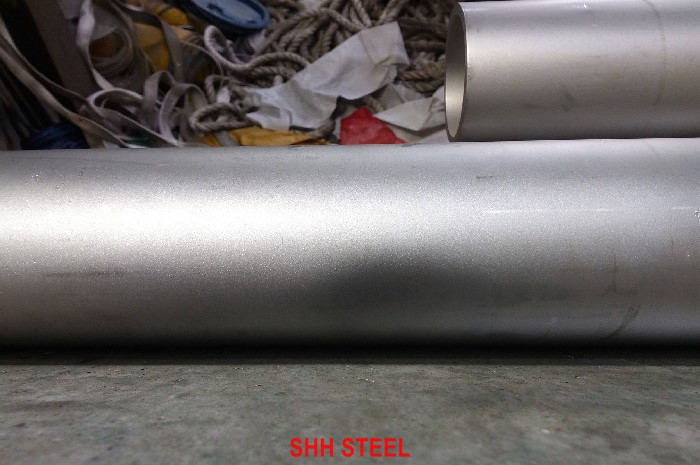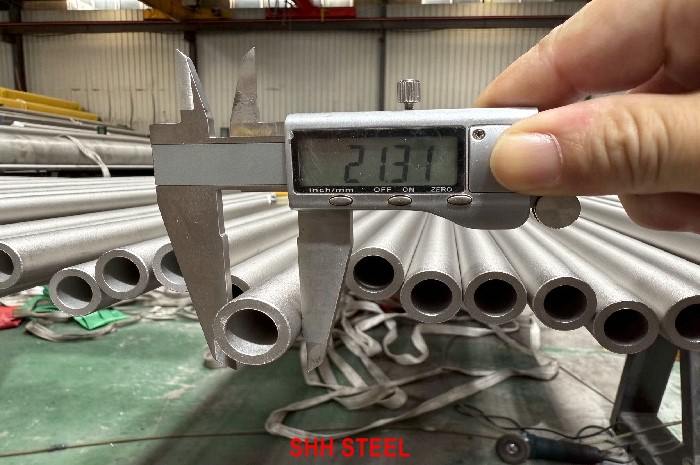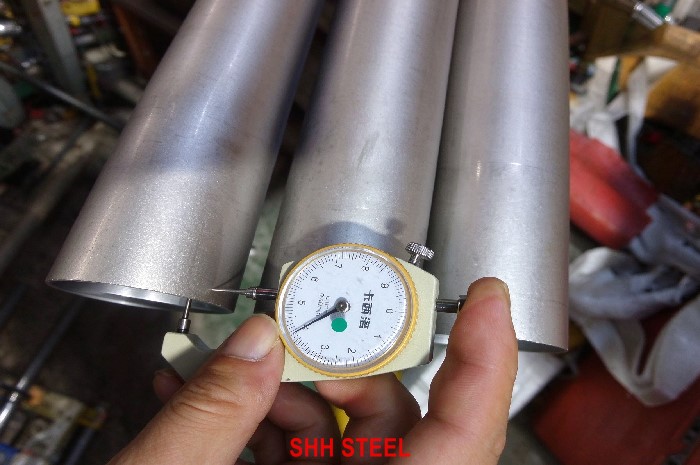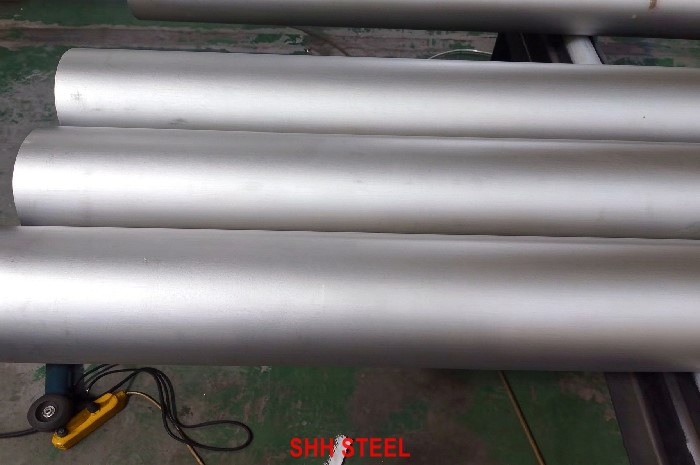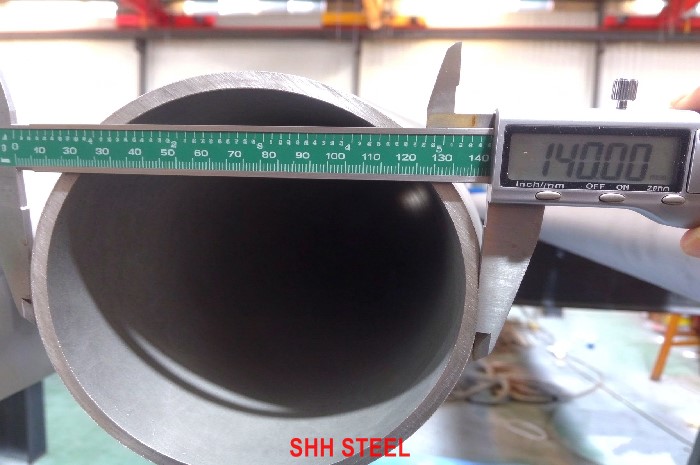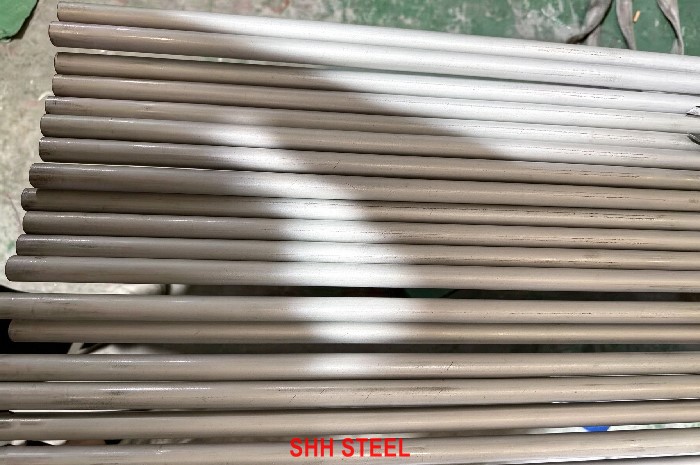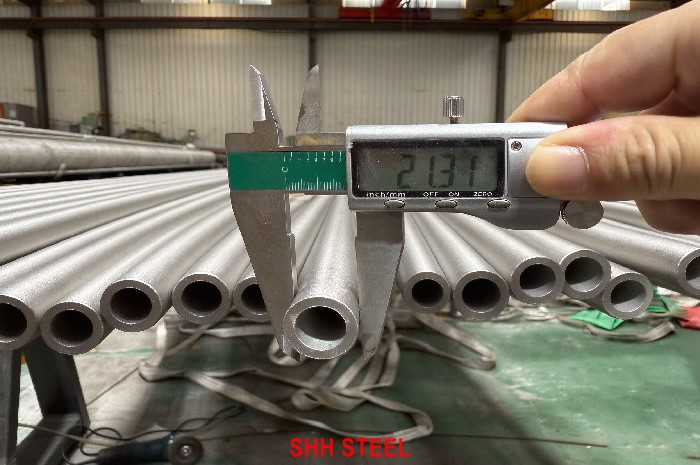
ASTM A312 TP304L Stainless Steel Pipe
What is ASTM A312 TP304L Stainless Steel Pipe
ASTM A312 / A312M covers seamless, welded, and heavily cold-worked austenitic stainless steel pipe for high-temperature and general corrosive service. Grade TP304L is the low-carbon 18-8 listed as UNS S30403, with Table 1 carbon capped at ≤0.035% (Footnote D allows ≤0.040% on some small-OD / light-wall product), chromium 18.0–20.0%, and nickel 8.0–13.0%. The extra nickel headroom versus TP304, together with the carbon ceiling, is what lets fabricators leave many spools in the as-welded condition without jumping straight to a stabilized or molybdenum grade.
SHH STEEL can supply ASTM A312 TP304L stainless steel pipe as SML, WLD, and HCW product in ASME B36.19 schedules and special OD/wall by agreement, documented on EN 10204 3.1 certificates that show the full Table 1 chemistry — including the low carbon — and the Table 4 tensile pair of 70 ksi / 25 ksi. Dual A312 / SA-312 marking is added only when the purchase order requests that separate ASME Code Book standard; ASTM and ASME stay independent on the stamp. Survey sister grades on the A312/A312M
Shop language still says 304L, 304L stainless, or S30403; the MTC and stencil must say ASTM A312 Grade TP304L. Buyers comparing options on the same enquiry usually open A312 TP304 when a 75/30 ksi floor is mandatory, A312 TP304H for creep-range carbon and grain size, A312 TP316L when chlorides need molybdenum, and A312 TP304LN when nitrogen-strengthened low-carbon 304 chemistry is specified. For Code-stamp work written to SA-312 rather than A312, use the separate SA312 TP304L page — it is not a retitled copy of this ASTM article.
Manufacturing Types (SML / WLD / HCW)
ASTM A312 allows TP304L as seamless (SML), welded (WLD), and heavily cold-worked (HCW) pipe, and the manufacturing type is part of the required marking. Seamless product is chosen when owner specs or the piping code prefer a wall without a weld seam; welded product is the workhorse for shop-fabricated spools where low carbon is doing the sensitization control; HCW is welded pipe given a defined cold reduction and treated as its own type under the standard.
Because TP304L is so often selected specifically for as-welded fabrication, WLD and HCW enquiries dominate, but SML remains available when the datasheet demands it. Name the type on every line item. Wall is interpreted as nominal unless Supplementary Requirement S8 is invoked for minimum wall, and OD tolerances come through ASTM A999/A999M. SHH STEEL states SML, WLD, or HCW on both the stencil and the EN 10204 3.1 certificate so receiving inspection can match the PO without guessing from chemistry alone.
Mixed isometrics that combine TP304L pipe with TP304 fittings should call out dual certification or matching low-carbon fittings explicitly; otherwise the weld procedure may be qualified on 304L pipe and then challenged by higher-carbon fitting heats at the flange neck.
Chemical Composition of A312 TP304L
Under ASTM A312, TP304L chemistry starts with the Table 1 melting analysis that every heat must meet. Product analysis on finished pipe is required only when Supplementary Requirement S1 (or equivalent PO wording) is ordered; those product limits are A480/A480M Table A1.1 tolerances applied to Table 1, not a second invented chemistry window. SHH STEEL reports ladle carbon at or below the 0.035% ceiling on the MTC and will not advertise a tighter “0.03 max shop grade” that the ASTM standard does not define.
The tables below show the Table 1 melt limits for TP304L / UNS S30403 and the corresponding product-analysis limits. Ellipsis (…) means no requirement in the ordered edition. Footnote D on carbon is part of the standard text for certain small-OD / light-wall product and should be read on the ordered A312 edition rather than assumed away.
Melting analysis (heat / ladle analysis) — Table 1
| Element | TP304L (UNS S30403) melting analysis |
|---|---|
| Carbon (C) | ≤ 0.035 D |
| Manganese (Mn) | ≤ 2.00 |
| Phosphorus (P) | ≤ 0.045 |
| Sulfur (S) | ≤ 0.030 |
| Silicon (Si) | ≤ 1.00 |
| Chromium (Cr) | 18.0 – 20.0 |
| Nickel (Ni) | 8.0 – 13.0 |
| Molybdenum (Mo) | … (no requirement) |
| Nitrogen (N) | … (no requirement) |
Product analysis — A480/A480M Table A1.1 tolerances applied to Table 1
| Element | Melting (Table 1) | Tolerance (A480 A1.1) | Product analysis limit |
|---|---|---|---|
| Carbon (C) | ≤ 0.035 | 0.01 over | ≤ 0.045 |
| Manganese (Mn) | ≤ 2.00 | 0.04 over | ≤ 2.04 |
| Phosphorus (P) | ≤ 0.045 | 0.010 over | ≤ 0.055 |
| Sulfur (S) | ≤ 0.030 | 0.005 over | ≤ 0.035 |
| Silicon (Si) | ≤ 1.00 | 0.05 over | ≤ 1.05 |
| Chromium (Cr) | 18.0 – 20.0 | 0.20 under / over | 17.80 – 20.20 |
| Nickel (Ni) | 8.0 – 13.0 | 0.10 under / 0.15 over | 7.90 – 13.15 |
Nickel at 8.0–13.0% is wider than the 8.0–11.0% band on A312 TP304, which is why qualifying heats can often dual-certify TP304/TP304L when carbon is low enough and tensile clears both Table 4 rows. Molybdenum and nitrogen remain no-requirement ellipses for TP304L in Table 1; if your end user needs nitrogen control, look at A312 TP304LN rather than inventing an N limit on a 304L MTC.
Product analysis, when ordered, may read up to C 0.045%, Mn 2.04%, P 0.055%, S 0.035%, Si 1.05%, with Cr 17.80–20.20% and Ni 7.90–13.15%. Those are the limits we quote. Project-specific carbon or sulfur ceilings below Table 1 must appear on the purchase order before heat selection.
Mechanical Properties of A312 TP304L
ASTM A312 Table 4 sets TP304L tensile strength at 70 ksi [485 MPa] minimum and yield strength at 25 ksi [170 MPa] minimum, with elongation 35% longitudinal / 25% transverse minimum. Those floors are lower than the 75/30 ksi pair for TP304 and TP304H, which is the trade-off that comes with guaranteed low carbon. Table 4 does not publish a hardness maximum for TP304L; any HB/HRB cap has to be an extra PO requirement with an agreed test method.
| Property | TP304L requirement (Table 4) |
|---|---|
| Tensile strength, min | 70 ksi [485 MPa] |
| Yield strength (0.2% offset), min | 25 ksi [170 MPa] |
| Elongation in 2 in. or 50 mm (or 4D) | 35% longitudinal / 25% transverse, min |
Designers who need both low carbon and a 75 ksi tensile floor usually look for dual TP304/TP304L heats that actually reach 75/30 while keeping C ≤0.035%, or they reconsider whether the tensile callout can accept 70/25. Do not paste a TP304L certificate into a TP304 tensile line without checking the numbers. Flattening or bend testing and hydro or NDE of each length complete the standard mechanical/inspection package.
Dimensions and Tolerances
ASTM A312 TP304L pipe is ordered to ASME B36.19 schedules for common NPS × schedule combinations, with special OD and wall by agreement. Outside-diameter variations follow ASTM A999/A999M; wall variations follow A312 Table 3. Say whether wall is nominal or minimum (S8) on the purchase order — the same schedule number is not the same pipe under those two readings.
| NPS designator | Over | Under |
|---|---|---|
| 1/8 – 2-1/2, all t/D | 20.0% | 12.5% |
| 3 – 18, t/D ≤ 5% | 22.5% | 12.5% |
| 3 – 18, t/D > 5% | 15.0% | 12.5% |
| ≥ 20 welded | 17.5% | 12.5% |
| ≥ 20 seamless, t/D ≤ 5% | 22.5% | 12.5% |
| ≥ 20 seamless, t/D > 5% | 15.0% | 12.5% |
Source: ASTM A312 Table 3; OD per A999/A999M. Under-tolerance stays at 12.5% across the listed bands; over-tolerance depends on NPS and t/D, which is why thin Sch 5S/10S lengths need a careful weight and clearance check. Lengths may be SRL, DRL, or cut-to-length. Representative stock/enquiry sizes are listed under Supply Capability rather than as a fake inventory SKU sheet.
Equivalent Grades
“304L equivalent” on a vendor datasheet is not enough to accept pipe against ASTM A312. The governing designation here is ASTM A312 Grade TP304L / UNS S30403. EN 1.4306 and 1.4307 are approximate wrought low-carbon names; which EN number a European project should order is project-specific and still requires the correct EN product specification for pipe or tube.
| Designation | Notes |
|---|---|
| ASTM A312 / A312M Grade TP304L | Governing ASTM pipe product standard for this article |
| UNS S30403 | Unified number listed in Table 1 |
| ASME SA-312 TP304L | Separate ASME Code Book adoption — dual-mark only when the PO asks |
| EN 1.4306 / 1.4307 (X2CrNi19-11 / X2CrNi18-9) | Approximate wrought low-carbon names; order EN pipe/tube under the relevant EN product specs, not by EN number alone on an A312 MTC |
| JIS SUS304L | Approximate Japanese grade name; confirm the Japanese pipe/tube product standard when ordering JIS product |
ASME SA-312 TP304L is a separate Code Book standard. Dual-mark when the PO asks; do not rewrite this ASTM page as an ASME title. For molybdenum low-carbon service open A312 TP316L; for nitrogen-strengthened low-carbon 304 chemistry open A312 TP304LN; for standard-carbon 18-8 open A312 TP304.
Heat Treatment and Delivery Condition
TP304L uses the ASTM A312 Table 2 default solution-anneal minimum of 1900 °F [1040 °C] with water quench or rapid cooling, the same default that covers grades not individually listed at another temperature. Low carbon reduces sensitization risk in the heat-affected zone, but it does not waive the mill solution anneal for the pipe product itself — A312 still delivers annealed pipe unless a documented alternative in the ordered edition applies.
SHH STEEL supplies TP304L solution annealed and pickled as standard, bright annealed by agreement, with the anneal temperature stated on the EN 10204 3.1 certificate. Straightening and end finishing follow heat treatment. When Supplementary Requirement S7 (A262 Practice E after sensitizing) is ordered, the corrosion test report travels with the heat-treatment record.
Corrosion Resistance
TP304L is chosen primarily to resist intergranular attack after welding in environments that would sensitize higher-carbon 304. The passive film behavior in oxidizing acids and clean aqueous media is otherwise in the same family as A312 TP304. Chloride pitting and crevice corrosion still push many services toward A312 TP316L; low carbon alone does not replace molybdenum in seawater or strong brines.
ASTM A312 does not tabulate corrosion rates for TP304L. When an owner specification requires A262 Practice E or another intergranular method, invoke S7 (or name the practice on the PO). SHH STEEL will not claim TP304L “equals 316L in chlorides” — that is outside the product standard and outside how we write certificates.
Applications of A312 TP304L Pipe
TP304L shows up wherever shop and field welding dominate and the owner wants as-welded corrosion performance without a mandatory post-weld anneal of every spool. Food, beverage, pharmaceutical utilities, chemical transfer, and modular skids are the everyday homes for the grade under ASTM A312.
| Application area | Typical use of TP304L pipe | Selection note |
|---|---|---|
| Chemical and process piping | Welded transfer lines for mild corrosive media ordered to A312 | Confirm fluid compatibility; prefer TP316L if chlorides dominate |
| Food, beverage, and dairy | Hygienic welded lines where 304L stainless is accepted | Follow hygiene finish and welding procedure requirements |
| Pharmaceutical / biotech | Process and utility stainless lines ordered as A312 product | State Ra/polish and documentation on the enquiry when required |
| Power and utility | Condensate, feedwater auxiliary, and general plant stainless piping | Dual A312/SA-312 marking often requested for Code work |
| Fabricated skids and modules | Shop-welded pipe spools delivered without post-weld anneal | Low carbon is the reason 304L is chosen over standard 304 |
| Architectural / structural | Exposed welded stainless ordered to A312 | Finish and marking language matter as much as grade |
If the line runs hot enough for creep design, switch the conversation to A312 TP304H. If chlorides dominate, open A312 TP316L. If the tensile floor must be 75 ksi and low carbon is still required, ask for dual TP304/TP304L on the enquiry and we will see whether a qualifying heat is available.
Weldability
TP304L is among the most weldable austenitic pipe grades in daily fabrication. ASTM A312 Table 6 references ER308L / S30883 and W30843 as the filler classification for TP304L. Matching low-carbon filler keeps the weld metal in the same carbon philosophy as the base pipe; project WPS documents still govern process, heat input, and inspection under the construction code.
Orbital and hygienic welds on small-bore TP304L are common; specify bore finish and end prep on the pipe order so the welder is not fighting pickle scale. Filler metal is a fabrication purchase unless the contract bundles it. SHH STEEL can cite the Table 6 reference on request documents without pretending the pipe MTC certifies the field weld.
Surface Finishes
Standard delivery is solution annealed and pickled. Blasted-and-pickled and bright-annealed finishes are available by agreement when appearance or cleanability drives the enquiry. Polished Ra finishes for hygienic service are commercial extras on top of ASTM A312 product — they need their own acceptance language and are not implied by the TP304L grade stamp alone.
SHH STEEL will stencil grade, type, and heat number per A312; polish grit marks, when required, are handled as additional identification agreed on the order, not as fake ASTM table requirements.
Inspection and Testing
Base testing includes heat analysis with carbon at the TP304L ceiling, tension tests to 70/25 ksi, flattening or bend tests as applicable, and hydro or NDE of each length. Marking carries ASTM A312, TP304L, manufacturing type, and heat number. Supplementary Requirements commonly added are listed below — invoke them by number on the PO.
| Option | Purpose |
|---|---|
| S1 product analysis | Confirms chemistry on finished pipe |
| S5 radiography | Weld integrity on WLD pipe |
| S7 intergranular corrosion | A262 Practice E after sensitizing treatment |
| S8 minimum wall | Wall interpreted as minimum rather than nominal |
| S9 weld decay | Compares weld and base-metal loss rates |
EN 10204 3.1 is standard from SHH STEEL; third-party inspection or 3.2 is arranged when the enquiry names the agency. Traceability from heat to length is maintained through the stencil and certificate for any later material review.
Packaging and Shipping
Pipe is bundled, end-protected, and tagged with ASTM A312 TP304L identification, size, heat number, and PO reference. Export packing ranges from bare or wrapped bundles to wooden cases for polished or small-bore lengths that need extra care. Shipments follow the Incoterms on the order acknowledgement — FOB, CFR, CIF, EXW, or other agreed terms — without burying freight inside unit prices silently.
Destination marking, cut-list segregation, and project end-cap colors can be added when the enquiry says so. Logistics notes belong beside the metallurgical notes so the pack list matches what site receiving expects.
Why Choose SHH STEEL
SHH STEEL writes TP304L orders to ASTM A312 as an enforceable product standard: full Table 1 chemistry with the low-carbon result on the MTC, Table 4 tensile at 70/25 ksi, manufacturing type on the stencil, and dual SA-312 marking only on request. That keeps as-welded fabrication jobs from receiving “generic 304” paperwork that fails an owner audit.
We also push back gently when the wrong sister grade is on the enquiry. Need 75/30 ksi and low carbon? Ask for dual TP304/TP304L. Need chlorides? Open A312 TP316L. Need creep-range carbon control? Open A312 TP304H. The A312/A312M is built grade-by-grade so those switches stay inside ASTM A312/A312M rather than drifting into vague catalogue names.
Quotations separate near-term availability from mill rolling. Cut length, polish, and third-party inspection are defined extras. The pipe that arrives should match the low-carbon ASTM callout the fabricator quoted to the owner.
Supply Capability
SHH STEEL can supply ASTM A312 TP304L stainless steel pipe to the edition and manufacturing type on your enquiry. Capability summary first, then the Stock / Available sizes map used for practical enquiries.
| Item | SHH STEEL capability for TP304L |
|---|---|
| Standard | ASTM A312 / A312M (dual SA-312 marking on request) Grade TP304L / UNS S30403 |
| Manufacturing types | SML, WLD, HCW |
| Size | NPS 1/8 and up per ASME B36.19; special OD/wall by agreement |
| Schedules | 5S, 10S, 40S, 80S and non-standard walls |
| Length | SRL, DRL, or cut-to-length |
| Finish | Annealed and pickled; blasted and pickled; bright annealed or polished by agreement |
| Testing | Tension (70/25 ksi), flattening/bend, hydro or NDE per length; C ≤0.035% on MTC; S1/S5/S7/S8/S9 on order |
| Documents | EN 10204 3.1 with full Table 1 chemistry; third-party inspection / 3.2 on request |
| Trade terms | FOB / CFR / CIF / EXW and other agreed Incoterms |
Stock / Available sizes
SHH STEEL quotes TP304L pipe against a practical stock-and-mill enquiry range rather than a frozen warehouse SKU list. The sizes below are the combinations buyers most often request under ASME B36.19; availability of any single NPS × schedule on a given week depends on mill rolling and our inbound schedule, so treat the table as a supply map for enquiry — not a guarantee that every line sits on the floor with a published tonnage.
| Item | Typical stock / enquiry range for TP304L |
|---|---|
| NPS | 1/2, 3/4, 1, 1-1/4, 1-1/2, 2, 2-1/2, 3, 4, 5, 6, 8, 10, 12, 14, 16, 18, 20, 24 (intermediates and larger on enquiry) |
| Schedules | Sch 5S, 10S, 40S, 80S per ASME B36.19; other walls by agreement |
| Common OD × wall examples | 21.3 × 2.77 mm (NPS 1/2 Sch 40S); 33.4 × 3.38 mm (NPS 1 Sch 40S); 60.3 × 3.91 mm (NPS 2 Sch 40S); 88.9 × 5.49 mm (NPS 3 Sch 40S); 114.3 × 6.02 mm (NPS 4 Sch 40S); 168.3 × 7.11 mm (NPS 6 Sch 40S); 219.1 × 8.18 mm (NPS 8 Sch 40S) — illustrative B36.19 sizes |
| Length | SRL, DRL, or cut-to-length on enquiry |
| Special | Non-standard OD/wall, heavy wall, HCW, and polished finishes — confirm on enquiry before the heat is reserved |
When you send an enquiry, list NPS × schedule (or OD × wall), manufacturing type (SML / WLD / HCW), quantity or cut list, required marking (A312 alone or dual A312/SA-312), and any Supplementary Requirements. We reply with what we can ship from near-term stock versus what needs a mill run, without inventing fake warehouse codes or tonnage claims.
Include NPS × schedule (or OD × wall), SML/WLD/HCW, quantity or cut list, marking (A312 or dual A312/SA-312), Supplementary Requirements, and destination on one enquiry. We confirm Table 1 carbon and Table 4 tensile, and we say clearly what ships soon versus what needs a mill slot.
FAQ
-
Is ASTM A312 the same as ASME SA-312 for TP304L?
- No. ASTM A312 / A312M is the ASTM product specification; ASME SA-312 / SA-312M is the separate ASME Code Book adoption. They align closely on TP304L chemistry and tensile floors but remain independent standards. Dual-mark only when the purchase order requests both names on the stencil and MTC.
-
Seamless vs welded TP304L — which is better under ASTM A312?
- Neither is universally better. Seamless (SML) is chosen when the specification prefers no weld seam; welded (WLD) is the everyday route for shop spools that rely on low carbon for as-welded corrosion resistance; HCW is a distinct A312 manufacturing type with its own cold-work and marking rules. Name the type on the PO so the mill does not substitute.
-
Hydrostatic test vs NDE — which do I get on TP304L pipe?
- ASTM A312 permits hydrostatic testing or nondestructive electric testing of each length as standard acceptance routes. State a mandatory preference on the enquiry if the end user requires one method; otherwise the mill applies the option allowed for the manufacturing type. Extra radiography is Supplementary Requirement S5, not the default hydro/NDE choice.
-
Does A312 Table 4 set a hardness limit for TP304L?
- No. Table 4 lists 70 ksi tensile, 25 ksi yield, and elongation minima only. Hardness maxima are not published for TP304L in that table. If a project needs a maximum HB or HRB, add it to the purchase order with the test method agreed in advance.
-
What is the UNS number and chemistry of ASTM A312 TP304L?
- TP304L is UNS S30403. Table 1 includes carbon ≤0.035% (Footnote D may allow ≤0.040% on certain small-OD / light-wall product), manganese ≤2.00%, phosphorus ≤0.045%, sulfur ≤0.030%, silicon ≤1.00%, chromium 18.0–20.0%, and nickel 8.0–13.0%. Molybdenum and nitrogen are no-requirement ellipses unless a different grade is ordered.
-
TP304L vs TP304 — which should I order?
- Order TP304L when as-welded intergranular resistance and guaranteed low carbon matter and the 70/25 ksi tensile floor is acceptable. Order TP304 when the specification needs the 75/30 ksi floor and carbon ≤0.08% is allowed. Dual TP304/TP304L heats exist when chemistry and tensile clear both grades — request dual marking on the PO rather than assuming it.
-
TP304L vs TP316L — which is better in chlorides?
- TP316L adds molybdenum and is the usual upgrade when chloride pitting or crevice corrosion dominates. TP304L remains appropriate for many low-chloride, welded stainless services where molybdenum is not justified. ASTM A312 does not publish a chloride ranking; treat selection as engineering judgment and open the TP316L page when brines or seawater are in play.
-
Why is nickel 8.0–13.0% on TP304L but 8.0–11.0% on TP304?
- Table 1 simply specifies a wider nickel band for TP304L than for TP304. That wider band, plus the low carbon ceiling, is what makes dual TP304/TP304L certification practical on many heats. It is not a license to treat the grades as identical: tensile floors still differ (70/25 vs 75/30), and the stencil must show what was ordered and certified.
-
What does Table 1 Footnote D mean for TP304L carbon?
- Footnote D in the ordered ASTM A312 edition addresses carbon on certain small outside-diameter or light-wall TP304L product and may allow a 0.040% carbon maximum in those cases. Read the footnote on the edition named in the purchase order; do not assume every small-bore length automatically uses 0.040%, and do not ignore the base ≤0.035% ceiling for standard product.
-
What filler metal should I use to weld TP304L pipe?
- ASTM A312 Table 6 references ER308L / S30883 and W30843 for TP304L. Matching low-carbon filler aligns with the base-metal carbon philosophy. The construction-code WPS still governs process and inspection. Confirm filler brand and lot rules with the fabricator; the pipe MTC does not certify the field weld.
-
What heat treatment applies to ASTM A312 TP304L?
- TP304L follows the Table 2 default solution anneal at 1900 °F [1040 °C] minimum with rapid cooling. Low carbon helps as-welded service but does not remove the mill anneal requirement for A312 pipe product. The anneal temperature should appear on the EN 10204 3.1 certificate with the quench method.
Conclusion
ASTM A312 TP304L / UNS S30403 is the low-carbon 18-8 pipe grade for welded fabrication when molybdenum is not required and a 70/25 ksi tensile floor is acceptable. SHH STEEL supplies SML, WLD, and HCW product to B36.19 and special OD/wall, solution annealed, tested, and documented on EN 10204 3.1 certificates, with dual SA-312 marking only when that separate ASME standard is named on the order. Start from the ASTM A312/A312M product hub for sister grades, then send your size list and marking requirements so stock and mill routes can be matched to the ASTM callout.
Contact: admin@steelspecs.com
Quality Steel Needed? Inquire for Offers
Related Products