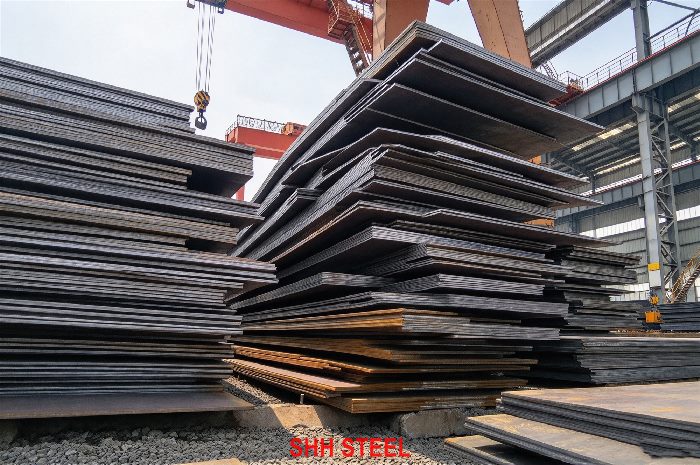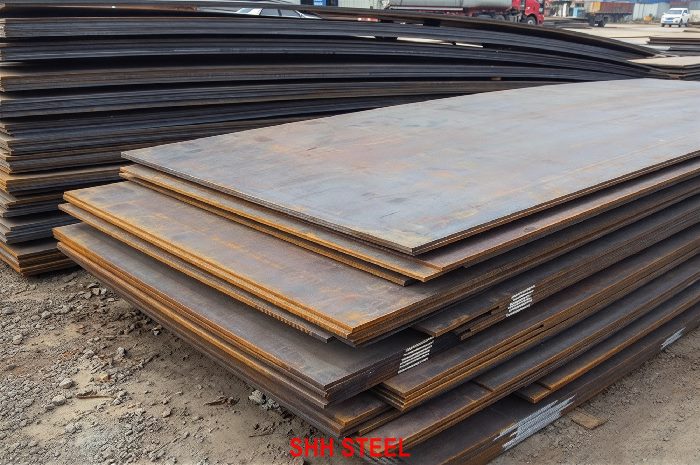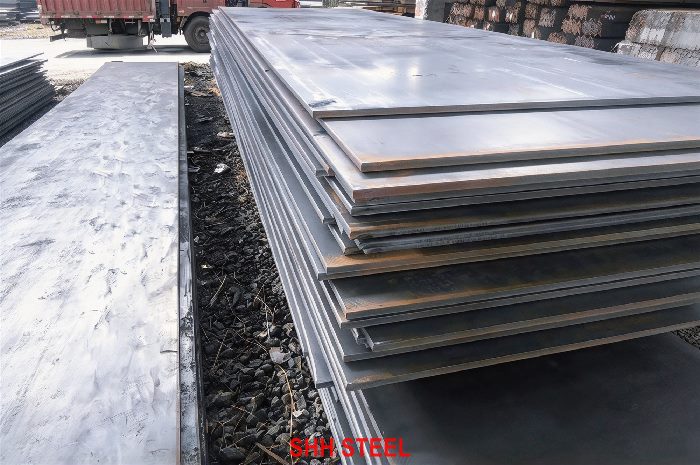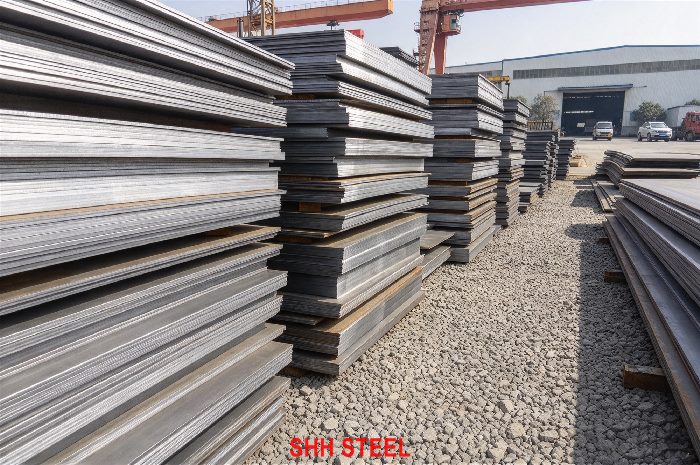
GB/T 19879 Q420GJD Building Steel Plate Supplier
What is GB/T 19879 Q420GJD Building Steel Plate?
Q420GJD, also written Q420GJ-D or Q420 GJD, is hot-rolled steel plate for building structures under GB/T 19879. Q means yield, 420 is the minimum yield in MPa, GJ (gao jian) marks high-performance building steel, and D is the quality grade: Charpy V-notch at −20°C, at least 47 J.
The GJ rules are what the structural engineer is paying for. Q420GJD sets a maximum yield as well as a minimum, caps the yield ratio, limits carbon equivalent by thickness and delivery route, and keeps P and S low. The frame then yields where the designer expects.
Q420GJD is chosen for thick welded nodes at −20°C. Because the D melt caps C at 0.18% and S at 0.010%, it is also the letter we suggest when the order adds Z25 or Z35.
GB/T 19879-2023 replaced GB/T 19879-2015 on 1 April 2024. The 2015 edition capped the Q420GJ yield ratio at 0.83; the 2023 edition sets 0.85. Yield is now ReH and is held at 420–540 MPa to 100 mm, without the old 10 MPa step at 50 mm. Chemistry and the 47 J impact requirement carry over. Sister grades are listed under GB/T 19879, including Q420GJB.
SHH STEEL (Shanghai Shenghonghe Import & Export Co., Ltd.) is a steel manufacturer and exporter and global steel mill sourcing partner, mill-direct, China origin. We ship Q420GJD cut to size with an EN 10204 3.1 or 3.2 certificate.
Material Specification
| Specification element | Requirement | SHH STEEL compliance |
|---|---|---|
| Plate standard | GB/T 19879-2023 Q420GJD (GB/T 19879-2015 when the drawing names it) | Confirmed |
| Thickness for Q420GJ | 6 mm – 150 mm | Confirmed |
| Yield strength | 420 MPa min; 420 – 540 MPa for 16–100 mm | Confirmed |
| Tensile strength | 530 – 680 MPa (to 100 mm) | Confirmed |
| Yield ratio | ≤ 0.85 | Printed on MTC |
| Quality grade | D, Charpy V at −20°C, KV2 ≥ 47 J, longitudinal | Confirmed |
| Delivery condition | CR, NR, N, NT, QT, TMCP or TMCP+T | As ordered |
| Through-thickness | Z15, Z25 or Z35 to GB/T 5313 | As ordered |
| Dimensions | GB/T 709-2019, thickness tolerance Class B | Confirmed |
| Chemistry report | Heat analysis + CEV; product analysis on request | Confirmed |
| Certificate | EN 10204 3.1 or 3.2 | As ordered |
Grades often confused with it are GB/T 1591 Q420D and ASTM A572 Gr.60. None of them carries the GJ yield cap or yield-ratio rule.
Chemical Composition: Heat Analysis and Product Analysis
Two chemistry numbers exist for every Q420GJD plate. The mill reports the heat (ladle) analysis, which must sit inside Table 1. A check analysis drilled from the plate is the product analysis; clause 7.1.4 of GB/T 19879 lets it differ from Table 1 by the GB/T 222 deviations.
Table 1 below is the heat analysis for Q420GJD. The columns on the right show the quality-grade groups at Q420GJ.
Table 1. Heat (ladle) analysis, GB/T 19879-2023 Table 1, %
| Element | Q420GJD heat analysis (%) | Q420GJ B / C | Q420GJ D / E |
|---|---|---|---|
| C, max | 0.18 | 0.20 | 0.18 |
| Si, max | 0.55 | 0.55 | 0.55 |
| Mn, max | 1.70 | 1.70 | 1.70 |
| P, max | 0.020 | 0.025 | 0.020 |
| S, max | 0.010 | 0.015 | 0.010 |
| V, max | 0.200 | 0.200 | 0.200 |
| Nb, max | 0.070 | 0.070 | 0.070 |
| Ti, max | 0.030 | 0.030 | 0.030 |
| Als, min | 0.015 | 0.015 | 0.015 |
| Cr, max | 0.80 | 0.80 | 0.80 |
| Cu, max | 0.30 | 0.30 | 0.30 |
| Ni, max | 1.00 | 1.00 | 1.00 |
| Mo, max | 0.50 | 0.50 | 0.50 |
| V + Nb + Ti, max (if combined) | 0.22 | 0.22 | 0.22 |
Notes to Table 1. Total aluminium (Alt ≥ 0.020%) may replace acid-soluble aluminium. If Al, V, Nb or Ti is added alone or together at 0.015% or more, the minimum aluminium does not apply. V + Nb + Ti, when combined, is limited to 0.22%. These limits are the same in the 2015 and 2023 editions.
B and C grades share one chemistry column. D and E grades tighten carbon to 0.18%, phosphorus to 0.020% and sulfur to 0.010%, because they are tested at −20°C and −40°C.
Table 2. Product analysis limits for Q420GJD, GB/T 19879 clause 7.1.4 with GB/T 222-2025, %
| Element | Heat limit (%) | Permitted deviation, GB/T 222-2025 Table 1 | Q420GJD product analysis limit (%) |
|---|---|---|---|
| C | ≤ 0.18 | +0.02 | ≤ 0.20 |
| Si | ≤ 0.55 | +0.05 | ≤ 0.60 |
| Mn | ≤ 1.70 | +0.06 | ≤ 1.76 |
| P | ≤ 0.020 | +0.005 | ≤ 0.025 |
| S | ≤ 0.010 | +0.005 | ≤ 0.015 |
| V | ≤ 0.200 | +0.02 | ≤ 0.220 |
| Nb | ≤ 0.070 | ±0.005 | ≤ 0.075 (Table 1 lists Nb to 0.060%; agree above that) |
| Ti | ≤ 0.030 | +0.02 | ≤ 0.050 |
| Als | ≥ 0.015 | −0.003 | ≥ 0.012 |
| Cr | ≤ 0.80 | +0.05 | ≤ 0.85 |
| Cu | ≤ 0.30 | +0.05 | ≤ 0.35 |
| Ni | ≤ 1.00 | +0.05 | ≤ 1.05 |
| Mo | ≤ 0.50 | Not listed in Table 1 | Agree in contract (alloy-steel Table 2 would give ≤ 0.52) |
How to read Table 2. The band is chosen by the Table 1 upper limit. Si ≤0.55% is above 0.37%, so +0.05% applies; Mn ≤1.70% falls in the 0.80–1.70% band, so +0.06%. For one heat an element may deviate in one direction only.
GB/T 222-2025 replaced GB/T 222-2006 on 1 December 2025. One more rule from it matters to buyers: if no reliable heat analysis exists, the product analysis must meet the heat limits with no deviation at all (clause 5.6).
Z-grade plate is cleaner still. GB/T 5313-2023 limits sulfur by heat analysis:
| Z grade | Heat sulfur, max (%) | Reduction of area, avg / single (%) |
|---|---|---|
| Z15 | 0.010 | 15 / 10 |
| Z25 | 0.007 | 25 / 15 |
| Z35 | 0.005 | 35 / 25 |
CEV and Pcm are always worked out from the heat analysis, not the product analysis. SHH STEEL prints the heat values used and adds a product-analysis column on request. This is building steel, not boiler chemistry such as GB/T 713 Q345R in GB/T 713.
Mechanical Properties
Values below follow Table 3 and Table 5 of GB/T 19879-2023 for Q420GJ. Tensile specimens are transverse; Charpy specimens are longitudinal.
| Thickness | Upper yield ReH (MPa) | Tensile Rm (MPa) | Yield ratio, max | Elongation A, min |
|---|---|---|---|---|
| 6 – 16 mm | ≥ 420 | 530 – 680 | 0.85 | 20% |
| > 16 – 100 mm | 420 – 540 | 530 – 680 | 0.85 | 20% |
| > 100 – 150 mm | 400 – 520 | 510 – 660 | 0.85 | 20% |
The 2015 edition used lower yield ReL and stepped yield down 10 MPa above 50 mm. Write the edition on the order so the mill tests to the right table.
| Test | Q420GJD requirement |
|---|---|
| Charpy V-notch, longitudinal | −20°C, KV2 ≥ 47 J, average of 3 |
| Single value | One value may fall below the average requirement, not below 70% of it (GB/T 17505) |
| Sub-size specimens | 7.5 mm or 5 mm wide when plate is too thin: 75% or 50% of the required energy |
| 180° bend | Per Table 6 to GB/T 232; may be omitted when the mill guarantees it (7.4.3.2) |
| Through-thickness (≥ 15 mm) | Z15, Z25 or Z35 to GB/T 5313, when ordered |
Density for theoretical weight is 7.85 g/cm³.
Q420GJD vs Q420ND and S420: Choosing 420 MPa Plate for a Building
At 420 MPa three books compete on Chinese and export projects: GB/T 1591, EN 10025 and GB/T 19879. All three start at 420 MPa on thin plate. Only Q420GJD keeps 420 MPa to 100 mm and caps the yield ratio.
For a 70 mm mega-column plate the general grades are effectively 380–390 MPa steel. Designers who sized the column at 420 MPa need GJ plate, or a thicker section.
| Property | Q420ND (GB/T 1591) | S420N / S420M (EN 10025-3/-4) | Q420GJD (GB/T 19879-2023) |
|---|---|---|---|
| Yield at 16 mm | 420 MPa | 420 MPa | 420 MPa |
| Yield at 40–63 mm | 390 MPa min | 390 MPa min | 420 – 540 MPa |
| Yield at 63–80 mm | 380 MPa min | 370 MPa min | 420 – 540 MPa |
| Yield ratio | No limit | No limit | ≤ 0.85 |
| Impact | −20°C (energy per GB/T 1591) | N/M: −20°C; NL/ML: −50°C | −20°C, 47 J |
| Ni / Cr, max | Per grade | Per grade | 1.00 / 0.80% |
| CEV ≤ 50 mm | Per route | Per route | 0.48% (CR/N), 0.44% (QT), 0.41% (TMCP) |
Closest European comparison for this letter: EN 10025-4 S420M. Closest GB/T 1591 comparison: GB/T 1591 Q420ND. Use either for strength checks only; neither is a drop-in GJ substitute.
Q420GJD vs Q390GJD and Q460GJD: Picking the Middle Grade
| Check | Q390GJD | Q420GJD | Q460GJD |
|---|---|---|---|
| Yield, 16–100 mm | 390 – 510 | 420 – 540 | 460 – 590 MPa |
| Tensile | 510 – 660 | 530 – 680 | 570 – 720 MPa |
| Yield ratio | ≤ 0.83 | ≤ 0.85 | ≤ 0.85 |
| Elongation A | 20% | 20% | 18% |
| CEV ≤ 50 mm, CR/N | 0.45% | 0.48% | 0.52% |
| CEV ≤ 50 mm, TMCP | 0.40% | 0.41% | 0.42% |
| Cr / Ni / Cu, max | 0.30 / 0.70 / 0.30 | 0.80 / 1.00 / 0.30 | 1.20 / 1.20 / 0.50 |
Q420GJ is the compromise grade. It gives 30 MPa more than Q390GJ for a 0.03-point CEV rise on CR/N plate, and it avoids the 0.52% CEV of normalized Q460GJ.
If a TMCP mill route is available, Q420GJ at 0.41% CEV welds almost like Q390GJ. Compare Q390GJD and Q460GJD before fixing the design grade.
Q420GJB, Q420GJC, Q420GJD or Q420GJE: Which Quality Grade?
| Grade | Impact temperature | Energy, min | C / P / S max (%) | Typical use |
|---|---|---|---|---|
| Q420GJB | +20°C | 47 J | 0.20 / 0.025 / 0.015 | Heated interiors, mild climates |
| Q420GJC | 0°C | 47 J | 0.20 / 0.025 / 0.015 | Cold regions, exposed frames |
| Q420GJD | −20°C | 47 J | 0.18 / 0.020 / 0.010 | Severe winters, thick welded nodes |
| Q420GJE | −40°C | 47 J | 0.18 / 0.020 / 0.010 | Arctic and low-temperature sites |
Strength, yield ratio and CEV do not change from B to E. Only the impact temperature and the D/E chemistry move. The letter should follow the coldest temperature the steel will see, during erection as well as in service.
Q420GJD is the letter for −20°C design temperatures, and the one we suggest when the plate is thick and restrained. For the same letter at another strength level: one level up, Q460GJD; one level down, Q390GJD.
Q420GJDZ15, Q420GJDZ25 and Q420GJDZ35: Through-Thickness Plate
Lamellar tearing starts inside the plate, parallel to the surface, when a large weld pulls on it through the thickness. Box-column diaphragms and T-joints on thick flanges are the classic cases. A Z grade is the guarantee against it.
The designation adds the Z level to the grade, for example Q420GJDZ25. Z tests apply to plate 15 mm and thicker and follow GB/T 5313-2023.
| Z grade | Heat sulfur, max (%) | Reduction of area, avg / single (%) |
|---|---|---|
| Z15 | 0.010 | 15 / 10 |
| Z25 | 0.007 | 25 / 15 |
| Z35 | 0.005 | 35 / 25 |
The D melt already caps S at 0.010%, the Z15 limit, so Z25 and Z35 are the levels that change the steelmaking.
GB/T 19879-2023 clause 7.6 requires every Z plate to be ultrasonic tested one by one to GB/T 2970, acceptance level III. Z35 costs most: lowest sulfur, more rejects, and a Z test on each plate.
Our advice: mark Z25 or Z35 on the cutting list by member, not on the whole order. Stiffeners and webs rarely need it.
Equivalent Material Grades
S420N and S420M are the usual European pairs for strength checks. ASTM A572 Gr.60 is 415 MPa. JIS has no 420 MPa building steel.
| Designation | Region | Standard | Notes |
|---|---|---|---|
| Q420GJD | China | GB/T 19879-2023 | Grade on this page |
| GB/T 1591 Q420ND | China | GB/T 1591-2018 | Normalized |
| GB/T 1591 Q420MD | China | GB/T 1591-2018 | TMCP |
| EN 10025-4 S420M | Europe | EN 10025-3/-4 | Closest strength match |
| EN 10025-3 S420NL | Europe | EN 10025-3 | Normalized family member |
| ASTM A572 Gr.60 | USA | ASTM A572 | 415 MPa; no impact or ratio rule |
| JIS G3106 SM570 | Japan | JIS G3106 | Higher yield; not a swap |
If a European drawing asks for S420 plate with yield-ratio control, we quote Q420GJD with the ratio printed, or S420 with a contract ratio clause. See EN 10025-3 and EN 10025-4.
Weldability
GB/T 19879 makes the mill calculate CEV from the heat analysis and print it, together with the elements used, on every Q420GJD certificate:
CEV = C + Mn/6 + (Cr + Mo + V)/5 + (Ni + Cu)/15
Pcm = C + Si/30 + Mn/20 + Cu/20 + Ni/60 + Cr/20 + Mo/15 + V/10 + 5B
| Delivery condition | CEV ≤ 50 mm | CEV > 50 – 100 mm | CEV > 100 – 150 mm | Pcm ≤ 50 mm | Pcm > 50 – 100 mm | Pcm > 100 – 150 mm |
|---|---|---|---|---|---|---|
| CR, NR, N, NT | 0.48 | 0.50 | 0.52 | 0.30 | 0.33 | 0.34 |
| QT | 0.44 | 0.47 | 0.49 | 0.28 | 0.30 | 0.31 |
| TMCP, TMCP+T | 0.41 | 0.44 | By agreement | 0.26 | By agreement | — |
Q420GJ spans 0.41% (TMCP) to 0.52% (CR/N, 100–150 mm). Preheat and interpass control are routine on thick plate; heat input needs an upper limit on QT plate to protect HAZ toughness.
The D letter helps: carbon is capped at 0.18% and P and S are lower, which reduces hot-cracking and HAZ embrittlement risk.
Typical consumables: E55-class low-hydrogen electrodes (E5515/E5516) or ER55 wire. Shops work to GB 50661 or AWS D1.1. Write the CEV basis (actual heat, not table maximum) into the WPS.
Heat Treatment and Delivery Condition
Q420GJD may be delivered CR, NR, N or NT, QT, or TMCP / TMCP+T. QT is also permitted. Each route has its own CEV and Pcm limits, so the route is part of the specification, not a mill detail.
TMCP gives the lowest CEV and the best weldability. N or NT gives the most uniform through-thickness properties on heavy plate. QT holds strength in the thickest sizes.
Agree the route before price. A mill quoting N where the drawing assumed TMCP CEV is not quoting the same plate. TMCP references: GB/T 1591 Q420MD; normalized: GB/T 1591 Q420ND.
Test lots follow clause 9.2 of GB/T 19879-2023; retests and judgement follow GB/T 17505.
Dimensions
Q420GJD sizes we supply from mill and stock:
- Thickness: 6 mm – 150 mm; most orders 8 mm – 100 mm
- Width: 1500 mm – 3000 mm standard; wider by mill confirmation
- Length: 3000 mm – 12000 mm; longer by enquiry
- Edge: mill edge or cut edge
- Weight: theoretical, on the mean of maximum and minimum thickness, 7.85 g/cm³
Column flanges, diaphragms, stiffeners and gussets are cut to drawing. Rolled sections for the same frame are under steel beam profiles and steel structural profiles.
Tolerances
Dimensional tolerances for Q420GJD come from GB/T 709-2019, as GB/T 19879 directs. The default is Class B, which fixes the minus side at 0.30 mm. Ask for Class C if the design cannot accept any minus.
| Nominal thickness (mm) | Width ≤ 1500 mm | Width > 1500 – 2500 mm |
|---|---|---|
| > 8 – 15 | −0.30 / +0.80 | −0.30 / +1.00 |
| > 15 – 25 | −0.30 / +1.00 | −0.30 / +1.20 |
| > 25 – 40 | −0.30 / +1.10 | −0.30 / +1.30 |
| > 40 – 60 | −0.30 / +1.30 | −0.30 / +1.50 |
| > 60 – 100 | −0.30 / +1.50 | −0.30 / +1.80 |
| > 100 – 150 | −0.30 / +2.10 | −0.30 / +2.50 |
Flatness and width follow GB/T 709. EN 10029 or ASTM A6 tolerances are possible if written on the order.
Supplementary Requirements
Q420GJD already fixes strength, yield ratio, CEV and −20°C impact. Anything more goes on the purchase order.
- Edition: GB/T 19879-2023 or -2015. Never write only Q420.
- Product analysis: ask for a second chemistry column checked to GB/T 222.
- Through-thickness: add Z15, Z25 or Z35, e.g. Q420GJDZ25.
- Delivery condition: name it (CR, NR, N, NT, QT, TMCP or TMCP+T) if the welding procedure depends on it.
- Ultrasonic testing beyond Z plates: GB/T 2970 class, or EN 10160 / ASTM A578.
- Impact: extra test positions (e.g. quarter thickness) or transverse tests, if the owner wants them beyond the D letter.
- Tolerance: Class C for zero minus.
- Inspection: EN 10204 3.2 with SGS, BV, TÜV or a named inspector.
Q420GJD Price Factors and How to Order
Two Q420GJD quotes can differ by a lot and both be fair. The base price is similar across mills; the extras below are where they part.
| Cost driver | Effect on price |
|---|---|
| GJ grade over general Q420 plate | Grade extra for cleaner steel, yield control and CEV |
| Quality letter D | Extra for −20°C testing and the cleaner D melt |
| Delivery route | QT costs more than TMCP or N |
| Thickness | Thin and very thick plate carry size extras; 10–60 mm is usually cheapest |
| Z15 / Z25 / Z35 | Desulfurization, plate-by-plate Z test and UT; Z35 costs most |
| Width and length | Over 3000 mm wide or 12 m long needs mill confirmation |
| Quantity per size | Mill rolling minimums per size; small lots come from stock or combined rolling |
| Inspection and cutting | 3.2 witness, profile cutting, blasting and priming are quoted per item |
To get a firm quote in one round, send:
- Grade and edition, e.g. Q420GJDZ25 to GB/T 19879-2023
- Thickness × width × length and pieces or tonnes
- Delivery route, UT standard and class
- Certificate type and inspector
- Destination port and Incoterm
We quote plate price, extras and freight line by line, so you can compare like with like. Need a different letter? See Q420GJE.
Applications
| Sector | Typical Q420GJD components |
|---|---|
| Super-tall towers | Mega-column plate, outrigger and belt trusses |
| Long-span structures | Truss chords, hangers, large node plates |
| Transfer floors | Deep transfer girders |
| Seismic frames | Heavy panel zones with Z25/Z35 |
D grade covers severe winters, thick welded nodes and members erected in sub-zero weather.
It is the wrong plate for pressure equipment (pressure vessel steel plates), for bare exposed steel (weathering steel plates) or for ship hulls (shipbuilding steel plates).
Supply Capability and Global Delivery
SHH STEEL sources Q420GJD from first-line building-steel mills: Wuyang (Wugang), a drafting mill of GB/T 19879, plus Xinyu, Valin Xiangtan, Shougang, Puyang and Hongchang when size requires.
- Certificates: EN 10204 3.1 standard; 3.2 with third-party witness
- Tests: tensile, −20°C Charpy, bend, Z test to GB/T 5313, UT to GB/T 2970, product analysis
- Processing: CNC plasma and flame cutting, bevelling, drilling, shot blast and primer
- Terms: FOB Shanghai, CFR, CIF; TT, LC or TT + LC
- Marking: steel-stamped and paint-marked with grade, heat, size and mill
Q420GJD leaves Shanghai for projects designed to Chinese codes abroad, mostly through EPC contractors in Southeast Asia, the Middle East and Africa. We also ship ASTM, ASME, EN, DIN and JIS plate to Europe and the Americas.
Lead time: stock sizes about 5–7 days; mill rolling about 30–45 days; Z35 or 3.2 inspection adds about 1–2 weeks. Sea time from Shanghai is about 7–12 days to Singapore and 28–35 days to Rotterdam.
Why Choose SHH STEEL
SHH STEEL works mill-direct as a steel manufacturer and exporter and global steel mill sourcing partner, China origin. With Q420GJD you get the GJ plate the drawing asks for, traced to the heat.
Before shipment we check four lines on every certificate: yield inside the GJ window, yield ratio within the cap, CEV inside the thickness band for the delivery route, and −20°C impact at 47 J or more. If one fails, the plate does not ship as GJ.
We also tell buyers when they are over-specifying. If the CEV budget is tight, we compare Q390GJD and TMCP Q420GJD side by side. Browse more structural steel plates and high strength low alloy plates.
FAQ
-
What is Q420GJD steel?
- Q420GJD is high-performance building structure steel plate to GB/T 19879. It has 420 MPa minimum yield, a 420–540 MPa yield window from 16 to 100 mm, yield ratio ≤0.85, CEV limits by delivery route and Charpy impact of at least 47 J at −20°C. GJ stands for gao jian, high-performance building steel.
-
Is Q420GJD the same as Q420ND?
- No. Q420ND is GB/T 1591 structural plate whose minimum yield drops below 420 MPa above 16 mm and which has no yield cap or ratio limit. Q420GJD is GB/T 19879 building plate: 420–540 MPa from 16 to 100 mm, yield ratio ≤0.85, CEV limits by delivery route and 47 J at −20°C.
-
When should I specify Q420GJD instead of Q420GJC?
- Specify Q420GJD when the lowest service or erection temperature reaches about −20°C, when plate is thick and heavily restrained, or when Z25/Z35 is ordered. D is tested at −20°C (47 J) and its melt is cleaner: C ≤0.18%, P ≤0.020%, S ≤0.010%, against P 0.025% and S 0.015% for C grade.
-
What is the yield ratio of Q420GJ in the 2023 edition?
- GB/T 19879-2023 caps the Q420GJ yield ratio at 0.85. The 2015 edition set 0.83. If a drawing names the 2015 edition, the tighter 0.83 limit applies.
-
What is the CEV limit of Q420GJD?
- Under GB/T 19879-2023 Table 2, Q420GJD up to 50 mm is capped at CEV 0.48% (CR, NR, N, NT); TMCP plate at 0.41%. CEV = C + Mn/6 + (Cr+Mo+V)/5 + (Ni+Cu)/15, from the heat analysis.
-
What is the ASTM or EN equivalent of Q420GJD?
- No exact equivalent exists. For strength checks Q420GJD is compared with EN 10025-3 S420N, EN 10025-4 S420M and ASTM A572 Gr.60 (415 MPa). These grades have no yield cap and no yield-ratio limit; Q420GJD caps yield at 540 MPa (16–100 mm) and the ratio at 0.85.
Conclusion
Q420GJD steel plate to GB/T 19879 is building structure plate with 420 MPa minimum yield, a capped yield window, a yield-ratio limit and 47 J impact at −20°C. It shares its chemistry with Q420GJB but proves toughness at its own letter. It is not general structural plate under GB/T 1591.
Every Q420GJD plate from SHH STEEL ships with heat analysis, CEV, yield and yield ratio, and Charpy results on an EN 10204 3.1 or 3.2 certificate. Product analysis to GB/T 222, Z15–Z35, UT to GB/T 2970, Class C tolerance and cut-to-size are options.
We ship from Shanghai to buyers worldwide. Browse the full GB/T 19879 range or other carbon steel plates.
Share your size list, Z level, quality letter and the edition on the drawing, and we reply with the mill, delivery route, lead time, test plan and price in one message. Contact SHH STEEL for a mill-direct Q420GJD building steel plate quotation.
Quality Steel Needed? Inquire for Offers
Related Products