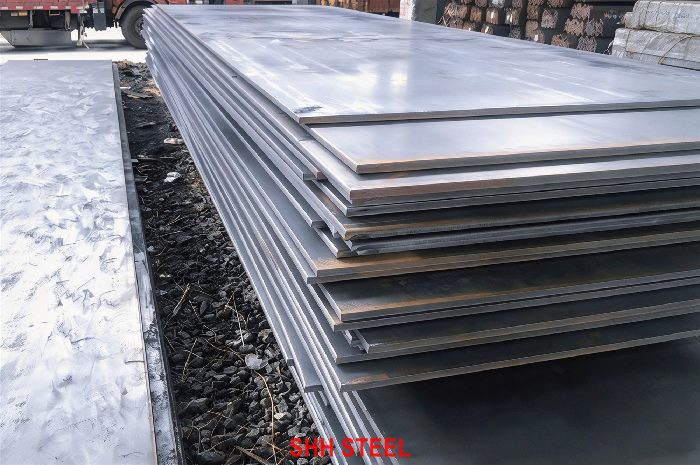
GB/T 19879 Q420GJC Building Steel Plate Supplier
What is GB/T 19879 Q420GJC Building Steel Plate?
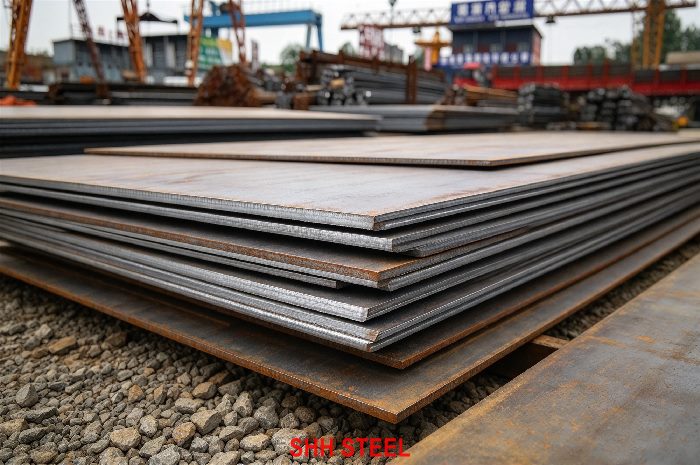
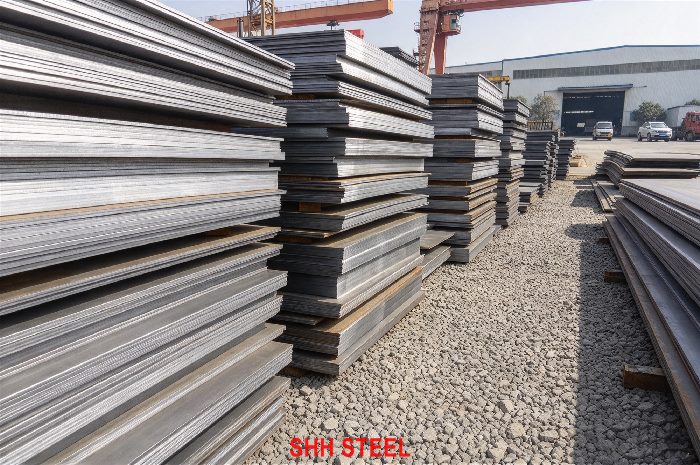
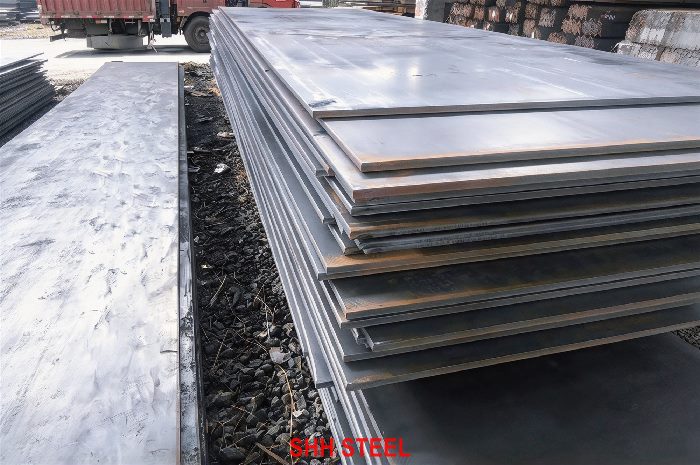
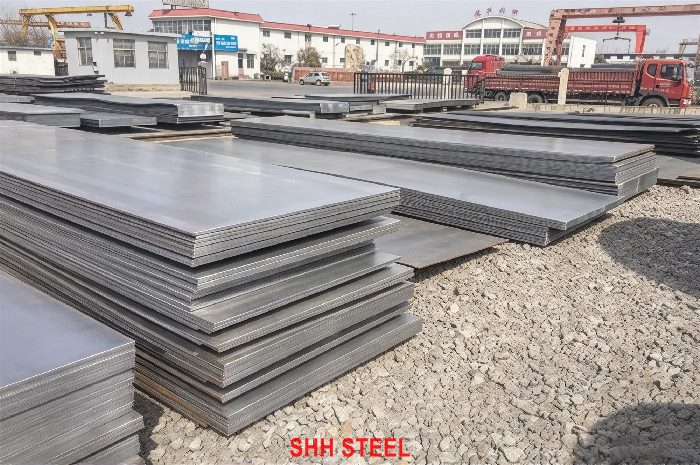
Q420GJC, also written Q420GJ-C or Q420 GJC, is hot-rolled steel plate for building structures under GB/T 19879. Q means yield, 420 is the minimum yield in MPa, GJ (gao jian) marks high-performance building steel, and C is the quality grade: Charpy V-notch at 0°C, at least 47 J.
The GJ rules are what the structural engineer is paying for. Q420GJC sets a maximum yield as well as a minimum, caps the yield ratio, limits carbon equivalent by thickness and delivery route, and keeps P and S low. The frame then yields where the designer expects.
Q420GJC is the 420 MPa grade most often seen on super-tall tower drawings. It sits between Q390GJ and Q460GJ: strong enough to trim mega-column plate thickness, but with a CEV (0.48% to 50 mm in CR/N condition) that most structural shops still weld with standard procedures.
GB/T 19879-2023 replaced GB/T 19879-2015 on 1 April 2024. The 2015 edition capped the Q420GJ yield ratio at 0.83; the 2023 edition sets 0.85. Yield is now ReH and is held at 420–540 MPa to 100 mm, without the old 10 MPa step at 50 mm. Chemistry and the 47 J impact requirement carry over. Sister grades are listed under GB/T 19879, including Q420GJB.
SHH STEEL (Shanghai Shenghonghe Import & Export Co., Ltd.) is a steel manufacturer and exporter and global steel mill sourcing partner, mill-direct, China origin. We ship Q420GJC cut to size with an EN 10204 3.1 or 3.2 certificate.
Material Specification
| Specification element | Requirement | SHH STEEL compliance |
|---|---|---|
| Plate standard | GB/T 19879-2023 Q420GJC (GB/T 19879-2015 when the drawing names it) | Confirmed |
| Thickness for Q420GJ | 6 mm – 150 mm | Confirmed |
| Yield strength | 420 MPa min; 420 – 540 MPa for 16–100 mm | Confirmed |
| Tensile strength | 530 – 680 MPa (to 100 mm) | Confirmed |
| Yield ratio | ≤ 0.85 | Printed on MTC |
| Quality grade | C, Charpy V at 0°C, KV2 ≥ 47 J, longitudinal | Confirmed |
| Delivery condition | CR, NR, N, NT, QT, TMCP or TMCP+T | As ordered |
| Through-thickness | Z15, Z25 or Z35 to GB/T 5313 | As ordered |
| Dimensions | GB/T 709-2019, thickness tolerance Class B | Confirmed |
| Chemistry report | Heat analysis + CEV; product analysis on request | Confirmed |
| Certificate | EN 10204 3.1 or 3.2 | As ordered |
Grades often confused with it are GB/T 1591 Q420NC and ASTM A572 Gr.60. None of them carries the GJ yield cap or yield-ratio rule.
Chemical Composition: Heat Analysis and Product Analysis
GB/T 19879 controls chemistry twice. The heat (ladle) analysis is taken from the melt and must meet Table 1 of the standard. The product analysis is taken from the finished plate and may sit slightly outside Table 1, by the permitted deviations of GB/T 222 (clause 7.1.4). Both are valid acceptance checks, but they are not the same number.
Table 1 below is the heat analysis for Q420GJC. The columns on the right show the quality-grade groups at Q420GJ.
Table 1. Heat (ladle) analysis, GB/T 19879-2023 Table 1, %
| Element | Q420GJC heat analysis (%) | Q420GJ B / C | Q420GJ D / E |
|---|---|---|---|
| C, max | 0.20 | 0.20 | 0.18 |
| Si, max | 0.55 | 0.55 | 0.55 |
| Mn, max | 1.70 | 1.70 | 1.70 |
| P, max | 0.025 | 0.025 | 0.020 |
| S, max | 0.015 | 0.015 | 0.010 |
| V, max | 0.200 | 0.200 | 0.200 |
| Nb, max | 0.070 | 0.070 | 0.070 |
| Ti, max | 0.030 | 0.030 | 0.030 |
| Als, min | 0.015 | 0.015 | 0.015 |
| Cr, max | 0.80 | 0.80 | 0.80 |
| Cu, max | 0.30 | 0.30 | 0.30 |
| Ni, max | 1.00 | 1.00 | 1.00 |
| Mo, max | 0.50 | 0.50 | 0.50 |
| V + Nb + Ti, max (if combined) | 0.22 | 0.22 | 0.22 |
Notes to Table 1. Total aluminium (Alt ≥ 0.020%) may replace acid-soluble aluminium. If Al, V, Nb or Ti is added alone or together at 0.015% or more, the minimum aluminium does not apply. V + Nb + Ti, when combined, is limited to 0.22%. These limits are the same in the 2015 and 2023 editions.
B and C grades share one chemistry column. D and E grades tighten carbon to 0.18%, phosphorus to 0.020% and sulfur to 0.010%, because they are tested at −20°C and −40°C.
Table 2. Product analysis limits for Q420GJC, GB/T 19879 clause 7.1.4 with GB/T 222-2025, %
| Element | Heat limit (%) | Permitted deviation, GB/T 222-2025 Table 1 | Q420GJC product analysis limit (%) |
|---|---|---|---|
| C | ≤ 0.20 | +0.02 | ≤ 0.22 |
| Si | ≤ 0.55 | +0.05 | ≤ 0.60 |
| Mn | ≤ 1.70 | +0.06 | ≤ 1.76 |
| P | ≤ 0.025 | +0.005 | ≤ 0.030 |
| S | ≤ 0.015 | +0.005 | ≤ 0.020 |
| V | ≤ 0.200 | +0.02 | ≤ 0.220 |
| Nb | ≤ 0.070 | ±0.005 | ≤ 0.075 (Table 1 lists Nb to 0.060%; agree above that) |
| Ti | ≤ 0.030 | +0.02 | ≤ 0.050 |
| Als | ≥ 0.015 | −0.003 | ≥ 0.012 |
| Cr | ≤ 0.80 | +0.05 | ≤ 0.85 |
| Cu | ≤ 0.30 | +0.05 | ≤ 0.35 |
| Ni | ≤ 1.00 | +0.05 | ≤ 1.05 |
| Mo | ≤ 0.50 | Not listed in Table 1 | Agree in contract (alloy-steel Table 2 would give ≤ 0.52) |
How to read Table 2. The band is chosen by the Table 1 upper limit. Si ≤0.55% is above 0.37%, so +0.05% applies; Mn ≤1.70% falls in the 0.80–1.70% band, so +0.06%. For one heat an element may deviate in one direction only.
GB/T 222-2025 replaced GB/T 222-2006 on 1 December 2025. One more rule from it matters to buyers: if no reliable heat analysis exists, the product analysis must meet the heat limits with no deviation at all (clause 5.6).
Z-grade plate is cleaner still. GB/T 5313-2023 limits sulfur by heat analysis:
| Z grade | Heat sulfur, max (%) | Reduction of area, avg / single (%) |
|---|---|---|
| Z15 | 0.010 | 15 / 10 |
| Z25 | 0.007 | 25 / 15 |
| Z35 | 0.005 | 35 / 25 |
CEV and Pcm are always worked out from the heat analysis, not the product analysis. SHH STEEL prints the heat values used and adds a product-analysis column on request. This is building steel, not boiler chemistry such as GB/T 713 Q345R in GB/T 713.
Mechanical Properties
Values below follow Table 3 and Table 5 of GB/T 19879-2023 for Q420GJ. Tensile specimens are transverse; Charpy specimens are longitudinal.
| Thickness | Upper yield ReH (MPa) | Tensile Rm (MPa) | Yield ratio, max | Elongation A, min |
|---|---|---|---|---|
| 6 – 16 mm | ≥ 420 | 530 – 680 | 0.85 | 20% |
| > 16 – 100 mm | 420 – 540 | 530 – 680 | 0.85 | 20% |
| > 100 – 150 mm | 400 – 520 | 510 – 660 | 0.85 | 20% |
The 2015 edition used lower yield ReL and stepped yield down 10 MPa above 50 mm. Write the edition on the order so the mill tests to the right table.
| Test | Q420GJC requirement |
|---|---|
| Charpy V-notch, longitudinal | 0°C, KV2 ≥ 47 J, average of 3 |
| Single value | One value may fall below the average requirement, not below 70% of it (GB/T 17505) |
| Sub-size specimens | 7.5 mm or 5 mm wide when plate is too thin: 75% or 50% of the required energy |
| 180° bend | Per Table 6 to GB/T 232; may be omitted when the mill guarantees it (7.4.3.2) |
| Through-thickness (≥ 15 mm) | Z15, Z25 or Z35 to GB/T 5313, when ordered |
Density for theoretical weight is 7.85 g/cm³.
Q420GJC vs Q420C and S420: Choosing 420 MPa Plate for a Building
At 420 MPa three books compete on Chinese and export projects: GB/T 1591, EN 10025 and GB/T 19879. All three start at 420 MPa on thin plate. Only Q420GJC keeps 420 MPa to 100 mm and caps the yield ratio.
For a 70 mm mega-column plate the general grades are effectively 380–390 MPa steel. Designers who sized the column at 420 MPa need GJ plate, or a thicker section.
| Property | Q420C (GB/T 1591) | S420N / S420M (EN 10025-3/-4) | Q420GJC (GB/T 19879-2023) |
|---|---|---|---|
| Yield at 16 mm | 420 MPa | 420 MPa | 420 MPa |
| Yield at 40–63 mm | 390 MPa min | 390 MPa min | 420 – 540 MPa |
| Yield at 63–80 mm | 380 MPa min | 370 MPa min | 420 – 540 MPa |
| Yield ratio | No limit | No limit | ≤ 0.85 |
| Impact | 0°C, 34 J | N/M: −20°C; NL/ML: −50°C | 0°C, 47 J |
| Ni / Cr, max | Per grade | Per grade | 1.00 / 0.80% |
| CEV ≤ 50 mm | Per route | Per route | 0.48% (CR/N), 0.44% (QT), 0.41% (TMCP) |
Closest European comparison for this letter: EN 10025-3 S420N. Closest GB/T 1591 comparison: GB/T 1591 Q420NC. Use either for strength checks only; neither is a drop-in GJ substitute.
Q420GJC vs Q390GJC and Q460GJC: Picking the Middle Grade
| Check | Q390GJC | Q420GJC | Q460GJC |
|---|---|---|---|
| Yield, 16–100 mm | 390 – 510 | 420 – 540 | 460 – 590 MPa |
| Tensile | 510 – 660 | 530 – 680 | 570 – 720 MPa |
| Yield ratio | ≤ 0.83 | ≤ 0.85 | ≤ 0.85 |
| Elongation A | 20% | 20% | 18% |
| CEV ≤ 50 mm, CR/N | 0.45% | 0.48% | 0.52% |
| CEV ≤ 50 mm, TMCP | 0.40% | 0.41% | 0.42% |
| Cr / Ni / Cu, max | 0.30 / 0.70 / 0.30 | 0.80 / 1.00 / 0.30 | 1.20 / 1.20 / 0.50 |
Q420GJ is the compromise grade. It gives 30 MPa more than Q390GJ for a 0.03-point CEV rise on CR/N plate, and it avoids the 0.52% CEV of normalized Q460GJ.
If a TMCP mill route is available, Q420GJ at 0.41% CEV welds almost like Q390GJ. Compare Q390GJC and Q460GJC before fixing the design grade.
Q420GJB, Q420GJC, Q420GJD or Q420GJE: Which Quality Grade?
| Grade | Impact temperature | Energy, min | C / P / S max (%) | Typical use |
|---|---|---|---|---|
| Q420GJB | +20°C | 47 J | 0.20 / 0.025 / 0.015 | Heated interiors, mild climates |
| Q420GJC | 0°C | 47 J | 0.20 / 0.025 / 0.015 | Cold regions, exposed frames |
| Q420GJD | −20°C | 47 J | 0.18 / 0.020 / 0.010 | Severe winters, thick welded nodes |
| Q420GJE | −40°C | 47 J | 0.18 / 0.020 / 0.010 | Arctic and low-temperature sites |
Strength, yield ratio and CEV do not change from B to E. Only the impact temperature and the D/E chemistry move. Pick the letter from the lowest service or erection temperature.
Q420GJC is the usual letter for temperate sites and for frames that see some frost during erection. For the same letter at another strength level: one level up, Q460GJC; one level down, Q390GJC.
Q420GJCZ15, Q420GJCZ25 and Q420GJCZ35: Through-Thickness Plate
Thick plate loaded across its thickness can tear in layers under weld shrinkage. Column flanges at beam-flange welds, diaphragm plates in box columns and base plates under heavy tension are the usual places. A Z grade guarantees ductility in that direction.
The designation adds the Z level to the grade, for example Q420GJCZ25. Z tests apply to plate 15 mm and thicker and follow GB/T 5313-2023.
| Z grade | Heat sulfur, max (%) | Reduction of area, avg / single (%) |
|---|---|---|
| Z15 | 0.010 | 15 / 10 |
| Z25 | 0.007 | 25 / 15 |
| Z35 | 0.005 | 35 / 25 |
B and C chemistry allows S up to 0.015%, so even Z15 needs extra desulfurization.
GB/T 19879-2023 clause 7.6 requires every Z plate to be ultrasonic tested one by one to GB/T 2970, acceptance level III. Z35 costs most: lowest sulfur, more rejects, and a Z test on each plate.
Ask for Z only where the joint needs it. Over-specifying Z35 across a whole order adds cost and lead time without helping the frame.
Equivalent Material Grades
S420N and S420M are the usual European pairs for strength checks. ASTM A572 Gr.60 is 415 MPa. JIS has no 420 MPa building steel.
| Designation | Region | Standard | Notes |
|---|---|---|---|
| Q420GJC | China | GB/T 19879-2023 | Grade on this page |
| GB/T 1591 Q420NC | China | GB/T 1591-2018 | Normalized |
| GB/T 1591 Q420MC | China | GB/T 1591-2018 | TMCP |
| EN 10025-3 S420N | Europe | EN 10025-3/-4 | Closest strength match |
| EN 10025-3 S420NL | Europe | EN 10025-3 | Normalized family member |
| ASTM A572 Gr.60 | USA | ASTM A572 | 415 MPa; no impact or ratio rule |
| JIS G3106 SM570 | Japan | JIS G3106 | Higher yield; not a swap |
If a European drawing asks for S420 plate with yield-ratio control, we quote Q420GJC with the ratio printed, or S420 with a contract ratio clause. See EN 10025-3 and EN 10025-4.
Weldability
GB/T 19879 makes the mill calculate CEV from the heat analysis and print it, together with the elements used, on every Q420GJC certificate:
CEV = C + Mn/6 + (Cr + Mo + V)/5 + (Ni + Cu)/15
Pcm = C + Si/30 + Mn/20 + Cu/20 + Ni/60 + Cr/20 + Mo/15 + V/10 + 5B
| Delivery condition | CEV ≤ 50 mm | CEV > 50 – 100 mm | CEV > 100 – 150 mm | Pcm ≤ 50 mm | Pcm > 50 – 100 mm | Pcm > 100 – 150 mm |
|---|---|---|---|---|---|---|
| CR, NR, N, NT | 0.48 | 0.50 | 0.52 | 0.30 | 0.33 | 0.34 |
| QT | 0.44 | 0.47 | 0.49 | 0.28 | 0.30 | 0.31 |
| TMCP, TMCP+T | 0.41 | 0.44 | By agreement | 0.26 | By agreement | — |
Q420GJ spans 0.41% (TMCP) to 0.52% (CR/N, 100–150 mm). Preheat and interpass control are routine on thick plate; heat input needs an upper limit on QT plate to protect HAZ toughness.
B/C chemistry allows C up to 0.20%. Check actual CEV on the MTC, not the table limit, when setting preheat.
Typical consumables: E55-class low-hydrogen electrodes (E5515/E5516) or ER55 wire. Shops work to GB 50661 or AWS D1.1. Write the CEV basis (actual heat, not table maximum) into the WPS.
Heat Treatment and Delivery Condition
Q420GJC may be delivered CR, NR, N or NT, QT, or TMCP / TMCP+T. QT is also permitted. Each route has its own CEV and Pcm limits, so the route is part of the specification, not a mill detail.
TMCP gives the lowest CEV and the best weldability. N or NT gives the most uniform through-thickness properties on heavy plate. QT holds strength in the thickest sizes.
Agree the route before price. A mill quoting N where the drawing assumed TMCP CEV is not quoting the same plate. TMCP references: GB/T 1591 Q420MC; normalized: GB/T 1591 Q420NC.
Test lots follow clause 9.2 of GB/T 19879-2023; retests and judgement follow GB/T 17505.
Dimensions
Usual Q420GJC supply range from SHH STEEL:
- Thickness: 6 mm – 150 mm; most orders 8 mm – 100 mm
- Width: 1500 mm – 3000 mm standard; wider by mill confirmation
- Length: 3000 mm – 12000 mm; longer by enquiry
- Edge: mill edge or cut edge
- Weight: theoretical, on the mean of maximum and minimum thickness, 7.85 g/cm³
Column flanges, diaphragms, stiffeners and gussets are cut to drawing. Rolled sections for the same frame are under steel beam profiles and steel structural profiles.
Tolerances
GB/T 19879-2023 sends dimensions and shape to GB/T 709-2019. Thickness tolerance is Class B by default: fixed minus 0.30 mm, plus by thickness and width. Class C (zero minus) is available by agreement.
| Nominal thickness (mm) | Width ≤ 1500 mm | Width > 1500 – 2500 mm |
|---|---|---|
| > 8 – 15 | −0.30 / +0.80 | −0.30 / +1.00 |
| > 15 – 25 | −0.30 / +1.00 | −0.30 / +1.20 |
| > 25 – 40 | −0.30 / +1.10 | −0.30 / +1.30 |
| > 40 – 60 | −0.30 / +1.30 | −0.30 / +1.50 |
| > 60 – 100 | −0.30 / +1.50 | −0.30 / +1.80 |
| > 100 – 150 | −0.30 / +2.10 | −0.30 / +2.50 |
Flatness and width follow GB/T 709. EN 10029 or ASTM A6 tolerances are possible if written on the order.
Supplementary Requirements
Q420GJC already fixes strength, yield ratio, CEV and 0°C impact. Anything more goes on the purchase order.
- Edition: GB/T 19879-2023 or -2015. Never write only Q420.
- Product analysis: ask for a second chemistry column checked to GB/T 222.
- Through-thickness: add Z15, Z25 or Z35, e.g. Q420GJCZ25.
- Delivery condition: name it (CR, NR, N, NT, QT, TMCP or TMCP+T) if the welding procedure depends on it.
- Ultrasonic testing beyond Z plates: GB/T 2970 class, or EN 10160 / ASTM A578.
- Impact: extra test positions (e.g. quarter thickness) or transverse tests, if the owner wants them beyond the C letter.
- Tolerance: Class C for zero minus.
- Inspection: EN 10204 3.2 with SGS, BV, TÜV or a named inspector.
Q420GJC Price Factors and How to Order
A Q420GJC price per ton is a base price plus extras. The extras explain most gaps between quotes.
| Cost driver | Effect on price |
|---|---|
| GJ grade over general Q420 plate | Grade extra for cleaner steel, yield control and CEV |
| Quality letter C | Small extra for 0°C testing |
| Delivery route | QT costs more than TMCP or N |
| Thickness | Thin and very thick plate carry size extras; 10–60 mm is usually cheapest |
| Z15 / Z25 / Z35 | Desulfurization, plate-by-plate Z test and UT; Z35 costs most |
| Width and length | Over 3000 mm wide or 12 m long needs mill confirmation |
| Quantity per size | Mill rolling minimums per size; small lots come from stock or combined rolling |
| Inspection and cutting | 3.2 witness, profile cutting, blasting and priming are quoted per item |
To get a firm quote in one round, send:
- Grade and edition, e.g. Q420GJCZ25 to GB/T 19879-2023
- Thickness × width × length and pieces or tonnes
- Delivery route, UT standard and class
- Certificate type and inspector
- Destination port and Incoterm
We quote plate price, extras and freight line by line, so you can compare like with like. Need a different letter? See Q420GJE.
Applications
| Sector | Typical Q420GJC components |
|---|---|
| Super-tall towers | Mega-column plate, outrigger and belt trusses |
| Long-span structures | Truss chords, hangers, large node plates |
| Transfer floors | Deep transfer girders |
| Seismic frames | Heavy panel zones with Z25/Z35 |
C grade suits frames that see winter during erection or in service, and exposed members in temperate climates.
It is the wrong plate for pressure equipment (pressure vessel steel plates), for bare exposed steel (weathering steel plates) or for ship hulls (shipbuilding steel plates).
Supply Capability and Global Delivery
SHH STEEL sources Q420GJC from first-line building-steel mills: Wuyang (Wugang), a drafting mill of GB/T 19879, plus Xinyu, Valin Xiangtan, Shougang, Puyang and Hongchang when size requires.
- Certificates: EN 10204 3.1 standard; 3.2 with third-party witness
- Tests: tensile, 0°C Charpy, bend, Z test to GB/T 5313, UT to GB/T 2970, product analysis
- Processing: CNC plasma and flame cutting, bevelling, drilling, shot blast and primer
- Terms: FOB Shanghai, CFR, CIF; TT, LC or TT + LC
- Marking: steel-stamped and paint-marked with grade, heat, size and mill
We ship GB, ASTM, ASME, EN, DIN and JIS plate to the United States, Europe, the Middle East, Southeast Asia, Africa and South America. Q420GJC mostly goes to EPC contractors building Chinese-code projects abroad.
Lead time: stock sizes about 5–7 days (B/C letters); mill rolling about 30–45 days; Z35 or 3.2 inspection adds about 1–2 weeks. Sea time from Shanghai is about 7–12 days to Singapore and 28–35 days to Rotterdam.
Why Choose SHH STEEL
SHH STEEL is a steel manufacturer and exporter and global steel mill sourcing partner, mill-direct, China origin. For Q420GJC that means real GJ plate at mill price, not relabelled general structural plate.
Before shipment we check four lines on every certificate: yield inside the GJ window, yield ratio within the cap, CEV inside the thickness band for the delivery route, and 0°C impact at 47 J or more. If one fails, the plate does not ship as GJ.
We also tell buyers when they are over-specifying. If the CEV budget is tight, we compare Q390GJC and TMCP Q420GJC side by side. Browse more structural steel plates and high strength low alloy plates.
FAQ
-
What is Q420GJC steel?
- Q420GJC is high-performance building structure steel plate to GB/T 19879. It has 420 MPa minimum yield, a 420–540 MPa yield window from 16 to 100 mm, yield ratio ≤0.85, CEV limits by delivery route and Charpy impact of at least 47 J at 0°C. GJ stands for gao jian, high-performance building steel.
-
Is Q420GJC the same as Q420C?
- No. Q420C is GB/T 1591 structural plate whose minimum yield drops below 420 MPa above 16 mm and which has no yield cap or ratio limit. Q420GJC is GB/T 19879 building plate: 420–540 MPa from 16 to 100 mm, yield ratio ≤0.85, CEV limits by delivery route and 47 J at 0°C.
-
What impact test does Q420GJC require?
- Q420GJC needs Charpy V-notch tests at 0°C on longitudinal specimens, with an average of at least 47 J from three tests. Plate too thin for a full 10 mm specimen is tested at 7.5 mm or 5 mm width, needing 75% or 50% of 47 J. The test applies to plate 6 mm and thicker.
-
Is Q420GJ quenched and tempered?
- It can be, but it does not have to be. GB/T 19879-2023 allows Q420GJ as CR, NR, N or NT, QT, or TMCP/TMCP+T. Each route has its own CEV limit; QT is used mainly on heavy plate.
-
What certificate comes with Q420GJC plate?
- Q420GJC ships with an EN 10204 3.1 mill certificate by default, or 3.2 with third-party witness. It shows heat analysis and the elements used for CEV, yield, tensile, yield ratio, elongation, Charpy at 0°C, delivery condition, and Z and UT results when ordered.
-
What is the ASTM or EN equivalent of Q420GJC?
- No exact equivalent exists. For strength checks Q420GJC is compared with EN 10025-3 S420N, EN 10025-4 S420M and ASTM A572 Gr.60 (415 MPa). These grades have no yield cap and no yield-ratio limit; Q420GJC caps yield at 540 MPa (16–100 mm) and the ratio at 0.85.
Conclusion
Q420GJC steel plate to GB/T 19879 is building structure plate with 420 MPa minimum yield, a capped yield window, a yield-ratio limit and 47 J impact at 0°C. It shares its chemistry with Q420GJB but proves toughness at its own letter. It is not general structural plate under GB/T 1591.
SHH STEEL supplies Q420GJC with heat analysis, CEV, yield ratio and impact on an EN 10204 3.1 or 3.2 certificate, and adds a product analysis checked to GB/T 222 when you need it. Z15, Z25 or Z35, UT to GB/T 2970, Class B or C tolerance, cutting and blasting are available.
We ship from Shanghai to buyers worldwide. Browse the full GB/T 19879 range or other carbon steel plates.
Send the edition, quality letter, Z level and size list; we confirm mill, delivery route, lead time and price in one reply. Contact SHH STEEL for a mill-direct quotation on Q420GJC building steel plate.
Quality Steel Needed? Inquire for Offers
Related Products