GB/T 714 Q345qC Bridge Steel Plate Supplier
What is GB/T 714 Q345qC Bridge Steel Plate?
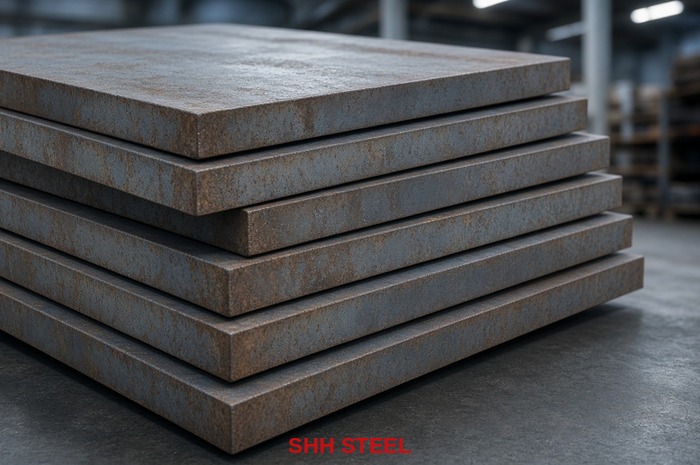
Q345qC is bridge structural steel plate to GB/T 714. Q stands for yield, 345 is the minimum yield in MPa for plate up to 50 mm, q stands for qiao (bridge) and C is the quality grade: Charpy V-notch at 0°C on longitudinal specimens.
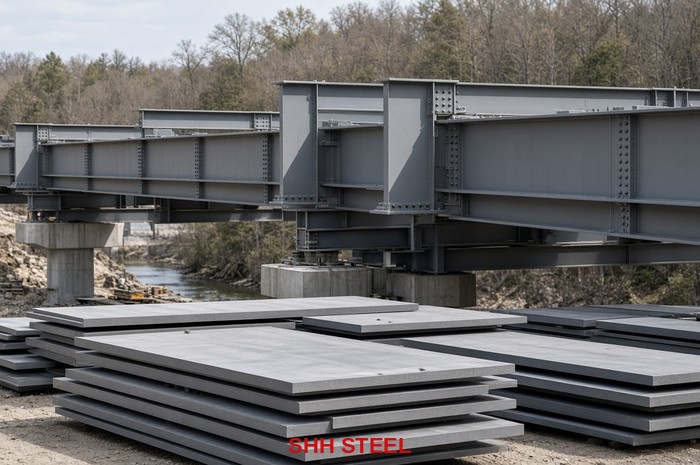
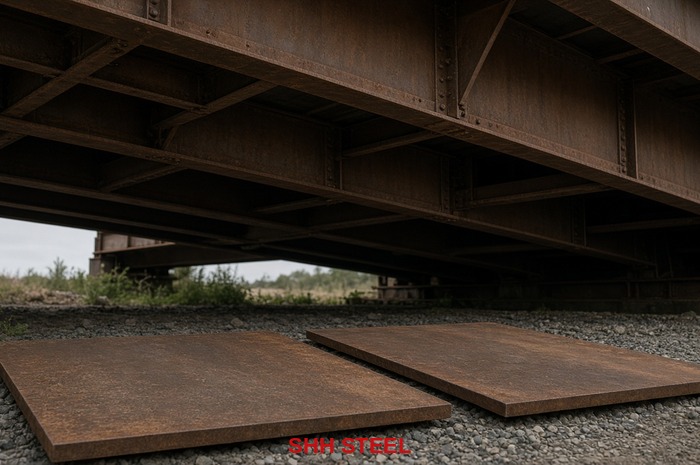
Q345q is the workhorse of Chinese steel bridges: plate girders, box girders, orthotropic deck plate, cross beams and stiffeners on railway and highway spans. Most bridge drawings issued in China still start at Q345q. It has the widest thickness range in GB/T 714 (up to 150 mm) and the lowest carbon-equivalent cap of any TMCP grade.
Q345qC is the plate we ship most often to bridge contractors working in tropical and subtropical regions: Southeast Asia, South Asia, East Africa and the Gulf. The site never sees frost, so a 0°C Charpy is the honest requirement, and the wider P and S limits of the C letter keep the plate economical.
Edition status: GB/T 714-2025 was published on 31 October 2025 and has applied since 1 May 2026. It fully replaces GB/T 714-2015. Orders signed under the 2015 edition can still be certified to it if the contract says so; new orders default to 2025.
SHH STEEL (Shanghai Shenghonghe Import & Export Co., Ltd.) is a steel manufacturer and exporter and global steel mill sourcing partner, mill-direct, China origin. We ship Q345qC cut to size with an EN 10204 3.1 or 3.2 certificate. Sister grades are listed under GB/T 714.
Material Specification
| Specification element | Requirement | SHH STEEL compliance |
|---|---|---|
| Standard | GB/T 714-2025 Q345qC | Confirmed |
| Product | Single-rolled plate ≤150 mm; hot-rolled strip and cut plate ≤25.4 mm | Plate |
| Thickness with tensile values | Up to 150 mm for Q345q | Confirmed |
| Minimum yield ReL | 345 MPa ≤50 mm; 335 MPa >50–100 mm | Confirmed |
| Minimum tensile Rm | 490 MPa ≤100 mm (no upper limit in the standard) | Confirmed |
| Elongation A | ≥ 20% | Confirmed |
| Charpy V-notch | 0°C, 120 J (12–100 mm), longitudinal | Confirmed |
| Delivery condition | TMCP or TMCP + tempering; normalized by agreement for >100–150 mm | As ordered |
| Weldability index | CEV (Table 6) and Pcm (Table 7) | Printed on MTC |
| Ultrasonic testing | Plate >20 mm: GB/T 2970, Class II or better | Every plate |
| Through-thickness | Z15, Z25 or Z35 to GB/T 5313, when ordered | As ordered |
| Dimensions | GB/T 709 | Confirmed |
| Certificate | GB/T 247; EN 10204 3.1 or 3.2 | As ordered |
Grades often compared with Q345qC are ASTM A709 Grade 50, ASTM A709 HPS 50W and EN 10025-4 S355M; the comparison below shows where they differ.
Chemical Composition: Heat Analysis and Product Analysis
A check analysis on finished plate often reads a few hundredths higher than the mill certificate. That is not automatically a failure. The certificate shows the heat (ladle) analysis; plate drilled after rolling is judged as product analysis, with the tolerances of GB/T 222.
Table 1 below is the heat (ladle) analysis for Q345qC from GB/T 714-2025 Tables 1, 2 and 3.
| Element | Q345qC TMCP (%) | Q345q normalized, >100–150 mm (%) |
|---|---|---|
| C, max | 0.14 | 0.18 |
| Si, max | 0.55 | 0.55 |
| Mn | 0.80 – 1.60 | 0.90 – 1.60 |
| P, max | 0.030 | 0.030 |
| S, max | 0.025 | 0.025 |
| Nb | 0.010 – 0.090 | 0.005 – 0.060 |
| V | 0.010 – 0.080 | 0.010 – 0.080 |
| Ti | 0.006 – 0.030 | 0.006 – 0.030 |
| Als | 0.010 – 0.045 | 0.010 – 0.045 |
| Cr, max | 0.30 | 0.30 |
| Ni, max | 0.30 | 0.30 |
| Cu, max | 0.30 | 0.30 |
| Mo, max | — | — |
| N, max | 0.0080 | 0.0080 |
| B, max | 0.0005 residual (≤0.0014 if C ≤0.10%) | 0.0005 residual |
| H, max | 0.0002 | 0.0002 |
Nb, V, Ti and Al may be added singly or together. Added singly, each must meet the range above; added together, at least one must reach its minimum and Nb + V + Ti ≤ 0.22%.
Table 2 is the product analysis: the limits a check analysis on finished plate is judged against. GB/T 714-2025 clause 7.1.3 calls up GB/T 222 for the permitted deviations.
| Element | Heat limit (%) | Deviation, GB/T 222-2025 Table 1 | Q345qC product analysis (%) |
|---|---|---|---|
| C | ≤ 0.14 | +0.02 | ≤ 0.16 |
| Si | ≤ 0.55 | +0.05 | ≤ 0.60 |
| Mn | 0.80 – 1.60 | ±0.06 | 0.74 – 1.66 |
| P | ≤ 0.030 | +0.005 | ≤ 0.035 |
| S | ≤ 0.025 | +0.005 | ≤ 0.030 |
| V | 0.010 – 0.080 | +0.02 / −0.01 | ≤ 0.100 |
| Ti | 0.006 – 0.030 | +0.02 / −0.01 | ≤ 0.050 |
| Nb | 0.010 – 0.090 | ±0.005 (listed for 0.015–0.060%) | Above 0.060%: agree in contract |
| Cr | ≤ 0.30 | +0.05 | ≤ 0.35 |
| Ni | ≤ 0.30 | +0.05 | ≤ 0.35 |
| Cu | ≤ 0.30 | +0.05 | ≤ 0.35 |
| Als | 0.010 – 0.045 | ±0.003 | Lower limit −0.003 (Table 1 row is for Al ≥0.015%; confirm) |
| Mo | — | Not listed in Table 1 | — |
| N | ≤ 0.0080 | Listed only for 0.010–0.020% | Agree in contract |
How to read Table 2. Q345q TMCP heats are low-alloy steel, so Table 1 of GB/T 222 applies. Si ≤0.55% is above 0.37%, so +0.05% applies; Mn falls in the 0.80–1.70% band, so ±0.06%. For one heat, an element may deviate in one direction only.
Mechanical Properties
Tensile values follow Table 9 of GB/T 714-2025 for Q345q. Tensile specimens are transverse; round specimens are used above 40 mm. Where yield is not distinct, Rp0.2 replaces ReL.
| Nominal thickness | ReL min (MPa) | Rm min (MPa) | A min |
|---|---|---|---|
| ≤ 50 mm | 345 | 490 | 20% |
| > 50 – 100 mm | 335 | 490 | 20% |
| > 100 – 130 mm | 305 | 430 | 20% |
| > 130 – 150 mm | 305 | 430 | 20% |
Impact values follow Table 10, on longitudinal specimens, average of three:
| Letter / test temperature | KV2 ≤12 mm | KV2 >12 – 100 mm | KV2 >100 – 150 mm |
|---|---|---|---|
| C / 0°C | 80 J | 120 J | 55 J |
One single value may fall below the required average, but not below 70% of it. Plate over 8 mm and under 12 mm is tested with 7.5 mm specimens (75% of the value); 6–8 mm plate with 5 mm specimens (50%). Plate under 6 mm is not impact tested.
180° bend test, transverse: mandrel D = 2a up to 16 mm and 3a above 16 mm; may be omitted when the mill guarantees it. Yield ratio is not mandatory. If the contract asks for it, Annex C recommends ReL/Rm ≤ 0.88 up to 12 mm and ≤ 0.85 above 12 mm for TMCP plate.
Q345qC / Q345qD / Q345qE: Which Quality Grade?
Q345qC is tested at 0°C. It suits bridges in southern China, Southeast Asia, the Middle East and other sites where the lowest service temperature stays around 0°C or above. C is the base letter for Q345q, Q370q and Q390q. It suits warm-climate bridges and keeps the melt within P ≤0.030% and S ≤0.025%, the widest limits in GB/T 714.
| Grade | Test temp. | KV2 ≤12 mm | KV2 12–100 mm | KV2 >100 mm | P / S max (%) |
|---|---|---|---|---|---|
| Q345qC | 0°C | 80 J | 120 J | 55 J | 0.030 / 0.025 |
| Q345qD | −20°C | 80 J | 120 J | 47 J | 0.025 / 0.015 |
| Q345qE | −40°C | 80 J | 120 J | 31 J | 0.020 / 0.010 |
The 120 J requirement for 12–100 mm plate is the same for C, D and E; only the test temperature and the P/S caps change. The value drops only above 100 mm (55 / 47 / 31 J).
Q345qC: What Changed from GB/T 714-2015 to GB/T 714-2025
For Q345qC buyers the 2025 edition changes more than the year on the certificate. The points below come from the foreword of GB/T 714-2025 and its tables.
- The Mn range for TMCP steel was revised: the minimum is now 0.80%, and the maximum may be raised to 2.00% by agreement.
- CEV and Pcm limits were revised (Tables 6 and 7).
- Normalized grades were dropped except for plate over 100 mm by agreement.
- Tensile strength is now banded by thickness (e.g. lower minimum Rm above 100 mm) instead of one value.
- Impact energy is set by thickness band (≤12 mm, 12–100 mm, >100 mm) in Table 10.
- Yield ratio is no longer a clause value; it is agreed in the contract, with recommendations in informative Annex C.
- Section products were removed; the standard now covers plate and strip only.
- Delivery is TMCP, TMCP + tempering or QT; normalizing is kept only for Q345q/Q370q plate over 100 mm by agreement.
If a drawing cites 2015 and the plate is made to 2025, get the designer’s written acceptance; tensile strength above 100 mm and the yield-ratio basis differ.
Q345qC vs ASTM A709 and EN 10025: Which Grade Matches?
Can Q345qC replace a US or European bridge grade, or the other way round? Strength can match; toughness rules differ in kind, not only in number.
| Property | Q345qC | ASTM A709 Grade 50 | ASTM A709 HPS 50W | EN 10025-4 S355M |
|---|---|---|---|---|
| Min. yield (MPa) | 345 (≤50 mm) | 345 | 345 | 355 (≤16 mm) |
| Tensile (MPa) | 490 min | 450 min | 485 min | 470 – 630 |
| Charpy | 120 J at 0°C (12–100 mm) | CVN by temperature zone and member type (T / F) | CVN by temperature zone; fracture-critical (F) levels | 40 J at −20°C |
| Weathering chemistry | No | No | Yes | No |
ASTM A709 sets Charpy requirements by temperature zone (1, 2, 3) and by member type: non-fracture-critical (T) or fracture-critical (F). GB/T 714 sets one value per letter, so compare the A709 zone with the GB/T 714 test temperature, not grade with grade.
EN 10025-3/-4/-6 grades show yield at the thinnest band; their values fall with thickness. GB/T 714 keeps 345 MPa to 50 mm. EN tensile ranges have upper limits; GB/T 714 gives minimums only.
The 120 J requirement in GB/T 714 for 12–100 mm plate is several times the 27–40 J typical of general structural grades. That margin is the main reason bridge owners specify Q345qC rather than GB/T 1591 plate.
Q345qC Delivery Condition: TMCP vs Normalized vs Quenched and Tempered
GB/T 714-2025 clause 3.2 defines TMCP as rolling with the final deformation in a controlled temperature range, including accelerated cooling with or without tempering (self-tempering included) but excluding direct quenching and quench-and-temper. The delivery route must be stated on the certificate.
| Route | Available for Q345qC | Weldability index | Notes |
|---|---|---|---|
| TMCP | Yes, standard | CEV (C >0.12%) or Pcm (C ≤0.12%) | C ≤0.14%; most plate up to 100 mm |
| TMCP + tempering | Yes | Same as TMCP | Used to relieve stresses or tune yield ratio |
| Normalized | Only >100–150 mm, by agreement | CEV by agreement | C ≤0.18%; heavy plate only |
| Quenched and tempered | Not listed | — | Not a GB/T 714 route at this level |
For Q345q we supply TMCP as standard. Normalized plate makes sense only for heavy sections over 100 mm, where accelerated cooling gives less benefit; CEV is then agreed in the contract. For C-letter plate, plain TMCP is normally the most economical route.
Ask for the route on the purchase order. It changes the weldability index, the welding procedure and, for heavy plate, the price of Q345qC.
Welding Q345qC and Fatigue in Bridge Girders
GB/T 714-2025 clause 7.1.2 uses CEV for normalized, QT and TMCP steel with C >0.12%, and Pcm for weathering steel and TMCP steel with C ≤0.12%, both from the heat analysis:
CEV = C + Mn/6 + (Cr + Mo + V)/5 + (Ni + Cu)/15
Pcm = C + Si/30 + Mn/20 + Cu/20 + Ni/60 + Cr/20 + Mo/15 + V/10 + 5B
| Index | ≤50 mm | >50–100 mm | >100–130 mm |
|---|---|---|---|
| CEV, TMCP, C >0.12% (Table 6) | ≤ 0.38 | ≤ 0.40 | by agreement |
| Pcm, TMCP (Table 7) | ≤ 0.20 | ≤ 0.20 | ≤ 0.20 |
| CEV, normalized | — | — | By agreement |
Preheat for Q345qC is set by the qualified welding procedure, from the actual index on the certificate, plate thickness, restraint and hydrogen level. Lower actual values than the table caps save preheat time on large girders. At 0°C, heat-affected-zone toughness is rarely the limiting factor; heat input can follow productive submerged-arc practice within the qualified range.
Typical consumables for Q345qC: E50-class low-hydrogen electrodes (AWS E7018 type) and matching SAW wire/flux.
Fatigue. Welded details govern fatigue life in a bridge, and their fatigue strength is set by detail category, not by yield strength. Higher-strength plate can carry higher stress ranges only if detailing improves too.
Fatigue design follows JTG D64 (highway) and TB 10091 (railway) in China, EN 1993-1-9 in Europe and AASHTO LRFD in the US; fabrication commonly follows TB 10212, JTG/T 3650 or AWS D1.5.
Q345qCZ15, Z25 and Z35: Through-Thickness Plate for Bridges
Bridge node plates, anchor boxes and pylon walls take weld shrinkage through their thickness. If the plate holds sulfide stringers, it can tear in steps under the weld. Z grades prove through-thickness ductility.
GB/T 714 adds the Z level to the end of the designation, for example Q345qCZ25. The test and acceptance follow GB/T 5313 and apply to plate 15 mm and thicker.
| Z grade | Heat sulfur, max (%) | Reduction of area, avg / single (%) |
|---|---|---|
| Z15 | 0.010 | 15 / 10 |
| Z25 | 0.007 | 25 / 15 |
| Z35 | 0.005 | 35 / 25 |
C chemistry allows S up to 0.025%, so any Z grade needs a deliberate low-sulfur heat; we order those plates as Z heats from the start.
Put Z only where the joint needs it, usually node plates, anchor boxes and diaphragm-to-flange joints over about 25 mm. Keep the rest standard Q345qC. Z options apply across the GB/T 714 bridge steel range.
Equivalent Material Grades
Annex B of GB/T 714-2025 lists foreign grades against each strength level. It is informative: it tells you which families are close, not that the plates are interchangeable.
| Standard | Grade(s) | Fit for Q345qC |
|---|---|---|
| ASTM A709 | ASTM A709 Grade 50, ASTM A709 Grade 50W, ASTM A709 HPS 50W | Listed in Annex B |
| EN 10025-3 | EN 10025-3 S355N, EN 10025-3 S355NL | Listed in Annex B |
| EN 10025-4 | EN 10025-4 S355M, EN 10025-4 S355ML | Listed in Annex B |
| GB/T 1591 | GB/T 1591 Q355MC | General structural, lower impact |
| JIS G3106 | JIS G3106 SM490C | Closest by strength |
Before substituting, compare three things line by line: minimum yield at the actual thickness, the impact test temperature and energy, and the weldability index. For Q345qC, the 120 J impact level and the Pcm/CEV caps are usually the hardest to match.
Q345qC Testing, UT and Certificate
A batch of Q345qC is one grade, one heat, one thickness, one rolling schedule and one heat-treatment condition, up to 60 t. Table 12 of GB/T 714-2025 sets the tests:
| Test | Frequency | Method |
|---|---|---|
| Heat analysis | 1 per heat | GB/T 20066; GB/T 4336 / GB/T 223 |
| Tensile | 1 per batch | GB/T 2975 / GB/T 228.1 |
| Bend 180° | 1 per batch (may be waived if guaranteed) | GB/T 232 |
| Charpy V at 0°C | 3 specimens per batch | GB/T 229 |
| Through-thickness (Z) | 3 specimens per batch, when ordered | GB/T 5313 |
| Ultrasonic | Every plate >20 mm, Class II or better | GB/T 2970 |
| Surface and dimensions | Every plate | Visual and gauges |
Impact retest: if a set fails, three more specimens are taken from the same batch. The average of all six must meet the requirement; two values may be below it, but only one below 70%. At 0°C, impact retests are uncommon, so C-letter batches rarely delay shipment.
Dimensions
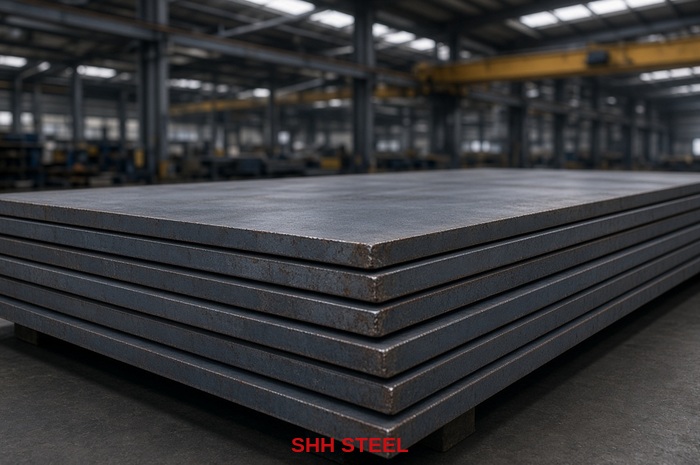
Usual Q345qC supply range from SHH STEEL:
- Thickness: 6 mm – 150 mm under GB/T 714 tensile tables; most orders 8 – 60 mm
- Width: 1500 – 4000 mm, depending on mill and thickness
- Length: 6000 – 18000 mm; longer by enquiry
- Edge: mill edge or cut edge
- Weight: theoretical, 7.85 g/cm³
Deck plate, webs, flanges, diaphragms and stiffeners are cut to drawing. For U-ribs and rolled sections on the same bridge, see steel beam profiles and steel structural profiles.
Tolerances
GB/T 714-2025 clause 7.6 sends dimensions and shape to GB/T 709. Thickness tolerance is Class B by default: −0.30 mm fixed, plus side by thickness and width.
| Nominal thickness (mm) | Width ≤ 1500 mm | Width > 1500 – 2500 mm |
|---|---|---|
| > 8 – 15 | −0.30 / +0.80 | −0.30 / +1.00 |
| > 15 – 25 | −0.30 / +1.00 | −0.30 / +1.20 |
| > 25 – 40 | −0.30 / +1.10 | −0.30 / +1.30 |
| > 40 – 60 | −0.30 / +1.30 | −0.30 / +1.50 |
| > 60 – 100 | −0.30 / +1.50 | −0.30 / +1.80 |
| > 100 – 150 | −0.30 / +2.10 | −0.30 / +2.50 |
Bridge fabricators often ask for Class C (zero minus) on deck and flange plate so section properties are never under the design value. Wider plates follow the heavier GB/T 709 rows; we state them on the offer.
Q345qC Price Factors and How to Order
A Q345qC price per ton is a base price plus extras. The extras explain most gaps between quotes.
| Cost driver | Effect on price |
|---|---|
| Strength level Q345q | Higher levels need more alloy and tighter rolling control |
| Quality letter | Lowest letter extra; 0°C testing |
| Delivery route | TMCP / TMCP+T (N >100 mm by agreement) |
| Thickness | Over 60 mm and under 10 mm carry size extras |
| Z15 / Z25 / Z35 | Low-sulfur heat, Z test, UT; Z35 costs most |
| Width and length | Over 3000 mm wide or 15 m long needs mill confirmation |
| Quantity per size | Mill minimums per heat and size |
| Inspection and processing | 3.2 witness, profile cutting, blasting, priming quoted per item |
To get a firm quote in one round, send:
- Grade, edition and Z level, e.g. Q345qCZ25 to GB/T 714-2025
- Thickness × width × length and pieces or tonnes
- Delivery route and UT class if beyond Class II
- Certificate type and inspector
- Destination port and Incoterm
We quote plate price, extras and freight line by line. Need another letter? See Q345qD, Q345qE.
Applications
| Sector | Typical Q345qC components |
|---|---|
| Highway bridges | Steel box girders, I-girders, orthotropic deck plate, U-ribs, diaphragms |
| Railway bridges | Plate girders, truss chords and diagonals, gusset plates, bearing stiffeners |
| Urban viaducts | Curved box girders, pier caps, steel-concrete composite girders |
| Pedestrian bridges | Box sections, cable anchor plates |
| Long-span bridges | Secondary members, cross frames, deck plate on cable-stayed spans |
The letter C suits bridges in southern China, Southeast Asia, the Middle East and other sites where the lowest service temperature stays around 0°C or above.
It is the wrong plate for pressure equipment (pressure vessel steel plates), unpainted exposure (weathering steel plates) or ship hulls (shipbuilding steel plates).
Supply Capability and Global Delivery
SHH STEEL sources Q345qC from first-line bridge-plate mills, including drafters of GB/T 714-2025 such as Ansteel, Valin Xiangtan, Jiangyin Xingcheng, Wuyang, Shougang and Xinyu.
- Certificates: EN 10204 3.1 standard; 3.2 with third-party witness (SGS, BV, TÜV or owner’s inspector)
- Tests: tensile, 0°C Charpy, bend, Z test, UT, product analysis
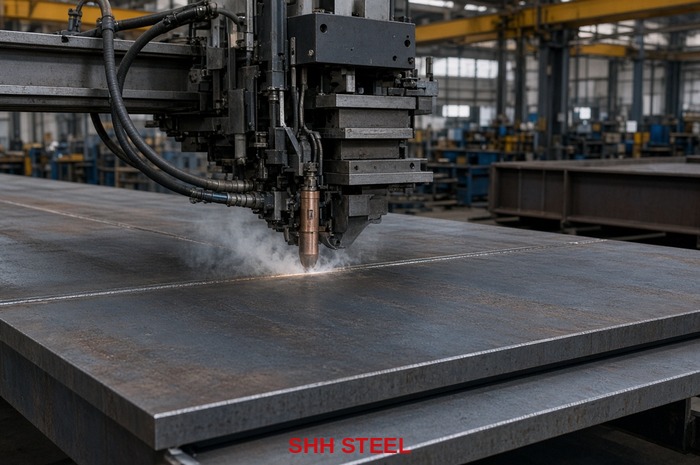
- Processing: CNC plasma and flame cutting, bevelling, drilling, shot blasting and priming
- Terms: FOB Shanghai, CFR, CIF; TT, LC or TT + LC
- Marking: steel-stamped and paint-marked with grade, heat, size and mill, per GB/T 247
We ship GB, ASTM, EN and JIS plate to the Americas, Europe, the Middle East, Southeast Asia and Africa. Q345qC mostly goes to EPC contractors building bridges to Chinese codes abroad.
Lead time: about 30–45 days from mill rolling; Z35, F letter or 3.2 inspection adds about 1–2 weeks. Sea time from Shanghai is about 7–12 days to Southeast Asia and 28–35 days to North Europe.
Why Choose SHH STEEL
SHH STEEL is a steel manufacturer and exporter and global steel mill sourcing partner, mill-direct, China origin. For Q345qC that means bridge plate from bridge-plate mills, not relabelled structural plate.
Before shipment we check four lines on every Q345qC certificate: yield and tensile for the actual thickness band, Charpy at 0°C, the CEV or Pcm for the delivery route, and UT results. If one fails, the plate does not ship as Q345qC.
If the drawing says Q345qC but the girders are erected in a cold season or carry plate over 60 mm, ask the designer whether Q345qD is wiser. The price step from C to D is small next to a fracture investigation.
We also tell buyers when another grade fits better. Neighbouring levels are Q370qC. The weathering counterpart is Q345qNHD. Browse more structural steel plates and high strength low alloy plates.
FAQ
-
What is Q345qC steel?
- Q345qC is bridge structural steel plate to GB/T 714-2025. It has 345 MPa minimum yield up to 50 mm, 490 MPa minimum tensile, 20% elongation and Charpy V-notch impact of 120 J at 0°C for 12–100 mm plate. It is delivered TMCP or TMCP + tempering, with normalizing allowed above 100 mm by agreement.
-
What is the difference between Q345qC and Q345qD?
- Strength and chemistry box are the same. Q345qC is Charpy tested at 0°C, Q345qD at −20°C, both needing 120 J for 12–100 mm plate. P/S caps are 0.030/0.025% for C and 0.025/0.015% for D. Choose by the lowest service or erection temperature.
-
What is the yield strength of Q345qC?
- Q345qC has a minimum lower yield strength of 345 MPa up to 50 mm and 335 MPa from 50 to 100 mm, and 305 MPa from 100 to 130 mm (GB/T 714-2025 Table 9). Minimum tensile is 490 MPa up to 100 mm. There is no upper tensile limit in the standard.
-
What is the ASTM or EN equivalent of Q345qC?
- Close grades for Q345qC: ASTM A709 Grade 50, 50W, HPS 50W / EN 10025-3 S355N, S355NL / EN 10025-4 S355M, S355ML. These are close families, not drop-in substitutes; compare yield at thickness, impact temperature and energy, and the weldability index before substituting.
-
Is GB/T 714-2015 still valid?
- No. GB/T 714-2025 was published on 31 October 2025 and took effect on 1 May 2026, fully replacing GB/T 714-2015. Contracts that still cite the 2015 edition can be certified to it, but new orders default to the 2025 edition.
-
Does steel grade affect fatigue life of a Q345qC bridge girder?
- Very little. Fatigue life of welded bridge details is governed by the detail category and stress range, not by yield strength. Higher-strength plate raises working stress, so detailing and weld quality must improve to keep the same fatigue life.
Conclusion
Q345qC to GB/T 714-2025 is bridge plate with 345 MPa minimum yield, 490 MPa minimum tensile and 120 J Charpy at 0°C for 12–100 mm plate.
The next strength level is Q370qC, with Q345qD and Q345qE as sister letters. Choose the letter from the lowest service or erection temperature, here 0°C, and step up a letter for thick, restrained or fracture-critical members.
SHH STEEL supplies Q345qC with heat analysis, Pcm or CEV, tensile and Charpy results on an EN 10204 3.1 or 3.2 certificate, and adds product analysis to GB/T 222 when you need it.
We ship from Shanghai to bridge builders worldwide. Browse the full GB/T 714 range or other high strength low alloy plates.
Send the edition, quality letter, Z level and size list; we confirm mill, delivery route, lead time and price in one reply. Contact SHH STEEL for a mill-direct quotation on Q345qC bridge steel plate.
Quality Steel Needed? Inquire for Offers
Related Products