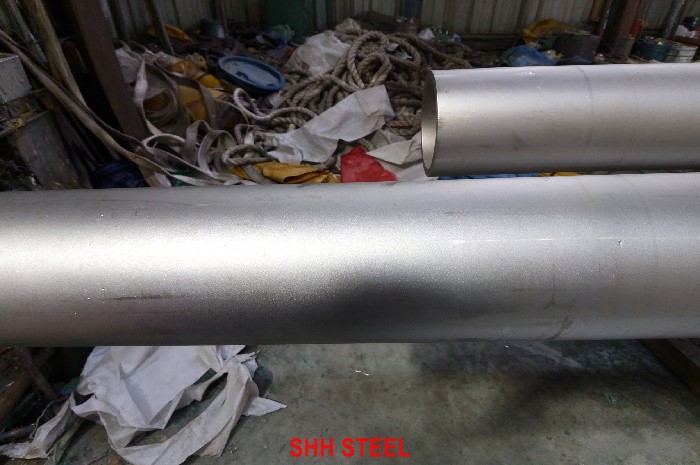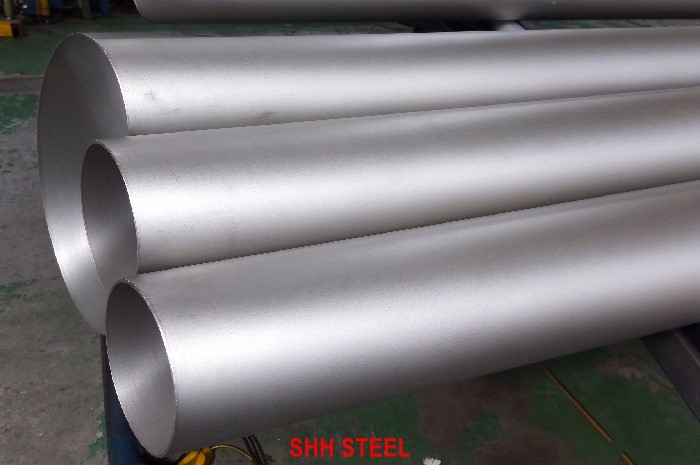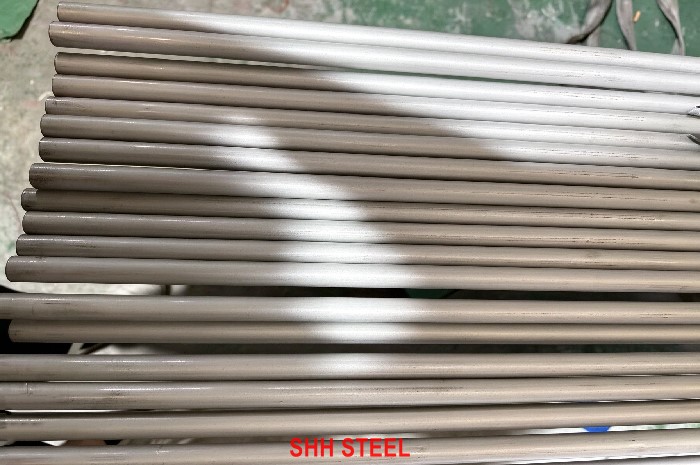
ASTM A312 UNS S31277 Stainless Steel Pipe
What is ASTM A312 UNS S31277 Stainless Steel Pipe
ASTM A312/A312M is the ASTM product specification for seamless, welded and heavily cold-worked austenitic stainless steel pipe intended for high-temperature and general corrosive service. It is a standard in its own right, maintained by ASTM, and this page is written against A312/A312M for UNS S31277, with every number taken from the A312 tables. ASME publishes a separate Code standard, SA-312, which is a different document even where its text runs parallel, so the two titles should not be treated as synonyms on a purchase order.
Within A312, UNS S31277 is a 7% molybdenum superaustenitic grade listed by UNS number only, with no TP designation. Table 1 sets C ≤0.020%, Mn ≤3.00%, Si ≤0.50%, Cr 20.5–23.0%, Ni 26.0–28.0%, Mo 6.5–8.0%, N 0.30–0.40% and Cu 0.50–1.50%. Table 4 requires 112 ksi [770 MPa] tensile and 52 ksi [360 MPa] yield, with elongation of 40% longitudinal minimum, a special Table 4 group shared with N08925, N08028 and N08029, and Table 2 calls for a solution anneal at 2050 °F [1120 °C] minimum followed by rapid cooling. This is its own Table 2 listing, distinct from the 2100 °F [1150 °C] used for S31254 and S31266, so the MTC should quote the S31277 row specifically.
S31277 pushes molybdenum to 6.5–8.0%, the highest Mo window among the stainless grades in this A312 series, and supports it with 26.0–28.0% nickel and 0.30–0.40% nitrogen. Chromium at 20.5–23.0% and copper at 0.50–1.50% complete a chemistry that sits close to the nickel-alloy boundary while still being specified as stainless pipe under A312.
Its Table 4 row is equally distinctive: 112 ksi [770 MPa] tensile and 52 ksi [360 MPa] yield, with a 40% longitudinal elongation requirement instead of the usual 35%. That ductility figure catches people out at receiving, because a test report that would pass a 316L order can fail S31277 on elongation alone. Check that the mill’s test plan quotes the right row before the pipe is made.
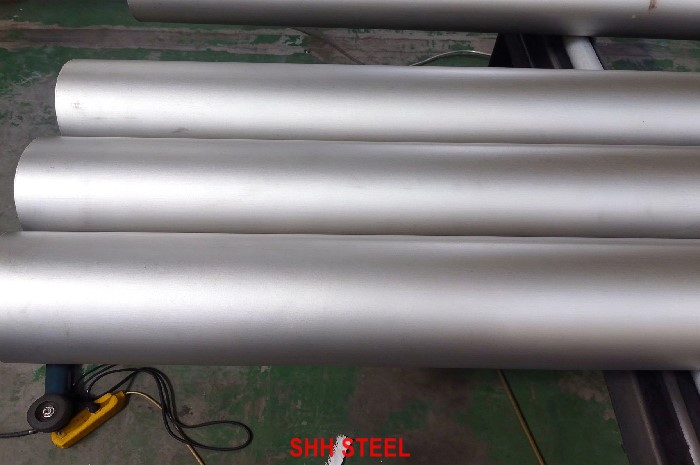
SHH STEEL can supply ASTM A312 UNS S31277 stainless steel pipe as seamless (SML), welded (WLD) or heavily cold-worked (HCW) product, in ASME B36.19 schedules or special OD and wall combinations, with EN 10204 3.1 mill test certificates showing the full Table 1 analysis, the Table 4 results and the anneal actually applied. Third-party 3.2 inspection is arranged when the enquiry names the agency. If a project also needs ASME SA-312 marking for Code piping, we arrange dual marking only when the purchase order asks for it; the separate ASME-framed page for this grade is SA312 UNS S31277.
In the market this chemistry may appear as proprietary 27Ni-7Mo superaustenitic brands; no reliable EN number is quoted here. Those labels are useful in conversation but carry no acceptance value; the pipe is UNS S31277 only when the heat certificate matches Table 1 line by line. Buyers comparing options within the ASTM series usually look next at A312 UNS S31254, A312 UNS S31266, A312 UNS S32053, A312 TP317L and A312 TP316L, and the full grade list sits on the A312/A312M hub. None of those pages describes a drop-in substitute, because chemistry, strength and anneal differ in ways that matter to the design.
Manufacturing Types (SML / WLD / HCW)
A312 recognizes three manufacturing routes for UNS S31277 pipe, and choosing between them is a purchase-order decision based on the design code, the size and wall, and how the owner wants the pipe inspected. The route never relaxes the chemistry: whichever way the pipe is made, the heat must still meet Table 1 and every length must still be solution annealed at 2050 °F [1120 °C] minimum before release.
- Seamless (SML) — made without welding at any stage. It is usually preferred for heavy walls, high-pressure lines and owners who exclude welded pipe from a design class, and it is the common route for small-bore UNS S31277 lines.
- Welded (WLD) — made from strip or plate by an automatic process without filler metal in the longitudinal seam, then heat treated. The strip or plate heat must itself carry the full UNS S31277 chemistry, so the certificate should trace the coil or plate heat number.
- Heavily cold-worked (HCW) — welded pipe cold worked by at least 35% reduction of wall and weld before the final anneal, with the weld radiographed before cold working. Order it only when the project specifically calls for the HCW marking and its process controls.
Every finished length is either hydrostatically tested or tested by a nondestructive electric method, and the mill may choose unless the purchase order fixes one. Mechanical test lots follow the sampling clauses of the referenced A312 edition. Naming SML, WLD or HCW on the enquiry lets the mill line up material, heat treatment and test plans before the heat is allocated, which is especially important for a UNS-only grade like UNS S31277 that is rarely held as general stock.
Chemical Composition of ASTM A312 UNS S31277
Two layers of chemistry apply to ASTM A312 UNS S31277. The melting (heat) analysis in Table 1 is mandatory on every heat and is the figure the mill reports on the certificate. Product analysis on finished pipe is optional; when Supplementary Requirement S1 is ordered, the A480/A480M Annex A1.1 tolerances define how far a check analysis may deviate from the Table 1 limits.
The first table shows the Table 1 melting limits. Read single values as maximums and ranges as both a floor and a ceiling, and expect every element in the table to appear on the MTC as a measured value rather than a summary line.
| Element | UNS S31277 melting analysis |
|---|---|
| Carbon (C) | ≤ 0.020 |
| Manganese (Mn) | ≤ 3.00 |
| Phosphorus (P) | ≤ 0.030 |
| Sulfur (S) | ≤ 0.010 |
| Silicon (Si) | ≤ 0.50 |
| Chromium (Cr) | 20.5 – 23.0 |
| Nickel (Ni) | 26.0 – 28.0 |
| Molybdenum (Mo) | 6.5 – 8.0 |
| Nitrogen (N) | 0.30 – 0.40 |
| Copper (Cu) | 0.50 – 1.50 |
For UNS S31277 the elements given as ranges deserve the closest look, because they define the grade rather than merely limit impurities. A heat that drifts outside any of those ranges is not UNS S31277, however close the rest of the analysis looks, and checking each range element against the certificate is the first job of receiving inspection.
When product analysis is ordered, the second table pairs each Table 1 limit with its A480 tolerance and the resulting acceptance limit on finished pipe. It lets an inspector judge a check-analysis result without reworking the tolerance rules by hand.
| Element | Melting (Table 1) | Tolerance (A480 A1.1) | Product analysis limit |
|---|---|---|---|
| Carbon (C) | ≤ 0.020 | 0.005 over | ≤ 0.025 |
| Manganese (Mn) | ≤ 3.00 | 0.04 over | ≤ 3.04 |
| Phosphorus (P) | ≤ 0.030 | 0.005 over | ≤ 0.035 |
| Sulfur (S) | ≤ 0.010 | 0.005 over | ≤ 0.015 |
| Silicon (Si) | ≤ 0.50 | 0.05 over | ≤ 0.55 |
| Chromium (Cr) | 20.5 – 23.0 | 0.25 under / over | 20.25 – 23.25 |
| Nickel (Ni) | 26.0 – 28.0 | 0.20 under / over | 25.80 – 28.20 |
| Molybdenum (Mo) | 6.5 – 8.0 | 0.10 under / over | 6.40 – 8.10 |
| Nitrogen (N) | 0.30 – 0.40 | 0.03 under / 0.04 over | 0.27 – 0.44 |
| Copper (Cu) | 0.50 – 1.50 | 0.05 under / 0.10 over | 0.45 – 1.60 |
Any row marked as a gap or by agreement in that table is a place where A480 does not tabulate a tolerance for the level this grade requires, and the acceptance band then has to be agreed in writing on the order. Product tolerances never apply to the heat analysis itself, which must stay inside Table 1.
Mechanical Properties of ASTM A312 UNS S31277
Table 4 sets the room-temperature tensile requirements that every lot of UNS S31277 pipe must meet after the final anneal. For this grade the minimums are 112 ksi [770 MPa] tensile and 52 ksi [360 MPa] yield, with elongation of 40% longitudinal minimum, a special Table 4 group shared with N08925, N08028 and N08029. The table below summarizes the row as it applies to this grade.
| Property | S31277 |
|---|---|
| Tensile, min | 112 ksi [770 MPa] |
| Yield, min | 52 ksi [360 MPa] |
| Elongation | 40% longitudinal (special Table 4 group) |
These are minimum values for acceptance, not design allowables. Allowable stresses for pressure design come from the governing piping code at the design temperature, and the code tables, not the A312 minimum, decide wall thickness. A312 does not assert a Table 4 hardness maximum for this grade, so if a hardness limit is needed for a specific service, write it on the purchase order.
At receiving, check that the tensile report quotes the right row for UNS S31277 rather than a generic 300-series line, that elongation is recorded with its direction, and that the specimen type matches the pipe size. Flattening tests and, where applicable, bend tests on welded pipe follow the A312 rules for the manufacturing type.
Dimensions, Tolerances and Stock Sizes
Dimensional supply for ASTM A312 UNS S31277 follows ASME B36.19 for standard NPS and schedule combinations, with special OD and wall by agreement when a project needs a section the schedules do not cover. Outside-diameter variations follow ASTM A999/A999M, and wall-thickness variations follow A312 Table 3, summarized below.
| NPS designator | Wall over | Wall under |
|---|---|---|
| 1/8 to 2-1/2 incl., all t/D | 20.0% | 12.5% |
| 3 to 18 incl., t/D up to 5% | 22.5% | 12.5% |
| 3 to 18 incl., t/D over 5% | 15.0% | 12.5% |
| 20 and larger, welded, all t/D | 17.5% | 12.5% |
| 20 and larger, seamless, t/D up to 5% | 22.5% | 12.5% |
| 20 and larger, seamless, t/D over 5% | 15.0% | 12.5% |
Read the table by NPS band first, then by the wall-to-diameter ratio. The under-tolerance is 12.5% throughout, while the permitted over-tolerance varies with size and route. Whether the ordered wall is nominal or minimum (Supplementary S8) changes how those percentages are applied, so state it on the purchase order.
- Lengths — single random, double random or cut-to-length as ordered
- Ends — plain or bevelled; give bevel angle and root face when the WPS is already fixed
- Jointers — not permitted unless the purchase order allows them
Stock / Available sizes. SHH STEEL quotes UNS S31277 against a practical stock-and-mill enquiry range rather than a frozen warehouse list. Because this is a UNS-only alloy, much of the volume is mill-order, and selected common sizes may be available from stock or remnant programmes. The table below shows the representative sizes we most often discuss; availability by route and wall must be confirmed on each enquiry, and we do not publish SKU numbers or tonnages.
| Representative size | Typical schedules / notes |
|---|---|
| NPS 1/2 – 2 | Sch 10S / 40S; instrument and small-bore process lines |
| NPS 3 – 8 | Sch 10S / 40S; the most frequent superaustenitic enquiry range |
| NPS 10 – 24 | Sch 10S (welded common); heavier walls normally mill-order |
| Special OD × wall | By agreement; state OD, wall (nominal or minimum) and length practice |
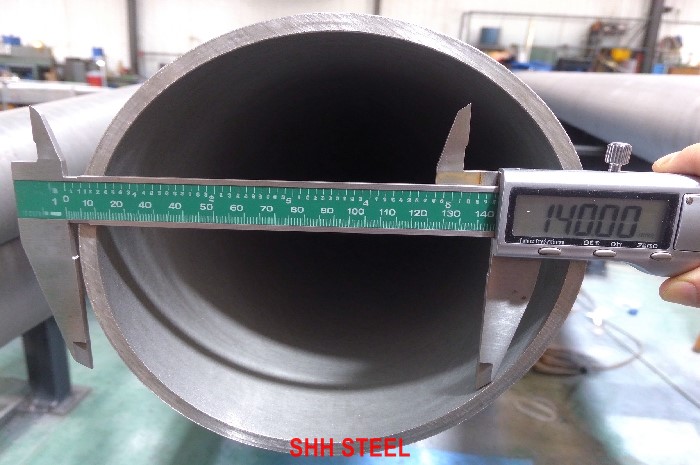
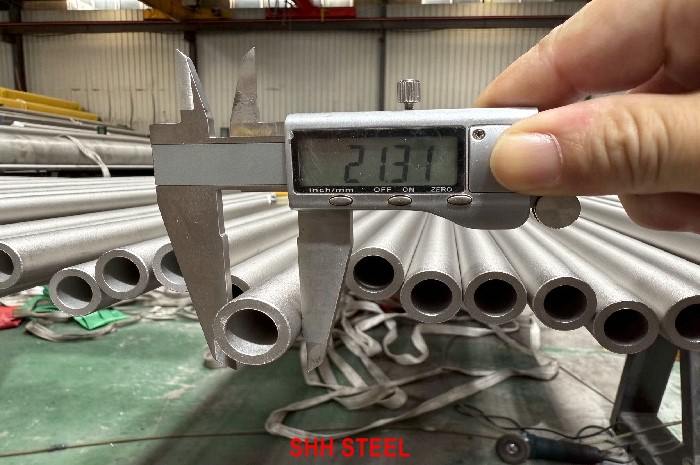
Typical examples we quote include 21.3 mm × 2.77 mm (NPS 1/2 Sch 40S), 60.3 mm × 3.91 mm (NPS 2 Sch 40S), 114.3 mm × 3.05 mm (NPS 4 Sch 10S) and 168.3 mm × 7.11 mm (NPS 6 Sch 40S). Special OD × wall, non-standard lengths and mixed SML/WLD packages are routine on enquiry; send the size list and we will separate what can ship from stock from what needs a mill slot.
Equivalent Grades
Equivalence for UNS S31277 is mainly an identity question. Under ASTM A312 the governing designation is the UNS number itself, and any trade name, European number or plate designation is only an engineering map back to the Table 1 row. The table below lists the references buyers most often bring to us, with how each relates to the A312 grade.
| Designation | How it relates to ASTM A312 UNS S31277 |
|---|---|
| ASTM A312 / A312M UNS S31277 | Governing pipe standard for this page; UNS identity only, no TP name |
| ASME SA-312 UNS S31277 | Separate ASME Code standard; dual marking only when the purchase order names both |
| Proprietary maps | Recheck Mo 6.5–8, Ni 26–28, N, Cu |
ASME SA-312 is listed because Code projects often need it, but it is a separate standard; when both marks are needed, the purchase order should name both and the mill certifies the heat against each. If a project specification quotes a brand name or EN number, ask for certification to ASTM A312 UNS S31277 and list any extra requirements separately rather than assuming the reference covers them.
Heat Treatment and Delivery Condition
All A312 pipe is furnished in the heat-treated condition. For UNS S31277 the solution anneal is 2050 °F [1120 °C] minimum, followed by quenching in water or rapid cooling by other means. This is its own Table 2 listing, distinct from the 2100 °F [1150 °C] used for S31254 and S31266, so the MTC should quote the S31277 row specifically. The purpose is to put alloying elements back into solution and leave a clean, uniform austenitic structure before the pipe is tested and shipped.
UNS S31277 is not an H grade under A312, so the Table 5 grain-size requirement, clause 6.2 reheat rules and mandatory heat-treatment lot marking do not apply unless the owner specification adds them. The MTC should state the actual temperature and cooling method used, because a mill running mixed grades through one furnace may otherwise default to a neighbouring grade’s practice. If pipe is hot formed or heavily cold bent during fabrication, plan a full re-anneal to the same Table 2 practice where the governing code requires it, and confirm that the furnace can hold the temperature for the size before the work starts.
Corrosion Resistance
S31277 is selected where 6Mo alloys are marginal: hot, concentrated chloride process streams, severe seawater duties and acidic chloride service in chemical plants. The higher molybdenum and nickel give additional resistance to pitting, crevice corrosion and chloride stress corrosion cracking, which is why it is often compared directly with S31266 rather than with 300-series grades.
A312 does not publish corrosion data for S31277, and PREN values sometimes quoted for it are calculations rather than specification values. If acceptance depends on a critical pitting or crevice temperature, specify the test (for example ASTM G48) and the acceptance criteria on the order so the result is tied to the delivered heat.
Applications of ASTM A312 UNS S31277 Pipe
The two application rows in our source datasheet are reproduced below; they describe why S31277 is chosen rather than listing every plant where it might appear. They are starting points for selection, not approvals, and the owner’s materials engineer should confirm each against process data.
| Application | Why | Note |
|---|---|---|
| Severe chloride process / seawater upgrades | Mo 6.5–8 + 112/52 ksi | Confirm vs S31266 |
| High-pressure chloride lines needing ductility | 40% elong min | Owner spec |
In every case the order should name ASTM A312 UNS S31277, the manufacturing route, size and wall, and the certificate requirements. Where a project also buys sister grades, keep them segregated through fabrication, because the Table 4 and Table 2 rows differ even when the pipes look identical on the rack.
Weldability
UNS S31277 pipe can be joined by GTAW, GMAW and SMAW when the procedure is qualified on the actual grade. On filler metal, Table 6 in the extract used for this page does not assign an AWS filler class to S31277, so the filler is by agreement. Mill longitudinal welds on WLD and HCW pipe are autogenous, so the filler question applies only to fabrication welds made in the shop or on site.
Industry practice is an overalloyed nickel-chromium-molybdenum filler so the segregated weld keeps at least the pitting resistance of the base pipe. Because A312 assigns no class, the WPS and PQR must name the consumable and be qualified on S31277 base metal, with low heat input and controlled interpass temperature to limit intermetallic precipitation in the HAZ. Back-purge roots with argon, keep interpass temperature controlled, and remove heat tint by pickling or mechanical cleaning where the owner specification requires a clean surface.
Surface Finishes
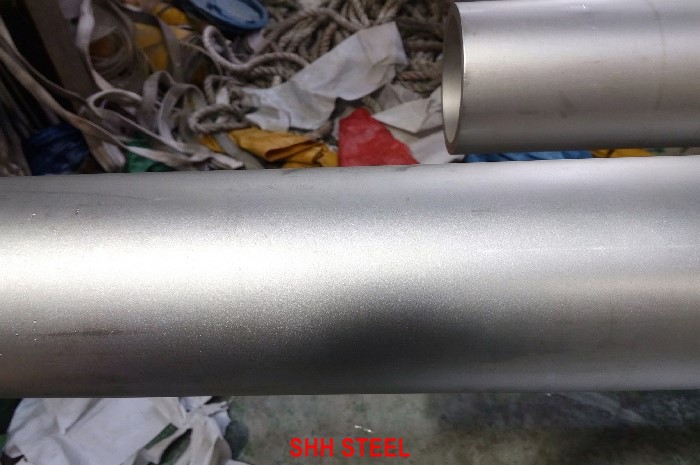
Surface condition for ASTM A312 UNS S31277 pipe should be stated on the purchase order rather than left to the mill default. For stainless pipe, residual scale, embedded free iron and handling contamination can matter as much as the nominal finish name, particularly on corrosion-critical lines.
- Annealed and pickled — the usual delivery condition after solution treatment
- Blasted and pickled — when scale removal needs a mechanical assist before passivation
- Bright annealed — by agreement for selected sizes and routes
- Polished OD or ID — grit or Ra target by agreement; state which surface
Export orders should also state how ends are protected and that chloride-bearing labels or markers must not contact the bore. Those handling notes prevent avoidable rejections at receiving without changing the A312 metallurgical release.
Inspection and Testing
The base acceptance package for ASTM A312 UNS S31277 combines heat chemistry, tension testing against the Table 4 row, flattening or bend tests per the route, heat-treatment evidence and a hydrostatic or electric test on every length. Supplementary requirements are optional until they are written on the order; the table below lists the ones buyers request most often for this grade.
| Option | Purpose |
|---|---|
| S1 product analysis | Confirms chemistry on finished pipe using A480 tolerances |
| S5 radiography | Weld integrity on WLD pipe |
| S7 intergranular corrosion | A262 Practice E check where the owner requires it |
| S8 minimum wall | Wall interpreted as minimum rather than nominal |
| Project corrosion test | For example ASTM G48, with method and acceptance agreed on the order |
EN 10204 3.1 certification is our standard document set, and 3.2 third-party inspection is arranged when the enquiry names the agency and hold points. Hydrostatic versus electric testing should also be fixed on the purchase order if the project has a preference, because a silent mill option is not the same as an approved method.
Packaging and Shipping
Each length of UNS S31277 pipe is marked with ASTM A312, UNS S31277, manufacturing route, size, heat number and test method, with SA-312 added only when dual marking is ordered. Packing lists repeat the heat numbers so receiving can match pipe to certificates without opening every bundle.
- End caps or bevel protectors as ordered
- Bundles strapped with protected contact points to limit iron pick-up
- Wooden cases or waterproof wrapping for ocean freight when specified
- Packing list with heat numbers, sizes and certificate references
Tell us the destination and any handling limits early, so packing suits the transport route and the receiving site instead of being redone at the port, and so special marking such as project tag numbers can be applied at the mill.
Why Choose SHH STEEL
SHH STEEL supplies specification-driven stainless pipe and plate, and for ASTM A312 UNS S31277 we quote against the edition you name rather than a generic catalogue sheet. UNS-only grades are where generic sourcing goes wrong most often: a heat that looks close on paper can miss one Table 1 element, carry the wrong tensile row or skip the specified anneal. Our job is to catch those issues before the pipe is made, not after it arrives.
- Full Table 1 chemistry for UNS S31277 on the MTC, including every range element
- The correct Table 4 row (112/52 ksi) and the 2050 °F [1120 °C] minimum anneal stated on the certificate
- Honest filler guidance based on what Table 6 does and does not say
- SML, WLD and HCW routes with EN 10204 3.1 MTCs, and 3.2 inspection on request
- Dual A312 / SA-312 marking only when the purchase order asks for both
If you are still choosing between UNS S31277 and its sister grades, send the service conditions, design temperature and preferred route; we will tell you plainly when a different A312 grade would fit better or cost less, rather than pushing whatever happens to be closest in name.
Supply Capability
SHH STEEL can supply ASTM A312 UNS S31277 pipe against the edition and route named on your enquiry. The capability table below summarizes the sizes, finishes and documents we regularly quote for this grade, and each line can be tightened on the purchase order.
| Item | SHH STEEL capability for UNS S31277 |
|---|---|
| Standard | ASTM A312 / A312M UNS S31277 |
| Manufacturing types | SML, WLD, HCW |
| Size | NPS 1/8 and up per ASME B36.19; special OD and wall by agreement |
| Schedules | 5S, 10S, 40S, 80S and non-standard walls |
| Length | Single random, double random or cut-to-length |
| Finish | Annealed and pickled; blasted and pickled; bright annealed or polished by agreement |
| Heat treatment | 2050 °F [1120 °C] minimum, rapid cool |
| Tensile | 112/52 ksi |
| Documents | EN 10204 3.1 with full Table 1 analysis; 3.2 on request |
| Trade terms | FOB, CFR, CIF, EXW and other agreed Incoterms |
Stock / Available sizes. The representative stock-and-mill range for UNS S31277 is shown in the Dimensions section (NPS 1/2–24 in typical Sch 10S/40S/80S combinations). Selected common sizes may ship from stock or remnant programmes, while heavy-wall seamless, unusual schedules and large quantities are normally mill-order; ask for a live check against your size list rather than relying on a catalogue claim.
A useful enquiry states the A312 edition, UNS S31277, route, NPS or OD × wall (nominal or minimum), quantity and length, finish, and any product analysis, corrosion test or 3.2 requirement. With that information we can confirm route, lead time and document package on the first reply instead of trading questions.
FAQ
-
Is ASTM A312 the same as ASME SA-312 for UNS S31277?
- No. They are two independent standards: ASTM A312/A312M is the ASTM product specification, and ASME SA-312 is a separate Code standard used in Code piping. The UNS S31277 requirements usually run parallel, but if your project needs both, name both on the purchase order and ask for dual marking on a heat certified to each.
-
What chemistry defines ASTM A312 UNS S31277?
- Table 1 sets C ≤0.020%, Mn ≤3.00%, Si ≤0.50%, Cr 20.5–23.0%, Ni 26.0–28.0%, Mo 6.5–8.0%, N 0.30–0.40% and Cu 0.50–1.50%. Every element with a range must be inside it on the heat analysis, and the MTC should report all of them as measured values. If S1 product analysis is ordered, A480 tolerances apply to the finished pipe only, never to the heat analysis.
-
UNS S31277 vs UNS S31254: when is the upgrade worth it?
- Consider S31277 when A312 UNS S31254 margins are too thin: Mo rises from 6.0–6.5% to 6.5–8.0%, Ni from 17.5–18.5% to 26.0–28.0%, and Table 4 rises to 112/52 ksi with 40% elongation. The anneal is 2050 °F rather than 2100 °F. The cost step is significant, so justify it with service data.
-
What are the tensile requirements for ASTM A312 UNS S31277?
- Table 4 requires 112 ksi [770 MPa] tensile and 52 ksi [360 MPa] yield, with elongation of 40% longitudinal minimum, a special Table 4 group shared with N08925, N08028 and N08029. These are acceptance minimums after the final anneal, not design allowables. Pressure design uses the governing code's allowable stress at temperature, which is why the code, not this table, sets the wall.
-
What heat treatment applies to ASTM A312 UNS S31277 pipe?
- The pipe is solution annealed at 2050 °F [1120 °C] minimum and rapidly cooled. This is its own Table 2 listing, distinct from the 2100 °F [1150 °C] used for S31254 and S31266, so the MTC should quote the S31277 row specifically. The certificate should state the actual temperature and cooling method. UNS S31277 is not an H grade, so there is no mandatory Table 5 grain-size test.
-
Why is the elongation requirement 40% for S31277?
- Table 4 places S31277 in a special group with N08925, N08028 and N08029 that requires 40% longitudinal elongation, rather than the 35% L / 25% T pattern used by most A312 grades. Receiving inspectors should check the elongation against that 40% value, not the general austenitic rule, and reject reports that quote the wrong row.
-
UNS S31277 vs UNS S31266: which is stronger?
- On paper S31277 has the higher Table 4 tensile, 112 ksi against 109 ksi, while A312 UNS S31266 has the higher yield, 61 ksi against 52 ksi. S31266 relies on tungsten and very high nitrogen; S31277 relies on more molybdenum and nickel. Compare code allowables for the design temperature rather than room-temperature minimums alone.
-
Seamless or welded UNS S31277 pipe: which should I order?
- Seamless is usually chosen for small bores, heavy walls and owners who exclude welded pipe. Welded pipe, made without filler and then annealed, is often more economical in larger diameters and thin walls. Both must meet the same Table 1 chemistry and heat treatment; the design code and inspection plan decide.
-
What filler metal should be used to weld UNS S31277 pipe?
- Table 6 in the extract used for this page does not assign an AWS filler class to S31277, so the filler is by agreement. Whatever consumable is chosen, qualify it on UNS S31277 base metal, record the class on the WPS and PQR, and keep heat input and interpass temperature under control. The mill seam on WLD pipe is autogenous, so this applies only to fabrication welds.
-
Which sizes of ASTM A312 UNS S31277 pipe can SHH STEEL supply?
- We quote NPS 1/8 upward to ASME B36.19 schedules such as 10S, 40S and 80S, plus special OD and wall by agreement. Representative enquiry sizes run from NPS 1/2 to 24; selected sizes may come from stock, and the rest are mill-order, confirmed size by size on each enquiry.
-
How should I check an MTC for ASTM A312 UNS S31277 pipe?
- Confirm the certificate names ASTM A312/A312M and UNS S31277, reports every Table 1 element as a measured heat value, quotes the Table 4 row for this grade (112/52 ksi), and states the anneal temperature and cooling method. Then match heat numbers on the certificate to the pipe stencil and packing list.
Conclusion
ASTM A312 UNS S31277 is a 7% molybdenum superaustenitic grade with C ≤0.020%, Mn ≤3.00%, Si ≤0.50%, Cr 20.5–23.0%, Ni 26.0–28.0%, Mo 6.5–8.0%, N 0.30–0.40% and Cu 0.50–1.50%, a Table 4 floor of 112/52 ksi and a solution anneal at 2050 °F [1120 °C] minimum. It is ordered by UNS number, and it is not a drop-in replacement for A312 UNS S31254 or any other sister grade. Put the A312 edition, route, size and wall, finish and any supplementary tests on the purchase order, then check the EN 10204 3.1 certificate against Table 1 and Table 4 before release. SHH STEEL can supply ASTM A312 UNS S31277 pipe to the edition you name; browse sister grades on the A312/A312M hub, or send your size list to admin@steelspecs.com.
Quality Steel Needed? Inquire for Offers
Related Products