ASME SA312 TP317L Stainless Steel Pipe | SA 312/SA 312M
What is ASME SA312 TP317L Stainless Steel Pipe
ASME SA-312/SA-312M covers seamless, welded and heavily cold-worked austenitic stainless steel pipe for high-temperature and general corrosive service, and it is technically aligned with ASTM A312/A312M of the referenced edition. Grade TP317L is listed in Table 1 as UNS S31703. For pressure piping and code work, cite the grade, the UNS number and the edition of the standard on the purchase order and on the mill test certificate, rather than relying on a market label that several neighbouring grades share.
TP317L is the low-carbon version of TP317. Table 1 caps carbon at 0.035% and keeps the same Cr 18.0–20.0%, Ni 11.0–15.0% and Mo 3.0–4.0%, so buyers get the higher-molybdenum process advantage over 316L together with better resistance to intergranular attack in weld heat-affected zones. Unlike TP316L, Table 4 keeps the full 75 ksi [515 MPa] tensile / 30 ksi [205 MPa] yield row rather than the reduced 70/25 ksi. It is not an H grade; Table 2 does not list S31703 individually, so the default 1900 °F [1040 °C] anneal with rapid cooling applies. Table 6 lists TP317L, but the filler-class pairing is not clearly populated in the edition extract, so the low-carbon consumable is agreed on the WPS. Where the ordered edition carries a small-diameter carbon footnote for L grades, check it on the order.
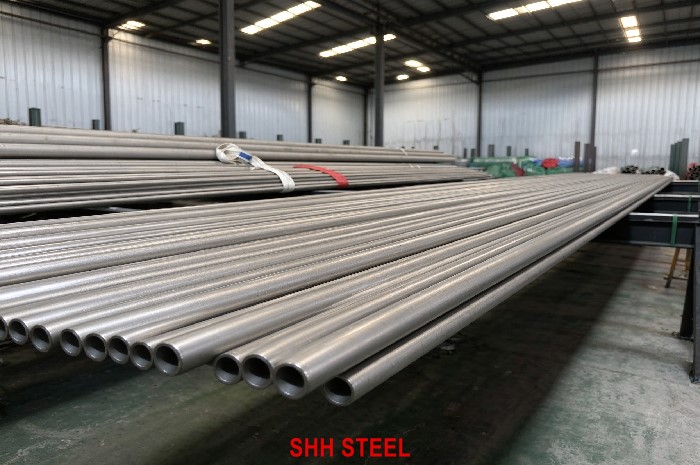
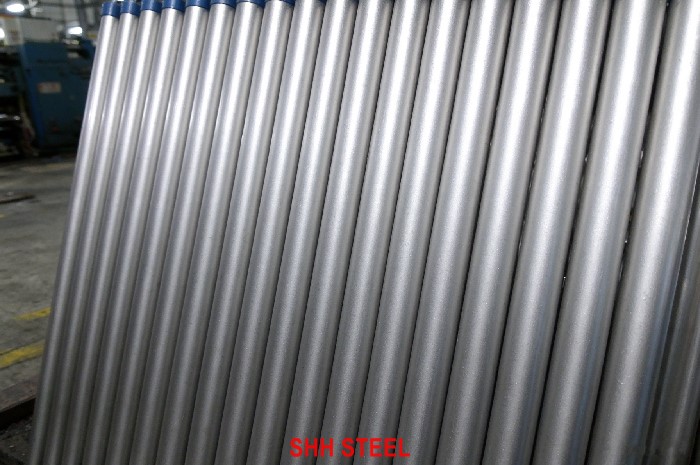
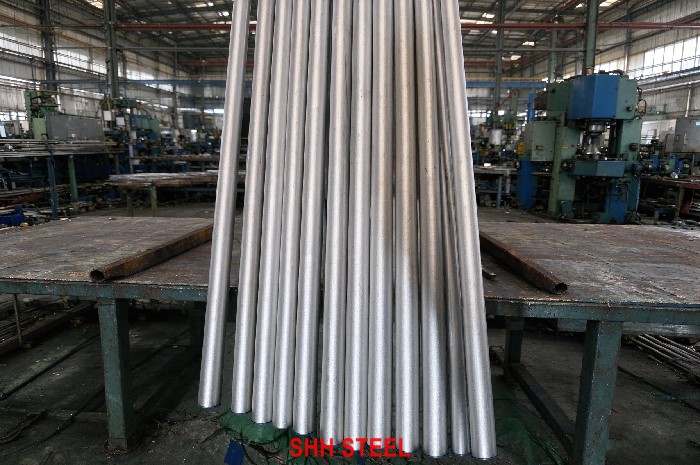
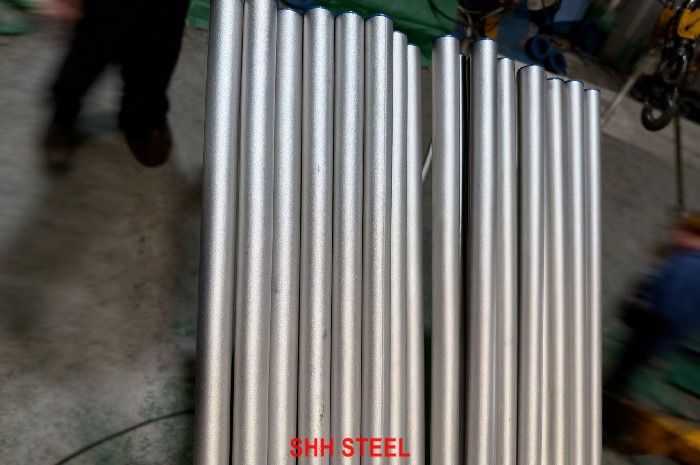
SHH STEEL can supply ASME SA312 TP317L stainless steel pipe to the edition named on the enquiry, in seamless (SML), welded (WLD) and heavily cold-worked (HCW) forms. We cover ASME B36.19 schedules and special OD and wall combinations by agreement, issue EN 10204 3.1 mill test certificates as standard, and can dual-mark SA-312/A312 when the heat analysis, heat treatment, mechanical tests and marking satisfy both editions named on the purchase order. Tell us the NPS, wall or schedule, finish, length practice and any product-analysis or supplementary tests at enquiry stage, and we will confirm stock or mill rolling against those details.
Common commercial names and how they map to the ordered product are listed below. Use the full SA-312/A312 designation on the purchase order rather than market shorthand alone, because the shorthand is where grade substitutions usually start.
- ASME SA312 TP317L / SA-312 Grade TP317L — preferred marking language for ASME-code and dual-marked pipe
- ASTM A312 TP317L — same chemistry and tensile tables when the ASTM edition is referenced
- UNS S31703 — unified numbering identity used on MTCs, stencils and ASME Section II Part D cross-references
- 317L / 317L stainless steel pipe — market shorthand; confirm C ≤0.035%, Mo 3.0–4.0% and UNS S31703 on the order
TP317L is not a drop-in for ASME SA312 TP317 Stainless Steel Pipe, ASME SA312 TP316L Stainless Steel Pipe or ASME SA312 UNS S31725 Stainless Steel Pipe. Against TP317, the only chemistry difference is the 0.035% carbon cap, and both share the 75/30 ksi row. Against TP316L, TP317L adds a full point of molybdenum and higher Cr and Ni, and keeps a higher tensile row (75/30 vs 70/25 ksi). S31725 is a further-developed high-Mo grade with its own Table 1 row. Hub: ASME SA 312/SA 312M.
Manufacturing Types (SML / WLD / HCW)
SA-312 defines three manufacturing routes that may be marked on finished TP317L pipe. The route is a purchase-order decision driven by design code, size range, wall thickness and inspection preference. It does not change the Table 1 chemistry of UNS S31703, and every route must still finish with the solution anneal required by SA-312.
- Seamless (SML) — no welding at any stage. Preferred for small-bore and thick-wall pressure pipe, and wherever the piping class excludes welded product.
- Welded (WLD) — automatic welding without filler metal, finished so the pipe meets dimensional and mechanical requirements after final heat treatment. Common for larger NPS lines where the code accepts welded austenitic pipe.
- Heavily cold-worked (HCW) — welded pipe cold worked at least 35% in wall and weld before the final anneal, with the weld radiographed before cold work. Ordered when tighter OD and wall consistency matters.
Each finished length is hydrostatically tested or nondestructively electrically tested, and the manufacturer may choose the method unless the purchase order fixes one. Pipe NPS 10 and larger may ship marked “NH” only when the purchaser agrees to a system test instead. State SML, WLD or HCW explicitly on the enquiry; bids that differ only in manufacturing type are a common evaluation trap, and the same letters should appear on the stencil and the MTC.
Chemical Composition of SA312 TP317L
Melting analysis (heat / ladle analysis) — Table 1
The table below is the SA-312 Table 1 heat analysis for TP317L / UNS S31703. Values are maximum unless a range is shown, and an ellipsis (…) means no requirement. These are the numbers the mill must report on the certificate, and they are the numbers receiving inspection should check first.
| Element | TP317L / UNS S31703 melting analysis |
|---|---|
| Carbon (C) | ≤ 0.035 |
| Manganese (Mn) | ≤ 2.00 |
| Phosphorus (P) | ≤ 0.045 |
| Sulfur (S) | ≤ 0.030 |
| Silicon (Si) | ≤ 1.00 |
| Chromium (Cr) | 18.0 – 20.0 |
| Nickel (Ni) | 11.0 – 15.0 |
| Molybdenum (Mo) | 3.0 – 4.0 |
Product analysis — A480/A480M Table A1.1 tolerances applied to Table 1
When product analysis is ordered (Supplementary Requirement S1 or PO wording), the check analysis may vary from the Table 1 limits by the A480 tolerances below. Product analysis is not automatic, so order it explicitly if your project needs it rather than assuming ladle values will satisfy the client inspector.
| Element | Melting (Table 1) | Tolerance (A480 A1.1) | Product analysis limit |
|---|---|---|---|
| Carbon (C) | ≤ 0.035 | 0.01 over | ≤ 0.045 |
| Manganese (Mn) | ≤ 2.00 | 0.04 over | ≤ 2.04 |
| Phosphorus (P) | ≤ 0.045 | 0.010 over | ≤ 0.055 |
| Sulfur (S) | ≤ 0.030 | 0.005 over | ≤ 0.035 |
| Silicon (Si) | ≤ 1.00 | 0.05 over | ≤ 1.05 |
| Chromium (Cr) | 18.0 – 20.0 | 0.20 under / over | 17.80 – 20.20 |
| Nickel (Ni) | 11.0 – 15.0 | 0.15 under / over | 10.85 – 15.15 |
| Molybdenum (Mo) | 3.0 – 4.0 | 0.10 under / over | 2.90 – 4.10 |
The two numbers that make a heat TP317L are carbon at or below 0.035% and molybdenum inside 3.0–4.0%. A heat that meets both can usually be dual-certified TP317/TP317L, which is common mill practice and convenient for stock. Product-analysis limits apply the A480 tolerances shown above, including ±0.10 on molybdenum. A certificate quoting UNS S31600-series identity instead of S31703 should go back to the mill.
Mechanical Properties of SA312 TP317L
| Property | TP317L |
|---|---|
| Tensile, min | 75 ksi [515 MPa] |
| Yield, min | 30 ksi [205 MPa] |
| Elongation | 35% L / 25% T |
The 75/30 ksi row is the release floor for TP317L—higher than TP316L and equal to TP317. Do not apply 70/25 acceptance by habit from 316L work. Design allowables come from the code tables for UNS S31703, and the certificate should cite that row explicitly.
Actual certificate values are usually comfortably above the minima, but design and acceptance still use the Table 4 row unless the purchase order states higher guaranteed values. Record the row on the datasheet so fabricators and inspectors do not substitute a sister grade’s strength line from memory, and make sure the tension test on the MTC is traceable to the heat and lot that was shipped.
Dimensions and Tolerances
TP317L pipe is normally ordered to ASME B36.19 schedules, with heavier B36.10 walls and special OD and wall combinations available by agreement. Wall thickness tolerance follows SA-312 Table 3, and outside diameter variations follow A999/A999M for the ordered size.
| NPS designator | Wall over | Wall under |
|---|---|---|
| 1/8 to 2-1/2 incl., all t/D | 20.0% | 12.5% |
| 3 to 18 incl., t/D up to 5% | 22.5% | 12.5% |
| 3 to 18 incl., t/D over 5% | 15.0% | 12.5% |
| 20 and larger, welded, all t/D | 17.5% | 12.5% |
| 20 and larger, seamless, t/D up to 5% | 22.5% | 12.5% |
| 20 and larger, seamless, t/D over 5% | 15.0% | 12.5% |
Source: SA-312 Table 3; outside diameter variations per A999/A999M. Cut lengths should not be shorter than ordered, and random or fixed length practice should be stated on the enquiry. Special walls and non-standard sizes need written mill agreement before rolling slots are booked, so raise them early if your design does not fit a standard schedule.
Equivalent Grades
| Designation | Notes |
|---|---|
| ASME SA-312 TP317L / UNS S31703 | Governing specification for ASME code work |
| ASTM A312 TP317L / UNS S31703 | Same chemistry and tensile rows for the referenced edition |
| UNS S31703 | Unified numbering identity on MTC and stencil |
Cross-references to EN or other national numbers are not given here, because SA-312 does not define them and near-equivalents rarely match every Table 1 limit. If a project needs a cross-standard equivalence, treat it as an engineering decision against both specifications rather than a catalogue lookup. Dual SA-312/A312 certification is straightforward when both editions are named on the order. Related grades for comparison: ASME SA312 TP316 Stainless Steel Pipe, ASME SA312 TP316L Stainless Steel Pipe, ASME SA312 TP317 Stainless Steel Pipe, ASME SA312 UNS S31725 Stainless Steel Pipe.
Heat Treatment and Delivery Condition
UNS S31703 is not individually listed in Table 2, so the default solution-annealing practice applies: heat to a minimum of 1900 °F [1040 °C] and cool rapidly. TP317L is not an H grade, so there is no Table 5 grain-size requirement and no clause 6.2 reheat rule. Pipe is delivered in the solution-annealed condition, and the certificate should state the heat-treatment temperature and cooling method actually used.
Fabricators who hot form or heavily cold work TP317L bends and fittings should re-anneal to the same practice where the governing code requires it. Cite the ordered edition’s Table 2 default on the enquiry so the mill does not apply a neighbouring grade’s anneal by habit.
Corrosion Resistance
Low carbon plus Mo 3–4% suits welded chloride and chemical service where ASME SA312 TP316L Stainless Steel Pipe is marginal, including many flue-gas desulfurization, pulp-and-paper and chemical process lines. It is not a 6Mo seawater grade; for warm seawater, compare ASME SA312 UNS S31254 Stainless Steel Pipe. SA-312 publishes no corrosion rates for TP317L, so service claims need engineering review against the actual medium, temperature and crevice geometry.
Intergranular-corrosion testing to A262 or similar is a supplementary requirement and applies only when written on the purchase order, so state the practice and acceptance criteria if your client needs it. The same applies to any pitting or crevice tests requested by the end user.
Applications of SA312 TP317L Pipe
| Application | Why TP317L | Buyer note |
|---|---|---|
| Welded chemical process piping beyond 316L | Low C with Mo 3.0–4.0% | Qualify WPS on TP317L |
| FGD, pulp and paper lines | Higher Mo, Cr and Ni than 316L | Validate against actual medium |
| Stock programmes needing 317 and 317L | Dual TP317/TP317L when C ≤0.035% | State dual acceptance on PO |
TP317L is the welded-service counterpart to TP317 and is the form most mills actually stock, often dual-certified with TP317. It is ordered when the corrosion basis needs more molybdenum than 316L and the piping will be heavily welded. Enquiries should state UNS S31703, the 75/30 ksi row and any small-diameter carbon footnote considerations for the ordered sizes.
Weldability
Because the Table 6 filler-class pairing for TP317L is not clearly extracted, freeze a low-carbon consumable by agreement on the WPS and PQR; low-carbon 317-type practice is common, but record it as a project decision. Qualify the procedure on TP317L base metal and keep heat input controlled. Mill longitudinal welds on WLD and HCW pipe are autogenous and use no filler.
Use stainless-only tooling and back-purge root passes where the specification calls for a clean root, and keep consumable lot records with the weld traveler when Section IX or B31 documentation applies. NDE extent for girth welds is a fabrication-code decision, separate from the mill hydro or electric test on each length.
Surface Finishes
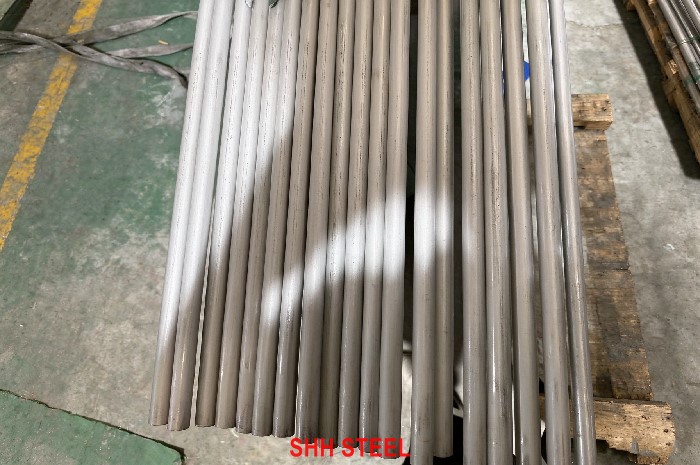
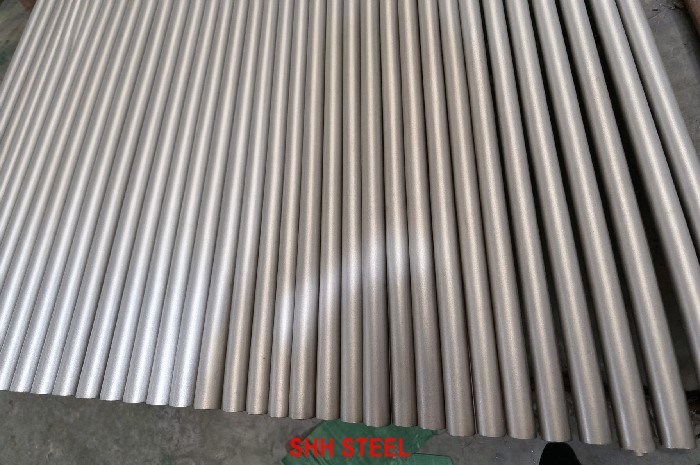
Most TP317L pipe ships pickled and passivated after the solution anneal, which is the normal finish for process piping. Other finishes are order extras and should be stated on the enquiry, together with whether a roughness target applies to the OD, the ID or both.
- Annealed and pickled (standard)
- Bright annealed, by agreement
- Mechanically polished OD, by agreement
- Electropolished ID for hygienic service, by agreement
Inspection and Testing
SA-312 sets the minimum test package for every heat and length of TP317L. Supplementary tests are only applied when written on the order, so the inspection and test plan should list them before production starts.
- Heat analysis to Table 1, including every element with a limit
- Tension test to the Table 4 row (75 ksi [515 MPa] / 30 ksi [205 MPa])
- Flattening and, for welded pipe, the applicable weld tests
- Hydrostatic or nondestructive electric test on each length
- Visual and dimensional checks to Table 3 and A999
- Optional: product analysis, IGC test, PMI, UT/RT of welds, EN 10204 3.2 witness
Packaging and Shipping
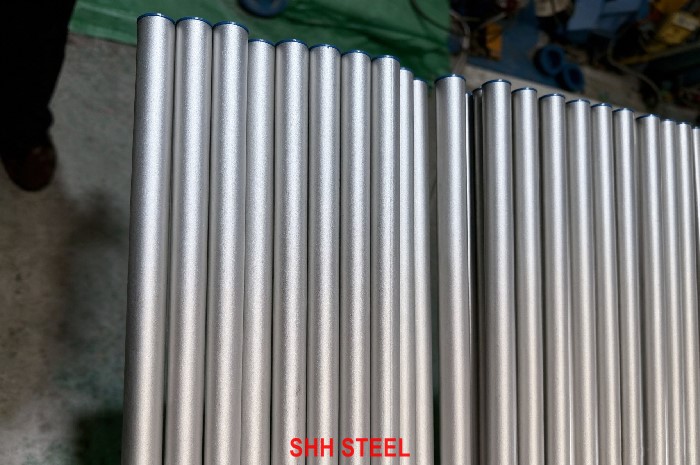
Each length is marked with SA-312 (and A312 when dual-certified), TP317L / UNS S31703, the manufacturing type, size, heat number and test method. For export, we pack in a way that protects the stainless surface from carbon steel contact and moisture during ocean transit.
- Plastic end caps on every length
- Bundles strapped with non-metallic or protected bands
- Seaworthy wooden cases or crates for polished or thin-wall pipe
- Segregation from sister grades so stencils cannot be mixed
Why Choose SHH STEEL
SHH STEEL works with qualified stainless mills to supply TP317L to the edition you name, and our job is to make sure what arrives on site matches the datasheet. That starts with reading the enquiry against the actual SA-312 rows—Table 1 chemistry, the 75 ksi [515 MPa] / 30 ksi [205 MPa] Table 4 row and the Table 2 anneal—and flagging mismatches before an order is placed. We are honest where the standard is silent: if Table 6 does not give a clear filler class, we say so rather than inventing one.
- Seamless, welded and HCW TP317L to SA-312/A312, with dual marking when both editions are ordered
- EN 10204 3.1 MTCs as standard; 3.2 and third-party witness by arrangement
- Full Table 1 reporting, including molybdenum on every heat
- B36.19 schedules plus special OD and wall by agreement
- Export packing and heat traceability from mill to site
Supply Capability
We supply TP317L pipe from mill production and selected stock, with lead time depending on size, wall and manufacturing type. The table summarises what we can offer; please confirm the details for your order on enquiry.
| Item | Supply |
|---|---|
| Grade | TP317L / UNS S31703 |
| Standard | ASME SA-312/SA-312M, ASTM A312/A312M (dual by agreement) |
| Routes | SML, WLD, HCW |
| Sizes | ASME B36.19 schedules; special OD and wall by agreement |
| Filler guidance | by agreement (Table 6 pairing not clearly extracted) |
| Certificates | EN 10204 3.1; 3.2 by arrangement |
Standard schedules can often ship from stock or short mill runs, while heavy-wall seamless and special sizes need a rolling slot. Send the edition, grade and UNS, size list, quantities and required date, and we will separate stock lengths from made-to-order items in our quotation so your site dates are realistic.
FAQ
-
Is ASME SA312 the same as ASTM A312?
- For chemistry, tensile requirements, manufacturing types and most testing language, ASME SA-312/SA-312M matches ASTM A312/A312M of the referenced edition. Dual SA312/A312 marking for TP317L is common when ordered. Name both editions on the purchase order and the certificate so inspectors can verify the heat against the exact books you cited; a bare market stamp does not prove dual certification.
-
What is the UNS number for TP317L?
- Table 1 lists TP317L as UNS S31703. Use that UNS on the purchase order, the stencil and the MTC so the chemistry and tensile rows stay unambiguous. When a project mixes plate, fittings and pipe, carry the same UNS language across all forms, but still order pipe to SA-312/A312 rather than to a plate specification.
-
TP317L vs TP317 — which should I order?
- The chemistry is identical except carbon: TP317L caps C at 0.035%, TP317 allows 0.08%, and both are released at 75/30 ksi. Choose TP317L for welded aqueous service where sensitization matters. Many mills supply dual TP317/TP317L heats; write that acceptance on the purchase order if it is useful for the project.
-
TP317L vs TP316L — which should I order?
- TP317L carries Mo 3.0–4.0% with Cr 18–20% and Ni 11–15%, against Mo 2–3% in TP316L, and is released at 75/30 ksi rather than 316L’s 70/25 ksi. Order TP317L when the corrosion basis needs the extra molybdenum; otherwise TP316L is cheaper and easier to source.
-
Seamless vs welded TP317L — which is better?
- Neither is universally better. Seamless suits small-bore, thick-wall and pressure parts where the piping class excludes welds, while welded and HCW pipe are economical for larger sizes and offer good wall consistency. Choose the route your design code and datasheet allow, state SML, WLD or HCW on the order, and confirm the same letters on the marking and certificate.
-
Hydrostatic test vs NDE — which do I get?
- Each length of TP317L is either hydrotested or nondestructively electrically tested, and the manufacturer may choose unless the purchase order fixes the method. If your piping class or client specification requires one method, state it on the order and check that the chosen test appears on the certificate for every length; a silent mill choice is not an approved project method.
-
What heat treatment applies to TP317L?
- UNS S31703 is not individually listed in Table 2, so the default solution anneal at a minimum of 1900 °F [1040 °C] with rapid cooling applies. TP317L is not an H grade, so there is no Table 5 grain-size rule. Delivery is in the solution-annealed condition, and the certificate should state the temperature and cooling used so the record is complete.
-
What Table 1 chemistry defines TP317L?
- Table 1 for UNS S31703: C ≤0.035%, Mn ≤2.00%, P ≤0.045%, S ≤0.030%, Si ≤1.00%, Cr 18.0–20.0%, Ni 11.0–15.0% and Mo 3.0–4.0%. These are melting-analysis limits from the ordered edition, so do not invent tighter catalogue windows. When product analysis is needed, order it explicitly through Supplementary Requirement S1 or PO wording, and the A480 tolerances shown in the chemistry section then apply.
-
What are the Table 4 tensile requirements for TP317L?
- Table 4 minima for TP317L are 75 ksi [515 MPa] tensile and 30 ksi [205 MPa] yield, with elongation of 35% longitudinal and 25% transverse. Actual certificate values are usually higher, but design and acceptance use Table 4 unless the order states higher guarantees. Record the row on the datasheet so nobody substitutes a sister grade’s line from memory.
-
What filler metal should I use to weld TP317L pipe?
- Table 6 lists TP317L but the filler-class pairing is not clearly populated in the edition extract, so filler is by agreement. Freeze the AWS or EN class on the WPS and PQR before production welding and qualify the procedure on TP317L base metal. Mill longitudinal welds on WLD and HCW pipe are autogenous, so Table 6 guidance applies only to joints made with filler, not to the mill seam.
-
Why choose TP317L over TP317?
- Choose TP317L when the line will be welded and the service is aqueous or chemical, because the 0.035% carbon cap limits sensitization in heat-affected zones. Strength and molybdenum are the same, so there is rarely a penalty. TP317 remains acceptable where welding is limited or where the code basis was written around it.
-
Is TP317L an H grade for creep service?
- No. TP317L has no carbon floor, no Table 5 grain-size rule and no clause 6.2 reheat requirement, so it is not an H grade. Its low carbon actually works against creep strength. It is chosen for corrosion resistance; use code allowables for UNS S31703 at the design temperature and do not apply H-grade assumptions to the order.
Conclusion
ASME SA312 TP317L (UNS S31703) is the low-carbon, high-molybdenum 300-series pipe grade: C ≤0.035%, Cr 18.0–20.0%, Ni 11.0–15.0% and Mo 3.0–4.0%, released against 75/30 ksi Table 4 minima with a Table 2 default 1900 °F [1040 °C] anneal. The Table 6 filler pairing is not clearly extracted, so the low-carbon consumable is agreed on the WPS. It is not an H grade and not interchangeable with TP316L. State the manufacturing type, schedule or wall, finish and any footnote requirements on the enquiry, and ask for the heat certificate with carbon and molybdenum clearly reported. For stock checks, mill certificates or dual SA-312/A312 supply questions, contact SHH STEEL at admin@steelspecs.com or browse the ASME SA 312/SA 312M category.
Quality Steel Needed? Inquire for Offers
Related Products