ASME SA312 UNS S31725 Stainless Steel Pipe | SA 312/SA 312M
What is ASME SA312 UNS S31725 Stainless Steel Pipe
ASME SA-312/SA-312M covers seamless, welded, and heavily cold-worked austenitic stainless steel pipe for high-temperature and general corrosive service. UNS S31725 appears in Table 1 with no TP designation, so the pipe is ordered, stencilled, and certified by its UNS number alone. It is a low-carbon 4–5% molybdenum austenitic (often called 317LM-type). The Table 1 melting analysis is C ≤0.03%, Mn ≤2.00%, P ≤0.040%, S ≤0.030%, Si ≤1.00%, Cr 18.0–20.0%, Ni 13.5–17.5%, Mo 4.0–5.0%, N ≤0.10%, and Cu ≤0.75%. The 4–5% molybdenum is the whole reason the grade exists: it raises pitting and crevice resistance above TP317L without the nitrogen strengthening, copper additions, or higher anneal temperatures of the neighbouring UNS rows.
Table 4 sets a single tensile row of 75 ksi [515 MPa] tensile and 30 ksi [205 MPa] yield, with 35% longitudinal and 25% transverse elongation. For heat treatment, S31725 is not individually listed in Table 2, so the general 1900 °F [1040 °C] minimum solution anneal with rapid cooling applies. UNS S31725 is not an H grade, so there is no carbon floor, no Table 5 grain-size rule, and no H-grade reheat clause. Table 6 does not clearly assign an AWS filler class to S31725 in the extract used for this page, so the consumable is a matter of agreement and must be frozen on the WPS. Fabricators commonly choose an overalloyed molybdenum-bearing filler so the weld metal does not end up leaner in Mo than the 4–5% base metal. The usual service niche is chloride-bearing chemical and process streams, flue-gas condensate, and pulp-mill liquors where TP317L is marginal but a 6Mo superaustenitic would be more alloy than the duty needs.
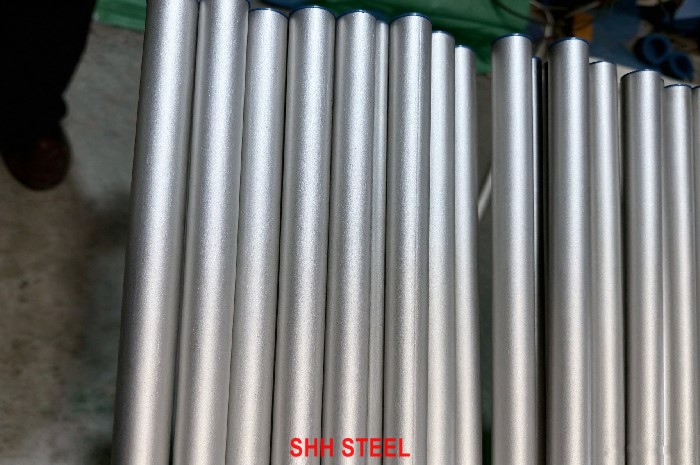
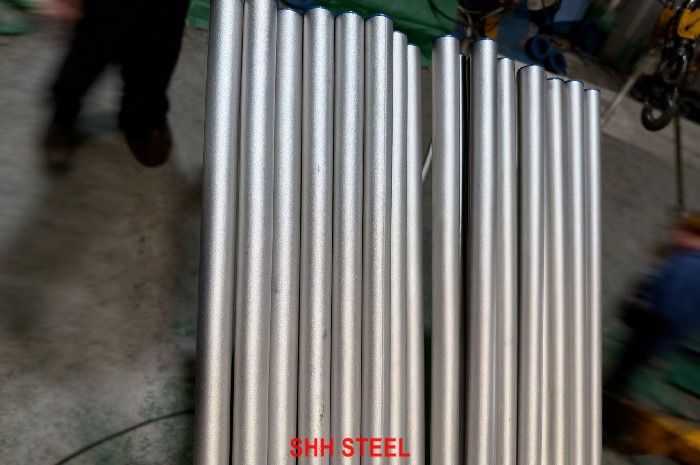
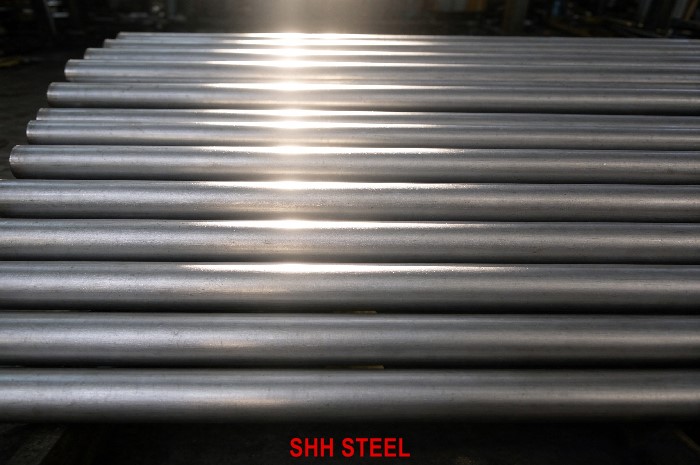
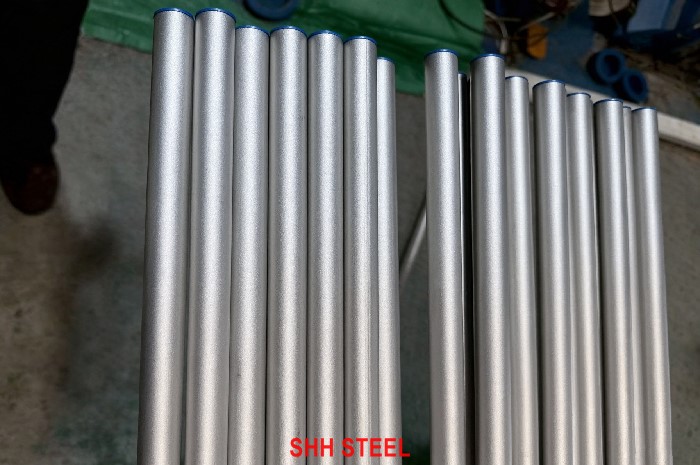
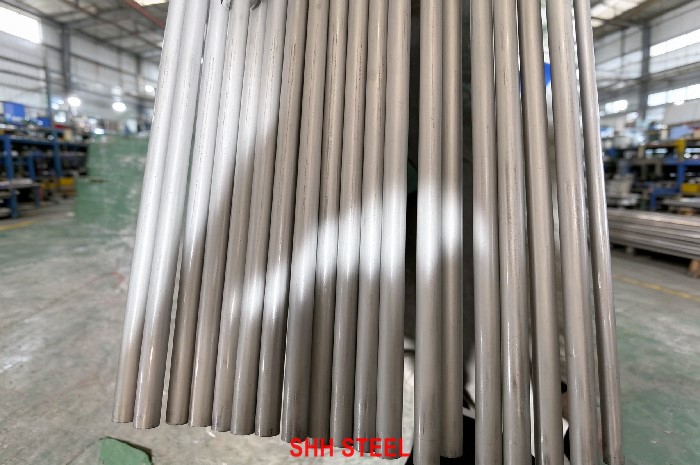
SHH STEEL can supply ASME SA312 UNS S31725 stainless steel pipe to the edition named on your enquiry, in seamless (SML), welded (WLD), and heavily cold-worked (HCW) routes. We work to ASME B36.19 schedules and to special OD and wall combinations by agreement, issue EN 10204 3.1 mill test certificates that report the full Table 1 row including Mo 4.0–5.0%, N ≤0.10%, and Cu ≤0.75%, and can dual-mark SA-312/A312 when heat analysis, anneal, mechanical tests, and marking satisfy both editions on the purchase order. Tell us NPS, wall or schedule, finish, length, and any supplementary tests when you enquire.
Common commercial names and how they map to the ordered product are listed below. Market shorthand is useful in conversation, but the purchase order and certificate should always carry the full SA-312/A312 designation plus UNS S31725 so receiving inspection has one unambiguous identity to check.
- ASME SA312 UNS S31725 — preferred marking for ASME-code and dual-marked pipe (no TP name exists)
- ASTM A312 UNS S31725 — same Table 1 and Table 4 rows when the ASTM edition is referenced
- 317LM-type — market shorthand for the 4–5% Mo low-carbon grade; confirm N ≤0.10% and Cu ≤0.75% on the MTC
- EN 1.4439 (approx.) — closer to the nitrogen-bearing S31726; treat only as a rough engineering map
UNS S31725 is not a drop-in for ASME SA312 TP317L Stainless Steel Pipe, ASME SA312 UNS S31726 Stainless Steel Pipe, or ASME SA312 UNS S31727 Stainless Steel Pipe, even though these grades often appear together on the same bid list. Versus TP317L, S31725 lifts Mo from 3.0–4.0% to 4.0–5.0% and widens nickel to 13.5–17.5% while adding Cu ≤0.75% and N ≤0.10% maxima. Versus S31726, the chemistry is almost the same, but S31726 requires nitrogen 0.10–0.20% and so earns a higher 80/35 ksi tensile row; S31725 keeps nitrogen as a maximum and stays at 75/30 ksi. Versus S31727, S31725 has no intentional copper range and uses the ordinary 1900 °F anneal. Each has its own Table 1 row and Table 4 floor, so dual marking across them is rarely possible. For the full family overview see the ASME SA 312/SA 312M hub.
Manufacturing Types (SML / WLD / HCW)
ASME SA-312 allows three manufacturing routes for UNS S31725, and the choice is a purchase-order decision driven by design code, size, wall thickness, and inspection preference. The route never changes the chemistry: every heat must still meet Mo 4.0–5.0%, N ≤0.10%, and Cu ≤0.75% together with the rest of the Table 1 row, and every length must be solution annealed at 1900 °F [1040 °C] minimum with rapid cooling before it leaves the mill.
- Seamless (SML) — no welding at any stage. Usually preferred for heavier walls, smaller diameters, and critical process lines where the project specification excludes welded pipe.
- Welded (WLD) — made from UNS S31725 strip or plate by automatic welding without filler metal, then annealed. Practical and economical for larger diameters and thinner walls, provided the plate heat itself meets the UNS S31725 row.
- Heavily cold-worked (HCW) — welded pipe cold worked at least 35% in wall and weld before the final anneal, with the weld radiographed before cold work. Ordered when the buyer wants that route and its marking.
Every finished length is hydrostatically tested or nondestructively electrically tested, and the mill may choose the method unless the purchase order fixes one. Pipe NPS 10 and larger may be marked “NH” only when the purchaser agrees to a system test instead. In practice UNS S31725 is a made-to-order grade at most mills, with minimum melt quantities above those of commodity TP316L or TP317L, so grouping project sizes onto one heat helps both lead time and chemistry consistency. Confirm the route, edition, wall basis, and any corrosion or supplementary tests before the mill order is placed so the certificate matches the design basis.
Chemical Composition of SA312 UNS S31725
Melting analysis (heat / ladle analysis) — Table 1
Heat analysis for UNS S31725. Values are maximum unless a range is shown; ellipses (…) mean no requirement.
| Element | UNS S31725 melting analysis |
|---|---|
| Carbon (C) | ≤ 0.03 |
| Manganese (Mn) | ≤ 2.00 |
| Phosphorus (P) | ≤ 0.040 |
| Sulfur (S) | ≤ 0.030 |
| Silicon (Si) | ≤ 1.00 |
| Chromium (Cr) | 18.0 – 20.0 |
| Nickel (Ni) | 13.5 – 17.5 |
| Molybdenum (Mo) | 4.0 – 5.0 |
| Nitrogen (N) | ≤ 0.10 |
| Copper (Cu) | ≤ 0.75 |
Source: SA-312 Table 1, UNS S31725 (TP “…”). N and Cu are maxima.
Product analysis — A480/A480M Table A1.1 tolerances applied to Table 1
| Element | Melting (Table 1) | Tolerance (A480 A1.1) | Product analysis limit |
|---|---|---|---|
| Carbon (C) | ≤ 0.03 | 0.005 over | ≤ 0.035 |
| Manganese (Mn) | ≤ 2.00 | 0.04 over | ≤ 2.04 |
| Phosphorus (P) | ≤ 0.040 | 0.005 over | ≤ 0.045 |
| Sulfur (S) | ≤ 0.030 | 0.005 over | ≤ 0.035 |
| Silicon (Si) | ≤ 1.00 | 0.05 over | ≤ 1.05 |
| Chromium (Cr) | 18.0 – 20.0 | 0.20 under / over | 17.80 – 20.20 |
| Nickel (Ni) | 13.5 – 17.5 | 0.15 under / over | 13.35 – 17.65 |
| Molybdenum (Mo) | 4.0 – 5.0 | 0.10 under / over | 3.90 – 5.10 |
| Nitrogen (N) | ≤ 0.10 | 0.01 over | ≤ 0.11 |
| Copper (Cu) | ≤ 0.75 | 0.05 over | ≤ 0.80 |
Vs S31726: S31726 requires N 0.10–0.20 (range) and has Cr 17–20; S31725 has N ≤0.10 max and Cr 18–20. Vs TP317L: Mo 4–5 vs 3–4; Ni 13.5–17.5 vs 11–15; Cu ≤0.75 added. Product Mo uses ±0.10 on 4–5%. Cu product +0.05 on 0.75 max. N product +0.01 on 0.10 max. P heat max 0.040% is tighter than many 317 grades.
When reviewing a certificate for UNS S31725, check every element in the Table 1 row rather than only chromium and nickel. The elements that define this grade, Mo 4.0–5.0%, N ≤0.10%, and Cu ≤0.75%, are exactly the ones a commodity 300-series heat will miss, and a missing or out-of-range value is a nonconformance even when tensile results look good. Product analysis, when ordered, is judged against the A480 tolerances shown above. Designers should take allowable stresses only from the governing code tables listed for UNS S31725, not from a neighbouring grade.
Mechanical Properties of SA312 UNS S31725
| Property | S31725 |
|---|---|
| Tensile, min | 75 ksi [515 MPa] |
| Yield, min | 30 ksi [205 MPa] |
| Elongation | 35% L / 25% T |
Source: SA-312 Table 4 for UNS S31725. One tensile row applies regardless of wall thickness; no hardness maximum is asserted here and there is no Table 5 grain-size requirement because UNS S31725 is not an H grade.
The 75/30 ksi minimums are the values your receiving inspector should look for on the MTC, and they are not interchangeable with sister rows: S31725 is 75/30, S31726 is 80/35, S31727 is 80/36, S31730 is 70/25, and S32053 is 93/43 ksi. Base testing covers tension on a lot basis, flattening on a sample of lengths, and hydrostatic or electric testing of every length. Elevated-temperature tensile, impact, and hardness limits are purchase-order or construction-code options rather than base SA-312 requirements, so write them on the order if your piping class needs them.
Like other austenitics, UNS S31725 work-hardens during cold bending or expanding, so severe forming may need an intermediate anneal that again meets the 1900 °F [1040 °C] minimum practice. For pressure design, use the allowable stresses listed for UNS S31725 in the governing Section II Part D or project-code tables; copying TP316L or TP317L allowables into the calculation package is a common and avoidable error.
Dimensions and Tolerances
Dimensional supply for UNS S31725 pipe follows ASME B36.19 schedules for the common NPS and schedule combinations, with special OD and wall by agreement when an exchanger, header, or process skid needs a non-standard section. Outside-diameter variations follow ASTM A999/A999M, and wall-thickness variations follow SA-312 Table 3 as summarised below. State on the order whether wall is nominal or minimum (Supplementary S8), so the mill rolls to the interpretation your design assumed.
| NPS designator | Wall over | Wall under |
|---|---|---|
| 1/8 to 2-1/2 incl., all t/D | 20.0% | 12.5% |
| 3 to 18 incl., t/D up to 5% | 22.5% | 12.5% |
| 3 to 18 incl., t/D over 5% | 15.0% | 12.5% |
| 20 and larger, welded, all t/D | 17.5% | 12.5% |
| 20 and larger, seamless, t/D up to 5% | 22.5% | 12.5% |
| 20 and larger, seamless, t/D over 5% | 15.0% | 12.5% |
Source: SA-312 Table 3; outside diameter variations per A999/A999M.
- Lengths — single random, double random, or cut-to-length by agreement
- Cut lengths — typically no more than 1/4 in. [6 mm] over unless a tighter band is ordered
- Ends — plain or beveled; confirm bevel angle and root face when the WPS is already frozen
Many chemical-process buyers order UNS S31725 by OD × wall rather than by NPS and schedule, especially for exchanger and instrument lines. For thin schedules with socket-weld or threaded ends, check that the remaining wall is still adequate after the 12.5% under-tolerance. Jointers are not permitted unless the order allows them, and cut-to-length programmes should include an allowance for fit-up scrap so pieces do not arrive short.
Equivalent Grades
Equivalence for UNS S31725 is mainly an ASME/ASTM identity question. The governing pipe designation is ASME SA-312 UNS S31725, and any trade name, European number, or plate counterpart has to be mapped back to that Table 1 row before a mill is asked to dual-mark or substitute.
| Designation | Notes |
|---|---|
| ASME SA-312 UNS S31725 | Governing pipe grade (no TP designation) |
| ASTM A312 UNS S31725 | Same Table 1 / Table 4 when the ASTM edition is referenced |
| 317LM-type | market shorthand for the 4–5% Mo low-carbon grade; confirm N ≤0.10% and Cu ≤0.75% on the MTC |
| EN 1.4439 (approx.) | closer to the nitrogen-bearing S31726; treat only as a rough engineering map |
| SA-240 / A240 UNS S31725 | Plate and sheet counterpart where listed—not a pipe specification |
Related SA-312 grades on steelspecs.com include ASME SA312 TP317L Stainless Steel Pipe, ASME SA312 UNS S31726 Stainless Steel Pipe, and ASME SA312 UNS S31727 Stainless Steel Pipe. These pages sit close together because buyers often compare them, but none of them is an automatic equivalent of UNS S31725. European numbers and brand names are engineering maps only; if a project specification quotes one, ask the mill to certify against the SA-312 UNS S31725 row and list any extra European requirements separately on the order.
Heat Treatment and Delivery Condition
All SA-312 pipe is delivered in the solution-annealed condition. For UNS S31725, S31725 is not individually listed in Table 2, so the general 1900 °F [1040 °C] minimum solution anneal with rapid cooling applies. Because the grade is not an H grade, there is no grade-specific heat-treatment lot marking requirement and no grain-size test, but most process projects still ask for heat and lot identity on the stencil so traceability survives fabrication.
- Solution anneal at 1900 °F [1040 °C] minimum — followed by rapid cooling in water or by other rapid means
- No Table 5 grain-size rule — not an H grade
- Pickled and passivated — free of scale and embedded iron, which matters for crevice resistance
- Bright anneal — available by agreement when the end user requires a scale-free surface
The anneal temperature should be stated on the MTC, not just the words “solution annealed”, so that inspection can verify it against the 1900 °F [1040 °C] minimum requirement. Rapid cooling is what keeps the high-alloy structure free of chromium carbides and molybdenum-rich intermetallic phases, so a slow furnace cool is not acceptable even if tensile results pass. If pipe is hot-formed or heavily cold-formed during fabrication, plan a re-anneal to the same practice before it goes into corrosive service.
Corrosion Resistance
UNS S31725 is chosen for chloride-bearing chemical and process streams, flue-gas condensate, and pulp-mill liquors where TP317L is marginal but a 6Mo superaustenitic would be more alloy than the duty needs. The 4–5% molybdenum is the whole reason the grade exists: it raises pitting and crevice resistance above TP317L without the nitrogen strengthening, copper additions, or higher anneal temperatures of the neighbouring UNS rows. SA-312 does not publish corrosion rates or critical pitting temperatures for any grade, so the selection must be backed by process-licensor data, published alloy data, or project testing rather than by the specification itself.
In practice, most corrosion failures in this class of alloy trace back to fabrication rather than base-metal chemistry: heat tint left on weld roots, iron contamination from carbon-steel tools, chloride-bearing insulation, and crevices under gaskets or deposits. Ask for pickled and passivated delivery, keep UNS S31725 apart from carbon steel in storage and fabrication, and remove weld oxide before commissioning. When the corrosion case needs proof, order Supplementary S7 intergranular testing (ASTM A262 Practice E) or a project pitting test such as ASTM G48; neither is automatic under SA-312.
Applications of SA312 UNS S31725 Pipe
Buyers usually arrive at UNS S31725 after a corrosion review has ruled out commodity 316L or 317L but has not justified the cost of a nickel alloy. The table below shows typical uses; every application still needs confirmation of temperature, concentration, and chloride level against real data.
| Application | Why UNS S31725 | Note |
|---|---|---|
| Chemical and acid process lines | Mo 4.0–5.0%, N ≤0.10%, and Cu ≤0.75% | Confirm concentration and temperature |
| Flue-gas and scrubber systems | Chloride-bearing condensate | Watch deposits and crevices |
| Pulp and paper liquors | Mixed chloride and oxidising chemistry | Compare with sister UNS rows |
| Heat exchanger and instrument piping | Corrosion margin over 317L | Often seamless, ordered by OD × wall |
If only moderate chloride resistance is needed, ASME SA312 TP317L Stainless Steel Pipe or ASME SA312 TP316L Stainless Steel Pipe are usually easier to source and cheaper. If the duty calls for full 6Mo performance, compare ASME SA312 UNS S31254 Stainless Steel Pipe before stretching a leaner heat into service it was not designed for. The right grade is the one your corrosion engineer and the governing code both support, and we are happy to quote alternatives side by side.
Weldability
UNS S31725 welds well with GTAW, GMAW, and SMAW when the procedure is qualified on the actual grade. Table 6 does not clearly assign an AWS filler class to S31725 in the extract used for this page, so the consumable is a matter of agreement and must be frozen on the WPS. Fabricators commonly choose an overalloyed molybdenum-bearing filler so the weld metal does not end up leaner in Mo than the 4–5% base metal. Mill longitudinal welds on WLD and HCW pipe are autogenous, so the filler question applies only to fabrication welds.
Good practice for this alloy class is low heat input, controlled interpass temperature (commonly 150 °C or below), full back-purging with argon to keep the root bright, and removal of heat tint by pickling or mechanical cleaning. Molybdenum segregates in autogenous weld metal, so overalloyed filler is normally used for corrosion-critical joints rather than fusing the root without filler. Dissimilar joints to carbon steel need a transition procedure approved by the piping engineer.
Surface Finishes
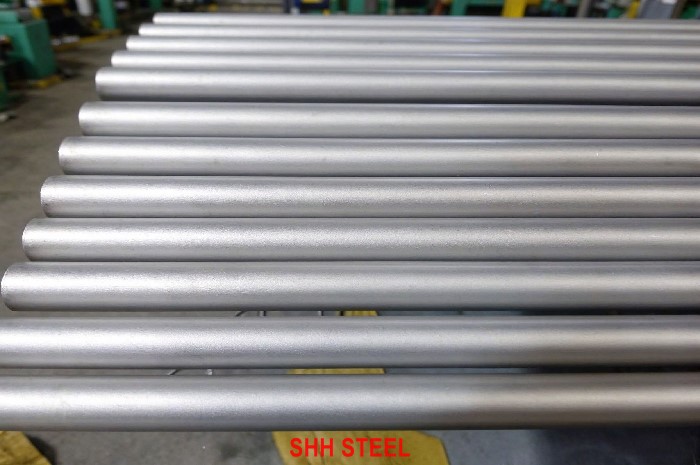
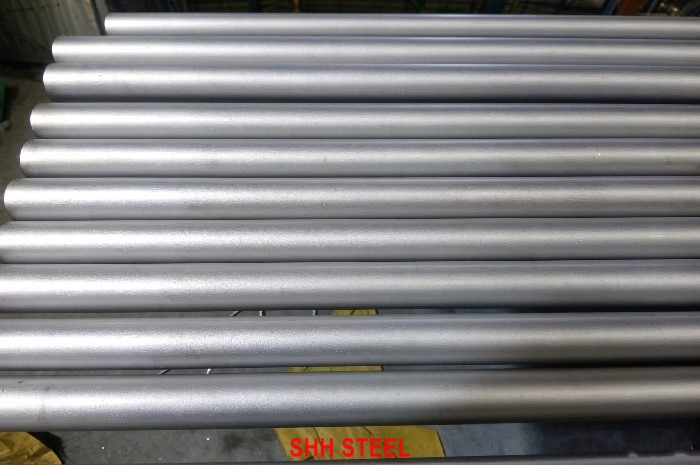
Standard delivery for UNS S31725 is annealed and pickled, which gives a clean matte surface free of scale and embedded iron. Other finishes are available by agreement and should be written on the order with a clear measurement basis.
- Annealed and pickled (AP) — standard process-piping finish
- Bright annealed — scale-free surface from a protective atmosphere
- Mechanically polished or electropolished — by agreement, with Ra target and OD/ID scope stated
For corrosion-critical service, the finish is less about appearance than about removing anything that could start a pit or crevice. If you need a polished or electropolished ID, specify the Ra value, whether it applies to OD, ID, or both, and whether it is measured before or after passivation, so that both mill and inspector are working to the same number.
Inspection and Testing
Base SA-312 testing for UNS S31725 covers heat analysis, tension tests, flattening tests, and hydrostatic or nondestructive electric testing of every length. Supplementary requirements such as product analysis, ultrasonic or radiographic weld examination, intergranular corrosion testing, or third-party witness apply only when written on the purchase order.
- Chemistry — full Table 1 row on the MTC, including Mo 4.0–5.0%, N ≤0.10%, and Cu ≤0.75%
- Tensile — 75/30 ksi with 35% L / 25% T elongation
- Heat treatment — actual anneal temperature against 1900 °F [1040 °C] minimum
- Integrity — hydrostatic or electric test result for each length
- Options — PMI, EN 10204 3.2, S7 / G48 corrosion tests, UT/RT of welds
We recommend a positive material identification check on receipt for any UNS S31725 order, because the distinguishing elements are easy to verify with a portable analyser and a mixed-up length is far cheaper to catch before fabrication than after. When a third-party inspector is required, book the witness before final testing so the inspector sees the actual lengths being tested.
Packaging and Shipping
UNS S31725 pipe is packed to protect both the surface and the identity of each length. Typical export packing uses plastic end caps, wrapping or woven bags, and seaworthy wooden cases or bundles with stainless or non-metallic strapping, with heat number, size, and grade marked on each package.
- Marking — SA-312 UNS S31725, manufacturing type, size, heat number, and edition on every length
- Segregation — kept apart from carbon steel and from sister UNS grades in the same shipment
- Documents — packing list and MTC numbers matching the stencil
Because several grades in this family look identical on the rack, we keep UNS S31725 physically separated from ASME SA312 TP317L Stainless Steel Pipe and ASME SA312 UNS S31726 Stainless Steel Pipe during packing and list each heat on the packing list. On arrival, receiving staff should check stencil, packing list, and certificate against each other before the pipe enters the fabrication shop.
Why Choose SHH STEEL
Grades like UNS S31725 are where specification detail decides whether a shipment is accepted. SHH STEEL reads the Table 1, Table 2, and Table 4 rows for the exact UNS on your enquiry, checks mill offers against them before quoting, and tells you openly where the standard is silent, such as Table 6 filler assignments, rather than filling gaps with guesses. Our aim is a certificate package your inspector can clear on the first review.
- Specification fidelity — full Table 1 reporting including Mo 4.0–5.0%, N ≤0.10%, and Cu ≤0.75%, correct 75/30 ksi row, and anneal at 1900 °F [1040 °C] minimum
- Mill sourcing — made-to-order melts for specialty UNS grades, with remnant stock checked for urgent small lots
- Certification — EN 10204 3.1 as standard, 3.2 and third-party witness by agreement, dual SA-312/A312 when both editions are met
- Honest limits — we state where SA-312 is silent and where a sister grade would serve you better
- Export packing — capped, segregated, and documented for ocean freight
Supply Capability
We supply ASME SA312 UNS S31725 pipe for project and maintenance orders, from single lengths for replacement work to full heats for new process units. The summary below shows our normal range; anything outside it can usually be arranged by agreement with the mill.
| Item | Capability |
|---|---|
| Grade | ASME SA312 / ASTM A312 UNS S31725 (no TP designation) |
| Manufacturing types | Seamless (SML), welded (WLD), heavily cold-worked (HCW) |
| Sizes | ASME B36.19 schedules plus special OD × wall by agreement |
| Heat treatment | Solution annealed at 1900 °F [1040 °C] minimum, rapid cooled |
| Certification | EN 10204 3.1; 3.2 / third-party by agreement |
| Testing options | PMI, product analysis, UT/RT, S7 / G48 corrosion tests |
Because UNS S31725 is rarely held as open stock, most orders are made to order, and lead time depends on the next available melt campaign. Small urgent quantities can sometimes be met from remnant lengths of earlier certified heats, so it is always worth asking. Send us the edition, sizes, quantities, manufacturing type, and any supplementary tests, and we will come back with a clear offer and delivery estimate.
FAQ
-
Is ASME SA312 the same as ASTM A312?
- For chemistry (Table 1), tensile (Table 4), manufacturing types, and most testing language, ASME SA-312/SA-312M matches ASTM A312/A312M of the referenced edition. Dual SA312/A312 marking of UNS S31725 is common when ordered. Name both editions on the purchase order and the mill test certificate so inspectors can verify the heat against the exact books you cited.
-
What is the UNS number for this grade, and is there a TP name?
- Table 1 lists S31725 as the unified number for this pipe grade with an ellipsis in the TP column, so there is no TP designation. Cite UNS S31725 on the purchase order, stencil, packing list, and mill test certificate so that chemistry and tensile rows cannot be confused with a neighbouring grade that shares a similar commercial nickname.
-
UNS S31725 vs TP317L — which should I order?
- TP317L carries Mo 3.0–4.0% and Ni 11.0–15.0%, while S31725 raises Mo to 4.0–5.0% and Ni to 13.5–17.5% and caps copper at 0.75% and nitrogen at 0.10%. Choose S31725 when the corrosion engineer has asked for the extra molybdenum; otherwise TP317L is easier to source. Switching after drawings are frozen needs a formal material change, not a mill substitution.
-
UNS S31725 vs UNS S31726 — which should I order?
- The two rows share Mo 4.0–5.0%, Ni 13.5–17.5%, and Cu ≤0.75%. The difference is nitrogen: S31726 must contain 0.10–0.20% N and therefore carries 80/35 ksi minimums, while S31725 keeps N ≤0.10% and 75/30 ksi. A heat certified to S31726 may satisfy S31725 chemistry only if its nitrogen is at or below 0.10%, so do not assume interchangeability.
-
Seamless vs welded UNS S31725 — which is better?
- Neither is universally better. Seamless suits heavier walls and services where the project excludes welded pipe, while welded pipe is economical for larger diameters and thinner walls. Both are legitimate SA-312 forms and both must meet the full UNS S31725 chemistry and anneal. State SML, WLD, or HCW on the order and check the same letters on the marking.
-
Can you dual-certify SA312 / A312 UNS S31725?
- Yes, when heat analysis (including Mo 4.0–5.0%, N ≤0.10%, and Cu ≤0.75%), the solution anneal, mechanical tests on the 75/30 ksi row, and marking meet both editions named on the order. Write the ASME and ASTM edition years on the purchase order and require the MTC to reference both, so receiving inspection can clear the heat without a second paperwork chase.
-
Hydrostatic test or NDE — which will I get?
- Each length is either hydrostatically tested or nondestructively electrically tested, and the manufacturer may choose unless the purchase order fixes the method. If your piping class or client specification requires one method, state it on the order and check that the chosen test is recorded on the MTC for every length supplied.
-
What heat treatment applies to UNS S31725?
- S31725 is not individually listed in Table 2, so the general 1900 °F [1040 °C] minimum solution anneal with rapid cooling applies. It is not an H grade, so there is no grain-size requirement or H-grade reheat clause. Ask the mill to show the actual anneal temperature on the certificate rather than just the words solution annealed.
-
What Table 1 chemistry defines UNS S31725?
- Table 1 sets C ≤0.03%, Mn ≤2.00%, P ≤0.040%, S ≤0.030%, Si ≤1.00%, Cr 18.0–20.0%, Ni 13.5–17.5%, Mo 4.0–5.0%, N ≤0.10%, and Cu ≤0.75%. These are melting-analysis limits from the ordered edition; product analysis, when required, uses the A480 tolerances. Check that every element is reported, because the distinguishing elements are exactly the ones a commodity 300-series heat would miss.
-
What are the Table 4 tensile requirements for UNS S31725?
- Table 4 sets tensile strength of 75 ksi [515 MPa] minimum and yield strength of 30 ksi [205 MPa] minimum, with 35% longitudinal and 25% transverse elongation. A single row applies regardless of wall thickness. Use the allowable stresses listed for UNS S31725 in the governing code, not those of a sister grade with a different tensile row.
-
What filler metal should I use to weld UNS S31725 pipe?
- Table 6 does not clearly assign an AWS filler class to S31725 in the extract used for this page, so the consumable is a matter of agreement and must be frozen on the WPS. Fabricators commonly choose an overalloyed molybdenum-bearing filler so the weld metal does not end up leaner in Mo than the 4–5% base metal. Qualify the procedure on the actual grade, use low heat input and full back-purging, and remove heat tint after welding so the joint keeps its corrosion resistance.
-
How much molybdenum is in UNS S31725, and why does it matter?
- Table 1 requires 4.0–5.0% molybdenum, with a product-analysis tolerance of 0.10% either side, giving 3.90–5.10% on check analysis. That band is what lifts pitting and crevice resistance above TP317L. A heat at 3.8% Mo may look like a good 317L, but it is not S31725, so the MTC must report Mo against the 4.0–5.0% window.
Conclusion
ASME SA312 UNS S31725 is a TP-less low-carbon 4–5% molybdenum austenitic (often called 317LM-type), defined by Mo 4.0–5.0%, N ≤0.10%, and Cu ≤0.75%, a 75/30 ksi tensile row, and a solution anneal at 1900 °F [1040 °C] minimum. Order it by UNS number, check every Table 1 element and the anneal temperature on the certificate, and compare it carefully with ASME SA312 TP317L Stainless Steel Pipe and ASME SA312 UNS S31726 Stainless Steel Pipe before accepting any substitution. For stock, mill certificates, or a quotation on SA312 UNS S31725 pipe, contact admin@steelspecs.com or browse the ASME SA 312/SA 312M category.
Quality Steel Needed? Inquire for Offers
Related Products