
LR Grade A Steel Plate | LR/A Marine Steel Plate
What is LR Grade A / LR/A marine steel plate?
LR Grade A, often written LR/A on mill certificates and plate markings, is the base ordinary-strength (normal-strength) hull structural steel under Lloyd’s Register Rules for the Manufacture, Testing and Certification of Materials. Those rules implement the IACS Unified Requirement W11 for normal and higher strength hull structural steels. In commercial enquiries the grade is called LR Grade A, LR/A marine steel plate or LR A ship plate. It has a minimum yield strength of 235 N/mm², a tensile strength of 400–520 N/mm² and 22 % minimum elongation (A5). Among the four normal-strength grades (A, B, D, E), Grade A is the only one for which Charpy V-notch impact testing is generally not required on plates up to and including 50 mm.
Equivalent grades: LR Grade A ≈ ASTM A131 Grade A ≈ ABS A ≈ DNV NV A ≈ BV Grade A ≈ CCS Grade A ≈ NK KA ≈ KR RA ≈ RINA Grade A ≈ GB 712 Grade A (all class-approved, stamped by the issuing society).
Because LR Grade A carries no low-temperature toughness guarantee at ordinary thicknesses, it is used where the hull member stays in temperate service and the approved drawing allows Grade A: inner bottom and internal structure of small and medium vessels, superstructures, deckhouses, non-critical bulkheads, inland and coastal barges, pontoons, hatch covers and many shipyard fittings. Where the drawing calls for LR Grade B, Grade D or Grade E in a strake, Grade A cannot be substituted; the reverse (supplying B, D or E for A) is normally accepted because the tougher grades meet every Grade A tensile and chemistry requirement.
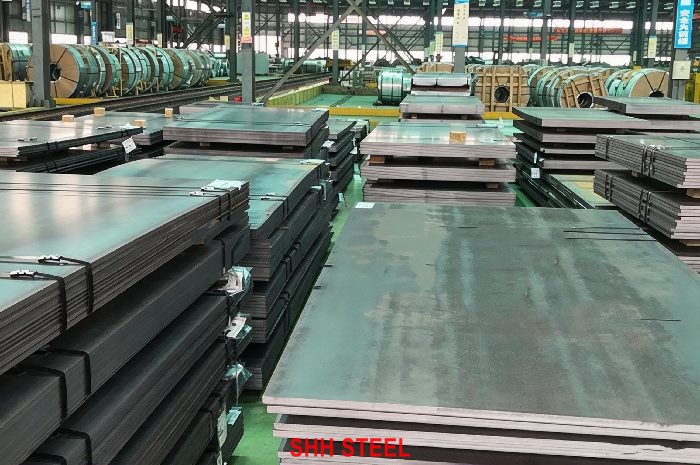
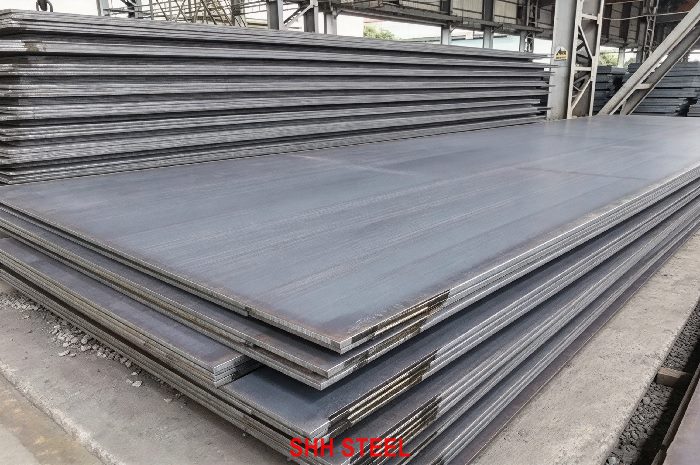
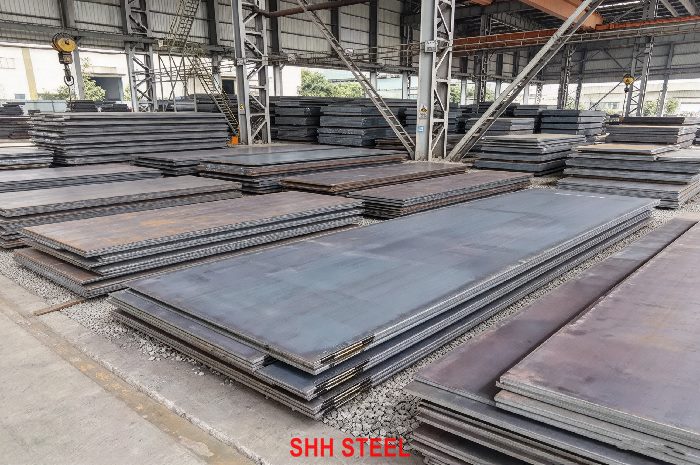
Plates that pass mill tests under Lloyd’s Register survey are die-stamped or stencilled LR Grade A or LR/A (plus Z or U where through-thickness or ultrasonic requirements apply) and are supplied with a mill certificate the LR Surveyor endorses. SHH STEEL supplies LR Grade A / LR/A plate from Chinese mills that hold Lloyd’s Register works approval for the grade, from stock in common sizes or from a mill rolling cycle, with LR survey arranged at the mill.
LR Grade A / LR/A plate: specification summary
| Item | LR Grade A / LR/A data |
|---|---|
| Rule basis | Lloyd’s Register Rules for the Manufacture, Testing and Certification of Materials (rolled steel for hull construction); IACS UR W11 normal-strength Grade A (Rev.10 checked for chemistry and tensile) |
| Strength level | normal (ordinary) strength, yield strength ReH 235 N/mm² min. |
| Plate thickness primarily covered | up to 100 mm under IACS UR W11 scope for plates; greater thickness by special consideration under LR Materials rules (see UNCERTAIN for any LR-specific limit) |
| Steelmaking | basic oxygen, electric furnace or open-hearth, or other process specially approved by LR |
| Deoxidation | any method except rimmed steel for t ≤ 50 mm; killed for t > 50 mm (rimmed Grade A sections only up to 12.5 mm with special approval) |
| Condition of supply | any for t ≤ 50 mm; for t > 50 mm normalized, controlled rolled or thermo-mechanically rolled (as-rolled only with special LR approval and impact testing) |
| Impact test | generally not required for t ≤ 50 mm; at +20 °C for t > 50 mm unless fine-grain practice and normalized (or TM at Society discretion) |
| Marking | LR Grade A / LR/A; plus Z / U / TM where ordered and qualified |
| Thickness tolerance | IACS UR W13 as adopted by LR (minus tolerance commonly 0.3 mm class — confirm on PO; see UNCERTAIN) |
| Certificate | mill certificate endorsed by the LR Surveyor; EN 10204 3.1 / 3.2 on request |
Size range. LR Grade A is rolled on wide plate mills in China from about 5 mm to 100 mm and more, widths 1500–3500 mm and lengths up to about 18 m depending on mill; 6–25 mm plate in 1800–2500 mm width is the bulk of the market. Plates under about 6 mm are often cut from LR-approved hot-rolled coil, which needs separate approval of the coil process. Ask for confirmation for plates over 100 mm or wider than 3200 mm.
LR Grade A / LR/A chemical composition (heat and product analysis)
| Element | Heat (ladle) analysis, % | Product (check) analysis, % | Note |
|---|---|---|---|
| C | 0.21 max. | numeric tolerance not tabulated in LR Rules for Materials – agree on order / mill certificate | 0.23 max. allowed for Grade A sections, not plates |
| Mn | 2.5 × C min. | numeric tolerance not tabulated in LR Rules for Materials – agree on order / mill certificate | e.g. heat C 0.16 % → Mn ≥ 0.40 % |
| Si | 0.50 max. | numeric tolerance not tabulated in LR Rules for Materials – agree on order / mill certificate | widest Si allowance among A/B/D/E |
| P | 0.035 max. | numeric tolerance not tabulated in LR Rules for Materials – agree on order / mill certificate | |
| S | 0.035 max. | numeric tolerance not tabulated in LR Rules for Materials – agree on order / mill certificate | lower S may be agreed for cold-flanging quality |
| Cu | to be determined and reported | numeric tolerance not tabulated in LR Rules for Materials – agree on order / mill certificate | residual / intentionally added — report when present (IACS UR W11 Table 1 notes 7–8) |
| Cr | to be determined and reported | numeric tolerance not tabulated in LR Rules for Materials – agree on order / mill certificate | residual / intentionally added — report when present (IACS UR W11 Table 1 notes 7–8) |
| Ni | to be determined and reported | numeric tolerance not tabulated in LR Rules for Materials – agree on order / mill certificate | residual / intentionally added — report when present (IACS UR W11 Table 1 notes 7–8) |
| Mo | to be determined and reported | numeric tolerance not tabulated in LR Rules for Materials – agree on order / mill certificate | residual / intentionally added — report when present (IACS UR W11 Table 1 notes 7–8) |
| C + Mn/6 | 0.40 max. | not applicable (calculated from heat analysis) | carbon + 1/6 manganese cap |
Product (check) analysis column: LR Rules for Materials specify heat (ladle) limits; no numeric product-analysis tolerance is tabulated in the rule text reviewed, so product (check) limits are agreed on the order or taken from the approved mill specification and certificate.
Source: IACS UR W11 Table 1 (ladle samples) for normal-strength Grade A — the chemistry Lloyd’s Register applies to LR Grade A / LR/A hull plate under its Materials rules. Heat (ladle) analysis is determined by the mill on each heat and must meet Table 1. Product (check) analysis on the finished plate is not given numeric tolerances in UR W11 itself; W11 4.2 accepts the manufacturer’s declared analysis subject to occasional Surveyor checks. When a purchaser or Surveyor requires product analysis on the certificate, ask at enquiry and record the agreed tolerances (national standard or mill practice) — do not invent numbers. Slight chemistry deviations for plates over 50 mm may be allowed only as approved by LR.
Grade A is the only normal-strength grade with manganese written as a ratio of carbon (2.5 × C) instead of a fixed minimum: Grade B needs 0.80 % Mn (0.60 % if impact-tested), D 0.60 % and E 0.70 %. Grade A also has the widest silicon allowance (0.50 %), which is why any deoxidation except rimmed steel is legitimate up to 50 mm. In practice, Chinese mills supply aluminium-killed LR Grade A with ladle C typically around 0.14–0.18 % and Mn 0.5–1.0 %; treat those figures as indicative only and check the actual mill certificate.
LR Grade A / LR/A tensile properties
| Property | Requirement (IACS UR W11 Table 6) |
|---|---|
| Tensile strength Rm | 400–520 N/mm² |
| Yield strength ReH | 235 N/mm² min. (or Rp0.2 where ReH cannot be determined) |
| Elongation A5 | 22 % min. (5.65 √S0) |
| Impact test temperature (where required) | +20 °C |
On the 200 mm gauge full-thickness flat specimen (25 mm width), minimum elongation depends on thickness:
| Thickness (mm) | ≤5 | >5–10 | >10–15 | >15–20 | >20–25 | >25–30 | >30–40 | >40–50 |
|---|---|---|---|---|---|---|---|---|
| Elongation min. % | 14 | 16 | 17 | 18 | 19 | 20 | 21 | 22 |
One frequent certificate error is quoting a relaxed upper tensile limit on plate: IACS allows the Society to exceed the upper Rm limit for Grade A sections only, not for plate. For each batch, one tensile test is taken from one piece (extra tests when finished weight exceeds 50 t, and for every 10 mm variation in thickness from the same cast), unless otherwise agreed by LR.
When does LR Grade A plate need a Charpy test?
| Plate thickness | Deoxidation | Condition of supply | Charpy V at +20 °C |
|---|---|---|---|
| ≤ 50 mm | any except rimmed | any | generally not required |
| > 50–100 mm | killed | normalized (N), CR or TM | not required if fine-grain practice and normalized; TM may be accepted without impact at Society discretion |
| > 50–100 mm | killed | as-rolled (AR*) with special approval | required; one set per 50 t lot (thickest piece) |
Where a Charpy test applies to Grade A over 50 mm, average energies at +20 °C (full-size specimens, long / trans) per IACS UR W11 Table 6:
| Thickness | Longitudinal (J min.) | Transverse (J min.) |
|---|---|---|
| 50 < t ≤ 70 | 34 | 24 |
| 70 < t ≤ 100 | 41 | 27 |
One individual value may fall below the average if it is at least 70 % of it. Generally only longitudinal specimens are prepared unless the purchaser or LR asks for transverse. For buyers: if you order 60 mm or 80 mm LR Grade A for foundations or heavy brackets, agree N/TM (often no impact) or AR with impact testing at enquiry; both routes can be legitimate under special approval, but the certificate must match the supply condition. If the design needs a 0 °C or −20 °C guarantee on thinner plate, order LR Grade B or Grade D instead of adding a special test to Grade A.
Thickness tolerance and surface condition
Lloyd’s Register applies the thickness tolerances of IACS UR W13 (Thickness tolerances of steel plates and wide flats) unless the purchase order states otherwise. In practice class-approved hull plate is ordered to the class minus-tolerance band commonly associated with UR W13 (often 0.3 mm minus — confirm the exact class and plus tolerance on the PO; see UNCERTAIN for the LR Materials paragraph without a local LR PDF on disk). Plus tolerance, flatness, width and length follow the agreed national or international standard (for example ASTM A6 or EN 10029) unless specified otherwise.
Surface quality follows a recognised standard such as EN 10163 parts 1–2 (or equivalent accepted by LR). Surface defects may be ground within UR W11 limits; grinding areas are checked so remaining thickness stays within the allowed minus tolerance. If you plan to shot-blast and prime at the yard, state any surface class on receipt in the order.
LR Grade A / LR/A plate stock in China
| Thickness (mm) | Width (mm) | Length (mm) | Condition | Approx. quantity | Location |
|---|---|---|---|---|---|
| 6 | 1800 / 2000 | 6000 / 8000 | AR / CR | 100+ t | China |
| 8 | 1800 / 2000 | 8000 / 12000 | AR / CR | 200+ t | China |
| 10 | 2000 / 2200 | 8000 / 12000 | AR / CR | 200+ t | China |
| 12 | 2000 / 2200 / 2500 | 12000 | AR / CR | 200+ t | China |
| 14 | 2000 / 2200 | 12000 | AR / CR | 100+ t | China |
| 16 | 2000 / 2500 | 12000 | AR / CR | 200+ t | China |
| 20 | 2000 / 2500 | 12000 | AR / CR | 100+ t | China |
| 25 | 2200 / 2500 | 12000 | AR / CR | 100+ t | China |
| 30 | 2200 | 10000 / 12000 | AR / CR | 100+ t | China |
| 40 | 2200 | 10000 | AR / CR | 50+ t | China |
| 50 | 2200 | 8000 / 10000 | AR / CR | 50+ t | China |
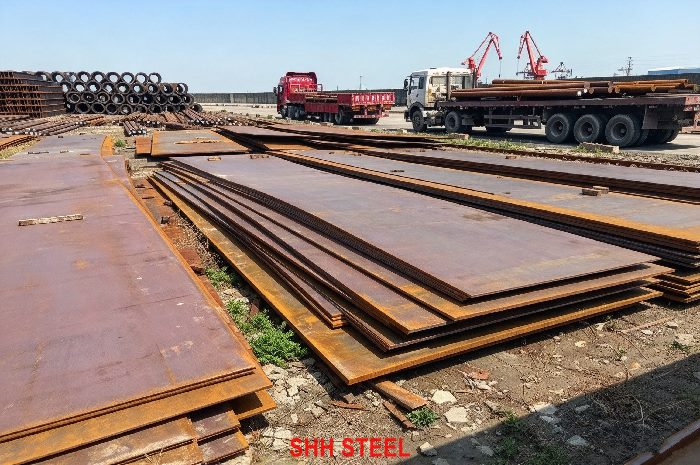
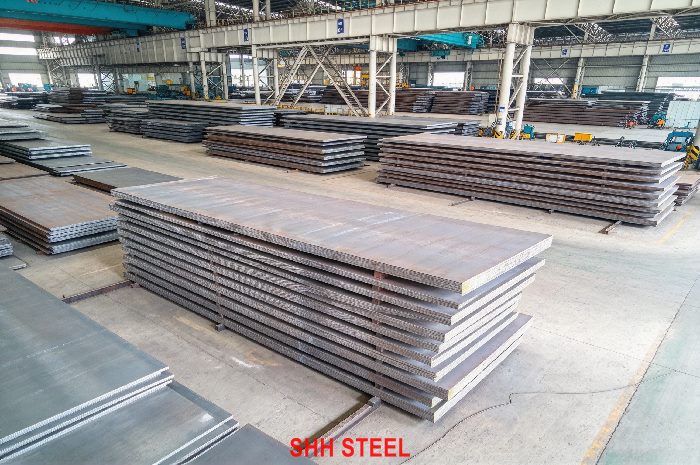
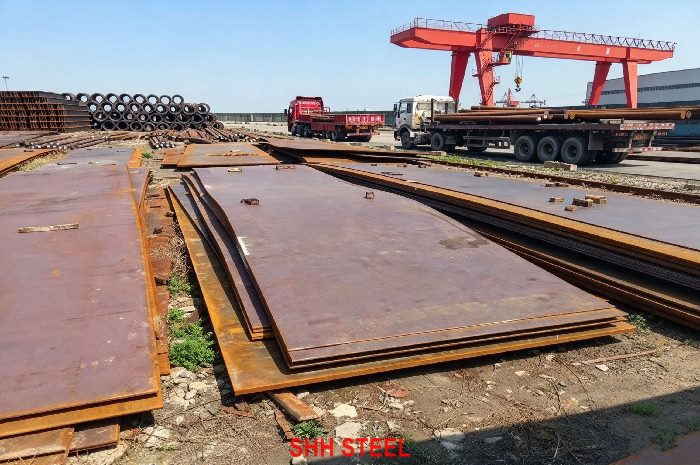
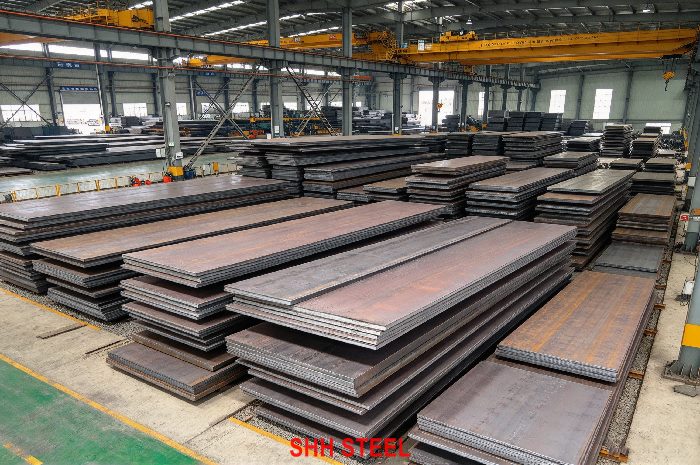
Quantities are approximate and change daily (indicative — confirm before booking); all stock plates carry LR Grade A / LR/A marking and LR-endorsed mill certificates when sold as LR class plate. Sizes outside the table (for example 3000 mm width, 60–100 mm thickness, or fixed lengths for a cutting plan) are produced in the next mill rolling cycle, typically 3–6 weeks including LR survey. Send your size list and we will reply with what is in stock and what must be rolled.
Packing. Plates are bundled by size with steel strapping, marked with heat number, grade and LR stamp, and shipped in containers (up to about 11.8 m) or break bulk for longer plates.
LR Grade A equivalents in other rules and standards
| Standard / society | Designation | Comment |
|---|---|---|
| LR (Lloyd’s Register) | LR Grade A / LR/A | this page; stamped under LR survey |
| ASTM A131/A131M | ASTM A131/A131M Grade A | same base chemistry and tensile band; A131 is a product standard, not class approval |
| ABS | ABS A | IACS UR W11 ordinary-strength; live product page (post 3810) |
| DNV | DNV NV A (DNV Grade A) | IACS UR W11; live product page (post 3892) |
| BV | BV Grade A | IACS UR W11; category link only (no live BV Grade A product page) |
| CCS | CCS A | IACS UR W11; category link only |
| NK (ClassNK) | NK KA | ClassNK designation KA for Grade A |
| KR | KR RA | KR designation RA for Grade A |
| RINA | RINA Grade A | IACS UR W11; category link only |
| GB 712 | GB 712 Grade A | Chinese ship steel standard; GB 712 alone is not class approval |
| ASTM A36 | ASTM A36 | similar strength band but not a hull steel; no class marking |
| EN 10025-2 | EN 10025-2 S235JR / S235J0 / S235J2 | structural; J0 has 0 °C test, J2 −20 °C |
| JIS G3106 | JIS G3106 SM400A / SM400B | welded-structure steel; SM400B adds a 0 °C test |
These are comparisons, not substitutions. An LR-classed hull needs plate made by a mill approved by Lloyd’s Register for Grade A and certified under LR survey. Dual or multi-class certification (for example LR + ABS, or LR + CCS) can be arranged at the mill when the heat is surveyed by both societies.
LR Grade A vs Grade B, D and E, and vs structural steels
All four normal-strength grades share the same 235 N/mm² yield and 400–520 N/mm² tensile range; they differ in deoxidation and toughness. LR Grade B is tested at 0 °C where the thickness/condition table requires it (generally not required ≤ 25 mm for Grade B); LR Grade D is tested at −20 °C and must be fine-grain treated above 25 mm; LR Grade E is killed fine-grain steel tested at −40 °C, with each plate tested when supplied normalized or TM. The hull steel grade for each strake is set by the classification rules according to structural member category and thickness, so check the approved drawing first. In general, LR Grade A is used for internal and lightly stressed members, while sheer strakes, bilge strakes, deck stringers and ice-belt plating usually call for B, D, E or higher-strength plates under LR Steel Plates.
Compared with land structural steels, LR Grade A is close in strength to ASTM A36, ASTM A283 Grade C and S275JR class steels but differs in three practical ways: class thickness tolerance practice, the C + Mn/6 ≤ 0.40 cap, and above all the LR survey and LR/A stamp. For a barge or pontoon that will be LR-classed, only LR-certified plate is accepted; for an unclassed workboat or a dock structure, buyers sometimes choose A36 or S235 for price, and LR Grade A can also be dual-certified to A131 and LR for such use.
When LR Grade A is the right choice: typical uses are non-critical hull plating, internal structure, decks and bulkheads of vessels working in temperate water, barges and pontoons. The Charpy temperature (+20 °C, only where required above 50 mm) is fixed by the letter A, and the strength by the normal-strength level (ReH 235 N/mm²). Pick the strength from the scantling calculation and the letter from the material class and design temperature on the approved drawing. Swapping to a different letter or strength needs class approval of the drawing change, not just a new purchase order.
Applications, cutting and welding of LR Grade A
Typical uses: internal hull structure, double-bottom floors and girders, non-watertight and watertight bulkheads in lightly stressed areas, superstructure and deckhouse plating, hatch covers, inland and coastal barges, pontoons, floating docks, fishing vessels and tugs, rudder and skeg internal plates, and ship repair replacement steel. Offshore and port structures also use Grade A for secondary steel; see offshore platform steel plates for primary structure grades.
Cutting: oxy-fuel, plasma and laser cutting all work without preheat in normal thicknesses. Welding: with C + Mn/6 at or below 0.40 %, LR Grade A is welded with ordinary-strength consumables approved for the grade and toughness level required by the shipyard’s LR-approved WPS; preheat is generally unnecessary below about 25–30 mm except in cold or humid conditions — follow your approved welding procedure, not a generic number from a catalogue. Forming: plates intended for cold flanging should be ordered with the flanging quality agreed on the PO (lower S where required).
Processing notes for LR Grade A: cold forming and flanging of normal-strength plate are routine. Keep the cut edges of plate thicker than 50 mm free of notches, because thick plate of this grade is controlled more tightly for deoxidation (killed above 50 mm) and supply condition.
Certificates, LR survey and third-party inspection
Every plate is tested and marked at the mill under Lloyd’s Register survey; the mill certificate lists heat number, ladle chemistry (elements required by UR W11 Table 1, plus intentionally added elements), tensile results, impact results where required, condition of supply and plate numbers, and is endorsed by the attending Surveyor. On request we add EN 10204 3.2 certificates with third-party witness by TÜV, SGS, BV or another agency, ultrasonic testing (U mark) or through-thickness testing (Z mark), and multi-class certification with other major class societies (ABS, DNV, BV, CCS, NK, KR, RINA).
On receipt, check: LR Grade A / LR/A stamp and heat number on each plate match the certificate; the certificate shows LR endorsement, not just a mill stamp; thickness at several points meets the ordered UR W13 / PO tolerance; for plates over 50 mm, the condition of supply and impact results agree with the table above.
Charpy acceptance for LR Grade A by thickness (from IACS UR W11 Table 6 where a test applies; actual results as per standard and mill certificate):
| Thickness t (mm) | Test temperature | Average energy, longitudinal (J min.) | Average energy, transverse (J min.) |
|---|---|---|---|
| t ≤ 50 | +20 °C | generally not required | generally not required |
| 50 < t ≤ 70 | +20 °C | 34 | 24 |
| 70 < t ≤ 100 | +20 °C | 41 | 27 |
On receipt, check that where Charpy is shown the test temperature is +20 °C and that the energy matches the band for the delivered thickness. Also check that the plate number on the stamp matches the certificate line, and that the LR Surveyor endorsement is present. If UT was ordered (e.g. EN 10160 or ASTM A578 level), check the UT report as well. If the PO asked for 3.2, the inspector’s report must name the witnessed tests and plate numbers.
Common mistakes when ordering LR Grade A / LR/A
- Ordering “LR A” or “Grade A” without specifying that Lloyd’s Register certification (LR Grade A / LR/A stamp + Surveyor-endorsed certificate) is required, then receiving GB 712 or A131 plate without class endorsement.
- Accepting a relaxed upper tensile limit on plate that only applies to Grade A sections under IACS.
- Ordering heavy plate (> 50 mm) without agreeing N/TM/CR or impact testing, then finding no Charpy results or an AR certificate without special approval.
- Substituting LR Grade A where the drawing requires Grade B, D or E in a high-stress or low-temperature strake.
- Plates cut from coil without the mill holding LR approval for coiled product.
- Ignoring the ordered thickness tolerance class when accepting re-rolled or trader stock.
- Confusing commercial “LR Grade A / LR/A” with higher-strength LR AH36 — different yield, chemistry and impact rules.
Each of these is avoided by writing the requirement into the purchase order and checking it on the certificate before the plates are cut.
Sourcing LR Grade A plate: buyer concerns and SHH STEEL solutions
| Concern | How SHH STEEL handles it |
|---|---|
| Fake or re-stamped class plate | plates from LR-approved mills only; certificate and LR/A stamp traceable to the heat; third-party witness and EN 10204 3.2 on request |
| Unsafe deposit or payment risk | T/T or L/C payment; inspection before balance payment |
| Small quantities across many sizes | mixed thicknesses and grades (LR Grade A, Grade B, AH36, etc.) combined in one container or shipment |
| Slow delivery | dedicated staff follow each order with weekly production and shipping updates and photos |
| Cutting and preparation | own workshop for cutting to size, bevelling, drilling and machining before shipment |
How to order LR Grade A / LR/A plate
State the grade and rule (LR Grade A / LR/A, Lloyd’s Register Rules for Materials – rolled steel for hull), whether multi-class certification is needed, thickness, width, length and quantity per size, condition of supply for plates over 50 mm, any Z or U requirement, surface or primer requirements, certificate type (mill certificate with LR endorsement, EN 10204 3.2 with third-party witness), packing and destination port. Send the list to SHH STEEL for price, available stock and lead time.
Sample PO line: “Steel plate to Lloyd’s Register Rules for Materials, Grade A (LR/A), delivery condition [AR/CR/N/TM], 20 × 2500 × 12000 mm, 30 pcs, marked LR Grade A / LR/A, certificate endorsed by LR Surveyor, EN 10204 3.2 [if required], UT [if required], CIF [port].” Each bracketed item changes price, lead time and which mills can supply, so fix them at enquiry stage.
FAQ
Conclusion
LR Grade A / LR/A is the economical base hull steel under Lloyd’s Register Materials rules and IACS UR W11: 235 N/mm² minimum yield, 400–520 N/mm² tensile, generally no impact test up to 50 mm, and class survey with the LR Grade A / LR/A stamp. What the rules leave open has to be fixed in the order: LR (or multi-class) certification, the supply condition and impact testing for plates over 50 mm, whether product analysis is required on the certificate, the thickness-tolerance class, and the certificate type (3.1 vs 3.2).
SHH STEEL supplies LR Grade A plate rolled by Chinese mills that hold Lloyd’s Register works approval for the grade, so every plate carries the LR/A stamp and a Surveyor-endorsed certificate traceable to its heat. Common thicknesses are available from stock; other sizes are scheduled into the mill rolling cycle with LR survey arranged at the mill. On request we add EN 10204 3.2 certificates with third-party witness (TÜV, SGS, BV or another agency) and joint certification with ABS, DNV, BV, CCS, NK, KR or RINA.
We accept T/T or L/C payment, with inspection before the balance is paid. Small quantities in several sizes, or LR Grade A mixed with Grade B, Grade D or higher-strength grades such as LR AH36, can be combined in one container. A dedicated coordinator sends production and shipping updates with photos, and our own workshop cuts to size, bevels, drills and machines plates before shipment so they arrive ready for fabrication.
Request a quotation: send SHH STEEL the grade (LR Grade A / LR/A), thickness, width, length, quantity per size and destination port, plus any multi-class, Z/U or 3.2 certificate requirement. We reply with price, available stock and lead time.
Quality Steel Needed? Inquire for Offers
Related Products