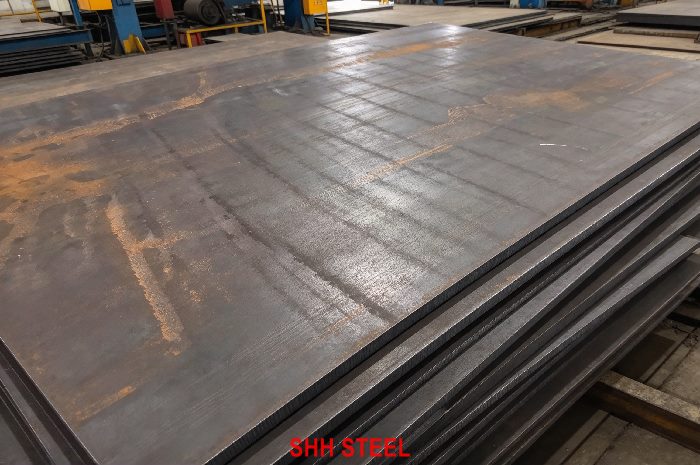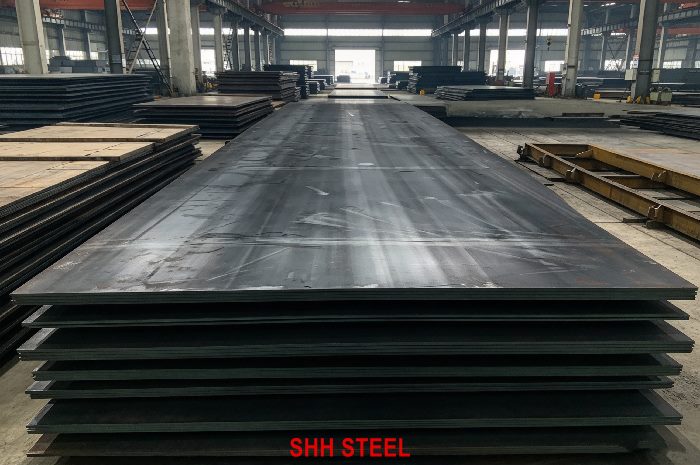

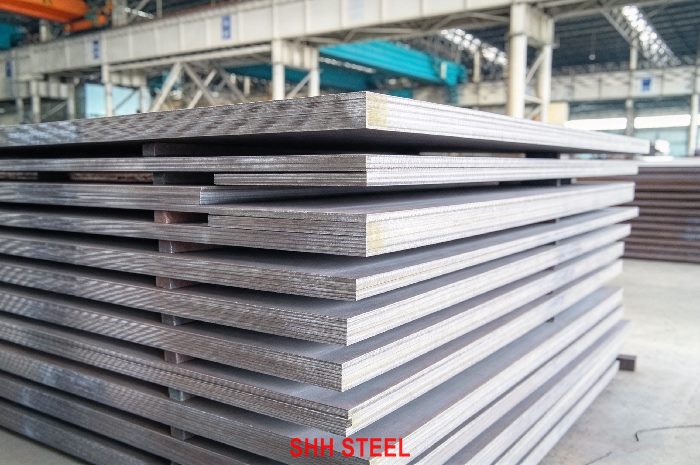
ASTM A131 Grade A Shipbuilding Steel Plate
ASTM A131 Grade A shipbuilding steel plate — overview
ASTM A131 Grade A is the basic mild hull steel of the American purchase specification for structural steel for ships. It guarantees 235 MPa [34 ksi] minimum yield and 400–520 MPa [58–75 ksi] tensile, and up to 50 mm [2 in.] it is bought without any Charpy test. It is the plate behind most US inland barges, deck barges and internal ship structure.
Equivalent grades: ABS A · DNV NV A · LR Grade A · BV Grade A · CCS Grade A · NK KA · KR RA · RINA Grade A · GB 712 Grade A.
In an A131 purchase order Grade A is the floor: anything a plan marks B, D or E cannot be met with it, however good its tensile results.
ASTM A131/A131M is a product specification: it tells a mill what to make and test, while the general rules for plate — dimensions, tolerances, test methods, retests, marking and test reports — come from ASTM A6/A6M, which A131 references. Read the two together; neither is complete alone.
A131 was developed to mirror the American Bureau of Shipping material rules, which is why its grade letters match the IACS system. The important difference is legal, not metallurgical: an A131 plate is certified by the mill; a classed plate is additionally certified by a surveyor. US Coast Guard plan reviewers and many US owners accept A131 for non-classed or domestic work, while classed hulls normally require the society certificate (confirm with the approving authority).
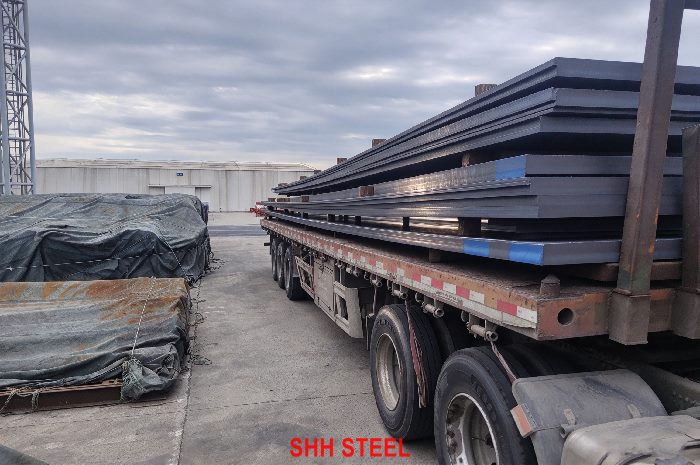
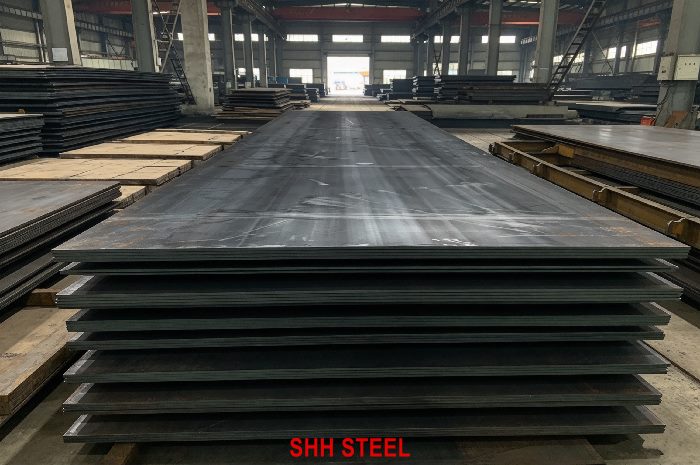
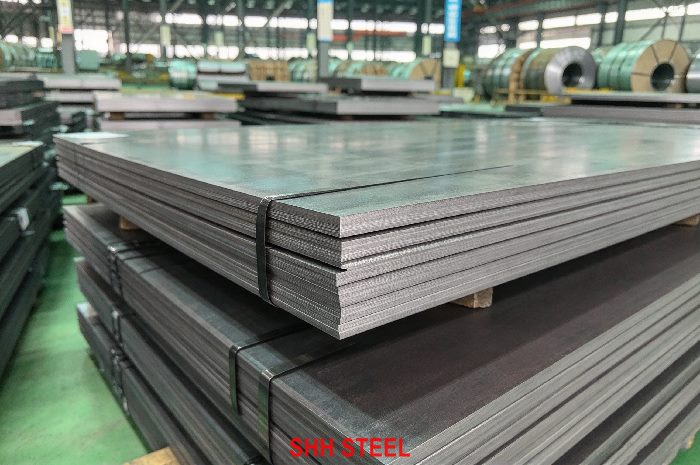
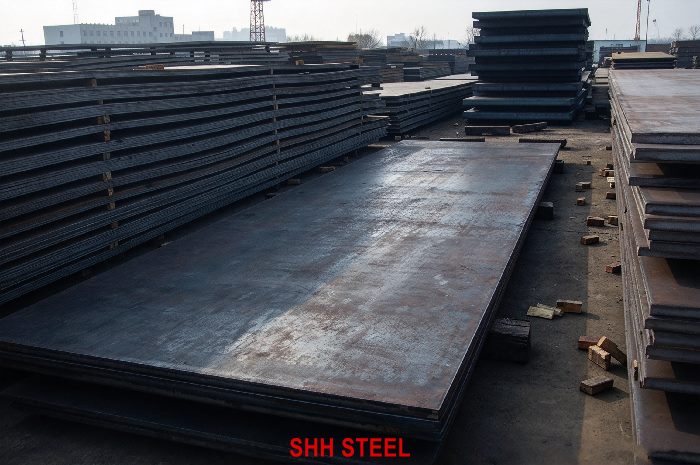
SHH STEEL supplies ASTM A131 Grade A with the mill test report, ABS or other class certification on the same heat when ordered, and cutting to drawing. The full range is under ASTM A131 Grade A.
Where Grade A sits. In A131 terms Grade A is the baseline of the specification — the plate the rest of the series is measured against. Because Grade A carries no impact requirement in the thicknesses most yards use, the purchase order is effectively a chemistry-and-tensile contract; everything else depends on what you write into the supplementary requirements.
ASTM A131 Grade A: key data at a glance
| Item | ASTM A131 Grade A |
|---|---|
| Specification | ASTM A131/A131M (structural steel for ships), ordinary-strength Grade A — edition to be stated on the order |
| General requirements | ASTM A6/A6M (dimensions, tolerances, testing, marking, test reports) |
| Yield strength, min. | 235 MPa [34 ksi] |
| Tensile strength | 400–520 MPa [58–75 ksi] |
| Elongation, min. | 21 % in 200 mm [8 in.] / 24 % in 50 mm [2 in.] (UNCERTAIN — verify edition) |
| Charpy V-notch | not required ≤ 50 mm; +20 °C above (unless N/TM) |
| Deoxidation | any method except rimmed up to 50 mm [2 in.]; killed above |
| Condition of supply | as-rolled, controlled-rolled, normalized or TMCP as the thickness and grade permit |
| Usual plate range | about 5–100 mm [3/16–4 in.] thick; shapes and bars are also within A131 scope |
| Certification | mill test report per A6/A6M; class certificate or third-party witness on request |
Dual units are deliberate: A131 is written in inch-pound units and A131M in SI. The two are not exact conversions of each other, so the order must name one system as governing — mixing them on a mill order is the classic source of a borderline rejection.
For Grade A the lines that matter are deoxidation and thickness: above 50 mm the plate must be killed and impact tested.
ASTM A131 Grade A chemical composition — every element on the report
| Element | Heat analysis, % | Product (check) analysis, % | Note |
|---|---|---|---|
| C | 0.21 max. | 0.25 max. (0.21 + 0.04) | |
| Si | 0.50 max. | 0.56 max. (0.50 + 0.06) | |
| Mn | 2.5 × C min. | 2.5 × C min. (ratio requirement – no tolerance row applies) | |
| P | 0.035 max. | 0.045 max. (0.035 + 0.010) | |
| S | 0.035 max. | 0.045 max. (0.035 + 0.010) | |
| Al (acid-soluble) | not specified (report if added) | no heat limit specified – report actual value | |
| Nb | report if intentionally added | no numeric heat limit – report actual value | |
| V | report if intentionally added | no numeric heat limit – report actual value | |
| Ti | report if intentionally added | no numeric heat limit – report actual value | |
| Cu | 0.35 max. (residual) | 0.38 max. (0.35 + 0.03) | residual |
| Cr | 0.20 max. (residual) | 0.24 max. (0.20 + 0.04) | residual |
| Ni | 0.40 max. (residual) | 0.43 max. (0.40 + 0.03) | residual |
| Mo | 0.08 max. (residual) | 0.09 max. (0.08 + 0.01) | residual |
| N | not specified | no heat limit specified – report actual value | report on request |
| Nb+V+Ti | not specified for mild grades (calculated if added) | not applicable (calculated from heat analysis) | |
| C + Mn/6 (Ceq) | 0.40 max. (calculated) | not applicable (calculated from heat analysis) | carbon-equivalent cap |
Product (check) analysis column = heat (ladle) limit adjusted by ASTM A6/A6M-19 Table A “Permitted Variations in Product Analysis”, which ASTM A131/A131M invokes through A6/A6M (maximum + “over”, minimum − “under”; row chosen by the specified upper limit); arithmetic shown in brackets.
Values follow the IACS UR W11 / ABS basis that A131 tracks; the A131 table in the edition named on your order governs (no local copy checked — UNCERTAIN). Grade A ties manganese to carbon (Mn ≥ 2.5 × C) and allows silicon to 0.50 %; it is the only letter that may be semi-killed up to 50 mm.
US mill test reports print a fixed analysis list — commonly C, Mn, P, S, Si, Cu, Ni, Cr, Mo, V, Nb, Al and sometimes Ti, N, B and Ca — regardless of grade. That makes residual-element screening easy: compare every line, not only the ones A131 limits.
A131 requires the heat analysis to be reported for every element with a limit in its table; where a grade allows grain-refining elements, the one actually used must be shown so the inspector can confirm fine-grain practice. Residuals that A6/A6M asks to be reported (Cu, Ni, Cr, Mo, V, Nb) normally appear even when A131 itself sets no limit (confirm A6/A6M reporting rule for the cited edition).
ASTM A131 Grade A tensile requirements
| Property | SI (A131M) | Inch-pound (A131) |
|---|---|---|
| Yield strength, min. | 235 MPa | 34 ksi |
| Tensile strength | 400–520 MPa | 58–75 ksi |
| Elongation in 200 mm [8 in.], min. | 21 % | same |
| Elongation in 50 mm [2 in.], min. | 24 % | same |
A131 follows A6/A6M practice for specimens: rectangular 200 mm [8 in.] or 50 mm [2 in.] gauge specimens, or round specimens in heavy plate, with elongation minimums tied to the gauge length — not the proportional 5.65√S₀ gauge used in European and class certificates. That is why the elongation figure on an A131 report can look lower than on a class certificate for the same steel (gauge-length adjustments for thin/thick plate per A6/A6M — UNCERTAIN).
All four mild letters share these values; A, B, D and E differ only in chemistry, deoxidation and impact testing.
A131 reports tensile results in both unit systems when the order is written to A131M or to the dual standard; the order must say which system governs, because rounding is not identical. For mild grades a missing distinct yield point is handled by the A6/A6M yield method (0.2 % offset or 0.5 % extension-under-load) — the report should name the method.
ASTM A131 Grade A: Charpy V-notch at +20 °C [+68 °F] only above 50 mm and condition of supply
Grade A is not impact tested up to 50 mm; above that a test at +20 °C applies unless the plate is normalized or TMCP-rolled under the conditions the standard permits.
| Thickness | Avg. longitudinal (J) | Avg. transverse (J) |
|---|---|---|
| ≤ 50 mm [2 in.] | 27 | 20 |
| 50–70 mm | 34 | 24 |
| 70–100 mm | 41 | 27 |
Each value is the average of three full-size specimens; one may fall below the average but not below 70 % of it. Longitudinal specimens apply unless transverse are ordered. Impact testing itself is done to ASTM A370 / E23 practice referenced through A6/A6M (clause numbers not quoted — UNCERTAIN).
The test lot rule is where A131 and the society rules are most often confused on the shop floor: the report should state the condition of supply, because it decides whether one set of three covers a batch, a plate-as-rolled or each heat-treated plate.
How ASTM A6/A6M governs ASTM A131 Grade A
Almost everything a receiving inspector checks on ASTM A131 Grade A apart from chemistry and mechanical values comes from A6/A6M: thickness, width, length and flatness tolerances; camber; permissible variations in weight; surface-imperfection removal by grinding; weld repair limits; retest rules; and the content of the test report.
Thickness tolerance is the point to watch. Class rules apply a small fixed minus tolerance to hull plate (IACS UR W13, commonly −0.3 mm), while A6/A6M expresses plate tolerances as variations over ordered thickness and weight (table numbers not quoted — UNCERTAIN). For classed hulls state on the order that the class minus tolerance applies; for domestic A131 work, A6/A6M governs.
Supplementary requirements in A6/A6M — for example ultrasonic examination (to A435 or A578), product analysis, through-thickness testing or additional tension tests — apply only when ordered by number. If it is not on the purchase order, the mill is not obliged to do it.
Heat vs. plate-as-rolled. A6/A6M distinguishes the heat (the melt) from the plate-as-rolled (the product of one slab or ingot). Test frequencies in A131 are expressed against those units, so a report listing one heat but several plates-as-rolled should show results for each unit the standard requires.
ASTM A131 Grade A and the ABS Rules for Materials and Welding
A131 and the ABS Rules (Part 2) share grade letters, chemistry columns and test values because A131 was written to align with them. A plate certified only to A131 is, however, not an ABS plate: ABS certification requires an ABS-approved mill, survey of testing and the ABS stamp on the plate.
In practice US and Gulf Coast yards order “ASTM A131 A / ABS A” dual-certified material. The mill makes one heat, the surveyor witnesses or audits the tests, and the plate is stencilled with both. Where a vessel is not classed — many inland barges and domestic workboats — A131 alone is often what the owner and the approving authority require.
Edition mismatches happen: the ABS Rules are revised yearly, while the A131 year is fixed on the order. If the contract cites both, state which governs in case of difference.
ASTM A131 Grade A against classification-society grades
| Standard / society | Designation | Remark |
|---|---|---|
| ASTM A131/A131M (this page) | ASTM A131 Grade A | US product specification; general requirements in A6/A6M |
| ABS | ABS Grade A | Rules Part 2 — the reference A131 was written to mirror |
| DNV | DNV VL A | VL prefix |
| LR | LR Grade A | |
| BV | BV Grade A | |
| CCS | CCS Grade A | |
| KR | KR Grade A (RA) | R-prefix |
| NK | NK Grade A (KA) | K-prefix |
| RINA | RINA Grade A | |
| GB 712 | GB 712 Grade A | Chinese national standard |
The table maps designations, not certificates. Every grade in it is built on the same IACS unified requirement, so chemistry, tensile and impact values line up closely; what differs is who tests, who stamps and which rule book the yard’s approved plan cites.
A plate can carry ASTM A131 Grade A plus one or more society marks when the mill holds the approvals and each surveyor witnesses the tests before shipment. Ordering the extra marks after rolling is not possible.
Choosing ASTM A131 Grade A within the A131 grade matrix
Grade A is untested up to 50 mm; B adds 0 °C, D −20 °C and E −40 °C. Higher letters may be supplied against an A order if they also meet A.
The letter is set by the structural category and thickness on the approved plan; the specification supplies the steel, it does not choose it.
Typical uses: inland and deck barges, river towboats, internal decks, tank tops, floors and bulkheads, and general hull structure in the lower thickness range.
A131 also lists the cold-flanging and special-quality mild grades (designated CS and DS in the standard — confirm current status in the edition you cite). They are not part of this page set; if your plan calls for them, quote that designation on the order rather than substituting one of A, B, D or E.
Cutting, forming and welding ASTM A131 Grade A
ASTM A131 Grade A cuts by oxy-fuel, plasma or laser without preheat and forms readily, including cold flanging. Weld with AWS A5.1 / A5.20 / A5.17 consumables of matching strength and suitable toughness (e.g. E7018, E71T-1 or F7A2 classes as chosen in the WPS) or class-approved consumables for classed hulls.
With C + Mn/6 capped at 0.40, preheat is normally unnecessary, but thick restrained joints and cold, damp yards still call for the minimum preheat in the qualified procedure (AWS D1.1 or the class rule, as the contract states).
ASTM A131 Grade A mill test report, marking and receiving checks
A6/A6M requires a test report showing the specification and year, grade, heat number, heat analysis, tensile results (impact results where thickness requires), condition of supply and any supplementary requirements. Ask for the report before shipment and check it against the purchase order line by line.
Plates are marked with the manufacturer’s name or brand, heat number, specification and grade — for example “A131 A” — and, where class certified, the society stamp. On receipt check the stencil, match heat and plate numbers, confirm the impact requirement for the thickness and measure thickness at several points.
Electronic MTRs. A6/A6M allows the test report to be transmitted electronically provided it carries the same content and is traceable to the mill’s quality system. Keep the PDF with the heat number in the file name — classification surveyors and US Coast Guard plan reviewers ask for it years later.
ASTM A131 Grade A stock, sizes and lead time
| Thickness (mm) | Width (mm) | Length (mm) | Condition | Approx. qty |
|---|---|---|---|---|
| 6 | 1829 / 2438 | 6096–12192 | AR / N | 100+ t |
| 8 | 2438 | 6096–12192 | AR / N | 120+ t |
| 10 | 2438 | 6096–12192 | AR / N | 150+ t |
| 12 | 2438 / 3048 | 6096–12192 | AR / N | 200+ t |
| 16 | 2438 / 3048 | 6096–12192 | AR / N | 150+ t |
| 20 | 2438 | 6096–12192 | AR / N | 120+ t |
| 25 | 2438 | 6096–12192 | AR / N | 100+ t |
| 32 | 2438 | 6096–12192 | AR / N | 60+ t |
| 40 | 2438 | 6096–12192 | AR / N | 40+ t |
| 50 | 2438 | 6096–12192 | AR / N | 30+ t |
Widths of 1829, 2438 and 3048 mm [72, 96, 120 in.] follow North American plate practice; metric widths are also available. Quantities change weekly — confirm before booking.
Non-stock sizes go into the next mill campaign: about 3–5 weeks plus freight (commercial estimate).
Processing. We cut Grade A to drawing by plasma or oxy-fuel, bevel, shot-blast and prime, and transfer the heat number, grade and specification to every cut piece so the mill test report stays valid for each part.
Mistakes we see on ASTM A131 Grade A purchase orders
- Ordering ASTM A36 when the plan calls for A131 Grade A
- Supplying A where the plan says B, D or E
- No specification year on the order
- Assuming A131 equals a class certificate
- Not checking C + Mn/6
A36 and A572 are building and bridge steels; they share yield levels with some A131 grades but not the hull-steel deoxidation, letter-graded toughness or marking. They are not substitutes on a ship plan.
The one we see most. The usual non-conformance is not bad steel but the wrong letter: Grade A delivered for a strake the approved plan marks B or D.
Ordering information for ASTM A131 Grade A
A6/A6M lists the information the purchaser must supply; A131 adds grade-specific items. Missing ordering information is the most common reason a mill delivers something technically compliant but commercially wrong.
Sample line: “Plate, ASTM A131/A131M-xx Grade A, 12.7 × 2438 × 12192 mm [1/2 × 96 × 480 in.], 40 pcs, SI governs, mill test report per A6/A6M, ABS certificate, UT per A578 Level B” — then send it to SHH STEEL.
Purchase-order checklist (A131/A6 ordering information):
- Specification and year: ASTM A131/A131M-xx (state A131 or A131M units)
- Grade: Grade A
- Quantity (weight or pieces), dimensions and thickness tolerance basis per A6/A6M
- Condition of supply / heat treatment (as-rolled, CR, N or TMCP as permitted)
- Impact test frequency and orientation where the order requires more than the basic rule
- Supplementary requirements (e.g. UT, through-thickness, product analysis) by number from A6/A6M
- Certification: mill test report, ABS (or other society) witness if required, EN 10204 3.1/3.2 if requested
- Marking, packing and destination
FAQ
Conclusion
ASTM A131 Grade A is the ordinary-strength grade of ASTM A131/A131M, the US purchase specification for ship structural steel aligned with the ABS Rules: yield 235 MPa [34 ksi], tensile 400–520 MPa, impact not required up to 50 mm. Order it by specification, year and grade, with A6/A6M ordering information complete.
SHH STEEL supplies ASTM A131 Grade A with mill test reports, dual ABS/class certification on request, cutting and UT. Send grade, sizes, quantities and port for a quotation.
Quality Steel Needed? Inquire for Offers
Related Products