ASME SA312 UNS S31272 Stainless Steel Pipe | SA 312/SA 312M
What is ASME SA312 UNS S31272 Stainless Steel Pipe
ASME SA-312/SA-312M covers seamless, welded, and heavily cold-worked austenitic stainless steel pipe for high-temperature and general corrosive service. UNS S31272 appears in Table 1 with no TP designation, so it is ordered, stencilled, and certified by UNS number only. It is a titanium- and boron-bearing austenitic grade with an unusual mid-alloy balance: C 0.08–0.12%, Mn 1.50–2.00%, P ≤0.030%, S ≤0.015%, Si 0.25–0.75%, Cr 14.0–16.0%, Ni 14.0–16.0%, Mo 1.00–1.40%, Ti 0.30–0.60%, and B 0.004–0.008%. Carbon, silicon, titanium, and boron are all true ranges with minimums, so a heat that is simply “low enough” does not qualify; it has to land inside each window.
Table 4 gives S31272 an unusually low floor for an SA-312 austenitic: 65 ksi [450 MPa] tensile and 29 ksi [200 MPa] yield, with the general 35% longitudinal / 25% transverse elongation. Table 2 lists a solution anneal at 1920 °F [1050 °C] minimum, grouped with S30815. Table 6 shows only an ellipsis for this grade, so there is no assigned AWS filler class and the consumable must be agreed. Although carbon starts at 0.08%, S31272 is not an H grade in SA-312 terms: there is no Table 5 grain-size requirement and no clause 6.2 reheat. The deliberate carbon band, titanium, and trace boron point to an alloy designed for high-temperature strength and structural stability rather than chloride corrosion, and it is usually specified by owners who have a specific engineering basis for it.
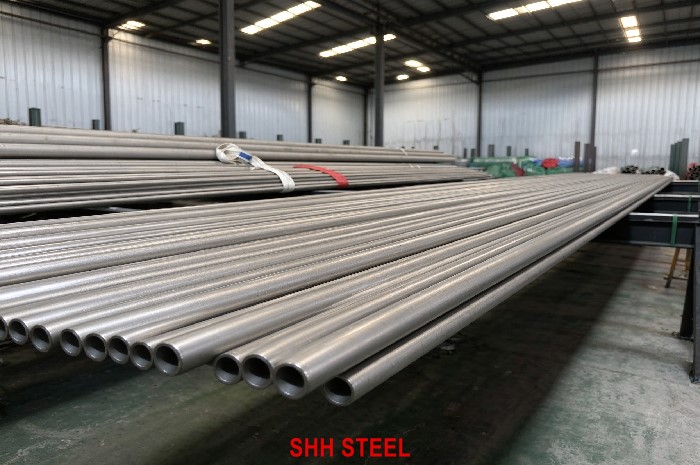
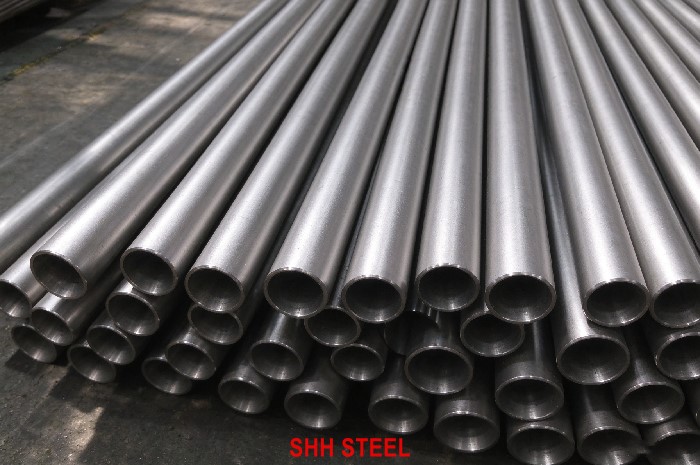
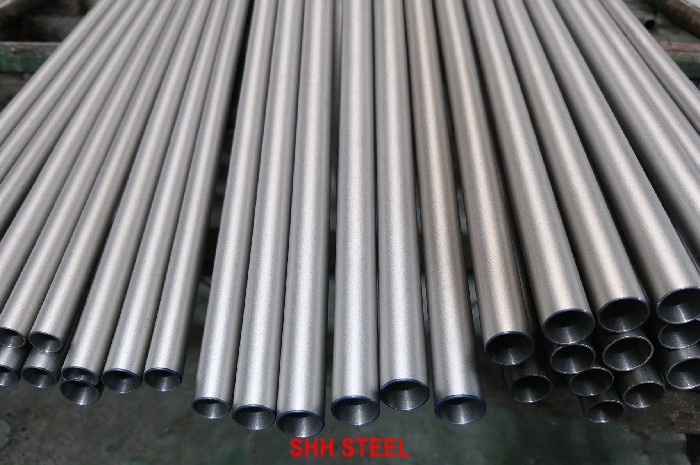
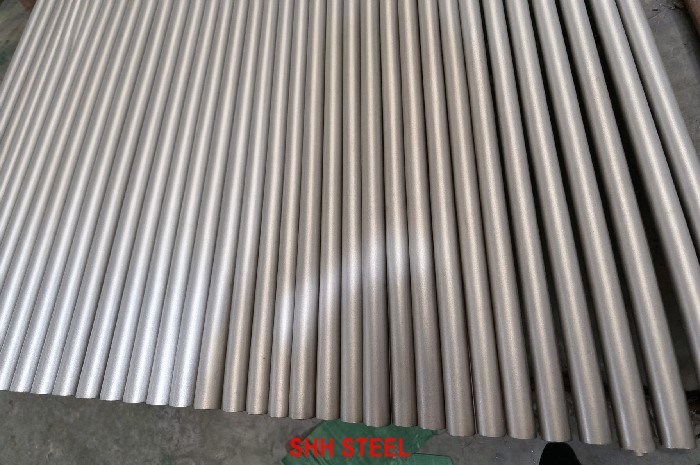
SHH STEEL can supply ASME SA312 UNS S31272 stainless steel pipe to the edition named on the enquiry, in seamless (SML), welded (WLD), and heavily cold-worked (HCW) form. We quote ASME B36.19 schedules and special OD/wall by agreement, ship with EN 10204 3.1 mill test certificates reporting every Table 1 element including the carbon band, titanium, and boron, state the 65/29 ksi Table 4 results and the 1920 °F anneal, and offer dual SA-312/A312 marking when chemistry, heat treatment, mechanical tests, and marking meet both editions on the purchase order. Please confirm NPS, wall or schedule, finish, length practice, filler preference, and any product-analysis requirement when you enquire.
The list below shows how the names buyers use map to what should appear on the order and certificate. Because the grade has no TP name, informal labels are especially risky here.
- ASME SA312 UNS S31272 / SA-312 Grade UNS S31272 — the marking language for ASME-code and dual-marked pipe
- ASTM A312 UNS S31272 — same chemistry and tensile tables when the ASTM edition is referenced
- “15-15Ti” or “stabilized 316” type labels — informal only and misleading; S31272 is not TP316Ti and not TP321
Grades that get confused with S31272 include ASME SA312 TP316Ti Stainless Steel Pipe (Ti by the 5 × (C+N) formula, Cr 16–18%, Mo 2–3%, 75/30 ksi), ASME SA312 TP321 Stainless Steel Pipe (Ti-stabilized 18-8 with no Mo requirement), and ASME SA312 UNS S30815 Stainless Steel Pipe (the high-temperature grade that shares the 1920 °F Table 2 listing). None is a drop-in, since each has its own Table 1 row and tensile floor. Grade hub: ASME SA 312/SA 312M.
Manufacturing Types (SML / WLD / HCW)
ASME SA-312 recognizes three manufacturing routes for UNS S31272 pipe, and the route is a purchase-order decision driven by the design code, the size range, wall thickness, and how the owner wants the pipe inspected. The route never changes the chemistry: whichever way the pipe is made, the heat must still meet C 0.08–0.12%, Mn 1.50–2.00%, P ≤0.030%, S ≤0.015%, Si 0.25–0.75%, Cr 14.0–16.0%, Ni 14.0–16.0%, Mo 1.00–1.40%, Ti 0.30–0.60%, and B 0.004–0.008%, and every length must still go through the solution anneal at 1920 °F [1050 °C] minimum before it is released.
- Seamless (SML) — no welding at any stage. Seamless is typical for high-temperature and pressure service where the project excludes welded pipe. Every seamless length must still be solution annealed at 1920 °F minimum and rapidly cooled.
- Welded (WLD) — automatic welding without filler metal, with the weld finished so the pipe meets dimensional and mechanical requirements after the final heat treatment. The strip or plate heat must itself carry the full UNS S31272 chemistry, so ask for the coil or plate heat number on the certificate.
- Heavily cold-worked (HCW) — welded pipe cold worked to at least 35% reduction of wall and weld before the final anneal, again without filler in the longitudinal seam, with the weld radiographed before cold work. Order HCW when the project specifically wants that marking and the process controls SA-312 writes around it.
Every finished length is hydrostatically tested or nondestructively electrically tested, and the mill may choose the method unless the purchase order fixes one. Pipe NPS 10 and larger may ship marked “NH” only when the purchaser accepts a system test in place of the hydrotest, and lots for mechanical testing follow clause 11.1. Clause 17 heat-treatment lot marking is not mandatory because S31272 is not an H grade, but owners who specify this alloy usually want full heat and lot identity carried on the stencil. The boron range is narrow enough that consistent melting practice matters, so grouping all project sizes onto one heat is strongly preferred.
S31272 is a niche grade and is almost always made to order, so expect longer lead times than for ASME SA312 TP321 Stainless Steel Pipe or ASME SA312 TP316Ti Stainless Steel Pipe, and expect mill minimums to drive the order quantity. Enquire early with route, sizes, wall, the anneal evidence you need, and the edition year, and confirm before the melt is booked that the mill can analyse and certify boron at the 0.004–0.008% level.
Chemical Composition of SA312 UNS S31272
Two chemistry layers matter for UNS S31272. The melting (heat or ladle) analysis is mandatory for every heat under SA-312/A312 Table 1, while product analysis on finished pipe applies only when it is ordered through Supplementary Requirement S1 or purchase-order wording. Product tolerances are not printed in SA-312 itself; they come through ASTM A999/A999M §6.3 from ASTM A480/A480M Table A1.1. SHH STEEL reports the actual ladle values and, when ordered, the product values, and never quotes tighter catalogue windows that the standard does not publish.
Melting analysis (heat / ladle analysis) — Table 1
The table below is the heat analysis for UNS S31272 from SA-312/SA-312M Table 1. Values are maximum unless a range is shown, and an ellipsis (…) means the ordered edition sets no requirement for that element. The TP column shows “…”, confirming there is no TP name.
| Element | UNS S31272 melting analysis |
|---|---|
| Carbon (C) | 0.08 – 0.12 |
| Manganese (Mn) | 1.50 – 2.00 |
| Phosphorus (P) | ≤ 0.030 |
| Sulfur (S) | ≤ 0.015 |
| Silicon (Si) | 0.25 – 0.75 |
| Chromium (Cr) | 14.0 – 16.0 |
| Nickel (Ni) | 14.0 – 16.0 |
| Molybdenum (Mo) | 1.00 – 1.40 |
| Titanium (Ti) | 0.30 – 0.60 |
| Boron (B) | 0.004 – 0.008 |
Product analysis — A480/A480M Table A1.1 tolerances applied to Table 1
| Element | Melting (Table 1) | Tolerance (A480 A1.1) | Product analysis limit |
|---|---|---|---|
| Carbon (C) | 0.08 – 0.12 | 0.01 under / over | 0.07 – 0.13 |
| Manganese (Mn) | 1.50 – 2.00 | 0.04 under / over | 1.46 – 2.04 |
| Phosphorus (P) | ≤ 0.030 | 0.005 over | ≤ 0.035 |
| Sulfur (S) | ≤ 0.015 | 0.005 over | ≤ 0.020 |
| Silicon (Si) | 0.25 – 0.75 | 0.05 under / over | 0.20 – 0.80 |
| Chromium (Cr) | 14.0 – 16.0 | 0.15 under / over | 13.85 – 16.15 |
| Nickel (Ni) | 14.0 – 16.0 | 0.15 under / over | 13.85 – 16.15 |
| Molybdenum (Mo) | 1.00 – 1.40 | 0.05 under / over | 0.95 – 1.45 |
| Titanium (Ti) | 0.30 – 0.60 | 0.05 under / over | 0.25 – 0.65 |
| Boron (B) | 0.004 – 0.008 | No A480 B row tabulated | By agreement |
Source: SA-312 Table 1, UNS S31272 (TP column “…”). Boron has no A480 A1.1 product-tolerance row, so product boron is by agreement.
The carbon requirement is a true band of 0.08–0.12%, not the ≤0.08% maximum of ordinary 316, so a low-carbon heat fails just as surely as a high one. Titanium at 0.30–0.60% is a fixed range rather than the 5 × (C+N) formula used for ASME SA312 TP316Ti Stainless Steel Pipe and ASME SA312 TP321 Stainless Steel Pipe, which means receiving inspection simply checks the reported value against the window. Boron at 0.004–0.008% must be reported on the certificate; if it is missing, the heat has not been shown to meet Table 1, however good the titanium figure looks.
Boron at these levels needs proper analytical practice, typically spark OES calibrated for low boron or a wet or ICP method, and the method should be stated if product analysis is ordered. Because A480 has no boron row, write the acceptance basis for product boron into the purchase order. Silicon also has a minimum (0.25%), and molybdenum is only 1.00–1.40%, well below the 2–3% of the 316 family, which is another reason not to treat this grade as a 316 variant.
Mechanical Properties of SA312 UNS S31272
Room-temperature tensile requirements for UNS S31272 come from SA-312 Table 4 and are summarized below. These are minimum release values for the lot, not typical values, and design allowables must always be taken from the governing code tables for UNS S31272 rather than from a neighbouring grade.
| Property | S31272 |
|---|---|
| Tensile, min | 65 ksi [450 MPa] |
| Yield, min | 29 ksi [200 MPa] |
| Elongation | 35% L / 25% T (general austenitic rule) |
The 65/29 ksi floor is deliberately lower than the 75/30 ksi of TP316 or TP321, so neither inspectors nor designers should apply 316-family floors or allowables to S31272. Elevated-temperature design must use the code allowable stresses listed for UNS S31272 itself; copying stress tables from ASME SA312 TP316H Stainless Steel Pipe or ASME SA312 TP321 Stainless Steel Pipe is not acceptable even where room-temperature values look similar. Table 4 does not set a hardness maximum for this grade.
Certificate results normally sit above the minima, but the design basis should still use Table 4 and the code tables unless the mill has accepted higher guarantees in writing. Delivery is the solution-annealed condition. If the owner’s specification calls for elevated-temperature tensile tests, creep data, or grain-size reporting, those are project extras and must be written into the order, because SA-312 does not require them for S31272.
Dimensions and Tolerances
Dimensional supply for SA312 UNS S31272 pipe follows ASME B36.19 schedules for the common NPS and schedule combinations, with special OD and wall available by agreement when a project needs a section the schedules do not cover. Outside-diameter variations follow ASTM A999/A999M, and wall-thickness variations follow SA-312 Table 3 as summarized below. State on the purchase order whether wall is nominal or minimum (Supplementary S8), because the two readings produce different pipe from the same size line.
| NPS designator | Wall over | Wall under |
|---|---|---|
| 1/8 to 2-1/2 incl., all t/D | 20.0% | 12.5% |
| 3 to 18 incl., t/D up to 5% | 22.5% | 12.5% |
| 3 to 18 incl., t/D over 5% | 15.0% | 12.5% |
| 20 and larger, welded, all t/D | 17.5% | 12.5% |
| 20 and larger, seamless, t/D up to 5% | 22.5% | 12.5% |
| 20 and larger, seamless, t/D over 5% | 15.0% | 12.5% |
Source: SA-312 Table 3; outside diameter variations per A999/A999M.
- Lengths — single random, double random, or cut-to-length on order
- Cut lengths — typically no more than 1/4 in. [6 mm] over the ordered length unless the PO states a tighter band
- Ends — plain or beveled; confirm bevel angle and root face when the WPS is already frozen
Many specialty high-temperature and process buyers order by OD × wall rather than NPS and schedule, which is fine as long as the enquiry says so clearly. Straightness, end finish, and length tolerance should be written into export orders so receiving inspection has an agreed acceptance basis instead of arguing after arrival. On thin schedules with threaded or socket-weld ends, check that the remaining wall is still adequate after the 12.5% under-tolerance. Jointers are not permitted unless the purchase order allows them, so cut-to-length programmes should include an allowance for fit-up scrap rather than expecting the mill to ship short pieces.
Equivalent Grades
UNS S31272 has no TP name in SA-312 and no simple one-to-one equivalent in other standards. Proprietary specifications and EN-type titanium-boron austenitic grades may look similar, but any cross-reference has to be checked element by element against Table 1.
| Designation | Notes |
|---|---|
| SA-312 UNS S31272 | Governing (no TP) |
| Proprietary maps | Recheck Ti, B, Mo, C band |
Substitution from a proprietary specification is only valid if every Table 1 limit is met, including the 0.08–0.12% carbon band, Ti 0.30–0.60%, B 0.004–0.008%, and Mo 1.00–1.40%. In particular, ASME SA312 TP316Ti Stainless Steel Pipe is not an equivalent: its titanium follows a formula, its chromium and molybdenum are higher, and its tensile floor is different. Related SA-312 pages: ASME SA312 UNS S30815 Stainless Steel Pipe, ASME SA312 TP316Ti Stainless Steel Pipe, ASME SA312 TP321 Stainless Steel Pipe, and ASME SA312 UNS S31277 Stainless Steel Pipe.
Heat Treatment and Delivery Condition
Table 2 requires UNS S31272 to be solution annealed at 1920 °F [1050 °C] minimum, the same listing as S30815, followed by rapid cooling. A commodity 1900 °F anneal applied by habit to 316 pipe is not automatic compliance, so the mill record and the MTC should both quote the 1920 °F practice for this grade. The anneal dissolves carbides formed during hot working while leaving the titanium available as stable carbonitrides, which is part of why the carbon and titanium windows are controlled together.
S31272 is not an H grade under SA-312, so clause 6.2 reheat, Table 5 grain size, and clause 17 heat-treatment lot marking are not mandatory. If the owner’s specification adds a grain-size requirement or a stabilizing treatment, it must be written into the purchase order, and any stabilizing cycle must never be confused with or replace the mandatory solution anneal. Bright annealing is possible by agreement where the mill can hold the temperature in a protective atmosphere.
Corrosion Resistance
SA-312 has no corrosion table, so this section is engineering commentary. With Cr 14–16% and Mo 1.00–1.40%, S31272 has less general and pitting corrosion resistance than TP316 or TP316L, and it should not be selected for chloride or seawater service on the strength of its molybdenum. Its titanium content does tie up carbon, which helps resistance to intergranular attack after exposure in the sensitizing range, but the grade’s purpose is mechanical and structural stability at temperature rather than corrosion resistance.
- Intergranular corrosion — titanium stabilization helps; S7 (A262 Practice E) can be ordered when proof is needed
- Chloride pitting — modest; lower than 316-family grades because of lower Cr and Mo
- High-temperature oxidation — adequate for moderate temperatures; for scaling resistance consider ASME SA312 TP310S Stainless Steel Pipe or ASME SA312 UNS S30815 Stainless Steel Pipe
Where the owner needs corrosion proof, write the test method and acceptance into the purchase order. Do not upgrade or downgrade from S31272 on corrosion grounds alone without checking the reason the owner specified it, because the decision is usually based on elevated-temperature properties.
Applications of SA312 UNS S31272 Pipe
Applications for UNS S31272 pipe are defined by the owner’s specification rather than by general market demand. The table below summarizes the typical situations in which buyers see the grade.
| Application | Why S31272 | Note |
|---|---|---|
| Specialty high-temperature / process lines per project spec | Ti+B + mid Mo | Follow owner grade list |
| Engineered substitutions from proprietary specs | UNS identity | Verify every Table 1 limit |
Typical enquiries come from specialty high-temperature process equipment, research and energy projects with their own material specifications, and engineered substitutions where a proprietary titanium-boron alloy has been mapped to an SA-312 UNS number. In all of these cases, follow the owner’s grade list exactly and verify every Table 1 limit before accepting a substitute. If the requirement is really general high-temperature service, ASME SA312 TP316H Stainless Steel Pipe, ASME SA312 TP321 Stainless Steel Pipe, or ASME SA312 UNS S30815 Stainless Steel Pipe may be easier to source.
Weldability
Table 6 shows only an ellipsis for UNS S31272, which means there is no assigned AWS filler class and the consumable must be agreed between purchaser and fabricator. Do not assume ER316 or ER321 simply because the base metal contains Mo or Ti; the choice should reflect the elevated-temperature duty and should be qualified on S31272 base metal. Record the agreed consumable on the WPS and PQR before production welding.
- Qualify on S31272 — not on 316 or 321 coupons
- Control heat input — around Ti- and B-bearing weld metal, which can be sensitive to hot cracking
- Back-purge roots — to protect the ID from oxidation
- Post-weld heat treatment — only when the owner specification requires it, and then to the agreed cycle
Mill longitudinal welds on WLD and HCW pipe are made without filler, so the filler question applies only to fabrication joints. NDE extent for girth welds is a fabrication-code decision, separate from the hydro or electric test the mill applies to each length. Because the grade is uncommon, have the welding engineer confirm consumable availability before the fabrication schedule is fixed.
Surface Finishes
Surface condition for SA312 UNS S31272 pipe should be stated on the purchase order rather than left to mill default. For stainless pipe, embedded free iron, residual scale, and chloride-bearing residues are where corrosion starts, so the finish is part of the material performance and not just appearance. The finishes we regularly quote for this grade are listed below.
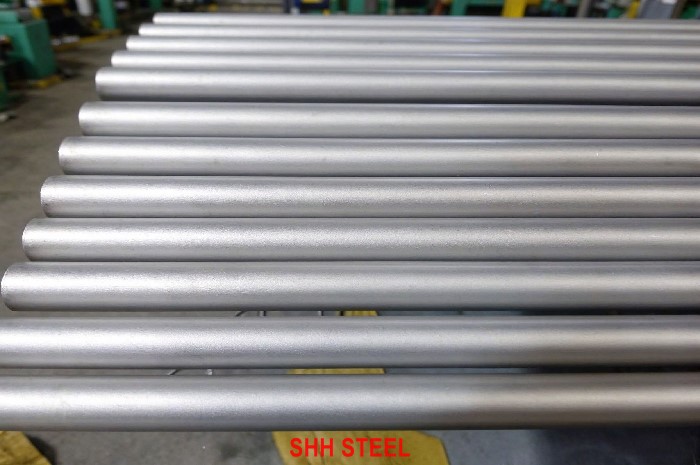
- Annealed and pickled (AP) — solution annealed at 1920 °F [1050 °C] minimum, then descaled in acid pickle or an equivalent process to a matte grey finish; the standard choice for process pipe
- Blasted and pickled — common on heavy-wall seamless where blasting first makes scale removal more reliable
- Bright annealed (BA) — annealed in a protective atmosphere where mill capability exists for the size; the anneal temperature still has to meet the Table 2 practice for UNS S31272
- Mechanically polished — OD and/or ID polish to an agreed grit or Ra when ordered; polishing never replaces the solution anneal
- Bead-finished welded OD — weld bead rolled or ground flush as agreed on WLD and HCW product
For S31272 the standard choice is annealed and pickled, since the grade is bought for high-temperature properties rather than surface appearance. Passivation after pickling or polishing can be added when the end-user specification calls for it, even though SA-312 itself does not require it. If the project bans chloride-bearing marking inks, say so on the order; otherwise the mill will apply its normal stencil practice and ship its default AP finish.
Inspection and Testing
The base acceptance package for SA-312 UNS S31272 pipe combines chemistry, tensile testing, heat-treatment evidence, and a pressure or electrical integrity test on every length. The items below make up the usual package; supplementary requirements and project corrosion tests only apply when they are written on the purchase order.
- Heat (melting) analysis — mandatory per heat against Table 1 for UNS S31272: C 0.08–0.12%, Mn 1.50–2.00%, P ≤0.030%, S ≤0.015%, Si 0.25–0.75%, Cr 14.0–16.0%, Ni 14.0–16.0%, Mo 1.00–1.40%, Ti 0.30–0.60%, and B 0.004–0.008%
- Product analysis — when ordered (Suppl. S1 or PO wording), using A480 Table A1.1 tolerances via A999 §6.3; product boron by agreement (no A480 row)
- Tension test — 65 ksi [450 MPa] tensile and 29 ksi [200 MPa] yield minimum, plus 35% L / 25% T elongation on a lot basis
- Flattening test — or the alternate bend test where the standard permits
- Hydrostatic or nondestructive electric test — every length; manufacturer’s option unless the order fixes the method
- Visual and dimensional check — against ordered NPS/schedule or OD × wall, with UNS S31272 (no TP name exists) on every stencil
Mill test certificates: EN 10204 3.1 is the standard documentation from SHH STEEL supply. For S31272 the certificate must report all ten Table 1 elements as actual values, with the carbon band, Si, Ti, and B clearly shown, together with 65/29 ksi tensile results, 35%/25% elongation, the hydro or NDE method, and a 1920 °F anneal statement. EN 10204 3.2 or third-party witness by SGS, Bureau Veritas, TÜV, or the buyer’s nominated agency is arranged when specified, and it should be booked before final testing rather than after the heat has been released. Dual ASME SA-312 / ASTM A312 certification is available when chemistry, heat treatment, mechanical tests, and marking satisfy both editions named on the order.
| Option | Purpose |
|---|---|
| S1 product analysis | Confirms chemistry on finished pipe |
| S5 radiography | Weld integrity on WLD pipe |
| S7 intergranular corrosion | A262 Practice E after sensitizing treatment |
| S8 minimum wall | Wall interpreted as minimum rather than nominal |
| S9 weld decay | Compares weld and base-metal loss rates |
Receiving review should confirm C 0.08–0.12, Si 0.25–0.75, Cr and Ni 14.0–16.0, Mo 1.00–1.40, Ti 0.30–0.60, and B 0.004–0.008, then the 65/29 ksi results, elongation, and the anneal statement. Third-party inspectors should check that the stencil reads UNS S31272 and not a 316Ti or 321 label. Handheld PMI cannot measure boron, so boron acceptance rests on the certified heat analysis or an agreed laboratory product analysis.
Packaging and Shipping
Export and domestic shipments of SA312 UNS S31272 pipe are packed for handling and for ocean or land transport. The packing we normally apply is summarized below, and anything beyond it can be agreed on the order.
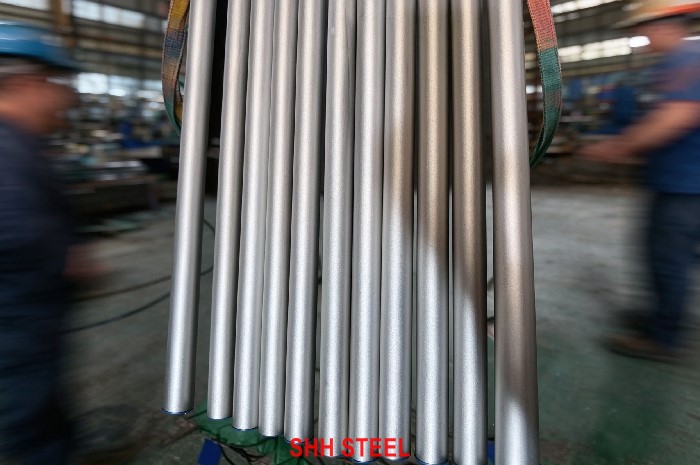
- Seaworthy bundles — pipes strapped or cradled in bundles sized for container or break-bulk handling, with non-metallic separators where the finish needs protecting
- End caps — plastic or metal caps on plain or beveled ends to keep out damage and contamination in transit
- Marking — specification, grade (UNS S31272 (no TP name exists)), heat number, size, manufacturing type (SML / WLD / HCW), test letters, and mill identity as SA-312 and the purchase order require
- Export protection — waterproof wrapping or desiccant as agreed for polished or bright-annealed finishes, with low-chloride inks on request
Segregate UNS S31272 from ASME SA312 TP316Ti Stainless Steel Pipe, ASME SA312 TP321 Stainless Steel Pipe, and other titanium-bearing stainless on the packing list and in the yard, because the grades look identical and a mix-up found after fabrication is expensive. Use separate bundles and distinct tags when S31272 ships with other stainless grades, and have receiving inspectors check stencil heat numbers against the MTC for every length. Keep interiors dry and capped so chloride-bearing moisture cannot stain or pit the surface before installation. Shipping documents normally include the packing list, invoice, bill of lading or air waybill, and the 3.1 or 3.2 MTC with full Table 1 chemistry, plus origin and customs papers to suit the agreed Incoterms.
Why Choose SHH STEEL
SHH STEEL supplies specification-driven stainless plate and pipe, and for SA312 UNS S31272 we quote against the edition you name rather than a generic catalogue sheet. We report every Table 1 element on the MTC—including the C 0.08–0.12% band, Ti 0.30–0.60%, and B 0.004–0.008%—together with the 65/29 ksi Table 4 results and the 1920 °F anneal statement. Heat identity stays unbroken from the melt to the finished length, so receiving inspection can clear each heat against Table 1 and Table 4 without chasing paperwork after the pipe has arrived.
We check supplier certificates before shipment for missing boron, a carbon value outside the band, or a generic 1900 °F anneal statement, so problems are caught at the mill. We are also open about what the standard does not cover: there is no A480 product tolerance for boron and Table 6 assigns no filler, and both are closed by agreement on the quotation rather than glossed over.
- Specification fidelity — chemistry and tensile to SA-312/A312 Table 1 and Table 4 for UNS S31272; C band, Ti, and B reported; 65/29 ksi confirmed; 1920 °F anneal stated; no 316Ti or 321 sold as S31272
- Mill resources — SML, WLD, and HCW from qualified stainless pipe mills with heat traceability; cutting and beveling on confirmed orders
- Documentation — EN 10204 3.1 MTCs as standard with full Table 1 chemistry; 3.2 or third-party inspection on request
- Dual marking — ASME SA-312 and ASTM A312 when the heat and tests meet both editions you name
- Related grades — ASME SA312 TP316Ti Stainless Steel Pipe, ASME SA312 TP321 Stainless Steel Pipe, and ASME SA312 UNS S30815 Stainless Steel Pipe when a project buys a matched package
- Export packing — seaworthy bundles, end protectors, and durable grade, heat, size, and type marking
Quotations follow your purchase-order language for edition year, manufacturing type, size, wall, finish, and any supplementary tests you name (S1, S5, S7, S8, S9). If the same project also needs plate or fittings, ask for coordinated heats so the chemistry lines up across product forms. Grade hub: ASME SA 312/SA 312M.
Supply Capability
SHH STEEL can supply ASME SA312 UNS S31272 stainless steel pipe against the edition and manufacturing type named on your enquiry. The capability table below summarizes the routes, sizes, finishes, and documents we regularly quote for this grade.
| Item | SHH STEEL capability for UNS S31272 |
|---|---|
| Standard | ASME SA-312/SA-312M and/or ASTM A312/A312M UNS S31272 (no TP designation) |
| Manufacturing types | SML, WLD, HCW |
| Size | NPS 1/8 and up per ASME B36.19; special OD/wall by agreement |
| Schedules | 5S, 10S, 40S, 80S and non-standard walls |
| Length | SRL, DRL, or cut-to-length |
| Finish | Annealed and pickled; blasted and pickled; bright annealed or polished by agreement |
| Testing | Tension (65/29 ksi), flattening/bend, hydro or NDE per length; C band, Ti and B on MTC; 1920 °F anneal stated; S1/S5/S7/S8/S9 on order |
| Documents | EN 10204 3.1 with full Table 1 chemistry; third-party inspection / 3.2 on request |
| Trade terms | FOB / CFR / CIF / EXW and other agreed Incoterms |
UNS S31272 is not a distributor stock grade, so orders are mill runs and lead times follow the mill’s melt schedule and minimum quantities. Enquiries should state the SA-312 edition, UNS S31272 (no TP name exists), SML/WLD/HCW, NPS or OD × wall (and whether wall is nominal or minimum), length practice, finish, and any product-analysis, corrosion-test, or 3.2 requirements, so mill slots line up with your need date. Cut lengths, beveling, and packing-list marking are available on confirmed orders, and grouping project sizes onto one heat keeps the chemistry consistent while helping meet mill minimums without over-ordering.
FAQ
-
Is ASME SA312 the same as ASTM A312 for UNS S31272?
- For chemistry (Table 1), tensile (Table 4), manufacturing types, and most testing language, ASME SA-312/SA-312M matches ASTM A312/A312M of the referenced edition, and S31272 has the same row in both. Dual SA312/A312 marking is common when ordered. Name both editions on the purchase order and the mill test certificate so inspectors can verify the heat against the books you cited.
-
Why does UNS S31272 have no TP name?
- Table 1 lists S31272 with an ellipsis in the TP column, so the unified number is the only grade identity in SA-312. Put UNS S31272 on the purchase order, stencil, packing list, and MTC. Informal labels such as stabilized 316 or 15-15Ti are not grade names and invite confusion with TP316Ti or TP321, which have different Table 1 rows.
-
UNS S31272 vs TP316Ti — are they the same?
- No. TP316Ti has Cr 16–18%, Ni 10–14%, Mo 2–3%, C ≤0.08%, and titanium set by the 5 × (C+N) formula with a 0.70% maximum, and its Table 4 floor is 75/30 ksi. S31272 has Cr and Ni 14–16%, Mo 1.00–1.40%, a C 0.08–0.12% band, a fixed Ti 0.30–0.60% range, boron 0.004–0.008%, and a 65/29 ksi floor.
-
UNS S31272 vs UNS S30815 — which should I order?
- They share the 1920 °F Table 2 anneal listing but are different alloys. S30815 is a high-temperature oxidation-resistant grade with its own chemistry and tensile row, while S31272 is a titanium-boron grade with a carbon band and a 65/29 ksi floor. Order the UNS your datasheet names; switching after drawings are frozen normally needs a formal material change.
-
Seamless vs welded UNS S31272 — which is better?
- Neither is universally better. Seamless is typical for high-temperature pressure parts and for projects that exclude welded pipe, while WLD and HCW are legitimate SA-312 forms when tested to the standard and annealed at 1920 °F. Choose the route your design code allows, state SML, WLD, or HCW on the purchase order, and confirm the same letters on the marking and MTC.
-
Can you dual-certify SA312 / A312 UNS S31272?
- Yes, when the heat analysis, heat treatment, mechanical tests, and marking satisfy both editions named on the order. Write the ASME and ASTM edition years on the purchase order and ask for the MTC to reference both. Dual certification to TP316Ti or TP321 is not possible, because the chromium, molybdenum, titanium, and carbon requirements conflict.
-
Hydrostatic test vs NDE — which do I get on S31272 pipe?
- Each length is either hydrostatically tested or nondestructively electrically tested, and the manufacturer may choose unless the purchase order fixes the method. If your piping class or the owner specification requires one method, state it on the PO and confirm the chosen test on the MTC for every length. NPS 10 and larger may be marked NH only when you accept a system test.
-
What anneal temperature applies to UNS S31272?
- Table 2 requires a solution anneal at 1920 °F [1050 °C] minimum, listed together with S30815, followed by rapid cooling. A habitual 1900 °F cycle used for 316 pipe is not automatic compliance. S31272 is not an H grade, so there is no clause 6.2 reheat or Table 5 grain-size requirement unless the owner adds one on the purchase order.
-
What Table 1 chemistry defines UNS S31272?
- Table 1 sets C 0.08–0.12%, Mn 1.50–2.00%, P ≤0.030%, S ≤0.015%, Si 0.25–0.75%, Cr 14.0–16.0%, Ni 14.0–16.0%, Mo 1.00–1.40%, Ti 0.30–0.60%, and B 0.004–0.008%. Note that carbon, silicon, titanium, and boron all have minimums. If product analysis is ordered, agree the boron acceptance on the PO because A480 has no boron row.
-
What are the Table 4 tensile requirements for UNS S31272?
- Table 4 requires 65 ksi [450 MPa] tensile and 29 ksi [200 MPa] yield minimum, with the general 35% longitudinal and 25% transverse elongation. That floor is deliberately lower than the 75/30 ksi of TP316 or TP321, so do not apply 316-family floors or allowables. Design to the code tables listed for UNS S31272 itself.
-
What filler metal should I use to weld UNS S31272 pipe?
- Table 6 shows only an ellipsis for S31272, so there is no assigned AWS class and the filler is by agreement. Choose a consumable suited to the elevated-temperature duty, qualify it on S31272 base metal, and record it on the WPS and PQR. Do not assume ER316 or ER321 just because the base metal contains molybdenum or titanium.
-
Does UNS S31272 require boron on the heat analysis?
- Yes. Boron at 0.004–0.008% is a Table 1 range, so the certificate must report an actual boron value inside that window. A heat without a reported boron result has not been shown to meet the grade, even if titanium and the other elements are correct. Handheld PMI cannot measure boron, so acceptance relies on the certified analysis.
Conclusion
ASME SA312 UNS S31272 is a TP-less titanium-boron austenitic pipe grade with C 0.08–0.12%, Mn 1.50–2.00%, Si 0.25–0.75%, Cr and Ni 14.0–16.0%, Mo 1.00–1.40%, Ti 0.30–0.60%, and B 0.004–0.008%, a 65/29 ksi Table 4 floor with 35% L / 25% T elongation, and a 1920 °F [1050 °C] Table 2 anneal shared with S30815. Table 6 assigns no filler, and A480 has no product tolerance for boron, so both are settled by agreement. It is not ASME SA312 TP316Ti Stainless Steel Pipe or ASME SA312 TP321 Stainless Steel Pipe under another name. Order the manufacturing type, size and wall, finish, full Ti and B reporting, anneal proof, and filler basis explicitly. For stock checks, mill certificates, or dual SA-312/A312 supply questions, contact SHH STEEL at admin@steelspecs.com or browse the ASME SA 312/SA 312M category on steelspecs.com.
Quality Steel Needed? Inquire for Offers
Related Products