ASME SA312 TPXM-11 Stainless Steel Pipe | SA 312/SA 312M
What is ASME SA312 TPXM-11 Stainless Steel Pipe
ASME SA-312/SA-312M is the ASME Boiler and Pressure Vessel Code adoption of ASTM A312/A312M for seamless, welded, and heavily cold-worked austenitic stainless steel pipe. Within its Table 1, Grade TPXM-11 carries the unified number UNS S21904. It is the low-carbon member of the XM-10 / XM-11 pair: the same chromium–nickel–manganese–nitrogen balance as ASME SA312 TPXM-10 Stainless Steel Pipe, but with carbon capped at 0.04% instead of 0.08%. On purchase orders the grade may appear as SA312 TPXM-11, ASTM A312 TPXM-11, A312 Grade TPXM-11, or S21904 pipe; for code documentation the safest form is “SA-312 TPXM-11 / UNS S21904” plus the edition year.
Why does a lower carbon ceiling matter for a high-strength nitrogen grade? Carbon combines with chromium at grain boundaries when austenitic steel spends time in the roughly 800–1500 °F range, as happens in a weld heat-affected zone or during slow cooling. Halving the permitted carbon reduces the amount available to form those chromium carbides, so fabricated spools are less prone to sensitization and subsequent intergranular attack in aggressive media. The nitrogen in S21904 also helps by slowing carbide precipitation. The result is a pipe grade intended for as-welded fabrications that still need the high strength floor of the XM family.
Table 4 sets TPXM-11 at 90 ksi [620 MPa] tensile and 50 ksi [345 MPa] yield minimum—exactly the same as TPXM-10. That is a notable contrast with the 300-series, where the L grade gives up strength: ASME SA312 TP304L Stainless Steel Pipe drops to 70 / 25 ksi from the 75 / 30 ksi of ASME SA312 TP304 Stainless Steel Pipe. In the XM-11 case, nitrogen carries the strength, so the low-carbon option costs nothing on the Table 4 floor.
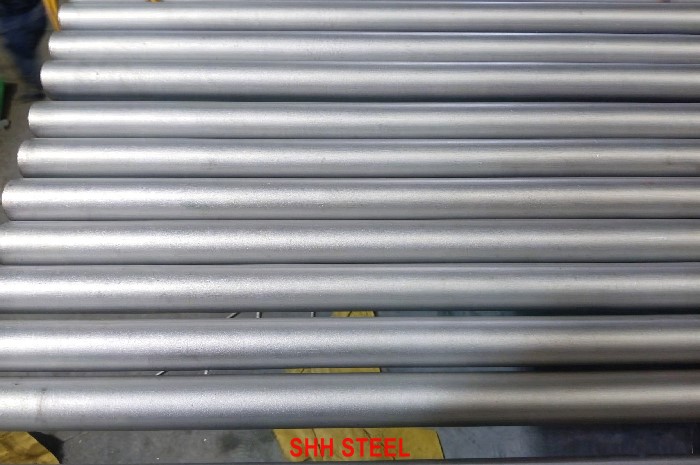
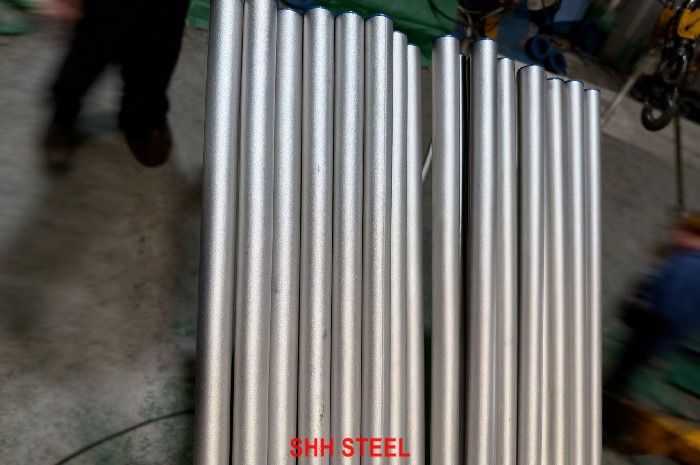
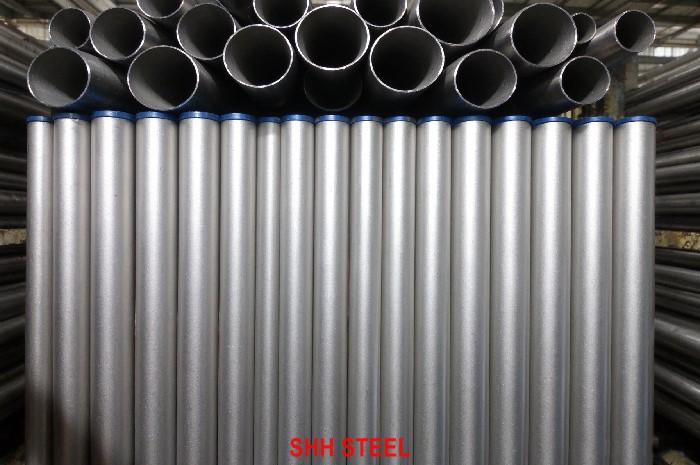
SHH STEEL can supply ASME SA312 TPXM-11 / UNS S21904 stainless steel pipe to the edition named on the enquiry, including seamless (SML), welded (WLD), and heavily cold-worked (HCW) routes; ASME B36.19 schedules and special OD/wall by agreement; EN 10204 3.1 mill test certificates; and dual SA-312/A312 marking when the heat analysis, heat treatment, mechanical tests, and marking satisfy both editions named on the purchase order. For this grade we quote only heats whose melt analysis meets C ≤0.04%, because a heat at 0.06% C can certify as TPXM-10 but never as TPXM-11. Confirm NPS, wall or schedule, finish, length practice, and any product-analysis or supplementary tests on enquiry.
Enquiries reach us under several names for this grade. The list below shows how each one relates to the ordered product; use the full SA-312/A312 designation with UNS S21904 on the purchase order, since a slip to S21900 changes the carbon limit.
- SA312 TPXM-11 / SA-312 Grade TPXM-11 — ASME marking for code-stamped work
- ASTM A312 TPXM-11 — the ASTM parent; same Table 1 and Table 4 rows
- UNS S21904 — unified number shown in Table 1 and on MTCs
- XM-11 / “21-6-9 low carbon” — trade shorthand; confirm S21904 rather than S21900 on the PO
Mix-ups between S21900 and S21904 are common in quoting because the two rows differ only in carbon. ASME SA312 TPXM-10 Stainless Steel Pipe allows C ≤0.08% with the same Mn, Cr, Ni, N ranges and 90/50 ksi floors; a heat meeting XM-11 also falls inside XM-10, but not the other way round. ASME SA312 TPXM-19 Stainless Steel Pipe (S20910) is the Mo-Nb-V grade with 100/55 ksi floors and C ≤0.06%, and ASME SA312 TPXM-29 Stainless Steel Pipe (S24000) is the lean-nickel, 11.5–14.5% Mn grade, also at 100/55 ksi. Against ASME SA312 TP304L Stainless Steel Pipe (70/25 ksi), XM-11 doubles the yield floor while keeping low carbon. Grade hub: ASME SA 312/SA 312M.
Manufacturing Types (SML / WLD / HCW)
SA-312 permits three product routes for TPXM-11, each marked on the pipe and certificate. The route affects availability and inspection planning, not the Table 1 chemistry.
- Seamless (SML) — pierced or extruded hollow, hot or cold finished, then solution annealed. No weld exists anywhere in the pipe. For a specialty grade such as S21904, seamless is usually produced to order rather than stocked.
- Welded (WLD) — strip formed and joined by an automatic process without filler metal, then annealed. The low carbon of XM-11 is useful here because the longitudinal seam is fully annealed in any case, but downstream girth welds remain as-welded.
- Heavily cold-worked (HCW) — welded pipe reduced at least 35% in wall and weld thickness before final anneal, with the weld radiographed before cold work. The recrystallized seam behaves much like parent metal.
Clause 11.5 notes that HCW pipe must be capable of passing the S9 weld-decay test with a weld-to-base metal loss ratio of 0.90 to 1.1, though the test is run only when S9 is ordered. Buyers who chose XM-11 for intergranular corrosion reasons often add S7 or S9 so that the low-carbon benefit is demonstrated on the actual product.
Each length is hydrotested or tested by a nondestructive electric method per A999, at the manufacturer’s option unless specified. Pipe at NPS 10 and above may ship without hydrotest marked “NH” only when the purchaser agrees to a system test in its place.
Chemical Composition of SA312 TPXM-11
Every heat of TPXM-11 is certified by melting analysis against Table 1. Product analysis on finished pipe is an option (Supplementary S1) and is judged using the tolerances of ASTM A480/A480M Table A1.1, which A312 reaches through A999. The only Table 1 difference between TPXM-11 and TPXM-10 is the carbon ceiling.
Melting analysis (heat / ladle analysis) — Table 1
Heat analysis for TPXM-11 (UNS S21904). Values are maximum unless a range is shown; ellipses (…) mean no requirement.
| Element | TPXM-11 (UNS S21904) melting analysis |
|---|---|
| Carbon (C) | ≤ 0.04 |
| Manganese (Mn) | 8.0 – 10.0 |
| Phosphorus (P) | ≤ 0.045 |
| Sulfur (S) | ≤ 0.030 |
| Silicon (Si) | ≤ 1.00 |
| Chromium (Cr) | 19.0 – 21.5 |
| Nickel (Ni) | 5.5 – 7.5 |
| Nitrogen (N) | 0.15 – 0.40 |
| Molybdenum (Mo) | … (no requirement) |
Source: ASME SA-312/SA-312M ≡ ASTM A312/A312M Table 1, Grade TPXM-11. Nitrogen determination method by agreement (Table 1 footnote).
Product analysis — A480/A480M Table A1.1 tolerances applied to Table 1
| Element | Melting (Table 1) | Tolerance (A480 A1.1) | Product analysis limit |
|---|---|---|---|
| Carbon (C) | ≤ 0.04 | 0.01 over | ≤ 0.05 |
| Manganese (Mn) | 8.0 – 10.0 | 0.06 under / over | 7.94 – 10.06 |
| Phosphorus (P) | ≤ 0.045 | 0.010 over | ≤ 0.055 |
| Sulfur (S) | ≤ 0.030 | 0.005 over | ≤ 0.035 |
| Silicon (Si) | ≤ 1.00 | 0.05 over | ≤ 1.05 |
| Chromium (Cr) | 19.0 – 21.5 | 0.20 under / 0.25 over | 18.80 – 21.75 |
| Nickel (Ni) | 5.5 – 7.5 | 0.10 under / over | 5.40 – 7.60 |
| Nitrogen (N) | 0.15 – 0.40 | 0.01 under / 0.04 over | 0.14 – 0.44 |
Carbon at 0.04% maximum falls in the A480 “over 0.030 to 0.20” row, so a product check may read up to 0.05%. Chromium uses two different bands: the 19.0 minimum is in the 15–20% row (0.20) while the 21.5 maximum is in the 20–30% row (0.25). Nitrogen at 0.15 minimum takes 0.01 under; 0.40 maximum takes 0.04 over.
Reading an MTC for XM-11, check three things first: carbon ≤0.04, nitrogen inside 0.15–0.40, and manganese inside 8.0–10.0. A carbon value of 0.05% on a heat analysis means the heat is TPXM-10, even if the product-analysis allowance would accept 0.05% on a check sample. Product tolerance never widens the heat analysis limit.
Mechanical Properties of SA312 TPXM-11
Table 4 of SA-312/A312 gives TPXM-11 the following minima, tested per A370 with specimen location and orientation as defined in the specification:
| Property | TPXM-11 requirement |
|---|---|
| Tensile strength, min | 90 ksi [620 MPa] |
| Yield strength (0.2% offset), min | 50 ksi [345 MPa] |
| Elongation in 2 in. or 50 mm (or 4D), min | 35% longitudinal / 25% transverse |
| Hardness | No maximum listed in Table 4 |
How the XM-11 floors compare with neighbours on the same page of Table 4:
| Grade | UNS | Tensile min, ksi [MPa] | Yield min, ksi [MPa] |
|---|---|---|---|
| TP304L | S30403 | 70 [485] | 25 [170] |
| TP304 | S30400 | 75 [515] | 30 [205] |
| TPXM-10 | S21900 | 90 [620] | 50 [345] |
| TPXM-11 | S21904 | 90 [620] | 50 [345] |
| TPXM-29 | S24000 | 100 [690] | 55 [380] |
| TPXM-19 | S20910 | 100 [690] | 55 [380] |
Against TP304L, the low-carbon option most buyers know, TPXM-11 doubles the minimum yield. For pressure design that gap only counts if the applicable code lists allowable stresses for S21904 at the design temperature; take those from ASME Section II Part D or the relevant B31 table and never back-calculate them from Table 4 minima.
Mechanical tests are made per heat-treatment lot as defined in clause 11.1: one tension test for lots of up to 100 pipes and two above that, plus flattening tests on 5% of the pipes in the lot (or bend tests where the standard permits). Hardness, Charpy impact, or elevated-temperature tensile data are not part of the base requirement; specify them on the PO if the project needs them.
Dimensions and Tolerances
TPXM-11 pipe is ordered to ASME B36.19 stainless schedules (5S, 10S, 40S, 80S) or to B36.10 weights and special OD/wall by agreement. SA-312 Appendix X1 reproduces the standard size table.
| NPS designator | Wall tolerance over | Wall tolerance under |
|---|---|---|
| 1/8 to 2-1/2 incl., all t/D | 20.0% | 12.5% |
| 3 to 18 incl., t/D up to 5% | 22.5% | 12.5% |
| 3 to 18 incl., t/D over 5% | 15.0% | 12.5% |
| 20 and larger, welded, all t/D | 17.5% | 12.5% |
| 20 and larger, seamless, t/D up to 5% | 22.5% | 12.5% |
| 20 and larger, seamless, t/D over 5% | 15.0% | 12.5% |
Source: SA-312 Table 3. OD variations follow A999/A999M.
- Length: NPS 1/8 to 8 normally furnished up to 24 ft, range 15–24 ft; definite cut lengths no more than 1/4 in. [6 mm] over
- Jointers: not permitted unless specified
- Ends: plain, beveled to B16.25 or customer drawing
Because XM-11 offers 50 ksi yield, a lighter schedule may satisfy the code calculation where TP304L would need a heavier one. Do the calculation with the 12.5% under-tolerance and any corrosion allowance included, and confirm that a thinner wall still suits the joining method—socket welding and threading on thin schedules can be problematic.
Equivalent Grades
Cross-references are a starting point only; substitution in a code design needs engineering approval.
| Designation | Relationship to TPXM-11 |
|---|---|
| ASME SA-312 / ASTM A312 TPXM-11 | The governing pipe grade |
| UNS S21904 | Unified number in Table 1 |
| XM-11 (trade) | Common shorthand; verify S21904 and the 0.04% C ceiling |
| TPXM-10 / UNS S21900 | Same balance with C ≤0.08%; an XM-11 heat usually also meets XM-10, not the reverse |
| TP304L / UNS S30403 | The familiar low-carbon 18-8 option; lower strength, higher nickel |
| EN / JIS | No one-to-one designation asserted here; confirm with the relevant regional standard if needed |
Dual certification of one heat as both TPXM-10 and TPXM-11 is possible if the heat satisfies both rows, but marking must follow what the PO requests. Sister pages: ASME SA312 TPXM-10 Stainless Steel Pipe, ASME SA312 TPXM-19 Stainless Steel Pipe, ASME SA312 TPXM-29 Stainless Steel Pipe, ASME SA312 UNS S20400 Stainless Steel Pipe, ASME SA312 TP201LN Stainless Steel Pipe, ASME SA312 TP304L Stainless Steel Pipe, ASME SA312 TP316L Stainless Steel Pipe. Plate: ASME SA240 304 Stainless Steel Plate.
Heat Treatment and Delivery Condition
TPXM-11 is not individually listed in SA-312 Table 2, so the general row applies: solution treat at 1900 °F [1040 °C] minimum and quench in water or cool rapidly by other means fast enough to prevent carbide re-precipitation. The capability is demonstrated by the A262 Practice E test, which is performed only when S7 is ordered.
Under the ASME-revised clause 6.2, seamless TPXM-11 may be individually quenched directly after hot forming provided its temperature is not below 1900 °F; the reheat-before-quench rule in that clause applies to H grades and to S33228, S30815, and S31272, not to S21904.
The quench matters more than it seems for a low-carbon grade: low carbon reduces the driving force for sensitization, but slow cooling through the precipitation range can still form some carbides or nitrides at grain boundaries in a nitrogen-rich alloy. A properly quenched anneal gives a clean, fully austenitic structure as the starting point for fabrication.
- Delivered condition: solution annealed and quenched
- Surface: free of scale and exogenous iron—pickled, blasted, or bright annealed
- Passivation: may be required by the purchaser (clause 6.1.7)
- Field stress relief: generally not applied to austenitic pipe; if a project requires PWHT, discuss its effect on sensitization with the fabricator
Corrosion Resistance
TPXM-11 shares the general corrosion character of TPXM-10: chromium of 19.0–21.5% supports a stable passive film in atmospheric exposure, fresh water, and many mildly oxidizing process streams. What XM-11 adds is better resistance to intergranular attack in welded condition because of its 0.04% carbon ceiling.
Intergranular corrosion: In acidic or oxidizing services where sensitized weld zones are a known failure mode, low-carbon pipe is preferred. TPXM-11 offers that low-carbon chemistry with the XM strength level. To verify it on delivered product, order S7 (A262 Practice E) or S9 weld decay for welded pipe.
Chloride pitting and crevice corrosion: There is no molybdenum requirement in Table 1, so pitting resistance is governed mainly by chromium and nitrogen. Do not assume parity with ASME SA312 TP316L Stainless Steel Pipe in seawater, brine, or chloride-concentrating crevices. If both low carbon and Mo are required, ASME SA312 TP316L Stainless Steel Pipe or a higher-alloy grade is the usual path; ASME SA312 TPXM-19 Stainless Steel Pipe is the Mo-bearing XM grade with C ≤0.06%.
Stress corrosion cracking: Like other austenitic stainless steels, XM-11 can suffer chloride SCC at elevated temperature under tensile stress. Higher yield strength does not improve this; design and environment control do.
Galling and wear: Nitrogen-strengthened Cr-Mn austenitics are often described as more resistant to galling than 304 in sliding contact, but this is a general observation, not an SA-312 requirement.
Applications of SA312 TPXM-11 Pipe
TPXM-11 is selected where three needs meet: an SA-312 pipe product, strength above the 300-series floor, and low carbon for welded construction.
| Area | Why TPXM-11 | Watch-out |
|---|---|---|
| Welded process spools | Low C limits HAZ sensitization; 50 ksi yield allows lighter walls | Confirm code allowable stresses for S21904 |
| Cryogenic and low-temperature lines | Austenitic structure retains toughness at low temperature | Check impact-test requirements in the governing code |
| Hydraulic and high-pressure tubing systems | High strength in a weldable stainless pipe | Specify tight OD/wall if fittings require it |
| Chemical plant utilities | Mild acid or oxidizing media where intergranular attack is a concern | Run S7 on critical heats |
| Marine deck and structural piping (non-immersed) | Strength-to-weight in exposed atmosphere | No Mo—avoid splash zones with chloride build-up |
| Fabricated frames and supports | Weld-and-forget assemblies without post-weld anneal | SA-312 is a pipe spec; order mechanical tube specs if more suitable |
For standard low-carbon work at lower strength, compare ASME SA312 TP304L Stainless Steel Pipe and ASME SA312 TP316L Stainless Steel Pipe. For the 0.08% C version, see ASME SA312 TPXM-10 Stainless Steel Pipe.
Weldability
Low carbon makes TPXM-11 one of the more forgiving XM grades to weld in thick sections or multipass joints, because the HAZ spends time in the sensitizing range without the carbon reserve of TPXM-10.
- GTAW — root and thin wall; use argon or argon-nitrogen backing gas to protect the ID and limit nitrogen loss from the weld pool
- GMAW / pulsed GMAW — fill passes on heavier walls
- SMAW — field welds where shielding gas is impractical
- Orbital GTAW — production girth welds with repeatable heat input
Filler metal and Table 6: TPXM-11 / S21904 does not appear in SA-312 Table 6. The standard therefore assigns no AWS A5.9 class to it, and filler choice is by agreement between purchaser and manufacturer (for seam repairs) or by the fabricator’s qualified WPS (for field welds). Record the selected filler and its carbon level; using a standard-carbon consumable would partly defeat the purpose of buying a low-carbon base metal. Strength matching is a second consideration, because the base metal yield floor of 50 ksi is well above that of most 300-series weld deposits.
Practical guidance: clean to bright metal, remove all carbon-steel contamination, control interpass temperature, and avoid excessive weave. Remove heat tint by pickling paste, mechanical means plus passivation, or electrochemical cleaning. Qualify procedures under ASME Section IX on S21904 base metal; a PQR on TP304L does not automatically cover it.
Mill longitudinal welds on WLD and HCW pipe are made without filler metal; repair welding of the seam, if used, must follow clause 15 and the filler identity must be reported.
Surface Finishes
Specify the finish at enquiry. Common options for SA312 TPXM-11:
- Annealed and pickled — standard descaled matte finish for process pipe
- Bright annealed — protective-atmosphere anneal; pickling not mandatory
- Sand- or grit-blasted then pickled — sometimes used on heavy-wall seamless
- Mechanically polished OD/ID — by agreement with Ra targets
- Bead-conditioned welded product — ID bead rolled, ground, or removed where flow or cleaning demands
Manganese-rich stainless forms a slightly different oxide during annealing than 304, and pickling practice is adjusted accordingly at the mill. The buyer only needs to state the finished appearance and any passivation requirement; SHH STEEL confirms the mill route on the quotation.
Inspection and Testing
Base SA-312 testing for TPXM-11 pipe:
- Heat analysis to Table 1, with carbon ≤0.04% as the critical check
- Tension test per lot to Table 4
- Flattening (or permitted bend) test on 5% of the lot
- Hydrostatic or nondestructive electric test on each length
- Visual and dimensional examination
Supplementary requirements commonly added for XM-11:
| Supplement | Purpose |
|---|---|
| S1 Product analysis | Confirms chemistry on finished pipe using A480 tolerances |
| S2 Transverse tension | Strength across the weld for WLD pipe |
| S5 Radiography | Weld soundness on WLD pipe |
| S7 Intergranular corrosion (A262 E) | Demonstrates the low-carbon benefit |
| S9 Weld decay | Weld versus base metal loss ratio on welded pipe |
Documentation: EN 10204 3.1 is standard; 3.2 with third-party witness (SGS, BV, TÜV, or the buyer’s agency) is available. PMI by handheld XRF can confirm Cr, Ni, and Mn but cannot reliably measure carbon or nitrogen; for those rely on the heat analysis or order S1.
Packaging and Shipping
- Bundling: hexagonal or square bundles with steel or nylon strapping on wooden saddles; small NPS may be boxed
- Isolation: plastic or wood spacers prevent contact with carbon-steel strapping
- End protection: plastic caps on plain ends; bevel protectors on beveled ends
- Marking: SA312 or A312, TPXM-11, heat number, size and schedule, SML/WLD/HCW, NH or test letters as applicable, manufacturer’s mark
- Export wrap: woven polypropylene or waterproof sheet for container or break-bulk transport
Shipping documents include packing list, commercial invoice, bill of lading or air waybill, MTCs, and certificates of origin per the agreed Incoterms. Keeping XM-11 separated from XM-10 in the warehouse matters because the stencils differ by only one character.
Why Choose SHH STEEL
SHH STEEL supplies specification-driven stainless plate and pipe. With TPXM-11 / UNS S21904 the single number that matters most is carbon: the reason to buy XM-11 instead of XM-10 is the 0.04% ceiling, so we quote against the edition you name, report the full Table 1 window on the MTC—C ≤0.04%, Mn 8.0–10.0%, Cr 19.0–21.5%, Ni 5.5–7.5%, N 0.15–0.40%—and refuse to stretch a 0.05% C heat into an XM-11 certificate. Heat identity stays unbroken from melt through finished length, so receiving inspection can clear the heat against Table 1 and the 90/50 ksi Table 4 floors. Table 6 does not list S21904, so we keep filler by agreement and suggest you record a low-carbon consumable on the WPS rather than undoing the base-metal benefit.
- Specification fidelity — Table 1 and Table 4 for TPXM-11 (S21904); carbon ≤0.04% on every heat we certify
- Mill resources — SML, WLD, and HCW from qualified stainless pipe mills with heat traceability; cutting and beveling on confirmed orders
- Documentation — EN 10204 3.1 MTCs standard; 3.2 or third-party inspection on request
- Dual marking — SA-312/A312, and dual XM-10/XM-11 when the PO allows and the heat qualifies
- Verification options — S7 (A262 Practice E) or S9 weld-decay testing when you need proof of the low-carbon benefit
- Export packing — seaworthy bundles, end protectors, and durable grade/heat/size/type marking
Quotations follow your purchase-order language for edition year, manufacturing type, size, finish, and supplementary tests. If the design case for XM-11 is welded spools in acidic or oxidizing service, tell us so at enquiry and we will price the intergranular testing alongside the pipe rather than as an afterthought.
Supply Capability
SHH STEEL can supply ASME SA312 TPXM-11 / UNS S21904 stainless steel pipe against the edition and manufacturing type named on your enquiry. The capability table below summarizes the routes, sizes, finishes, and documents we regularly quote for this grade.
| Item | SHH STEEL capability for TPXM-11 |
|---|---|
| Standard | ASME SA-312/SA-312M and/or ASTM A312/A312M Grade TPXM-11 (UNS S21904) |
| Manufacturing types | SML, WLD, HCW |
| Size | NPS 1/8 and up per ASME B36.19; special OD/wall by agreement |
| Schedules | 5S, 10S, 40S, 80S and non-standard walls |
| Length | SRL, DRL, or cut-to-length |
| Finish | Annealed and pickled; bright annealed or polished by agreement |
| Testing | Tension, flattening/bend, hydro or NDE per length; supplementary tests on order |
| Documents | EN 10204 3.1; third-party inspection / 3.2 on request |
| Trade terms | FOB / CFR / CIF / EXW and other agreed Incoterms |
XM-11 is a niche grade with thinner stock than TP304L or TP316L, and suitable low-carbon heats are not always on the mill schedule, so lead time depends on melt timing more than on pipe forming. Common NPS and schedule combinations can sometimes be found in stock or short runs; heavy walls, larger seamless sizes, and special OD/wall are mill-order items. Enquiries should state the SA-312 edition, TPXM-11 / UNS S21904, SML/WLD/HCW, NPS or OD×wall, length practice, finish, and any S1, S7, S9, or 3.2 requirements so mill slots line up with your need date. Grouping all sizes into one heat helps both chemistry consistency and mill minimums. Cut lengths, beveling, and packing-list marking are available on confirmed orders.
FAQ
-
What UNS number does Table 1 give TPXM-11?
- SA-312 Table 1 lists TPXM-11 as UNS S21904. Put both on the purchase order and the mill test certificate, for example “SA-312 TPXM-11 / UNS S21904” with the edition year, because quoting errors between S21904 and its sister S21900 (TPXM-10) are common and the two rows differ in carbon limit.
-
What is the difference between TPXM-11 and TPXM-10?
- Only carbon: TPXM-11 is limited to C ≤0.04%, TPXM-10 to C ≤0.08%. The Mn 8.0–10.0%, Cr 19.0–21.5%, Ni 5.5–7.5%, and N 0.15–0.40% ranges and the 90/50 ksi Table 4 floors are identical. Order XM-11 when welded fabrications must resist sensitization without a post-weld anneal.
-
Does the low carbon reduce strength?
- No. Unlike TP304L versus TP304, where the L grade drops from 75/30 to 70/25 ksi, TPXM-11 keeps the same 90 ksi tensile and 50 ksi yield minimum as TPXM-10. Nitrogen, not carbon, carries the strength in this family, so the low-carbon option costs nothing on the Table 4 floor.
-
Is TPXM-11 a substitute for TP304L?
- Only with engineering review. TPXM-11 is stronger and also low carbon, but it has less nickel, much more manganese, and needs code allowable stresses listed for S21904 before the higher strength can be used on paper. Corrosion behaviour in mild service is broadly 304-class; confirm the fluid before switching grades.
-
Which filler metal is specified for TPXM-11?
- None. S21904 is not listed in SA-312 Table 6, so filler is by agreement for seam repairs and by the fabricator’s qualified WPS for field welds. Record the selected consumable and its carbon level, because a standard-carbon filler partly defeats the purpose of buying low-carbon pipe, and check strength matching against the 50 ksi yield floor.
-
Is TPXM-11 suitable for seawater?
- It has no Mo requirement, so pitting and crevice resistance depend mainly on chromium and nitrogen and should not be assumed equal to TP316L in seawater or brine. For chloride immersion, TP316L, TPXM-19, or higher alloys are the usual path. Like other austenitics, XM-11 can also suffer chloride SCC at elevated temperature.
-
How is the low-carbon benefit verified?
- First by heat analysis showing C ≤0.04% on the MTC, and, when product analysis is ordered, C ≤0.05% under the A480 tolerance. If you need direct evidence of resistance to intergranular attack, order Supplementary Requirement S7 (A262 Practice E) or S9 weld-decay testing for welded pipe on the purchase order.
-
What heat treatment applies to TPXM-11?
- TPXM-11 is not individually listed in Table 2, so it is solution annealed at the default 1900 °F [1040 °C] minimum and quenched in water or rapidly cooled. Seamless pipe may be quenched directly after hot forming at or above that temperature. A good quench matters even with low carbon, since slow cooling can still form grain-boundary carbides or nitrides.
-
Is there a hardness limit for TPXM-11?
- Table 4 lists no hardness maximum for TPXM-11; it gives only tensile, yield, and elongation minima. Catalog hardness numbers are therefore not acceptance values. If your project or end user needs a hardness cap, impact data, or elevated-temperature tensile results, add them to the purchase order and ask for them on the certificate.
-
Can one heat be certified as both TPXM-10 and TPXM-11?
- Yes, when the PO allows it. A heat that meets the TPXM-11 limits, in particular C ≤0.04%, also falls inside the TPXM-10 limits, so dual marking is technically sound. The reverse is not true: a TPXM-10 heat with more than 0.04% carbon cannot be marked XM-11, and we will not certify it that way.
-
Is SA312 identical to A312 for TPXM-11?
- Yes for practical purposes. SA-312/SA-312M adopts ASTM A312/A312M of the referenced edition, with the ASME revision to clause 6.2 on heat treatment of H grades, which does not affect S21904. Dual SA-312/A312 certification is available when the heat, tests, and marking meet both editions named on the order.
-
Should I order seamless or welded TPXM-11?
- Either route is valid under SA-312 when made and tested to the standard. Seamless suits projects that exclude welded pipe or need heavy walls, while WLD and HCW pipe is usually quicker and cheaper in common sizes. The mill longitudinal weld is made without filler, so it does not add carbon to the seam.
Conclusion
ASME SA312 TPXM-11 (UNS S21904) is the low-carbon member of the XM-10/XM-11 pair: C ≤0.04%, Mn 8.0–10.0%, Cr 19.0–21.5%, Ni 5.5–7.5%, N 0.15–0.40%, no Mo, with the same Table 4 floors as XM-10—90 ksi [620 MPa] tensile and 50 ksi [345 MPa] yield—and a Table 2 default 1900 °F [1040 °C] anneal. It suits welded spools that need both high strength and resistance to sensitization, but it is not a chloride-service grade, and Table 6 lists no filler, so consumables are by agreement. Order the manufacturing type (SML/WLD/HCW), schedule or wall, finish, and any S7/S9 or product-analysis requirements explicitly. For stock checks, mill certificates, or dual SA-312/A312 supply questions, contact SHH STEEL at admin@steelspecs.com or browse the ASME SA 312/SA 312M category on steelspecs.com.
Quality Steel Needed? Inquire for Offers
Related Products