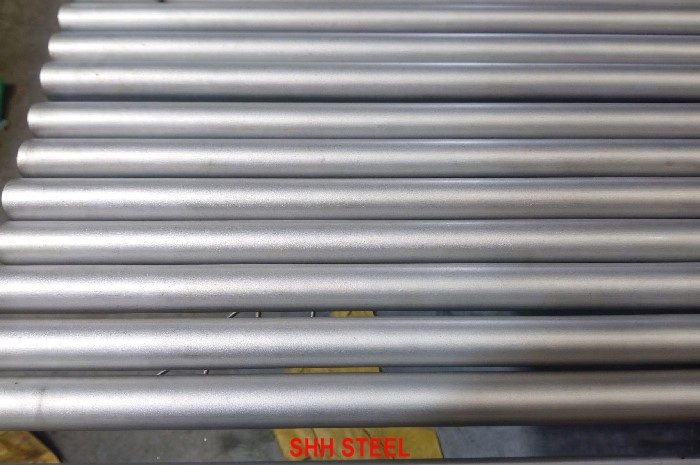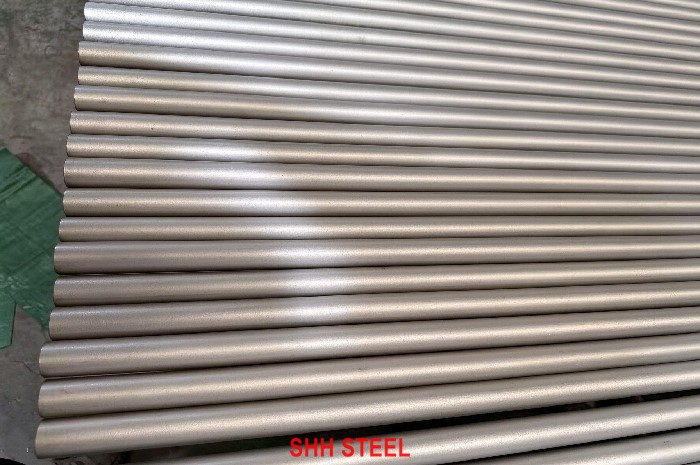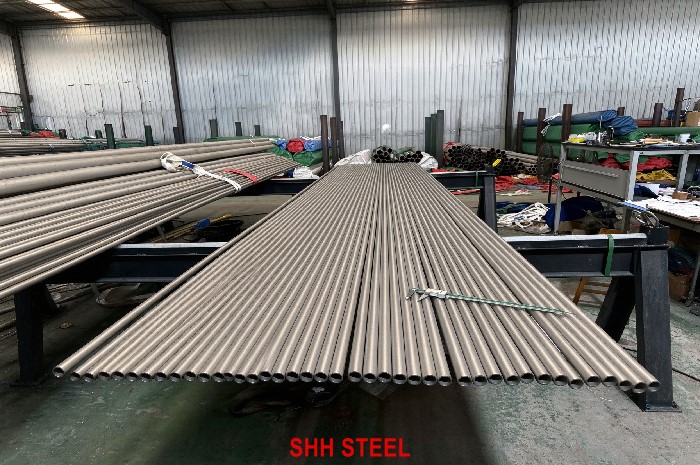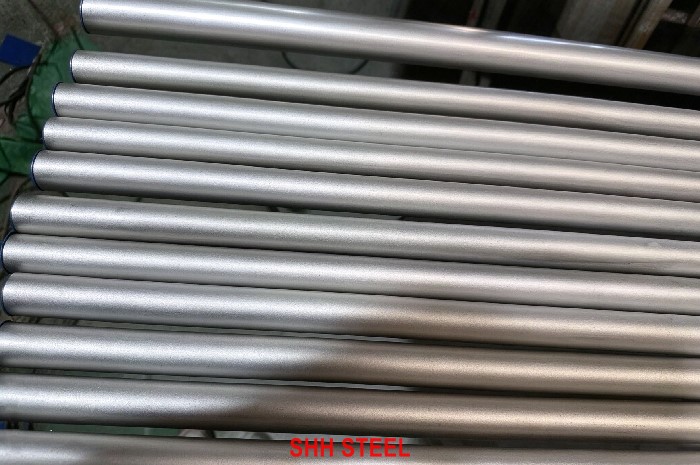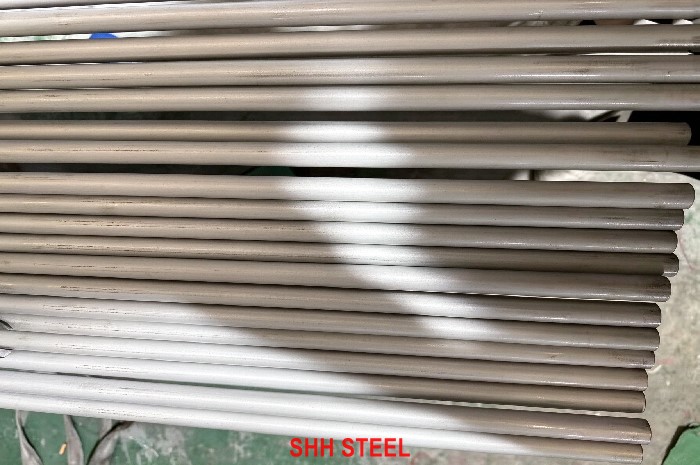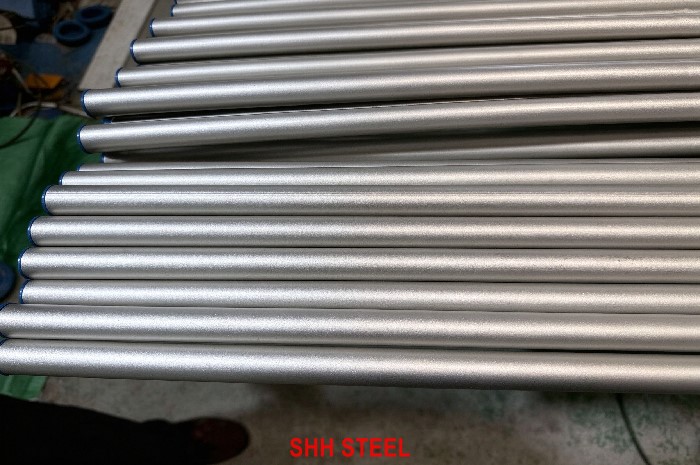
ASME SA213 TP348 Stainless Steel Tube
What is ASME SA213 TP348 Stainless Steel Tube
ASME SA-213 / SA-213M is the ASME Boiler and Pressure Vessel Code Book adoption of the seamless ferritic and austenitic alloy-steel boiler, superheater, and heat-exchanger tube product text. When Code-stamped boilers, superheaters, or heat exchangers invoke that adoption by name, SA-213 is the governing product standard for this cobalt- and tantalum-controlled niobium-stabilized tube — written as its own Code Book line, not as a merged synonym of ASTM A213. Begin from SA213/SA213M when the enquiry is Code-led.
Grade TP348 / UNS S34800 is the Co/Ta-controlled austenitic row inside that stainless family. Melting carbon is capped at 0.08%, chromium sits at 17.0–19.0%, nickel at 9.0–13.0%, and niobium plus tantalum must satisfy ≥10 × C with a 1.10% ceiling under chemistry Footnote G, while cobalt is held to ≤0.20% and tantalum alone to ≤0.10%. Table 4 sets tensile at 75 ksi [515 MPa] / 30 ksi [205 MPa] with elongation 35% minimum and hardness max 192 HBW / 90 HRB — the same mechanical floors as TP347, but the Co/Ta ceilings and Nb+Ta formula are what make the grade stamp. Buyers who write “348 HX tube” still need to name SA-213 on the purchase order so the mill applies the tube product standard, minimum-wall rules, and the Co/Ta package together. This is not a dual stamp of TP347, TP348H, or TP347H.
SHH STEEL can supply ASME SA213 TP348 as seamless cold-finished and hot-finished tube in the usual OD × wall / BWG band, with EN 10204 3.1 certificates that report Nb+Ta, cobalt, and tantalum together with the 75/30 ksi tensile set, 35% elongation, and hardness. Dual SA-213/A213 marking is added only when the purchase order asks; the live twin is A213 TP348.
Shop names include “348,” “S34800,” and “low-cobalt Nb-stabilized 18-8 tube.” Helpful for routing; the purchase order should still carry ASME SA-213 Grade TP348 / UNS S34800, wall basis, OD × wall or BWG, finish route, and any Supplementary Requirements (S1 / S2 when needed — both are listed for TP348 in the public excerpt). Sister SA213 pages include SA213 TP347, SA213 TP348H, SA213 TP347H, and SA213 TP321. Seamless only — no Manufacturing Types (SML / WLD / HCW) product-form split on this page.
Chemical Composition of SA213 TP348
Two chemistry layers matter for TP348 under ASME SA-213. Melting analysis is mandatory for every heat; product analysis on finished tube applies only when Supplementary Requirement wording or the purchase order invokes it through the general requirements (commonly ASTM A1016/A1016M), with tolerances typically from ASTM A480/A480M Table A1.1. The defining package for a reviewer is Nb+Ta ≥10 × C ≤1.10% (Footnote G), cobalt ≤0.20%, and tantalum ≤0.10%. A heat with 0.06% carbon needs at least 0.60% Nb + Ta, while a leaner-carbon heat can clear the formula with less stabilizer, still capped at 1.10%. Chromium 17.0–19.0% is narrower than TP347’s 17–20% window; nickel 9.0–13.0% matches the classic stabilized band.
The tables below reproduce the melt limits for TP348 / UNS S34800, the product-analysis limits from A480 Table A1.1 practice (with Co and Ta tolerance digits labeled UNCERTAIN pending the ordered A480 edition), and a short stabilizer/Co/Ta snapshot against TP347, TP348H, and TP347H. Later SA-213 / A213 editions place austenitic stainless grades in Table 2 (older editions used Table 1); confirm the ordered edition on the purchase order.
Melting analysis (heat / ladle analysis)
| Element | TP348 (UNS S34800) melting analysis |
|---|---|
| Carbon (C) | ≤ 0.08 |
| Manganese (Mn) | ≤ 2.00 |
| Phosphorus (P) | ≤ 0.045 |
| Sulfur (S) | ≤ 0.030 |
| Silicon (Si) | ≤ 1.00 |
| Chromium (Cr) | 17.0 – 19.0 |
| Nickel (Ni) | 9.0 – 13.0 |
| Molybdenum (Mo) | … (no requirement) |
| Nitrogen (N) | … (no requirement) |
| Niobium + Tantalum (Nb + Ta) | ≥ 10 × C, ≤ 1.10 (Footnote G) |
| Cobalt (Co) | ≤ 0.20 |
| Tantalum (Ta) | ≤ 0.10 |
| Titanium (Ti) | … (no requirement) |
Source: public SA-213 / A213 stainless chemistry table for Grade TP348 / UNS S34800 (same grade text family). Confirm the ordered edition. Where ellipses appear, the ordered edition sets no requirement for that element. Older shop language still says “columbium”; modern MTCs usually print Nb. UNCERTAIN: exact edition year and stainless chem table number on the ordered Code Book text; full Footnote G wording on the ordered text.
Product analysis — A480/A480M Table A1.1 tolerances applied
| Element | Melting | Tolerance (A480 A1.1) | Product analysis limit |
|---|---|---|---|
| Carbon (C) | ≤ 0.08 | 0.01 over | ≤ 0.09 |
| Manganese (Mn) | ≤ 2.00 | 0.04 over | ≤ 2.04 |
| Phosphorus (P) | ≤ 0.045 | 0.010 over | ≤ 0.055 |
| Sulfur (S) | ≤ 0.030 | 0.005 over | ≤ 0.035 |
| Silicon (Si) | ≤ 1.00 | 0.05 over | ≤ 1.05 |
| Chromium (Cr) | 17.0 – 19.0 | 0.20 under / over | 16.80 – 19.20 |
| Nickel (Ni) | 9.0 – 13.0 | 0.15 under / 0.20 over | 8.85 – 13.20 |
| Nb + Ta | ≥ 10 × C, ≤ 1.10 | 0.05 over on max (Nb formula practice) | max ≤ 1.15 product; min tied to heat C |
| Cobalt (Co) | ≤ 0.20 | 0.03 over (UNCERTAIN — confirm A480) | ≤ 0.23 |
| Tantalum (Ta) | ≤ 0.10 | 0.02 over (UNCERTAIN — confirm A480) | ≤ 0.12 |
Product analysis is not automatic — order it when the project needs finished-tube chemistry, especially cobalt and tantalum ceilings. UNCERTAIN: A480 product-tolerance digits for Co and Ta are applied from sister-pack practice pending the ordered A480 edition.
Stabilizer / Co / Ta snapshot — TP347 / TP348 / TP348H / TP347H
| Element | TP347 (S34700) | TP348 (S34800) | TP348H (S34809) | TP347H (S34709) |
|---|---|---|---|---|
| C | ≤ 0.08 | ≤ 0.08 | 0.04 – 0.10 | 0.04 – 0.10 |
| Cr | 17.0 – 20.0 | 17.0 – 19.0 | 17.0 – 19.0 | 17.0 – 19.0 |
| Stabilizer | Nb ≥ 10 × C, ≤ 1.10 | Nb+Ta ≥ 10 × C, ≤ 1.10 | Nb+Ta ≥ 8 × C, ≤ 1.10 | Nb ≥ 8 × C, ≤ 1.10 |
| Co / Ta | not listed | Co ≤ 0.20; Ta ≤ 0.10 | Co ≤ 0.20; Ta ≤ 0.10 | not listed |
Reading tip: a heat that clears TP347’s Nb formula still fails TP348 if cobalt or tantalum ceilings are exceeded, or if the stabilizer is reported as Nb alone without the Nb+Ta sum the Footnote G row expects. Do not accept a verbal “same as 347” note as Co/Ta equivalence under SA-213.
Mechanical Properties of SA213 TP348
Table 4 of the public SA-213 / A213 grade text family sets TP348 tensile strength at 75 ksi [515 MPa] minimum and yield (0.2% offset) at 30 ksi [205 MPa] minimum — the same floors as TP347 and TP348H. Elongation in 2 in. or 50 mm is 35% minimum, and hardness is capped at 192 HBW / 200 HV or 90 HRB. The Co/Ta chemistry does not raise the tensile floor; it changes which heat clears the grade stamp for nuclear-adjacent or low-cobalt purchase specifications that name S34800.
| Property | TP348 requirement |
|---|---|
| Tensile strength, min (Table 4) | 75 ksi [515 MPa] |
| Yield strength (0.2% offset), min (Table 4) | 30 ksi [205 MPa] |
| Elongation in 2 in. or 50 mm, min (Table 4) | 35% |
| Hardness, max (Table 4) | 192 HBW / 200 HV or 90 HRB |
| Grain size | No mandatory ASTM number in the public Table 3 row (confirm ordered edition) |
The public heat-treatment / grain-size table does not print a mandatory ASTM grain-size number for TP348 the way it does for H grades or TP347W. If a project datasheet asks for an E112 grain-size report, put that supplementary requirement on the purchase order rather than assuming base SA-213 includes it. Flattening and flaring follow the general requirements for the ordered size; hydrostatic or nondestructive examination follows the path selected on the PO.
Dimensions and Tolerances
Dimensional supply for ASME SA213 TP348 is tube language — outside diameter × wall thickness (minimum wall or average wall) and, commercially, BWG / gauge — not ASME B36.19 pipe schedules as the primary size story. Usual SA-213 sizes run from about 1/8 in. [3.2 mm] inside diameter to 5 in. [127 mm] outside diameter, with minimum wall from about 0.015 to 0.500 in. [0.4 to 12.7 mm]; other diameters may be furnished when all other requirements are met.
Boiler and heat-exchanger datasheets that pick Co/Ta-controlled TP348 usually assume minimum wall — state wall basis on the purchase order. Outside-diameter and wall variations follow the general requirements invoked by SA-213 (commonly ASTM A1016/A1016M). Cobalt and tantalum ceilings do not change the dimensional tolerance tables; they change which heat clears the grade stamp.
| Item | Typical SA213 TP348 dimensional practice |
|---|---|
| Product form | Seamless only (cold-finished or hot-finished) |
| Usual size band | ~1/8 in. [3.2 mm] ID to 5 in. [127 mm] OD; wall ~0.015–0.500 in. [0.4–12.7 mm] |
| Wall basis | Minimum wall (common for HX / boiler datasheets) or average wall if PO says so |
| OD / wall tolerance | Per general requirements (commonly A1016/A1016M) for the ordered finish |
| Length | Straight random / cut-to-length; U-bend by agreement |
BWG / gauge callouts are accepted on enquiry; certificates should still show OD and wall in inch or millimetre units. U-bends and polished ID finishes are commercial options — they do not replace the Nb+Ta / Co / Ta chemistry check.
Equivalent Grades
Equivalence talk for TP348 should start from the Code Book product standard and the UNS, not from a shop nickname. ASME SA-213 Grade TP348 / UNS S34800 is the governing designation on this page. ASTM A213 TP348 is the separate ASTM twin used when dual marking or a non-Code purchase is agreed — it is not a substitute lead standard for an SA-213 order. Related niobium grades without Co/Ta ceilings (TP347, TP347H) and the H-grade Co/Ta twin (TP348H) are sister options under the same hub, not automatic dual stamps.
| Designation | Notes |
|---|---|
| ASME SA-213 / SA-213M Grade TP348 | Governing Code Book seamless boiler / HX tube product standard for this article |
| UNS S34800 | Unified number listed in the stainless chemistry table |
| ASTM A213 TP348 | Separate ASTM product specification — dual-mark only when the PO asks; twin page A213 TP348 |
| Related Nb grades | TP347 / S34700 (Nb alone, no Co/Ta ceilings); TP348H / S34809 (H-grade Nb+Ta with Co/Ta) |
| Related plate | A240 / SA240 flat product in related UNS families — order plate and tube under their own product standards |
Hub entry point: SA213/SA213M. When a bill of materials only says “348 stainless tube,” ask whether cobalt and tantalum ceilings are actually required before shipping TP348 or a plain TP347 alternative.
Heat Treatment and Delivery Condition
TP348 under ASME SA-213 is furnished solution treated at a minimum of 1900 °F [1040 °C], then quenched in water or cooled rapidly by other means. The public heat-treatment table marks this row with Footnotes F and H. Footnote F ties quench capability to A262 Practice E demonstrability when that test is ordered (Supplementary Requirement S4); Footnote H warns that a solution treating temperature above 1950 °F [1065 °C] may impair intergranular-corrosion resistance after subsequent sensitizing exposure, and allows a purchaser-specified lower-temperature stabilization or resolution anneal after the higher solution anneal.
Supplementary Requirement S2 lists TP348 among grades that shall be given a stabilization heat treatment at a temperature lower than the initial solution anneal when the purchaser specifies S2 — temperature as agreed between purchaser and vendor. Supplementary Requirement S1 allows stress-relieved annealed TP348 (1500–1650 °F [815–900 °C] after roll straightening) for certain chloride stress-corrosion services when ordered — S1 names TP304L, TP316L, TP321, TP347, and TP348. Neither S1 nor S2 is automatic; write them on the purchase order when the project needs them.
Delivery condition for SHH STEEL TP348 is solution annealed and pickled (or bright annealed by agreement), with anneal temperature and quench method on the EN 10204 3.1 certificate. Straightening, cutting, and end finishing follow heat treatment. Cold-finished versus hot-finished is a process and dimensional route, not a substitute for the anneal. UNCERTAIN: full negotiated Footnotes F/H and S1/S2 wording on the ordered edition — confirm against the Code Book text named on the PO.
Corrosion Resistance
TP348 under ASME SA-213 is selected for niobium-plus-tantalum stabilization with cobalt and tantalum ceilings — a nuclear-adjacent or low-cobalt purchase control — not as a general wet-chloride upgrade over TP304. The Nb+Ta formula supports intergranular resistance in the sensitization window relative to unstabilized 18-8 when heat treatment follows Footnotes F and H. The grade is not a duplex or molybdenum-bearing superaustenitic for aggressive aqueous chlorides.
Where a datasheet mixes “348” with wet process condensates or chloride deposits, ask whether S1 stress-relief is intended and whether the service actually needs a molybdenum-bearing tube instead. SHH STEEL will not treat a low-cobalt PMI result alone as proof of aqueous corrosion suitability — chemistry, heat treatment, and the intended medium have to be read together.
Applications of SA213 TP348 Tube
Typical ASME SA213 TP348 placements are Code-stamped boiler, superheater, and heat-exchanger tubes where the material list names S34800 or explicitly requires cobalt and tantalum ceilings with an Nb+Ta stabilizer — not generic “347 family” replacements. Projects that already distinguish TP348 from TP347 for cobalt control are the natural fit.
When the enquiry only says “348” without Co/Ta language, confirm whether the buyer actually needs SA213 TP347 or the H-grade twin SA213 TP348H before substituting. SHH STEEL quotes TP348 when the enquiry names the UNS or the Co/Ta package explicitly.
Weldability
TP348 welds as a niobium-plus-tantalum stabilized austenitic. Matching or near-matching Nb-stabilized fillers (ER347 / ER348 family practice) are the usual starting point; confirm cobalt and tantalum pickup against the WPS when the project treats Co/Ta as contractual on the weld metal as well as the tube.
Autogenous welds and thin-wall HX joints need heat-input control to protect intergranular resistance near the HAZ. Post-weld stabilization is not a default SA-213 requirement — if the vessel code or the buyer wants S2-style stabilization after welding, write that as a separate ordered step. SHH STEEL can coordinate weld coupons when the PO asks.
Surface Finishes
Standard mill delivery for ASME SA213 TP348 is solution annealed and pickled, leaving a clean matte finish suitable for boiler and heat-exchanger tube duty. Bright annealing is available by agreement when OD appearance or polish steps favor it.
ID/OD polish and U-bend conditioning are commercial additions — they do not replace the Nb+Ta / Co / Ta chemistry check. End caps and dry export packaging matter more than paint on pickled stainless.
SHH STEEL notes the ordered surface route on the packing list and aligns it with the MTC finish description for receiving inspection.
Inspection and Testing
Base ASME SA-213 testing for TP348 includes heat analysis (C ≤0.08%, Cr 17.0–19.0%, Ni 9.0–13.0%, Nb+Ta ≥10 × C ≤1.10%, Co ≤0.20%, Ta ≤0.10%), tension tests to the 75/30 ksi floors with 35% elongation, hardness to 192 HBW / 90 HRB, and flattening / flaring tests for the ordered size. Hydrostatic testing or NDE follows the path selected on the purchase order.
Certificate reviewers should confirm the Nb+Ta formula result and the cobalt / tantalum ceilings rather than trusting a “347 family” PMI without Co. Product analysis, when ordered, applies A480 tolerances with Co/Ta digits labeled UNCERTAIN above. S1 / S2 and A262 practices apply only when named on the PO. EN 10204 3.1 is default; 3.2 when required. Dual SA-213/A213 names appear only when dual marking was ordered.
Packaging and Shipping
TP348 tube leaves SHH STEEL bundled, capped or end-protected, and tagged for export or domestic delivery according to length mix and bend form. Bundle tags repeat ASME SA-213 Grade TP348, UNS S34800, heat number, size, and wall basis so receivers can match the 3.1 certificate — including Nb+Ta, Co, and Ta — without opening every bundle.
Export packing uses seaworthy bundling appropriate for pickled stainless. Marking follows SA-213 and any dual-mark text the PO adds, referencing A213 TP348 only when dual ASTM marking was ordered.
Why Choose SHH STEEL
SHH STEEL treats ASME SA213 TP348 as a Code Book cobalt- and tantalum-controlled product with enforceable C ≤0.08%, Cr 17–19%, Ni 9–13%, Nb+Ta ≥10 × C ≤1.10%, Co ≤0.20%, Ta ≤0.10%, 75/30 ksi tensile, 35% elongation, hardness, and marking rules — not as “347 with a cobalt note” checked only by a Co PMI peak. Enquiry review verifies the Nb+Ta formula and Co/Ta ceilings before release.
That stops silent substitution with TP347 heats on datasheets that actually require S34800. We keep SA-213 and A213 independent, dual-mark only on request, and put Nb+Ta, Co, and Ta on the 3.1 certificate so inspectors can verify the grade.
Cross-links: SA213 TP347, SA213 TP348H, SA213 TP347H, SA213 TP321, hub SA213/SA213M.
Supply Capability
SHH STEEL can supply ASME SA213 TP348 stainless steel tube against the edition and finish route named on your enquiry. The capability table below summarizes sizes, finishes, and documents we regularly quote, followed by the Stock / Available sizes map for Co/Ta-controlled niobium-stabilized boiler and heat-exchanger tube.
| Item | SHH STEEL capability for TP348 |
|---|---|
| Standard | ASME SA213 / SA213M (dual A213 marking on request) |
| Grade | TP348 / UNS S34800 |
| Product form | Seamless only — cold-finished and hot-finished |
| Size | Typical OD × min wall (or average wall) in the SA-213 usual band; other diameters by agreement |
| Wall / gauge | Minimum wall or average wall; BWG / gauge callouts accepted on enquiry |
| Length | Cut-to-length for boiler / HX bundles; U-bend by agreement |
| Documentation | EN 10204 3.1 MTC with Nb+Ta / Co / Ta; S1 / S2 / A262 / witness on request |
| Trade terms | FOB / CFR / CIF / EXW and other agreed Incoterms |
Stock / Available sizes
SHH STEEL quotes TP348 against a stock-and-mill enquiry range rather than a frozen SKU or tonnage list. Representative OD × wall / BWG combinations below are an enquiry map for Co/Ta-controlled boiler and heat-exchanger tube — confirm live availability and cut lengths on the RFQ.
| OD (in.) | Typical wall / BWG enquiry band | Notes |
|---|---|---|
| 1/2 – 1 | BWG 16–12 / ~0.065–0.109 in. | Small HX / instrument sizes |
| 1-1/4 – 2 | BWG 14–10 / ~0.083–0.134 in. | Common boiler / HX band |
| 2-1/2 – 3 | 0.120 – 0.250 in. min wall | Heavier HX / boiler wall |
| 3-1/2 – 5 | 0.180 – 0.300 in. min wall | Upper usual SA-213 OD by agreement |
Send OD × wall (or BWG), wall basis, quantity, length mix, finish route, and any dual-mark or S1/S2 needs with the RFQ so we can align mill capacity to the Co/Ta package on the first reply.
FAQ
-
Is ASME SA-213 the same as ASTM A213 for TP348?
- No. ASME SA-213 / SA-213M is the ASME Code Book adoption; ASTM A213 / A213M is the separate ASTM product specification. Chemistry — including C ≤0.08%, Cr 17.0–19.0%, Ni 9.0–13.0%, Nb+Ta ≥10 × C ≤1.10%, Co ≤0.20%, and Ta ≤0.10% — tensile 75/30 ksi, elongation 35%, and hardness floors align in the shared grade text family, but the standards remain independent documents. Dual marking is a purchase-order option, not proof that the two titles are one standard.
-
Does SA213 TP348 cover welded or HCW tube?
- No. ASME SA-213 for this stainless series is a seamless boiler, superheater, and heat-exchanger tube product standard. SHH STEEL supplies TP348 as seamless cold-finished or hot-finished tube only. Welded (WLD) or heavily cold-worked welded (HCW) manufacturing types are outside this page’s product form and are not offered as a Manufacturing Types split under the SA213 TP348 listing.
-
What chemistry defines ASME SA213 TP348 versus TP347?
- TP348 / UNS S34800 requires Nb+Ta ≥10 × C ≤1.10% under Footnote G, cobalt ≤0.20%, tantalum ≤0.10%, and chromium 17.0–19.0%. Plain TP347 / S34700 uses Nb ≥10 × C ≤1.10% with chromium 17–20% and no mandatory cobalt or tantalum ceilings. A heat that clears the TP347 niobium formula still fails TP348 if cobalt or tantalum exceeds the ceilings, or if the stabilizer is not reported as the Nb+Ta sum.
-
How does SA213 TP348 differ from SA213 TP348H?
- TP348H is the H-grade twin with C 0.04–0.10%, Nb+Ta ≥8 × C ≤1.10% (chemistry Footnote H), the same Co ≤0.20% and Ta ≤0.10% ceilings, a finish-route solution anneal (cold-worked 2000 °F / hot-rolled 1925 °F), and mandatory grain size No. 7 or coarser. Non-H TP348 keeps C ≤0.08%, the 10 × C stabilizer rule, Footnotes F/H on a 1900 °F path, and no mandatory grain-size number. They share Co/Ta control but are not dual stamps.
-
What do Footnotes F and H mean for SA213 TP348 heat treatment?
- Footnote F ties quench capability to A262 Practice E demonstrability when that test is ordered. Footnote H warns that solution treating above 1950 °F [1065 °C] may impair intergranular-corrosion resistance after subsequent sensitizing exposure, and allows a purchaser-specified lower-temperature stabilization or resolution anneal afterward. Neither footnote is a free substitute for naming S2 or A262 on the purchase order when the project needs those tests.
-
Are Supplementary Requirements S1 and S2 available for TP348?
- Yes. In the public A213–13 excerpt, S2 lists TP348 among grades that shall receive a stabilization heat treatment when specified, and S1 lists TP348 among grades that may be ordered stress-relieved annealed (1500–1650 °F after roll straightening) for certain chloride stress-corrosion services. Neither is automatic — write S1 and/or S2 on the purchase order when the project needs them.
-
What hardness limit applies to ASME SA213 TP348 tube?
- Table 4 caps TP348 hardness at 192 HBW / 200 HV or 90 HRB — the same ceiling as TP347 and TP348H. Hardness is checked together with the 75/30 ksi tensile set and 35% elongation. A hardness result alone does not prove Co/Ta compliance; certificate reviewers should still read Nb+Ta, cobalt, and tantalum on the MTC.
-
Should I order minimum wall or average wall for TP348?
- Boiler and heat-exchanger datasheets that pick TP348 usually assume minimum wall. Average wall is acceptable when the purchase order says so and the general requirements for the ordered finish are applied. State wall basis, OD × wall or BWG, and length mix on the RFQ so the mill does not default to a basis your inspector will reject.
-
Can SHH STEEL dual-certify SA-213 and A213 for TP348?
- Yes, when the purchase order asks for dual marking and the heat meets both product standards’ grade text for TP348 / UNS S34800. Dual marking is a documentation and stencil option — it does not merge the two standards into one title. For non-Code purchases that only want the ASTM twin, see A213 TP348; for Code-led work, keep SA-213 as the lead standard on the PO.
-
Can a mill dual-stamp TP348 and TP348H on the same heat?
- Only when the heat chemistry and heat-treatment path actually satisfy both grade rows — including the H-grade carbon band, the 8 × C stabilizer rule, and the mandatory grain-size requirement for TP348H. Most Co/Ta heats aimed at non-H TP348 will not automatically clear TP348H. Ask for an honest single-grade stamp unless the MTC proves both rows.
-
Is TP348 suitable for wet chloride heat-exchanger service?
- Not as a default upgrade over molybdenum-bearing grades. TP348 is framed for Nb+Ta stabilization with cobalt and tantalum ceilings. Aggressive aqueous chlorides usually need molybdenum-bearing, duplex, or other project-specified alloys. If chloride stress-corrosion is a known risk, discuss whether S1 stress-relief is intended and whether a different alloy is the real answer.
-
What filler metal is typically used for SA213 TP348 tube?
- Matching or near-matching niobium-stabilized austenitic fillers in the ER347 / ER348 family are the usual starting point. When cobalt or tantalum is contractual on the weld metal as well as the tube, confirm filler chemistry against the WPS rather than assuming any “347” wire clears a low-cobalt purchase specification. Autogenous welds on thin HX tube still need heat-input control to protect intergranular resistance.
Conclusion
ASME SA213 TP348 / UNS S34800 is the cobalt- and tantalum-controlled niobium-stabilized seamless stainless steel tube grade for Code boiler, superheater, and heat-exchanger service when C ≤0.08%, Cr 17.0–19.0%, Ni 9.0–13.0%, Nb+Ta ≥10 × C ≤1.10%, Co ≤0.20%, Ta ≤0.10%, a 75/30 ksi tensile floor with 35% elongation, hardness max 192 HBW / 90 HRB, and a 1900 °F solution anneal with Footnotes F and H are required together. SHH STEEL supplies cold-finished and hot-finished seamless tube in the usual OD × wall / BWG band with EN 10204 3.1 MTCs that report Nb+Ta, Co, and Ta. For quotations and technical review, contact admin@steelspecs.com.
Quality Steel Needed? Inquire for Offers
Related Products