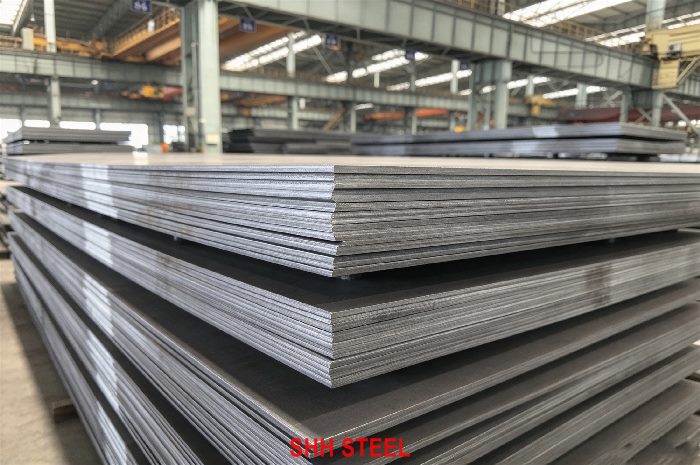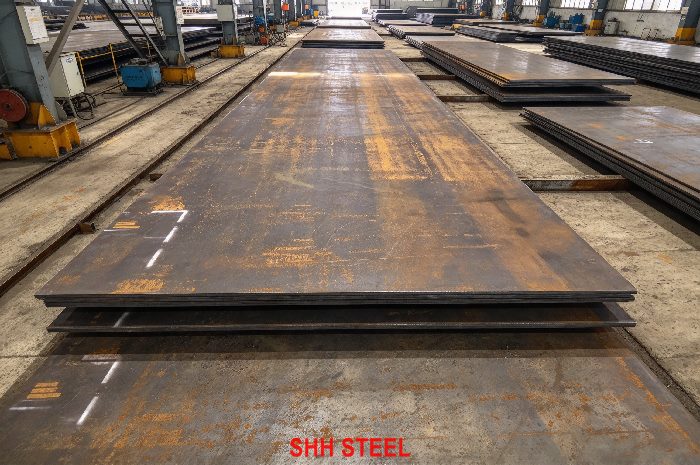

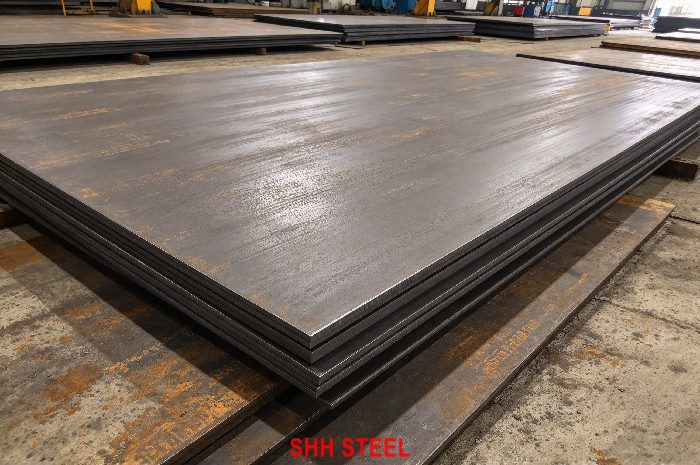
ABS Grade D Shipbuilding Steel Plate Supplier
What is ABS Grade D shipbuilding steel plate?
Equivalent grades: ABS D ≈ ASTM A131 Grade D ≈ DNV NV D ≈ LR Grade D ≈ BV Grade D ≈ CCS Grade D ≈ NK KD ≈ KR RD ≈ RINA Grade D ≈ GB 712 Grade D (all class-approved, stamped by the issuing society).
ABS Grade D is an ordinary-strength hull structural steel in the ABS Rules for Materials and Welding, Part 2, Chapter 1, Section 2 (2-1-2). Minimum yield point is 235 N/mm², tensile strength 400–520 N/mm² and elongation 22 % min. Grade D is ordinary-strength hull steel tested at −20 °C. Above 25 mm it must be killed and fine-grain treated. It is the usual choice for sheer strakes, bilge strakes, strength-deck stringers and ice-exposed plating on vessels that see sub-zero service without needing the −40 °C of Grade E.
Plates that pass mill tests under ABS survey are die-stamped or stencilled AB/D (or AB/DN when normalized, TM or control-rolled) and supplied with a Surveyor-endorsed certificate.
Compared with ABS Grade A and Grade B, Grade D lowers the impact temperature to −20 °C and requires fine grain above 25 mm. Grade E goes to −40 °C; higher-strength DH grades add yield above 235 N/mm².
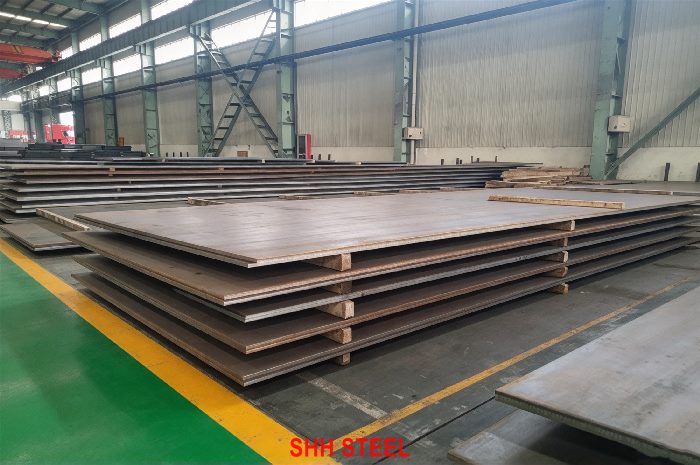
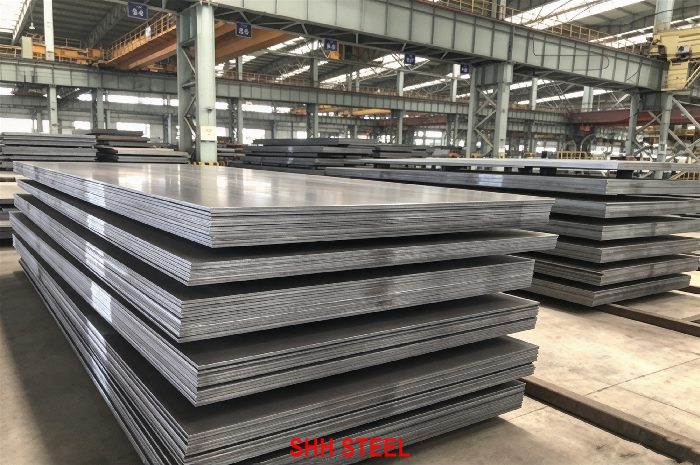
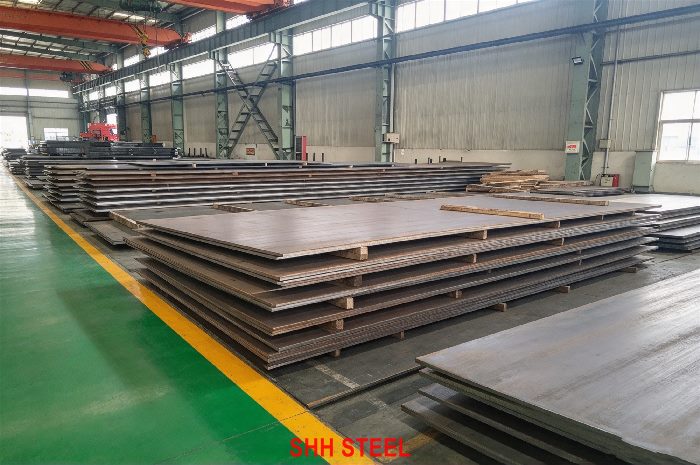
SHH STEEL supplies ABS Grade D plate from Chinese mills that hold ABS works approval for the grade, from stock in common sizes or from a mill rolling cycle, with ABS survey arranged at the mill. See also ABS B, ABS E and the live ABS Grade A page for the related ordinary-strength grades.
ABS D plate: specification summary
| Item | ABS Grade D data |
|---|---|
| Rule | ABS Rules for Materials and Welding, Part 2, 2-1-2 Ordinary-strength Hull Structural Steel (2023 edition checked) |
| Strength level | ordinary strength, yield point 235 N/mm² min. |
| Plate thickness covered | up to and including 150 mm |
| Steelmaking | basic oxygen, electric furnace or other approved process; continuous-cast slab reduced at least 3:1 to plate unless specially approved |
| Deoxidation | killed ≤25 mm; killed and fine grain >25 mm |
| Fine grain | required (Al/Nb/V per 2-1-2/5.7) |
| Impact test | Charpy at −20 °C; frequency per Table 5 (often 50 t lots; CR 25 t in heavy band) |
| Marking | AB/D (AB/DN if N/TM/CR) (plus Z or U where through-thickness or ultrasonic requirements are met) |
| Thickness tolerance | minus 0.3 mm regardless of thickness (2-1-1/15.3); plus tolerance per ASTM A6 or as agreed |
| Certificate | mill certificate endorsed by the ABS Surveyor; EN 10204 3.1 / 3.2 on request |
Size range. Grade D is rolled on wide plate mills in China from about 5 mm to 100 mm and more, widths 1500–3500 mm and lengths up to about 18 m depending on mill. Plates under 6 mm cut from coil need separate coil-process approval (2-1-2/3.1). Ask for confirmation for plates over 100 mm or wider than 3200 mm.
ABS Grade D chemical composition (heat and product analysis)
| Element | Heat (ladle) analysis, % | Product (check) analysis, % | Note |
|---|---|---|---|
| C | 0.21 max. | 0.25 max. (0.21 + 0.04) | plates; sections may differ where Notes allow |
| Mn | 0.60 min. | 0.60 min. (ASTM A6/A6M Table A has no minimum-only row for Mn – heat limit applies) | fixed minimum (not a C-ratio like Grade A) |
| Si | 0.10–0.35 (min. waived if Al sol. ≥0.015 %) | 0.05–0.40 (0.10 − 0.05; 0.35 + 0.05) | |
| P | 0.035 max. | 0.045 max. (0.035 + 0.010) | |
| S | 0.035 max. | 0.045 max. (0.035 + 0.010) | 0.020 max. (heat) for cold-flanging quality |
| Cu | to be determined and reported | no numeric heat limit – report actual value | residual / intentionally added — report when present (may be reported as ≤ 0.02 % when below 0.02 %) |
| Cr | to be determined and reported | no numeric heat limit – report actual value | residual / intentionally added — report when present (may be reported as ≤ 0.02 % when below 0.02 %) |
| Ni | to be determined and reported | no numeric heat limit – report actual value | residual / intentionally added — report when present (may be reported as ≤ 0.02 % when below 0.02 %) |
| Mo | to be determined and reported | no numeric heat limit – report actual value | residual / intentionally added — report when present (may be reported as ≤ 0.02 % when below 0.02 %) |
| C + Mn/6 | 0.40 max. | not applicable (calculated from heat analysis) | carbon-equivalent cap for all ordinary-strength grades |
Product (check) analysis column = heat (ladle) limit adjusted by ASTM A6/A6M-19 Table A “Permitted Variations in Product Analysis”, as required by ABS Rules Part 2, 2-1-2/5.3 (maximum + “over”, minimum − “under”; row chosen by the specified upper limit); arithmetic shown in brackets.
Source: ABS Rules 2-1-2/5.1 and 15.9 Table 1. The heat (ladle) analysis is determined by the mill on each heat and must meet Table 1. Product (check) analysis on the finished plate is not routine; when required by the purchaser or Surveyor, ABS 2-1-2/5.3 applies the chemical tolerances of ASTM A6 (or another nationally recognized standard) to the Table 1 limits. Ask for product analysis at enquiry if you need it on the certificate.
Grade D uses a 0.60 % Mn minimum and a Si range 0.10–0.35 % (minimum waived when acid-soluble Al ≥ 0.015 %). Above 25 mm it must contain a grain-refining element per 2-1-2/5.7. Intentionally added elements must also be reported. Check actual ladle figures on the mill certificate, not a typical sheet.
ABS Grade D tensile properties
| Property | Requirement |
|---|---|
| Tensile strength | 400–520 N/mm² (41–53 kgf/mm², 58–75 ksi) |
| Yield point | 235 N/mm² min. (24 kgf/mm², 34 ksi) |
| Elongation | 22 % min. (alternative A flat or C round specimen; also 22 % on 50 mm gauge for ASTM A370 specimens) |
| Cold-flanging quality (if ordered) | 380–450 N/mm², yield 205 N/mm² min., marked F |
Source: 2-1-2/15.9 Table 2. All four ordinary-strength grades share these tensile values. On the 200 mm gauge alternative B flat specimen, minimum elongation depends on thickness (Table 3):
| Thickness (mm) | ≤5 | 5–10 | 10–15 | 15–20 | 20–25 | 25–30 | 30–40 | 40–50 |
|---|---|---|---|---|---|---|---|---|
| Elongation min. % | 14 | 16 | 17 | 18 | 19 | 20 | 21 | 22 |
Tensile tests are taken on two different plates from each heat (one test if the heat is under 50 t), and from both the thickest and thinnest plate when thicknesses in the heat differ by 9.5 mm or more. The 550 N/mm² upper tensile limit applies only to Grade A sections, not to Grade D plate.
ABS Grade D: Charpy test temperature and supply condition
| Plate thickness | Deoxidation / grain | Condition of supply (plates) | Charpy V at −20 °C |
|---|---|---|---|
| ≤ 25 mm | killed | any (A), lot 50 t | 27 J long. / 20 J trans. |
| 25–50 mm | killed + fine grain | N/TM/CR, lot 50 t | 27 J / 20 J |
| 50–150 mm | killed + fine grain | N/TM (50) or CR (25) | 34–48 J long. by thickness |
Required average energy at −20 °C (Table 4):
| Thickness | Longitudinal | Transverse |
|---|---|---|
| ≤ 50 mm | 27 J | 20 J |
| 50–70 mm | 34 J | 24 J |
| 70–100 mm | 41 J | 27 J |
| 100–150 mm | 48 J | 32 J |
Normalized, TM or control-rolled Grade D plate is marked AB/DN. Fine-grain practice (2-1-2/5.7) is mandatory above 25 mm. For −40 °C service specify Grade E; for higher yield at −20 °C specify a DH grade.
Thickness tolerance and surface condition
ABS applies a fixed minus tolerance of 0.3 mm on nominal thickness for hull plates regardless of thickness (2-1-1/15.3.2), much tighter than the general ASTM A6 under-tolerance. The mill demonstrates compliance by measuring each plate at defined points; Class C of ISO 7452 may be used instead with ABS agreement. Plus tolerance, flatness, width and length follow ASTM A6 or another recognised standard unless specified otherwise. For plates under 5 mm (cut from coil), tolerances follow a national standard but the minus tolerance still may not exceed 0.3 mm.
Surface defects may be ground out within the limits of 2-1-1/3; grinding areas are excluded from the thickness tolerance. If you plan to shot-blast and prime at the yard, state any surface class (for example ISO 8501-1 rust grade A or B on receipt) in the order.
ABS Grade D plate stock in China
| Thickness (mm) | Width (mm) | Length (mm) | Condition | Approx. quantity | Location |
|---|---|---|---|---|---|
| 6 | 1800 / 2000 | 6000 / 8000 | AR / CR | 100+ t | China |
| 8 | 1800 / 2000 | 8000 / 12000 | AR / CR | 200+ t | China |
| 10 | 2000 / 2200 | 8000 / 12000 | AR / CR | 200+ t | China |
| 12 | 2000 / 2200 / 2500 | 12000 | AR / CR | 200+ t | China |
| 14 | 2000 / 2200 | 12000 | AR / CR | 100+ t | China |
| 16 | 2000 / 2500 | 12000 | AR / CR | 200+ t | China |
| 20 | 2000 / 2500 | 12000 | AR / CR | 100+ t | China |
| 25 | 2200 / 2500 | 12000 | AR / CR | 100+ t | China |
| 30 | 2200 | 10000 / 12000 | AR / CR | 100+ t | China |
| 40 | 2200 | 10000 | AR / CR | 50+ t | China |
| 50 | 2200 | 8000 / 10000 | AR / CR | 50+ t | China |
Quantities are approximate and change daily; all stock plates carry AB/D marking and ABS-endorsed mill certificates. Sizes outside the table are produced in the next mill rolling cycle, typically 3–6 weeks including ABS survey (as per standard and mill certificate for exact lead time). Send your size list and we will reply with stock vs roll.
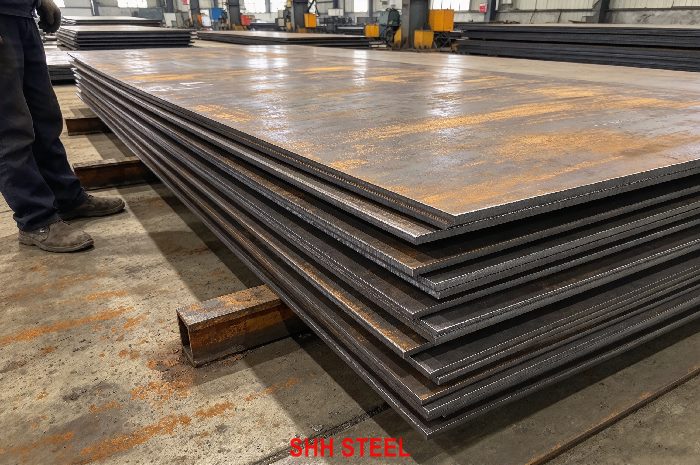
Packing. Plates are bundled by size with steel strapping, marked with heat number, grade and ABS stamp, and shipped in containers (up to about 11.8 m) or break bulk for longer plates.
ABS D equivalents in other rules and standards
| Standard / society | Designation | Comment |
|---|---|---|
| ASTM A131/A131M | ASTM A131/A131M Grade D | same base chemistry and tensile band; A131 is a product standard, not class approval |
| DNV, LR, BV, CCS, NK, KR, RINA | Grade D | IACS UR W11 unified requirements; each society stamps its own mark. See BV Grade FH36 / BV Grade FH40 for higher-strength BV plate |
| GB 712 | GB 712 Grade D | Chinese ship steel standard; GB 712 alone is not class approval |
| ASTM A36 | ASTM A36 | similar strength but not hull steel; no class marking |
| Related ABS grades | ABS Grade A / ABS B / ABS D / ABS E | same yield; differ by impact temperature and deoxidation |
These are comparisons, not substitutions. A classed hull needs plate made by a mill approved by the society that classes the vessel. Dual or multi-class certification can be arranged at the mill when the heat is surveyed by both societies.
When to specify ABS D vs A/B/D/E and higher-strength grades
All ordinary-strength grades share 235 N/mm² yield and 400–520 N/mm² tensile; they differ in deoxidation and toughness. The hull steel grade for each strake is set by classification rules according to member category and thickness — check the approved drawing first. Higher-strength ABS steel plates (AH/DH/EH/FH 32–40) raise yield to 315–390 N/mm².
Choose Grade D for −20 °C ordinary-strength members. Grade B is not a substitute for D. EH/DH higher-strength grades are the next step when scantlings need 315 N/mm² yield or more at −20/−40 °C — see ABS DH36 and ABS EH36.
Compared with land structural steels, Grade D differs by the 0.3 mm minus tolerance, the C + Mn/6 ≤ 0.40 cap, and class survey/stamp. For a classed barge or pontoon, only class-certified plate is accepted.
When ABS D is the right choice: typical uses are strakes and members that the class drawing assigns a −20 °C toughness level, e.g. thicker plating in sheer strake, bilge and deck stringer areas of ordinary-strength designs. The Charpy temperature (−20 °C) is fixed by the letter, and the strength by the ordinary-strength level (ReH 235 N/mm²). Pick the strength from the scantling calculation and the letter from the material class and design temperature on the approved drawing. Swapping to a different letter or strength needs class approval of the drawing change, not just a new purchase order.
Applications, cutting and welding of ABS Grade D
Typical uses: sheer and bilge strakes, deck stringers, ice-belt plating on non-ice-class ships, exposed superstructure on cold routes, offshore secondary members needing −20 °C. Offshore and port structures also use Grade D where ordinary strength with verified toughness is enough; see offshore platform steel plates for primary structure grades.
Cutting: oxy-fuel, plasma and laser cutting all work without preheat in normal thicknesses. Welding: with C + Mn/6 ≤ 0.40 %, Grade D is welded with ordinary-strength consumables approved for the required weld-metal toughness; preheat is generally unnecessary below about 25–30 mm except in cold or humid conditions — follow your approved WPS (as per standard and mill certificate for consumable grade). Forming: cold-flanging quality (S 0.020 % max., marked F) on request.
Processing notes for ABS D: cold forming and flanging of ordinary-strength plate are routine. The minimum Mn is set so that this grade can be cold-flanged where noted in 2-1-2. Keep the cut edges of plate thicker than 50 mm free of notches, because thick plate of this grade is controlled more tightly for deoxidation (killed ≤25 mm; killed and fine grain >25 mm).
Certificates, ABS survey and third-party inspection
Every plate is tested and marked at the mill under ABS survey; the mill certificate lists heat number, ladle chemistry including Ni, Cr, Mo and Cu, tensile results, impact results where required, condition of supply and plate numbers, and is endorsed by the attending Surveyor. On request we add EN 10204 3.2 certificates with third-party witness by TÜV, SGS, BV or another agency, ultrasonic testing (U mark) or through-thickness testing (Z mark), and multi-class certification with ABS, DNV, LR, BV, CCS, NK, KR or RINA.
On receipt, check: AB/D stamp and heat number match the certificate; ABS endorsement is present; thickness is not below nominal minus 0.3 mm; impact temperature is −20 °C where required and energy meets Table 4.
Charpy acceptance for ABS D by thickness (from 2-1-2; actual results as per standard and mill certificate):
| Thickness t (mm) | Test temperature | Average energy, longitudinal (J min.) | Average energy, transverse (J min.) |
|---|---|---|---|
| t ≤ 50 | −20 °C | 27 | 20 |
| 50 < t ≤ 70 | −20 °C | 34 | 24 |
| 70 < t ≤ 100 | −20 °C | 41 | 27 |
| 100 < t ≤ 150 | −20 °C | 48 | 32 |
On receipt, check that the test temperature on the certificate is −20 °C and that the energy matches the band for the delivered thickness, not the thinnest band. Also check that the plate number on the stamp matches the certificate line, and that the ABS Surveyor endorsement is present. If UT was ordered (e.g. EN 10160 or ASTM A578 level), check the UT report as well. If the PO asked for 3.2, the inspector’s report must name the witnessed tests and plate numbers.
Common mistakes when ordering ABS Grade D
- Ordering D but accepting B certificates (wrong impact temperature)
- Heavy D plate without fine-grain / AB/DN route agreed
- Missing −20 °C results on the certificate
- Coil-cut plate without coil approval
- Ignoring the 0.3 mm minus tolerance on trader stock
Each of these is avoided by writing the requirement into the purchase order and checking it on the certificate before the plates are cut.
Sourcing ABS D plate: buyer concerns and SHH STEEL solutions
| Concern | How SHH STEEL handles it |
|---|---|
| Fake or re-stamped class plate | plates from ABS-approved mills only; certificate and stamp traceable to the heat; EN 10204 3.2 on request |
| Unsafe deposit or payment risk | T/T or L/C payment; inspection before balance payment |
| Small quantities across many sizes | mixed thicknesses and grades (A, D, AH36, etc.) combined in one container |
| Slow delivery | dedicated staff follow each order with weekly production and shipping updates and photos |
| Cutting and preparation | own workshop for cutting to size, bevelling, drilling and machining before shipment |
How to order ABS Grade D plate
State the grade and rule (ABS Grade D, ABS Rules Part 2), whether multi-class certification is needed, thickness, width, length and quantity per size, condition of supply, any Z or U requirement, surface or primer requirements, certificate type (mill certificate with ABS endorsement, EN 10204 3.2), packing and destination port. Send the list to SHH STEEL for price, available stock and lead time.
Sample PO line: “Steel plate to ABS Rules Part 2 2-1-2, Grade D, delivery condition [AR/CR/N/TM], 20 × 2500 × 12000 mm, 30 pcs, marked AB/D (AB/DN if N/TM/CR), certificate endorsed by ABS Surveyor, EN 10204 3.2 [if required], UT [if required], CIF [port].” Each bracketed item changes price, lead time and which mills can supply, so fix them at enquiry stage.
FAQ
Conclusion
ABS Grade D is ordinary-strength hull steel at 235 N/mm² minimum yield and 400–520 N/mm² tensile, with Charpy at −20 °C where 2-1-2 Tables 4/5 require it, and marking AB/D (AB/DN if N/TM/CR). Fix in the order: class certification, supply condition and impact frequency, product analysis if needed, and certificate type.
SHH STEEL supplies Grade D plate from ABS-approved Chinese mills with the AB/D stamp and Surveyor-endorsed certificates. Stock covers common sizes; other sizes are scheduled into the mill rolling cycle. EN 10204 3.2 and multi-class stamps are available on request.
Payment is T/T or L/C with inspection before balance. Mixed sizes and grades combine in one shipment. Dedicated follow-up includes photos; our workshop provides cutting, bevelling, drilling and machining.
Request a quotation: send SHH STEEL ABS D, thickness, width, length, quantity per size, destination port and any multi-class/Z/U/3.2 needs.
Quality Steel Needed? Inquire for Offers
Related Products