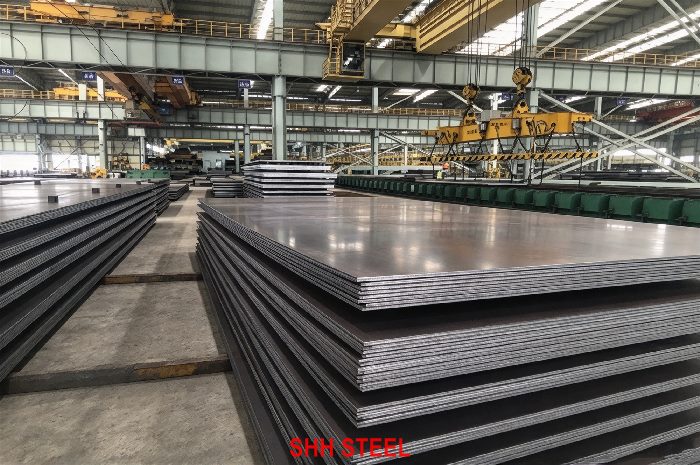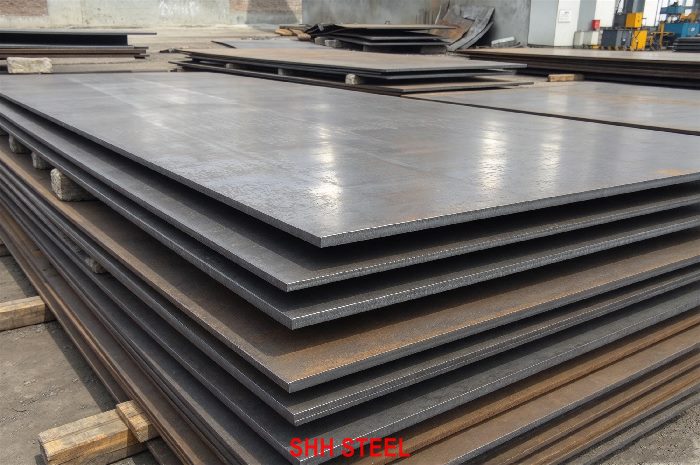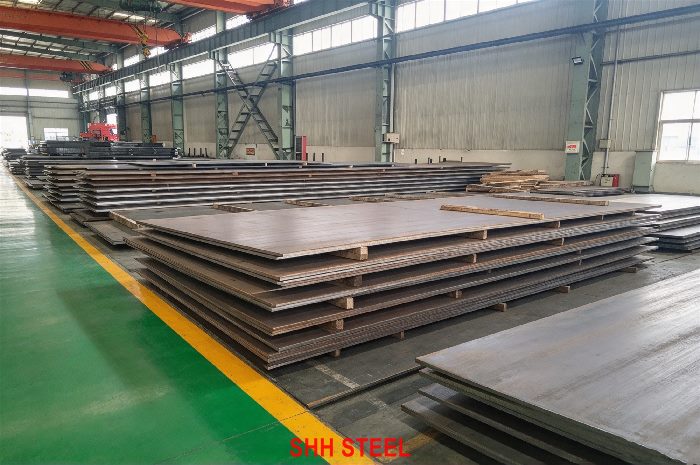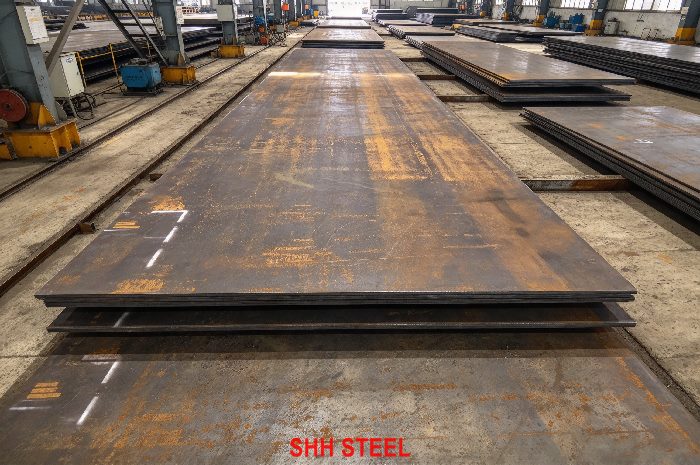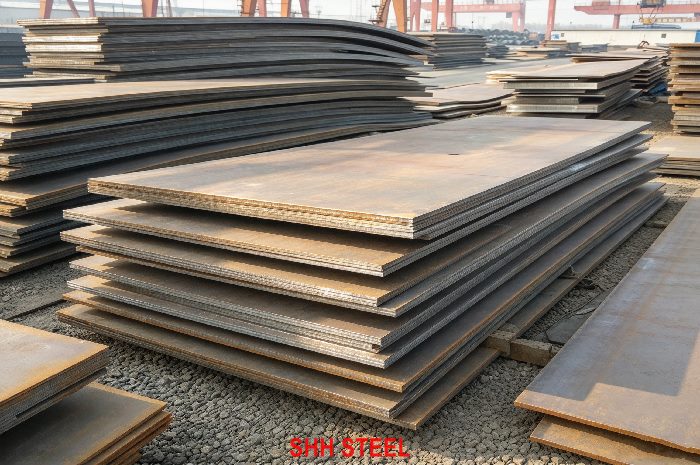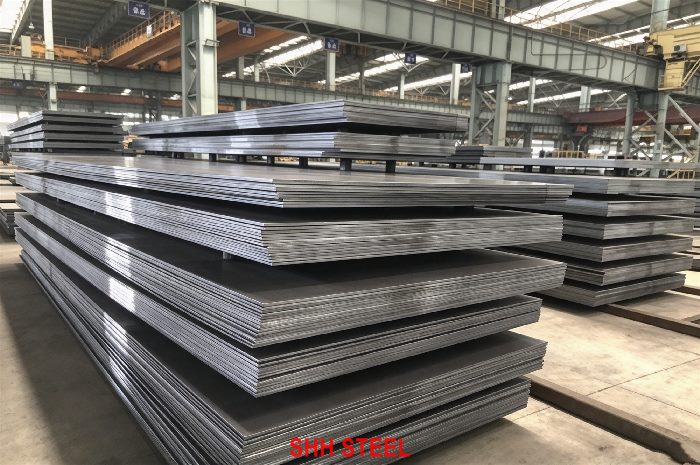

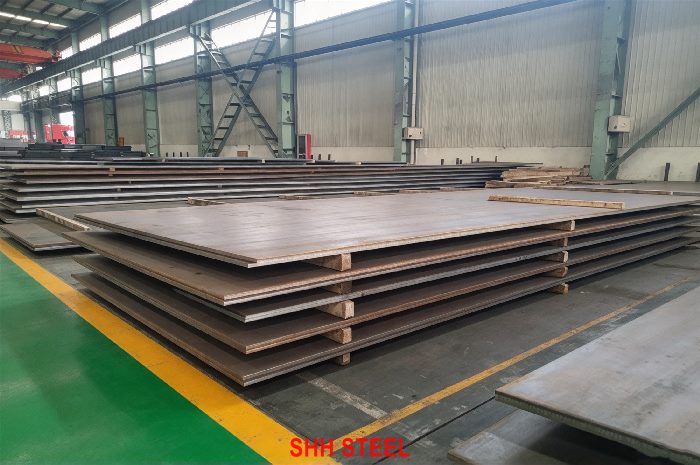
ABS FQ63 Shipbuilding Steel Plate Supplier
What is ABS FH62 (ABS FQ63) shipbuilding steel plate?
Equivalent grades: ABS FH62 / FQ63 ≈ ASTM A131 (no direct grade at this strength) ≈ DNV NV F620 ≈ LR FH62 ≈ BV F620 ≈ CCS FH620 ≈ NK KF620 ≈ KR RF63 ≈ RINA F620 ≈ GB 712 Grade FH620 (all class-approved, stamped by the issuing society).
Naming note: commercial and many yard enquiries use ABS FH62 for the ~620 N/mm² yield band. In ABS Rules Part 2, Section 2-1-8 Extra High Strength Steel, the official designation is FQ63 (category 63 = 620 N/mm² yield; letter FQ sets Charpy temperature). This page uses the title grade FH62 and states the ABS rule grade FQ63 wherever requirements are cited.
FQ63 provides minimum yield 620 N/mm², tensile 720–890 N/mm², elongation 15 % min., and Charpy at −60 °C with average energy 62 J longitudinal or 41 J transverse (2-1-8/5.11 Table 5A). It sits above the AH–FH 40 higher-strength family (2-1-3, max yield 390 N/mm²).
SHH STEEL sources Extra High Strength plate from mills with ABS approval for the grade, under Surveyor attendance. Related: ABS AH40 / ABS FH40 (higher-strength 40 band); live ABS Grade A; BV FH36 / BV FH40.
Category 63 (620 N/mm²) is near the top of the commonly traded EHS band. Table 4B Ceq/CET/Pcm caps tighten; agree the formula on the PO.
ABS FH62 / FQ63: specification summary
| Item | Data |
|---|---|
| Rule | ABS Rules Part 2, 2-1-8 Extra High Strength Steel (2018/2022 updates in 2023 edition); plus applicable 2-1-1/2/3 |
| ABS official grade | FQ63 |
| Commercial / title grade | FH62 |
| Yield / tensile / elongation | 620 / 720–890 N/mm² / 15 % min. |
| Impact | −60 °C; 62 J L or 41 J T average |
| Deoxidation | fully killed, fine grain (≥6 capability); N-binding elements per manufacturing specification |
| Delivery condition | N, NR/CR, TM (+AcC/+DQ), or QT — within Table 3 thickness limits and mill approval |
| Vacuum degassing | mandatory for category 70 (and 91/98) and for all EHS grades t > 50 mm |
| Marking | AB/FQ63 (plus delivery-condition marking; “R” suffix for MOU leg/rack/chord) |
| UT | ≥15 mm: EN10160 or ASTM A578 or agreed standard (2-1-8/11.1) |
| Thickness tolerance | 2-1-1/15 (0.3 mm minus for hull plates unless otherwise agreed) |
| Certificate | ABS Surveyor-endorsed; includes Ceq/CET/Pcm as applicable |
Maximum plate thickness depends on delivery condition (Table 3): e.g. N/QT up to 250 mm, TM/NR/CR up to 150 mm — actual approval limit is as per standard and mill certificate.
ABS FQ63 chemical composition (heat analysis envelope)
| Element | Heat (ladle) analysis, % | Product (check) analysis, % | Note |
|---|---|---|---|
| C (depends on route) | 0.14–0.20 max. by grade/condition (Table 4A) | 0.17–0.24 max. (each heat max.: 0.14 + 0.03; 0.20 + 0.04) | EQ/FQ and TM routes tighter than N/NR/CR AQ/DQ |
| Mn | 1.0–1.70 (QT: 1.70 max.) | 0.89–1.84 (1.0 − 0.11; 1.70 + 0.14) | |
| Si | 0.60 max. (QT 0.80 max.) | 0.66 max. (0.60 + 0.06) | |
| P / S | 0.010–0.030 max. by route | 0.020–0.040 max. (each heat max. + 0.010, same row for P and S) | EQ/FQ and QT tighter; sections may be +0.005 |
| Al total min. | 0.02 (N/TM) / 0.018 (QT) | 0.02 (N/TM) / 0.018 (QT) (Al not listed in ASTM A6/A6M Table A – heat limit applies) | Al/N ≥ 2:1 unless other N-binders used |
| Nb / V / Ti | limits per Table 4A | Table 4A heat max. + 0.01 for each of Nb, V, Ti (ASTM A6/A6M Table A: Nb to 0.10, V to 0.10, Ti to 0.15 incl.) | Nb+V+Ti < 0.26 % for N/TM (not QT) |
| Ni / Cu / Cr / Mo | per Table 4A | Table 4A heat max. + Ni 0.03 (to 1.00), Cu 0.03 (to 1.00), Cr 0.04 (to 0.90), Mo 0.01 (to 0.20) / 0.03 (0.20–0.40) / 0.04 (0.40–1.15) per ASTM A6/A6M Table A | Ni agreement at qualification for some routes |
| Ceq / CET / Pcm | maxima in Table 4B by category and condition | not applicable (calculated from heat analysis) | report on certificate; choice agreed mill/purchaser |
Product (check) analysis column = heat (ladle) limit adjusted by ASTM A6/A6M-19 Table A “Permitted Variations in Product Analysis”, as required by ABS Rules Part 2, 2-1-2/5.3 (maximum + “over”, minimum − “under”; row chosen by the specified upper limit); arithmetic shown in brackets.
Source: ABS 2-1-8/4 Tables 4A and 4B. Exact ladle limits depend on delivery condition (N/NR/CR vs TM vs QT) and on AQ/DQ vs EQ/FQ. Values above are the rule envelope — the purchase order and mill approval sheet govern. Product analysis tolerances: as per standard and mill certificate (ABS references general sampling; numeric product limits are not tabulated like ASTM A6 offsets in 2-1-2). All intentionally added elements and Ceq (or CET/Pcm) are to be reported.
ABS FQ63 tensile and impact properties
| Property | Requirement (Table 5A) |
|---|---|
| Yield strength ReH (or Rp0.2) | 620 N/mm² min. |
| Tensile strength Rm | 720–890 N/mm² |
| Elongation (transverse, 5.65√A) | 15 % min. |
| Impact test temperature | −60 °C |
| Impact energy | 62 J L or 41 J T average |
Alternative B specimen elongations: 2-1-8 Table 5B (thickness-dependent). For t > 100 mm, tensile reductions may be considered except MOU leg/rack/chord “R” material (Note 3). Test frequency: each heat-treatment batch of same cast/condition/thickness for plates (2-1-8/5.7).
Delivery condition and toughness for FQ63
Charpy temperature is fixed by the grade letter: FQ → −60 °C. Energy does not increase with thickness in Table 5A the way 2-1-3 Table 4 does — the listed 62 / 41 J applies, with mid-thickness rules for t > 100 mm (at least 2/3 energy or +10 °C test option).
Allowed delivery conditions and max thicknesses are in Table 3 (N, NR/CR, TM, QT). Vacuum degassing is mandatory when t > 50 mm and for category 70. State N / TM / QT on the PO; do not assume AR for Extra High Strength.
Thickness tolerance, UT and surface
Tolerances per 2-1-1/15 unless agreed otherwise (hull plates: 0.3 mm minus). Internal soundness: ultrasonic examination required for thickness ≥ 15 mm (EN10160 / ASTM A578 or agreed). Surface per EN 10163 or equivalent agreed with ABS. Edge discontinuities > 25 mm need investigation (2-1-8/9.1).
ABS FH62 / FQ63 plate availability in China
| Thickness (mm) | Width (mm) | Length (mm) | Condition | Approx. quantity | Location |
|---|---|---|---|---|---|
| 6 | 1800 / 2000 | 6000 / 8000 | N / TM / QT | 100+ t | China |
| 8 | 1800 / 2000 | 8000 / 12000 | N / TM / QT | 200+ t | China |
| 10 | 2000 / 2200 | 8000 / 12000 | N / TM / QT | 200+ t | China |
| 12 | 2000 / 2200 / 2500 | 12000 | N / TM / QT | 200+ t | China |
| 14 | 2000 / 2200 | 12000 | N / TM / QT | 100+ t | China |
| 16 | 2000 / 2500 | 12000 | N / TM / QT | 200+ t | China |
| 20 | 2000 / 2500 | 12000 | N / TM / QT | 100+ t | China |
| 25 | 2200 / 2500 | 12000 | N / TM / QT | 100+ t | China |
| 30 | 2200 | 10000 / 12000 | N / TM / QT | 100+ t | China |
| 40 | 2200 | 10000 | N / TM / QT | 50+ t | China |
| 50 | 2200 | 8000 / 10000 | N / TM / QT | 50+ t | China |
Quantities are approximate and change daily; all stock plates carry AB/FQ63 marking and ABS-endorsed mill certificates. Sizes outside the table are produced in the next mill rolling cycle, typically 3–6 weeks including ABS survey (as per standard and mill certificate for exact lead time). Send your size list and we will reply with stock vs roll.
Packing. Plates are bundled by size with steel strapping, marked with heat number, grade and ABS stamp, and shipped in containers (up to about 11.8 m) or break bulk for longer plates.
Extra High Strength FQ63 is less commonly stocked than AH36; many sizes are mill-roll only. Confirm available approved thicknesses with us before fixing the cutting plan.
ABS FH62 / FQ63 equivalents
| Standard / society | Designation | Comment |
|---|---|---|
| ABS Rules 2-1-8 | FQ63 | official ABS Extra High Strength grade for this page’s FH62 title |
| ASTM A131/A131M | ASTM A131/A131M | no direct FH62/FQ63 listing; A131 stops at FH40 for higher-strength hull grades |
| IACS / other societies | extra-high / 620 MPa class (society designation as per their rules) | confirm exact society grade mark at enquiry |
| GB 712 | GB 712 | verify whether the specific extra-high grade is listed; otherwise as per standard and mill certificate |
| ABS higher-strength 40 | ABS AH40 / ABS EH40 / ABS FH40 | 390 N/mm² band below EHS |
| Same letter other EHS | ABS FH42 / ABS FH46 / ABS FH50 / ABS FH55 / ABS FH70 | FH commercial family |
Comparisons, not substitutions. Dual classification for Extra High Strength needs mills approved by each society for that strength level.
When to order FH62 / FQ63
Use Extra High Strength when design yield exceeds the 390 N/mm² of AH–FH 40. Category steps: 43→420, 47→460, 51→500, 56→550, 63→620, 70→690 N/mm². Letter AQ/DQ/EQ/FQ (commercial AH/DH/EH/FH) sets 0/−20/−40/−60 °C.
Do not substitute ABS FH40 for FH62 without design approval — yield and rule section differ (2-1-3 vs 2-1-8).
When ABS FH62 is the right choice: typical uses are low-temperature service: Arctic and polar-class hulls, ice belts and offshore units in cold regions where −60 °C toughness is specified. The Charpy temperature (−60 °C) is fixed by the letter, and the strength by the number (ReH 620 N/mm²). Pick the strength from the scantling calculation and the letter from the material class and design temperature on the approved drawing. Swapping to a different letter or strength needs class approval of the drawing change, not just a new purchase order.
Applications and fabrication notes for FQ63
Typical uses: weight-critical hull and offshore members, MOU legs/racks/chords (order “R” designation when required), high-stress deck and bulkhead plating specified at 620 N/mm². See offshore platform steel plates.
Fabrication: welding and PWHT windows are narrower than for AH36; use WPS qualified for the strength level and follow mill Ceq/CET/Pcm and hydrogen-control guidance. Incorrect post-weld or flame-straightening heat can damage toughness (2-1-8/13). Parameters from weldability tests may be requested from the mill (2-1-8/15).
Project pattern for category 63: Typical projects: specialized offshore and naval-adjacent structures ordered to ABS Extra High Strength rather than ordinary hull grades. Compared with ABS AH36 / ABS FH40, this grade changes both rule section (2-1-8 vs 2-1-3) and yield.
Order checklist unique to FH62: write ABS FQ63 on the PO; Charpy −60 °C; yield 620 N/mm²; UT level for t≥15 mm; vacuum degassing if t>50 mm; delivery condition N/TM/QT; optional R suffix for MOU leg/rack/chord.
Processing notes for ABS FH62: FQ63 owes its strength to TM or QT processing. Hot forming or stress relieving above the tempering temperature can lower the properties, so any heat treatment after delivery must be agreed with the mill and ABS. Cold forming and bending radii should follow the mill’s data sheet.
Survey, UT and documentation
Surveyor witnesses mechanical tests and verifies process/NDE. Certificates include cast/batch/plate ID, grade, chemistry + Ceq/CET/Pcm, delivery condition with heat-treatment temperatures, mechanical results, surface and UT reports (2-1-8/23). Optional EN 10204 3.2 and multi-class.
Charpy acceptance for ABS FH62 by thickness (from 2-1-8; actual results as per standard and mill certificate):
| Thickness t (mm) | Test temperature | Average energy, longitudinal (J min.) | Average energy, transverse (J min.) |
|---|---|---|---|
| as per 2-1-8 Table 5A | −60 °C | 62 | 41 |
On receipt, check that the test temperature on the certificate is −60 °C and that the energy matches the band for the delivered thickness, not the thinnest band. Also check that the plate number on the stamp matches the certificate line, and that the ABS Surveyor endorsement is present. For thickness ≥ 15 mm, 2-1-8 requires ultrasonic examination; check the UT report and the agreed acceptance level. If the PO asked for 3.2, the inspector’s report must name the witnessed tests and plate numbers.
Common mistakes ordering ABS FH62
- Using title FH62 on the PO without ABS grade FQ63 / 2-1-8 reference — mill may mis-route to 2-1-3
- Assuming A131 / GB 712 automatically cover Extra High Strength
- Omitting delivery condition (N/TM/QT) and UT class
- Skipping vacuum-degassing / t>50 mm requirements
- No “R” suffix when ordering MOU leg/rack/chord plate
- Substituting FH40 for EHS without design change
- How does ABS FH62 differ from ABS FH40?: FH40 is higher-strength 2-1-3 steel at 390 N/mm² yield and −60 °C. FH62 is Extra High Strength 2-1-8 (official FQ63) at 620 N/mm² and −60 °C. Chemistry, UT rules and vacuum-degassing requirements differ — do not substitute without design approval.
Sourcing ABS FH62: buyer concerns and SHH STEEL solutions
| Concern | How SHH STEEL handles it |
|---|---|
| Mill not approved for EHS grade | we only quote mills with ABS approval for the specific FQ63 / condition |
| Payment / quality risk | T/T or L/C; inspection before balance; 3.2 witness available |
| Long lead time | photo updates; combine with AH36/FH40 tonnage when possible |
| Fabrication damage risk | mill WPS data forwarded on request; cutting plan reviewed before ship |
| Prep | cutting, bevelling, drilling, machining in-house |
How to order ABS FH62 / FQ63
State both ABS FQ63 (rule) and commercial FH62 if used in the yard BOM; delivery condition; thickness × width × length × qty; UT level; Z/R if needed; multi-class; certificate type; port. Email SHH STEEL.
Sample PO line: “Steel plate to ABS Rules Part 2 2-1-8, Grade FQ63 (commercial FH62), delivery condition [AR/CR/N/TM/QT], 20 × 2500 × 12000 mm, 30 pcs, marked AB/FQ63, certificate endorsed by ABS Surveyor, EN 10204 3.2 [if required], UT [if required], CIF [port].” Each bracketed item changes price, lead time and which mills can supply, so fix them at enquiry stage.
FAQ
Conclusion
ABS FH62 maps to rule grade FQ63: yield 620 N/mm², tensile 720–890 N/mm², Charpy −60 °C (62 J L / 41 J T). Fix on the order: official grade, delivery condition, UT, vacuum-degassing/t>50 needs, R-suffix if MOU, multi-class and 3.2.
SHH STEEL quotes only ABS-approved EHS mills, arranges Surveyor attendance, and can add third-party 3.2 and multi-class stamps.
T/T or L/C with inspection before balance; dedicated photo follow-up; workshop cutting/bevelling/drilling/machining.
Request a quotation: send SHH STEEL ABS FQ63 (title FH62), sizes, qty, delivery condition, port and inspection needs.
Quality Steel Needed? Inquire for Offers
Related Products