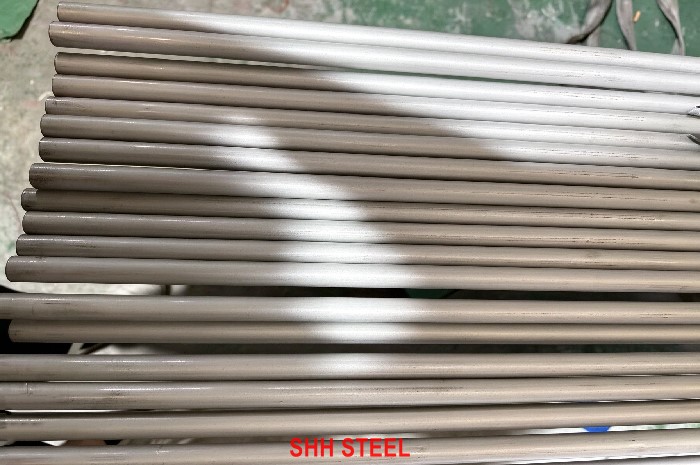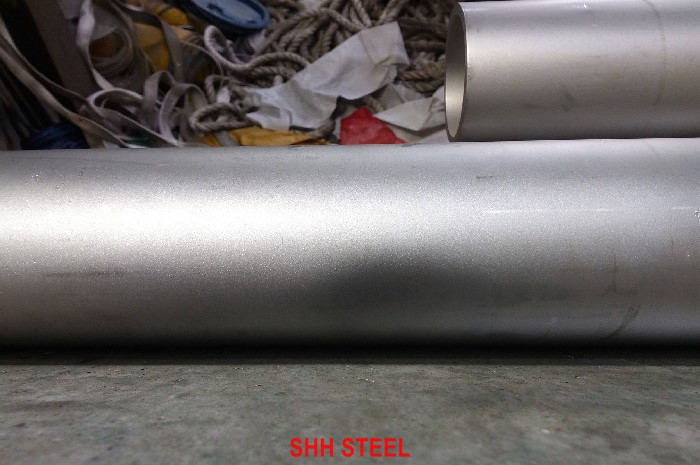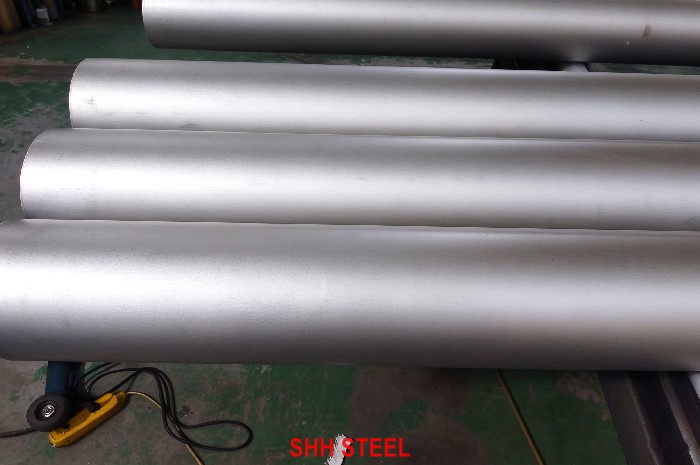
ASTM A312 TP321 Stainless Steel Pipe
What is ASTM A312 TP321 Stainless Steel Pipe
ASTM A312/A312M is the ASTM product specification for seamless, welded and heavily cold-worked austenitic stainless steel pipe intended for high-temperature and general corrosive service. It stands on its own as a standard; ASME SA-312 is a separate Code Book specification with related text, and the two should not be treated as interchangeable titles on a purchase order. This page is written against A312/A312M for grade TP321 / UNS S32100, with every chemistry, tensile and tolerance figure taken from the referenced A312/A312M tables rather than from catalogue sheets.
TP321 is the titanium-stabilized member of the 18Cr–10Ni family. Titanium combines with carbon and nitrogen as stable carbonitrides, so chromium carbides are much less likely to form at grain boundaries when the pipe is welded or held in the sensitizing range. Table 1 sets C ≤0.08%, N ≤0.10% and Ti at least 5×(C+N) with a 0.70% ceiling under footnote F, with chromium at 17.0–19.0% and nickel at 9.0–12.0%; molybdenum is not required. Unusually, the Table 4 row depends on route and wall: welded pipe and seamless walls up to 0.375 in. release at 75/30 ksi, while seamless walls over 0.375 in. drop to 70 ksi [485 MPa] / 25 ksi [170 MPa]. TP321 is not an H grade, so the default 1900 °F [1040 °C] anneal applies.
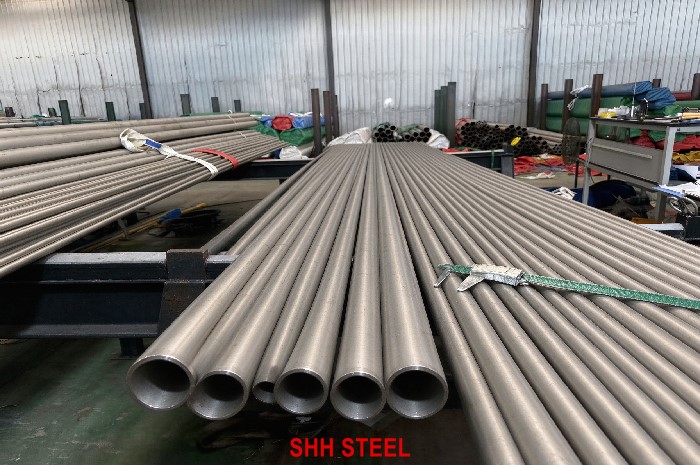
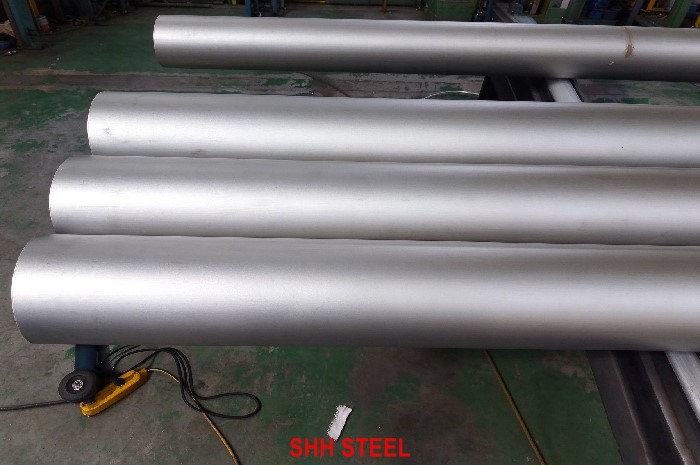
SHH STEEL can supply ASTM A312 TP321 stainless steel pipe as seamless (SML), welded (WLD) or heavily cold-worked (HCW) product, in ASME B36.19 schedules and in special OD and wall combinations by agreement. EN 10204 3.1 mill test certificates are standard, and third-party 3.2 inspection is arranged when the enquiry names an agency. Dual A312/SA-312 marking is offered only when the purchase order names both standards and the heat qualifies under each; for the separately published ASME page on this grade, see SA312 TP321.
Commercial names include 321 stainless pipe, S32100 and “Ti-stabilized 18-10”. Whatever the label, the certificate must report carbon, nitrogen and titanium together, because the titanium minimum is a formula, not a fixed number. TP321 and TP321H are separate Table 1 rows with different carbon bands and Ti multipliers, so a heat certified to one does not automatically qualify as the other unless the MTC proves both and the order asks for dual grading.
Within the ASTM A312 series, buyers comparing TP321 usually look next at A312 TP321H, A312 TP347, A312 TP316Ti and A312 TP304L. The full grade list sits on the A312/A312M hub, which is the quickest place to check neighbouring chemistries when a datasheet leaves more than one option open.
Manufacturing Types (SML / WLD / HCW)
ASTM A312 recognises three manufacturing routes for TP321 pipe, and the choice is a purchase-order decision driven by the design code, size, wall thickness and how the owner wants the pipe inspected. The route never changes the chemistry: every heat must still meet C ≤0.08%, Mn ≤2.00%, P ≤0.045%, S ≤0.030%, Si ≤1.00%, Cr 17.0–19.0%, Ni 9.0–12.0%, N ≤0.10% and Ti at least 5×(C+N) with a 0.70% ceiling (footnote F), and every length must be heat treated before release. For TP321 the route also selects the Table 4 row: seamless walls over 0.375 in. use the lower 70/25 ksi line, while welded pipe stays at 75/30 ksi for every wall.
- Seamless (SML) — no welding at any stage; preferred for high pressure, thick walls and owners who exclude welded pipe from the piping class.
- Welded (WLD) — automatic welding without filler metal, finished so the pipe meets dimensional and mechanical requirements after final heat treatment; ask for the coil or plate heat number on the certificate.
- Heavily cold-worked (HCW) — welded pipe cold worked at least 35% in wall and weld before the final anneal, again without filler; ordered when the project wants that specific marking and process control.
Every finished length is hydrostatically tested or nondestructively electrically tested, and the mill may choose the method unless the purchase order fixes one. When comparing seamless and welded offers, check the route and the hydro or NDE method on the certificate, not only the grade stamp, so that the test plan matches what the piping class actually requires.
Chemical Composition of ASTM A312 TP321
Two chemistry layers matter for ASTM A312 TP321. The melting (heat or ladle) analysis in Table 1 is mandatory for every heat, while product analysis on finished pipe applies only when Supplementary Requirement S1 or the purchase order asks for it, using the ASTM A480/A480M Table A1.1 tolerances referenced through A999/A999M. The table below gives the Table 1 melting limits that the mill must report on the certificate.
| Element | TP321 / UNS S32100 melting analysis |
|---|---|
| Carbon (C) | ≤ 0.08 |
| Manganese (Mn) | ≤ 2.00 |
| Phosphorus (P) | ≤ 0.045 |
| Sulfur (S) | ≤ 0.030 |
| Silicon (Si) | ≤ 1.00 |
| Chromium (Cr) | 17.0 – 19.0 |
| Nickel (Ni) | 9.0 – 12.0 |
| Molybdenum (Mo) | No requirement (…) |
| Titanium (Ti) | 5 × (C+N) min, 0.70 max (footnote F) |
| Nitrogen (N) | ≤ 0.10 |
Read the table as maxima unless a range is shown. The stabilizer rule for TP321 (Ti ≥5×(C+N), ≤0.70%) is not a fixed number; it moves with the actual chemistry of each heat. At C = 0.05% and N = 0.03%, C+N = 0.08%, so titanium must be at least 0.40% and no more than 0.70%. That is why the MTC has to report carbon, nitrogen and titanium on the same heat, so the Ti ≥5×(C+N), ≤0.70% rule can be proven.
When product analysis is ordered, finished-pipe chemistry is judged against Table 1 widened by the A480 tolerances. The next table pairs each Table 1 limit with its tolerance and the resulting product-analysis bound, so receiving inspectors can clear a check analysis on TP321 without having to rebuild the arithmetic themselves.
| Element | Melting (Table 1) | Tolerance (A480 A1.1) | Product analysis limit |
|---|---|---|---|
| Carbon (C) | ≤ 0.08 | 0.01 over | ≤ 0.09 |
| Manganese (Mn) | ≤ 2.00 | 0.04 over | ≤ 2.04 |
| Phosphorus (P) | ≤ 0.045 | 0.010 over | ≤ 0.055 |
| Sulfur (S) | ≤ 0.030 | 0.005 over | ≤ 0.035 |
| Silicon (Si) | ≤ 1.00 | 0.05 over | ≤ 1.05 |
| Chromium (Cr) | 17.0 – 19.0 | 0.20 under / over | 16.80 – 19.20 |
| Nickel (Ni) | 9.0 – 12.0 | 0.10 under / 0.15 over | 8.90 – 12.15 |
| Titanium (Ti) | 5 × (C+N) min, 0.70 max | 0.05 over on max | max ≤ 0.75 product; min tied to C+N |
| Nitrogen (N) | ≤ 0.10 | 0.01 over | ≤ 0.11 |
Product analysis is not automatic under ASTM A312: if your client inspector expects check analyses on finished lengths, order S1 explicitly. A product result inside the widened bound but outside Table 1 is acceptable as a check analysis; it does not mean the heat analysis itself may drift, and SHH STEEL reports actual ladle values rather than unpublished tighter windows.
Mechanical Properties of ASTM A312 TP321
Room-temperature tensile requirements for ASTM A312 TP321 come from Table 4 and are summarised below. They are the minimum release values for the lot; actual certificate values are usually higher, but design allowables still come from the applicable code for UNS S32100, not from this product page or from a sister grade’s strength line.
| Condition | Tensile strength, min | Yield strength, min |
|---|---|---|
| Welded pipe, all walls | 75 ksi [515 MPa] | 30 ksi [205 MPa] |
| Seamless, wall ≤ 0.375 in. [9.5 mm] | 75 ksi [515 MPa] | 30 ksi [205 MPa] |
| Seamless, wall > 0.375 in. [9.5 mm] | 70 ksi [485 MPa] | 25 ksi [170 MPa] |
Pick the row from the actual route and wall. Welded pipe stays on 75/30 ksi for every wall, but seamless pipe with walls over 0.375 in. [9.5 mm] drops to the 70/25 ksi line, and receiving inspection should check that the MTC quotes the row that matches the shipped product. Heavy-wall seamless is hot finished, which is why its floor is lower than the welded row.
Dimensions, Tolerances and Stock Sizes
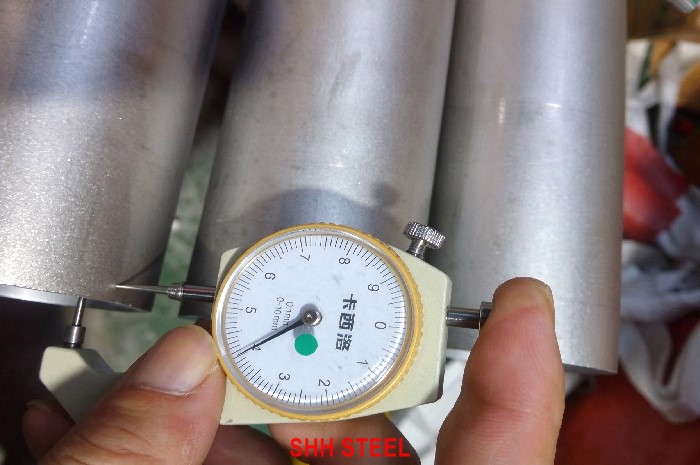
Dimensional supply for ASTM A312 TP321 pipe follows ASME B36.19 schedules for the common NPS and schedule combinations, with special OD and wall available by agreement when a project needs a section the schedules do not cover. Outside-diameter variations follow ASTM A999/A999M, and wall-thickness variations follow A312 Table 3, summarised below with t/D meaning specified wall divided by ordered OD.
| NPS designator | Wall over | Wall under |
|---|---|---|
| 1/8 to 2-1/2 incl., all t/D | 20.0% | 12.5% |
| 3 to 18 incl., t/D up to 5% | 22.5% | 12.5% |
| 3 to 18 incl., t/D over 5% | 15.0% | 12.5% |
| 20 and larger, welded, all t/D | 17.5% | 12.5% |
| 20 and larger, seamless, t/D up to 5% | 22.5% | 12.5% |
| 20 and larger, seamless, t/D over 5% | 15.0% | 12.5% |
Reading the table, the 12.5% under-tolerance is constant while the over-tolerance depends on NPS, t/D and, above NPS 20, on whether the pipe is welded or seamless. State on the purchase order whether wall is nominal or minimum (Supplementary S8), because the two readings produce different pipe from the same size line, and recheck pressure design after under-tolerance on light Sch 10S walls.
- Lengths — single random, double random or cut-to-length as ordered
- Ends — plain or bevelled; confirm bevel angle and root face when the WPS is already frozen
- Jointers — not permitted unless the purchase order allows them
Stock / Available sizes. SHH STEEL quotes TP321 against a practical stock-and-mill enquiry range rather than a frozen SKU list. The representative sizes below, with example OD × wall figures from ASME B36.19, are the combinations we most often discuss for this grade. TP321 is one of the more widely held stabilized grades, especially in Sch 10S and 40S. Availability by route and exact wall is confirmed on enquiry, and we do not publish tonnages against individual lines.
| Representative size (ASME B36.19) | Example OD × wall | Typical schedules / notes |
|---|---|---|
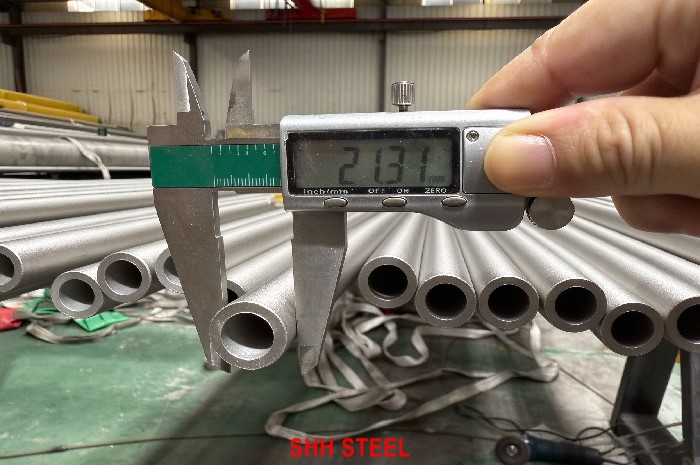
| NPS 1/2 | 21.3 mm × 2.77 mm (Sch 40S) | Sch 10S / 40S / 80S; instrument and small-bore take-offs |
| NPS 2 | 60.3 mm × 3.91 mm (Sch 40S) | Sch 10S / 40S / 80S; common process branch size |
| NPS 4 | 114.3 mm × 6.02 mm (Sch 40S) | Sch 10S / 40S / 80S; frequent stock and mill enquiry size |
| NPS 6 | 168.3 mm × 7.11 mm (Sch 40S) | Sch 10S / 40S / 80S; confirm SML vs WLD on enquiry |
| NPS 8 – 12 | 219.1 mm × 8.18 mm (NPS 8 Sch 40S) | Sch 10S / 40S; route and wall decide stock vs mill-order |
| NPS 14 – 24 | Per B36.19 for the ordered schedule | Sch 10S / 40S; usually mill-order, often welded |
| Special OD × wall | By agreement | State OD, wall (nominal or minimum) and length practice |
Read the table as a guide to where enquiries usually land, not a promise that every size is on the floor; special OD × wall, non-standard lengths and mixed SML/WLD packages are routine on enquiry.
Equivalent Grades
Equivalent designations help sourcing, but they do not replace the ASTM A312 grade line on the purchase order. The table below lists the primary ASTM identity for TP321, the separately published ASME specification, and the sister grades buyers most often confuse with it on enquiries.
| Designation | Notes |
|---|---|
| ASTM A312 TP321 / UNS S32100 | Governing product specification on this page |
| ASME SA-312 TP321 / S32100 | Separate Code Book standard; dual-mark only when the PO names both |
| TP321H / UNS S32109 | H grade: C 0.04–0.10%, Ti 4×(C+N), grain size No. 7 or coarser |
| TP347 / UNS S34700 | Nb-stabilized sister; Nb ≥10×C, Ni up to 13.0% |
| EN 1.4541 (X6CrNiTi18-10) | Approximate regional map; recheck Ti rule and carbon before any substitution |
EN 1.4541 is a soft regional cross-reference only: EN chemistry is not written as 5×(C+N), so the titanium rule and carbon have to be rechecked before any substitution is accepted. Within A312 itself, sister grades each have their own Table 1 and Table 4 rows, so a shared market label is never a reason to swap one for another without the datasheet owner agreeing.
Heat Treatment and Delivery Condition
All A312 pipe is furnished heat treated. TP321 is not an H grade, so it receives the default 1900 °F [1040 °C] minimum solution anneal followed by rapid cooling, since TP321 has no individual Table 2 row. There is no Table 5 grain-size mandate and no clause 6.2 reheat rule, and HCW cold reduction is completed before the final anneal so delivery remains the annealed condition. Supplementary requirement S6 adds a stabilization treatment at an agreed temperature below the solution anneal only when the purchase order invokes it.
Delivery is normally solution annealed and pickled unless the order asks for bright annealing or another finish. The MTC should record the anneal temperature and cooling method actually used, and fabricators who hot form or heavily cold work TP321 bends should re-anneal to the same practice where the governing code requires it, rather than applying a neighbouring grade’s anneal by habit.
Corrosion Resistance
ASTM A312 does not publish corrosion rates, so this section is engineering commentary. TP321 is chosen where welded construction or service in the sensitizing range would put an unstabilized grade such as TP304 at risk of intergranular attack. Titanium ties up carbon before chromium can, so the chromium-depleted zones behind weld decay are much less likely to form, and the grade keeps good oxidation resistance in intermittent hot service.
Stabilization does not add pitting resistance. When chloride pitting or crevice attack drives the material choice, a molybdenum-bearing grade such as A312 TP316Ti is usually a better fit. Titanium can also be partly lost across the welding arc, which is one reason Table 6 lists ER347 as an alternative filler; intergranular corrosion testing applies only when it is written on the order.
Applications of ASTM A312 TP321 Pipe
Applications for ASTM A312 TP321 follow directly from its chemistry and heat-treatment package. The table below summarises where buyers typically place the grade and what to check before freezing the order; always confirm code allowables for UNS S32100 at the design temperature before final wall selection.
| Application area | Typical use of TP321 pipe | Selection note |
|---|---|---|
| Welded process lines | Lines exposed to the sensitizing range during welding or service | Prove the stabilizer rule on the MTC |
| Exhaust, expansion-joint and heater piping | Intermittent elevated-temperature duty without H-grade creep design | Use TP321H when the design is creep-governed |
| Chemical and refining utility | Oxidizing or mildly corrosive service specified with stabilized 18–10 chemistry | Prefer Mo grades if chlorides dominate |
| Code piping packages | Dual A312/SA-312 projects with heat traceability | Name edition, route, and UNS on the enquiry |
Plants that already run TP321H or TP347 sometimes buy TP321 in the same package, which makes sense logistically but only when each line’s datasheet actually allows the grade being shipped to it. Match the grade to the corrosion and code case first and let commercial convenience come second; in particular, do not ship TP321 into a creep-governed line that was designed around TP321H.
Weldability
For filler selection, Table 6 maps TP321 to ER321 and also lists ER347 as an option. Qualify the WPS and PQR on actual TP321 base metal and freeze the consumable before production welds. Mill longitudinal welds on WLD and HCW pipe are made without filler metal, so Table 6 guidance applies to fabrication joints, not to the mill seam.
TP321 welds readily by GTAW for roots and thin walls, GMAW for productive fill passes and SMAW for field girth welds, with orbital GTAW common on repetitive high-integrity joints. Stabilization lowers HAZ sensitization risk compared with unstabilized 18-8, but low heat input and controlled interpass remain good practice. Girth-weld NDE and cleanliness follow the fabrication code, such as ASME B31 and Section IX, which A312 does not rewrite.
Surface Finishes
Surface condition for ASTM A312 TP321 pipe should be stated on the purchase order rather than left to mill default. On stainless pipe, embedded free iron, residual scale and chloride contamination from handling can matter as much as the nominal finish name, especially on aqueous and clean-process lines.
- Annealed and pickled — the usual delivery for process piping after solution treatment
- Bright annealed — by agreement for selected sizes and routes
- Mechanically polished OD/ID — grit or Ra target by agreement; polishing does not replace annealing
- Bead-finished welded OD — weld bead rolled or ground flush on WLD/HCW pipe as agreed
Inspection and Testing
The base acceptance package for ASTM A312 TP321 pipe combines heat analysis against Table 1, Table 4 tension tests, flattening or bend tests per route and size, heat-treatment evidence, and a hydrostatic or nondestructive electric test on every length. For this grade the certificate should show carbon, nitrogen and titanium on the same heat, so the Ti ≥5×(C+N), ≤0.70% rule can be proven.
Supplementary requirements are optional until written on the order. The options buyers request most often for this grade are summarised below, and each one should be priced and scheduled at enquiry rather than added after the pipe is rolled.
| Option | Purpose |
|---|---|
| S1 product analysis | Confirms chemistry on finished pipe |
| S5 radiography | Weld integrity on WLD pipe |
| S6 stabilization | Stabilizing heat treatment at an agreed temperature |
| S7 intergranular corrosion | A262 Practice E after sensitizing treatment |
| S8 minimum wall | Wall read as minimum rather than nominal |
| S9 weld decay | Compares weld and base-metal loss rates |
EN 10204 3.1 certification is our standard document set, and 3.2 third-party witness by an agency such as SGS, Bureau Veritas or TÜV is arranged when the enquiry names it and its hold points. Hydrostatic versus NDE selection also belongs on the PO.
Packaging and Shipping
Export and domestic shipments of ASTM A312 TP321 pipe are packed for handling and for ocean or land transport. Each length is marked with ASTM A312 (and SA-312 only when dual-certified), TP321 / UNS S32100, the route, size and heat number, and bundle lists repeat the heat numbers so receiving can match pipe to certificates without opening every wrap.
- Ends capped or bevel-protected as ordered
- Bundles strapped with protected contact points to limit iron pickup
- Waterproof wrapping for ocean freight when specified
- Packing list with heat numbers, sizes and certificate references
We keep TP321 physically segregated from TP321-family and TP347-family heats in the yard and on the packing list, because stencils look alike and mix-ups are expensive once pipe is cut.
Why Choose SHH STEEL
SHH STEEL supplies specification-driven stainless pipe and plate, and for ASTM A312 TP321 we quote against the edition you name rather than a generic catalogue sheet. We report full Table 1 chemistry, Table 4 results and heat-treatment evidence, keep heat identity unbroken from melt to finished length, and match route and size to the enquiry instead of pushing a one-size stock answer.
- Grade control — carbon, nitrogen and titanium on the same heat, so the Ti ≥5×(C+N), ≤0.70% rule can be proven stated on the MTC
- Honest sister-grade advice when TP321H or TP347 would fit the service better
- Filler guidance for WPS planning: ER321 (ER347 listed as an option)
- SML, WLD and HCW routes with EN 10204 3.1 MTCs; 3.2 inspection on request
- Dual A312/SA-312 marking only when the purchase order asks for both
- Cut lengths, bevelling and project marking coordinated on confirmed orders
If you are still choosing between TP321 and its sister grades, send the design temperature, the medium, the welded or seamless preference and any project chemistry limits. We would rather tell you that a more available grade does the job than sell you a harder-to-source heat you do not need, and that conversation is cheapest before the purchase order is frozen.
Supply Capability
SHH STEEL can supply ASTM A312 TP321 stainless steel pipe against the edition and manufacturing type named on your enquiry. The capability table below summarises the routes, sizes, finishes, tests and documents we regularly quote for this grade,.
| Item | SHH STEEL capability for TP321 |
|---|---|
| Standard | ASTM A312 / A312M TP321 / UNS S32100 |
| Manufacturing types | SML, WLD, HCW |
| Size | NPS 1/8 and up per ASME B36.19; special OD/wall by agreement |
| Schedules | 5S, 10S, 40S, 80S and non-standard walls |
| Length | SRL, DRL or cut-to-length |
| Finish | Annealed and pickled; bright annealed or polished by agreement |
| Filler guidance | ER321 (ER347 listed as an option) |
| Testing | Tension (75/30 ksi (70/25 ksi for seamless walls over 0.375 in.)), flattening/bend, hydro or NDE per length; supplementary tests on order |
| Documents | EN 10204 3.1 with full Table 1 chemistry; 3.2 / third-party inspection on request |
| Trade terms | FOB / CFR / CIF / EXW and other agreed Incoterms |
Stock / Available sizes. Representative stock and mill-enquiry sizes for TP321 are listed in the Dimensions section, typically NPS 1/2–24 in Sch 10S/40S/80S with example OD × wall figures per ASME B36.19. Selected common combinations may ship from stock, while heavy-wall seamless, unusual schedules and special cut lengths are normally mill-order. We do not invent warehouse SKUs or tonnages, so ask for a live check against your size list.
Enquiries should state the A312 edition, TP321 (UNS S32100), SML/WLD/HCW, NPS or OD × wall with nominal or minimum wall, length practice, finish, and any product-analysis, corrosion-test or 3.2 requirements, so mill slots line up with your need date. Dual SA-312 marking, cut lengths, bevelling and packing-list marking are available on confirmed orders.
FAQ
-
Is ASTM A312 TP321 the same as ASME SA-312 TP321?
- They are two independent standards. ASTM A312/A312M is the ASTM product specification, while ASME SA-312 is the Code Book specification used for ASME-stamped work. For a referenced edition the TP321 chemistry and tensile rows are technically aligned, but a purchase order should name the standard it needs, and dual A312/SA-312 marking is available only when both are written on the order and the heat qualifies under each.
-
What is the chemical composition of ASTM A312 TP321 pipe?
- Table 1 sets C ≤0.08%, Mn ≤2.00%, P ≤0.045%, S ≤0.030%, Si ≤1.00%, Cr 17.0–19.0%, Ni 9.0–12.0%, N ≤0.10% and Ti at least 5×(C+N) with a 0.70% ceiling (footnote F). These are heat-analysis limits that the mill must report for every heat. If product analysis is ordered under S1, finished pipe is judged against Table 1 widened by the ASTM A480 Table A1.1 tolerances shown in the chemistry section of this page.
-
What are the mechanical properties of ASTM A312 TP321?
- Table 4 requires 75 ksi [515 MPa] tensile / 30 ksi [205 MPa] yield for welded pipe and for seamless walls up to 0.375 in. [9.5 mm], and 70 ksi [485 MPa] / 25 ksi [170 MPa] for seamless walls over 0.375 in.. These are minimum release values; mill results are usually higher, but design allowables come from the governing code for UNS S32100. Hardness is not separately mandated by Table 4, so state a limit on the order if fabrication needs one.
-
What is the difference between ASTM A312 TP321 and TP321H?
- TP321 caps carbon at 0.08% and needs Ti at least 5×(C+N), with the default 1900 °F anneal and no grain-size rule. TP321H uses a 0.04–0.10% carbon band, a lower Ti multiplier of 4×(C+N), Table 5 grain size No. 7 or coarser and higher anneal temperatures of 2000 °F cold-finished and 1925 °F hot-finished. Use TP321H only where creep strength is in the design basis.
-
Which is better, A312 TP321 or TP347 pipe?
- Both are stabilized 18-10 grades. TP321 uses titanium at 5×(C+N) minimum with nickel 9.0–12.0%, while TP347 uses niobium at 10×C minimum with nickel up to 13.0%. TP347 is often preferred for heavily welded joints because niobium is less prone to loss across the arc, but TP321 is widely stocked and economical. The datasheet and code allowables should decide, not habit.
-
What heat treatment does ASTM A312 TP321 require?
- TP321 is supplied solution annealed at the default 1900 °F [1040 °C] minimum solution anneal followed by rapid cooling, since TP321 has no individual Table 2 row. It is not an H grade, so there is no Table 5 grain-size requirement, and the MTC should record the temperature and cooling method actually used.
-
Which filler metal is used to weld ASTM A312 TP321 pipe?
- Table 6 maps TP321 to ER321 and also lists ER347 as an option. Qualify the procedure on actual TP321 base metal and freeze the classification on the WPS and PQR before production. The mill seam on WLD and HCW pipe is made without filler, so this guidance applies to fabrication joints only.
-
What sizes of ASTM A312 TP321 pipe can SHH STEEL supply?
- We quote TP321 in ASME B36.19 sizes from NPS 1/8 upward, most often NPS 1/2–24 in Sch 10S, 40S and 80S, for example 114.3 mm × 6.02 mm for NPS 4 Sch 40S, plus special OD × wall by agreement. Selected common sizes may ship from stock, and heavy walls or unusual schedules are usually mill-order, confirmed on enquiry.
-
Why does seamless TP321 have a lower tensile minimum on thick walls?
- Table 4 puts seamless TP321 with walls over 0.375 in. [9.5 mm] on a 70 ksi [485 MPa] tensile / 25 ksi [170 MPa] yield row, while welded pipe and thinner seamless walls stay at 75/30 ksi. Heavy-wall seamless pipe is hot finished and typically shows lower strength after annealing. Inspectors should therefore choose the row from the actual route and wall, and designers should use code allowables for UNS S32100.
-
Does TP321 pipe need a stabilization heat treatment?
- Not by default. Supplementary requirement S6 adds a stabilization treatment at an agreed temperature below the solution anneal, but it applies only when the purchase order invokes it. Some licensors or owners specify S6 for hot service with polythionic-acid risk; if yours does, state it at enquiry because it adds a furnace step and the temperature must appear on the MTC.
-
What certificates come with ASTM A312 TP321 pipe from SHH STEEL?
- Every shipment carries an EN 10204 3.1 mill test certificate with full Table 1 heat chemistry, Table 4 tensile results, heat-treatment details and the hydro or NDE method. For TP321 it should show carbon, nitrogen and titanium on the same heat, so the Ti ≥5×(C+N), ≤0.70% rule can be proven. Third-party 3.2 inspection and supplementary tests such as S1 or S7 are added when named on the order.
Conclusion
ASTM A312 TP321 / UNS S32100 is defined by C ≤0.08%, Mn ≤2.00%, P ≤0.045%, S ≤0.030%, Si ≤1.00%, Cr 17.0–19.0%, Ni 9.0–12.0%, N ≤0.10% and Ti at least 5×(C+N) with a 0.70% ceiling (footnote F), a Table 4 floor of 75/30 ksi (70/25 ksi for seamless walls over 0.375 in.), and the default 1900 °F [1040 °C] minimum solution anneal followed by rapid cooling, since TP321 has no individual Table 2 row. Order it by grade and UNS number rather than market shorthand, state the route, size, wall basis, finish and any supplementary tests, and keep the sister grades on their own datasheets. Treat ASME SA-312 as a separate standard that is added only when dual marking is genuinely required. For grade selection, stock checks or a quotation against your size list, browse the A312/A312M range or email SHH STEEL at admin@steelspecs.com.
Quality Steel Needed? Inquire for Offers
Related Products