ASTM A269 TP201 Stainless Steel Tube
What is ASTM A269 TP201 Stainless Steel Tube
ASTM A269 / A269M is the ASTM International product specification for nominal-wall-thickness, seamless and welded austenitic stainless steel tubing intended for general corrosion-resisting and low- or high-temperature service. Grade TP201 sits in that Table 1 family under UNS S20100 as a chromium-manganese-nickel lean austenitic: manganese is deliberately high at 5.5–7.5%, nickel is held lean at 3.5–5.5%, chromium runs 16.0–18.0%, and carbon is capped at 0.15%. Buyers who write “201 tube,” “S20100 instrumentation tube,” or “A269 201 hydraulic line” on a bill of materials still need to name ASTM A269 (or A269M) on the purchase order so the mill applies the correct nominal-wall rules, heat-treatment, hardness, flaring or flange tests, and marking clauses rather than an A213 boiler-tube or A312 pipe text.
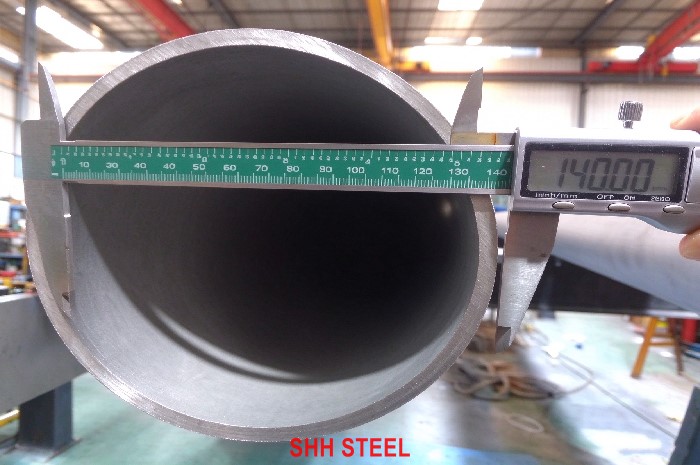
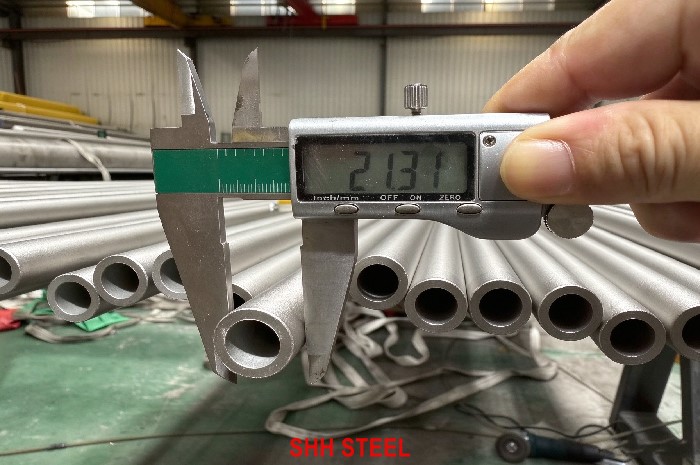
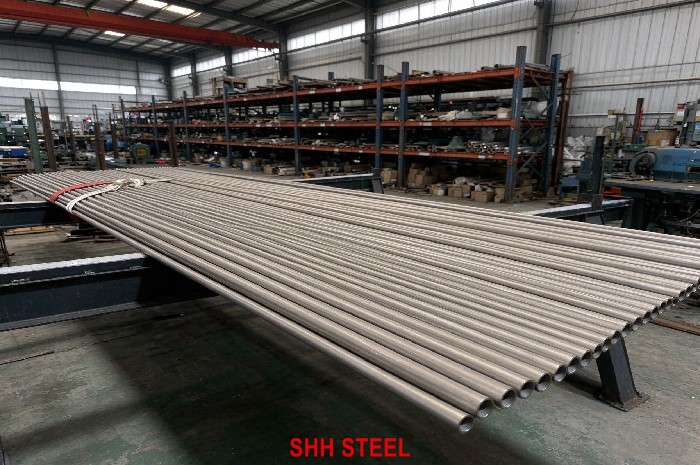
SHH STEEL can produce and supply ASTM A269 TP201 stainless steel tube as seamless and welded product in the usual instrument, hydraulic, and process OD × nominal-wall band, solution annealed and quenched, and shipped with EN 10204 3.1 mill test certificates that report the full Table 1 ladle chemistry and the Table 2 hardness result. Typical enquiry sizes for this grade run from about 6 mm to 114 mm outside diameter with 0.5–6.0 mm nominal wall (or the equivalent inch / BWG list); other diameters and walls are available by agreement. Browse the grade family on the A269/A269M hub.
Commercially, TP201 tube is still called 201, Cr-Mn-Ni, or S20100 general-service tube; none of those shop names replace the ASTM grade on the MTC or stencil. Sister grades under the same A269 product standard include A269 TP201LN, the workhorse A269 TP304 / A269 TP304L pair, and molybdenum-bearing A269 TP316L. When the same UNS chemistry is needed as boiler / heat-exchanger tube or as pipe, open the separate A213 TP201 or A312 TP201 pages rather than stretching an A269 tubing order into those product forms. A269 uses a nominal-wall basis — not the minimum-wall convention of A213 — so OD × wall language on the enquiry should say “nominal wall” unless the purchase order deliberately calls for a different wall basis by agreement.
Chemical Composition of A269 TP201
Two chemistry layers matter for TP201 under ASTM A269. The melting (heat or ladle) analysis is mandatory for every heat under Table 1, while product analysis on finished tube applies when the purchase order or supplementary wording invokes it through the general requirements in ASTM A1016/A1016M. Product-analysis tolerances are not reprinted as a standalone chemistry table inside A269 itself; when ordered, they typically flow from ASTM A480/A480M Table A1.1. SHH STEEL reports the actual ladle values — and the product values when ordered — and does not advertise tighter catalogue chemistry windows that the ASTM standard does not publish.
The table below reproduces the Table 1 heat analysis for TP201 / UNS S20100 as shown in public A269 Table 1 excerpts (ASTM abstract page and mill PDF reproductions cross-checked against each other). Values are maximum unless a range is shown, and an ellipsis (…) means the ordered edition sets no requirement for that element. Confirm the purchased A269/A269M edition on the purchase order before treating any secondary catalogue as the acceptance text — the public block-1 columns come from older excerpt copies, while current store pages emphasize later Table 1 blocks.
Melting analysis (heat / ladle analysis) — Table 1
| Element | TP201 (UNS S20100) melting analysis |
|---|---|
| Carbon (C) | ≤ 0.15 |
| Manganese (Mn) | 5.5 – 7.5 |
| Phosphorus (P) | ≤ 0.060 |
| Sulfur (S) | ≤ 0.030 |
| Silicon (Si) | ≤ 1.00 |
| Chromium (Cr) | 16.0 – 18.0 |
| Nickel (Ni) | 3.5 – 5.5 |
| Molybdenum (Mo) | … (no requirement) |
| Nitrogen (N) | ≤ 0.25 |
Source: ASTM A269/A269M Table 1 for Grade TP201 / UNS S20100, cross-checked between the ASTM abstract Table 1 reproduction and the tubingchina / piping-mart public PDF excerpts of the A269 text. Nitrogen analysis method is a matter of agreement between purchaser and producer where the standard’s nitrogen footnote applies. Read the Mn and Ni lines first: they are what make TP201 a lean austenitic rather than a nickel-heavy 18-8. Chromium at 16–18% builds the passive film; nickel at 3.5–5.5% is deliberately lean; carbon ≤0.15% sits above an L-grade ceiling, so as-welded sensitization risk is higher than for TP201LN or TP304L unless the fabrication procedure accounts for it.
Mechanical Properties of A269 TP201
Unlike ASTM A213 boiler tube or ASTM A312 pipe for the same UNS number, ASTM A269 does not publish a tensile-strength / yield / elongation acceptance table for TP201 in the mechanical section that buyers usually quote. Lot acceptance for finished A269 tubing is built around hardness (Table 2), plus the flaring test for seamless tube, the flange and reverse-flattening tests for welded tube, and a hydrostatic or nondestructive electric test on each length. Inventing a 75/30 ksi-style tensile floor from a sister product standard and calling it an A269 requirement would be incorrect — if a project needs guaranteed tensile numbers, write them as a purchase-order supplement or open the matching A213 / A312 grade text instead.
Table 2 of A269 sets the hardness ceiling for TP201 / UNS S20100 at 220 HBW / 230 HV or 96 HRB after the required solution heat treatment. That is a maximum, not a target; mill certificates typically clear it with margin on properly annealed tube. Hardness testing is waived on very small inside-diameter or thin-wall tubes under the size exemptions in the hardness clause, but the heat-treatment requirement itself still applies.
| Property | TP201 requirement (A269 Table 2) |
|---|---|
| Hardness, max | 220 HBW / 230 HV or 96 HRB |
| Tensile / yield / elongation | Not specified as an A269 acceptance table for this grade (do not invent from A213/A312) |
Source: ASTM A269/A269M Table 2 heat-treatment and hardness requirements for TP201 / UNS S20100 (public PDF excerpt of the A269 text). Superficial Rockwell limits for thin-wall S20100 tube are stated separately in the hardness clause (not exceeding 79 on the 30 T scale or 91 on the 15 T scale when that method is used). Always confirm the ordered edition, because Table 2 footnotes and superficial-scale wording can move between revisions.
Seamless and Welded Tube
ASTM A269 allows TP201 tubing to be made by either the seamless or the welded process, and the manufacturer may furnish the product hot-finished or cold-finished. Welded A269 tube is produced without filler metal — the longitudinal weld is an autogenous seam that is then cold-worked and heat-treated with the tube, not a deposited filler-metal weld. That is a different product-form story from ASTM A312 pipe, where WLD and HCW manufacturing types carry their own stencil letters; A269 simply states seamless or welded and does not use those pipe-style codes as the primary product claim.
Mechanical differentiation follows the process. Seamless TP201 tube takes a flaring test on a lot basis; welded TP201 tube takes a flange test and a reverse-flattening test so the weld seam is exercised in both opening and reverse-bend modes. Both routes share the Table 2 hardness check and the mandatory hydrostatic or nondestructive electric test on each length. When you enquire, say whether the line specification prefers seamless (no weld seam in the pressure boundary) or accepts welded A269 tube; SHH STEEL can produce and supply both routes for TP201 against the same chemistry and heat-treatment floors.
Cold-finished A269 tube is the usual choice for instrumentation, hydraulic, and bright process lines where OD tolerance, surface, and straightness matter; hot-finished seamless is more common on heavier walls. Neither finish changes the grade chemistry — it changes how the mill reaches final size and how the surface looks before pickling or bright anneal.
Dimensions and Tolerances
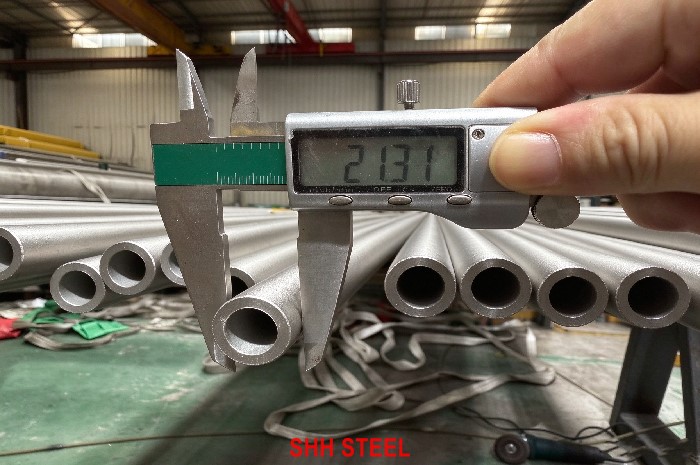
A269 is a nominal-wall tubing specification. The purchase order should state outside diameter and nominal wall thickness (or an agreed average-wall basis if that is what the project uses), not a pipe schedule as the primary size language. Permissible variations in outside diameter, wall thickness, and cut length are given in A269 Table 4 and flow through the general requirements of ASTM A1016/A1016M. Thin-wall ovality rules in clause 12.2 apply when the wall is below the thin-wall thresholds listed for each OD group.
| OD group (A269 Table 4) | Outside diameter tolerance | Wall thickness tolerance |
|---|---|---|
| Up to ½ in. [13 mm] | ±0.005 in. [0.13 mm] | ±15% |
| ½ to 1½ in. [13–38 mm], excl. | ±0.005 in. [0.13 mm] | ±10% |
| 1½ to 3½ in. [38–89 mm], excl. | ±0.010 in. [0.25 mm] | ±10% |
| 3½ to 5½ in. [89–140 mm], excl. | ±0.015 in. [0.38 mm] | ±10% |
| 5½ to 8 in. [140–203 mm], excl. | ±0.030 in. [0.76 mm] | ±10% |
Source: ASTM A269/A269M Table 4 permissible variations (public PDF excerpt). Heavier walls (≥¾ in. [19 mm]) or tubes whose ID is ≤60% of OD may take the wider ±12.5% wall variation noted in the table footnotes; tubes under ½ in. [12.7 mm] ID that cannot be mandrel-drawn may take ±15% wall. Cut-length over-tolerances in Table 4 apply up to 24 ft [7.3 m], with an incremental allowance for longer lengths. SHH STEEL quotes A269 TP201 against the OD × nominal-wall list you issue; if your drawing is written to A213 minimum-wall language, say so explicitly so the mill does not build the wrong wall basis.
Equivalent Grades
TP201 / UNS S20100 is the ASTM tubing designation for the lean Cr-Mn-Ni austenitic that shops often call 201 stainless. Closest commercial neighbours under other ASTM product standards include A213 TP201 (seamless boiler / HX tube) and A312 TP201 (pipe), which share the same UNS chemistry idea but apply different wall bases, mechanical tables, and marking rules. European designations sometimes map toward X12CrMnNiN17-7-5-type chemistries, but those EN numbers are not drop-in substitutes for an A269 order — confirm chemistry, product form, and heat treatment against the purchased ASTM edition.
| Reference | Designation | Note |
|---|---|---|
| ASTM A269 | TP201 / UNS S20100 | This product standard (nominal-wall tube) |
| UNS | S20100 | Chemistry identity |
| ASTM A213 | TP201 | Seamless boiler / HX tube; min-wall / tensile table |
| ASTM A312 | TP201 | Pipe product form, not tubing |
| ASTM A240 | Type 201 / S20100 | Plate / sheet chemistry cousin |
Inside the A269 family, A269 TP201LN is the low-carbon, nitrogen-controlled sister when as-welded corrosion performance matters more than the standard TP201 carbon ceiling. For chloride or process duty that outgrows lean 200-series resistance, move to A269 TP304 or molybdenum-bearing A269 TP316L rather than stretching TP201 past its intended general-service envelope.
Heat Treatment and Delivery Condition
All A269 material is furnished in the solution heat-treated condition. For TP201, Table 2 sets a minimum austenitizing temperature of 1900 °F [1040 °C], followed by quenching in water or rapid cooling by other means. Seamless tube may alternatively be individually quenched immediately after hot forming while still at or above that minimum temperature. If a purchaser deliberately orders a final heat treatment below 1900 °F [1040 °C] for controlled structural reasons, each tube must be stenciled with the actual heat-treatment temperature after the suffix “HT” — that is an ordered exception, not the default mill practice for TP201.
| Item | TP201 (A269 Table 2) |
|---|---|
| Austenitizing temperature, min | 1900 °F [1040 °C] |
| Cooling | Water quench or rapid cool by other means |
| Hardness after heat treatment, max | 220 HBW / 230 HV or 96 HRB |
| Delivery condition | Solution heat-treated (pickled or bright-annealed by agreement) |
Source: ASTM A269/A269M §6 and Table 2 for TP201. Bright-annealed or pickled surfaces are finish choices on top of the mandatory solution treatment; they do not replace it. SHH STEEL ships A269 TP201 in the heat-treated condition stated on the MTC, and we will not mark a tube as A269 TP201 if the final anneal falls outside the ordered Table 2 requirement.
Corrosion Resistance
TP201 is a general-service austenitic. Chromium at 16–18% supports a passive film in many mildly corrosive aqueous and atmospheric environments, while the lean nickel and high manganese balance keep the structure austenitic without the nickel load of TP304. In practice that makes TP201 a cost-sensitive option for indoor process lines, some food-contact tubing where chloride load is low, and hydraulic / pneumatic lines that see clean fluids — not a substitute for molybdenum-bearing grades in seawater, strong chlorides, or reducing acid service.
Carbon up to 0.15% means TP201 can sensitize in the heat-affected zone if welded and left in the as-welded condition under conditions that favour chromium-carbide precipitation. Where as-welded intergranular corrosion resistance is a purchase requirement, buyers usually step to A269 TP201LN (C ≤0.03% with controlled nitrogen) or to an L-grade 300-series tube rather than relying on standard TP201. A269 itself does not publish a PREN or critical-pitting-temperature table for TP201; do not invent one from marketing sheets. Corrosion performance claims on an enquiry should name the medium, temperature, and whether the tube will be welded and re-annealed.
Applications of A269 TP201 Tube
A269 TP201 tube shows up where a lean austenitic, nominal-wall tubing product is enough for the duty and the buyer wants seamless or welded general-service tube rather than boiler tube or pipe. Typical placements include instrumentation and impulse lines, hydraulic and pneumatic tubing, light process transfer lines, food and beverage utility tubing in low-chloride service, and architectural or mechanical tubing that still needs an ASTM stainless tubing specification on the MTC.
It is the wrong first choice for chloride-rich offshore splash zones, strong reducing acids, or Code boiler / superheater duty — those jobs belong to molybdenum grades, higher alloys, or A213 / SA213 boiler-tube standards respectively. When a project already standards on 304 or 316L tubing for corrosion margin, switching to TP201 only to save nickel cost needs a materials engineer’s sign-off, not a catalogue swap. SHH STEEL can produce and supply A269 TP201 for the general-service band above, and we will say so plainly when an enquiry’s medium looks too aggressive for S20100.
Weldability
TP201 welds with the usual austenitic practices — GTAW and GMAW with matching or over-alloyed filler when a filler is used on fabrication joints — but the 0.15% carbon ceiling makes HAZ sensitization a live concern if the finished assembly will see corrosive service without a post-weld solution anneal. Autogenous A269 welded tube already carries a mill weld that has been cold-worked and solution-treated with the tube; field or shop welds on cut lengths are a separate fabrication step and are not covered by the mill’s A269 heat treatment.
For welded fabrications that must remain as-welded in corrosive service, specify A269 TP201LN or an L-grade 300-series A269 tube instead of standard TP201. Filler selection, purge quality, and interpass temperature remain the fabricator’s responsibility; SHH STEEL’s scope on an A269 order is the mill product, the MTC chemistry and hardness, and the process route (seamless or welded tube) named on the purchase order.
Surface Finishes
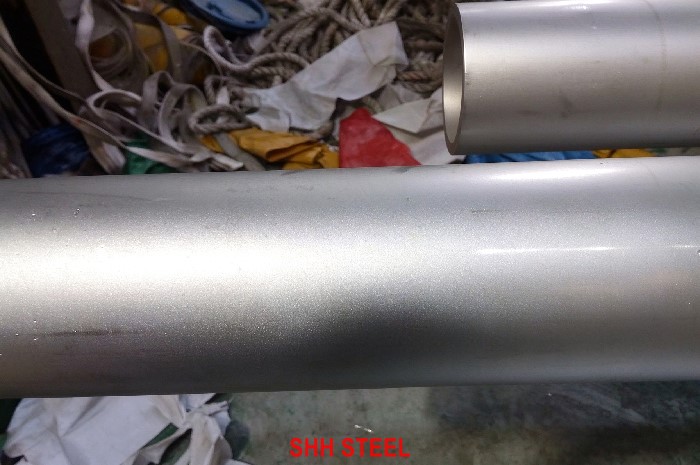
A269 TP201 tube is commonly supplied pickled after solution treatment, or bright annealed when a clean, scale-free OD/ID is needed for instrumentation and hygienic utility lines. Cold-finished tube can also be supplied with a polished OD (for example 180# / 320# belt polish) when the purchase order names the grit; A269 itself does not mandate a polish grade, so polish is a supplementary finish, not a substitute for heat treatment or chemistry.
Interior surface requirements for food, dairy, or high-purity utility service should be written into the enquiry (max Ra, scrubbed ID, or bright ID). SHH STEEL can produce and supply pickled, bright-annealed, and polished A269 TP201 finishes against an agreed surface note; we do not claim a polish that the mill cannot measure and report.
Inspection and Testing
Lot mechanical testing under A269 for TP201 covers hardness (Table 2), flaring on seamless tube, and flange plus reverse flattening on welded tube, with lot definitions tied to heat, size, and heat-treatment charge as written in the standard. In addition, each tube shall be subjected to either a hydrostatic test or a nondestructive electric test; the manufacturer chooses which one unless the purchase order locks the method. When NDE is performed, lengths are marked “NDE” and the certification reflects that choice.
SHH STEEL’s EN 10204 3.1 MTC for A269 TP201 reports ladle chemistry, heat-treatment condition, hardness results, and the hydro or NDE statement for the shipped lengths. Supplementary PMI, positive material identification on cut pieces, or third-party inspection can be arranged when named on the order. We do not skip the mandatory hydro/NDE choice or the hardness lot test to shorten lead time.
Packaging and Shipping
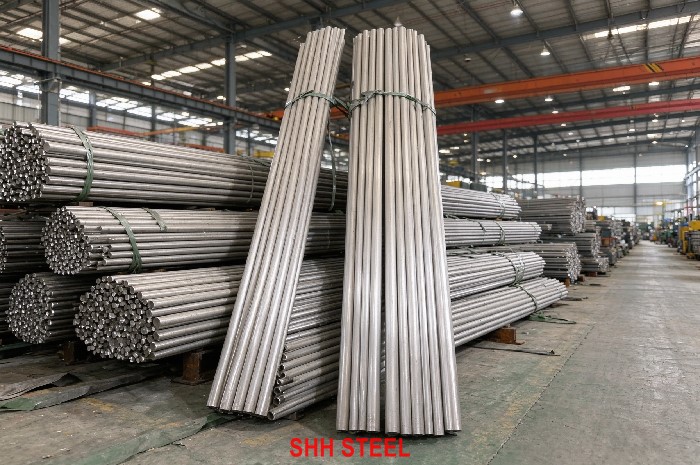
A269 TP201 tube is packed to protect OD finish and ends for export or domestic shipment: plastic end caps or plugs, bundled and sleeved or crated by diameter, with waterproof wrapping for ocean freight when required. Soft-OD or polished tube gets extra sleeve protection so belt polish and bright anneal surfaces do not gall in transit. Coil shipment is available when the order is written for coiled tubing rather than cut lengths; coiled product follows the continuous-coil rules in A269 (no circumferential butt welds in a coil).
Marking typically includes ASTM A269, grade TP201 / S20100, size, heat number, and seamless or welded identity, plus NDE when that test route was used. SHH STEEL aligns stencil and bundle tags with the purchase-order marking clause before the tubes leave the mill or finishing shop.
Why Choose SHH STEEL
SHH STEEL can produce and supply ASTM A269 TP201 as a real tubing product standard — nominal-wall seamless or welded tube, solution annealed to Table 2, hardness-tested, and documented on EN 10204 3.1 certificates — not as a catalogue nickname for “any 201 stainless tube.” We keep the wall basis honest (nominal wall unless you order otherwise), we state seamless versus welded on the MTC and stencil, and we will not borrow A213 tensile floors or A312 pipe manufacturing codes to dress up an A269 shipment.
On grade selection we stay practical. If your medium, chloride level, or as-welded fabrication plan outgrows lean TP201, we say so and point you to A269 TP201LN, A269 TP304L, or A269 TP316L instead of selling the cheaper grade into the wrong duty. That is how a mill-facing supplier protects both the project and the MTC.
Supply Capability
SHH STEEL can produce and supply ASTM A269 TP201 stainless steel tube against the edition, process route, and finish named on your enquiry. The capability table below summarizes the sizes, finishes, and documents we regularly quote for this grade, followed by the Stock / Available sizes map buyers use when they need a quick sense of what to enquire against for instrument, hydraulic, and process duty.
| Item | SHH STEEL capability for TP201 |
|---|---|
| Standard | ASTM A269 / A269M |
| Grade | TP201 / UNS S20100 |
| Product form | Seamless and welded tube (no filler metal for welded), hot-finished or cold-finished |
| Delivery condition | Solution heat-treated ≥1900 °F [1040 °C]; pickled or bright-annealed |
| Typical size band | ~6–114 mm OD × 0.5–6.0 mm nominal wall (other sizes by agreement) |
| Testing | Hardness; flaring (seamless) / flange + reverse flattening (welded); hydro or NDE |
| Documents | EN 10204 3.1 MTC; third-party inspection on request |
Stock / Available sizes
The list below is an enquiry-oriented supply range for A269 TP201, not a frozen warehouse SKU list with tonnages. Availability moves with mill heats and finishing slots; send the OD × nominal-wall list and seamless/welded preference and we will confirm what can ship from near-term production or partner stock.
| OD (mm) | Typical nominal walls (mm) | Notes |
|---|---|---|
| 6 / 8 / 10 / 12 | 0.5 / 0.8 / 1.0 / 1.2 | Instrumentation / hydraulic band |
| 12.7 / 15.9 / 19.1 / 25.4 | 1.0 / 1.2 / 1.5 / 2.0 | Inch OD common in process skids |
| 32 / 38 / 42 / 48.3 | 1.5 / 2.0 / 2.5 / 3.0 | Utility and light process lines |
| 60.3 / 76.1 / 88.9 / 114.3 | 2.0 / 2.5 / 3.0 / 4.0 / 6.0 | Larger process tube; confirm welded vs seamless |
Cut lengths, coils, polished OD, and bright-annealed ID/OD are quoted as options on top of the base A269 TP201 product. For sister-grade swaps inside the same project, compare A269 TP304 and A269 TP316L on the same OD × wall list so corrosion margin and cost stay visible in one enquiry.
FAQ
-
What is ASTM A269 TP201 stainless steel tube used for?
- A269 TP201 is nominal-wall seamless or welded austenitic tubing for general corrosion-resisting and low- or high-temperature service — instrumentation, hydraulic lines, light process transfer, and similar duties where a lean Cr-Mn-Ni grade is enough. It is not a boiler/superheater tube standard; for that product form open A213 TP201 instead and keep the wall basis and tensile table honest.
-
Is A269 TP201 the same as A213 TP201 or A312 TP201?
- No. All three can share the UNS S20100 chemistry idea, but A269 is nominal-wall general-service tubing (seamless or welded, hardness-based), A213 is seamless boiler/HX tube with a tensile table and typically a minimum-wall basis, and A312 is pipe. Order the product standard that matches the drawing; do not treat the shop name “201” as interchangeable across those forms.
-
Does ASTM A269 TP201 include welded tube?
- Yes. A269 explicitly covers seamless and welded austenitic tubing. Welded A269 tube is made without filler metal, then cold-worked and solution heat-treated with the tube, and it takes flange and reverse-flattening tests on the seam. Titles on this site omit the word “Welded” by house style, but the body and MTC still distinguish seamless versus welded when you order.
-
What hardness does A269 require for TP201?
- Table 2 sets a maximum of 220 HBW / 230 HV or 96 HRB after solution treatment at ≥1900 °F [1040 °C]. That is a hardness ceiling, not a tensile guarantee. A269 does not publish a tensile/yield/elongation acceptance table for TP201 the way A213 or A312 do, so do not invent 75/30 ksi-style floors from a sister standard unless the purchase order adds them as extras.
-
TP201 vs TP201LN for A269 tubing — which should I buy?
- Buy TP201 when standard carbon (≤0.15%) is acceptable and the tube will be solution-treated after fabrication or used in mild service. Buy TP201LN when you need low carbon (≤0.03%), controlled nitrogen (0.10–0.25%), and better as-welded intergranular corrosion behaviour. The two grades are sisters under A269, not interchangeable stamps on the same heat.
-
Is A269 a minimum-wall or nominal-wall tube standard?
- A269 is written on a nominal-wall-thickness basis for general-service tubing. That differs from A213’s common minimum-wall boiler-tube practice. Put “nominal wall” (or an agreed average-wall note) on the enquiry so the mill does not build the wrong wall; Table 4 then governs OD, wall, and cut-length tolerances for the ordered size group.
-
What size range can SHH STEEL supply for A269 TP201?
- SHH STEEL can produce and supply A269 TP201 in a typical enquiry band of about 6–114 mm OD with 0.5–6.0 mm nominal wall, seamless or welded, pickled or bright-annealed, with EN 10204 3.1 MTCs. Larger or heavier sizes are quoted by agreement against mill capability. Send the OD × wall list and process preference for a firm availability answer rather than assuming a frozen stock tonnage.
-
Does A269 TP201 need hydrostatic testing?
- Each tube must receive either a hydrostatic test or a nondestructive electric test; the manufacturer chooses unless the purchase order locks one method. When NDE is used, lengths are marked “NDE” and the certificate states it. Hardness, flaring (seamless), and flange/reverse-flattening (welded) remain separate lot requirements beside the hydro/NDE choice.
-
Can TP201 replace TP304 in chloride process lines?
- Usually not without a materials review. TP201’s lean nickel and absence of molybdenum make it less forgiving than TP304/TP316L in chloride-bearing or reducing media. It is a general-service, cost-sensitive austenitic, not a drop-in corrosion upgrade. If chlorides, seawater, or strong acids are in the duty description, step up to TP304L, TP316L, or a 6Mo grade under A269 rather than stretching S20100.
-
What documents come with SHH STEEL A269 TP201 tube?
- Standard supply includes an EN 10204 3.1 mill test certificate reporting ladle chemistry against Table 1, solution-treatment condition, hardness against Table 2, and the hydrostatic or NDE statement. Third-party inspection, PMI, or supplementary product analysis can be added when named on the purchase order. Stencil and bundle tags carry ASTM A269, TP201 / S20100, size, heat, and seamless or welded identity.
-
How do I enquire for A269 TP201 with SHH STEEL?
- Send the ASTM edition if known, grade TP201 / UNS S20100, seamless or welded preference, OD × nominal-wall list (and length or coil), finish (pickled, bright-annealed, polish grit), and any lock on hydro versus NDE. SHH STEEL can produce and supply to that enquiry and will flag if TP201LN or a 300-series A269 grade is the safer metallurgical fit for the medium you describe.
Conclusion
ASTM A269 TP201 / UNS S20100 is the lean Cr-Mn-Ni answer inside the A269 nominal-wall tubing family when general corrosion service, instrumentation or hydraulic lines, and a cost-aware austenitic are the real need — not boiler tube and not pipe. SHH STEEL can produce and supply seamless and welded A269 TP201 tube, solution annealed to Table 2, hardness-tested, hydro- or NDE-tested, and documented on EN 10204 3.1 certificates. For sister grades and size discussions, start from the A269/A269M hub, then send your OD × nominal-wall list and process route so we can align production to the enquiry. Contact admin@steelspecs.com with the size list and medium notes to receive a production-backed offer.
Quality Steel Needed? Inquire for Offers
Related Products