
GB/T 4237 12Cr13 S41010 Stainless Steel Plate Supplier
GB/T 4237 12Cr13: what it is and who uses it
12Cr13 is 410, the basic 13% chromium martensitic stainless (old name 1Cr13): C ≤0.15%, Cr 11.50–13.50%. Supplied annealed for machining and forming, it can be hardened by quenching and tempering to resist wear and moderate corrosion.
How to read the name: under GB/T 20878 the leading ’12’ is the carbon code (here C ≤0.15%), then Cr13 = about 13% chromium. S41010 is the unified numeric code (ISC) used in GB/T 4237-2015. Older drawings and Chinese buyers may still write the pre-2007 name 1Cr13.
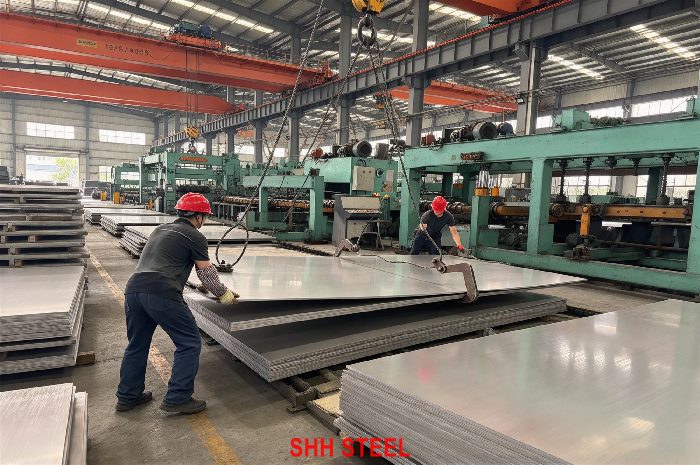
SHH STEEL produces and exports martensitic stainless plate from China, works as a sales agent for leading stainless mills, and runs its own processing warehouse for cutting and surface finishing. 12Cr13 is part of our GB/T 4237 stainless plate range; for comparison, see our ASTM A240 Type 410 page.
What the standard covers for this grade
| Item | GB/T 4237-2015 requirement / SHH STEEL supply |
|---|---|
| Standard | GB/T 4237-2015 Hot rolled stainless steel plate, sheet and strip (current edition, replaces GB/T 4237-2007) |
| Grade / unified code | 12Cr13 / S41010 |
| Steel class | Martensitic |
| Chemical composition | Table 18 (heat analysis); product analysis per GB/T 222 |
| Mechanical properties | Table 23 |
| Product forms | Hot-rolled thick plate (3.0 – 200 mm in the standard), hot-rolled wide strip and cut plate (2.0 – 25.4 mm) |
| Our usual thickness range | 3 – 100 mm |
| Delivery condition | Annealing: about 750 °C rapid cooling, or 800 – 900 °C slow cooling |
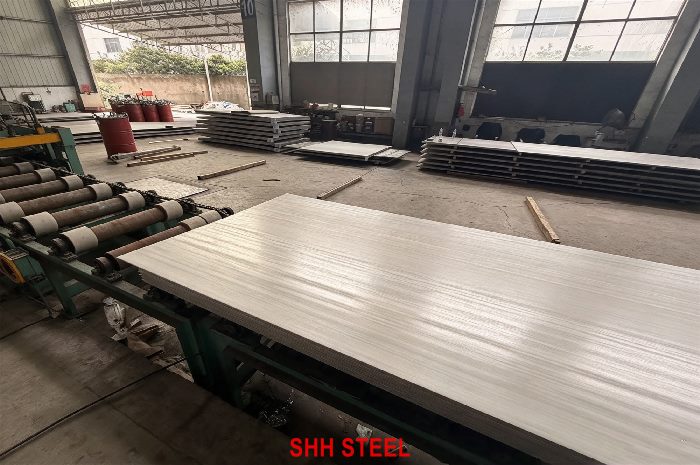
| Surface | Hot rolled, heat treated, pickled (No.1 / 1D) as standard; ground or polished by agreement |
| Density | 7.75 g/cm³ |
| Certificate | EN 10204 3.1 mill certificate; 3.2 with third-party inspection on request |
Sister grades on the same standard are listed under GB/T 4237; cold-rolled sheet of the same chemistry is ordered to GB/T 3280, and all our plate lines sit in stainless steel sheets and plates.
Chemical composition of 12Cr13 S41010
| Element | 12Cr13 heat analysis, % (Table 18) | Why it matters |
|---|---|---|
| C | ≤ 0.15 | Carbon. Low values protect welds from carbide precipitation; higher values add hot strength or hardenability. |
| Si | ≤ 1.00 | Silicon. Deoxidizer; in heat-resistant grades it builds a protective scale. |
| Mn | ≤ 1.00 | Manganese. Deoxidizer; in Mn-bearing grades it replaces nickel and keeps nitrogen in solution. |
| P | ≤ 0.040 | Phosphorus. Impurity, kept low for toughness and weld cracking resistance. |
| S | ≤ 0.030 | Sulfur. Impurity; low sulfur improves pitting resistance, hot workability and polishability. |
| Cr | 11.50 – 13.50 | Chromium. Forms the passive film; the main driver of corrosion and oxidation resistance. |
| Ni | ≤ 0.60 | Nickel. Stabilizes austenite, improves toughness and resistance to reducing acids. |
| PREN (Cr + 3.3Mo + 16N) | 11.5 – 12.5 (minimum – mid-range) | Calculated from the limits above, not a requirement of GB/T 4237 |
Values are maximum unless a range is given. The mill reports the ladle (heat) analysis on the certificate; this is the figure to compare with Table 18.
Product (check) analysis tolerances
A check analysis drilled from the finished plate may differ slightly from the heat analysis. GB/T 4237 refers to GB/T 222 for the permitted deviations; the table applies them to the 12Cr13 limits. Deviations apply to one side of a range only, never to both sides in the same heat.
| Element | Heat analysis limit (%) | Permitted deviation | Product analysis limit (%) |
|---|---|---|---|
| C | ≤ 0.15 | ±0.01 | ≤ 0.16 |
| Si | ≤ 1.00 | ±0.05 | ≤ 1.05 |
| Mn | ≤ 1.00 | ±0.03 | ≤ 1.03 |
| P | ≤ 0.040 | +0.005 | ≤ 0.045 |
| S | ≤ 0.030 | +0.005 | ≤ 0.035 |
| Cr | 11.50 – 13.50 | ±0.15 | 11.35 – 13.65 |
| Ni | ≤ 0.60 | ±0.03 | ≤ 0.63 |
Where the table says ‘by agreement’, the deviation is not tabulated for that content level and should be agreed in the contract, usually by reference to ASTM A480 Table A1.1.
Mechanical properties at room temperature
| Property | 12Cr13 (Table 23) |
|---|---|
| Proof strength Rp0.2, MPa | ≥ 205 |
| Tensile strength Rm, MPa | ≥ 450 |
| Elongation A, % | ≥ 20 |
| Hardness HBW | ≤ 217 |
| Hardness HRB | ≤ 96 |
| Hardness HV | ≤ 210 |
| 180° bend (cold) | D=2a, no cracks on the outer surface |
Values are for the annealed delivery condition. Hardened and tempered strength depends on the heat treatment chosen by the user.
Heat treatment and delivery condition
Recommended heat treatment for 12Cr13 (GB/T 4237-2015 Annex C): Annealing: about 750 °C rapid cooling, or 800 – 900 °C slow cooling.
Martensitic plate is delivered annealed for machinability. Users harden by austenitizing (about 950–1 050 °C), quenching in oil or air, and tempering to the required hardness.
How the martensitic grade is hardened
12Cr13 is delivered annealed. To reach high strength, the user austenitizes, quenches and tempers it. Tempering between about 400 and 550 °C should be avoided for 12Cr13-type steels because of temper embrittlement and lower corrosion resistance.
Harden after rough machining and before final grinding. Thick plate needs time at temperature (about 30 min per 25 mm) for uniform transformation.
For welded, tough parts the low-carbon 13-4 grade GB/T 4237 04Cr13Ni5Mo S41595 is the usual alternative.
International equivalents of 12Cr13 S41010
| Standard system | Equivalent / closest grade |
|---|---|
| China GB/T 4237-2015 | 12Cr13 (S41010) |
| Former Chinese name | 1Cr13 |
| ASTM A240/A240M | Type 410 / S41000 |
| EN 10088-2 | X12Cr13 / 1.4006 |
| JIS G4304 (hot rolled) | SUS410 |
| Common name | 410 |
Equivalent grades are close in chemistry and properties but are never identical: limits on carbon, nitrogen and residual elements differ. For dual or multiple certification the heat must meet every standard named on the order, and we confirm that from the heat chemistry before quotation.
Related pages: ASTM A240 Type 410, ASME SA240 410, JIS G4305 SUS410, AISI 410. See also our ASTM A240/A240M and JIS G4305 plate lists.
Cutting, forming and welding 12Cr13 plate
Martensitic plate must be preheated (about 200–300 °C for 12Cr13, about 100–150 °C for 13-4 grades) and tempered after welding to avoid cold cracking.
Use matching filler (ER410, ER410NiMo for 13-4) when the weld must harden like the base metal, or austenitic ER309L for repair welds that do not need hardness.
Cold forming is limited; annealed plate can be bent with generous radii.
Corrosion resistance and PREN of 12Cr13
Martensitic grades have modest corrosion resistance, best in the hardened and tempered, polished condition. They are chosen for strength and wear rather than corrosion.
PREN of 12Cr13 from the GB/T 4237 limits: 11.5 – 12.5. PREN is a ranking tool for pitting in chlorides, not a guarantee; temperature, crevices, deposits and weld finish matter as much.
Intergranular corrosion testing of ferritic and martensitic plate is by agreement (GB/T 4334 or ASTM A763 practices).
If service is harsher than 12Cr13 can handle, the next step up in this batch is GB/T 4237 10Cr17 S11710.
Typical uses of GB/T 4237 12Cr13
Typical uses (most after hardening):
- Valve trim, pump shafts and turbine blades (after hardening)
- Cutlery and tools (strip)
- Petrochemical tray parts
- Steam and gas turbine components
- Mining wear parts
Buyers specifying 12Cr13 for these jobs often compare it with GB/T 4237 06Cr13 S41008 and GB/T 4237 10Cr17 S11710; the comparison table on this page shows the differences.
International grade pages for the alternatives mentioned above: ASTM A240 Type 410S, ASTM A240 S41500, AISI 405, ASTM A240 Type 430.
Choosing between 12Cr13 and its neighbours
The table compares 12Cr13 with the grades buyers most often weigh it against. Strength values are GB/T 4237-2015 minimums; PREN is calculated from the minimum chemistry.
| Grade (GB/T 4237) | Key chemistry, % | PREN min | Rp0.2 min, MPa | Rm min, MPa |
|---|---|---|---|---|
| 12Cr13 S41010 | C ≤ 0.15, Cr 11.50 – 13.50, Ni ≤ 0.60 | 11.5 | 205 | 450 |
| GB/T 4237 06Cr13 S41008 | C ≤ 0.08, Cr 11.50 – 13.50, Ni ≤ 0.60 | 11.5 | 205 | 415 |
| GB/T 4237 04Cr13Ni5Mo S41595 | C ≤ 0.05, Cr 11.50 – 14.00, Ni 3.50 – 5.50, Mo 0.50 – 1.00, Mn 0.50 – 1.00 | 13.2 | 620 | 795 |
| GB/T 4237 06Cr13Al S11348 | C ≤ 0.08, Cr 11.50 – 14.50, Ni ≤ 0.60 | 11.5 | 170 | 415 |
| GB/T 4237 10Cr17 S11710 | C ≤ 0.12, Cr 16.00 – 18.00, Ni ≤ 0.75 | 16.0 | 205 | 420 |
Code check: 12Cr13 is S41010 in GB/T 4237-2015. S40310 is 12Cr12 (the 403 type), a different grade; we use S41010 on this page. Preheat (around 200–300 °C) before welding and temper afterwards to avoid cracking.
Surface finish and processing
| Finish | Description | Availability for this grade |
|---|---|---|
| No.1 / 1D | Hot rolled, heat treated, pickled; the GB/T 4237 standard surface | Standard |
| Shot-blasted + pickled | Uniform matte for welded structures | On request |
| No.4 / brushed | Abrasive finish, grit 150–180 | Warehouse processing, thin plate |
| HL (hairline) | Long continuous lines, decorative | Warehouse processing, thin plate |
| 8K mirror | Polished reflective finish | Warehouse processing, limited sizes |
| 2B / BA | Cold-rolled finishes (ordered as GB/T 3280 sheet, not hot-rolled plate) | Sheet only |
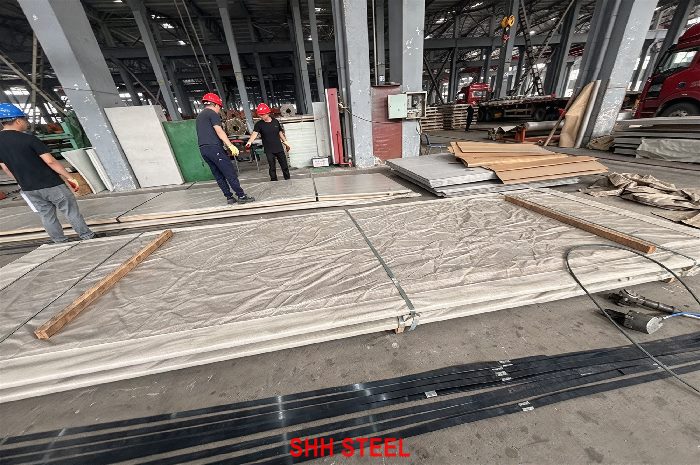
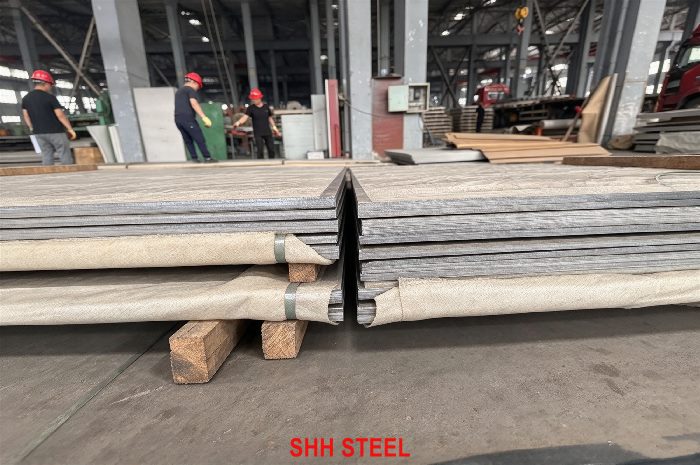
Our warehouse cuts plate to size (plasma, laser, waterjet, saw), bevels weld edges, polishes and applies PVC protective film. Processed plate ships with the original mill heat number marked. Ask for cut pieces of other stainless steel products at the same time to consolidate freight.
12Cr13 plate sizes
| Dimension | Typical supply |
|---|---|
| Thickness | 3 – 100 mm |
| Width | 1 000 / 1 219 / 1 250 / 1 500 / 1 800 / 2 000 mm; wider by mill order |
| Length | 2 000 / 2 438 / 3 000 / 6 000 mm or cut to size |
| Flatness | Per GB/T 4237; ≤15 mm per metre for plate up to 25 mm unless agreed tighter |
| Thickness tolerance | Per the GB/T 4237 dimensional tolerance tables (normal or higher accuracy as ordered) |
| Edge | Mill edge or cut edge |
Weight: plate mass in kg/m² = thickness (mm) × density (7.75 g/cm³). A 10 mm 12Cr13 plate weighs about 77.5 kg/m²; a 1 500 × 6 000 × 10 mm plate about 698 kg.
Inspection, tests and mill certificates
- Heat chemical analysis on every heat; product analysis by agreement
- Tensile test (Rp0.2, Rm, A) per batch
- Hardness test
- 180° bend test
- Ultrasonic testing (NB/T 47013.3 or ASTM A578) when specified
- Positive material identification (PMI) on every plate leaving our warehouse
- Visual and dimensional inspection; third-party inspection (SGS, BV, TÜV, Intertek) at the buyer’s request
Certificates follow EN 10204 3.1 as standard. Where plate is also certified to ASME SA240 or ASTM A240, both standards are shown on one certificate.
How to order
- Standard and edition: GB/T 4237-2015
- Grade and code: 12Cr13 (S41010); add the equivalent if dual certification is needed
- Thickness × width × length, quantity in pieces or tonnes
- Thickness tolerance class and flatness if tighter than standard
- Surface finish and protective film
- Tests beyond the standard (IGC, UT, impact, ferrite, PMI, grain size)
- Certificate type (EN 10204 3.1 / 3.2) and inspection body
- Marking, packing (wooden cases, steel pallets) and delivery terms
Send the list to SHH STEEL and we return a quotation with mill, lead time and stock options. Other grades from the same standard can be combined in one shipment; browse GB/T 4237 plate grades.
Where our plate comes from
12Cr13 is a mainstream grade at Chinese stainless mills. We supply it from our own stock and processing warehouse, and by mill order from major producers such as TISCO and Baosteel Stainless, for which we act as a sales agent. Stock plate ships in about 1–2 weeks after cutting; mill orders typically take 30–60 days depending on thickness and rolling schedule.
Every plate is traceable to its heat number, and copies of the mill certificates stay on file for repeat orders and audits. The same mills also supply our ASTM A240, ASME SA240, JIS G4305 and AISI plate ranges, so mixed-standard orders can ship together.
FAQ
- What is the unified code for 12Cr13?
- In GB/T 4237-2015 and GB/T 20878, 12Cr13 has the unified code S41010 and corresponds to ASTM Type 410 (S41000), EN 1.4006 and JIS SUS410. S40310 belongs to 12Cr12 (403 type), so orders quoting 12Cr13 S40310 should be corrected.
- What is the chemical composition of 12Cr13?
- Under GB/T 4237-2015 Table 18, 12Cr13 (S41010) has C ≤ 0.15, Cr 11.50 – 13.50, Ni ≤ 0.60. Phosphorus is limited to ≤0.040% and sulfur to ≤0.030%.
- What is the ASTM equivalent of 12Cr13?
- The closest equivalents of 12Cr13 (S41010) are Type 410 / S41000 in ASTM, X12Cr13 / 1.4006 in EN, SUS410 in JIS (common name: 410). Chemistry limits differ slightly, so dual certification depends on the actual heat.
- What are the mechanical properties of 12Cr13 plate?
- GB/T 4237-2015 Table 23 requires for 12Cr13: proof strength Rp0.2 ≥205 MPa, tensile strength ≥450 MPa and elongation ≥20%, hardness ≤217 HBW. Values apply to plate in the delivery heat-treated condition.
- Is 12Cr13 stainless steel magnetic?
- Yes. 12Cr13 is martensitic and is magnetic in all conditions.
- What thickness of 12Cr13 plate can you supply?
- Under GB/T 4237 we supply 12Cr13 hot-rolled plate in 3 – 100 mm, widths up to 2 000 mm (wider by mill order), cut to size in our warehouse. Thinner material is cold-rolled sheet to GB/T 3280.
Conclusion
GB/T 4237 12Cr13 (S41010) is a martensitic plate grade, known internationally as 410. It is defined by Table 18 chemistry (C ≤ 0.15, Cr 11.50 – 13.50, Ni ≤ 0.60) and Table 23 properties of at least 205 MPa proof strength and 450 MPa tensile strength. Typical uses include valve trim, pump shafts and turbine blades, cutlery and tools and petrochemical tray parts. Code check: 12Cr13 is S41010 in GB/T 4237-2015.
Before ordering, state the standard edition, the grade name with its code, and any extra tests, so that the mill certificate matches your design documents. SHH STEEL supplies 12Cr13 plate from stock and by mill order, cut to size and finished in our own warehouse, with EN 10204 3.1 certificates. For related grades see GB/T 4237 06Cr13 S41008 and GB/T 4237 04Cr13Ni5Mo S41595, our GB/T 4237 category and the ASTM A240 Type 410 page. Send your sizes and quantities for a quotation.
Quality Steel Needed? Inquire for Offers
Related Products