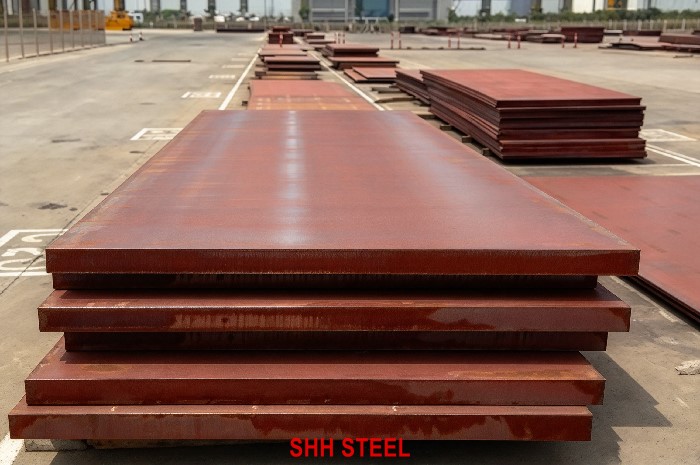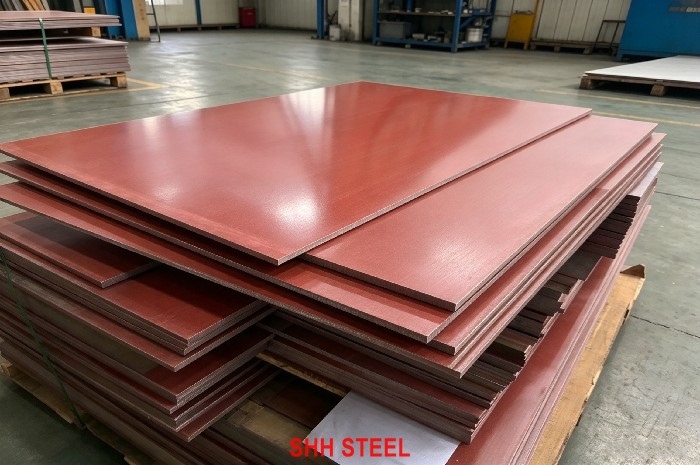
NM550 Wear-Resistant Steel Plate
What is NM550 Wear-Resistant Steel Plate (GB/T 24186)
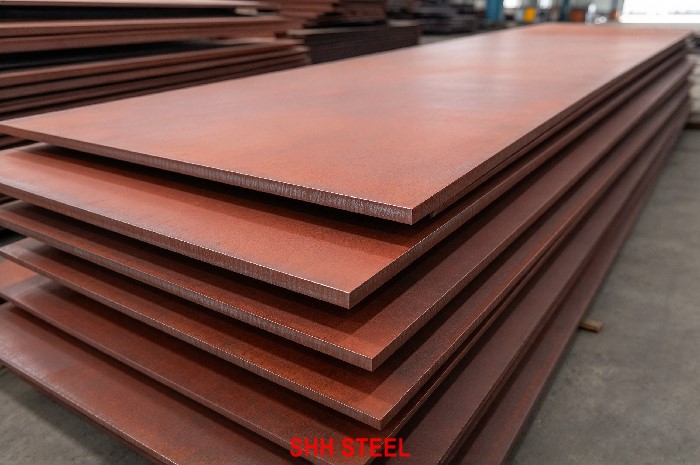
NM550 wear-resistant steel plate belongs to the top end of GB/T 24186, where the standard itself starts handing decisions back to buyer and supplier. NM is the Pinyin initials of Nai Mo, meaning wear-resistant; 550 is the nominal Brinell class. In GB/T 24186-2022 the surface hardness up to 70 mm is 520–580 HBW and the thickness range ends at 100 mm. Unlike NM500 and below, the standard sets no default Charpy energy or tensile values for NM550 — they must be agreed in the contract.
SHH STEEL can produce and supply NM550 wear-resistant steel plate to GB/T 24186, quenched on Chinese mill lines with batch Brinell testing, and NM550D or NM550E when a low-temperature impact test with agreed energy is required. Because this is a specialist grade, we discuss the duty before quoting and cut liners in our workshop under controlled conditions.
NM550 is selected for very abrasive, low-impact service: sliding sand, slag, sinter, quartz-rich ores and fine coal dust. It is a liner and wear-strip material, used on a tougher backing structure.
For more toughness choose NM500 Wear-Resistant Steel Plate; the hardest grade in the standard is NM600 Wear-Resistant Steel Plate. Family hub: GB/T 24186; category: Wear-Resistant Steel Plates.
Material Specification and Designation: NM, NM550D and NM550E
NM550 is the base grade; NM550D and NM550E add Charpy tests at −20 °C and −40 °C. For these two grades Table 5 note a says the longitudinal absorbed energy may be determined by agreement, so the order must state the required joules — writing “NM550D” alone fixes only the test temperature.
An order should read: GB/T 24186-2022, NM550 (or NM550D / NM550E with agreed KV2), quenched or quenched and tempered, sizes, quantity, certificate. If tensile values are wanted, they too must be agreed, because Table 6 note a leaves them open for NM550.
Few projects really need NM550E; when cold-climate impact is a concern, many engineers drop to NM500D, where the standard sets impact energy explicitly.
Chemical Composition of NM550 Wear-Resistant Steel Plate
Ladle chemistry for NM550 (Table 2) and NM550D/E (Table 3) is shown below.
| Element (mass %) | NM550 (Table 2, ladle) | NM550D/E (Table 3, ladle) |
|---|---|---|
| C | ≤ 0.38 | ≤ 0.38 |
| Si | ≤ 0.70 | ≤ 0.7 |
| Mn | ≤ 1.70 | ≤ 1.7 |
| P | ≤ 0.020 | ≤ 0.015 |
| S | ≤ 0.010 | ≤ 0.005 |
| Cr | ≤ 1.50 | ≤ 1.50 |
| Ni | ≤ 1.50 | ≤ 1.5 |
| Mo | ≤ 0.70 | ≤ 0.70 |
| Ti | ≤ 0.050 | ≤ 0.05 |
| B | 0.0005–0.0060 | 0.0005–0.0060 |
| Als | ≥ 0.010 | ≥ 0.015 |
| CEV (≤ 50 mm / > 50 mm) | not capped in Table 2 | ≤ 0.72 / ≤ 0.82 |
NM550 shares the 0.38 % carbon ceiling of NM500 but allows nickel up to 1.50 % and molybdenum up to 0.70 %, giving the extra hardenability needed for 520+ HBW. The D/E version keeps carbon at 0.38 %, tightens P to 0.015 % and S to 0.005 %, and its CEV caps of 0.72 % up to 50 mm and 0.82 % above are high — a clear signal that welding is demanding.
Other alloying elements must be reported (7.1.2); Cu ≤ 0.30 %, As ≤ 0.08 % as residuals (7.1.3). Use the actual heat analysis for welding calculations.
Hardness and Mechanical Properties of NM550 Steel Plate
Surface Brinell hardness to Table 4 is the acceptance requirement and the only mandatory mechanical property for base NM550. Remove the decarburized layer before testing.
| Grade | Thickness (mm) | Surface hardness (HBW) | Centre hardness (HBW) |
|---|---|---|---|
| NM550 | ≤ 70 | 520–580 | 475–580 |
| NM550D/E | > 70–100 | 500–580 | not specified |
Thick NM550D/E above 70 mm to 100 mm has a 500–580 HBW surface window. The status of impact and tensile is summarised below.
| Property | GB/T 24186-2022 value | Status |
|---|---|---|
| Charpy KV2, NM550D (−20 °C) / NM550E (−40 °C) | energy by agreement (Table 5 note a) | Temperature fixed by D/E; value agreed in contract |
| Transverse tensile Rm / A50mm | by agreement | Table 6 note a — no default values for NM550 |
Bend testing is not applicable to NM550 or NM550D/E (Table 7 note a), which is the standard’s way of saying this plate is not meant to be formed. Impact, where ordered, follows the 3-specimen mean rule with one value allowed down to 70 % of the agreed figure.
Thickness, Dimensions and Tolerances for NM550 Plate
Table 1 limits NM550 and NM550D/E to 100 mm. Dimensions, shape and tolerances follow GB/T 709-2019, with Class H flatness by default and Class L by agreement.
Most NM550 is ordered in 8–40 mm for liners. Flatness and accurate cutting matter more than wide size range, because these plates are bolted or plug-welded as tiles.
Delivery Condition and Heat Treatment of NM550 Wear Plate
Clause 7.3 permits quenched, quenched and tempered, TMCP plus tempered, or hot-rolled before heat treatment. NM550 is usually delivered quenched, sometimes with a very low temper. Residual stress is high, so plates should be handled without impact and cut with preheat on heavier sections.
Hot-rolled-before-heat-treatment plate is not mechanically tested (7.4.6). Batches are one grade, heat, thickness, delivery condition and heat-treatment cycle, up to 60 t.
Equivalent Grades: NM550 vs AR550 vs Hardox 550 (SSAB Hardox)
NM550 is compared with AR550 and Hardox 550 under the SSAB Hardox brand standard. They share a similar 520–580 HBW hardness class but are not drop-in identical; the brand plates follow their producers’ data, including toughness that GB/T 24186 leaves to agreement.
| Designation / family | Typical hardness class | Notes for enquiry |
|---|---|---|
| GB/T 24186 NM550 / NM550D / NM550E | 520–580 HBW (≤ 70 mm surface) | Governing standard; impact energy by agreement |
| Commercial AR550 | ~550 HBW class | Commercial name; maker data governs |
| SSAB Hardox brand standard — Hardox 550 | ~525–575 HBW class (brand data) | Brand plate under SSAB Hardox; similar hardness class, not drop-in identical |
| GB/T 24186 NM600 | 570–640 HBW | Hardest grade in the standard |
Agree any substitution before rolling and write the GB/T 24186 grade and agreed impact energy on the order. Peer ranges are orientation only. Related grades: NM500 Wear-Resistant Steel Plate and NM600 Wear-Resistant Steel Plate; AR-side category: AR400/AR500.
Wear Performance and Applications of NM550 Plate
Typical NM550 duties include sand and gravel processing chutes, slag handling, sinter and pellet plant liners, dredge pipe liners, coal pulveriser and fan liners, and wear tiles in concrete and asphalt plants.
The test is simple: if the existing liner wears smoothly and thins, harder plate helps; if it cracks or spalls, NM550 will make the problem worse, and NM450 or NM500 is the better choice.
Welding, Cutting and Handling Cautions for ~550 HBW Plate
Welding NM550 is a specialist operation: qualified procedure, dry hydrogen-controlled (often austenitic) consumables for attachment welds, preheat, controlled interpass temperature and slow cooling. Many users avoid structural welds on NM550 altogether and fix liners by bolts or plug welds.
Cold forming is not appropriate. Thermal cutting needs preheat on heavy plate and slow cooling; abrasive water-jet cutting is a good option for precise tiles. Drilling is difficult; holes are usually cut thermally or by water-jet.
Surface Finishes and Surface Condition for NM550 Plate
Clause 7.5: no cracks, blisters, scabs, laps, inclusions or visible lamination; dressing within half the thickness tolerance; no welding repair; light scale acceptable. GB/T 14977 by agreement.
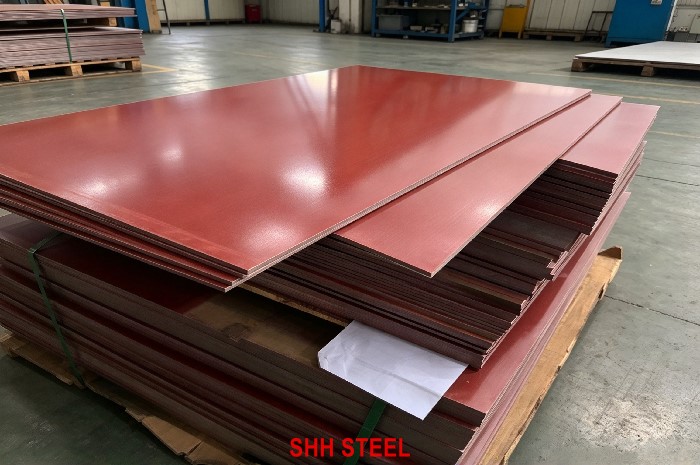
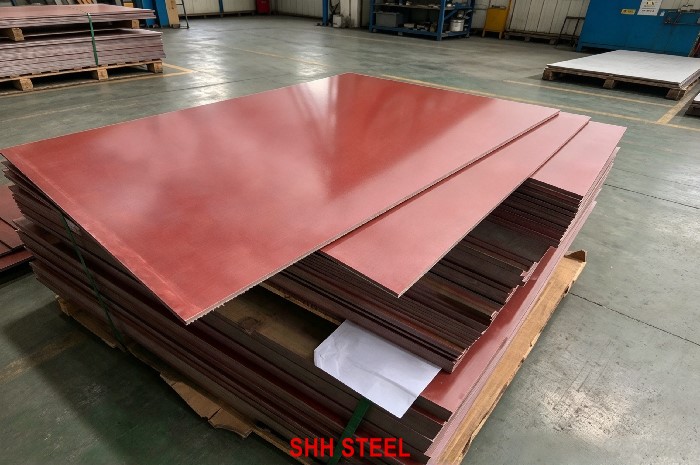
NM550 is normally supplied with mill surface, as liners are rarely painted.
| Finish / condition | Typical supply | Order note |
|---|---|---|
| As heat-treated mill surface | Normal for liners | Adequate for bolting |
| Water-jet cut tiles | SHH STEEL workshop | Precise edges without heat input |
| Thermally cut blanks with preheat | Heavier plate | Slow cooling advised |
| GB/T 14977 surface class | By agreement (7.5.4) | Write the class on the order |
Grind a test spot below the decarburized layer for hardness checks.
Inspection and Testing for NM550 Wear-Resistant Steel Plate
Table 8: chemistry per heat, hardness per batch, Charpy (3 specimens) for NM550D/E against the agreed energy, and NDT by agreement. Tensile only when agreed; bend not applicable.
SHH STEEL issues EN 10204 3.1 certificates and arranges 3.2 witness on request. On receipt, check the hardness band for thickness, agreed impact values where ordered, and edges for cutting cracks.
Stock and Sizes of NM550 Plate SHH STEEL Can Supply
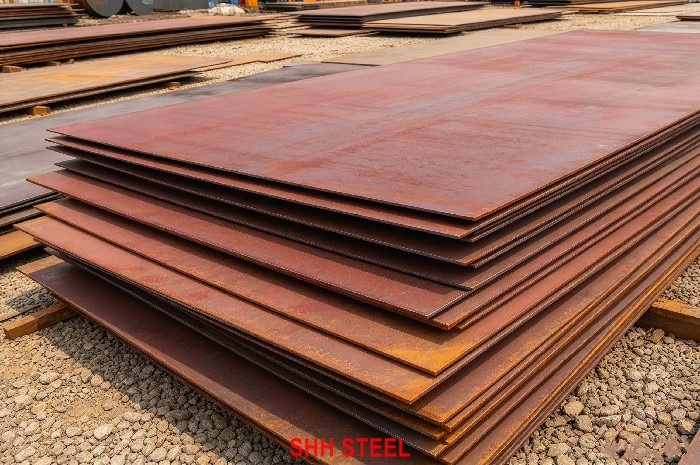
NM550 is a lower-volume grade. SHH STEEL keeps limited liner thicknesses and schedules most orders through mill cycles. Quantities are approximate.
| Thickness (mm) | Width (mm) | Length (mm) | Condition | Approx. quantity | Location |
|---|---|---|---|---|---|
| 8–12 | 1500 / 2000 | 6000 | Q / Q&T | 50+ t | China |
| 16–25 | 2000 | 6000 / 8000 | Q / Q&T | 100+ t | China |
| 30–50 | 2000 | 6000 | Q / Q&T | 50+ t | China |
| > 50–100 (incl. NM550D/E) | 2000 | 6000 | Q / Q&T | mill schedule | China |
Water-jet or thermally cut tiles can be prepared in our workshop.
Why Choose SHH STEEL for NM550 Wear-Resistant Steel Plate
SHH STEEL produces and supplies NM550 with batch hardness testing, agreed impact for D/E and careful cutting. We will discuss the wear pattern before quoting so the hardness is justified.
EN 10204 3.1 / 3.2 certificates and third-party inspection are available.
Supply Capability
SHH STEEL can produce and supply NM550 / NM550D / NM550E up to 100 mm thick per Table 1, quenched or quenched and tempered, with GB/T 709 dimensions. Compare NM500 Wear-Resistant Steel Plate and NM600 Wear-Resistant Steel Plate, or see the GB/T 24186 hub.
FAQ
-
What is NM550 steel plate?
- NM550 is a GB/T 24186 wear-resistant plate with a nominal 550 HBW class for extreme sliding abrasion, up to 100 mm thick.
-
What is the hardness of NM550?
- 520–580 HBW surface up to 70 mm (centre 475–580 HBW by agreement); NM550D/E above 70 mm to 100 mm is 500–580 HBW.
-
What is the chemical composition of NM550?
- Table 2 maxima: C 0.38, Si 0.70, Mn 1.70, P 0.020, S 0.010, Cr 1.50, Ni 1.50, Mo 0.70, Ti 0.050 %, B 0.0005–0.0060 %, Als ≥ 0.010 %. NM550D/E: P 0.015, S 0.005, CEV ≤ 0.72 / 0.82 %.
-
What are the equivalent grades of NM550?
- AR550 and Hardox 550 under the SSAB Hardox brand standard are similar hardness-class products, not drop-in identical.
-
Does GB/T 24186 set impact energy for NM550D/E?
- No. The test temperature is fixed (−20 °C for D, −40 °C for E), but the energy is agreed between buyer and supplier.
-
Where can I get an NM550 data sheet?
- This page summarises GB/T 24186-2022; the mill certificate gives heat chemistry, hardness and any agreed tests.
-
What is the difference between NM550, NM550D and NM550E?
- D and E add Charpy tests at −20 °C and −40 °C with contract-agreed energy, and follow Table 3 chemistry.
-
Does NM550 have tensile requirements?
- Not by default. Table 6 note a leaves tensile strength and elongation for NM550 to agreement.
-
Can NM550 be bent?
- No. The bend test does not apply to NM550, and it should be used flat as a liner.
-
When should I choose NM550 over NM500?
- Only when wear is smooth sliding abrasion and NM500 liners wear out without cracking. If impact is present, NM500 or NM450 is safer.
Conclusion
NM550 is the specialist GB/T 24186 grade for extreme sliding abrasion: 520–580 HBW, up to 100 mm, with D/E impact energy and tensile left to agreement. Use it flat, as liners, where the wear pattern proves the hardness pays.
SHH STEEL can produce and supply NM550 / NM550D / NM550E from China. Email admin@steelspecs.com with your duty, sizes and port.
Quality Steel Needed? Inquire for Offers
Related Products