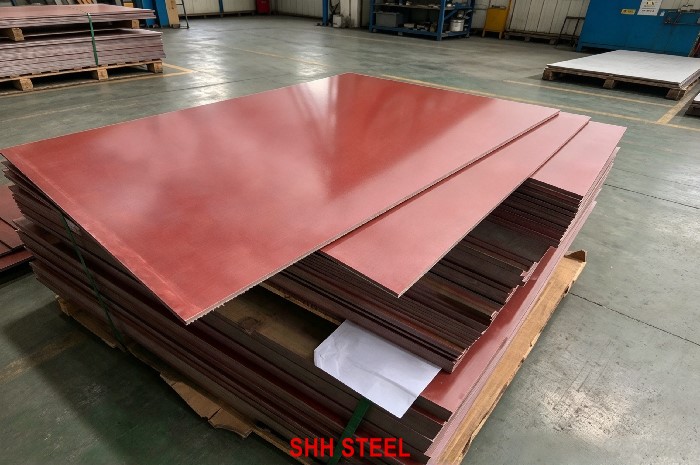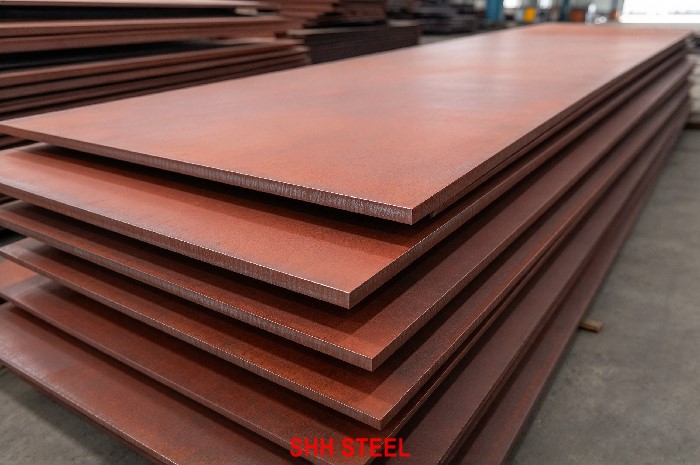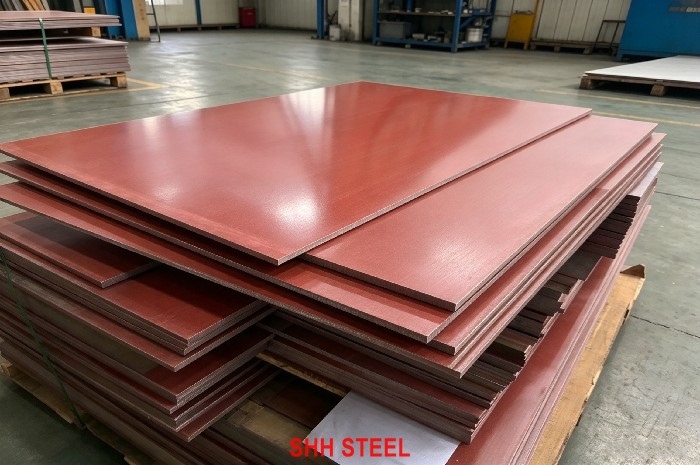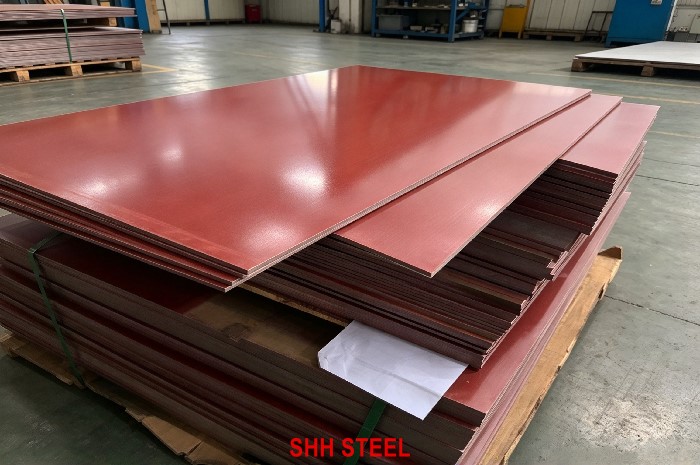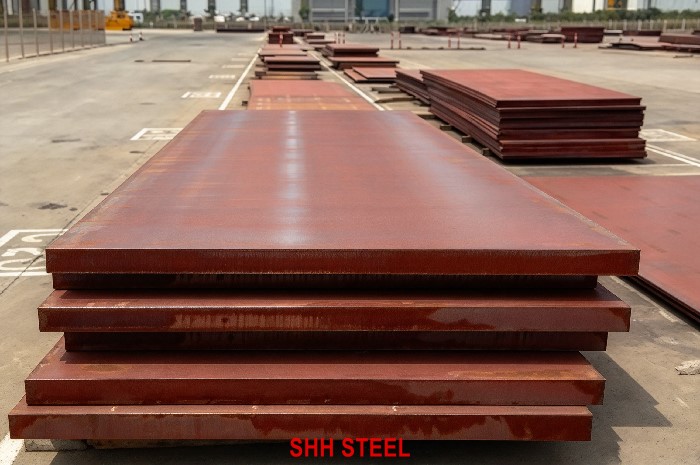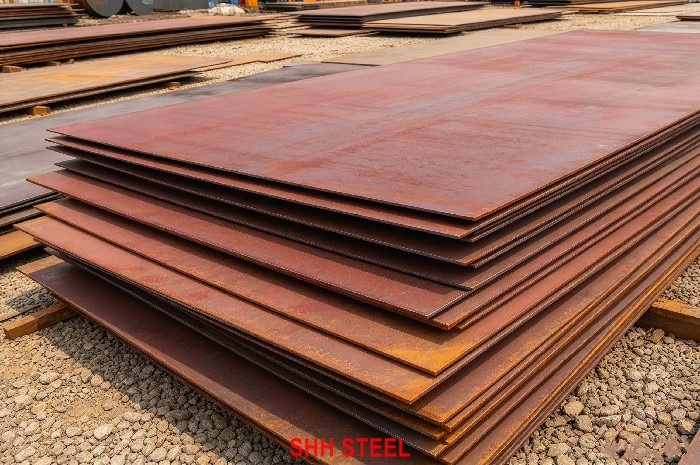
NM500 Wear-Resistant Steel Plate
What is NM500 Wear-Resistant Steel Plate (GB/T 24186)
NM500 wear-resistant steel plate is the severe-abrasion grade of GB/T 24186 — the plate engineers reach for when NM400 or NM450 liners are visibly thinning between shutdowns. NM is the Pinyin initials of Nai Mo, meaning wear-resistant; 500 is the nominal Brinell class. Under GB/T 24186-2022 the surface hardness up to 70 mm is 470–540 HBW, and the thickness range stops at 100 mm, not 120 mm as for the softer grades.
SHH STEEL can produce and supply NM500 wear-resistant steel plate to GB/T 24186, quenched and lightly tempered on Chinese mill lines with batch Brinell testing, plus NM500D and NM500E when a Charpy guarantee is required. Cutting hard plate well is half the job, so we prepare NM500 liners in our workshop with controlled thermal cutting and drilling.
NM500 is a wear material first and a structural material second. It is used as liners, cutting edges and wear strips on parts whose structure is made from tougher steel, and it rewards a design that keeps it in compression and away from tight bends.
For a tougher, more weldable alternative look at NM450 Wear-Resistant Steel Plate; for still higher hardness see NM550 Wear-Resistant Steel Plate. The series hub is GB/T 24186; wider range at Wear-Resistant Steel Plates.
Material Specification and Designation: NM, NM500D and NM500E
By clause 4, NM500 is the base grade, NM500D carries Charpy testing at −20 °C and NM500E at −40 °C. D and E are low-temperature toughness quality grades, specified on the order and certificate and covered in this page’s tables.
The standard itself uses NM500 and NM500D as its designation examples, which shows how central this grade is in Chinese practice. The order should read: GB/T 24186-2022, NM500 (or NM500D / NM500E), quenched and tempered, sizes, quantity, certificate.
At 500 HBW, toughness reserve is limited. Where a liner sees impact as well as sliding in freezing conditions, NM500D or NM500E is worth the premium — or the designer should consider NM450 instead.
Chemical Composition of NM500 Wear-Resistant Steel Plate
NM500 chemistry from Table 2 (base) and Table 3 (D/E) is shown below as ladle maxima, ranges or minima.
| Element (mass %) | NM500 (Table 2, ladle) | NM500D/E (Table 3, ladle) |
|---|---|---|
| C | ≤ 0.38 | ≤ 0.35 |
| Si | ≤ 0.70 | ≤ 0.7 |
| Mn | ≤ 1.70 | ≤ 1.7 |
| P | ≤ 0.020 | ≤ 0.015 |
| S | ≤ 0.010 | ≤ 0.005 |
| Cr | ≤ 1.50 | ≤ 1.50 |
| Ni | ≤ 1.00 | ≤ 1.5 |
| Mo | ≤ 0.65 | ≤ 0.65 |
| Ti | ≤ 0.050 | ≤ 0.05 |
| B | 0.0005–0.0060 | 0.0005–0.0060 |
| Als | ≥ 0.010 | ≥ 0.015 |
| CEV (≤ 50 mm / > 50 mm) | not capped in Table 2 | ≤ 0.64 / ≤ 0.77 |
Carbon is allowed up to 0.38 % on the base grade with Cr 1.50 %, Ni 1.00 % and Mo 0.65 %, and phosphorus is tightened to 0.020 %. The D/E version reduces carbon to 0.35 %, tightens P to 0.015 % and S to 0.005 %, permits more nickel (1.5 %) for toughness and caps CEV at 0.64 % up to 50 mm and 0.77 % above. These carbon levels are why NM500 hardens to 470+ HBW — and why it must be welded with care.
Other alloying elements must be reported (7.1.2); Cu residual ≤ 0.30 %, As ≤ 0.08 % (7.1.3). Product analysis tolerances, if requested, follow GB/T 222.
Hardness and Mechanical Properties of NM500 Steel Plate
Table 4 surface hardness is the acceptance property, tested after removing the decarburized layer. Centre hardness applies only by agreement.
| Grade | Thickness (mm) | Surface hardness (HBW) | Centre hardness (HBW) |
|---|---|---|---|
| NM500 | ≤ 70 | 470–540 | 420–540 |
| NM500D/E | > 70–100 | 450–540 | not specified |
Note the thickness bands change at this grade: the main band is up to 70 mm, and NM500D/E above 70 mm to 100 mm has a 450–540 HBW surface window. Impact energies are also lower than for the softer grades, and the bands differ.
| Property | GB/T 24186-2022 value | Status |
|---|---|---|
| Charpy KV2, longitudinal, NM500D (−20 °C) / NM500E (−40 °C), t ≤ 60 mm | ≥ 21 J (mean of 3) | Mandatory for D/E |
| Charpy KV2, longitudinal, NM500D (−20 °C) / NM500E (−40 °C), t > 60–100 mm | ≥ 18 J (mean of 3) | Mandatory for D/E |
| Transverse tensile Rm, t ≤ 80 mm | ≥ 1350 MPa | Only when agreed in contract (7.4.3) |
| Elongation A50mm | ≥ 7 % | Only when agreed in contract |
Table 6 reference values for NM500 (Rm ≥ 1350 MPa, A50mm ≥ 7 %) apply only when tensile testing is agreed for plate up to 80 mm. The bend test of Table 7 remains available by agreement for NM500, but the 7 % elongation reference shows how little forming margin remains. Impact is not required below 6 mm.
Thickness, Dimensions and Tolerances for NM500 Plate
Table 1 limits NM500 and NM500D/E to 100 mm thickness. Dimensions, shape and tolerances follow GB/T 709-2019, with Table 4 of GB/T 709-2019 for continuously rolled thickness and flatness Class H by default, Class L by agreement.
In practice NM500 is mostly 6–50 mm. Thin NM500 (6–12 mm) is popular for truck-body liners and screens where weight matters; 20–50 mm for crusher, hopper and bucket wear parts. Flatness matters for bolted liners because a 500 HBW plate cannot be pulled flat by bolts.
Delivery Condition and Heat Treatment of NM500 Wear Plate
Clause 7.3 allows quenched, quenched and tempered, TMCP plus tempered, or hot-rolled before heat treatment. NM500 is usually supplied quenched or quenched with a low-temperature temper, which keeps hardness high but leaves residual stress. Avoid reheating hardened plate above the tempering range during cutting or welding, or the wear surface will soften.
Hot-rolled-before-heat-treatment plate is not tested mechanically (7.4.6) and is not finished NM500. Batches: one grade, heat, thickness, delivery condition and heat-treatment cycle, up to 60 t.
Equivalent Grades: NM500 vs AR500 vs Hardox 500 (SSAB Hardox)
NM500 is compared with AR500, Hardox 500 under the SSAB Hardox brand standard, and Raex 500 class plates. All belong to a similar 470–540 HBW hardness class, but their chemistry, impact data and thickness ranges come from different documents; they are not drop-in identical.
| Designation / family | Typical hardness class | Notes for enquiry |
|---|---|---|
| GB/T 24186 NM500 / NM500D / NM500E | 470–540 HBW (≤ 70 mm surface) | Governing standard for this page |
| Commercial AR500 | ~500 HBW class | Commercial name; maker data governs |
| SSAB Hardox brand standard — Hardox 500 | ~470–530 HBW class (brand data) | Brand plate under SSAB Hardox; similar hardness class, not drop-in identical |
| Raex 500 class | ~500 HBW class (maker data) | Verify on producer data sheet |
| GB/T 24186 NM550 | 520–580 HBW | Next harder grade; no default impact or tensile |
Substitutions should be agreed before rolling, with GB/T 24186 NM500 written on the certificate. Peer ranges are orientation only and flagged in the pack notes. Related grades: NM450 Wear-Resistant Steel Plate and NM550 Wear-Resistant Steel Plate; AR-side category: AR400/AR500.
Wear Performance and Applications of NM500 Plate
NM500 is used where wear is the overwhelming failure mode: crusher feed chutes and discharge liners, mining shovel and bucket wear packages, screen panels, sinter plant and coke-oven chutes, dredging pipes and pump liners, shot-blast cabinet liners and target plates for steel shooting ranges.
Its best use is as a replaceable liner on a tougher structure. When liners crack rather than wear out, the cause is usually impact beyond what 500 HBW can absorb; in that case NM450 or NM400 often lasts longer despite being softer.
Weldability, Cutting and Forming Limits for ~500 HBW Plate
Welding NM500 requires discipline: qualified procedure, hydrogen-controlled consumables (often softer austenitic or low-strength ferritic filler for liner attachment), dry joints, preheat on most thicknesses, controlled interpass temperature and slow cooling. Calculate CEV from the heat analysis; for D/E the cap is 0.64 % up to 50 mm.
Cold forming should be avoided or limited to very large radii agreed with the mill. Thermal cutting must be controlled — preheat heavier plate for flame cutting and cool slowly — because cut-edge cracking is a real risk. Plasma or laser cuts on thin plate are cleaner. Drill with carbide tooling on rigid machines; many users prefer cutting holes thermally.
Surface Finishes and Surface Condition for NM500 Plate
Clause 7.5: no cracks, blisters, scabs, laps, inclusions or visible lamination; dressing within half the thickness tolerance; no welding repair; light scale and minor marks acceptable. GB/T 14977 by agreement.
For NM500, buyers usually keep the mill surface for liners and blast only where painting is required.
| Finish / condition | Typical supply | Order note |
|---|---|---|
| As heat-treated mill surface | Standard for liners | Usually adequate |
| Shot-blasted and primed | Where painting is needed | Primer must suit welding |
| Cut and drilled liner kits | SHH STEEL workshop | Controlled thermal cutting |
| GB/T 14977 surface class | By agreement (7.5.4) | Write the class on the order |
Hardness verification still requires a prepared spot below the decarburized layer.
Inspection and Testing for NM500 Wear-Resistant Steel Plate
Table 8: chemistry per heat, hardness per batch, Charpy (3 specimens) for NM500D/E, and tensile, bend and NDT by agreement, using GB/T 231.1, GB/T 229 and GB/T 228.1 with GB/T 2975 sampling.
On NM500 we pay particular attention to edge inspection after cutting and to UT on thicker plate when agreed. SHH STEEL issues EN 10204 3.1 certificates and arranges 3.2 witness when requested before production.
Stock and Sizes of NM500 Plate SHH STEEL Can Supply
SHH STEEL holds NM500 in common liner thicknesses in China and schedules thicker plate into mill cycles. Quantities are approximate.
| Thickness (mm) | Width (mm) | Length (mm) | Condition | Approx. quantity | Location |
|---|---|---|---|---|---|
| 6–12 | 1500 / 2000 | 6000 / 8000 | Q&T | 100+ t | China |
| 16–25 | 2000 / 2200 | 8000 / 12000 | Q&T | 200+ t | China |
| 30–50 | 2000 / 2200 | 6000 / 10000 | Q&T | 100+ t | China |
| 60–70 | 2000 | 6000 / 8000 | Q&T | 50+ t | China |
| > 70–100 (incl. NM500D/E) | 2000 | 6000 / 8000 | Q&T | mill schedule | China |
Liner kits, drilled plates and cut wear strips can be prepared in our workshop.
Why Choose SHH STEEL for NM500 Wear-Resistant Steel Plate
SHH STEEL produces and supplies NM500 with batch hardness testing, optional D/E impact and careful hard-plate cutting. We will tell you when NM500 is the wrong choice because impact will crack it.
EN 10204 3.1 / 3.2 certificates, third-party inspection and mixed loads are standard.
Supply Capability
SHH STEEL can produce and supply NM500 / NM500D / NM500E up to 100 mm thick per Table 1, quenched and tempered, with GB/T 709 dimensions and export packing. Compare NM450 Wear-Resistant Steel Plate and NM550 Wear-Resistant Steel Plate, or see the GB/T 24186 hub.
FAQ
-
What is NM500 steel plate?
- NM500 is a GB/T 24186 wear-resistant plate with a nominal 500 HBW class for severe abrasion, usually quenched and tempered, up to 100 mm thick.
-
What is the hardness of NM500?
- 470–540 HBW surface up to 70 mm (centre 420–540 HBW by agreement); NM500D/E above 70 mm to 100 mm is 450–540 HBW at the surface.
-
What is the chemical composition of NM500?
- Table 2 maxima: C 0.38, Si 0.70, Mn 1.70, P 0.020, S 0.010, Cr 1.50, Ni 1.00, Mo 0.65, Ti 0.050 %, B 0.0005–0.0060 %, Als ≥ 0.010 %. NM500D/E: C 0.35, P 0.015, S 0.005, Ni 1.5, CEV ≤ 0.64 / 0.77 %.
-
What are the equivalent grades of NM500?
- AR500, Hardox 500 under the SSAB Hardox brand standard, and Raex 500 class plates are similar hardness-class plates, not drop-in identical.
-
NM500 vs AR500 — what is the difference?
- AR500 is a commercial name defined by each maker; NM500 is defined by GB/T 24186 with set chemistry, hardness and optional impact. Agree substitution before ordering.
-
Where can I get an NM500 data sheet?
- This page summarises GB/T 24186-2022; the mill certificate provides the heat chemistry, hardness and any agreed test results.
-
What is the difference between NM500, NM500D and NM500E?
- D adds Charpy at −20 °C and E at −40 °C: ≥ 21 J up to 60 mm and ≥ 18 J for 60–100 mm. D/E follow Table 3 chemistry.
-
Is tensile testing mandatory for NM500?
- No. It is optional for plate up to 80 mm, with Table 6 reference Rm ≥ 1350 MPa and A50mm ≥ 7 %.
-
Can NM500 be bent?
- Only to very large radii with mill guidance. It is intended as a liner material rather than a formed part.
-
Why did my NM500 liner crack?
- Usually impact beyond what 500 HBW plate can absorb, or cut-edge or weld cracking from poor thermal control. Consider NM450 or better cutting and welding practice.
Conclusion
NM500 is the severe-abrasion GB/T 24186 grade: 470–540 HBW, up to 100 mm, with D/E impact options and strict fabrication needs. Use it as a liner where wear, not impact, is the limiting factor.
SHH STEEL can produce and supply NM500 / NM500D / NM500E from China, cut and drilled to drawing. Email admin@steelspecs.com with sizes and port.
Quality Steel Needed? Inquire for Offers
Related Products