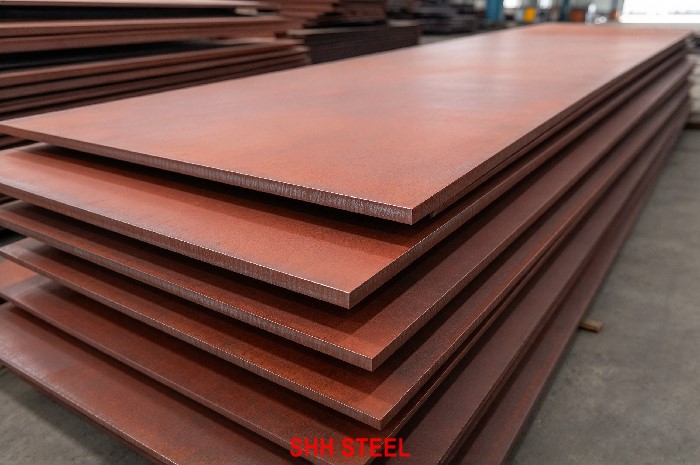
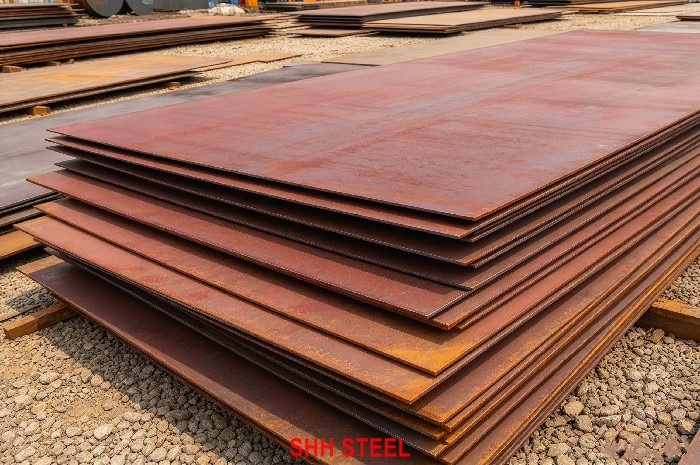
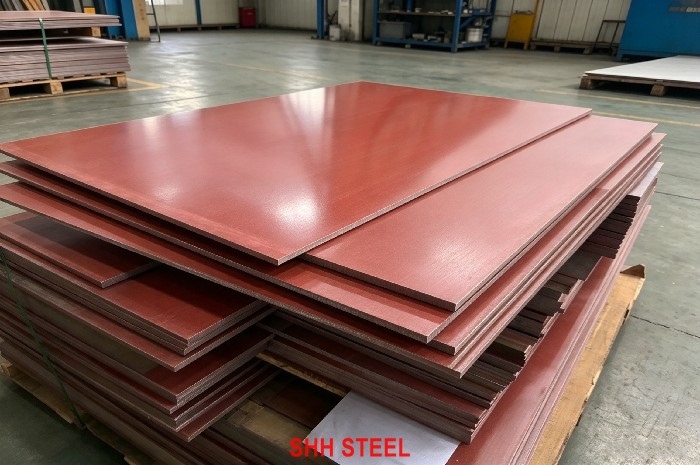
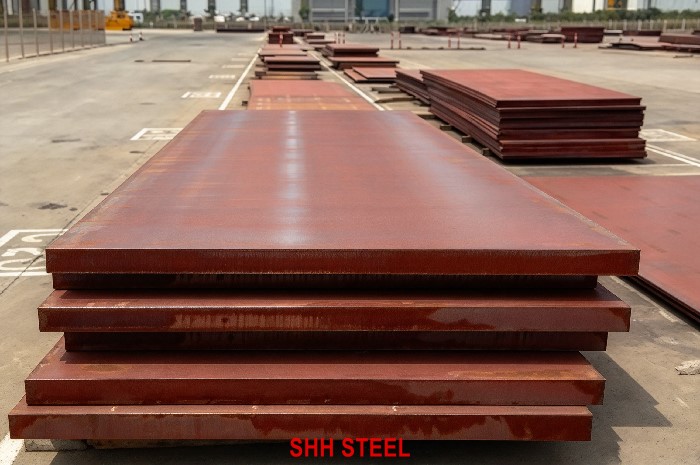
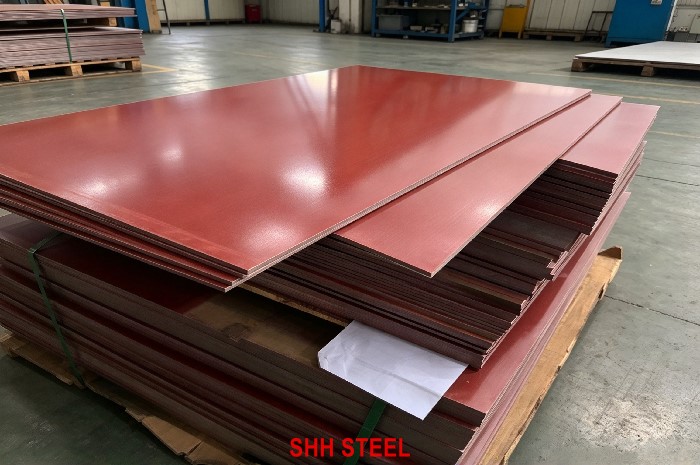
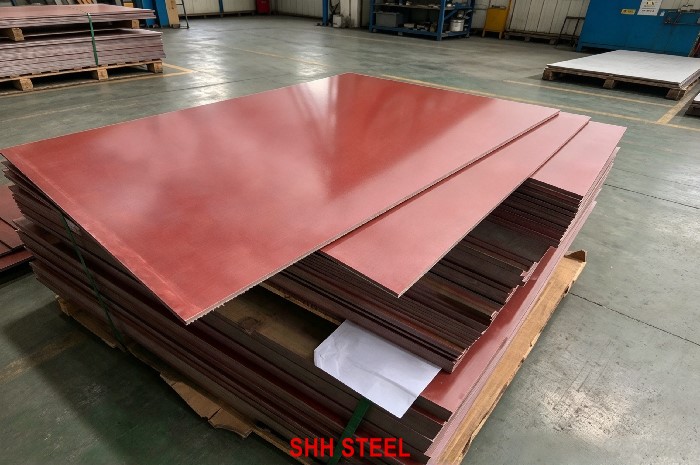
NM300 Wear-Resistant Steel Plate
What is NM300 Wear-Resistant Steel Plate (GB/T 24186)
NM300 wear-resistant steel plate is the softest grade in the GB/T 24186 family, and that is exactly why so many fabricators buy it. NM is the Pinyin initials of Nai Mo, meaning wear-resistant; 300 is the nominal surface Brinell hardness class. Under GB/T 24186-2022 the surface window for NM300 up to 80 mm is 270–330 HBW, which is roughly two to two-and-a-half times the hardness of an ordinary Q235 or A36 structural plate, while the steel still bends, rolls and welds in a way a shop used to mild steel can manage.
SHH STEEL can produce and supply NM300 wear-resistant steel plate to GB/T 24186 from Chinese plate mills with quenched-and-tempered lines. We control the order from heat selection through Brinell testing to cutting in our own workshop, and we supply NM300D and NM300E when a low-temperature Charpy guarantee is needed. Common thicknesses are held in China or rolled on short cycles.
In practice NM300 sits in the place where a buyer has outgrown structural plate as a liner — the hopper wears through every season — but cannot yet justify the forming limits of a 400 HBW plate. Agricultural machinery, conveyor skirt boards, light truck-body side walls and lined chutes for coal or grain are the jobs we see most. The standard covers NM300 and NM300D/E up to 120 mm thickness, with dimensions and tolerances referred to GB/T 709-2019.
If the abrasion is heavier, the next step in the same standard is NM360 Wear-Resistant Steel Plate and then NM400 Wear-Resistant Steel Plate. The series hub is GB/T 24186, and the wider category is Wear-Resistant Steel Plates.
Material Specification and Designation: NM, NM300D and NM300E
GB/T 24186 builds every grade name from the same logic: NM plus the specified surface hardness, and optionally a quality-grade letter. NM300 is the base grade. NM300D carries a Charpy V-notch guarantee at −20 °C and NM300E at −40 °C. The D and E letters are toughness grades written on the purchase order and certificate; they are covered in the tables on this page rather than as separate products.
Because NM300 is often bought as a “better liner” by people who normally order structural plate, enquiries sometimes arrive as “Q345 hard plate” or “300 Brinell plate”. Those descriptions do not bind the mill to anything. Write the order as: GB/T 24186-2022, NM300 (or NM300D / NM300E), quenched and tempered, size, quantity, certificate type — and the Table 4 hardness becomes a contractual requirement.
A frequent question is whether NM300E is worth paying for. For a liner inside a heated plant, no. For a scraper blade or chute on a machine that works outdoors in north-east China, Mongolia or Canada at −30 °C, the E grade with its −40 °C test is the sensible choice, because a soft wear plate that cracks on a frozen morning is worse than a harder one that wears.
Chemical Composition of NM300 Wear-Resistant Steel Plate
Chemistry for NM300 is the leanest in the series. Table 2 covers the base grade on ladle analysis; Table 3 covers NM300D/E and adds carbon-equivalent caps. All values below are maxima unless a range or minimum is shown.
| Element (mass %) | NM300 (Table 2, ladle) | NM300D/E (Table 3, ladle) |
|---|---|---|
| C | ≤ 0.23 | ≤ 0.23 |
| Si | ≤ 0.70 | ≤ 0.7 |
| Mn | ≤ 1.60 | ≤ 1.6 |
| P | ≤ 0.025 | ≤ 0.020 |
| S | ≤ 0.015 | ≤ 0.010 |
| Cr | ≤ 0.80 | ≤ 0.80 |
| Ni | ≤ 0.50 | ≤ 0.6 |
| Mo | ≤ 0.40 | ≤ 0.40 |
| Ti | ≤ 0.050 | ≤ 0.05 |
| B | 0.0005–0.0060 | 0.0005–0.0060 |
| Als | ≥ 0.010 | ≥ 0.015 |
| CEV (≤ 50 mm / > 50 mm) | not capped in Table 2 | ≤ 0.45 / ≤ 0.57 |
Carbon is capped at 0.23 %, the same as NM300D/E, and chromium at 0.80 % with molybdenum to 0.40 %. That modest alloy load is enough, with boron in the 0.0005–0.0060 % window, to harden a plate of moderate thickness to the 270–330 HBW band without driving carbon equivalent up. The D/E version tightens phosphorus to 0.020 % and asks for Als ≥ 0.015 %, and its CEV is held to 0.45 % up to 50 mm and 0.57 % above — the lowest caps in the whole standard.
For the welding engineer that CEV ceiling is the most useful line on the table: NM300D at 0.45 % behaves close to a high-strength structural steel in the weld procedure, which is a large part of why NM300 is chosen for welded box structures. By agreement, Si and Mn may rise to 2.00 % and 2.50 % (boron minimum then may be waived); residual Cu is limited to 0.30 % and As to 0.08 %. Product analysis tolerances, if ordered, follow GB/T 222.
Hardness and Mechanical Properties of NM300 Steel Plate
Surface Brinell hardness per Table 4 is the acceptance property for NM300, measured after the decarburized surface layer is removed (clause 8.2). Centre hardness only applies when the purchaser asks and the supplier agrees.
| Grade | Thickness (mm) | Surface hardness (HBW) | Centre hardness (HBW) |
|---|---|---|---|
| NM300 | ≤ 80 | 270–330 | 240–330 |
| NM300D/E | > 80–120 | 270–340 | not specified |
Note the slight widening in the thick band: NM300D/E above 80 mm up to 120 mm may run to 340 HBW at the surface, reflecting the extra hardenability needed to get a thick plate through. Charpy and tensile requirements are summarised below.
| Property | GB/T 24186-2022 value | Status |
|---|---|---|
| Charpy KV2, longitudinal, NM300D (−20 °C) / NM300E (−40 °C), t ≤ 80 mm | ≥ 24 J (mean of 3) | Mandatory for D/E |
| Charpy KV2, longitudinal, NM300D (−20 °C) / NM300E (−40 °C), t > 80–120 mm | ≥ 21 J (mean of 3) | Mandatory for D/E |
| Transverse tensile Rm, t ≤ 80 mm | ≥ 1000 MPa | Only when agreed in contract (7.4.3) |
| Elongation A50mm | ≥ 14 % | Only when agreed in contract |
Tensile testing is a contract option, not a default line on every NM300 certificate: clause 7.4.3 allows transverse tests on plate up to 80 mm when agreed, with Table 6 giving Rm ≥ 1000 MPa and A50mm ≥ 14 % as the reference for NM300 / NM300D/E. The 14 % elongation is the highest in the series and is the numerical reason NM300 forms better than its siblings. Bend testing (90°, D = 6a, transverse) is also available by agreement for plate thicker than 4 mm. Impact is not required below 6 mm thickness.
Thickness, Dimensions and Tolerances for NM300 Plate
Table 1 gives NM300 and NM300D/E a thickness range up to 120 mm. Width, length, shape, weight and tolerances are taken from GB/T 709-2019; continuously rolled plate uses Table 4 of GB/T 709-2019 for thickness tolerance. Flatness defaults to Class H for single-rolled plate, and Class L (PF.A) may be agreed in the contract.
Most NM300 business is thin: 3–4 mm strip-based plate for agricultural and conveyor parts, and 6–20 mm plate for liners and bodies. Strip and sheared plate are within scope up to 25.4 mm. Because NM300 is often rolled or pressed after cutting, flatness and thickness consistency matter more than they do on a bolt-on liner — ask for Class L flatness if the part goes into a press brake in long lengths.
Delivery Condition and Heat Treatment of NM300 Wear Plate
Clause 7.3 allows four delivery conditions: quenched; quenched and tempered; TMCP plus tempering; or hot-rolled before heat treatment. For NM300 the market standard is still quenched and tempered, but at this hardness level some mills reach the 270–330 HBW band through TMCP followed by tempering, especially on thin plate. Either route is acceptable as long as it is declared on the certificate and the plate meets Table 4.
Plate delivered hot-rolled before heat treatment is not tested for mechanical properties under clause 7.4.6 and should not be accepted as finished NM300. Batches are formed from one grade, heat, thickness, delivery condition and heat-treatment cycle, not exceeding 60 t (clause 9.1).
Equivalent Grades: NM300 vs AR300 and Other ~300 HBW Plates
NM300 is usually cross-referenced to commercial AR300, to Hardox 300 under the SSAB Hardox brand standard, and to maker brands in the ~300 HBW class such as Raex 300. These comparisons put the plates in the same hardness neighbourhood; they do not make them identical. Chemistry, thickness range, impact guarantees and certificate wording come from different documents.
| Designation / family | Typical hardness class | Notes for enquiry |
|---|---|---|
| GB/T 24186 NM300 / NM300D / NM300E | 270–330 HBW (≤ 80 mm surface) | Governing standard for this page; D −20 °C / E −40 °C |
| Commercial AR300 | ~300 HBW class | Commercial name, maker data governs |
| SSAB Hardox brand standard — Hardox 300 | ~270–330 HBW class (brand data) | Brand plate under SSAB Hardox; similar hardness class, not drop-in identical |
| Raex 300 class | ~270–330 HBW class (maker data) | Brand plate; verify on producer data sheet |
| GB/T 24186 NM360 | 330–400 HBW | Next harder grade in the same standard |
For a Chinese-certified project, write GB/T 24186 NM300 on the order. If a foreign drawing names AR300 or a brand, agree in writing whether NM300 is acceptable before rolling. Peer values in the table are orientation, not standard values. Neighbouring grades in the same standard are NM360 Wear-Resistant Steel Plate and NM400 Wear-Resistant Steel Plate; AR-side comparisons sit under AR400/AR500.
Wear Performance and Applications of NM300 Plate
NM300 is the grade for wear that is real but gentle: sliding grain, coal, wood chips, sand and soil, rather than sharp rock hitting from a height. Typical parts are combine-harvester and tillage wear parts, conveyor skirt and transfer chute liners, light dump-trailer floors, concrete-plant hoppers, fan housings in dusty air and garbage-truck bodies.
Where NM300 earns its place is in parts that must be formed or welded heavily. A trailer floor that is rolled into a curve, or a hopper fabricated from many welded panels, can be built from NM300 in a normal shop and still outlast a structural plate by a factor of two or more in sliding service. Once the wear becomes impact-dominated, step to NM400 or higher.
Weldability, Cutting and Cold Forming of NM300 Plate
NM300 is the easiest grade in GB/T 24186 to weld. With carbon at 0.23 % maximum and, for D/E, CEV ≤ 0.45 % up to 50 mm, thin plate is often welded without preheat using low-hydrogen consumables; preheat becomes sensible on thick sections, on restrained joints and in cold workshops. As always, the welding procedure should be qualified on the actual heat chemistry rather than on the table maxima.
Cold forming is the main reason buyers choose NM300. The 14 % elongation reference in Table 6, and the lower hardness, allow tighter bend radii and less springback than NM400. Still, bend across the rolling direction where possible, grind flame-cut edges at the bend line, and check the minimum radius with the mill before committing a press tool. Plasma, laser and oxy-fuel cutting all work; the hardened cut edge is shallow at this hardness.
Surface Finishes and Surface Condition for NM300 Plate
GB/T 24186 clause 7.5 defines surface quality in engineering terms: no cracks, blisters, scabs, laps, inclusions or visible lamination; local dressing allowed within half the thickness tolerance; no weld repair. Thin scale, light rust and minor marks that do not hide defects are acceptable. GB/T 14977 may be applied by agreement.
For NM300, surface condition matters more than on the harder grades because more of it is painted or shown on finished machinery. Agricultural OEMs often take blasted and primed plate straight onto the line.
| Finish / condition | Typical supply | Order note |
|---|---|---|
| As heat-treated mill surface | Standard Q&T plate | State if scale removal is required |
| Shot-blasted and primed | Common for OEM machinery parts | Choose primer compatible with forming and welding |
| Pickled and oiled (thin plate) | By agreement on strip-based sizes | Confirm availability by thickness |
| Cut-to-size blanks | SHH STEEL workshop | Markings transferred before cutting |
If the part will be bent after blasting and priming, choose a primer that tolerates forming. Hardness checks still need a locally ground spot clear of decarburization.
Inspection and Testing for NM300 Wear-Resistant Steel Plate
Table 8 sets the inspection plan: chemical analysis per heat, one Brinell hardness test per batch, three Charpy specimens per batch for NM300D/E, and tensile, bend and NDT only when agreed. Methods are GB/T 231.1 for hardness, GB/T 229 for impact and GB/T 228.1 for tensile, with sampling to GB/T 2975.
On NM300 orders we recommend buyers add the bend test when parts will be formed, because it gives real evidence of formability on the actual heat. SHH STEEL issues EN 10204 3.1 certificates and arranges 3.2 third-party witness before production on request. On receipt, check grade letter, thickness band against Table 4 and the declared delivery condition.
Stock and Sizes of NM300 Plate SHH STEEL Can Supply
SHH STEEL keeps NM300 in the thinner sizes where demand is highest and rolls heavier plate to order. Quantities are approximate working ranges; location is China.
| Thickness (mm) | Width (mm) | Length (mm) | Condition | Approx. quantity | Location |
|---|---|---|---|---|---|
| 3–5 | 1250 / 1500 | 2000 / 6000 | Q&T | 100+ t | China |
| 6–10 | 1500 / 2000 | 6000 / 8000 | Q&T | 200+ t | China |
| 12–20 | 2000 / 2200 | 8000 / 12000 | Q&T | 200+ t | China |
| 25–50 | 2000 / 2200 | 6000 / 10000 | Q&T | 50+ t | China |
| > 50–120 (incl. NM300D/E) | 2000 / 2200 | 6000 / 10000 | Q&T | mill schedule | China |
Cut blanks, bevelled edges and pressed parts can be prepared in our workshop on the same heat. NM300 often ships together with NM400 liners for the same machine.
Why Choose SHH STEEL for NM300 Wear-Resistant Steel Plate
SHH STEEL produces and supplies NM300 as a mill-side partner, with hardness and, where ordered, impact and bend tests run on each batch. We advise honestly when NM300 is enough and when a buyer is better off paying for NM400 — over-specifying hardness on a formed part only creates cracked bends.
Mixed loads with other wear grades and structural plate, workshop cutting and forming, and EN 10204 3.1 / 3.2 certificates are part of our normal supply.
Supply Capability
SHH STEEL can produce and supply NM300 / NM300D / NM300E across the ≤ 120 mm thickness range of Table 1, mainly quenched and tempered, with GB/T 709 dimensions and export packing from Chinese ports. Compare the harder neighbours NM360 Wear-Resistant Steel Plate and NM400 Wear-Resistant Steel Plate, or browse the GB/T 24186 hub.
FAQ
-
What is NM300 steel plate?
- NM300 is the entry wear-resistant grade of GB/T 24186. NM stands for the Pinyin initials of Nai Mo, meaning wear-resistant, and 300 is the nominal surface hardness class. It is usually supplied quenched and tempered and is chosen where wear resistance is needed but forming and welding must stay easy.
-
What is the hardness of NM300?
- Table 4 gives 270–330 HBW surface hardness up to 80 mm (centre 240–330 HBW when agreed). NM300D/E above 80 mm up to 120 mm has 270–340 HBW at the surface.
-
What is the chemical composition of NM300?
- Table 2 maxima for NM300: C 0.23, Si 0.70, Mn 1.60, P 0.025, S 0.015, Cr 0.80, Ni 0.50, Mo 0.40, Ti 0.050 %, B 0.0005–0.0060 %, Als ≥ 0.010 %. NM300D/E uses Table 3 with P 0.020, S 0.010, Ni 0.6 and CEV ≤ 0.45 / 0.57 %.
-
What are the equivalent grades of NM300?
- AR300, Hardox 300 under the SSAB Hardox brand standard, and ~300 HBW maker brands such as Raex 300 are in the same hardness class. They are comparisons, not drop-in substitutes; the governing standard must be agreed on the order.
-
NM300 vs NM400 — which should I choose?
- NM300 forms and welds more easily and has 14 % elongation reference against 10 % for NM400. NM400 lasts noticeably longer in abrasive sliding service. Choose NM300 for formed or heavily welded parts with gentle wear, NM400 for liners and bodies facing rock.
-
Where can I get an NM300 data sheet?
- This page summarises the GB/T 24186-2022 requirements. For a project we provide the mill certificate with heat chemistry, hardness and impact (if ordered), and a size list from SHH STEEL stock.
-
What is the difference between NM300, NM300D and NM300E?
- NM300D adds Charpy testing at −20 °C and NM300E at −40 °C, with ≥ 24 J up to 80 mm and ≥ 21 J above 80 mm. D/E also follow Table 3 chemistry with CEV limits.
-
Is tensile testing mandatory for NM300?
- No. Tensile is a contract option for plate up to 80 mm; Table 6 reference values are Rm ≥ 1000 MPa and A50mm ≥ 14 %.
-
Can NM300 be bent?
- Yes, it is the most formable grade in the standard. Follow mill minimum radius guidance, bend across rolling direction where possible and order the agreed bend test if forming is critical.
-
Can SHH STEEL cut NM300 to size?
- Yes. We flame, plasma or laser cut, bevel and drill NM300 and pack it for export with full traceability.
Conclusion
NM300 is the practical first step into wear plate: 270–330 HBW, low carbon equivalent and the best formability in GB/T 24186. Order it quenched and tempered, add D or E when the machine works in the cold, and add tensile or bend tests only where they genuinely matter.
SHH STEEL can produce and supply NM300 / NM300D / NM300E from China with cutting and certification. Email admin@steelspecs.com with grade, sizes, quantity and port.
Quality Steel Needed? Inquire for Offers
Related Products