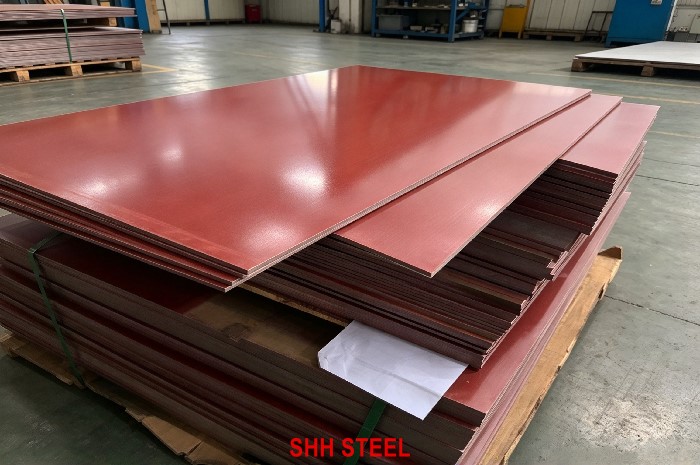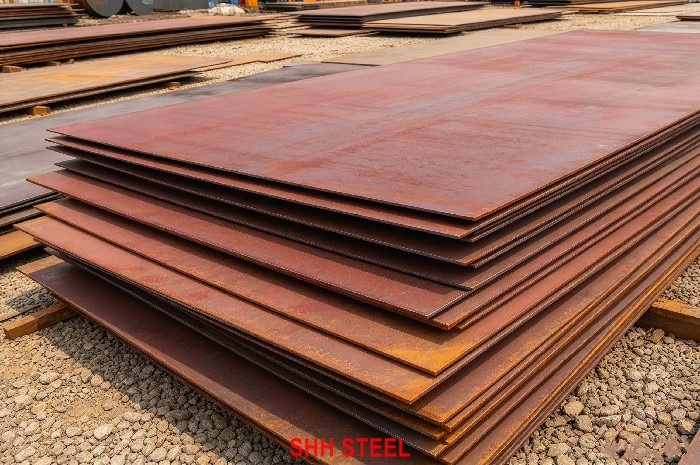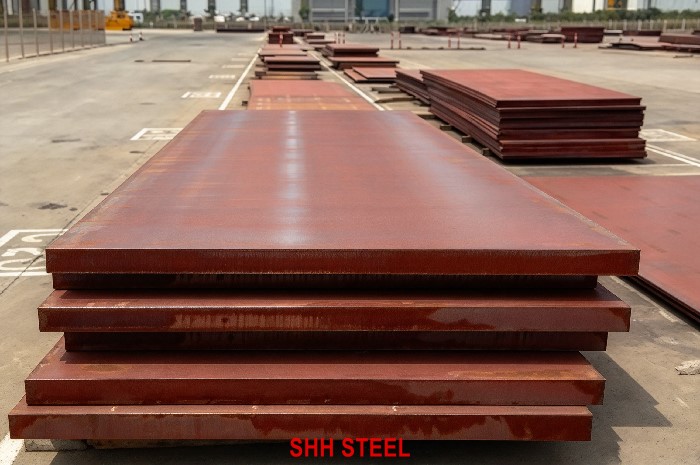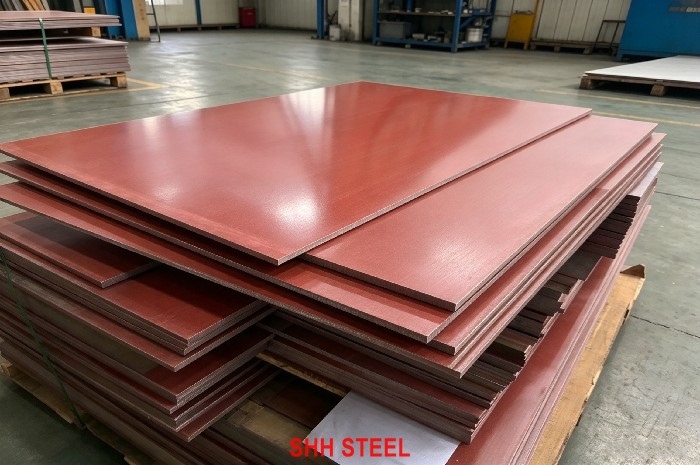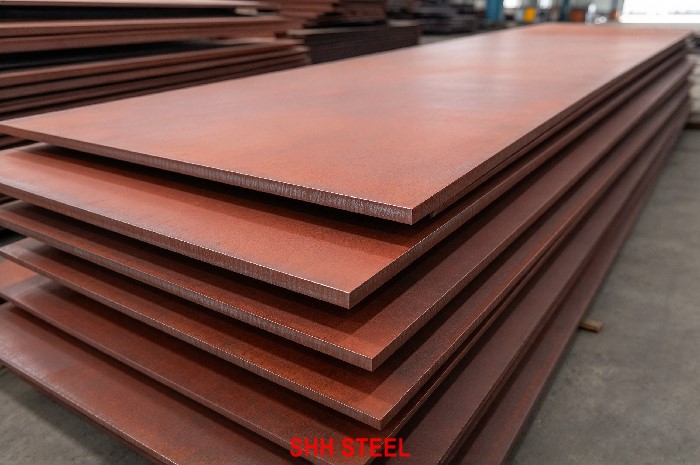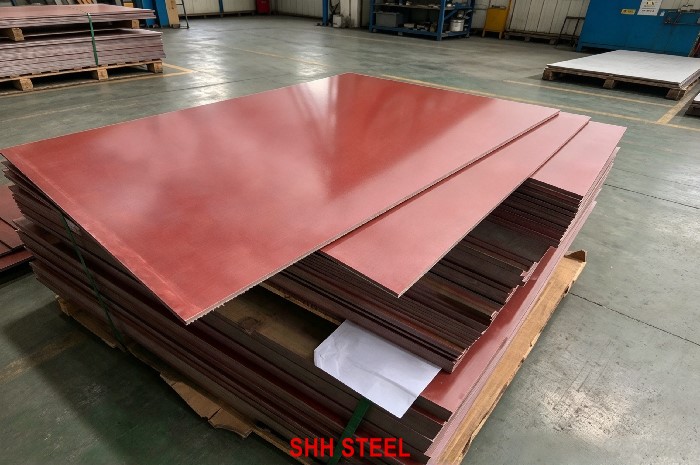
NM450 Wear-Resistant Steel Plate
What is NM450 Wear-Resistant Steel Plate (GB/T 24186)
NM450 wear-resistant steel plate is where GB/T 24186 moves from “improved liner” into genuine heavy-abrasion plate. NM is the Pinyin initials of Nai Mo, meaning wear-resistant; 450 is the nominal Brinell class. In GB/T 24186-2022 the surface hardness up to 80 mm is 420–480 HBW. Against NM400 that extra 50 HBW typically buys a meaningful increase in liner life in rock and ore service, and the price is paid in fabrication: tighter bending limits and more careful welding.
SHH STEEL can produce and supply NM450 wear-resistant steel plate to GB/T 24186, quenched and tempered at Chinese plate mills with batch Brinell testing, and NM450D / NM450E when the order demands −20 °C or −40 °C toughness. We cut, drill and bevel NM450 liners in our workshop so the hard plate reaches site ready to bolt or weld.
Thickness under Table 1 is up to 120 mm for both NM450 and NM450D/E, with dimensions per GB/T 709-2019. Typical buyers are mines, quarries and cement plants replacing chute, hopper and bucket liners, and OEMs building mining truck bodies where payload matters and thinner, harder plate saves weight.
For easier forming step back to NM400 Wear-Resistant Steel Plate; for more extreme abrasion look at NM500 Wear-Resistant Steel Plate. The family hub is GB/T 24186; see also Wear-Resistant Steel Plates.
Material Specification and Designation: NM, NM450D and NM450E
Following clause 4 of the standard, NM450 is the base grade, NM450D adds a Charpy guarantee at −20 °C and NM450E at −40 °C. These letters are quality grades for toughness, shown in the order, the certificate and the tables on this page.
NM450 is often ordered against a drawing that names Hardox 450 (SSAB Hardox brand standard) or AR450. The mill can only certify what is written, so the order should read: GB/T 24186-2022, NM450 (or NM450D / NM450E), quenched and tempered, sizes, quantity, certificate. If brand equivalence is a contract issue, settle it before rolling.
Because higher hardness means lower toughness reserve, the D grade is a common choice for mining truck bodies that see impact from loading shovels in cold mornings, even when ambient temperatures are moderate.
Chemical Composition of NM450 Wear-Resistant Steel Plate
NM450 chemistry per Table 2 (base) and Table 3 (D/E) is given below as ladle-analysis maxima, ranges or minima.
| Element (mass %) | NM450 (Table 2, ladle) | NM450D/E (Table 3, ladle) |
|---|---|---|
| C | ≤ 0.35 | ≤ 0.30 |
| Si | ≤ 0.70 | ≤ 0.7 |
| Mn | ≤ 1.70 | ≤ 1.7 |
| P | ≤ 0.025 | ≤ 0.020 |
| S | ≤ 0.010 | ≤ 0.005 |
| Cr | ≤ 1.40 | ≤ 1.40 |
| Ni | ≤ 0.80 | ≤ 1.0 |
| Mo | ≤ 0.55 | ≤ 0.60 |
| Ti | ≤ 0.050 | ≤ 0.05 |
| B | 0.0005–0.0060 | 0.0005–0.0060 |
| Als | ≥ 0.010 | ≥ 0.015 |
| CEV (≤ 50 mm / > 50 mm) | not capped in Table 2 | ≤ 0.59 / ≤ 0.74 |
Carbon climbs to 0.35 % on the base grade with chromium to 1.40 %, nickel to 0.80 % and molybdenum to 0.55 %, and manganese is allowed to 1.70 %. NM450D/E deliberately pulls carbon back to 0.30 %, tightens sulphur to 0.005 % and caps CEV at 0.59 % up to 50 mm and 0.74 % above. That trade — less carbon, more nickel, cleaner steel — is how the standard reconciles 420+ HBW with a low-temperature impact guarantee.
Other alloying additions must be reported on the certificate (7.1.2); Cu residual ≤ 0.30 % and As ≤ 0.08 % (7.1.3). For the base grade there is no CEV cap in Table 2, so the welding engineer must work from the actual heat analysis.
Hardness and Mechanical Properties of NM450 Steel Plate
Surface Brinell hardness to Table 4 is the primary acceptance requirement, measured after removing the decarburized layer (clause 8.2). Centre hardness is by agreement only.
| Grade | Thickness (mm) | Surface hardness (HBW) | Centre hardness (HBW) |
|---|---|---|---|
| NM450 | ≤ 80 | 420–480 | 375–480 |
| NM450D/E | > 80–120 | 410–480 | not specified |
In thick NM450D/E plate, the lower surface limit drops to 410 HBW above 80 mm, recognising the difficulty of quenching very heavy sections. Charpy and tensile data follow.
| Property | GB/T 24186-2022 value | Status |
|---|---|---|
| Charpy KV2, longitudinal, NM450D (−20 °C) / NM450E (−40 °C), t ≤ 80 mm | ≥ 24 J (mean of 3) | Mandatory for D/E |
| Charpy KV2, longitudinal, NM450D (−20 °C) / NM450E (−40 °C), t > 80–120 mm | ≥ 21 J (mean of 3) | Mandatory for D/E |
| Transverse tensile Rm, t ≤ 80 mm | ≥ 1250 MPa | Only when agreed in contract (7.4.3) |
| Elongation A50mm | ≥ 8 % | Only when agreed in contract |
Tensile testing is optional: when agreed for plate up to 80 mm, Table 6 gives Rm ≥ 1250 MPa and A50mm ≥ 8 %. The 8 % elongation reference tells the fabricator plainly that NM450 is not a forming grade. A bend test to Table 7 is available by agreement; impact is not required below 6 mm.
Thickness, Dimensions and Tolerances for NM450 Plate
Table 1 permits NM450 and NM450D/E up to 120 mm. GB/T 709-2019 governs dimensions, shape and tolerances, with Table 4 of GB/T 709-2019 for continuously rolled thickness and Class H flatness by default (Class L by agreement).
Most NM450 sells between 8 and 40 mm. Mining truck bodies use 8–16 mm floors and side walls; chute and hopper liners 16–40 mm; crusher and mill wear parts may go thicker. Flatness is important for bolted liners because hard plate does not pull flat against the backing.
Delivery Condition and Heat Treatment of NM450 Wear Plate
Clause 7.3 lists quenched, quenched and tempered, TMCP plus tempered, or hot-rolled before heat treatment. NM450 for wear service is quenched and normally low-temperature tempered; the temper is light because hardness must stay above 420 HBW, so the plate carries relatively high internal stress and should be handled and cut with that in mind.
Hot-rolled-before-heat-treatment plate receives no mechanical testing (7.4.6) and is not finished NM450. Batches follow clause 9.1: one grade, heat, thickness, delivery condition and heat-treatment cycle, up to 60 t.
Equivalent Grades: NM450 vs AR450 vs Hardox 450 (SSAB Hardox)
NM450 is routinely cross-referenced to AR450, to Hardox 450 under the SSAB Hardox brand standard, and to Raex 450 class plate. All sit in a similar 420–480 HBW class, but chemistry, impact guarantees, thickness limits and certificates differ — they are not drop-in identical.
| Designation / family | Typical hardness class | Notes for enquiry |
|---|---|---|
| GB/T 24186 NM450 / NM450D / NM450E | 420–480 HBW (≤ 80 mm surface) | Governing standard for this page |
| Commercial AR450 | ~450 HBW class | Commercial name; maker data governs |
| SSAB Hardox brand standard — Hardox 450 | ~425–475 HBW class (brand data) | Brand plate under SSAB Hardox; similar hardness class, not drop-in identical |
| Raex 450 class | ~450 HBW class (maker data) | Verify on producer data sheet |
| GB/T 24186 NM500 | 470–540 HBW | Next harder grade in the same standard |
If the drawing names a brand, either buy the brand or agree an NM450 substitution with the owner before rolling. Peer hardness ranges are orientation only, flagged in the pack notes. Neighbouring grades: NM400 Wear-Resistant Steel Plate and NM500 Wear-Resistant Steel Plate; AR-side category: AR400/AR500.
Wear Performance and Applications of NM450 Plate
NM450 is chosen where sliding abrasion by hard rock or ore dominates: mining dump-truck bodies, excavator and wheel-loader bucket liners and cutting edges, crusher feed hoppers, grizzly and screen side plates, transfer chutes for iron ore and granite, cement-plant clinker chutes and dredge pump liners.
In many plants NM450 is used selectively: the impact and sliding zone of a chute gets NM450, while the supporting structure stays NM360 or structural plate. That keeps fabrication simple while putting hardness exactly where the wear map shows it is needed.
Weldability, Cutting and Cold Forming Cautions for ~450 HBW Plate
At about 450 HBW, welding needs a qualified procedure. Use hydrogen-controlled consumables — often a softer, tougher filler for structural joints — keep the joint dry, apply preheat on thicker plate and restrained joints, control interpass temperature, and avoid high heat input that would leave a soft band in the heat-affected zone. Calculate CEV from the heat; for D/E the Table 3 caps help.
Cold forming is limited: bend radii must be large and springback is pronounced; tight bends risk cracking. Thermal cutting is possible but cut edges can crack in thick plate if cooled fast — preheat for flame cutting of heavy sections and slow cooling are common practice. Drilling needs rigid set-ups and carbide or cobalt tooling.
Surface Finishes and Surface Condition for NM450 Plate
Clause 7.5 applies: no cracks, blisters, scabs, laps, inclusions or visible lamination; dressing within half the thickness tolerance; no welding repair. Light scale and minor marks are permitted; GB/T 14977 can be agreed.
For NM450 liners, the surface finish is usually functional rather than cosmetic.
| Finish / condition | Typical supply | Order note |
|---|---|---|
| As heat-treated mill surface | Standard Q&T liner plate | Adequate for bolted liners |
| Shot-blasted and primed | Truck bodies and painted structures | Primer must suit welding |
| Cut, drilled and countersunk liners | SHH STEEL workshop | Supply hole pattern and bolt type |
| GB/T 14977 surface class | By agreement (7.5.4) | Write the class on the order |
Blasting before hardness testing does not replace grinding a test spot below the decarburized layer.
Inspection and Testing for NM450 Wear-Resistant Steel Plate
Table 8 inspection: chemistry per heat, Brinell hardness per batch, Charpy (3 specimens) per batch for NM450D/E, with tensile, bend and NDT by agreement. Methods: GB/T 231.1, GB/T 229, GB/T 228.1; sampling GB/T 2975.
For thick NM450 liners and mining body plate, ultrasonic testing by agreement (clause 7.6) is worth adding. SHH STEEL issues EN 10204 3.1 certificates and arranges 3.2 witness before production. On receipt, check the grade letter, that hardness lies within the band for the delivered thickness, and that cut edges are free of cracks.
Stock and Sizes of NM450 Plate SHH STEEL Can Supply
SHH STEEL holds NM450 in the main liner and body thicknesses in China and schedules thicker plate to mill cycles. Quantities are approximate.
| Thickness (mm) | Width (mm) | Length (mm) | Condition | Approx. quantity | Location |
|---|---|---|---|---|---|
| 8–12 | 2000 / 2200 | 8000 / 12000 | Q&T | 200+ t | China |
| 16–25 | 2000 / 2200 / 2500 | 8000 / 12000 | Q&T | 200+ t | China |
| 30–50 | 2000 / 2200 | 6000 / 10000 | Q&T | 100+ t | China |
| 60–80 | 2000 / 2200 | 6000 / 8000 | Q&T | 50+ t | China |
| > 80–120 (incl. NM450D/E) | 2000 / 2200 | 6000 / 8000 | Q&T | mill schedule | China |
Liners can be cut, drilled and countersunk in our workshop and shipped as kits by part number.
Why Choose SHH STEEL for NM450 Wear-Resistant Steel Plate
SHH STEEL produces and supplies NM450 with batch hardness verification, optional D/E impact and workshop preparation of hard liners. We are direct about where NM450 pays back and where NM400 is a safer fabrication choice.
Third-party inspection, EN 10204 3.1 / 3.2 certificates and mixed loads with other wear grades are routine.
Supply Capability
SHH STEEL can produce and supply NM450 / NM450D / NM450E up to 120 mm thick, quenched and tempered, with GB/T 709 dimensions and export packing. Compare NM400 Wear-Resistant Steel Plate and NM500 Wear-Resistant Steel Plate, or see the GB/T 24186 hub.
FAQ
-
What is NM450 steel plate?
- NM450 is a heavy-duty wear-resistant plate under GB/T 24186 with a nominal 450 HBW class, usually quenched and tempered, for mining, quarrying and cement equipment.
-
What is the hardness of NM450?
- 420–480 HBW surface hardness up to 80 mm (centre 375–480 HBW by agreement); NM450D/E above 80 mm to 120 mm is 410–480 HBW at the surface.
-
What is the chemical composition of NM450?
- Table 2 maxima: C 0.35, Si 0.70, Mn 1.70, P 0.025, S 0.010, Cr 1.40, Ni 0.80, Mo 0.55, Ti 0.050 %, B 0.0005–0.0060 %, Als ≥ 0.010 %. NM450D/E: C 0.30, S 0.005, Ni 1.0, Mo 0.60, CEV ≤ 0.59 / 0.74 %.
-
What are the equivalent grades of NM450?
- AR450, Hardox 450 under the SSAB Hardox brand standard, and Raex 450 class plates are in a similar hardness class. They are not drop-in identical; agree substitutions in writing.
-
NM450 vs Hardox 450 (SSAB Hardox brand standard) — are they the same?
- No. Both sit around 450 HBW, but Hardox 450 under the SSAB Hardox brand standard follows its producer’s data sheet while NM450 follows GB/T 24186. Compare chemistry, impact and thickness range before substituting.
-
Where can I get an NM450 data sheet?
- This page summarises GB/T 24186-2022. Project data comes from the mill certificate with heat chemistry, hardness and any agreed impact or tensile results.
-
What is the difference between NM450, NM450D and NM450E?
- D adds Charpy at −20 °C and E at −40 °C, ≥ 24 J up to 80 mm and ≥ 21 J above; D/E use Table 3 chemistry with lower carbon and CEV caps.
-
Is tensile testing mandatory for NM450?
- No. For plate up to 80 mm it may be agreed, with Table 6 reference Rm ≥ 1250 MPa and A50mm ≥ 8 %.
-
Does NM450 need preheat for welding?
- Often yes on thicker or restrained joints. Preheat and interpass temperature come from the qualified welding procedure using the actual heat chemistry.
-
Can SHH STEEL supply NM450 liner kits?
- Yes. We cut, drill and countersink NM450 liners to drawing and ship them labelled by part number.
Conclusion
NM450 is the GB/T 24186 grade for heavy sliding abrasion: 420–480 HBW, NM450D/E for cold or impact-loaded service, and fabrication that rewards careful welding and generous bend radii.
SHH STEEL can produce and supply NM450 / NM450D / NM450E from China, including cut liner kits. Email admin@steelspecs.com with your drawings, sizes and port.
Quality Steel Needed? Inquire for Offers
Related Products