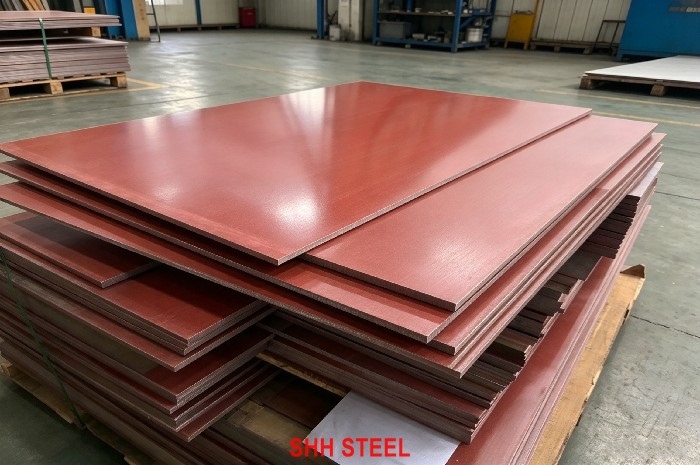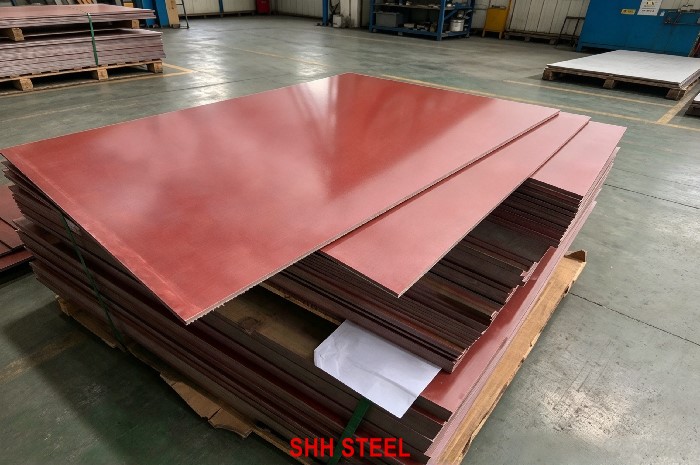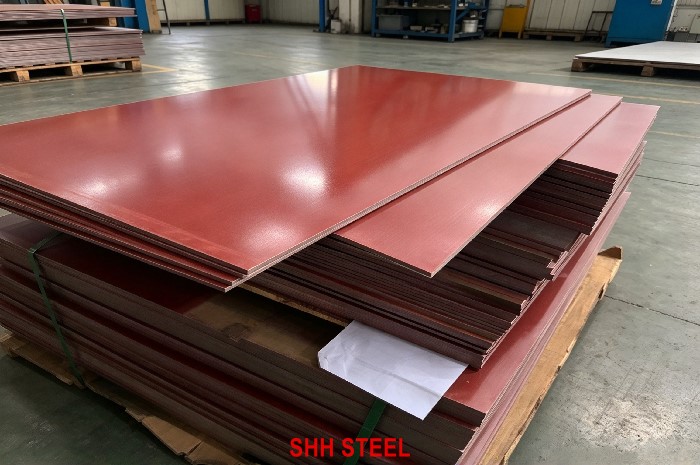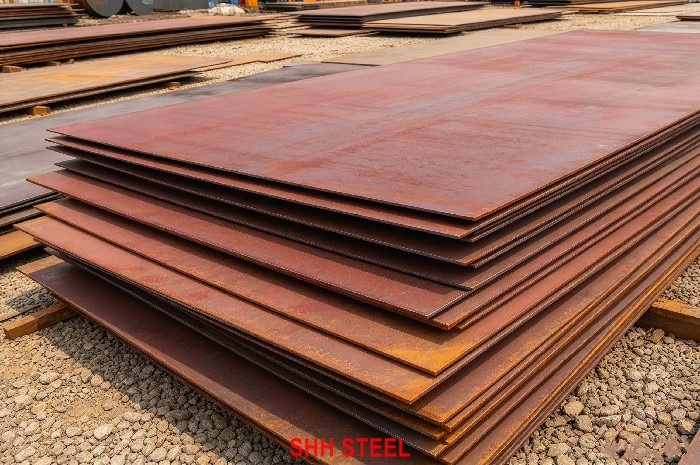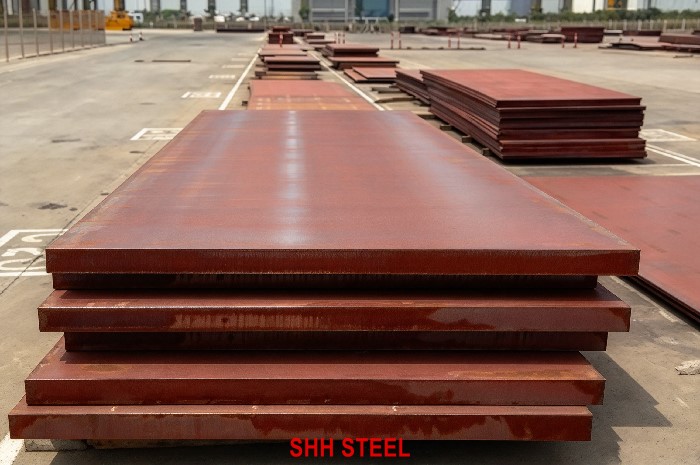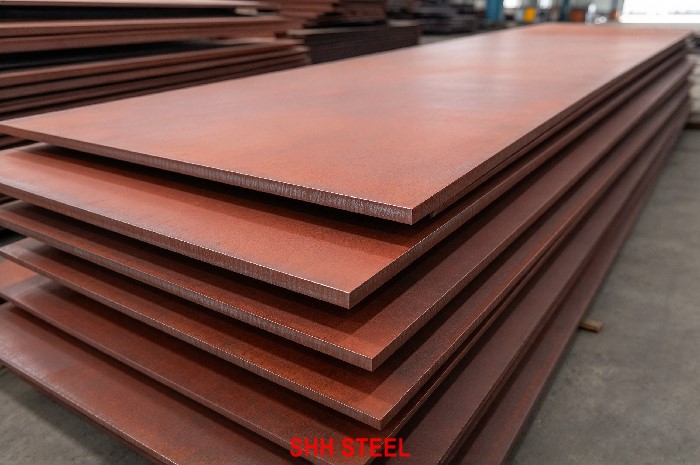
NM360 Wear-Resistant Steel Plate
What is NM360 Wear-Resistant Steel Plate (GB/T 24186)
NM360 wear-resistant steel plate is the compromise grade many equipment builders end up standardising on. NM is the Pinyin initials of Nai Mo, meaning wear-resistant, and 360 is the nominal Brinell hardness class. Under GB/T 24186-2022 its surface hardness up to 80 mm is 330–400 HBW: hard enough to give a clear step in wear life over NM300, yet soft enough that bucket shells, truck-body side walls and hopper cones can still be pressed and welded without the precautions an NM450 plate demands.
SHH STEEL can produce and supply NM360 wear-resistant steel plate to GB/T 24186, quenched and tempered on Chinese mill lines and tested to Table 4 on every batch. NM360D and NM360E are available when Charpy toughness at −20 °C or −40 °C is required. We hold the busy thicknesses in China and cut, bevel and bend in our own workshop.
The standard allows NM360 and NM360D/E up to 120 mm. Dimensions and tolerances follow GB/T 709-2019. In service, NM360 is common in construction-machinery structures that are both load-bearing and wearing — loader bucket shells, mixer drums, scraper bowls — where the designer wants abrasion resistance without giving up structural toughness.
Lighter duty can step down to NM300 Wear-Resistant Steel Plate; heavier sliding abrasion usually moves to NM400 Wear-Resistant Steel Plate. See the GB/T 24186 hub and the Wear-Resistant Steel Plates category for the full family.
Material Specification and Designation: NM, NM360D and NM360E
The name follows clause 4 of GB/T 24186: NM plus the surface hardness number. NM360 is the base grade; adding D gives NM360D with Charpy at −20 °C and adding E gives NM360E at −40 °C. D and E are quality grades for low-temperature toughness, written into the order and shown in the tables here, not separate product lines.
Because 360 is not a round number in Western AR nomenclature, foreign drawings often say “AR360”, “AR350” or “360 BHN plate”. Treat those as hints about hardness class. The binding order line is: GB/T 24186-2022, NM360 (or NM360D / NM360E), quenched and tempered, dimensions, certificate type.
For structural wear parts on mobile machinery, NM360D is a common default: the extra −20 °C impact guarantee costs little and protects the welded structure against cold-weather cracking.
Chemical Composition of NM360 Wear-Resistant Steel Plate
NM360 chemistry is defined by Table 2 (base grade) and Table 3 (NM360D/E, with carbon-equivalent caps). Values are ladle-analysis maxima unless shown as a range or minimum.
| Element (mass %) | NM360 (Table 2, ladle) | NM360D/E (Table 3, ladle) |
|---|---|---|
| C | ≤ 0.25 | ≤ 0.25 |
| Si | ≤ 0.70 | ≤ 0.7 |
| Mn | ≤ 1.60 | ≤ 1.6 |
| P | ≤ 0.025 | ≤ 0.020 |
| S | ≤ 0.015 | ≤ 0.010 |
| Cr | ≤ 0.90 | ≤ 0.90 |
| Ni | ≤ 0.50 | ≤ 0.7 |
| Mo | ≤ 0.50 | ≤ 0.50 |
| Ti | ≤ 0.050 | ≤ 0.05 |
| B | 0.0005–0.0060 | 0.0005–0.0060 |
| Als | ≥ 0.010 | ≥ 0.015 |
| CEV (≤ 50 mm / > 50 mm) | not capped in Table 2 | ≤ 0.48 / ≤ 0.60 |
Compared with NM300, carbon rises to 0.25 %, chromium to 0.90 % and molybdenum to 0.50 %. Those small increases are what push the quenched hardness up by about 60 HBW. NM360D/E keeps carbon at 0.25 % but raises the nickel allowance to 0.7 % for toughness and holds CEV to 0.48 % up to 50 mm and 0.60 % above.
Additional alloying elements may be used if reported on the certificate (7.1.2); residual Cu ≤ 0.30 % and As ≤ 0.08 % (7.1.3). The Si/Mn increase to 2.00 / 2.50 % is only by agreement. For welding, always calculate CEV from the reported heat.
Hardness and Mechanical Properties of NM360 Steel Plate
Table 4 surface Brinell hardness is the main acceptance test for NM360, measured after the decarburized layer has been removed. Centre hardness is applied only by agreement.
| Grade | Thickness (mm) | Surface hardness (HBW) | Centre hardness (HBW) |
|---|---|---|---|
| NM360 | ≤ 80 | 330–400 | 295–400 |
| NM360D/E | > 80–120 | 330–400 | not specified |
NM360 is unusual in that the thick D/E band keeps the same 330–400 HBW surface window as thin plate. The Charpy and tensile data are summarised below.
| Property | GB/T 24186-2022 value | Status |
|---|---|---|
| Charpy KV2, longitudinal, NM360D (−20 °C) / NM360E (−40 °C), t ≤ 80 mm | ≥ 24 J (mean of 3) | Mandatory for D/E |
| Charpy KV2, longitudinal, NM360D (−20 °C) / NM360E (−40 °C), t > 80–120 mm | ≥ 21 J (mean of 3) | Mandatory for D/E |
| Transverse tensile Rm, t ≤ 80 mm | ≥ 1100 MPa | Only when agreed in contract (7.4.3) |
| Elongation A50mm | ≥ 12 % | Only when agreed in contract |
Table 6 tensile values (Rm ≥ 1100 MPa, A50mm ≥ 12 %) apply only when tensile testing is agreed in the contract for plate up to 80 mm; they are not printed on every NM360 certificate by default. Bend testing to Table 7 can be added for plate above 4 mm that will be formed. Impact is not required below 6 mm.
Thickness, Dimensions and Tolerances for NM360 Plate
Table 1 allows NM360 and NM360D/E up to 120 mm thick. Dimensions, shape, weight and tolerances come from GB/T 709-2019, with Table 4 of GB/T 709-2019 for continuously rolled thickness tolerance and flatness Class H by default (Class L by agreement).
Demand for NM360 concentrates in 6–30 mm. Bucket shells and mixer drums use 8–16 mm; scraper and grader blades push into 20–40 mm. For rolled shells, a tight flatness class and consistent thickness across the plate make the rolling far more predictable.
Delivery Condition and Heat Treatment of NM360 Wear Plate
Under clause 7.3 NM360 may be delivered quenched, quenched and tempered, TMCP and tempered, or hot-rolled before heat treatment. For finished wear plate the normal condition is quenched and tempered; tempering is what gives NM360 its useful balance of toughness and hardness for welded structures.
Plate supplied hot-rolled before heat treatment receives no mechanical testing (7.4.6), so it is not a finished NM360 product. Acceptance batches are one grade, heat, thickness, delivery condition and heat-treatment cycle, up to 60 t.
Equivalent Grades: NM360 vs AR360 and Other ~360 HBW Plates
Commercially, NM360 is compared with AR360, with Hardox 400 under the SSAB Hardox brand standard (the usual enquiry match because Hardox has no 360-named product), and with maker grades in the ~360 HBW class such as EH360-type plates from Japanese and Korean mills. These share a hardness class, not a common specification.
| Designation / family | Typical hardness class | Notes for enquiry |
|---|---|---|
| GB/T 24186 NM360 / NM360D / NM360E | 330–400 HBW (≤ 80 mm surface) | Governing standard for this page |
| Commercial AR360 / AR350 | ~360 HBW class | Commercial name; maker data governs |
| SSAB Hardox brand standard — Hardox 400 | ~370–430 HBW class (brand data) | Usual commercial enquiry match for ~360 HBW; Hardox has no 360-named product — similar hardness class, not identical |
| EH360-type maker grades | ~360 HBW class (maker data) | Brand plate; verify on producer data sheet |
| GB/T 24186 NM400 | 370–430 HBW | Next harder grade in the same standard |
When a buyer substitutes NM360 for an AR or brand plate, the substitution should be agreed in writing, with the GB/T 24186 grade on the certificate. Peer values above are orientation only. Related grades: NM300 Wear-Resistant Steel Plate and NM400 Wear-Resistant Steel Plate; AR-side pages: AR400/AR500.
Wear Performance and Applications of NM360 Plate
NM360 suits wear that combines sliding abrasion with structural loading: loader and excavator bucket shells and side plates, concrete-mixer drums and blades, scraper bowls, grader and dozer mouldboards, rail-wagon and truck-body side walls, and coal-handling chutes in power plants.
In these parts, the plate is often welded into a load path and sometimes rolled. NM360 gives a worthwhile wear advantage over structural and NM300 plate while keeping the fabrication risk acceptable. When rock or ore starts to cut grooves through NM360 within months, the next step is NM400 or NM450 on the worst surfaces only.
Weldability, Cutting and Cold Forming of NM360 Plate
NM360 welds well with low-hydrogen consumables. Carbon equivalent on NM360D/E is limited to 0.48 % up to 50 mm, so thin plate may need little or no preheat, while thick or highly restrained joints should follow a qualified procedure with preheat and controlled interpass temperature. Avoid excessive heat input, which softens the heat-affected zone.
Cold forming is practical but more demanding than NM300: the elongation reference is 12 % rather than 14 %, and springback is higher. Use generous radii, bend across the rolling direction where possible, and remove hardened flame-cut edges at the bend. Thermal cutting is routine; thicker plate benefits from slow cooling after cutting to avoid edge cracking.
Surface Finishes and Surface Condition for NM360 Plate
Clause 7.5 sets surface quality for NM360: free from cracks, blisters, scabs, laps, inclusions and visible lamination; dressing allowed within half the thickness tolerance; no welding repair. Light scale, rust and minor marks are acceptable if they do not hide defects; GB/T 14977 may be specified by agreement.
Because NM360 is often a painted structural part of the machine, blasting and priming are common.
| Finish / condition | Typical supply | Order note |
|---|---|---|
| As heat-treated mill surface | Standard Q&T plate | State if scale removal is needed |
| Shot-blasted and primed | Structural machine parts | Primer must be weldable if welded through |
| Cut-to-size and rolled shells | SHH STEEL workshop | Specify radius and edge preparation |
| GB/T 14977 surface class | By agreement (7.5.4) | Write the class on the order |
State primer type and thickness if parts will be welded through primer. Hardness testing requires a prepared spot free of decarburization.
Inspection and Testing for NM360 Wear-Resistant Steel Plate
Per Table 8: chemical analysis per heat, one hardness test per batch, three Charpy specimens per batch for NM360D/E, and tensile, bend and NDT only when agreed. Hardness follows GB/T 231.1, impact GB/T 229, tensile GB/T 228.1, sampling GB/T 2975.
For welded structural parts we recommend ultrasonic testing of thicker plate by agreement (clause 7.6) and naming the UT standard on the order. SHH STEEL issues EN 10204 3.1 certificates and arranges 3.2 witness before production when requested.
Stock and Sizes of NM360 Plate SHH STEEL Can Supply
SHH STEEL keeps common NM360 thicknesses in China and schedules heavier plate into mill heat-treatment cycles. Quantities are approximate.
| Thickness (mm) | Width (mm) | Length (mm) | Condition | Approx. quantity | Location |
|---|---|---|---|---|---|
| 6–10 | 1500 / 2000 | 6000 / 8000 | Q&T | 200+ t | China |
| 12–20 | 2000 / 2200 / 2500 | 8000 / 12000 | Q&T | 200+ t | China |
| 25–40 | 2000 / 2200 | 6000 / 12000 | Q&T | 100+ t | China |
| 50–80 | 2000 / 2200 | 6000 / 10000 | Q&T | 50+ t | China |
| > 80–120 (incl. NM360D/E) | 2000 / 2200 | 6000 / 10000 | Q&T | mill schedule | China |
Rolled shells, cut blanks and bevelled parts can be prepared in our workshop from the same heats.
Why Choose SHH STEEL for NM360 Wear-Resistant Steel Plate
SHH STEEL produces and supplies NM360 with batch hardness testing, optional D/E impact and workshop processing under one order. We help buyers decide whether NM360 is enough or whether harder plate belongs only on the most worn surfaces.
EN 10204 3.1 / 3.2 certificates, third-party inspection and mixed-grade loading are standard parts of our service.
Supply Capability
SHH STEEL can produce and supply NM360 / NM360D / NM360E up to 120 mm thickness, mainly quenched and tempered, with GB/T 709 dimensions and export packing. Compare NM300 Wear-Resistant Steel Plate and NM400 Wear-Resistant Steel Plate, or see the GB/T 24186 hub.
FAQ
-
What is NM360 steel plate?
- NM360 is a GB/T 24186 wear-resistant plate with a nominal 360 HBW hardness class. NM is the Pinyin initials of Nai Mo, meaning wear-resistant. It is usually quenched and tempered and used for wearing structural parts of construction machinery.
-
What is the hardness of NM360?
- Surface hardness is 330–400 HBW up to 80 mm (centre 295–400 HBW by agreement), and 330–400 HBW at the surface for NM360D/E above 80 mm up to 120 mm.
-
What is the chemical composition of NM360?
- Table 2 maxima: C 0.25, Si 0.70, Mn 1.60, P 0.025, S 0.015, Cr 0.90, Ni 0.50, Mo 0.50, Ti 0.050 %, B 0.0005–0.0060 %, Als ≥ 0.010 %. NM360D/E follows Table 3 with CEV ≤ 0.48 / 0.60 %.
-
What are the equivalent grades of NM360?
- AR360 / AR350 and EH360-type maker grades are similar hardness-class plates. The usual SSAB Hardox brand-standard enquiry match is Hardox 400 (Hardox has no 360-named grade). They are not drop-in identical; agree substitutions in writing.
-
NM360 vs NM400 — which is better?
- NM400 resists abrasion better; NM360 forms and welds more easily and carries a 12 % elongation reference against 10 %. Many builders use NM360 for the structure and NM400 for the worst-wearing liners.
-
Where can I get an NM360 data sheet?
- This page summarises GB/T 24186-2022. For a project we issue mill certificates with chemistry, hardness and impact where ordered, plus a stock size list.
-
What is the difference between NM360, NM360D and NM360E?
- D adds Charpy testing at −20 °C and E at −40 °C, ≥ 24 J up to 80 mm and ≥ 21 J above. D/E also follow Table 3 chemistry and CEV caps.
-
Is tensile testing mandatory for NM360?
- No. It is a contract option for plate up to 80 mm, with Table 6 reference Rm ≥ 1100 MPa and A50mm ≥ 12 %.
-
Can NM360 be rolled into bucket shells?
- Yes, with generous radii and proper edge preparation. We can roll shells in our workshop and advise radius limits by thickness.
-
Does SHH STEEL keep NM360 in stock?
- Yes, common thicknesses from 6 to 40 mm are held in China, with heavier plate rolled to order.
Conclusion
NM360 is the balanced GB/T 24186 grade: 330–400 HBW, workable forming and welding, and D/E toughness options for cold climates. It is the sensible default for structural wear parts where NM400 would make fabrication harder than it needs to be.
SHH STEEL can produce and supply NM360 / NM360D / NM360E from China. Email admin@steelspecs.com with sizes, quantity and destination port.
Quality Steel Needed? Inquire for Offers
Related Products