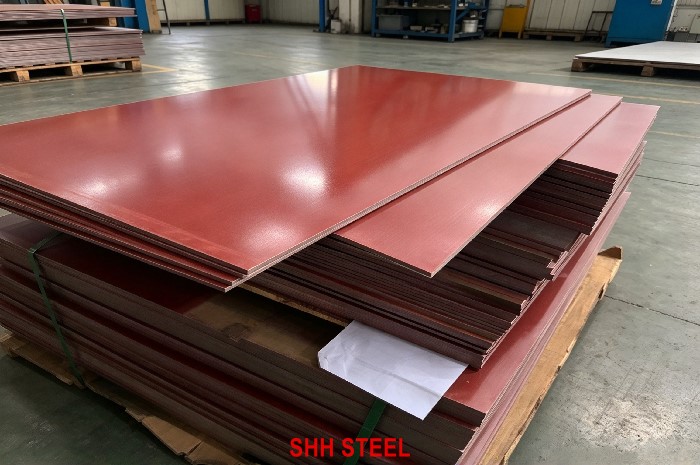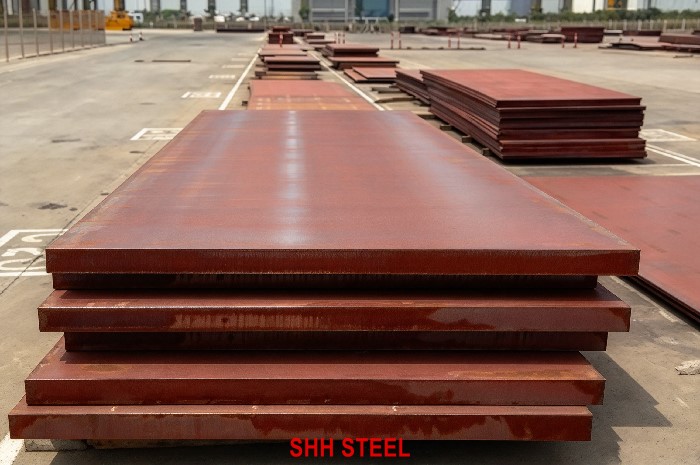
NM400 Wear-Resistant Steel Plate
What is NM400 Wear-Resistant Steel Plate (GB/T 24186)
NM400 wear-resistant steel plate is a quenched-and-tempered abrasion plate whose name itself tells the buyer what matters first: the “NM” prefix is the Pinyin initials of Nai Mo, meaning wear-resistant, and “400” is the nominal surface Brinell hardness class around 400 HBW. In the current Chinese national product standard GB/T 24186-2022 — Wear-resistant steel plates and strips for construction machinery — NM400 sits in the middle of the NM300–NM600 family and is the workhorse hardness for dump-truck bodies, excavator buckets, chute liners and crusher wear parts that see sliding and moderate impact abrasion rather than extreme gouging.
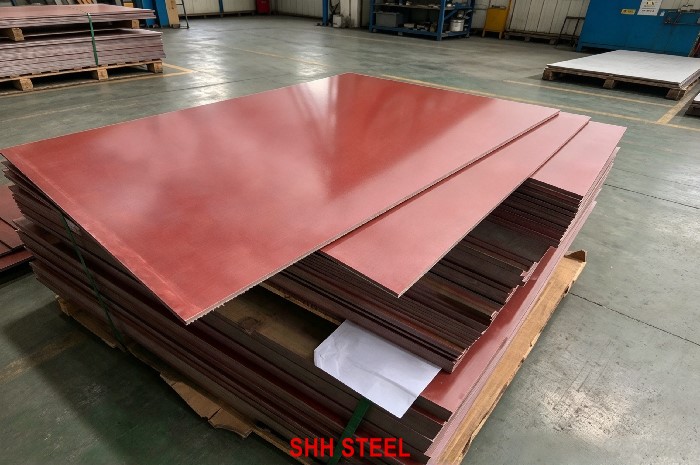
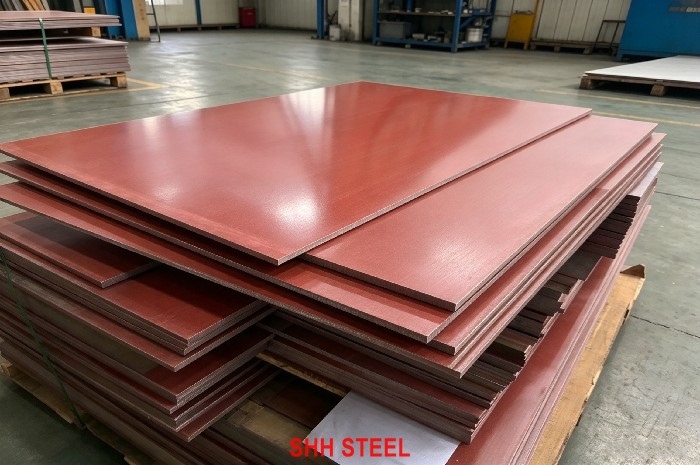
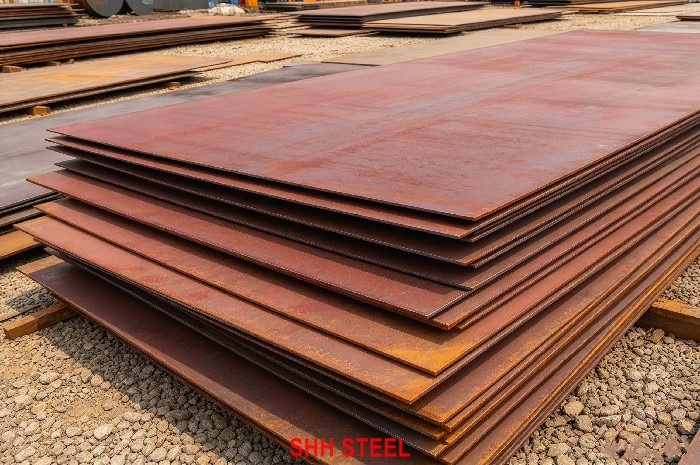
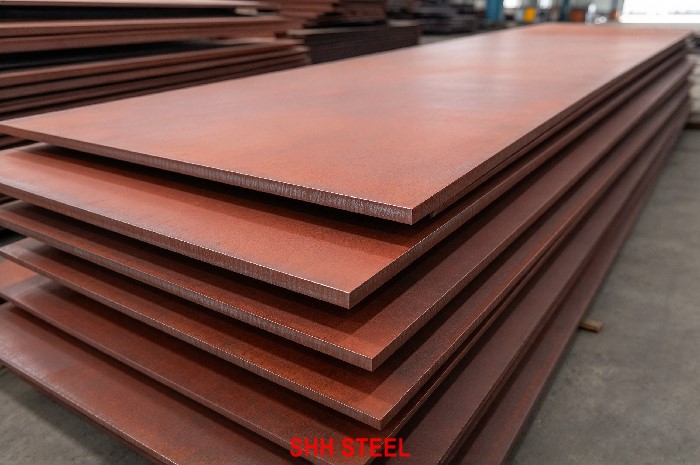
SHH STEEL can supply, produce and manufacture NM400 wear-resistant steel plate to GB/T 24186. We are a producer-side supplier, not a trader-only desk: plate is rolled and heat-treated on approved Chinese plate mills, hardness-tested against Table 4 of the standard, cut and bevelled in our workshop when the drawing needs finished blanks, and certified with full heat and batch traceability. Common thicknesses ship from China stock or short-cycle production; thicker or impact-graded NM400D/E plate is scheduled into the mill heat-treatment line to the purchase order.
Buyers often meet NM400 through a drawing note that simply says “AR400” or “400 HBW wear plate”. That commercial shorthand is useful for enquiry, but it is not a substitute for the GB/T 24186 grade string on the purchase order and the mill certificate. The standard fixes ladle chemistry (Table 2 for NM400, Table 3 for NM400D/E), surface and optional centre hardness bands (Table 4), optional Charpy energy for the D (−20 °C) and E (−40 °C) quality grades (Table 5), and optional transverse tensile values when they are written into the contract (Table 6). Thickness for NM400 / NM400D/E runs up to 120 mm. Dimensions, shape and tolerances follow GB/T 709-2019, which the product standard cites directly.
Within the same GB/T 24186 series, softer NM360 Wear-Resistant Steel Plate is chosen when formability and welding ease outweigh absolute wear life, while harder NM450 Wear-Resistant Steel Plate and NM500 Wear-Resistant Steel Plate are specified where sliding abrasion is more severe and the fabricator can live with tighter forming and preheat practice. The family hub is GB/T 24186; the broader wear-plate category is Wear-Resistant Steel Plates.
Material Specification and Designation: NM, NM400D and NM400E
Clause 4 of GB/T 24186-2022 builds the grade name in a deliberate way. The base designation is NM plus the specified surface Brinell hardness value — so NM400 means a wear plate whose surface hardness is controlled in the 400 HBW class of Table 4. When the order also needs guaranteed low-temperature toughness, the quality grade symbol is appended: NM400D for Charpy testing at −20 °C and NM400E for Charpy testing at −40 °C. Those D and E letters are toughness quality grades; they are not separate product pages and they do not change the H1 of this article. They belong on the purchase order line, in the hardness and impact tables, and on the mill certificate.
A clean order line therefore reads something like: “Steel plate to GB/T 24186-2022, grade NM400 (or NM400D / NM400E), delivery condition quenched and tempered, thickness × width × length, surface hardness per Table 4, impact per Table 5 if D/E, EN 10204 3.1 (or 3.2) certificate.” Leaving the year off the H1 is intentional for search, but the contract and the certificate should still name GB/T 24186-2022 so there is no ambiguity with the superseded 2009 edition, which had different chemistry and toughness wording.
Two practical traps show up on enquiries. First, a buyer asks for “NM400 with −40 °C impact” without writing NM400E — the mill then has to guess whether Table 5 applies. Second, a trader quotes “NM400 AR” as if as-rolled hardness plate were the normal delivery condition; clause 7.3 allows quenched, quenched and tempered, TMCP-and-tempered, or hot-rolled before heat treatment, but commercial wear plate for construction machinery is almost always quenched and tempered to hit Table 4. Spell the delivery condition in the PO.
Chemical Composition of NM400 Wear-Resistant Steel Plate
GB/T 24186 separates chemistry into two tables. Table 2 covers the base hardness grades (including NM400) on ladle analysis. Table 3 covers the low-temperature toughness grades (NM400D/E) and adds carbon-equivalent caps. The numbers below are taken from the GB/T 24186-2022 extract; they are maxima unless a range or minimum is stated. Do not treat a mill “typical” sheet as a substitute for the heat analysis on the certificate.
| Element (mass %) | NM400 (Table 2 ladle) | NM400D/E (Table 3 ladle) |
|---|---|---|
| C | ≤ 0.30 | ≤ 0.25 |
| Si | ≤ 0.70 | ≤ 0.70 |
| Mn | ≤ 1.60 | ≤ 1.60 |
| P | ≤ 0.025 | ≤ 0.020 |
| S | ≤ 0.010 | ≤ 0.005 |
| Cr | ≤ 1.20 | ≤ 1.20 |
| Ni | ≤ 0.70 | ≤ 0.70 |
| Mo | ≤ 0.50 | ≤ 0.60 |
| Ti | ≤ 0.050 | ≤ 0.050 |
| B | 0.0005–0.0060 | 0.0005–0.0060 |
| Als | ≥ 0.010 | ≥ 0.015 |
| CEV (≤50 mm / >50 mm) | — (not capped in Table 2) | ≤ 0.57 / ≤ 0.67 |
Reading the table as an engineer, not as a checklist, the story is clear. NM400 uses carbon up to 0.30 % with chromium, nickel, molybdenum and a controlled boron addition so that the plate hardens through on quenching to the 370–430 HBW surface band. Sulphur is held to 0.010 % max on the base grade and tightened further to 0.005 % on D/E, because clean steel improves both toughness and through-thickness integrity on thick plate. Aluminium is killed (Als ≥ 0.010 %, or ≥ 0.015 % on D/E; when Alt is used for calculation the standard asks for Alt ≥ 0.015 %, or ≥ 0.020 % on toughness grades).
Clause 7.1.2 allows Cr, Ni and Mo from the tables to be added individually or in combination provided properties are met, and other alloying elements may be added if they are reported on the quality certificate. Residual copper is capped at 0.30 % and arsenic at 0.08 % when analysed (7.1.3). Si and Mn may be raised by agreement to 2.00 % and 2.50 % respectively, in which case the boron lower limit may be waived — that is a contract option, not a default, and it changes weldability calculation, so it must be explicit. Product (check) analysis deviations, when required, follow GB/T 222.
Carbon equivalent on NM400D/E is calculated with the standard’s Formula (1) using C, Mn, Cr, Mo, V, Cu and Ni. The Table 3 caps (0.57 % up to 50 mm nominal thickness, 0.67 % above 50 mm) are there so that a plate ordered for −20 °C or −40 °C impact remains weldable under a sensible procedure. On base NM400 without a D/E suffix there is no Table 2 CEV cap; fabricators still ask for the heat CEV on the MTC before writing the WPS.
Hardness and Mechanical Properties of NM400 Steel Plate
Hardness is the primary acceptance property for NM400. Clause 7.4.1 and Table 4 of GB/T 24186-2022 set the surface Brinell hardness; centre hardness is informative and only applies when the purchaser asks for it and the parties agree. Specimens for surface hardness must have the decarburized layer removed before the test (clause 8.2), which is why a rough as-received mill scale reading is not a valid acceptance value.
| Grade | Thickness (mm) | Surface hardness (HBW) | Centre hardness (HBW) |
|---|---|---|---|
| NM400 | ≤ 80 | 370–430 | 330–430 |
| NM400D/E | > 80–120 | 360–440 | — (not specified) |
Two reading notes matter in practice. For thicknesses up to 80 mm the surface window is 370–430 HBW with an optional centre band of 330–430 HBW. For the toughness grades in the thick band above 80 mm up to 120 mm, Table 4 lists NM400D/E at 360–440 HBW surface and does not prescribe a centre value. Buyers who want centre hardness on thick plate must write that agreement into the contract; otherwise the mill is entitled to certify surface hardness only.
Charpy V-notch impact is mandatory only for the D and E quality grades (Table 5). For NM400D/E the longitudinal absorbed energy (KV2, average of three) is ≥ 24 J at thicknesses ≤ 80 mm and ≥ 21 J at > 80–120 mm. The test temperature is −20 °C for grade D and −40 °C for grade E. One individual specimen may fall below the specified average but not below 70 % of it. Impact is not required below 6 mm thickness. Sub-size specimens (7.5 × 10 × 55 mm or 5 × 10 × 55 mm) are used when the plate is too thin for a full-size 10 × 10 × 55 mm bar.
Transverse tensile testing is not a standing mandatory requirement of GB/T 24186 for every NM400 plate. Clause 7.4.3 says that, subject to agreement and when written into the contract, transverse tensile tests may be run on plates and strips not thicker than 80 mm, and the results may refer to Table 6. For NM400 / NM400D/E that reference is Rm ≥ 1200 MPa and A50mm ≥ 10 %. Treat those numbers as contractual targets when ordered — do not oversell them as always-on certificate lines. Bend testing (Table 7, D = 6a, 90°) is likewise by agreement for grades that require bending; it is not used on plate ≤ 4 mm.
Thickness, Dimensions and Tolerances for NM400 Plate
Table 1 of GB/T 24186-2022 sets the thickness range for NM400 and NM400D/E at ≤ 120 mm. The product standard itself does not reprint a full width/length grid; instead clause 6.2 points dimensions, shape, weight and permissible deviations to GB/T 709-2019. Continuously rolled plate thickness tolerance follows Table 4 of GB/T 709-2019. Flatness for single-rolled plate may follow Class H of GB/T 709-2019; Class L (PF.A) is available by agreement for both single-rolled and continuously rolled plate when the contract says so.
In commercial Chinese plate-mill practice, the NM400 sizes that move every week are roughly 6–50 mm thick, 1500–2500 mm wide and 6000–12000 mm long, with 8, 10, 12, 16, 20 and 25 mm the most asked thicknesses for dump bodies and bucket liners. Wider plate (to about 3000–3200 mm) and lengths beyond a container (cut-to-length or break-bulk) are mill-roll items. Strip and sheared plate under the standard’s scope are limited to 25.4 mm thickness; above that the product is single-rolled plate.
When you send a cutting plan, state whether thickness is ordered to GB/T 709 Class A/B/C style windows or to a tighter project tolerance, and whether flatness Class H or L applies. Wear plate that will be laser- or plasma-cut into many small liners benefits from tighter flatness; truck-body floor plate that is pressed as a single panel needs length and camber control more than ultra-tight thickness. None of that is guessed from the grade name — it has to sit in the order.
Delivery Condition and Heat Treatment of NM400 Wear Plate
Clause 7.3 of GB/T 24186-2022 lists the permitted delivery conditions in plain language: quenched; quenched and tempered; TMCP (thermo-mechanical control process) and tempered; or hot-rolled (the hot-rolled state before heat treatment). For construction-machinery wear plate in the NM400 hardness class, the condition that actually reaches the fabricator is almost always quenched and tempered. Quenching from the austenitising temperature puts the martensitic / bainitic structure in place; tempering then balances hardness against toughness so the plate lands inside the Table 4 window without being glass-brittle in service.
Hot-rolled-before-heat-treatment delivery is a mill intermediate, not a finished wear product. Clause 7.4.6 is explicit: mechanical property tests are not conducted on steel delivered in the hot-rolled condition unless the purchaser and supplier agree special requirements. Do not buy “NM400 hot-rolled” expecting a 370–430 HBW certificate — you will not get one under the default rules.
TMCP-and-tempered routes appear on some thick-plate programmes where the mill wants to reduce alloy load or improve through-thickness uniformity; they remain a contract choice. Whatever route is used, the batch definition in clause 9.1 ties acceptance to the same grade, heat number, thickness, delivery condition and heat-treatment cycle, with a batch mass not exceeding 60 t. That is why heat-treatment cycle identity belongs on the certificate alongside the hardness results.
Equivalent Grades: NM400 vs AR400 vs Hardox 400 (SSAB Hardox) vs VRN400
Engineers cross-reference NM400 to other ~400 HBW abrasion plates every day. The honest framing is similar hardness class, not drop-in identical. Chemistry windows, impact guarantees, thickness caps, surface-finish rules and certificate language differ. A plate dual-certified only happens when both product standards are named on the order and both test programmes are run (or formally waived) by the mill. On the brand side, the usual SSAB Hardox brand-standard match is Hardox 400.
| Designation / family | Typical hardness class | Notes for enquiry |
|---|---|---|
| GB/T 24186 NM400 / NM400D / NM400E | ~370–430 HBW (≤80 mm surface) | Governing Chinese product standard for this page; D −20 °C / E −40 °C when ordered |
| Commercial AR400 (see AR400/AR500) | ~360–440 HBW class (maker-dependent) | Peer commercial name — not a GB/T 24186 grade string; confirm maker data sheet |
| SSAB Hardox brand standard — Hardox 400 | ~370–430 HBW class (brand data) | Brand plate under SSAB Hardox; similar hardness class, not drop-in identical |
| VRN400 / similar mill brands | ~400 HBW class | Mill brand designations; treat as peer hardness class, verify chemistry and impact |
| GB/T 24186 NM360 / NM450 / NM500 siblings | lower / higher HBW bands | Same standard family — change grade when wear life or formability demand it |
When a drawing says AR400 and the project is built in China or certified to Chinese standards, specifying GB/T 24186 NM400 (or NM400D/E) on the purchase order gives you enforceable Table 4 hardness and, if ordered, Table 5 impact. When a drawing insists on a brand name, buy that brand or an agreed dual route — do not silently substitute NM400 and hope the owner’s inspector accepts the MTC. Peer-sourced hardness bands for AR400 / Hardox 400 under the SSAB Hardox brand standard / VRN400 above are engineering orientation only; they are flagged as non-standard in the pack’s UNCERTAIN notes where a maker sheet was not opened this turn.
Related live category pages for horizontal browsing: AR400/AR500 and the parent Wear-Resistant Steel Plates hub. Sibling product URLs such as NM360 Wear-Resistant Steel Plate and NM500 Wear-Resistant Steel Plate use the planned grade-first slugs and may 404 until those pages are published.
Wear Performance and Applications of NM400 Plate
NM400 earns its keep wherever mineral, aggregate or scrap slides and tumbles against steel at moderate impact energy. The ~400 HBW surface resists scoring and thinning far longer than structural carbon plate of the same thickness, which is why replacing an A36 or Q235 liner with NM400 is one of the first upgrades a maintenance engineer tries when a chute or hopper wears through every few months.
Typical construction-machinery and mining uses include dump-truck and articulated-hauler body floors and side walls, excavator and loader bucket shells and side cutters (where forming radius still allows ~400 HBW plate), crusher discharge chutes, vibrating feeder decks, screen decks and side plates, silo and bunker liners, concrete-mixer drum wear blades and scrap-yard chute work. In cement and aggregate plants, NM400 is common on transfer points where rock is sliding rather than being pounded by high-drop impact; for high-drop primary crusher boxes many owners step up to NM450 or NM500.
Wear life is not a single number in GB/T 24186 — the standard certifies hardness and optional toughness, not a guaranteed tonnage through a chute. Field life depends on ore abrasiveness, impact angle, moisture, and whether the liner was installed with countersunk fasteners or welded hard-facing overlays at edges. What the grade does give you is a repeatable hardness class so that a replacement liner matches the last one, which is exactly what a fleet maintenance schedule needs.
Weldability, Cutting and Cold Forming Cautions for ~400 HBW Plate
At roughly 400 HBW, NM400 is weldable with the right procedure, but it is not mild steel. Carbon up to 0.30 % (0.25 % on D/E) plus Cr–Ni–Mo–B alloy push carbon equivalent into a range where hydrogen-controlled consumables, controlled preheat and interpass temperature, and low-hydrogen practice are normal — especially above about 20–25 mm or on highly restrained joints. Always calculate CEV from the actual heat analysis on the mill certificate before locking the WPS; do not use a brochure “typical”.
Shop practice that works on NM400 truck bodies and bucket repairs usually includes: removing mill scale and moisture from the joint, using a matching or slightly undermatched low-hydrogen consumable designed for abrasion-resistant plate, keeping heat input moderate so the heat-affected zone does not over-temper into a soft band, and allowing slow cooling under blankets on thick sections. Soft buttering layers are sometimes used under hard-facing overlays at high-wear edges. None of these temperatures are printed as fixed values in GB/T 24186; they come from the fabricator’s qualified procedure and the heat chemistry.
Thermal cutting (oxy-fuel, plasma, laser) is routine. Expect a hardened edge on plasma and laser cuts; grind or machine that edge before welding if the WPS requires it, and keep cut edges free of notches that can start cracks when the plate is later cold-formed. Cold forming of ~400 HBW plate is possible on generous radii — dump-body presses do it every day — but inside radius rules of thumb are much larger than for mild steel, and springback is significant. Do not attempt sharp brake-press bends that would be acceptable on NM360; if the drawing needs tight bends, discuss NM360 or a pressed-then-hardfaced route instead of forcing NM400 past its practical formability.
Surface Finishes and Surface Condition for NM400 Plate
GB/T 24186 does not sell cosmetic finishes the way stainless sheet standards do. Clause 7.5 sets engineering surface quality: plates shall be free from cracks, blisters, scabs, laps and inclusions, with no visually apparent lamination. Local dressing of defects is allowed if the dressed depth from the actual dimension does not exceed half the thickness tolerance and the minimum thickness is still met; the dressed area must be smooth and free of sharp edges. Welding repair of surface defects is forbidden (7.5.3).
A thin layer of iron oxide scale, rust, roughness from embedded scale, scratches and indentations that do not hinder inspection are permitted when their depth stays within half the thickness tolerance (7.5.2). By agreement, surface quality may also be specified to GB/T 14977. That is the standard language; commercial supply then adds the finishes buyers actually write on enquiries.
| Finish / condition | Typical supply | Order note |
|---|---|---|
| As heat-treated mill surface | Default Q&T plate with adherent scale | State if scale must be removed before painting or rubber lining |
| Shot-blasted (Sa 2 / Sa 2½ class by agreement) | Common before shop primer or for liner fit-up | Name the blast standard and any roughness target |
| Shop primer / weldable primer | Export truck-body and bucket plate | Primer type and DFT must be compatible with later welding |
| Cut-to-size blanks, edges dressed | Workshop supply from SHH STEEL | Transfer heat/grade marking before cutting; say if bevel is required |
| GB/T 14977 surface class (by agreement) | When the contract cites 7.5.4 | Write the class on the PO — not assumed from “NM400” |
Hardness testing after blasting still needs a properly prepared spot with decarburization removed; blasting alone is not a hardness-prep method. If the plate will be rubber-lined or ceramic-tiled, say so early so scale and primer choices do not fight the adhesive system.
Inspection and Testing for NM400 Wear-Resistant Steel Plate
Table 8 of GB/T 24186-2022 lists the inspection menu: chemical composition (1 per heat), hardness (1 per batch), impact (3 per batch when required), tensile and bend (when agreed), non-destructive testing (plate by plate when agreed), and dimensions/surface on each plate or coil. Hardness is the non-negotiable production test for every NM400 batch. Impact becomes non-negotiable when the grade string carries D or E. Tensile and bend join the certificate only when the contract called them up under 7.4.3 / 7.4.4.
Batches are built from the same grade, heat, thickness, delivery condition and heat-treatment cycle, ≤ 60 t (clause 9.1). Sampling follows GB/T 2975; hardness testing follows GB/T 231.1; impact follows GB/T 229; tensile follows GB/T 228.1. Ultrasonic or other NDT methods and their acceptance levels are pure agreement items under clause 7.6 — write the UT standard (for example a GB/T or EN plate UT class) if the liner is thick or will be highly stressed in bending.
SHH STEEL supplies EN 10204 3.1 mill certificates as standard practice for export NM400, with heat analysis, delivery condition, thickness, surface hardness results and, for NM400D/E, the Charpy temperature and energy. EN 10204 3.2 with third-party witness (SGS, TÜV, BV or the buyer’s agency) is arranged when the enquiry asks for it before rolling — it cannot be invented after the batch has left the heat-treatment line. On receipt, check that the grade stamp matches the PO (NM400 vs NM400D vs NM400E), that surface hardness sits inside Table 4 for the delivered thickness, and that any agreed tensile or UT report is attached.
Stock and Sizes of NM400 Plate SHH STEEL Can Supply
SHH STEEL holds and rapidly produces NM400 wear-resistant steel plate in China for export programmes. Quantities below are approximate working ranges, not a frozen warehouse printout; they move with mill cycles and project call-offs. Location for all rows is China.
| Thickness (mm) | Width (mm) | Length (mm) | Condition | Approx. quantity | Location |
|---|---|---|---|---|---|
| 6–8 | 1500 / 2000 | 6000 / 8000 | Q&T | 100+ t | China |
| 10 | 2000 / 2200 | 6000 / 12000 | Q&T | 200+ t | China |
| 12 | 2000 / 2200 / 2500 | 8000 / 12000 | Q&T | 200+ t | China |
| 16 | 2000 / 2500 | 8000 / 12000 | Q&T | 200+ t | China |
| 20 | 2000 / 2500 | 8000 / 12000 | Q&T | 200+ t | China |
| 25 | 2000 / 2500 | 8000 / 12000 | Q&T | 100+ t | China |
| 30–40 | 2000 / 2500 | 6000 / 12000 | Q&T | 100+ t | China |
| 50–80 | 2000 / 2500 | 6000 / 10000 | Q&T | 50+ t | China |
| >80–120 (NM400D/E) | 2000 / 2500 | 6000 / 10000 | Q&T + impact | mill schedule | China |
Cut-to-size blanks, bevelled weld edges, drilled liner plates and shot-blast-and-prime packages are available from our workshop on the same heats. Mixed thicknesses of NM400 with NM360 or NM450 can share a container when a project buys a wear package rather than a single size. Send the size list and destination port; we reply with what is on the ground in China and what must enter the next heat-treatment slot.
Why Choose SHH STEEL for NM400 Wear-Resistant Steel Plate
SHH STEEL can produce and manufacture NM400 wear-resistant steel plate, not merely broker other people’s leftovers. Plate is sourced from Chinese mills that run quenched-and-tempered wear programmes to GB/T 24186, hardness is verified to Table 4, and D/E impact testing is booked when the grade string demands it. That producer-side control is what lets us answer a dump-body builder who needs 12 mm and 16 mm from the same heat, or a mine warehouse that wants 20 mm liners cut and stencilled before sailing.
Technical conversation happens before the proforma: which hardness band matters for the thickness, whether NM400D or NM400E is justified by the service temperature, whether tensile Table 6 should be on the certificate, and when NM450 would actually be the cheaper life-cycle choice. Certificates are EN 10204 3.1 by default and 3.2 by arrangement; third-party inspectors are welcomed at the mill and at our cutting shop.
Supply Capability
SHH STEEL can supply and produce NM400 / NM400D / NM400E plate across the full ≤120 mm thickness range of GB/T 24186 Table 1, in widths and lengths to GB/T 709, primarily in the quenched-and-tempered condition. Export packing uses steel strapping, timber separators and waterproof wrapping suitable for container or break-bulk loading from Chinese ports. Lead time for common stock thicknesses is typically measured in days to a couple of weeks including cutting; mill-scheduled thick plate or special flatness Class L programmes are quoted case by case.
Compare neighbouring hardness grades on the planned sibling pages — NM360 Wear-Resistant Steel Plate, NM450 Wear-Resistant Steel Plate, NM500 Wear-Resistant Steel Plate — and browse the live series hub GB/T 24186 when you are still choosing the hardness class. For brand-side or AR-side comparisons use the live AR400/AR500 category page without treating them as automatic substitutes.
FAQ
-
What is NM400 steel plate?
- NM400 is a wear-resistant (abrasion-resistant) steel plate under Chinese standard GB/T 24186. The “NM” prefix is the Pinyin initials of Nai Mo, meaning wear-resistant, and “400” is the nominal ~400 HBW surface hardness class. It is typically supplied quenched and tempered for construction machinery, mining equipment, dump bodies and liner applications.
-
What is the hardness of NM400 wear-resistant steel plate?
- Per GB/T 24186-2022 Table 4, NM400 surface hardness is 370–430 HBW for thickness ≤ 80 mm (optional centre hardness 330–430 HBW when agreed). For NM400D/E in the >80–120 mm band, surface hardness is 360–440 HBW. Always remove the decarburized layer before the official Brinell test.
-
What is the chemical composition of NM400?
- Table 2 ladle limits for NM400 include C ≤ 0.30 %, Si ≤ 0.70 %, Mn ≤ 1.60 %, P ≤ 0.025 %, S ≤ 0.010 %, Cr ≤ 1.20 %, Ni ≤ 0.70 %, Mo ≤ 0.50 %, Ti ≤ 0.050 %, B 0.0005–0.0060 %, Als ≥ 0.010 %. NM400D/E follows the tighter Table 3 window (including C ≤ 0.25 %, S ≤ 0.005 % and CEV caps). Use the mill heat analysis on the certificate for welding calculations.
-
What are the equivalent grades of NM400?
- Engineering cross-references put NM400 in the same hardness class as commercial AR400, Hardox 400 under the SSAB Hardox brand standard, and mill brands such as VRN400. These are similar hardness-class comparisons, not identical chemistries or drop-in certificates. Specify GB/T 24186 NM400 on the purchase order when you need the Chinese standard’s tables to govern.
-
NM400 vs AR400 — what is the difference?
- AR400 is a commercial abrasion-resistant designation used by many mills, and Hardox 400 is the SSAB Hardox brand-standard grade in the same hardness class; NM400 is the GB/T 24186 grade with defined chemistry, hardness and optional D/E impact rules. A plate can sometimes be dual-discussed at enquiry, but substitution on a certified project needs both parties’ agreement and matching test evidence. See also the AR400/AR500 category on steelspecs.com.
-
Where can I get an NM400 data sheet?
- This product page summarises GB/T 24186-2022 requirements for NM400 / NM400D/E. For a project data pack we issue the mill certificate (heat chemistry, hardness, delivery condition, and impact when ordered) plus dimensional inspection. Ask SHH STEEL for the current heat-available sizes and a printable summary with your thickness list.
-
What is the difference between NM400, NM400D and NM400E?
- NM400 is the base hardness grade. NM400D adds Charpy V-notch testing at −20 °C; NM400E adds testing at −40 °C, with longitudinal energy per Table 5 (≥ 24 J ≤ 80 mm, ≥ 21 J for >80–120 mm). D and E also follow Table 3 chemistry and CEV caps. Choose D/E when the equipment sees low ambient temperature or code-required toughness; otherwise base NM400 is the usual truck-body and liner grade.
-
Is tensile testing mandatory for NM400?
- No. GB/T 24186 clause 7.4.3 makes transverse tensile testing a contract option for thickness ≤ 80 mm, referring to Table 6 (for NM400: Rm ≥ 1200 MPa, A50mm ≥ 10 %) when agreed. Hardness remains the primary mandatory mechanical test. Write tensile on the PO if you need it on the certificate.
-
Can SHH STEEL cut and process NM400 plate?
- Yes. We cut, bevel, drill and blast NM400 in our workshop, transfer grade and heat markings before cutting, and pack for export from China. Mixed sizes for one wear package can ship together.
-
What delivery condition should I order for NM400?
- Order quenched and tempered unless you have a written reason to choose another clause 7.3 route. Hot-rolled-before-heat-treatment delivery does not carry the default mechanical tests and is not a finished wear plate under normal practice.
Conclusion
NM400 wear-resistant steel plate under GB/T 24186 is the practical ~400 HBW workhorse for dump bodies, buckets, chutes and plant liners: Table 2/3 chemistry, Table 4 hardness, optional D/E impact at −20 °C or −40 °C, and optional Table 6 tensile only when the contract asks for it. Quenched-and-tempered delivery is the condition that makes those hardness numbers real on the plate you install.
SHH STEEL can supply, produce and manufacture NM400 / NM400D / NM400E from China with workshop cutting and EN 10204 certification. If your wear duty is lighter or heavier, step to the planned sibling grades NM360, NM450 or NM500 on the same standard; if you are still mapping hardness class against AR400 or Hardox 400-class plate, use the live category hubs and then lock the purchase order to one governing specification.
Request a quotation: email admin@steelspecs.com with grade (NM400 / NM400D / NM400E), thickness × width × length, quantity, delivery condition, any tensile/UT/3.2 needs, and destination port.
Quality Steel Needed? Inquire for Offers
Related Products