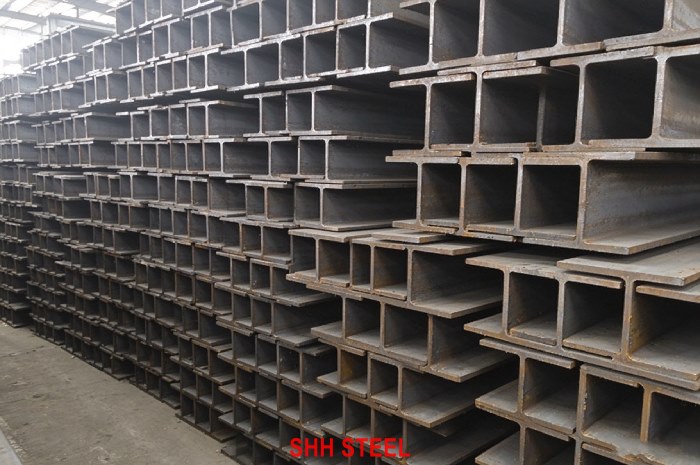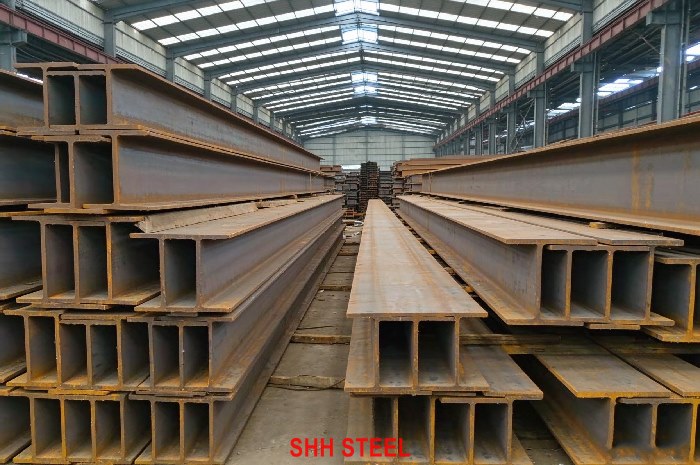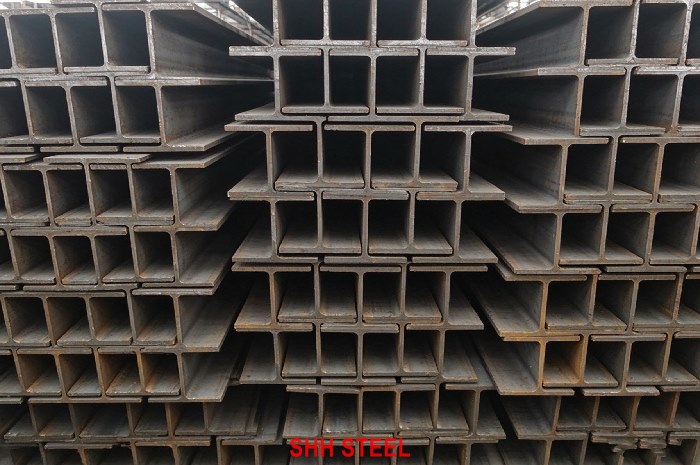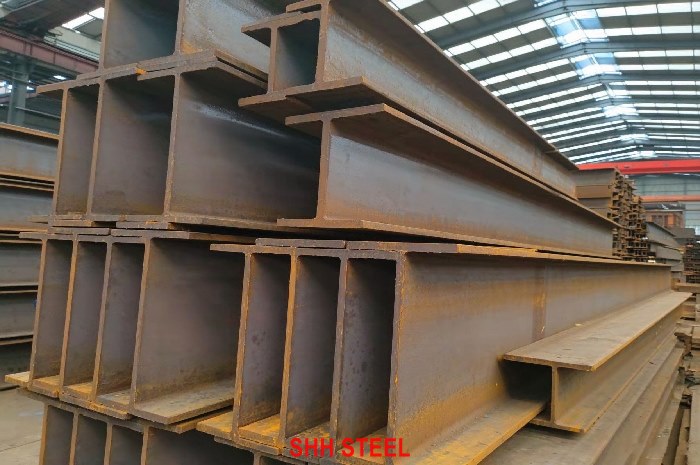
GB/T 11263 Q420B H-Beam
What is GB/T 11263 Q420B H-Beam?
GB/T 11263 Q420B H-beam is a hot-rolled Chinese H-section whose material grade is as-rolled Q420B under GB/T 1591 and whose shape, mass and tolerances are ordered to GB/T 11263. Q stands for yield strength, 420 is the minimum upper yield strength in MPa in the first thickness band, and B is the quality grade, which carries a longitudinal Charpy V-notch requirement of 34 J at +20 °C when impact testing applies. In GB/T 1591-2018, as-rolled Q420 is written only for sections and bars, in qualities B and C; there is no as-rolled Q420D or Q420E in Table 1.
This page covers the as-rolled Q420B lead grade together with as-rolled Q420C and the Q390B, Q390C and Q390D family, which share the same GB/T 11263 shape series. The 355 MPa sister is GB/T 11263 Q355B H-beam. These beams are filed under steel beam profiles in the steel structural profiles category. They are parallel-flange HW, HM or HN sections, not GB/T 706 taper-flange I-beams, and not European HEA, HEB or IPE sections of a similar depth.
Material, Dimensions and the Q390 / Q420 Quality Family
The purchase order and the inspection document should name, separately:
- GB/T 11263 is the product standard for hot-rolled H-sections and split T-sections. The tables on this page use the established HW/HM/HN series with 2017 theoretical masses. The edition of GB/T 11263 named on the order governs dimensional and mass acceptance.
- GB/T 1591 is the material standard. This page uses GB/T 1591-2018 as the numeric basis. The edition named on the order governs.
- the full as-rolled grade (Q420B, Q420C, Q390B, Q390C or Q390D), not a bare “Q420” or “Q390” call;
- the delivery condition (as-rolled on this page; N or M only when that route is actually ordered);
- the carbon equivalent, and the inspection document type.
As-rolled Q420 exists only in qualities B and C, and only for sections and bars. Q420D is not a Table 1 as-rolled grade. Q390 exists as-rolled in B, C and D.
Q420B H-Beam Sizes: GB/T 11263 HW, HM and HN Series
The tables give designation, actual depth h, width b, web thickness tw, flange thickness tf and theoretical mass per metre for the HW, HM and HN series as published against GB/T 11263-2017. They are the same dimensional series used for other GB/T 11263 grades, including Q355B and Q235B. They are reference dimensions for identification and estimating, not a rolling list for any one mill. Mid-range HW and HN sizes are the usual enquiry core; the lightest HN rows, the heavier HN 700–1000 sizes, and less common variants should be confirmed size by size.
GB/T 11263-2017 classified sections as HW, HM, HN (and HT for split tees). GB/T 11263-2024, implemented on 1 May 2025, reclassified sections as H and HK and revised appendix dimensions and masses. Export orders still often call sizes as HW, HM or HN. Masses in the 1998, 2017 and 2024 editions are not identical for every size, so the edition used for settlement must be written on the order.
Apply the GB/T 1591 thickness band that matches the governing thickness of the ordered size. For an H-section this is usually the flange, and for sections the standard points to the specimen-preparation thickness in GB/T 2975. In this 2017 series, fourteen tabulated flanges are thicker than 16 mm, and one row, HN 1000×300×19×36, has a 36 mm flange. No tabulated flange exceeds 40 mm. Later mechanical and CEV bands remain in the tables because a heavier special section could be agreed.
HW series (11 sizes, HW 100×100×6×8 to HW 400×400×13×21)
Swipe horizontally to view all dimensions.
HM series (11 sizes, HM 148×100×6×9 to HM 588×300×12×20)
Swipe horizontally to view all dimensions.
HN series (30 sizes, HN 100×50×5×7 to HN 1000×300×19×36)
Swipe horizontally to view all dimensions.
Q420 and Q390 Chemical Composition (Heat Analysis)
The figures below are heat-analysis maxima from GB/T 1591-2018 Table 1 for as-rolled steels. For these H-sections the relevant thickness is the specimen-preparation thickness in GB/T 2975, ordinarily the flange. Niobium may be raised to 0.07% and vanadium to 0.20% for Q390 and Q420. If acid-soluble aluminium is at least 0.015%, or total aluminium is at least 0.020%, or other nitrogen-fixing elements are added, nitrogen is not limited; those elements shall be stated on the certificate. For sections and bars, the standard allows the phosphorus and sulphur maxima to be raised by 0.005%. For sections thicker than 100 mm, carbon may be agreed. Elements not listed in Table 1 may be added by agreement and shall be reported.
Swipe horizontally to view all dimensions.
As-rolled Q420, including this chemistry table, is written for sections and bars only. A plate enquiry in Q420 should not assume this Table 1 row.
Q420 and Q390 Carbon Equivalent
Table 2 of GB/T 1591-2018 gives the following as-rolled CEV maxima, calculated from the heat analysis as C + Mn/6 + (Cr+Mo+V)/5 + (Ni+Cu)/15. In the tabulated HW/HM/HN series only HN 1000×300×19×36 has a flange above 30 mm, so it enters the second CEV band when the flange is the test location. Later bands remain in the table for a heavier special section.
Swipe horizontally to view all dimensions.
The 0.54% allowance is the figure the standard attaches to the >150–250 mm cell for sections and bars on Q420, not a general raising of the thinner bands. When silicon is controlled, for example for a hot-dip galvanizing route, and carbon or manganese is raised to keep the tensile properties, the standard allows a further CEV increment of 0.02% if silicon is not more than 0.030%, or 0.01% if silicon is not more than 0.25%, as footnoted on the Q355 row of the same table; if that increment is to be used it should be written on the order.
Q420 and Q390 Mechanical Properties: Yield, Tensile and Impact
Tensile properties of as-rolled Q390 and Q420 follow Tables 7 and 8 of GB/T 1591-2018. Thickness is the specimen-preparation thickness in GB/T 2975, ordinarily the flange. The default elongation column for sections is longitudinal. An HW 400×400 flange is 21 mm, so Q420B minimum yield is 410 MPa, not 420 MPa, and Q390B is 380 MPa, not 390 MPa. The HN 1000×300 flange is 36 mm, so those minima become 390 MPa and 360 MPa respectively.
Swipe horizontally to view all dimensions.
Longitudinal elongation is as follows. Dashes above 150 mm match Table 8; none of the tabulated flanges in the 2017 series reaches that thickness.
When impact testing applies (nominal thickness not less than 6 mm, using the GB/T 2975 specimen-preparation thickness for sections), Table 11 gives:
Swipe horizontally to view all dimensions.
Subsize specimens of 10 mm × 7.5 mm × 55 mm or 10 mm × 5 mm × 55 mm, when a standard specimen cannot be prepared, shall reach 75% or 50% of the Table 11 value; the larger specimen is preferred. Impact specimens are longitudinal unless a transverse test is agreed.
Delivery Conditions, Inspection and Identification
This page is written for the as-rolled condition. Normalizing (N) or a thermo-mechanical control process (M) is a different delivery route, with its own chemistry, CEV and tensile tables, and should be named only when it is actually ordered (for example Q420NB or Q420MB). The inspection document should identify GB/T 1591 and its edition, the full grade and quality letter, the as-rolled condition, the carbon equivalent, the GB/T 11263 designation and the edition used for dimensions and mass, ladle analysis, and tensile and impact results against the thickness at the test location, ordinarily the flange. Packaging, marks and certificates follow GB/T 2101. A plate certificate or a Q355B certificate does not, by itself, identify a Q420B H-beam.
Weldability of Q420B and Q390 H-Beams
Preheat and consumable choice should use the certified heat analysis, the certified CEV, the actual flange thickness and the joint design. Q420 has a higher nickel and molybdenum maximum than Q390; do not assume the two grades weld identically. A CEV raised under a silicon-control footnote should appear on the certificate if it is used.
GB/T 11263 Shape Tolerances and Theoretical Mass
Shape, mass and tolerances belong to the ordered edition of GB/T 11263. Mass in the size tables is the 2017 theoretical figure. Millimetre tolerance tables are not reproduced here. Settlement on theoretical or weighed mass should follow the contract and the named edition.
Applications and Service Limits
Q420B and Q390 H-beams are used in welded frames, industrial structures and similar work where a Chinese 420 MPa or 390 MPa as-rolled H-section is named. Choose the quality letter for the impact temperature actually required. They are not a silent substitute for GB/T 11263 Q355B H-beam, for a European S355 section, or for a JIS G 3106 H-section of similar depth. A Q420D as-rolled H-beam is not a Table 1 grade; if a −20 °C test is required on a 420 MPa section, agree the test or order an N/M quality that actually carries it.
Q420B Compared with Q390, Q355B and S355
The comparisons below are an orientation only; they are not automatic substitutes.
Near-Equivalents: Not Automatic Substitutes
A near-equivalent is a starting point for a discussion, not a licence to swap certificates. If a project names Q420B or Q390C, keep that grade, quality letter and GB/T 11263 on the order. The 355 MPa sister is GB/T 11263 Q355B H-beam.
Sourcing Q420B H-Beams from SHH STEEL
SHH STEEL supplies GB/T 11263 Q420B H-beams, and the Q390 family, against a named designation list, the quality letter, the material edition and the inspection document type. Enquiries should state the HW, HM or HN designations (or the 2024 H/HK calls if that edition is used), the grade and quality, cut lengths or mill lengths, any processing, and whether GB/T 11263 Q355B H-beam is acceptable on part of the list.
The size table is the standard series, not a claim that every designation is rolled in every quality. Once the list is clear, a quotation can be prepared against the stated edition and certificate.
Q420B H-Beam FAQs
-
Is there an as-rolled Q420D H-beam in GB/T 1591-2018?
- No. Table 1 lists as-rolled Q420 only in qualities B and C, and only for sections and bars. A −20 °C test on a 420 MPa section should be agreed on the order, or specified as an N or M quality that actually carries a D impact table.
-
Does every Q420B H-beam have a 420 MPa yield?
- No. 420 MPa is the minimum upper yield only up to 16 mm. Between 16 and 40 mm the minimum is 410 MPa. An HW 400×400 flange is 21 mm, so 410 MPa applies when the flange is the test location. The HN 1000×300 flange is 36 mm, so the minimum is 390 MPa.
-
Can I treat a Q390D certificate as a default −20 °C H-section test?
- Table 11 lists 34 J longitudinal / 27 J transverse at −20 °C for as-rolled Q355 and Q390 quality D, but footnotes those figures as applying only to Q355D plates thicker than 250 mm. A Q390D section order should state the required impact test, or use Q390ND or Q390MD, which have a complete D impact table.
-
Which editions are used on this page?
- Material tables use GB/T 1591-2018. Dimensional sizes and theoretical masses use the GB/T 11263-2017 HW/HM/HN series. GB/T 11263-2024 recodes those series as H and HK; the edition named on the order governs.
Request a Quotation for GB/T 11263 Q420B H-Beam
GB/T 11263 Q420B H-beam is an as-rolled Chinese H-section with 420 MPa minimum yield in the first thickness band and a 34 J impact requirement at +20 °C when testing applies. Nominate the HW, HM or HN designation, the full grade and quality letter (Q420B, Q420C, or a Q390 quality), GB/T 1591-2018 and the GB/T 11263 edition used for mass, and the inspection document type. Send the size list, grade, edition, certificate type and any processing notes; SHH STEEL will review the package and quote accordingly.
Quality Steel Needed? Inquire for Offers
Related Products