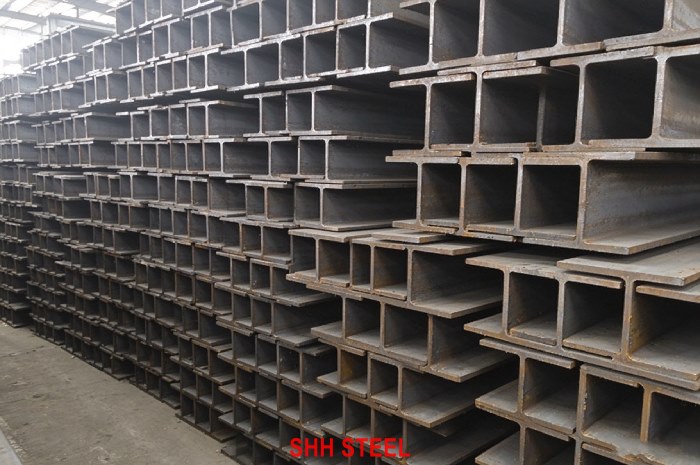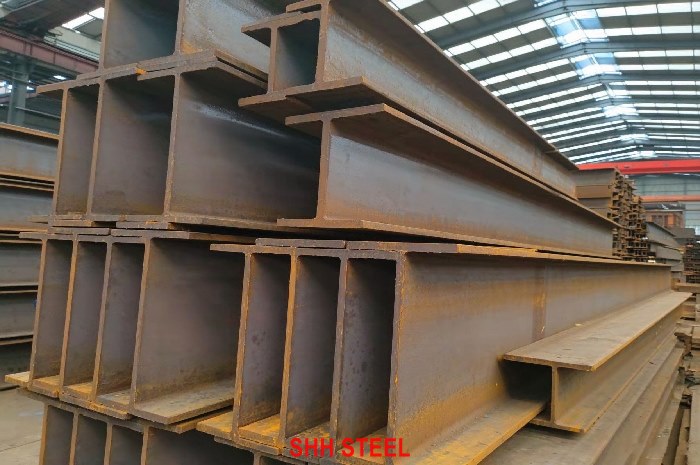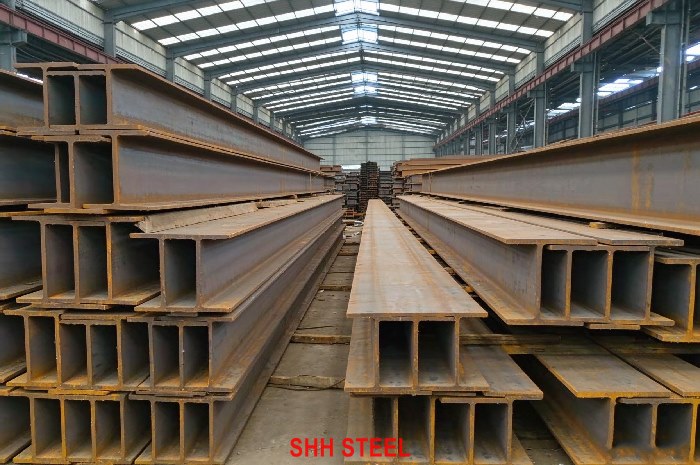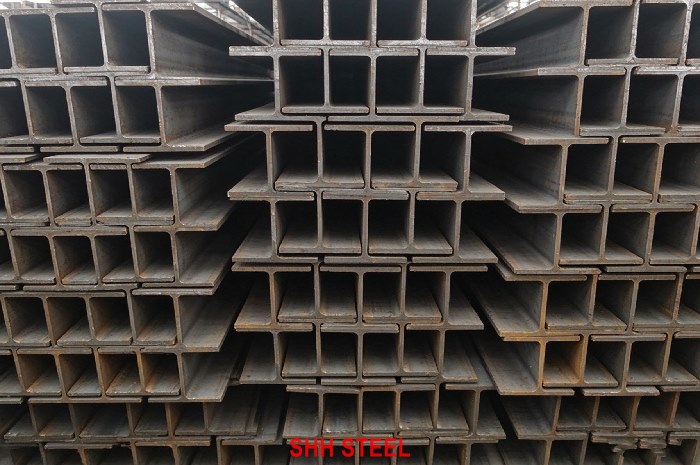
GB/T 11263 Q355D H-Beam
What is GB/T 11263 Q355D H-Beam?
GB/T 11263 Q355D H-beam is a hot-rolled Chinese H-section whose material grade is as-rolled Q355D under GB/T 1591 and whose shape, mass and tolerances are ordered to GB/T 11263. Q stands for yield strength, 355 is the minimum upper yield strength in MPa in the first thickness band, and D is the quality grade in the as-rolled Q355 family, written alongside B and C in Table 1. The +20 °C sister is GB/T 11263 Q355B H-beam.
This page covers as-rolled Q355D as the lead grade, as-rolled Q355C on the same page, and Q355E only as a normalized (Q355NE) or thermo-mechanically rolled (Q355ME) designation. Q355E is not an as-rolled Table 1 grade and must not be ordered as if it were. These beams are filed under steel beam profiles in the steel structural profiles category. They are parallel-flange HW, HM or HN sections, not GB/T 706 taper-flange I-beams, and not European HEA, HEB or IPE sections of a similar depth.
Material, Dimensions and the Q355C / Q355D / Q355E Family
The purchase order and the inspection document should name, separately:
- GB/T 11263 is the product standard for hot-rolled H-sections and split T-sections. The tables on this page use the established HW/HM/HN series with 2017 theoretical masses. The edition of GB/T 11263 named on the order governs dimensional and mass acceptance.
- GB/T 1591 is the material standard. This page uses GB/T 1591-2018 as the numeric basis. The edition named on the order governs.
- the full grade and quality letter (Q355C or Q355D as-rolled; Q355NE or Q355ME if an E-quality N or M route is actually required);
- the delivery condition;
- the carbon equivalent, the required impact test, and the inspection document type.
Q355B remains a separate page. Do not treat a B certificate as a C or D result.
Q355D H-Beam Sizes: GB/T 11263 HW, HM and HN Series
The tables give designation, actual depth h, width b, web thickness tw, flange thickness tf and theoretical mass per metre for the HW, HM and HN series as published against GB/T 11263-2017. They are the same dimensional series used for other GB/T 11263 grades, including Q355B and Q235B. They are reference dimensions for identification and estimating, not a rolling list for any one mill. Mid-range HW and HN sizes are the usual enquiry core; the lightest HN rows, the heavier HN 700–1000 sizes, and less common variants should be confirmed size by size.
GB/T 11263-2017 classified sections as HW, HM, HN (and HT for split tees). GB/T 11263-2024, implemented on 1 May 2025, reclassified sections as H and HK and revised appendix dimensions and masses. Export orders still often call sizes as HW, HM or HN. Masses in the 1998, 2017 and 2024 editions are not identical for every size, so the edition used for settlement must be written on the order.
Apply the GB/T 1591 thickness band that matches the governing thickness of the ordered size. For an H-section this is usually the flange, and for sections the standard points to the specimen-preparation thickness in GB/T 2975. In this 2017 series, fourteen tabulated flanges are thicker than 16 mm, and one row, HN 1000×300×19×36, has a 36 mm flange. No tabulated flange exceeds 40 mm. Later mechanical and CEV bands remain in the tables because a heavier special section could be agreed.
HW series (11 sizes, HW 100×100×6×8 to HW 400×400×13×21)
Swipe horizontally to view all dimensions.
HM series (11 sizes, HM 148×100×6×9 to HM 588×300×12×20)
Swipe horizontally to view all dimensions.
HN series (30 sizes, HN 100×50×5×7 to HN 1000×300×19×36)
Swipe horizontally to view all dimensions.
Q355C and Q355D Chemical Composition (Heat Analysis)
The figures below are heat-analysis maxima from GB/T 1591-2018 Table 1 for as-rolled Q355C and Q355D. Niobium, vanadium, titanium and molybdenum are dashes in that table; they may be added as necessary under 7.1.6 and shall be reported when they are added. For sections and bars, the standard allows the phosphorus and sulphur maxima to be raised by 0.005%. For sections thicker than 100 mm, carbon may be agreed. In the tabulated 2017 series only HN 1000×300 has a flange above 30 mm; none exceeds 40 mm, so the 0.22% carbon column is kept for a thicker special section or a relocated specimen.
Swipe horizontally to view all dimensions.
Q355E chemistry is not in Table 1. If Q355NE or Q355ME is ordered, the chemistry, CEV and tensile tables of the N or M route (Tables 3 and 4, or 5 and 6, with Tables 9 or 10) apply; they are not retabulated in full on this as-rolled page.
Q355C and Q355D Carbon Equivalent
Table 2 of GB/T 1591-2018 gives the following as-rolled CEV maxima, calculated from the heat analysis as C + Mn/6 + (Cr+Mo+V)/5 + (Ni+Cu)/15. The HN 1000×300 flange is 36 mm, so that row enters the 0.47% band when the flange is the test location.
Swipe horizontally to view all dimensions.
The 0.54% allowance is the figure the standard attaches to the >150–250 mm cell for sections and bars, not a general raising of the thinner bands. When silicon is controlled, for example for a hot-dip galvanizing route, and carbon or manganese is raised to keep the tensile properties, the standard allows the tabulated CEV maximum to be increased by 0.02% if silicon is not more than 0.030%, or by 0.01% if silicon is not more than 0.25%. Those increments should appear on the order if they are to be used.
Q355C and Q355D Mechanical Properties: Yield, Tensile and Impact
Tensile properties of as-rolled Q355C and Q355D follow Tables 7 and 8 of GB/T 1591-2018 and are the same yield and longitudinal elongation table used for Q355B. Thickness is the specimen-preparation thickness in GB/T 2975, ordinarily the flange. An HW 400×400 flange is 21 mm, so the minimum yield is 345 MPa, not 355 MPa. The HN 1000×300 flange is 36 mm, so the minimum yield is 335 MPa. Table 7’s 265 MPa yield and the last tensile column above 250 mm are footnoted for quality D plates only and are not used for these H-sections.
Swipe horizontally to view all dimensions.
When impact testing applies (nominal thickness not less than 6 mm, using the GB/T 2975 specimen-preparation thickness for sections), Table 11 is as follows.
Swipe horizontally to view all dimensions.
Subsize specimens of 10 mm × 7.5 mm × 55 mm or 10 mm × 5 mm × 55 mm, when a standard specimen cannot be prepared, shall reach 75% or 50% of the Table 11 value; the larger specimen is preferred. Impact specimens are longitudinal unless a transverse test is agreed. A Q355B certificate does not demonstrate a 0 °C or −20 °C test.
Delivery Conditions, Inspection and Identification
Q355C and Q355D on this page are as-rolled grades. Q355E must be ordered as Q355NE or Q355ME; it is not an as-rolled Table 1 grade. The inspection document should identify GB/T 1591 and its edition, the full grade and quality letter and the delivery condition, the carbon equivalent, the GB/T 11263 designation and the edition used for dimensions and mass, ladle analysis, and tensile and impact results against the thickness at the test location, ordinarily the flange. A plate certificate or a Q355B certificate does not, by itself, identify a Q355D H-beam.
Weldability of Q355C and Q355D H-Beams
Preheat and consumable choice should use the certified heat analysis, the certified CEV, the actual flange thickness and the joint design. A CEV raised under a silicon-control footnote should appear on the certificate if it is used.
GB/T 11263 Shape Tolerances and Theoretical Mass
Shape, mass and tolerances belong to the ordered edition of GB/T 11263. Mass in the size tables is the 2017 theoretical figure. Millimetre tolerance tables are not reproduced here. Settlement on theoretical or weighed mass should follow the contract and the named edition.
Applications and Service Limits
Q355C and Q355D H-beams are used in welded frames and similar work where a Chinese 355 MPa H-section is named with a 0 °C or a specified low-temperature test. Because Table 11 footnotes the as-rolled D −20 °C figures to Q355D plates thicker than 250 mm, a section order that actually requires a −20 °C test should say so, or should name Q355ND or Q355MD. These sections are not a silent substitute for GB/T 11263 Q355B H-beam, for GB/T 11263 Q235B H-beam, or for a European S355J2 H-section.
Q355D Compared with Q355B, Q355C and S355J2
The comparisons below are an orientation only; they are not automatic substitutes.
Near-Equivalents: Not Automatic Substitutes
A near-equivalent is a starting point for a discussion, not a licence to swap certificates. If a project names Q355D or Q355C, keep that quality letter, the delivery condition and GB/T 11263 on the order. The +20 °C sister is GB/T 11263 Q355B H-beam.
Sourcing Q355D H-Beams from SHH STEEL
SHH STEEL supplies GB/T 11263 Q355D and Q355C H-beams against a named designation list, the quality letter, the material edition, the required impact test and the inspection document type. Enquiries should state the HW, HM or HN designations (or the 2024 H/HK calls if that edition is used), whether the route is as-rolled or an N/M E quality, cut lengths or mill lengths, any processing, and whether GB/T 11263 Q355B H-beam is acceptable on part of the list.
The size table is the standard series, not a claim that every designation is rolled in every quality. Once the list is clear, a quotation can be prepared against the stated edition and certificate.
Q355D H-Beam FAQs
-
Is Q355E an as-rolled H-beam grade?
- No. Q355E is not in Table 1 of GB/T 1591-2018. Quality E exists on the normalized and TMCP routes as Q355NE or Q355ME, with a −40 °C impact table. Do not treat an as-rolled Q355D certificate as Q355E.
-
Does as-rolled Q355D automatically mean 34 J at −20 °C on an H-beam?
- Table 11 lists 34 J longitudinal / 27 J transverse at −20 °C for as-rolled Q355 and Q390 quality D, but footnotes those figures as applying only to Q355D plates thicker than 250 mm. A Q355D H-section order that requires a −20 °C test should state that test, or should name Q355ND or Q355MD, which have a complete D impact table.
-
How does Q355C differ from Q355B?
- Both are as-rolled 355 MPa grades. C uses a thickness-split carbon table (0.20% up to 40 mm, 0.22% above), tighter phosphorus and sulphur (0.030%), and a 0 °C impact test at 34 J longitudinal / 27 J transverse. B is tested at +20 °C and uses a 0.24% carbon maximum, with 0.22% above 30 mm.
-
Which editions are used on this page?
- Material tables use GB/T 1591-2018. Dimensional sizes and theoretical masses use the GB/T 11263-2017 HW/HM/HN series. GB/T 11263-2024 recodes those series as H and HK; the edition named on the order governs.
Request a Quotation for GB/T 11263 Q355D H-Beam
GB/T 11263 Q355D H-beam is an as-rolled Chinese H-section in the 355 MPa yield class. Nominate the HW, HM or HN designation, the quality letter (C or D as-rolled, or NE/ME if an E-quality N or M route is required), the impact test actually required, GB/T 1591-2018 and the GB/T 11263 edition used for mass, and the inspection document type. Send the size list, grade, edition, certificate type and any processing notes; SHH STEEL will review the package and quote accordingly.
Quality Steel Needed? Inquire for Offers
Related Products