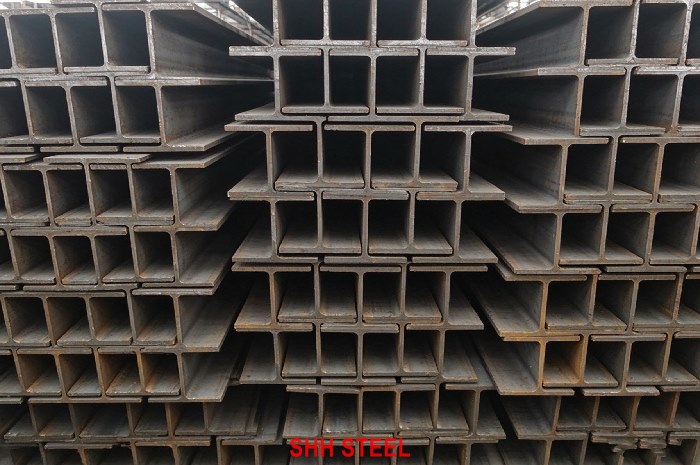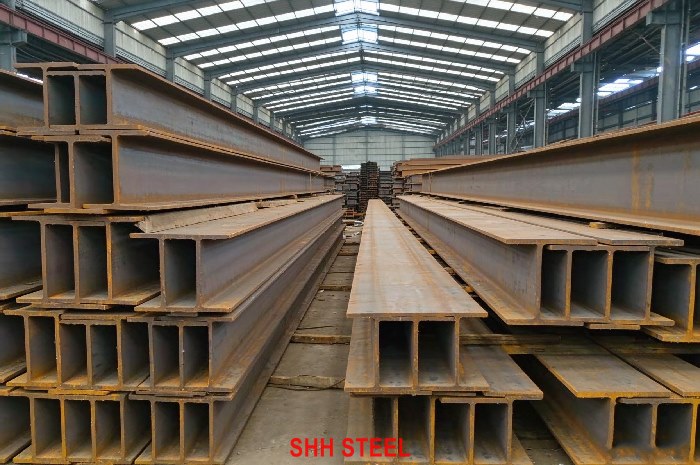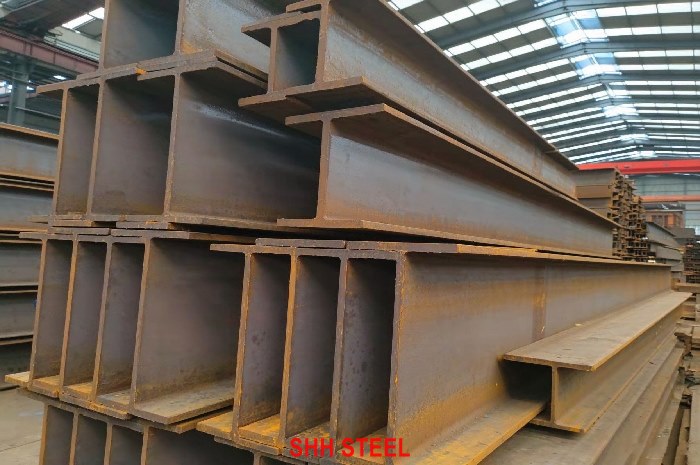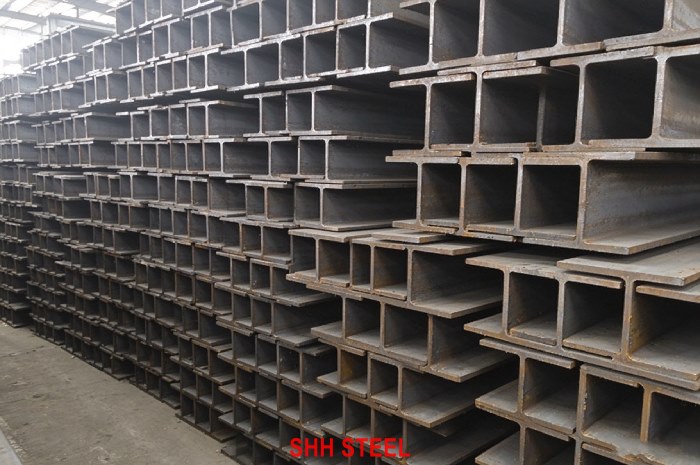
GB/T 11263 Q355B H-Beam
What is GB/T 11263 Q355B H-Beam?
GB/T 11263 Q355B H-beam is a hot-rolled H-section whose material grade is as-rolled Q355B under GB/T 1591 and whose shape, tolerances and theoretical mass are ordered to GB/T 11263. Q stands for yield strength, 355 is the minimum upper yield strength in MPa for the thinnest tabulated thickness band, and B is the quality grade. For quality B the Charpy V-notch requirement is 34 J on a longitudinal specimen, or 27 J on a transverse specimen, at +20 °C. Longitudinal specimens are the default; transverse testing is by agreement.
This page covers the rolled H-section, not plate. The same grade in plate form is listed separately as Q355B steel plate (GB/T 1591). Sampling direction, elongation and some thickness-band footnotes differ between plates and sections, so the plate page is not a substitute data sheet for H-beams. GB/T 1591 itself refers the dimensions, shape, mass and tolerances of hot-rolled H-sections to GB/T 11263.
These beams are filed under GB/T 11263 in the steel beam profiles category of steel structural profiles. The Chinese commercial size families remain HW, HM and HN. Those names belong only to this dimensional system; they are not a key to European HEA/HEB/IPE or to American W-shapes of a similar nominal depth.
Q355B is the current as-rolled 355 MPa quality-B grade in GB/T 1591-2018, which replaced the former Q345 designation. It is a high-strength low-alloy structural steel for building frames, plant structures and general fabrication where a +20 °C impact quality is accepted. It is not Q355N or Q355M, not a weathering grade, and not a pressure-vessel or nuclear safety material. An enquiry that still says only “Q345B H-beam” should be confirmed against the 2018 designation and edition before rolling.
Material, Dimensions and Tolerances for Q355B Sections
Three documents should appear, separately, on the purchase order and on the inspection certificate:
- GB/T 1591 is the material standard for high-strength low-alloy structural steels. This article uses the as-rolled Q355B chemistry, carbon equivalent, tensile and impact values published in GB/T 1591-2018. Normalized (N) and thermomechanical (M) Q355 grades have their own tables and are a different order. The edition named on the order governs acceptance.
- GB/T 11263 is the product standard for hot-rolled H-sections and split T-sections. The 2017 edition classified sections as HW, HM, HN (and HT for split tees). GB/T 11263-2024, implemented on 2025-05-01, reclassified sections as H and HK and revised appendix dimensions and masses. Export orders still often call sizes as HW, HM or HN. The tables below use the established HW/HM/HN series with 2017 theoretical masses. Masses in the 1998, 2017 and 2024 editions are not identical for every size, so the edition used for settlement must be written on the order.
- Tolerances on depth, width, thickness, out-of-square, web off-centre, straightness and mass are those of the ordered GB/T 11263 edition, not of GB/T 1591.
A mill may certify Q355B on a Japanese or European shape, or roll an HW section to a different material standard, if that combination is in its programme and is fully documented. Do not treat “Q355B H-beam” as if it automatically meant an HW 300×300, and do not substitute EN 10025-2 S355JR H-beam sizes or ASTM A572 W-shapes by matching a nominal 300 mm or 12 in depth.
Q355B H-Beam Sizes: HW, HM and HN Reference Tables
The tables give designation, actual depth h, width b, web thickness tw, flange thickness tf and theoretical mass per metre for the HW, HM and HN series as published against GB/T 11263-2017. They are the same dimensional series used for other GB/T 11263 grades, including Q235B. They are reference dimensions for identification and estimating, not a rolling list for any one mill and not a claim that every size is produced in Q355B. Mid-range HW and HN sizes are the usual enquiry core; the lightest HN rows, the heavier HN 700–1000 sizes, and less common variants should be confirmed size by size.
Apply the GB/T 1591 thickness band that matches the governing thickness of the ordered size — for an H-section this is usually the flange, and for sections the standard points to the specimen-preparation thickness in GB/T 2975. The headline 355 MPa yield applies only up to 16 mm. Many mid-range flanges sit in the 16–40 mm band, where the minimum yield is 345 MPa; heavier HN flanges fall further. That is a material-standard effect, not a reason to pick a different size table.
HW sections are the wide-flange, essentially square family. HM sits between square and narrow (HM 300×200 has an actual depth of 294 mm). HN is the narrow-flange family used as beams rather than columns. A model name such as HM 150×100 is a series call; the actual depth may be slightly less. Root radius and cross-sectional area are omitted because they were not printed in the 2017 mass table used here.
Theoretical mass is the 2017 figure. Settlement on 1998 or 2024 masses will give a different kilogram total. State the edition, and whether theoretical or weighed mass applies, on the order.
HW series
Wide-flange H-sections, 11 sizes in the 2017 table, from HW 100×100×6×8 to HW 400×400×13×21, including the heavier 250×255 and 300×305 variants.
Swipe horizontally to view all dimensions.
HM series
Medium-flange H-sections, 11 sizes, from HM 148×100×6×9 to the 600 mm-class 588×300×12×20.
Swipe horizontally to view all dimensions.
HN series
Narrow-flange H-sections, 30 sizes, from HN 100×50×5×7 to HN 1000×300×19×36. Several 2017 rows (including 550, 625, 630 and 1000) do not appear in the older 1998 column and should be called by their actual 2017 dimensions.
Swipe horizontally to view all dimensions.
Japanese metric H sizes follow JIS G 3192 and are not selected from these HW/HM/HN tables. European HEA/HEB/IPE sizes belong to that material system, as shown on the S355JR H-beam page, not as Q355B dimensions.
Q355B Chemical Composition (GB/T 1591 As-Rolled Ladle Analysis)
The figures below are ladle-analysis maxima for as-rolled Q355B in GB/T 1591-2018 Table 1. They are limits, not typical heat results. Product analysis, when required, follows the deviations in GB/T 222. These values are not the Table 3 or Table 5 limits used for Q355N or Q355M, and they should not be taken from unofficial trader sheets that still quote a 0.20% carbon cap or a 0.030% phosphorus cap as if those were the quality-B as-rolled defaults.
Quality C and D of the same steel grade use a thickness-split carbon table (0.20% up to 40 mm, 0.22% above) and tighter phosphorus and sulphur. Those are different quality letters, not a silent tightening of Q355B.
Q355B Carbon Equivalent for As-Rolled Steel
The carbon equivalent is calculated from the ladle analysis by the standard IIW formula given in GB/T 1591: CEV = C + Mn/6 + (Cr + Mo + V)/5 + (Ni + Cu)/15. Table 2 maxima for as-rolled Q355 (qualities B, C and D share these cells) are:
When silicon is controlled, for example for a hot-dip galvanizing route, and carbon or manganese is raised to keep the tensile properties, the standard allows the tabulated CEV maximum to be increased by 0.02% if silicon is not more than 0.030%, or by 0.01% if silicon is not more than 0.25%. Those increments should appear on the order if they are to be used. This page does not quote other raised CEV figures for thinner bands, because the 0.54% allowance is the one the standard attaches to the >150–250 mm cell for sections and bars.
Q355B Mechanical Properties: Yield, Tensile and +20 °C Impact
Tensile properties of as-rolled Q355 are thickness-dependent. The values below are from GB/T 1591-2018 Tables 7 and 8, using the longitudinal elongation column that applies to sections and bars. For sections, the governing thickness is the specimen-preparation thickness defined in GB/T 2975, not a casual reading of the web. Transverse elongation values in Table 8 are two percentage points lower in the thinner bands and are the usual plate orientation — see Q355B steel plate rather than this table for plate sampling.
Quality B and C share the yield and tensile columns through 250 mm. The >250–400 mm yield of 265 MPa and the corresponding tensile footnote apply only to quality D plate, so they are omitted here. When yield is not clearly pronounced, Rp0.2 may be used in place of ReH, as the standard allows.
Quality B requires a Charpy V-notch absorbed energy at +20 °C of 34 J on a longitudinal specimen, or 27 J if a transverse specimen is agreed. The default is longitudinal. If the project needs 34 J at 0 °C or at −20 °C, the grade to nominate is Q355C or Q355D, not Q355B. Q355N and Q355M have their own impact ladders and are not covered by this as-rolled table.
Apply the band that matches the governing thickness. An HW 400×400 flange is 21 mm, so the minimum yield is 345 MPa, not 355 MPa. That is expected, and it is one reason this grade is not interchangeable by name with a 16 mm plate value.
Delivery Conditions, Inspection and Identification
This product is as-rolled Q355B. GB/T 1591 also defines normalized and thermomechanical Q355 grades; those conditions, and their chemistry tables, must be named if they are required. The inspection document should show the material edition, the grade Q355B, the delivery condition, the GB/T 11263 edition used for dimensions and mass, the size designation, the heat number, ladle analysis, the carbon equivalent, and the tensile and impact results.
An EN 10204 type 3.1 document is the usual export request; type 3.2 or nominated third-party attendance can be added when the specification requires it. Identification on the product follows the mill’s marking practice and the ordered standards: typically the grade, mill identification and heat or piece reference.
Length is not fixed by the size table. Mills commonly roll these sections in fixed lengths in the region of 6–15 m; other lengths are a matter for the rolling programme and the order.
Weldability and Surface Condition of Q355B H-Beams
Q355B is a weldable high-strength low-alloy structural steel when thickness, joint design, hydrogen control and the actual carbon equivalent are taken into account. The CEV table above is the starting point; the certificate values and a procedure suited to the thickness are the practical controls. This page does not prescribe a procedure or a preheat chart.
The as-rolled surface is mill scale. A blast class, a paint system, or a hot-dip galvanizing chemistry is an order option, not something implied by the grade name. If galvanizing is planned, the silicon and phosphorus on the heat, the CEV footnotes for controlled silicon, and the processor’s coating specification should be reviewed before production. Surface quality also follows the ordered edition of GB/T 11263; special finish requirements belong in the enquiry.
Cutting to length, weld-end preparation, forming or coating can be reviewed when the specification is sent with the enquiry. They are not assumed for every size.
GB/T 11263 Shape Tolerances and Theoretical Mass
Dimensional and mass tolerances for these H-sections are those of GB/T 11263, not of GB/T 1591. The ordered edition matters: 2017 and 2024 do not use identical tolerance wording or mass appendices. This article does not reproduce the millimetre tolerance tables; acceptance is against the edition named on the order.
The size tables above are nominal reference dimensions. A delivered HW 200×200 will measure close to 200 × 200 × 8 × 12 mm within those tolerances, not as a set of exact advertised millimetres. Out-of-square and web off-centre matter for end-plate connections.
The kg/m column is a 2017 theoretical mass. Weighed mass may sit above or below that figure and still be within tolerance. Settlement should follow the contract — 2017 theoretical mass, 2024 theoretical mass, 1998 theoretical mass, or weighed mass — not an informal mix of those bases.
Applications and Service Limits
Q355B H-beams are used where a 355 MPa yield class and a +20 °C impact quality are accepted:
- Building frames, plant structures, platforms and general structural fabrication that specify a 355 MPa Chinese grade.
- Members that were historically called Q345B, once the 2018 designation, edition and tables have been confirmed on the order.
- Export packages that compare the grade with S355JR or with a 50 ksi American shape, provided each line keeps its own standard and shape system.
It is not specified here for pressure equipment, for nuclear safety-related components, or for structures whose specification requires a lower impact-test temperature or a normalized or thermomechanical delivery condition. Durability comes from the coating or fire-protection system, not from the grade name. Weathering or marine exposure needs an agreed protection system, not bare Q355B.
Q355B Compared with Q235B, S355JR and A572 Grade 50
Q355B and Q235B share the HW/HM/HN shape system under GB/T 11263, but they are different material standards and different yield classes. Q235B is specified to GB/T 700, with a 235 MPa yield class, a looser phosphorus and sulphur table, no published CEV maximum, and a 27 J longitudinal impact requirement at +20 °C. An enquiry that says only “Chinese H-beam” is incomplete.
S355JR H-beam is a near-equivalent in yield class, but it is rolled as HEA, HEB or IPE (or UB/UC), not as HW/HM/HN, unless a mill has a documented special combination, and its impact requirement is 27 J rather than 34 J longitudinal. ASTM A572 Grade 50 wide-flange beams are a 50 ksi (345 MPa) grade on W-shapes to ASTM A6. Dual certification is possible only when the delivered piece meets every requirement of each named standard, including chemistry, tests, dimensions and tolerances.
Near-Equivalents: Not Automatic Substitutes
The comparisons below are for orientation. They are not a licence to substitute one grade for another on a contract or a mill certificate. Where a project allows an alternative, the substitution should be written into the order and verified on the inspection document.
Sister beam pages in this series (Q235B, A572 Grade 50, S355J0, S355J2) will be linked here once they are published. Until then, use the live category and plate links above, and the published S355JR H-beam page when the comparison is with the 355 MPa European grade.
Sourcing Q355B H-Beams from SHH STEEL
SHH STEEL supplies Q355B H-beams as an export trading house, coordinating mill production and project procurement. The useful part of that model is to align the material edition (GB/T 1591-2018, as-rolled Q355B rather than a former Q345B call or an N/M condition), the carbon-equivalent basis, the shape edition and mass basis (GB/T 11263-2017 or 2024, and whether HW/HM/HN or the newer H/HK calls are to be used), and the inspection document before a rolling programme is committed.
Sections can be sourced from mills that SHH STEEL buys from, including Masteel, Rizhao Steel, Laiwu (Shandong Steel Laiwu) and Tung Ho Steel, among others when the programme matches the order. Those mills do not each roll every HW, HM or HN size in Q355B. Mid-range sizes are the usual core; heavier HN and special 2017-only sizes are confirmed per line. Mixed procurement can be used when a take-off spans more than one rolling programme.
The same enquiry can also cover European, American or Japanese designations, provided each line states its material standard, shape standard and size. If cutting, weld-end preparation, forming or a coating system is required, include that specification for review. Export packing and container loading can be arranged to the packing list agreed for the shipment.
Q355B H-Beam FAQs
-
Is Q355B the same as Q345B?
- Q355B is the current as-rolled quality-B grade in GB/T 1591-2018; that edition replaced the Q345 designation with Q355. Appendix A maps Q355B to the former Q345B, but a historical Q345B certificate should not be treated as automatically meeting the 2018 tables. New orders should name Q355B and the 2018 edition (or the edition actually agreed).
-
Why is the minimum yield not always 355 MPa?
- 355 MPa is the minimum upper yield strength only up to 16 mm. The minimum falls through the Table 7 thickness bands, to 345 MPa between 16 and 40 mm and lower for heavier flanges. For an H-section the governing thickness is usually the flange, using the specimen-preparation thickness in GB/T 2975.
-
Is the impact requirement 27 J, like S355JR?
- No. As-rolled Q355B requires 34 J on a longitudinal specimen at +20 °C, or 27 J if a transverse specimen is agreed. S355JR uses 27 J at +20 °C under EN 10025-2. The two figures are not interchangeable, and the shape systems differ as well.
-
Can I replace an HW section with an HEA or W-shape of the same depth?
- No. HW, HM and HN are the GB/T 11263 families. HEA/HEB/IPE and American W-shapes are different series with different widths, flange thicknesses, masses and tolerance standards. Select the section from the standard named on the drawing, or obtain a formal design change.
-
Which standards should appear on the mill certificate?
- At least GB/T 1591 and its edition, the grade Q355B, the as-rolled delivery condition, the carbon equivalent, the GB/T 11263 edition used for dimensions and theoretical mass, the size designation (HW/HM/HN or the 2024 H/HK call, as ordered), ladle analysis, tensile results by thickness, and the +20 °C impact result (34 J longitudinal unless a transverse test was agreed).
Request a Quotation for GB/T 11263 Q355B H-Beam
GB/T 11263 Q355B H-beam is an as-rolled high-strength low-alloy H-section with 355 MPa minimum yield up to 16 mm and a 34 J longitudinal impact requirement at +20 °C. Nominate the HW, HM or HN size to the agreed edition of GB/T 11263, and name GB/T 1591-2018 (or the edition on the order) as the material standard, in the as-rolled condition. The tables are 2017 reference dimensions, not a rolling list. Send the size list, edition, carbon-equivalent basis, certificate type and any processing notes; SHH STEEL will review the package and quote accordingly.
Quality Steel Needed? Inquire for Offers
Related Products