
CCS D36 / DH36 Shipbuilding Steel Plate
CCS D36 / DH36 (CCS D36 / DH36) shipbuilding steel plate — overview
China Classification Society lists CCS D36 / DH36 (CCS D36 / DH36) as a higher-strength hull grade with Charpy fixed at −20 °C under CCS Materials / IACS UR W11. Purchase orders should write both D36 and DH36 (or the dual stamp CCS D36 / DH36) so the mill and Surveyor match the drawing. Strength level 36 means minimum yield 355 N/mm², tensile 490–630 N/mm² and elongation 21 % min. (A5). The letter DH (short D) fixes Charpy V-notch testing at −20 °C. GB 712 Grade DH36 covers the same chemistry/tensile band as a Chinese product standard; CCS class work still needs the CCS D36 / DH36 stamp, not GB 712 alone. In commercial enquiries it is called CCS D36 / DH36 or CCS D36 / DH36 shipbuilding steel plate.
Equivalent grades: CCS D36 / DH36 ≈ ASTM A131 Grade DH36 ≈ ABS DH36 ≈ DNV NV D36 ≈ LR DH36 ≈ BV DH36 ≈ NK KD36 ≈ KR RD36 ≈ RINA DH36 ≈ GB 712 Grade DH36 (all class-approved, stamped by the issuing society).
CCS D36 / DH36 is selected when scantlings need the higher yield of the 36 band and the material class assigns −20 °C toughness. Ordinary-strength CCS Grade A–E stay at 235 N/mm² yield and cannot replace D36/DH36 without a drawing change. Within the 36 band, letter choice is toughness: A/AH 0 °C → D/DH −20 °C → E/EH −40 °C → F/FH −60 °C; within the DH letter, strength steps 32 → 36 → 40 raise yield from 315 to 355 to 390 N/mm².
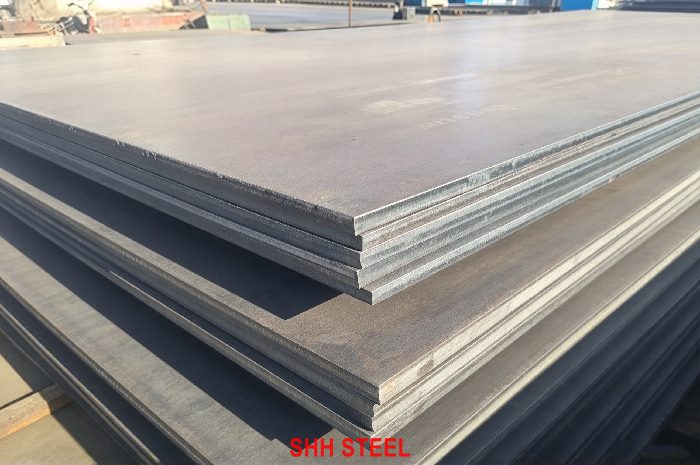
Plates that pass mill tests under CCS survey are die-stamped or stencilled CCS D36, CCS DH36 or CCS D36 / DH36 (plus Z or U where through-thickness or ultrasonic requirements apply) and are supplied with a mill certificate the CCS Surveyor endorses. SHH STEEL supplies CCS D36 / DH36 from Chinese mills that hold CCS works approval for the grade, from stock in common sizes or from a mill rolling cycle, with CCS survey arranged at the mill.
CCS CCS D36 / DH36 plate: specification summary
| Item | CCS CCS D36 / DH36 / D36 / DH36 data |
|---|---|
| Rule basis | CCS Rules for Materials; IACS UR W11 higher-strength Grade DH36 (CCS Materials paragraph cross-refs UNCERTAIN without local CCS PDF) |
| Commercial dual name | CCS D36 / DH36 (both forms used in prose and PO; same grade) |
| Related product standard | GB 712 Grade DH36 — aligned chemistry/tensile; not class approval alone |
| Strength level | higher strength 36, yield 355 N/mm² min., tensile 490–630 N/mm² |
| Toughness class | DH / D → Charpy at −20 °C |
| Plate thickness primarily covered | up to 100 mm under IACS UR W11 scope for plates; greater thickness by special consideration (see UNCERTAIN) |
| Deoxidation | killed, fine grain practice (UR W11) |
| Impact test | Charpy V at −20 °C; frequency and supply condition per UR W11 / CCS Materials tables |
| Marking | CCS D36 / DH36 / CCS D36 / DH36; plus Z / U / TM where ordered and qualified |
| TMCP Ceq (indicative UR W11 / industry practice) | ≤ 0.38 % for t ≤ 50 mm; ≤ 0.40 % for 50 < t ≤ 100 mm (TM steels) — confirm on mill approval / PO |
| Thickness tolerance | IACS UR W13 as adopted by CCS (minus tolerance commonly 0.3 mm class — confirm on PO; see UNCERTAIN) |
| Certificate | mill certificate endorsed by the CCS Surveyor; EN 10204 3.1 / 3.2 on request |
Size range. Common market thicknesses for D36/DH36 are about 6–80 mm (heavier plates available as per mill approval), widths 1500–3500 mm. Exact maximum thickness for a given delivery condition is as per standard and mill certificate / CCS works approval. Ask for confirmation above 100 mm.
CCS D36 / DH36 (CCS D36 / DH36) chemical composition (heat and product analysis)
| Element | Heat (ladle) analysis, % | Product (check) analysis, % | Note |
|---|---|---|---|
| C | 0.18 max. | numeric tolerance not tabulated in CCS Rules for Materials and Welding – agree on order / mill certificate | AH/DH/EH group |
| Mn | 0.90–1.60 (AH ≤12.5 mm may be 0.70 min.) | numeric tolerance not tabulated in CCS Rules for Materials and Welding – agree on order / mill certificate | AH ≤12.5 mm may use 0.70 % Mn min. |
| Si | 0.10–0.50 | numeric tolerance not tabulated in CCS Rules for Materials and Welding – agree on order / mill certificate | min. waived if acid-soluble Al ≥ 0.015 % |
| P | 0.035 max. | numeric tolerance not tabulated in CCS Rules for Materials and Welding – agree on order / mill certificate | |
| S | 0.035 max. | numeric tolerance not tabulated in CCS Rules for Materials and Welding – agree on order / mill certificate | |
| Al (acid soluble) min. | 0.015 min. acid-soluble (or total Al per UR W11 fine-grain practice) | numeric tolerance not tabulated in CCS Rules for Materials and Welding – agree on order / mill certificate | grain refining |
| Nb | 0.02–0.05 when used singly | numeric tolerance not tabulated in CCS Rules for Materials and Welding – agree on order / mill certificate | when used singly; combined minima in UR W11 |
| V | 0.05–0.10 when used singly | numeric tolerance not tabulated in CCS Rules for Materials and Welding – agree on order / mill certificate | when used singly |
| Ti | 0.02 max. | numeric tolerance not tabulated in CCS Rules for Materials and Welding – agree on order / mill certificate | need not be reported unless intentionally added |
| Cu | 0.35 max. | numeric tolerance not tabulated in CCS Rules for Materials and Welding – agree on order / mill certificate | |
| Cr | 0.20 max. | numeric tolerance not tabulated in CCS Rules for Materials and Welding – agree on order / mill certificate | |
| Ni | 0.40 max. | numeric tolerance not tabulated in CCS Rules for Materials and Welding – agree on order / mill certificate | |
| Mo | 0.08 max. | numeric tolerance not tabulated in CCS Rules for Materials and Welding – agree on order / mill certificate | |
| N | — | numeric tolerance not tabulated in CCS Rules for Materials and Welding – agree on order / mill certificate | not specified as a max in AH/DH/EH column |
Product (check) analysis column: CCS Rules for Materials and Welding specify heat (ladle) limits; no numeric product-analysis tolerance is tabulated in the rule text reviewed, so product (check) limits are agreed on the order or taken from the approved mill specification and certificate.
Source: IACS UR W11 higher-strength chemistry tables (ladle samples) — the chemistry China Classification Society applies to CCS D36 / DH36 via CCS Rules for Materials. The same alloy set appears in GB 712 for Grade DH36; CCS survey is what turns the plate into class steel. AH/DH/EH share one chemistry column; FH is tighter on C, P, S and adds N control with higher Ni allowance. Toughness is differentiated by impact temperature and supply routes, not by separate C/Mn caps within AH/DH/EH. Product (check) analysis numeric tolerances are not tabulated in UR W11; when required, agree tolerances at enquiry. TMCP steels must also meet the applicable Ceq / Pcm limits on the mill approval — ask for Ceq on the certificate.
CCS CCS D36 / DH36 tensile properties
| Property | Requirement (IACS UR W11) |
|---|---|
| Tensile strength Rm | 490–630 N/mm² |
| Yield strength ReH | 355 N/mm² min. |
| Elongation A5 | 21 % min. |
| Impact test temperature | −20 °C |
Alternative flat-specimen elongations by thickness (indicative UR W11 / industry table for strength 36):
| Thickness (mm) | ≤5 | >5–10 | >10–15 | >15–20 | >20–25 | >25–30 | >30–40 | >40–50 |
|---|---|---|---|---|---|---|---|---|
| Elongation min. % | 13 | 15 | 16 | 17 | 18 | 19 | 20 | 21 |
Same tensile band applies to A/AH, D/DH, E/EH and F/FH 36; only impact temperature and chemistry group (FH vs AH/DH/EH) change across the letter.
CCS CCS D36 / DH36: Charpy at −20 °C and supply condition
| Thickness | Long. avg. at −20 °C | Trans. avg. at −20 °C |
|---|---|---|
| t ≤ 50 mm | 34 J | 24 J |
| 50 < t ≤ 70 mm | 41 J | 27 J |
| 70 < t ≤ 100 mm | 50 J | 34 J |
Source: IACS UR W11 impact table for higher-strength Grade DH36 (full-size; either direction acceptable unless specified). Energies rise with thickness — a 60 mm plate must meet higher values than a 20 mm plate at the same −20 °C. Condition of supply and impact lot size depend on grain-refining practice and thickness (AR/CR/N/TM/QT as permitted). For TMCP D36/DH36, respect Ceq caps ≈ 0.38 % (t≤50) / 0.40 % (50
Thickness tolerance and surface condition
China Classification Society applies IACS UR W13 thickness tolerances unless the PO states otherwise (often 0.3 mm minus class — confirm on PO; see UNCERTAIN). Plus/flatness/width/length per agreed standard (ASTM A6, EN 10029 or GB/T 709). Surface quality per EN 10163 or equivalent accepted by CCS; state primer/surface class on receipt if needed.
CCS CCS D36 / DH36 plate stock in China
| Thickness (mm) | Width (mm) | Length (mm) | Condition | Approx. quantity | Location |
|---|---|---|---|---|---|
| 6 | 1800 / 2000 | 6000 / 8000 | AR / CR / N / TM | 100+ t | China |
| 8 | 1800 / 2000 | 8000 / 12000 | AR / CR / N / TM | 200+ t | China |
| 10 | 2000 / 2200 | 8000 / 12000 | AR / CR / N / TM | 200+ t | China |
| 12 | 2000 / 2200 / 2500 | 12000 | AR / CR / N / TM | 200+ t | China |
| 14 | 2000 / 2200 | 12000 | AR / CR / N / TM | 100+ t | China |
| 16 | 2000 / 2500 | 12000 | AR / CR / N / TM | 200+ t | China |
| 20 | 2000 / 2500 | 12000 | AR / CR / N / TM | 100+ t | China |
| 25 | 2200 / 2500 | 12000 | AR / CR / N / TM | 100+ t | China |
| 30 | 2200 | 10000 / 12000 | AR / CR / N / TM | 100+ t | China |
| 40 | 2200 | 10000 | AR / CR / N / TM | 50+ t | China |
| 50 | 2200 | 8000 / 10000 | AR / CR / N / TM | 50+ t | China |
Quantities are approximate and change daily (indicative — confirm before booking); all stock plates carry CCS D36 / DH36 marking and CCS-endorsed mill certificates when sold as CCS class plate. Sizes outside the table (for example 3000 mm width, 60–100 mm thickness, or fixed lengths for a cutting plan) are produced in the next mill rolling cycle, typically 3–6 weeks including CCS survey. Send your size list and we will reply with what is in stock and what must be rolled.
Packing. Plates are bundled by size with steel strapping, marked with heat number, grade and CCS stamp, and shipped in containers (up to about 11.8 m) or break bulk for longer plates.
CCS CCS D36 / DH36 equivalents in other rules and standards
| Standard / society | Designation | Comment |
|---|---|---|
| CCS (China Classification Society) | CCS D36 / DH36 (CCS D36 / DH36) | this page; dual commercial name; stamped under CCS survey |
| GB 712 | GB 712 Grade DH36 | Chinese product standard; not class approval by itself |
| ASTM A131/A131M | ASTM A131/A131M Grade DH36 | A131 lists AH–FH 32/36/40; product standard only |
| ABS | ABS DH36 | IACS UR W11 higher-strength; live product page |
| DNV | DNV NV D36 | IACS UR W11; live product page |
| LR | LR DH36 / LR/DH36 | IACS UR W11; live product page |
| BV | BV DH36 | IACS UR W11; live product page |
| NK (ClassNK) | NK KD36 | ClassNK KD36 |
| KR | KR RD36 | KR RD36 |
| RINA | RINA Grade DH36 | confirm exact designation per RINA rules |
| Structural (indicative) | EN 10025-2 S355JR / S355J2 | land structural; no class marking |
These are comparisons, not substitutions. Multi-class stamps (CCS + ABS / DNV / LR / BV) require joint survey before rolling. Other CCS siblings in the 36 band are linked via CCS until each product page is live.
CCS CCS D36 / DH36 vs other CCS hull grades
Pick D36/DH36 when the drawing specifies higher-strength grade DH36 (or the dual commercial form D36 / DH36). Do not substitute ordinary Grade A/B unless the designer recalculates scantlings — yield differs (355 vs 235). Within the 36 band, letter choice is toughness: A/AH 0 °C → D/DH −20 °C → E/EH −40 °C → F/FH −60 °C. Within the DH letter, strength steps 32 → 36 → 40 raise yield from 315 to 355 to 390 N/mm².
For yields above 390 N/mm² China Classification Society / IACS move to extra-high strength (UR W16 naming — CCS uses AH420…FH690 with H, matching DNV-style W16 names, not BV’s A420 form).
When CCS CCS D36 / DH36 is the right choice: typical uses are higher-strength members that the material class table assigns to −20 °C, such as thicker deck and bottom strakes, sheer strakes and hatch coamings. The Charpy temperature (−20 °C) is fixed by the letter, and the strength by the number (ReH 355 N/mm²). Pick the strength from the scantling calculation and the letter from the material class and design temperature on the approved drawing.
Applications, cutting and welding of CCS CCS D36 / DH36
Typical uses: higher-strength members that the material class table assigns to −20 °C, such as thicker deck and bottom strakes, sheer strakes and hatch coamings; weight-saving vs ordinary-strength plate in large tankers, bulkers and container ships built to CCS class. See offshore platform steel plates when primary offshore grades apply.
Welding: higher-strength hull steels need approved higher-strength consumables matched to −20 °C weld-metal toughness; preheat and heat input follow the approved WPS and often track Ceq/Pcm from the mill certificate. TMCP D36/DH36 must respect the Ceq caps noted above. Cutting by oxy-fuel/plasma/laser is routine; thick FH plate may need hydrogen control — follow mill recommendations.
Processing notes for CCS D36 / DH36: cold forming is routine within normal shipyard radii. Line heating and fairing of TMCP plate should stay within the temperature limits recommended by the mill, because overheating can reduce the strength gained in controlled rolling. Check the delivery condition on the certificate before planning hot forming.
Certificates, CCS survey and third-party inspection
Every plate is tested and marked at the mill under China Classification Society survey; the mill certificate lists heat number, ladle chemistry, Ceq where applicable, tensile results (ReH ≥ 355 N/mm², Rm 490–630 N/mm², A ≥ 21 %), Charpy at −20 °C, delivery condition and plate numbers, endorsed by the Surveyor. Optional EN 10204 3.2, UT (U), Z-direction, multi-class with ABS/DNV/LR/BV.
On receipt: verify CCS D36 / DH36 (or CCS D36 / CCS DH36) stamp, −20 °C impact data, energies for the delivered thickness band, thickness within UR W13 / PO tolerance, CCS endorsement present — not a GB 712-only stamp.
Charpy acceptance for CCS D36 / DH36 by thickness (IACS UR W11; actual results as per standard and mill certificate):
| Thickness t (mm) | Test temperature | Average energy, longitudinal (J min.) | Average energy, transverse (J min.) |
|---|---|---|---|
| t ≤ 50 | −20 °C | 34 | 24 |
| 50 < t ≤ 70 | −20 °C | 41 | 27 |
| 70 < t ≤ 100 | −20 °C | 50 | 34 |
If UT or 3.2 was ordered, check the UT report and inspector’s plate list as well.
Common mistakes when ordering CCS D36 / DH36 (CCS D36 / DH36)
- Ordering “CCS 36” without the letter (DH/…) — toughness class missing
- Writing only D36 or only DH36 without clarifying CCS class — use dual D36 / DH36 or CCS D36 / DH36 on the PO
- Accepting ordinary-strength Grade A/B certificates for a D36/DH36 PO
- Accepting GB 712 Grade DH36 alone without CCS Surveyor endorsement
- Ignoring TMCP Ceq caps on TM plate
- Substituting a different letter (e.g. AH for DH) without drawing approval
- Coil-cut plate without coil approval
- Missing CCS endorsement on the MTC
- Writing DNV NV D36 or LR/DH36 on a CCS-class PO without arranging that society’s survey
Write dual grade (D36 / DH36), delivery condition, impact temperature and certificate type into the PO.
Sourcing CCS CCS D36 / DH36: buyer concerns and SHH STEEL solutions
| Concern | How SHH STEEL handles it |
|---|---|
| Fake class plate | CCS-approved mills only; traceable CCS D36 / DH36 stamp + certificate; 3.2 on request |
| Payment risk | T/T or L/C; inspection before balance |
| Mixed sizes / grades | D36/DH36 combined with CCS Grade A/B/D/E or other A–FH sizes in one container |
| Lead time visibility | weekly photo updates from dedicated coordinator |
| Prep before ship | cutting, bevelling, drilling, machining in our workshop |
How to order CCS CCS D36 / DH36 plate
Specify CCS D36 / DH36 (CCS D36 / DH36), delivery condition (AR/CR/N/TM/QT as applicable), thickness × width × length × qty, Z/U, multi-class, certificate type, port. Send to SHH STEEL.
Sample PO line: “Steel plate to China Classification Society Rules for Materials, Grade D36 / DH36 (CCS D36 / DH36), delivery condition [AR/CR/N/TM/QT], 20 × 2500 × 12000 mm, 30 pcs, marked CCS D36 / DH36, certificate endorsed by CCS Surveyor, EN 10204 3.2 [if required], UT [if required], CIF [port].”
FAQ
Conclusion
CCS D36 / DH36 / CCS D36 / DH36 is higher-strength hull steel under China Classification Society Rules for Materials and IACS UR W11: yield 355 N/mm², tensile 490–630 N/mm², Charpy at −20 °C, marking CCS D36 / DH36. Both commercial forms D36 and DH36 name the same grade. GB 712 Grade DH36 is the related product standard — not a substitute for the CCS stamp. Lock on the order: delivery condition, impact lot size, TMCP Ceq if TM, product analysis if needed, multi-class and 3.2.
SHH STEEL supplies CCS D36 / DH36 plate rolled by Chinese mills that hold China Classification Society works approval for the grade, so every plate carries the CCS D36 / DH36 stamp and a Surveyor-endorsed certificate traceable to its heat. Common thicknesses are available from stock; other sizes are scheduled into the mill rolling cycle with CCS survey arranged at the mill. On request we add EN 10204 3.2 certificates with third-party witness (TÜV, SGS, LR or another agency) and joint certification with ABS, DNV, LR, BV, NK, KR or RINA.
We accept T/T or L/C payment, with inspection before the balance is paid. Small quantities in several sizes, or CCS D36 / DH36 mixed with CCS Grade A/B/D/E or other A–FH sizes, can be combined in one container. A dedicated coordinator sends production and shipping updates with photos, and our own workshop cuts to size, bevels, drills and machines plates before shipment so they arrive ready for fabrication.
Request a quotation: send SHH STEEL the grade (CCS D36 / DH36 / CCS D36 / DH36), thickness, width, length, quantity per size and destination port, plus any multi-class, Z/U or 3.2 certificate requirement. We reply with price, available stock and lead time.
Quality Steel Needed? Inquire for Offers
Related Products