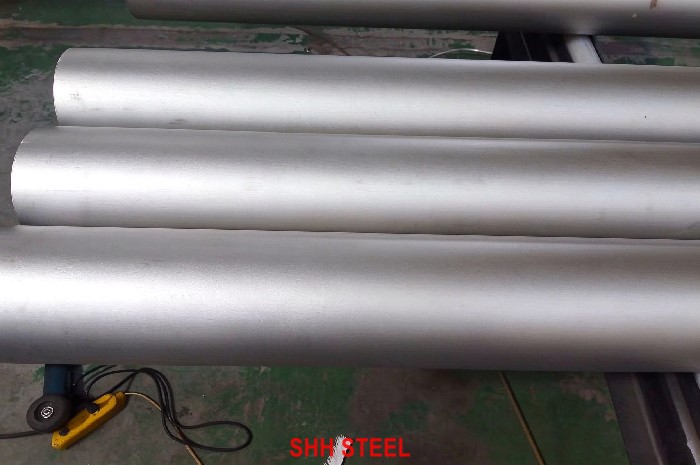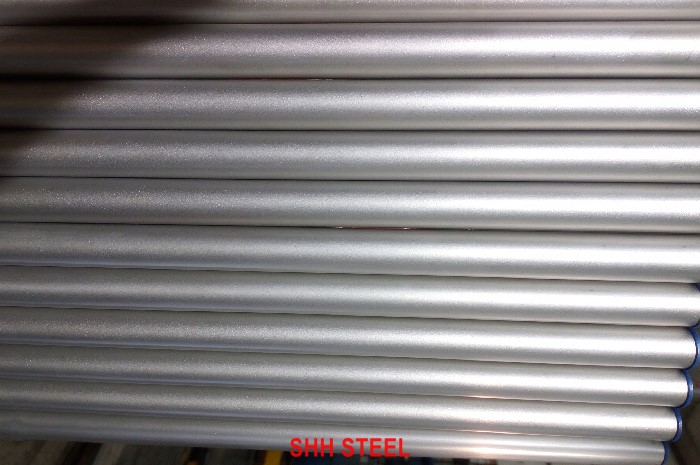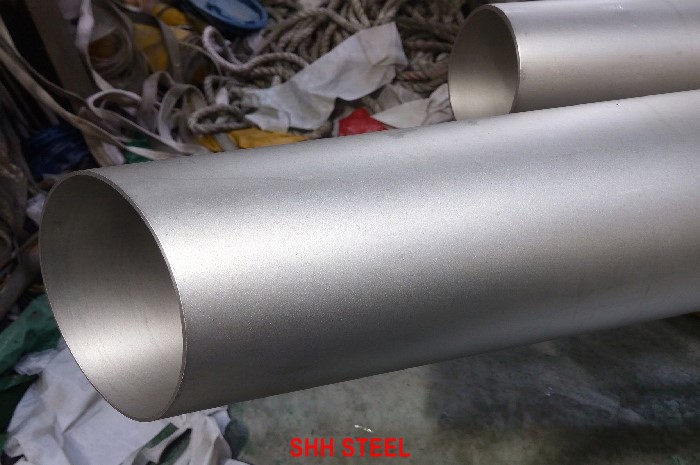
ASTM A312 TP310S Stainless Steel Pipe
What is ASTM A312 TP310S Stainless Steel Pipe
ASTM A312/A312M is the ASTM product specification for seamless, straight-seam welded, and heavily cold-worked austenitic stainless steel pipe intended for high-temperature and general corrosive service. It stands on its own as an ASTM document, with its own chemistry table, tensile table, heat-treatment table, and testing clauses, and a purchase order written to it should name the ASTM edition directly. This page covers Grade TP310S / UNS S31008 under that specification and draws every number from the referenced A312/A312M tables rather than from catalogue habit.
TP310S is the general-purpose, low-carbon-capped heat-resisting member of the 25Cr–20Ni ASTM A312 family. Table 1 sets C ≤0.08%, Cr 24.0–26.0%, Ni 19.0–22.0%, Mo ≤0.75%, with manganese capped at 2.00%, silicon at 1.00%, phosphorus at 0.045% and sulfur at 0.030%. The 310 family is the highest chromium–nickel group among the common A312 heat-resisting grades, and buyers usually reach for it when the 309 family is close to its oxidation limit or when the service cycles hard between ambient and furnace temperature. Table 4 releases the grade at 75 ksi [515 MPa] tensile and 30 ksi [205 MPa] yield with 35% longitudinal / 25% transverse elongation, and the pipe is delivered solution annealed at 1900 °F [1040 °C] minimum with rapid cooling.
The “S” suffix tells you the carbon is capped at 0.08% with no lower limit, which keeps the grade easy to weld and fabricate while still giving the full 310 oxidation benefit. Read the suffix as part of the grade identity, because a length stenciled only “310” does not tell receiving inspection which Table 1 row the heat was melted to.
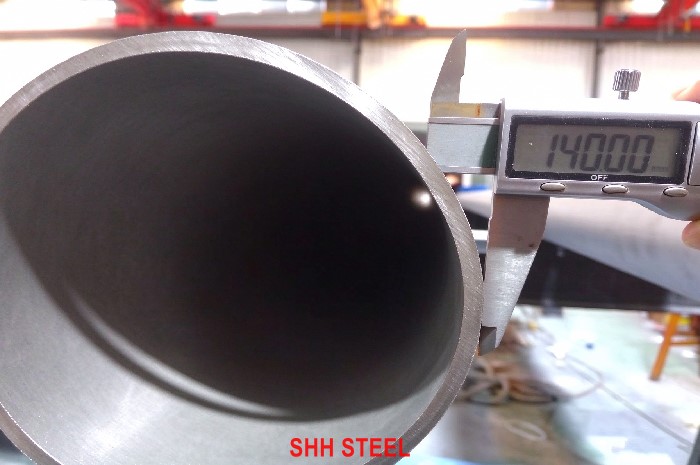
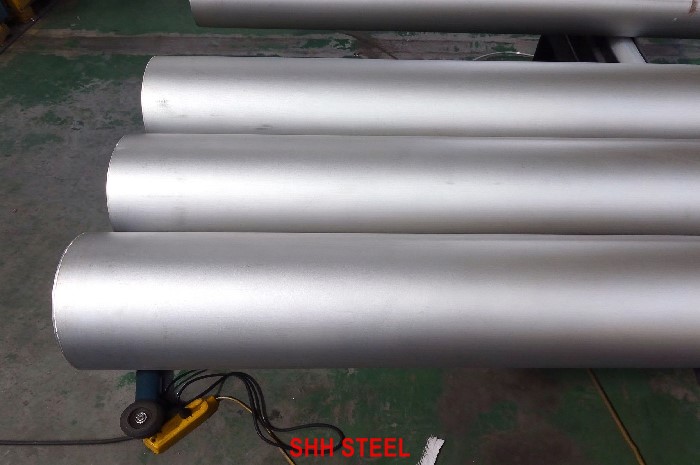
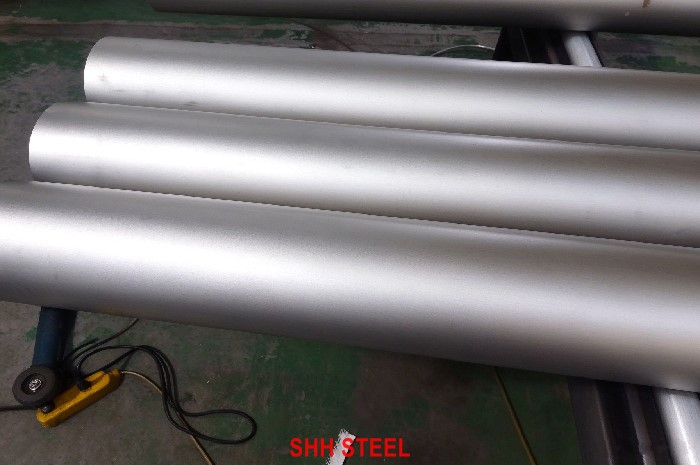
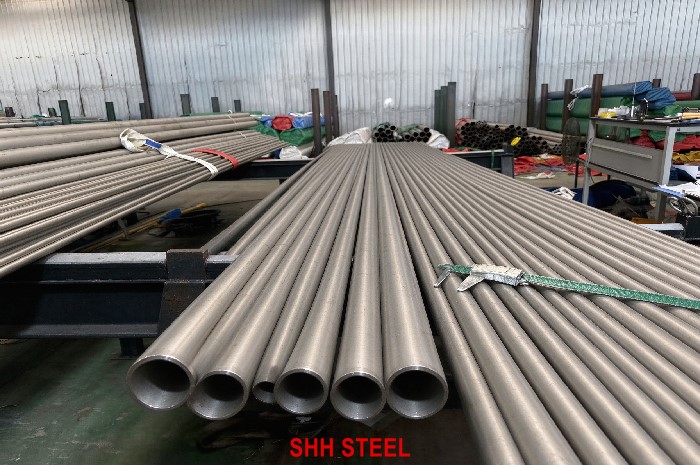
SHH STEEL can supply ASTM A312 TP310S stainless steel pipe as seamless (SML), welded (WLD), or heavily cold-worked (HCW) product in ASME B36.19 schedules and in special OD and wall combinations, with EN 10204 3.1 mill test certificates as the standard document package and EN 10204 3.2 or third-party witness when the enquiry asks for it. Where a project also runs under the ASME Boiler and Pressure Vessel Code, dual A312/SA-312 marking can be arranged, but only when the purchase order names both standards and the heat qualifies under each. ASME SA-312 is a separate standard with its own adoption history, and the same grade is described on its own page at SA312 TP310S.
Buyers comparing TP310S within the ASTM A312 series usually look next at A312 TP310H, A312 TP310Cb, A312 TP310HCb, and at the matching 309-family grade A312 TP309S. The full grade list is on the A312/A312M hub, which is the quickest way to check a neighbouring grade when the datasheet leaves more than one heat-resisting option open.
Manufacturing Types (SML / WLD / HCW)
ASTM A312 allows three manufacturing routes for TP310S pipe, and the choice belongs on the purchase order because it changes inspection, marking, and sometimes the design allowance, while it never changes the chemistry. Whichever route is chosen, the heat must still meet C ≤0.08%, Cr 24.0–26.0%, Ni 19.0–22.0%, Mo ≤0.75%, and every length still has to pass through the solution anneal before release.
- Seamless (SML) — produced without welding at any stage, and preferred for high-pressure service, heavy wall, and owners who exclude welded pipe from the line class. Seamless supply in this grade is typically mill-order rather than stock.
- Welded (WLD) — made by an automatic welding process with no filler metal in the longitudinal seam, then solution annealed. For general furnace and hot-air ducting, welded pipe is the economical choice on larger diameters and thinner walls.
- Heavily cold-worked (HCW) — welded pipe cold worked by at least 35% reduction in both wall and weld before the final anneal, with the weld radiographed before cold work. Order HCW only when the project specifically calls for that marking and its process controls.
Chemical Composition of ASTM A312 TP310S
Two layers of chemistry matter on an ASTM A312 TP310S order. The heat (ladle) analysis is mandatory for every heat and must meet Table 1, while product analysis on the finished pipe is made only when the purchase order calls for it, using the tolerances that A312 brings in through ASTM A999/A999M and ASTM A480/A480M Table A1.1. SHH STEEL reports actual heat values on the certificate and, when ordered, product values as well; we do not quote tighter in-house windows as if they were part of the standard.
Heat analysis — ASTM A312 Table 1
The table below sets out the Table 1 heat-analysis limits for TP310S / UNS S31008. Values are maxima unless a range is shown, and an ellipsis means the edition places no requirement on that element.
| Element | TP310S / UNS S31008 heat analysis, % |
|---|---|
| Carbon (C) | ≤ 0.08 |
| Manganese (Mn) | ≤ 2.00 |
| Phosphorus (P) | ≤ 0.045 |
| Sulfur (S) | ≤ 0.030 |
| Silicon (Si) | ≤ 1.00 |
| Chromium (Cr) | 24.0 – 26.0 |
| Nickel (Ni) | 19.0 – 22.0 |
| Molybdenum (Mo) | ≤ 0.75 |
Reading the table, the defining lines are chromium at 24.0–26.0% and nickel at 19.0–22.0%, with carbon capped at 0.08% and no lower limit. Molybdenum is limited to 0.75%, which is a residual cap rather than an alloying addition, and no nitrogen requirement is listed. Because there is no carbon floor, TP310S is not the grade to order for creep-range design that relies on H-grade allowables; that job belongs to A312 TP310H.
Product analysis — A480/A480M Table A1.1 tolerances
When product analysis is ordered, the Table A1.1 tolerances are applied to the Table 1 limits as shown below. The tolerance applies to an individual product determination; it does not widen the heat-analysis range that the mill must meet in the first place.
| Element | Melting (Table 1) | Tolerance (A480 A1.1) | Product analysis limit |
|---|---|---|---|
| Carbon (C) | ≤ 0.08 | 0.01 over | ≤ 0.09 |
| Manganese (Mn) | ≤ 2.00 | 0.04 over | ≤ 2.04 |
| Phosphorus (P) | ≤ 0.045 | 0.010 over | ≤ 0.055 |
| Sulfur (S) | ≤ 0.030 | 0.005 over | ≤ 0.035 |
| Silicon (Si) | ≤ 1.00 | 0.05 over | ≤ 1.05 |
| Chromium (Cr) | 24.0 – 26.0 | 0.25 under / over | 23.75 – 26.25 |
| Nickel (Ni) | 19.0 – 22.0 | 0.15 under / 0.20 over | 18.85 – 22.20 |
| Molybdenum (Mo) | ≤ 0.75 | 0.05 over | ≤ 0.80 |
310 family side by side
Because four 310-family rows sit next to each other in Table 1, it helps to see them together. The comparison below uses the same Table 1 values and shows where TP310S differs from its sisters; chromium is 24.0–26.0% for all four.
| Element | TP310S | TP310H | TP310Cb | TP310HCb |
|---|---|---|---|---|
| C | ≤ 0.08 | 0.04 – 0.10 | ≤ 0.08 | 0.04 – 0.10 |
| Ni | 19.0 – 22.0 | 19.0 – 22.0 | 19.0 – 22.0 | 19.0 – 22.0 |
| Mo | ≤ 0.75 | … | ≤ 0.75 | ≤ 0.75 |
| Nb | … | … | 10×C – 1.10 | 10×C – 1.10 |
| Table 5 grain size | — | No. 6 or coarser | — | No. 6 or coarser |
Reading across, the S and Cb grades share the 0.08% carbon cap, the H and HCb grades share the 0.04–0.10% band and the Table 5 grain-size rule, and the niobium line appears only on the two stabilized rows. In the 310 family nickel is 19.0–22.0% on every row, so the comparison turns entirely on carbon, niobium, and grain size. The differences look small on paper but they decide which heats a mill can allocate, so name the exact TP designation and UNS number on the order instead of a family name.
Mechanical Properties of ASTM A312 TP310S
Room-temperature tensile requirements for TP310S come from ASTM A312 Table 4. They are minima for release testing, not typical values, and they are the same 75/30 ksi floor shared by the other 310-family grades. Mill results usually sit above these figures, but design should still use the table unless the purchase order states higher guaranteed values.
| Property | ASTM A312 TP310S / UNS S31008 |
|---|---|
| Tensile strength, min | 75 ksi [515 MPa] |
| Yield strength, min | 30 ksi [205 MPa] |
| Elongation | 35% longitudinal / 25% transverse |
| Hardness | No Table 4 maximum |
TP310S has no hardness maximum in Table 4 and no Table 5 grain-size requirement, because it is not an H grade. The values above are the whole room-temperature acceptance basis, and anything stricter, such as a Rockwell limit for expanding or tight bending, has to be stated on the purchase order and reported on the certificate.
Dimensions, Tolerances and Stock Sizes
Dimensional supply for ASTM A312 TP310S follows ASME B36.19 for the standard NPS and schedule combinations, with special outside diameters and walls available by agreement when a furnace, heater, or duct needs a section the schedules do not cover. Outside-diameter variations follow ASTM A999/A999M, and wall-thickness variations follow A312 Table 3, summarized below.
| NPS designator | Wall over | Wall under |
|---|---|---|
| 1/8 to 2-1/2 incl., all t/D | 20.0% | 12.5% |
| 3 to 18 incl., t/D up to 5% | 22.5% | 12.5% |
| 3 to 18 incl., t/D over 5% | 15.0% | 12.5% |
| 20 and larger, welded, all t/D | 17.5% | 12.5% |
| 20 and larger, seamless, t/D up to 5% | 22.5% | 12.5% |
| 20 and larger, seamless, t/D over 5% | 15.0% | 12.5% |
In short, the under-tolerance on wall is 12.5% across the whole range, while the permitted over-tolerance depends on the NPS, the wall-to-diameter ratio, and for NPS 20 and larger on whether the pipe is welded or seamless. State on the order whether the wall is nominal or minimum (Supplementary S8), because the two readings produce different pipe from the same line item, and the difference matters most on thin-wall heat-resisting ducts.
- Lengths — single random, double random, or cut-to-length as ordered
- Cut lengths — normally no more than 1/4 in. [6 mm] over the ordered length unless the PO sets a tighter band
- Ends — plain or beveled; confirm bevel angle and root face if the WPS is already fixed
- Jointers — not permitted unless the purchase order expressly allows them
Stock / Available sizes
SHH STEEL quotes ASTM A312 TP310S against a practical stock-and-mill enquiry range rather than a fixed list of stock-keeping units. The representative sizes below are the combinations most often discussed for this grade; availability for a given manufacturing route and exact wall still has to be confirmed at enquiry, and we do not publish tonnages against individual lines.
| Representative size (ASME B36.19) | Typical schedules / notes for TP310S |
|---|---|
| NPS 1/2 – 2 | Sch 10S / 40S / 80S; instrument and small process connections |
| NPS 2-1/2 – 6 | Sch 10S / 40S / 80S; common furnace and process line sizes |
| NPS 8 – 12 | Sch 10S / 40S; confirm SML or WLD at enquiry |
| NPS 14 – 24 | Sch 10S / 40S; usually welded and often mill-order depending on wall |
| Special OD × wall | By agreement — state OD, wall (nominal or minimum), and length practice |
Example enquiries we handle are framed as OD × wall, for instance NPS 4 Sch 40S or a special OD with a minimum wall for a heater coil, and we answer with what can ship from selected stock and what needs a mill slot. TP310S is the most commonly held member of the 310 family, so standard schedules are more likely to be available quickly than for the H or Cb sisters. Special sizes, cut lengths, and mixed seamless and welded packages are on enquiry.
Equivalent Grades
Equivalence for TP310S is first an identity question within ASTM A312 and only second a cross-reference to other systems. The governing designation on this page is ASTM A312 Grade TP310S / UNS S31008; trade names, plate counterparts, and foreign designations all need to be mapped back to that row before a mill is asked to substitute or dual-mark.
| Designation | Notes |
|---|---|
| ASTM A312 / A312M TP310S / UNS S31008 | Governing pipe grade for this page |
| ASME SA-312 TP310S | Separate ASME standard; dual marking only when the PO names both and the heat qualifies |
| 310S (trade names) | Confirm UNS S31008 chemistry on the MTC; not a grade name by itself |
| ASTM A240 UNS S31008 | Plate and sheet counterpart — not a pipe specification |
| EN 1.4845 (X8CrNi25-21), approx. | Engineering map only — recheck limits |
| JIS SUS 310S | Similar intent; verify C and Si |
Read the notes column literally: an EN or JIS designation is a starting point for engineering comparison, not a substitute grade, and the carbon and silicon limits should be checked before any dual certification is promised. Within ASTM A312 the closest relatives are A312 TP310H, A312 TP310Cb, A312 TP310HCb, but each one is a separate row with its own limits, so an order for one is not satisfied by a certificate for another.
Compared with A312 TP309S, the 310 family adds about two points of chromium and seven of nickel, which buys oxidation and scaling margin at the top of the heat-resisting range; it is overkill on lines that TP309S handles comfortably. Where a project spans pipe and plate, carry the same UNS number through both forms but still order the pipe to A312.
Heat Treatment and Delivery Condition
All pipe furnished to ASTM A312 is heat treated. TP310S does not carry its own row in Table 2, so the default practice applies: solution anneal at 1900 °F [1040 °C] minimum, followed by water quenching or another rapid cool sufficient to prevent harmful carbide precipitation. Because TP310S is not an H grade, clause 6.2 allows seamless pipe to be quenched directly after hot forming when the temperature is at or above the solution minimum, and there is no Table 5 grain-size requirement.
- Solution annealed and rapidly cooled — 1900 °F [1040 °C] minimum (Table 2 default)
- No Table 5 grain-size rule — unlike TP310H and TP310HCb
- Surface — free of scale and contaminating iron; pickled or equivalent as ordered
- Lot marking — heat-treatment lot traceability on request
Where the design worries about sensitization, Supplementary S7 demonstrates freedom from harmful carbide precipitation by ASTM A262 Practice E, and it has to be ordered; it is not part of the base test package. Bright-annealed small sizes must still reach the Table 2 minimum, so ask for the actual anneal temperature on the certificate when that finish is ordered, and make sure the mill is not applying an H-grade reheat habit, or skipping one, by mistake on a mixed campaign.
Corrosion Resistance
The case for TP310S is primarily oxidation and scaling resistance at high temperature. The 24.0–26.0% chromium forms a protective oxide that holds up in hot air and many combustion atmospheres where 18-8 grades scale away, and the 19.0–22.0% nickel keeps the matrix fully austenitic and tough through thermal cycling. The 310 family takes this to the top of the common A312 range, which is why it is chosen for the hottest sections of furnaces and heaters.
Because carbon is capped at 0.08% and the grade is unstabilized, TP310S can sensitize in weld heat-affected zones held in the carbide-precipitation range. That matters less in dry hot-gas service than in lines that see aqueous condensate during shutdown, where intergranular attack or polythionic-acid cracking become possible. If that risk is real, look at A312 TP310Cb, or order Supplementary S7 to verify the as-supplied condition.
Applications of ASTM A312 TP310S Pipe
Buyers typically select TP310S when the line needs 310-level oxidation resistance with straightforward fabrication and no creep-range design requirement. The table below lists the services where we most often see the grade on an enquiry, together with the reason it is chosen and the point worth checking before ordering.
| Application | Why TP310S | Check before ordering |
|---|---|---|
| Furnace and kiln components | 310 oxidation resistance in hot air | Check thermal cycling and support spacing |
| Hot air and flue-gas ducting | Economical welded large diameters | Confirm condensate behaviour |
| Heat-treatment equipment | Scaling resistance | Carburizing service may need other alloys |
| Dissimilar-metal transitions | Rich Cr–Ni base tolerates dilution | Document filler choice on the WPS |
| Process heater convection sections | Oxidation margin over 304 | Compare the H grade if creep governs |
Reading the table, the common thread is heat: TP310S is rarely bought for room-temperature corrosion alone, where cheaper grades do the job. Typical size mixes run from instrument connections at NPS 1/2–2, through process lines at NPS 3–8, up to welded ducts at NPS 12–24, and the availability of fittings and flanges in matching chemistry can limit the line list, so check companion components before the isometrics are frozen. When TP310S replaces another grade in an existing unit, review the weld procedures as well, because a base-metal change alone does not update a WPS.
Weldability
TP310S welds readily by GTAW, GMAW, SMAW, and SAW, and its fully austenitic structure means no preheat is normally required. The mill longitudinal seam on WLD and HCW pipe is made without filler metal, so the filler question only arises for field and shop joints. Table 6 of A312 shows no AWS filler classification for TP310S, which means the filler is selected by agreement on the welding procedure specification rather than dictated by the pipe standard.
In practice the WPS will usually choose a matching 310-type filler, or a richer one where dilution or dissimilar joints are involved, and that choice should be documented and qualified for the service temperature. If the welded joints will see shutdown condensate, consider whether the unstabilized grade is the right choice before blaming the filler. Keep interpass temperatures controlled, as for other high-alloy austenitics, to limit hot-cracking risk in a fully austenitic weld, and avoid long holds in the carbide-precipitation range during repair welding.
Surface Finishes
A312 requires pipe to be free of scale and contaminating iron particles, and the way that condition is reached becomes the surface finish. For TP310S, which mostly goes into hot service, the finish is usually chosen for cleanliness and inspection rather than appearance, but it still needs to be stated on the order so the mill and the receiving inspector are working to the same expectation.
- Annealed and pickled — the standard mill finish for most sizes; matte and free of scale
- Bright annealed — for smaller sizes where a clean, oxide-free bore is wanted; the anneal must still meet the Table 2 minimum
- Blasted and pickled — common on heavier walls and larger diameters
- Polished — by agreement where internal or external roughness is specified
- Passivated — on request where the end-user specification asks for it
Inspection and Testing
Base inspection and testing for ASTM A312 TP310S combine chemistry, mechanical, and integrity checks, and the list below is the usual acceptance package. Supplementary requirements apply only when they are written on the purchase order.
- Heat analysis — every heat against Table 1 for TP310S, including C ≤0.08%, Cr 24.0–26.0%, Ni 19.0–22.0%, Mo ≤0.75%
- Product analysis — when ordered, using A480 Table A1.1 tolerances
- Tension test — Table 4 tensile, yield, and elongation on a lot basis (75/30 ksi minima)
- Flattening test — or the alternative bend where permitted, typically on 5% of the lot
- Hydrostatic or electric test — every length; manufacturer’s option unless the order fixes the method
- Visual and dimensional check — against the ordered size and the tolerance clauses
EN 10204 3.1 is the standard certificate from SHH STEEL supply. It reports the full Table 1 heat chemistry, the Table 4 results, the test method used on each length, and the heat-treatment condition. EN 10204 3.2 or third-party witness by SGS, Bureau Veritas, TÜV, or the buyer’s nominated agency is arranged when specified, and the inspector should be booked before final testing rather than after the pipe is packed.
Supplementary options worth considering for TP310S are summarized below; none of them applies unless the order names it.
| Option | Purpose |
|---|---|
| S1 product analysis | Confirms chemistry on the finished pipe |
| S5 radiography | Weld integrity on WLD pipe |
| S7 intergranular corrosion | A262 Practice E check of the as-supplied condition |
| S8 minimum wall | Wall ordered as minimum rather than nominal |
| S9 weld decay | Compares weld and base-metal loss rates |
On receipt, check the stencil reads TP310S or S31008 and not just “310,” then compare the certificate against the limits above. Confirm carbon is at or below 0.08% and that the test method for each length is stated. Positive material identification by optical emission on a sample length is a sensible extra when several 310-family grades share the same storage area, because handheld XRF cannot resolve carbon.
Packaging and Shipping
Packaging for ASTM A312 TP310S is chosen to keep the surface free of iron contamination and the ends protected through export transit. Each length carries the A312 marking required by clause 17, normally including the manufacturer, the specification, the grade, the manufacturing type, the size, the heat number, and the test method, and the packing list repeats those identifiers so bundles can be checked without unpacking.
- End caps on all lengths; bevel protectors on beveled ends
- Bundles strapped with non-metallic or covered straps to avoid contact with carbon steel
- Wooden cases or crates for bright-annealed, polished, or thin-wall pipe
- Moisture protection for sea freight on request
- Packing lists that match heat numbers to bundle numbers
Why Choose SHH STEEL
SHH STEEL supplies specification-driven stainless pipe, and for ASTM A312 TP310S we quote against the edition you name rather than a generic catalogue sheet. We report the full Table 1 chemistry, the Table 4 results, and the heat-treatment evidence the grade calls for, and we match the manufacturing route and size to the enquiry instead of pushing whatever is nearest on the shelf.
- Clear reporting of the 0.08% carbon cap, chromium 24.0–26.0%, and nickel 19.0–22.0% on every certificate
- Straight advice when a sister grade such as TP310H or TP310Cb would actually suit the service better
- SML, WLD, and HCW routes with EN 10204 3.1 certificates; 3.2 inspection on request
- Dual A312/SA-312 marking only when the purchase order asks for both standards
- Cut lengths, beveling, and project packing coordinated on confirmed orders
If you are still choosing between 310-family grades, send the design temperature, the atmosphere, whether the line is welded heavily in fabrication, and whether shutdown condensate is expected. We will answer with the grade that fits that combination rather than the one whose name is closest to the datasheet.
Supply Capability
SHH STEEL can supply ASTM A312 TP310S / UNS S31008 stainless steel pipe to the edition and manufacturing type named on your enquiry. The table summarizes the routes, sizes, finishes, and documents we regularly quote for this grade, and it is a capability statement rather than a promise that every combination is in stock today.
| Item | SHH STEEL capability for TP310S |
|---|---|
| Standard | ASTM A312 / A312M TP310S / UNS S31008 |
| Manufacturing types | SML, WLD, HCW |
| Size | NPS 1/8 and up per ASME B36.19; special OD/wall by agreement |
| Schedules | 5S, 10S, 40S, 80S and non-standard walls |
| Length | SRL, DRL, or cut-to-length |
| Finish | Annealed and pickled; blasted and pickled; bright annealed or polished by agreement |
| Testing | Tension (75/30 ksi), flattening/bend, hydro or NDE per length; S1/S5/S7/S8/S9 on order |
| Documents | EN 10204 3.1; third-party inspection / 3.2 on request |
| Trade terms | FOB / CFR / CIF / EXW and other agreed Incoterms |
Stock / Available sizes. The representative range for TP310S is set out in the Dimensions section: NPS 1/2–24 with Sch 10S, 40S, and 80S as typical, plus special OD × wall on enquiry. Selected common sizes may be available from stock or recent heats, while heavy-wall seamless, unusual schedules, and special cut lengths are normally mill-order. We do not invent stock lists or tonnage claims, so ask for a live check against your size list.
A good enquiry for this grade states the A312 edition, TP310S (UNS S31008), the manufacturing type, NPS or OD × wall with nominal or minimum wall, length practice, finish, and any product-analysis, corrosion-test, or 3.2 requirement. With that information we can line up a mill slot or a stock allocation against your need date, and combining project sizes into one heat helps with chemistry consistency and mill minimums.
FAQ
-
Is ASTM A312 the same as ASME SA-312 for TP310S?
- No. ASTM A312/A312M and ASME SA-312 are two independent standards, even though the referenced editions are closely aligned on Table 1 chemistry, Table 4 tensile values, and most testing language for TP310S. If the piping is built to the ASME Code, name both standards on the purchase order and ask for dual marking; otherwise order to ASTM A312 alone and do not treat the titles as synonyms.
-
What is the UNS number for ASTM A312 TP310S?
- The UNS number is UNS S31008. It identifies the same chemistry across product forms, so plate to ASTM A240 and pipe to ASTM A312 can share it, but the pipe still has to be ordered and certified to A312. Put both the TP designation and the UNS number on the order and check that both appear on the certificate and the stencil.
-
What chemical composition defines TP310S pipe?
- Table 1 of ASTM A312 sets C ≤0.08%, Cr 24.0–26.0%, Ni 19.0–22.0%, Mo ≤0.75%, with Mn ≤2.00%, Si ≤1.00%, P ≤0.045% and S ≤0.030%. Those limits apply to the heat analysis; product analysis, when ordered, uses the A480 Table A1.1 tolerances, which widen individual readings slightly but never replace the heat requirement.
-
What are the tensile requirements for ASTM A312 TP310S?
- Table 4 requires 75 ksi [515 MPa] minimum tensile strength and 30 ksi [205 MPa] minimum yield strength, with elongation of 35% longitudinal and 25% transverse. These are the same floors as the other 310-family grades. There is no hardness maximum in Table 4, so any hardness limit for bending or expanding must be written on the order.
-
TP310S vs TP310H — which should I order?
- TP310S caps carbon at 0.08% with no minimum and has no grain-size rule, which suits general oxidation service and easy fabrication. TP310H adds a 0.04–0.10% carbon band, ASTM grain size No. 6 or coarser, and a reheated anneal, which is what creep-range design usually relies on. If the design allowables assume an H grade, order the H grade rather than TP310S.
-
TP310S vs TP309S — which grade suits higher temperature?
- The 310 family, with chromium 24.0–26.0% and nickel 19.0–22.0%, has more oxidation and scaling margin than the 309 family at 22.0–24.0% chromium, so TP310S is the more conservative choice for the hottest sections, while TP309S covers many lines more economically. The step between families is mainly about oxidation margin, not room-temperature strength, because both share the 75/30 ksi Table 4 floor. Choose by the actual atmosphere and metal temperature, and remember that the richer grade costs more and can be harder to source in special sizes.
-
What heat treatment applies to ASTM A312 TP310S pipe?
- TP310S has no individual Table 2 row, so the default solution anneal at 1900 °F [1040 °C] minimum with water quench or other rapid cooling applies. As a non-H grade, seamless pipe may be direct quenched after hot forming when the temperature is at or above the solution minimum, and there is no grain-size requirement.
-
Seamless vs welded TP310S pipe — which is better?
- Neither is better in general. Seamless suits heavy walls, high pressure, and line classes that exclude welded pipe, while welded pipe is economical on larger diameters and thinner walls and is common in furnace ducting. Both must meet the same Table 1 chemistry and Table 4 tensile values, and the choice should follow the design code and the inspection plan.
-
What filler metal is used to weld TP310S pipe?
- Table 6 of ASTM A312 shows no AWS filler classification for TP310S, so the filler is chosen by agreement and recorded on the welding procedure specification. A matching 310-type filler is typical, with a richer filler for dissimilar joints, and the procedure should be qualified for the service temperature rather than copied from a room-temperature job.
-
Hydrostatic test vs NDE — which do I get on TP310S pipe?
- Every length receives either a hydrostatic test or a nondestructive electric test, and the manufacturer chooses unless the purchase order specifies one. If your inspection plan depends on a particular method, write it on the order. Pipe NPS 10 and larger may ship marked “NH” only when the purchaser accepts a system test instead of the hydrotest.
-
What sizes of TP310S pipe can SHH STEEL supply?
- SHH STEEL quotes TP310S across ASME B36.19 sizes, typically NPS 1/2–24 in Sch 10S, 40S, and 80S, plus special OD and wall by agreement. Some common sizes may come from stock or recent heats, while heavy-wall seamless and unusual sizes are mill-order. Send your size list for a live availability check.
Conclusion
ASTM A312 TP310S / UNS S31008 is the general-purpose, low-carbon-capped heat-resisting member of the 25Cr–20Ni family, with C ≤0.08%, Cr 24.0–26.0%, Ni 19.0–22.0%, Mo ≤0.75%, a 75/30 ksi Table 4 floor with 35% L / 25% T elongation, and a solution anneal at 1900 °F [1040 °C] minimum. It is ordered for heat, not for general corrosion, and it is not a drop-in for A312 TP310H. Put the manufacturing type, size and wall basis, finish, and the grade-specific evidence on the purchase order, then review the EN 10204 3.1 certificate before release. SHH STEEL can supply TP310S pipe to the edition you name; browse the sister grades on the A312/A312M hub, or send your size list to admin@steelspecs.com.
Quality Steel Needed? Inquire for Offers
Related Products