ASME SA240 UNS S32906 Stainless Steel Plate
What is ASME SA240 UNS S32906 Stainless Steel Plate?
Equivalent grades: UNS S32906 ≈ EN 1.4477 X2CrNiMoN29-7-2.
UNS S32906 is a super duplex (high chromium) grade. S32906 is a 29Cr-6.5Ni-2Mo-0.35N super-duplex grade. Its very high chromium and nitrogen give strong resistance to ammonium carbamate in urea plants and to chloride pitting (PREN about 40), with the highest yield strength of the common duplex grades.
ASME SA-240 is the Boiler and Pressure Vessel Code version of ASTM A240, published in Section II Part A. It is ordered when plate will be used in Code construction such as Section VIII pressure vessels, Section I boilers or B31.3 piping components made from plate. Chemistry and tensile limits are the same as in A240, but the certificate and marking must state SA-240 so the Authorized Inspector can accept the material.
This page sets out the ASME SA-240/SA-240M requirements for UNS S32906 plate: specification summary, chemistry, mechanical properties, corrosion resistance, heat treatment, finishes and tolerances, current stock, equivalents, fabrication and testing. SHH STEEL supplies it mill-direct from China with EN 10204 3.1 certificates, optional third-party inspection and in-house cutting.
UNS S32906 plate: specification summary
| Item | UNS S32906 data |
|---|---|
| Standard | ASME BPVC Section II Part A, SA-240/SA-240M (identical with or adapted from ASTM A240/A240M) |
| General requirements | SA-480/SA-480M |
| Product form | plate 5.00 mm (3/16 in.) and over; sheet and strip also covered |
| Typical thickness | 5–80 mm hot-rolled; heavier by mill enquiry |
| Widths | 1500, 2000, 2500 mm; wider by enquiry |
| Lengths | 6000 mm standard; up to 12000 mm or cut to size |
| Finish | No.1 (hot-rolled, annealed and pickled) |
| Marking | SA-240 with grade, heat and plate number; dual A240/SA-240 marking common |
| Certificates | EN 10204 3.1 stating SA-240; 3.2 with third-party or AI witness on request |
| Grade family | super duplex |
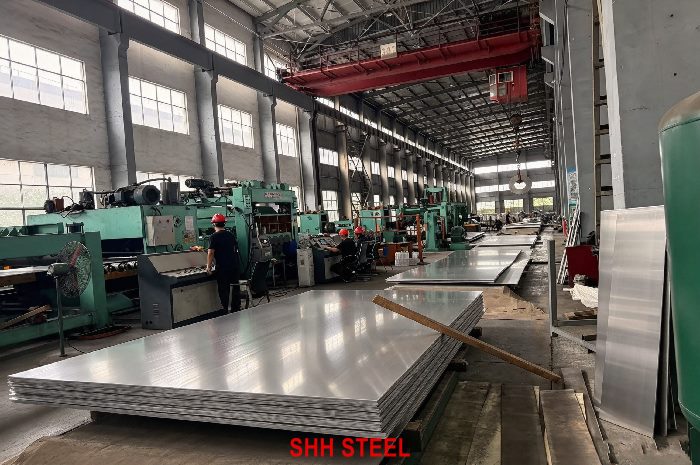
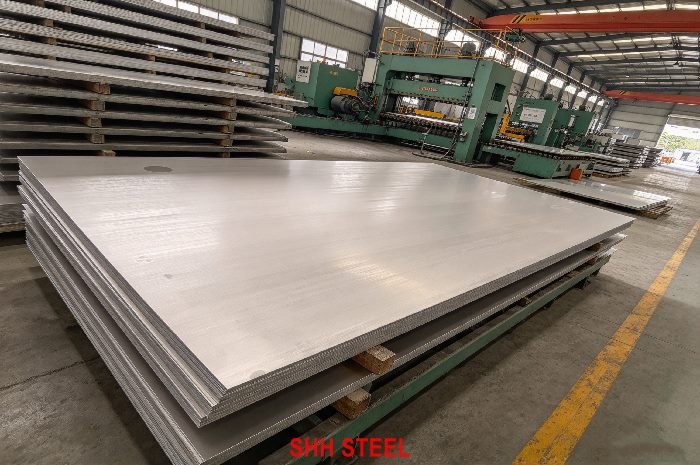
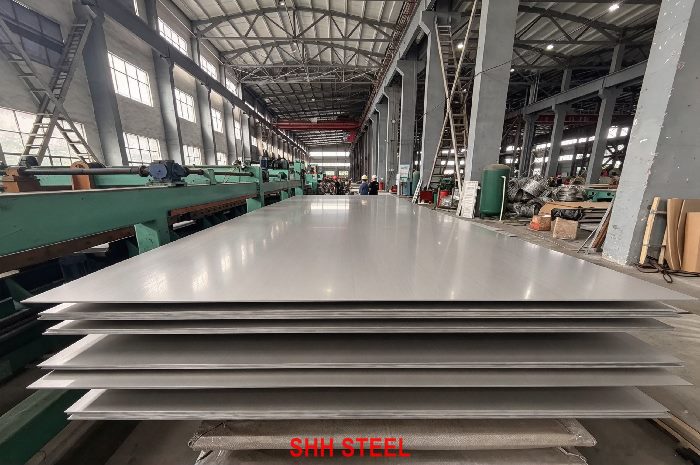
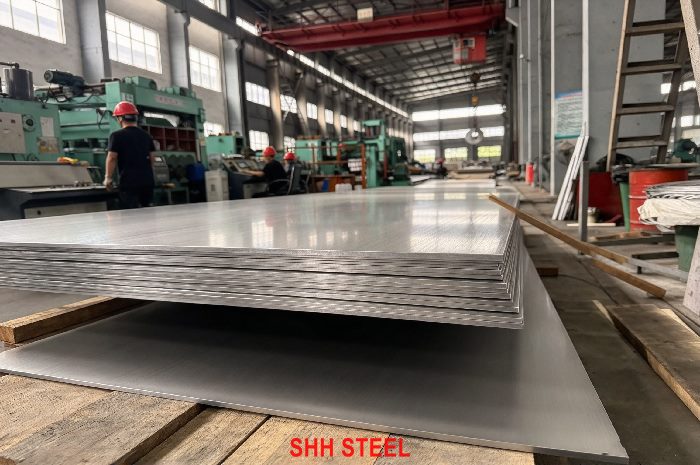
Size range. Plate is produced on Steckel or reversing mills from about 5 mm up to 80–100 mm depending on grade, with widths of 1500–2500 mm and lengths up to 12 m; thinner plate of 3–12 mm is often cut from hot-rolled coil. Very heavy or wide plates, and plates with tight flatness, should be confirmed before ordering. UNS S32906 is a specialty grade made by a limited number of mills in campaign rolling. Stock covers the common sizes listed below; for project quantities or unusual sizes, plan for a mill campaign and reserve the heat early.
Chemical composition of UNS S32906 (ASME SA-240/SA-240M)
| Element | wt % |
|---|---|
| C | 0.030 max |
| Si | 0.80 max |
| Mn | 0.80–1.50 |
| P | 0.030 max |
| S | 0.030 max |
| Cr | 28.0–30.0 |
| Ni | 5.8–7.5 |
| Mo | 1.50–2.60 |
| Cu | 0.80 max |
| N | 0.30–0.40 |
Single values are maximums unless marked min. Ranges are heat (cast) analysis limits.
PREN check (Cr + 3.3 Mo + 16 N): about 37.8 at the specification minimums and about 41.4 at mid-range. Where corrosion resistance is critical, write a minimum PREN on the order and ask for the calculated value from the heat analysis on the certificate.
Mechanical properties of UNS S32906 plate
| Condition / thickness | Tensile strength, min | Yield strength 0.2 %, min | Elongation in 50 mm, min | Hardness, max |
|---|---|---|---|---|
| thickness < 10 mm | 800 MPa (116 ksi) | 650 MPa (94 ksi) | 25 % | 310 HBW / 32 HRC |
| thickness ≥ 10 mm | 750 MPa (109 ksi) | 550 MPa (80 ksi) | 25 % | 310 HBW / 32 HRC |
The minimum yield strength of 650 MPa is about 3.8 times the 170 MPa minimum of ASTM 316L. Designers use this to reduce thickness, but higher strength also means higher press loads and more springback. Mill values for production heats are usually well above the minimums; use certificate values when you calculate bending forces. Tension tests are taken in the direction stated in the standard; where a hardness limit is given, it is a maximum that confirms correct annealing.
Corrosion resistance of UNS S32906: PREN and limits
Super-duplex grades are duplex steels with PREN of about 40 or more. At the specification minimum this grade calculates to about 37.8, and a mid-range heat to about 41.4. That level gives resistance to pitting and crevice corrosion in ambient seawater, strong resistance to chloride stress-corrosion cracking and a yield strength above 500 MPa.
The higher alloy content makes super-duplex more sensitive to intermetallic phases than 2205. The solution-anneal temperature is higher and cooling must be fast, especially for heavy plate. Specify ASTM A923 Methods A, B and C, a ferrite range (commonly 35–55 % by ASTM E562) and, for critical service, an ASTM G48 Method A test at the temperature named in the project specification. Like all duplex grades, the upper service limit is about 250–300 °C.
How UNS S32906 compares with related grades
| Grade | Cr | Ni | Mo | N | PREN (min) | YS / Rp0.2 min, MPa |
|---|---|---|---|---|---|---|
| UNS S32906 | 28.0–30.0 | 5.8–7.5 | 1.50–2.60 | 0.30–0.40 | 37.8 | 650 |
| UNS S32760 | 24.0–26.0 | 6.0–8.0 | 3.0–4.0 | 0.20–0.30 | 37.1 | 550 |
| UNS S32550 | 24.0–27.0 | 4.5–6.5 | 2.9–3.9 | 0.10–0.25 | 35.2 | 550 |
| UNS S32520 | 24.0–26.0 | 5.5–8.0 | 3.0–4.0 | 0.20–0.35 | 37.1 | 550 |
Choose UNS S32906 for ambient seawater, chlorinated brines and high-chloride process water where 2205 is not sufficient, and where its high strength reduces weight. Do not use it above about 250–300 °C, and check that your fabricator has qualified super-duplex welding procedures.
The table uses specification limits, not typical mill values, so it shows the guaranteed position of each grade. Final selection should also consider product availability in the thickness you need, welding consumables, and the inspection requirements of your project.
Heat treatment and delivery condition of UNS S32906
Heat treatment: 1040–1100 °C, rapid cooling.
The higher alloy content gives faster intermetallic precipitation than 2205, so heavy plate must be water quenched. Hot forming is done between about 1000 and 1200 °C and must be followed by a full solution anneal and quench.
Surface finishes for UNS S32906 plate
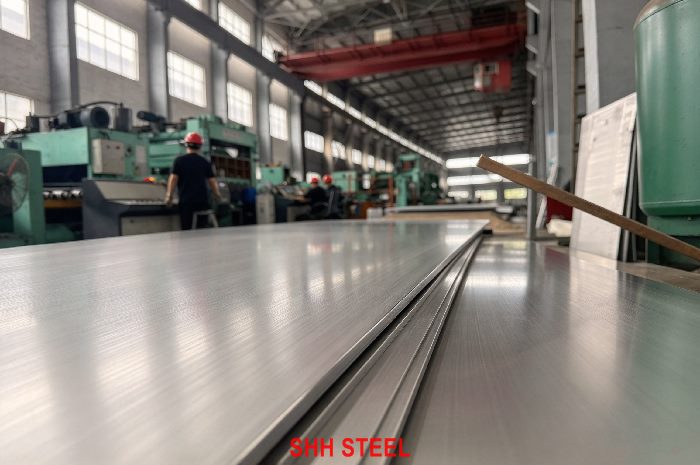
Plate to SA-240 is normally supplied with a No.1 finish: hot rolled, solution annealed and pickled, with a matt grey surface. Shot-blasted and pickled surfaces are the norm on heavy plate. Ground or polished faces, and plates with protective film for the process side, can be produced after delivery in our workshop. Surface defects are judged against the A480/SA-480 workmanship clause; for vessel internals the purchaser may add surface-roughness or cleanliness requirements.
Dimensions, tolerances and flatness
Thickness, width, length, flatness and camber tolerances follow SA-480/A480 tables for hot-rolled plate; ordered thickness is a minimum unless the order states nominal. For pressure parts, the thickness at any point must not fall below the ordered minimum, so heavy plate is often ordered with a small plus allowance. Flatness of thin plate cut from coil should be checked after cutting. Mill edge, sheared, plasma or waterjet-cut edges and bevelling for welding are available.
Code use of SA-240 plate. Before welding, the manufacturer must identify the P-Number and group number of S32906 from ASME Section IX (QW/QG-422) for the welding procedure qualification, and the designer takes allowable stresses from Section II Part D. Impact-test exemptions for austenitic and duplex plate are given in Section VIII Division 1 (UHA-51) and depend on grade, thickness and minimum design metal temperature, so cryogenic or low-temperature duty should be stated when you order. For heavy plate, ultrasonic examination to SA-578 and PMI of each plate are common supplementary requirements. Ask for the plate number to be hard-stamped or stencilled so traceability survives cutting.
UNS S32906 plate stock in China
| Thickness (mm) | Width (mm) | Length (mm) | Finish | Approx. quantity | Location |
|---|---|---|---|---|---|
| 6 | 1500 / 2000 | 6000 | No.1 | 100+ t | China |
| 8 | 1500 / 2000 | 6000 | No.1 | 100+ t | China |
| 10 | 2000 | 6000 | No.1 | 100+ t | China |
| 12 | 2000 | 6000 | No.1 | 100+ t | China |
| 16 | 2000 / 2500 | 6000 | No.1 | 100+ t | China |
| 20 | 2000 / 2500 | 6000 / 8000 | No.1 | 100+ t | China |
| 30 | 2000 / 2500 | 6000 | No.1 | 100+ t | China |
Quantities are approximate and stock changes daily. Send your size list for current availability; other thicknesses, widths and cut sizes can be supplied from mill production.
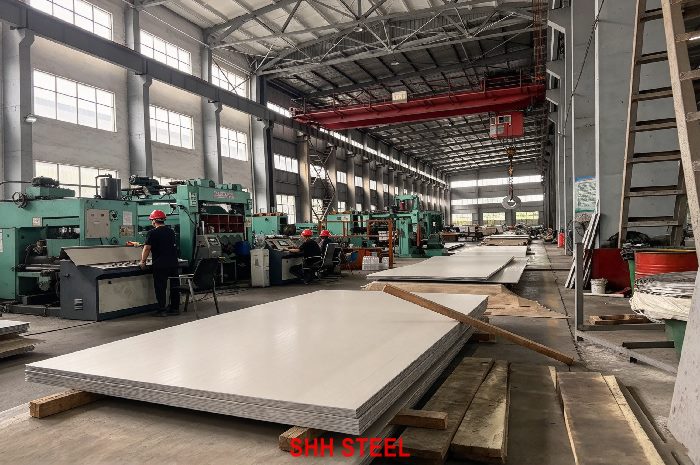
Packing and logistics. Plate is bundled on steel or wooden skids with steel bands and edge protection, typically 3–8 t per bundle, and marked with heat and plate numbers. Cut pieces are crated. Heavy and wide plate ships in open-top or flat-rack containers or by break-bulk; we send loading photos with the shipping documents.
UNS S32906 equivalents in other standards
| Standard | Designation | Comment |
|---|---|---|
| EN | 1.4477 X2CrNiMoN29-7-2 | same alloy family and limits closely matched; compare each limit on the certificate |
Equivalents are close, not identical. When a project names one standard, order to that standard or ask for multiple certification and check every limit on the certificate.
Related grades by alloy family
Super duplex
PREN 40+ duplex grades for seawater and severe chlorides: SA-240 S32750, 1.4410 plate, 1.4501 plate, 1.4507 plate, SA-240 S32760, SA-240 S32520, SA-240 S32550.
Duplex and lean duplex
Duplex grades with about twice the yield strength of 316L: SA-240 S32205, SA-240 S32304, SA-240 S32101, 1.4462 plate, 1.4362 plate.
Super austenitic
6Mo and 7Mo grades for seawater and chloride service; upgrade path from 316L and 904L: SA-240 N08904, SA-240 S31726.
Same grade, other specification
Applications, forming and welding of UNS S32906
Typical uses: urea strippers and carbamate condensers, offshore hydraulic and umbilical components, seawater systems and high-strength structural parts.
Super-duplex plate needs more press force than 2205 and careful control of cutting heat. Cut by plasma, laser or waterjet and remove heat tint by pickling or grinding. For welding use a super-duplex filler such as ER2594 (AWS A5.9) or a nickel-base filler where the specification allows it. Keep the weld area clean and free of carbon-steel contamination, and pickle and passivate after welding where corrosion resistance matters.
Welding practice. Super duplex has a narrower heat-input window than 2205, typically about 0.5–1.5 kJ/mm with interpass below 100–150 °C. Use a nitrogen-bearing shielding and backing gas, and qualify with ferrite counts in weld metal and HAZ, G48 testing and Charpy tests as the project specification requires. Avoid repair welding in the same spot more than once.
Certificates, testing and receiving inspection
Every delivery carries a mill certificate to ASME SA-480/SA-480M with heat analysis, tensile results and hardness, and the grade and standard as ordered. Supplementary tests we can arrange: ASTM A923 Methods A, B and C, ferrite count to ASTM E562, ASTM G48 Method A at the specified temperature, Charpy impact, and PMI on each plate. Third-party witness by SGS, BV, TÜV, DNV, ABS or LR is available with EN 10204 3.2 certificates.
On receipt, check marking and heat number against the certificate, measure thickness at several points and confirm the finish and edge condition before cutting.
Common mistakes when specifying UNS S32906
- Not stating whether PREN includes tungsten.
- Accepting heavy plate without A923 results; intermetallics are invisible on the surface.
- Using a 2205 welding procedure for super duplex.
Each of these can be avoided by writing the requirement into the purchase order and checking it on the certificate before the material is cut.
Sourcing UNS S32906: buyer concerns and SHH STEEL solutions
| Concern | How SHH STEEL handles it |
|---|---|
| Sigma phase in heavy plate | A923 A/B/C and G48 results reviewed per heat before cutting |
| PREN definition (with or without W) | formula and minimum fixed in the purchase order |
| Small quantities across many sizes | mixed thicknesses and grades combined in one shipment |
| Cutting and edge preparation | in-house shearing, plasma, laser and waterjet cutting, bevelling |
| Delivery delays | weekly production and shipping updates with photos |
How to order UNS S32906 plate
State the standard and edition (ASME SA-240/SA-240M), the grade (UNS S32906), thickness, width and length or coil, finish, quantity, tolerance class, any added chemistry limits, the supplementary tests and acceptance values from your specification, the certificate type and inspection agency, and packing. Send the list to SHH STEEL and we will reply with price, available stock and lead time.
FAQ
-
What is the difference between SA-240 and A240 for S32906?
- The chemistry and tensile requirements are the same. SA-240 is the ASME Code edition, so plate for pressure vessels must be certified and marked SA-240; dual-certified A240/SA-240 plate covers both.
-
Is UNS S32906 equivalent to EN 1.4477 X2CrNiMoN29-7-2?
- They are the same alloy designation in different standards. Limits are closely matched, but always order to the standard named in your specification or ask for multiple certification.
-
Should PREN include tungsten?
- Only if your specification says so. Some specifications use Cr + 3.3 Mo + 16 N, others Cr + 3.3 (Mo + 0.5 W) + 16 N; write the formula and the minimum on the order.
-
Can I order small quantities or cut sizes?
- Yes. We combine mixed thicknesses and grades into one shipment and cut plate and sheet to size in our workshop.
-
Which certificates and tests can you provide?
- Every order ships with a mill certificate (EN 10204 3.1 type) showing heat analysis and mechanical tests. Supplementary tests and 3.2 certificates with SGS, BV, TÜV or another agency are available by agreement.
Conclusion
UNS S32906 plate should be ordered with the points the standard leaves open written into the contract: finish, tolerance class, any extra chemistry limits and the supplementary tests your application needs. With those fixed, stock material from China is a fast and reliable route.
Quality Steel Needed? Inquire for Offers
Related Products