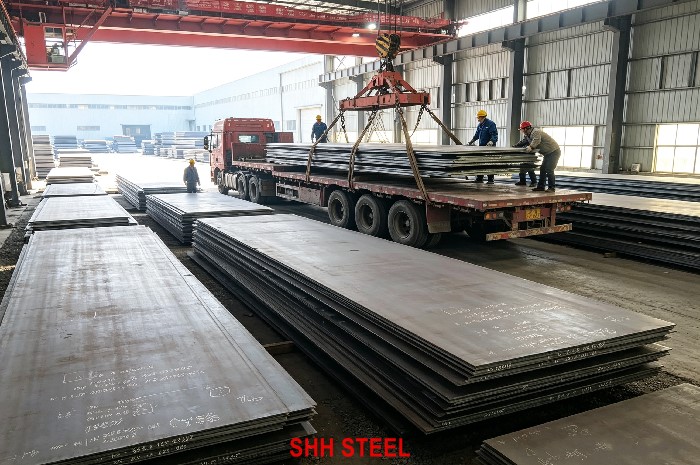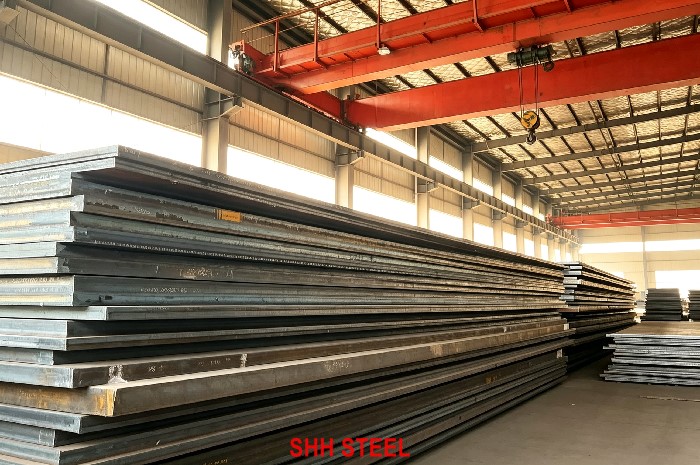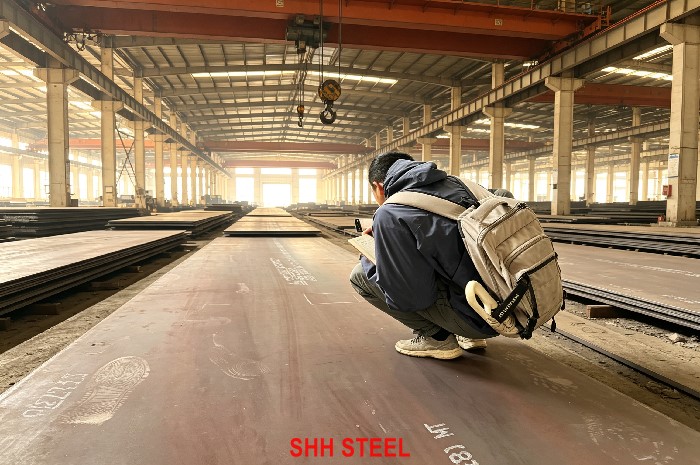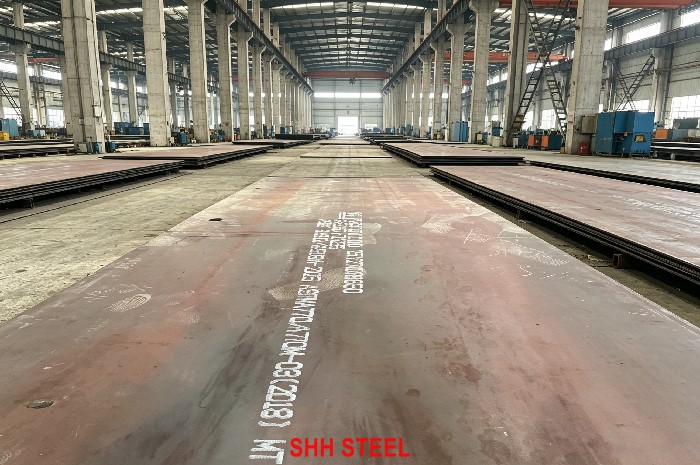
ISO 9328-2 16Mo3 Steel Plate | 16Mo3 Mo Pressure Vessel Plate
What is ISO 9328-2 16Mo3 plate?
ISO 9328-2 16Mo3 is covered by the pressure-purpose flat-product specification ISO 9328-2:2018. The standard covers plate and strip and works together with ISO 9328-1:2018 general requirements. This enquiry page concerns plate, not a guarantee that every plate size or processing route is available.
16Mo3 is an alloy special steel, not one of the non-alloy GH grades. Its visible row specifies molybdenum, and the fourth-edition foreword specifically adds consideration of normalizing rolling for this grade.
SHH STEEL handles enquiries within the ISO 9328-2 range and the Pressure Vessel Steel Plates family. We keep the specified ISO edition separate from familiar national-standard product names.
The ISO catalogue was checked on 12 November 2026 (Asia/Shanghai): the 2018 fourth edition remains Published, at stage 90.92 (to be revised). ISO/DIS 9328-2 is under development, not a published replacement. Reconfirm the edition when placing a later order.
Material specification for ISO 9328-2 16Mo3
| Ordering item | Basis |
|---|---|
| Standard | ISO 9328-2:2018, Edition 4 |
| General requirements | ISO 9328-1:2018 |
| Grade | 16Mo3 |
| Classification, clause 4.1 | Alloy special steel |
| Grade table route | Annex A |
| Product form | Plate enquiry within the standard scope for plates and strip |
| Dimensions | State nominal thickness, width, length and quantity; no verified grade thickness range is reproduced |
| Delivery and testing | Confirm applicable table row, ordered condition and all options |
| Inspection documents | Specify the required document and traceability with the enquiry |
Clause 5 requires purchaser information and treats supplementary options as order-stage decisions. Do not confuse the standard’s illustrative order dimensions with a grade-specific production range. The plate schedule and vessel material specification should accompany the enquiry.
ISO cast-analysis requirements for 16Mo3
The following cast (heat) analysis is transcribed from the visible 16Mo3 row of ISO 9328-2:2018 Table A.1, printed page 9. Values are mass percent. A maximum is not a target addition; an em dash is retained as a source dash, not interpreted as zero.
| Element | Cast analysis, mass % |
|---|---|
| C | 0.12–0.20 |
| Si | ≤0.35 |
| Mn | 0.40–0.90 |
| P | ≤0.025 |
| S | ≤0.010 |
| Al total | Report cast content (note e) |
| N | ≤0.012 |
| Cr | ≤0.30 |
| Cu | ≤0.30 |
| Mo | 0.25–0.35 |
| Nb | — |
| Ni | ≤0.30 |
| Ti | — |
| V | — |
Note e requires the cast aluminium content to be determined and reported in the inspection document; it does not supply an aluminium minimum in this row.
Note b permits agreement on a lower copper maximum and/or a maximum copper-plus-tin criterion where only a copper maximum is specified. Any such option must be stated on the order; no optional value is assumed here.
Table A.1 note a requires purchaser agreement for intentional additions of unlisted elements except cast finishing. Product analysis must be assessed separately under clause 6.3.2 and Table 1; do not silently widen the cast-analysis limits.
EN 10028-2 comparison mechanical properties for ISO 9328-2 16Mo3 (not ISO Table A.2/A.3 transcription)
ISO 9328-2:2018 clause 6.4.1 refers 16Mo3 mechanical acceptance to Tables A.2 and A.3 and to ISO 9328-1. Those ISO grade-property tables are not in the official 2018 preview, and they are not transcribed here as ISO normative limits.
The ISO 9328-2:2018 foreword states that the technical data in Annex A were aligned with EN 10028-2. The following room-temperature and elevated-temperature values are therefore presented as EN 10028-2 comparison/reference data, taken from EN 10028-2:2009 Tables 3 and 4 (transverse direction). They must not be treated as an independently verified copy of ISO Tables A.2 and A.3, and they must not be used as allowable design stresses. Confirm every acceptance value against the complete ISO 9328-2:2018 tables and the ordered edition before supply or design use.
EN 10028-2:2017 superseded the 2009 edition. A cell-by-cell identity between the 2009 and 2017 mechanical tables is not independently confirmed here, because the complete 2017 mechanical tables and Annex F were not available for that comparison. ISO option 5.2(m) refers to mechanical properties for nominal thicknesses greater than 250 mm in Table A.2 footnote a, which is consistent with an EN-style table that states values through 250 mm and treats greater thickness as an agreement option; that ISO footnote is not itself a verified ISO thickness-column transcription.
EN steel number 1.5415 is given only as the EN designation. Thickness bands below are EN table bands, not a stock list and not a silently claimed ISO grade thickness range. 250 mm in EN 10028-2:2009 Table 3 (comparison only).
Room-temperature tensile properties — EN 10028-2:2009 Table 3 comparison (transverse).
| Nominal thickness t (mm) | Usual delivery (EN Table 3) | Yield ReH, min (MPa) | Tensile Rm (MPa) | Elongation A, min (%) |
|---|---|---|---|---|
| ≤16 | +N | 275 | 440–590 | 22 |
| 16 < t ≤ 40 | +N | 270 | 440–590 | 22 |
| 40 < t ≤ 60 | +N | 260 | 440–590 | 22 |
| 60 < t ≤ 100 | +N | 240 | 430–580 | 22 |
| 100 < t ≤ 150 | +N | 220 | 420–570 | 22 |
| 150 < t ≤ 250 | +N | 210 | 410–570 | 22 |
Impact energy KV — EN 10028-2:2009 Table 3 comparison.
| Thickness applicability (EN Table 3) | KV at −20 °C (J, min) | KV at 0 °C (J, min) | KV at +20 °C (J, min) |
|---|---|---|---|
| all listed bands | agreed | agreed | 31 |
Minimum 0.2 % proof strength Rp0,2 at elevated temperature — EN 10028-2:2009 Table 4 comparison (MPa).
| Nominal thickness t (mm) | 50 °C | 100 °C | 150 °C | 200 °C | 250 °C | 300 °C | 350 °C | 400 °C | 450 °C | 500 °C |
|---|---|---|---|---|---|---|---|---|---|---|
| ≤16 | 273 | 264 | 250 | 233 | 213 | 194 | 175 | 159 | 147 | 141 |
| 16 < t ≤ 40 | 268 | 259 | 245 | 228 | 209 | 190 | 172 | 156 | 145 | 139 |
| 40 < t ≤ 60 | 258 | 250 | 236 | 220 | 202 | 183 | 165 | 150 | 139 | 134 |
| 60 < t ≤ 100 | 238 | 230 | 218 | 203 | 186 | 169 | 153 | 139 | 129 | 123 |
| 100 < t ≤ 150 | 218 | 211 | 200 | 186 | 171 | 155 | 140 | 127 | 118 | 113 |
| 150 < t ≤ 250 | 208 | 202 | 191 | 178 | 163 | 148 | 134 | 121 | 113 | 108 |
EN Table 3: −20 °C and 0 °C may be agreed (footnote f). +20 °C minimum 31 J, with footnote g (40 J may be agreed).
EN Table 4 notes: EN 10028-2:2009 Table 4 heading: minimum 0.2 % proof strength Rp0,2 at the stated test temperature. A test temperature is not a maximum service temperature or an allowable design stress. EN Table 4 footnote a: values correspond to the lower band of the relevant trend curve determined in accordance with EN 10314, with a confidence limit of about 98 % (2s). That is an EN methodology statement, not an ISO design-code allowable. EN Table 4 footnote d (P235GH, P265GH, P295GH, P355GH): values reflect minima for furnace-normalized test pieces. EN Table 4 footnote e (18MnMo4-5): Rp0,2 was not determined in accordance with EN 10314; values are minima of the scatter band considered at the time of that edition. EN Table 4 footnote b: Rp0,2 for thicknesses above the stated maximum may be agreed. ISO 9328-2:2018 option 5.2(p) similarly refers to Rp0,2 for increased nominal thicknesses in Table A.3 footnote b.
The tabulated EN numbers are EN 10028-2:2009 Tables 3 and 4 comparison/reference values. No ASTM A516, GB/T 713 or other-standard property numbers have been substituted as ISO limits.
Delivery condition and ordering options for 16Mo3
Clause 6.2.2 permits the manufacturer to replace normalizing with normalizing rolling for this grade. Additional tests in the simulated normalized condition, including their frequency, may be agreed at enquiry and order. Untreated delivery may be agreed under clause 6.2.4, subject to clause 6.2.5; it is not an automatic normalized-plate certificate.
For agreed untreated supply, the marking and processor-testing provisions of clauses 6.2.4 and 6.2.5 must be reviewed. Tests representing a simulated heat-treated condition do not remove the processor’s responsibility to demonstrate the specified properties in the adequately heat-treated finished product.
The usual-condition tables and informative heat-treatment guidance are not fully visible in this preview. No normalizing, tempering, quenching or holding-time numbers are invented here. Record the agreed condition, any subsequent fabrication treatment and the required supporting tests before production confirmation.
EN 10028-2:2009 Table 3 comparison usual delivery condition for this grade: +N (EN 10028-2:2009 Table 3). Footnote e: the manufacturer may also supply +NT. ISO 6.2.2 permits replacing normalizing with normalizing rolling for this grade.. This is an EN comparison statement, consistent in kind with ISO 9328-2:2018 clause 6.2.1 (usual conditions given in Table A.2 unless otherwise agreed). It is not a substitute for the unseen ISO Table A.2 row. Confirm the ISO usual condition and any agreed alternative on the order.
Weldability and fabrication review for 16Mo3
Clause 6.7.1 describes the steels as suitable for welding processes in current use. This is not a qualified welding procedure for 16Mo3. The fabricator must establish consumables, preheat, interpass control, heat input and any post-weld heat treatment through the applicable procedure qualification and design requirements.
Clause 6.7.2 warns that excessive post-weld heat treatment can reduce mechanical properties. Tell SHH STEEL the intended treatment and discuss simulated heat-treated sample tests at enquiry stage where appropriate. The preview does not expose the applicable critical parameters in Annex E, so no universal PWHT temperature, duration or cycle limit is supplied.
Actual heat chemistry, thickness, restraint and hydrogen control require fabrication review. Base-plate certification is not proof of completed-weld or heat-affected-zone performance. Any required weld and HAZ toughness must be addressed by the fabrication qualification.
Dimensions, surface quality and inspection
Clause 6.8 refers dimensions and dimensional tolerances to ISO 9328-1. Surface condition, internal soundness, inspection, retesting and marking also refer to that general-requirements standard. This preview does not supply the full tolerance schedule; no numeric thickness deviation, flatness allowance or ultrasonic acceptance class is claimed.
State the required nominal dimensions, edge condition, dimensional acceptance, surface restrictions, internal-soundness examination and document type on the enquiry. Review the applicable general requirements before imposing additional tests or accepting repair provisions. An examination should not be advertised as mandatory or included by default without the supporting order requirements.
Require heat and plate identification to remain traceable through cutting, packing and shipment. Confirm how test certificates and cut-piece identification will be supplied; dimensional availability remains subject to mill confirmation.
Applications and service limits of 16Mo3
16Mo3 may be considered for pressure-retaining plate components such as vessel shells, heads and welded equipment where the design specification selects this exact grade. These are intended-use examples, not authorization for a particular pressure, temperature, wall thickness or fabrication code.
Elevated-temperature properties in a material specification are not a universal maximum service temperature. The designer must assess allowable stresses, creep where relevant, corrosion allowance, toughness, fabrication history and the actual operating environment. No nuclear, RCC-M or ASME III qualification is claimed.
Clause 6.10 allows agreement on hydrogen-induced-cracking testing for relevant sour-service exposure. The grade name does not itself establish sour-service or HIC resistance. Specify the test method and acceptance conditions before ordering.
Related standard ranges include EN 10028-2 and GB/T 713. Their certificates cannot replace the specified ISO delivery requirements without engineer approval.
Compare 16Mo3 with related ISO grades
Compare the following ISO grades by their complete annex rows, delivery condition and project acceptance, not only by similar designations. These are related selections within the standard, not interchangeable materials.
| ISO product | Classification | Review before a grade change |
|---|---|---|
| ISO 9328-2 18MnMo4-5 | Alloy special steel | Annex A requirements, thickness, delivery condition and ordered tests; engineer approval required |
| ISO 9328-2 19MnMo4-5 | Alloy special steel | Annex B requirements, thickness, delivery condition and ordered tests; engineer approval required |
| ISO 9328-2 19MnMo5-5 | Alloy special steel | Annex B requirements, thickness, delivery condition and ordered tests; engineer approval required |
| ISO 9328-2 19MnMo6-5 | Alloy special steel | Annex B requirements, thickness, delivery condition and ordered tests; engineer approval required |
No numerical strength ranking is supplied because the ISO mechanical-property tables are outside the verified preview. A similarly named Annex A and Annex B grade must remain a separate material identity.
Related grades and substitution limits for 16Mo3
The heading identifies a comparison topic, not a declaration of interchangeable material. No automatic foreign equivalent or dual certification is offered for 16Mo3.
| Product / range | Verified relationship or limitation | Substitution control |
|---|---|---|
| EN 10028-2 16Mo3 | Same designation under EN 10028-2; Annex A alignment stated in the ISO foreword. Not automatic identity of every requirement. | Engineer approval is required before substitution; compare complete specifications and design-code acceptance. |
The ISO 9328-2:2018 foreword states that the technical data in Annex A were aligned with EN 10028-2. This supports describing the linked EN product as the same designation under that standard, not asserting that both specifications are automatically identical in every requirement. General requirements, edition, options, inspection and project acceptance still need review.
Why choose SHH STEEL for 16Mo3
SHH STEEL supports specification-led pressure-plate purchasing rather than substitution by catalogue name.
- We quote the requested ISO edition and grade separately from related national-standard products.
- Delivery condition, fabrication heat treatment and supplementary test requests are reviewed before confirmation.
- We identify missing technical requirements instead of filling them with unverified foreign-standard values.
- Plate dimensions, cutting, identification, inspection documentation and export packing are coordinated against the order.
- Supply capability, lead time and any additional testing remain subject to quotation confirmation.
Enquiry and supply review for 16Mo3
Send the project material schedule for 16Mo3. SHH STEEL will review the enquiry and identify any clarification needed before confirming the supply route.
| Enquiry item | Information required |
|---|---|
| Material identity | ISO 9328-2:2018 16Mo3; identify any proposed dual certification explicitly |
| Dimensions and quantity | Nominal thickness, width, length, quantity and cutting drawings |
| Delivery condition | Applicable annex table row, agreed treatment and any untreated-supply provisions |
| Acceptance tests | Complete ISO chemistry and mechanical requirements, thickness band and specimen basis |
| Supplementary tests | Any impact, mid-thickness, HIC, step-cooling or simulated heat-treatment agreements |
| Fabrication | Welding procedure constraints, forming and planned PWHT or other treatment |
| Inspection and traceability | Document type, required examinations, plate identification and cut-piece traceability |
| Delivery | Destination, packing, shipment schedule and export-document requirements |
The full applicable ISO tables must be checked before a technical supply commitment. Missing numerical requirements in this source-limited page are not waivers of the standard. Do not approve a substitution solely from this comparison content.
FAQ
-
Which edition applies to 16Mo3 here?
- This page uses ISO 9328-2:2018, Edition 4. The ISO catalogue checked on 12 November 2026 (Asia/Shanghai) still lists it as Published, with revision planned and ISO/DIS 9328-2 under development.
-
What is the classification of 16Mo3?
- Alloy special steel under clause 4.1. The applicable grade route is Annex A; its complete requirements and ISO 9328-1 general requirements must be used together.
-
Are chemistry and mechanical numbers included?
- The visible ISO Table A.1 cast-analysis row is included, with an evidenced note on the merged Others residual sum where it applies. Mechanical figures are EN 10028-2:2009 Table 3 and Table 4 comparison/reference values, provided because the ISO 2018 foreword states that Annex A was aligned with EN 10028-2. They are not independently verified ISO Table A.2 or A.3 cells. Confirm against the complete ISO edition.
-
Can another standard or a similar designation replace it?
- Not automatically. The linked EN 10028-2 product is the same designation, and Annex A alignment is stated in the ISO foreword, but that is not automatic identity of every requirement. Complete specification review and engineer approval are required before substitution or dual-certification claims.
-
What should I send for a quotation?
- Send the ISO edition and grade, dimensions, quantity, delivery condition, complete ISO acceptance requirements, inspection-document type and planned fabrication heat treatment. Include agreed supplementary tests and destination. If EN 10028-2 comparison values are being used for enquiry only, say so and identify the EN edition.
Request a quotation for ISO 9328-2 16Mo3 plate
Request a SHH STEEL quotation for ISO 9328-2:2018 16Mo3 plate. Send nominal thickness, width, length, quantity, destination and the project material specification.
Identify the delivery condition, complete ISO chemistry and mechanical acceptance requirements, required inspection document and any impact, internal-soundness or supplementary tests. Include forming, welding and intended post-weld heat treatment for technical review.
Availability, dimensions, processing, testing and lead time will be confirmed against the enquiry. Related grades are not treated as approved substitutes without engineer review.
Contact: admin@steelspecs.com
Quality Steel Needed? Inquire for Offers
Related Products