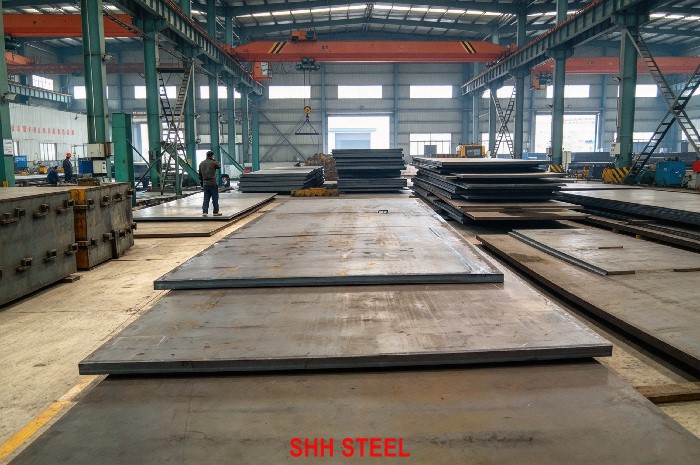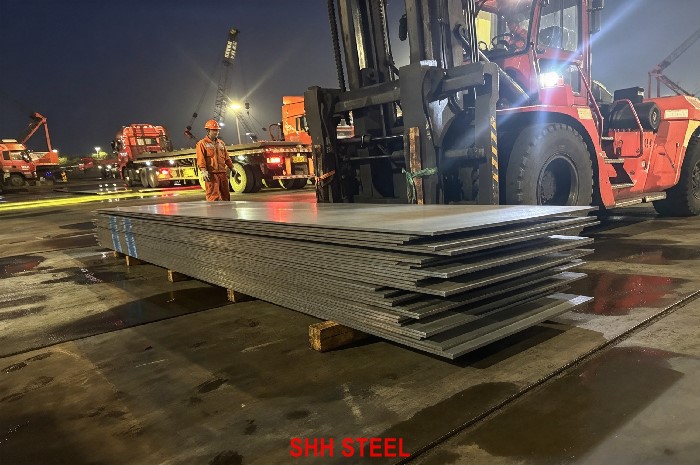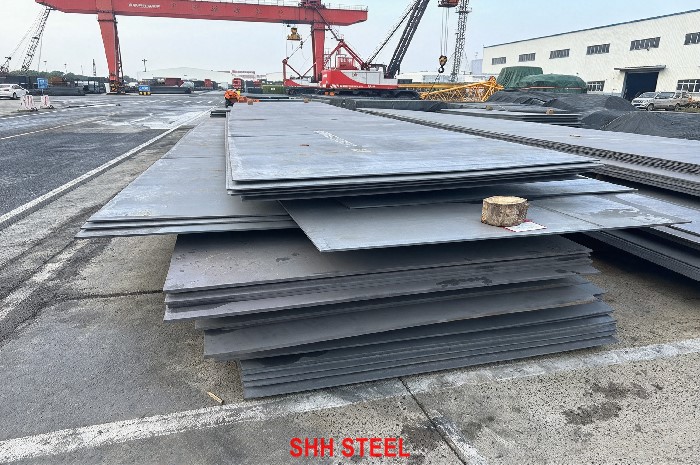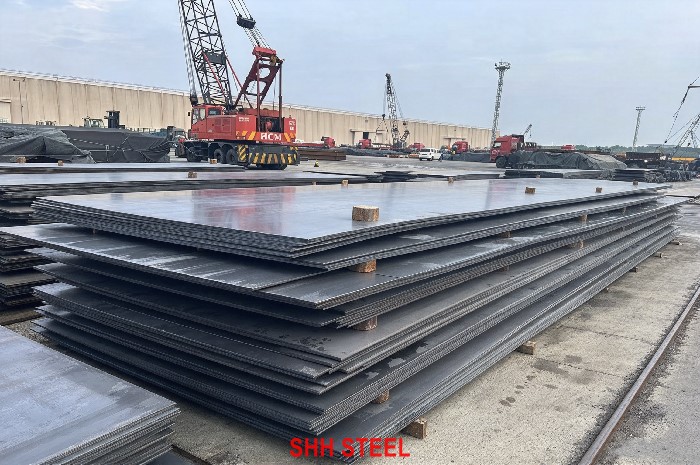

GB 712 Grade FH36 shipbuilding steel plate
GB 712 Grade FH36 shipbuilding steel plate — overview
GB 712 Grade FH36 is the −60 °C grade at the 36 level, with the tighter F-column chemistry: lower C, P and S, a nitrogen cap and a higher Ni allowance. In GB 712 the 36 level is the workhorse of Chinese merchant shipbuilding. Most of the hull girder of a bulk carrier, tanker or container ship built in China is level-36 plate, and it is the high-tensile grade Chinese mills roll in the largest volume. Minimum yield is 355 N/mm², tensile 490–630 N/mm², elongation 21 %.
Equivalent grades: ASTM A131 Grade FH36 · ABS FH36 · DNV NV F36 · LR FH36 · BV FH36 · CCS F36 / FH36 · NK KF36 · KR RF36 · RINA FH36.
Current edition: GB/T 712-2022 (Structural steel for ships and ocean engineering) (replaced GB 712-2011; implementation date 2023-05-01). English page titles keep the form “GB 712 Grade …”. Chemistry and tensile figures on this page are verified against the GB 712-2011 OCR tables and Caishuku consensus; full 2022 tables were not obtained free — do not assume 2022-only UHSS grades beyond this pack.
GB 712 names high-tensile hull steel the IACS way: H for higher strength, the toughness letter in front (A 0 °C, D −20 °C, E −40 °C, F −60 °C) and the strength level behind (32 → 315, 36 → 355, 40 → 390 N/mm²). FH36 is the F letter at level 36. Typical uses: polar and Arctic vessels, icebreaking cargo ships, Arctic gas carrier hull areas and offshore units designed for −60 °C service.
China builds more merchant tonnage than any other country, and large integrated mills such as Baosteel, Ansteel and Wisco (now part of China Baowu) roll FH36 on wide-plate mills with controlled rolling and accelerated cooling (general market context, not a claim about any one mill’s approvals). The GB 712 grade is the common base; class certificates are added on top for export or classed hulls.
Compared with the GB/T 1591 structural grade Q355, GB 712 Grade FH36 has a similar yield level but is a different product: hull-steel fine-grain practice, Charpy grading by letter, a carbon-equivalent discipline for TMCP plate and hull-steel marking. Do not let a buyer or a mill swap one for the other.
SHH STEEL supplies GB 712 Grade FH36 from Chinese mills, from stock in common sizes or rolled to order, with class certification on the same heat when required.
How GB 712 names it. FH36 is written exactly as on an IACS drawing; Chinese buyers sometimes shorten it to “F36” or “Level 36”, but the full form belongs on the order and the stencil.
Level 36 is the most widely produced high-tensile hull grade in China and worldwide, so it has the widest choice of mills, sizes and stock.
GB 712 Grade FH36: key data at a glance
| Item | GB 712 Grade FH36 |
|---|---|
| Standard | GB 712, higher-strength hull structural steel FH36; IACS UR W11 basis (GB 712 clause/table numbers not quoted — UNCERTAIN) |
| Designation | FH36: toughness letter FH + strength level 36 |
| Strength | ReH ≥ 355 N/mm², Rm 490–630 N/mm², A ≥ 21 % |
| Charpy V | −60 °C |
| Steelmaking | killed and fine-grain treated (Al, Nb, V or Ti) |
| Condition of supply | AR / CR / N / TMCP as permitted by thickness; QT where agreed |
| TM carbon equivalent | Ceq ≤ 0.38 % (t ≤ 50 mm), ≤ 0.40 % (50–100 mm) — indicative UR W11 practice |
| Thickness range | plates typically up to 100 mm (sections also within GB 712) |
| Dimensions | GB/T 709 or agreed export standard |
| Certificate | GB 712 mill certificate; class certificate / EN 10204 3.2 on request |
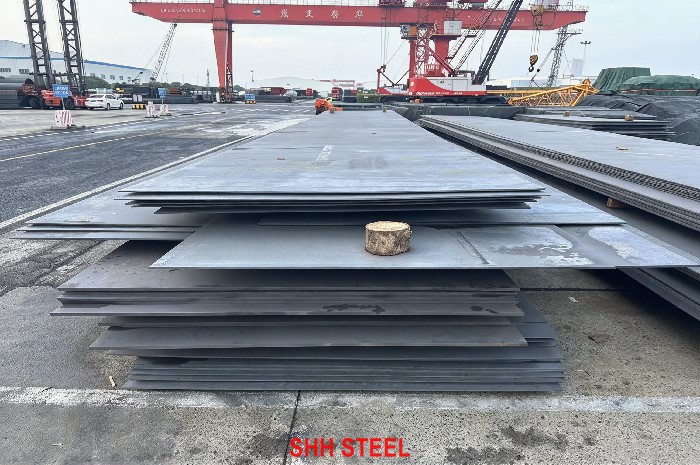
Traded GB 712 Grade FH36 is mostly 6–60 mm thick and 2000–3500 mm wide. FH plate thicker than about 50 mm is offered by a smaller group of mills; check before you fix the design thickness.
GB 712 Grade FH36 chemistry — full alloy list
| Element | Heat (ladle) analysis, % | Product (check) analysis, % | Comment |
|---|---|---|---|
| C | 0.16 max. | 0.18 max. (0.16 + 0.02) | FH column |
| Si | 0.10–0.50 | 0.05–0.55 (0.10 − 0.05; 0.50 + 0.05) | |
| Mn | 0.90–1.60 | 0.84–1.66 (0.90 − 0.06; 1.60 + 0.06) | |
| P | 0.025 max. | 0.030 max. (0.025 + 0.005) | F column tighter |
| S | 0.025 max. | 0.030 max. (0.025 + 0.005) | F column tighter |
| Al (acid-soluble) | 0.015 min. acid-soluble | 0.012 min. (0.015 − 0.003) | grain refiner |
| Nb | 0.02–0.05 when used singly | 0.015–0.055 (0.02 − 0.005; 0.05 + 0.005) | grain refiner / strength |
| V | 0.05–0.10 when used singly | 0.04–0.12 (0.05 − 0.01; 0.10 + 0.02) | |
| Ti | 0.02 max. | 0.04 max. (0.02 + 0.02) | |
| Cu | 0.35 max. | 0.40 max. (0.35 + 0.05) | |
| Cr | 0.20 max. | 0.25 max. (0.20 + 0.05) | |
| Ni | 0.80 max. | 0.85 max. (0.80 + 0.05) | larger allowance in F column |
| Mo | 0.08 max. | 0.08 max. (Mo not listed in GB/T 222-2006 Table 1 – heat limit applies) | |
| N | 0.009 max. (0.012 if Al present) | 0.009 max. (value outside the GB/T 222-2006 Table 1 N rows – no tabulated deviation; agree on order) | cap applies to F column |
| Nb+V+Ti | 0.12 max. (combined, when used together) | not applicable (calculated from heat analysis) | combined microalloy cap |
| Ceq (TM plate) | 0.38 / 0.40 max. (calculated) | not applicable (calculated from heat analysis) | t ≤ 50 / 50–100 mm |
Product (check) analysis column = heat (ladle) limit adjusted by GB/T 222-2006 Table 1 (non-alloy and low-alloy steel), as invoked by GB 712 clause 6.1.3 (upper limit + upper deviation, lower limit − lower deviation; row chosen by the specified upper limit; values for cross-sections up to 6 500 mm², larger sections by agreement); arithmetic shown in brackets.
These are the IACS UR W11 / GB 712-2011 OCR limits for higher-strength hull steel (Caishuku-aligned). Current national edition is GB/T 712-2022; full 2022 chem tables not obtained free — confirm any edition deltas on the mill certificate. The F column caps C at 0.16 %, P and S at 0.025 % and N at 0.009 % (0.012 % with Al), and allows Ni up to 0.80 %. Read each line on the certificate.
For TMCP plate ask for Ceq on the certificate, and Pcm too if the welding procedure is qualified on it. At level 36, Nb–Ti or Nb–V TMCP designs are usual. Product-product analysis tolerances follow GB/T 222 (referenced by GB 712-2011 §6.1.3); confirm any agreed offsets on the order and mill certificate.
For FH36, check that Nb, V and Ti are printed even when small, because the Nb+V+Ti cap and the Ceq both depend on them. Chinese certificates often give Ceq to two decimals using C + Mn/6 + (Cr+Mo+V)/5 + (Ni+Cu)/15.
GB 712 Grade FH36 tensile requirements
| Property | Requirement |
|---|---|
| ReH | 355 N/mm² min. |
| Rm | 490–630 N/mm² |
| A (5.65√S0) | 21 % min. |
| Charpy test temperature | −60 °C |
AH36, DH36, EH36 and FH36 share these tensile values; only the Charpy temperature and, for FH, the chemistry differ. Against mild Grade A the yield gain is 120 N/mm², which the designer turns into thinner plate. Chinese certificates give results in MPa; the yield/tensile ratio is not limited by the hull grade itself but is often reported, and some owners ask for it on export orders.
Tensile specimens are taken transverse to the rolling direction for plate, following UR W11/W16 practice; the certificate should show the specimen orientation and type. For TMCP plate the yield/tensile ratio is often around 0.8–0.9; no limit applies unless the order adds one (indicative).
GB 712 Grade FH36: Charpy at −60 °C and condition of supply
| Thickness | Avg. long. (J) | Avg. trans. (J) |
|---|---|---|
| ≤ 50 mm | 34 | 24 |
| 50–70 mm | 41 | 27 |
| 70–100 mm | 50 | 34 |
The required energy rises with thickness: 70–100 mm FH36 plate must average 50 J longitudinal at −60 °C against 34 J up to 50 mm. FH plate is almost always TMCP or N; as-rolled plate rarely reaches −60 °C reliably.
TMCP is the dominant route for high-tensile hull plate in Chinese mills; the certificate should state it explicitly, because test frequency and the Ceq cap depend on it.
Thickness tolerance and surface
GB 712 plate is normally rolled to GB/T 709 dimensions with a hull-steel minus tolerance (IACS UR W13 practice, often quoted as −0.3 mm — confirm on the order). Export orders may specify EN 10029 or ASTM A6/A20 instead. High-tensile designs leave little margin, so measure FH36 at several points on receipt and record the results with the plate number.
If the plate is ordered with a classification certificate, the class minus tolerance applies whatever dimension standard is named, so state both on the order. For thin plate under 10 mm, also state the flatness requirement; GB/T 709 flatness classes differ from EN 10029.
GB 712 Grade FH36 stock and lead time
| Thickness (mm) | Width (mm) | Length (mm) | Condition | Approx. qty |
|---|---|---|---|---|
| 5 | 1500 / 1800 | 6000–12000 | AR / N / TMCP | 80+ t |
| 6 | 1800 / 2000 | 6000–12000 | AR / N / TMCP | 100+ t |
| 8 | 2000 | 6000–12000 | AR / N / TMCP | 150+ t |
| 10 | 2000 / 2200 | 6000–12000 | AR / N / TMCP | 200+ t |
| 12 | 2000 / 2500 | 6000–12000 | AR / N / TMCP | 250+ t |
| 16 | 2200 / 2500 | 6000–12000 | AR / N / TMCP | 200+ t |
| 20 | 2500 | 6000–12000 | AR / N / TMCP | 150+ t |
| 25 | 2500 | 6000–12000 | AR / N / TMCP | 120+ t |
| 30 | 2200 / 2500 | 6000–12000 | AR / N / TMCP | 100+ t |
| 40 | 2200 | 6000–12000 | AR / N / TMCP | 60+ t |
| 50 | 2200 | 6000–12000 | AR / N / TMCP | 40+ t |
Quantities change weekly — confirm before booking. Stock plate is sold as GB 712 Grade FH36 with the original mill certificate. Other sizes go into the next mill campaign: about 4–6 weeks.
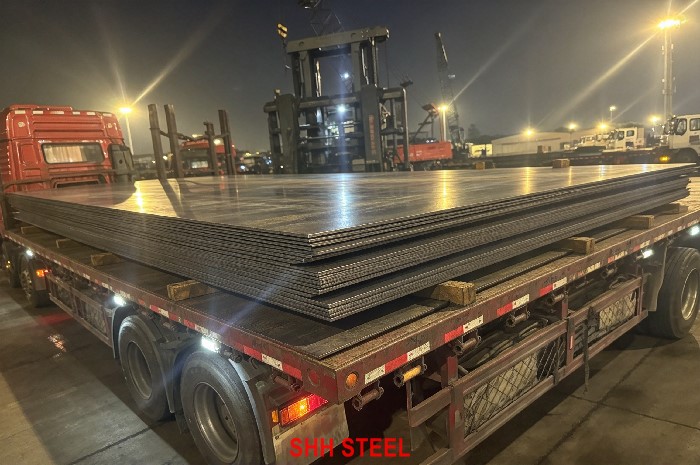
Packing and shipping: bundled by size with steel strapping, stencilled with standard, grade and heat number, and shipped from Shanghai, Tianjin, Qingdao or other Chinese ports in containers (≤ 11.8 m) or break bulk.
Processing before shipping. We cut FH36 to drawing by plasma or oxy-fuel, bevel edges, shot-blast and prime, and transfer grade, heat and plate number to every piece so that GB 712 traceability survives cutting. Cut parts ship with a cutting list cross-referencing each piece to its mother plate and certificate.
GB 712 Grade FH36 against class societies and ASTM A131
| Standard / society | Designation | Remark |
|---|---|---|
| GB 712 (this page) | GB 712 Grade FH36 | Chinese national product standard; no class stamp by itself |
| CCS | CCS FH36 | same letters as GB 712; the usual class mark on domestic Chinese hulls |
| ABS | ABS FH36 | |
| DNV | DNV VL F36 | VL prefix |
| LR | LR FH36 | |
| BV | BV FH36 | |
| KR | KR RF36 | R-prefix |
| NK | NK KF36 | K-prefix |
| RINA | RINA FH36 | |
| ASTM A131 | ASTM A131/A131M Grade FH36 | US product standard |
GB 712 and the CCS Rules. GB 712 was drafted to mirror the IACS unified requirements, which the China Classification Society (CCS) also applies in its Rules for Materials and Welding. In practice a Chinese mill rolls one heat to the shared chemistry and test plan; the plate becomes GB 712 Grade FH36 through the national standard and CCS FH36 through CCS survey. The two are parallel documents, not one replacing the other (CCS chapter numbering not quoted — UNCERTAIN).
Class certification on a GB 712 base. Export buyers often order “GB 712 FH36 with CCS, ABS or DNV certificate” (or another IACS society). The class surveyor must witness or audit the tests at the mill before shipment; a plain GB 712 certificate cannot be converted into a class certificate afterwards. Several marks on one plate are possible when every society is booked in advance and the mill holds the relevant approvals.
Where FH36 sits in the GB 712 AH/DH/EH/FH matrix
Read the series as a grid: across (AH36, DH36, EH36, FH36) the test temperature falls, down (FH32, FH36, FH40) the yield rises. The drawing fixes the letter from structural category and thickness; the scantling calculation fixes the number. A higher letter at the same number is normally accepted as a substitute; a lower letter is not.
FH36 is chosen for polar and Arctic service; check that the design really needs −60 °C before paying for it. Above 390 N/mm², GB 712 continues into the extra-high-strength series starting at FH420. See GB 712 shipbuilding steel plates.
Level 36 is the default for the main hull girder; designers move to level 40 only where deck or coaming thickness would become awkward to weld.
Welding and forming GB 712 Grade FH36
Typical uses: polar and Arctic vessels, icebreaking cargo ships, Arctic gas carrier hull areas and offshore units designed for −60 °C service.
Welding: use high-tensile consumables of grade 5Y or higher (typical UR W17 mapping — confirm in the WPS), with preheat and heat input set by the qualified procedure and the Ceq on the certificate. Chinese yards weld thick FH36 by one-side SAW and electrogas; those high-heat-input processes need a procedure qualified on plate from the same route.
Forming: TMCP plate gets part of its strength from controlled rolling and cooling; keep line heating below the mill’s stated limit (often quoted around 650 °C — UNCERTAIN, mill-specific).
Why the F letter. FH36 is tested at −60 °C and chosen for polar and Arctic service and the lowest design temperatures. FH needs the tightest steelmaking control, so check P, S, N and Ni line by line. Where blocks mix letters, keep FH36 plates separated and colour-marked so that a lower letter is never fitted by mistake.
GB 712 tests, certificate and receiving checks
The mill certificate lists heat analysis including microalloys, Ceq for TMCP plate, tensile results, Charpy results at −60 °C, condition of supply and plate numbers. A bilingual Chinese/English certificate is standard for export.
On receipt: check the stencil shows GB 712 and FH36, the Charpy temperature and thickness band match, and the heat numbers tie to the certificate. UT to GB/T 2970 (or EN 10160 / ASTM A578 for export), Z-direction tests and third-party witness can be added if booked before rolling.
Mill quality system. Chinese plate mills supplying GB 712 normally run ISO 9001-certified quality systems and hold their own national product certification; when a class certificate is wanted, the mill must also hold that society’s works approval for the grade and thickness (details per mill — UNCERTAIN). Ask for that approval scope before ordering; it is the single most useful check a buyer can make.
Mistakes we see on GB 712 Grade FH36 orders
- Writing “Q355” or “Q345” when the drawing says FH36
- Writing only “36 grade” so the toughness letter is undefined
- Accepting a mild A/B/D/E certificate against a high-tensile order
- No Ceq printed for TMCP plate
- Assuming a GB 712 certificate equals a class certificate
- F-column limits (N, P, S, Ni) not checked
A clean order line — standard, grade, condition, certificate, class — prevents nearly all of them.
With FH36 the costly errors are mixed letters within one delivery, missing Ceq for TMCP plate, and plates whose delivered thickness falls into a higher Charpy band than the test covered.
Buying GB 712 Grade FH36 from China: concerns and answers
| Concern | Answer |
|---|---|
| Is the certificate genuine? | Original mill certificate for GB 712 Grade FH36, traceable by heat and plate number; mill verification and third-party witness on request |
| Will a foreign yard or inspector read it? | Bilingual Chinese/English certificate; supply-condition codes translated |
| Export paperwork | commercial invoice, packing list, bill of lading, certificate of origin (Form E or general CO on request) |
| Payment safety | T/T with balance after inspection, or L/C at sight |
| Small or mixed orders | several sizes and grades in one container |
| Ready-to-fit parts | cutting, bevelling, shot-blasting and priming in our own workshop |
If you have not bought GB 712 plate from China before, we can send sample certificates in advance, arrange a trial lot, and let your inspector visit the mill during rolling and testing. For buyers outside China we also check that the bilingual certificate wording matches the purchase order line by line before shipment.
Ordering GB 712 Grade FH36
State: GB 712 FH36, condition of supply, sizes and quantities, tolerance standard, UT / Z-direction, class certificate if needed, certificate type and port, and send to SHH STEEL.
Sample line: “Hull structural steel plate to GB 712, grade FH36, TMCP, 16 × 2500 × 12000 mm, 40 pcs, bilingual mill certificate with Ceq, EN 10204 3.1, CFR Jebel Ali.”
Order checklist:
- Standard: GB 712 (state edition if your contract requires one)
- Grade: FH36
- Condition of supply (AR / N / TMCP as allowed)
- Sizes and quantity per size; tolerance standard and flatness class
- Certificate: bilingual GB 712 mill certificate, EN 10204 3.1 or 3.2; class certificate if required
- Extras: UT, Z-direction, shot-blast/prime, cutting
- Delivery terms, destination port and documents (CO, Form E)
FAQ
Conclusion
GB 712 Grade FH36 is the higher-strength hull structural steel of the Chinese national standard GB 712, on the IACS UR W11 basis: yield 355 N/mm², tensile 490–630 N/mm², Charpy −60 °C. Order it by standard and grade, and add a classification certificate on the same heat when the hull is classed.
SHH STEEL supplies GB 712 Grade FH36 from Chinese mills with bilingual certificates, cutting, UT and EN 10204 3.2 on request. Send grade, sizes, quantities and port for a quotation.
Quality Steel Needed? Inquire for Offers
Related Products