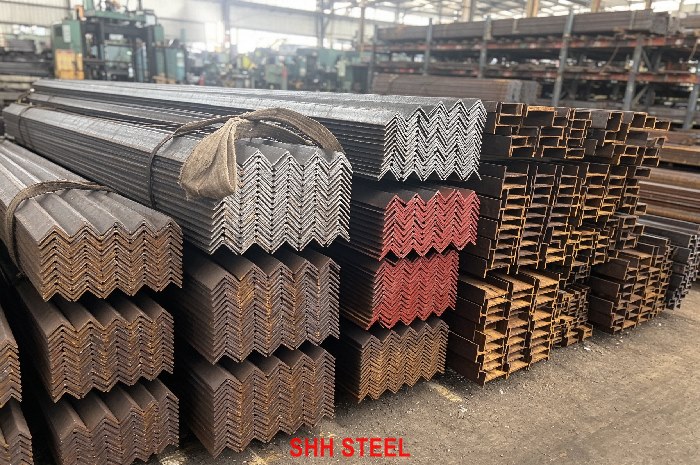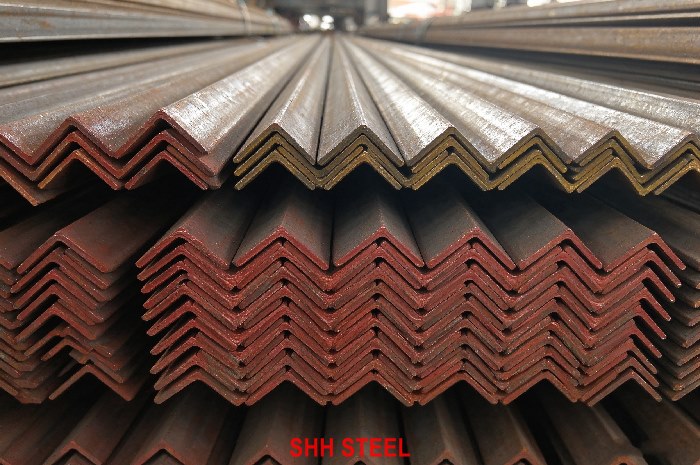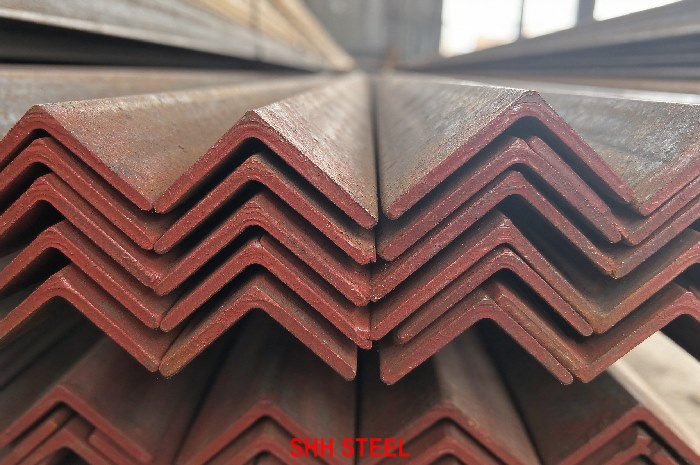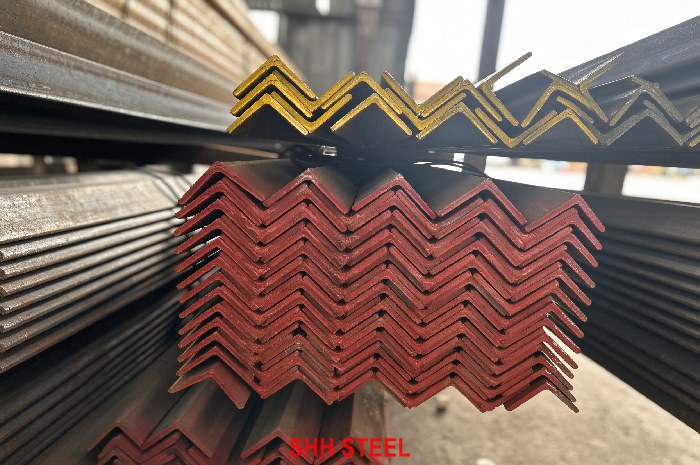
EN 10025-2 S275JR Equal and Unequal Steel Angles
What is EN 10025-2 S275JR Steel Angle?
EN 10025-2 S275JR steel angle is a hot-rolled European structural angle whose material grade is S275JR under EN 10025-2 and whose shape, tolerances and theoretical mass are ordered to EN 10056, with tolerances to EN 10056-2. S275 is the 275 MPa minimum yield class in the thinnest tabulated thickness band, and JR is the quality grade, which carries a longitudinal Charpy V-notch requirement of 27 J at +20 °C. The steel number is 1.0044.
This page covers the rolled angle, not plate and not a channel. The same grade in plate form is listed separately as EN 10025-2 S275JR steel plate. The plate page is not a substitute data sheet for angles, and neither is EN 10025-2 S275JR H-beam.
These bars are filed under steel angle profiles in the steel structural profiles category. They may be ordered as equal-leg or unequal-leg L sections. They are not American L shapes, Chinese GB/T 706 angles, or Japanese angles of a similar millimetre leg. Sister EN angles in S235JR and S355JR are different grades. A S275JR channel is a different product: see EN 10025-2 S275JR steel channel.
S275JR is a general structural steel for frames, towers, bracing and ordinary fabrication where a +20 °C impact quality is accepted. S275J0 and S275J2 are related qualities at 0 °C and −20 °C; they are noted here and are not given their own URLs.
This page covers Equal and Unequal Steel Angles in EN 10025-2 S275JR. The Equal Leg Steel Angles and Unequal Leg Steel Angles follow EN 10056-1; the material standard does not by itself define the dimensions.
Material, Dimensions and Tolerances for S275JR Angles
Three documents should appear, separately, on the purchase order and on the inspection certificate:
- the material standard and edition, EN 10025-2:2019 unless the order names another edition, and the grade S275JR (steel number 1.0044);
- the dimensional standard, EN 10056, with tolerances to EN 10056-2, with the angle designation;
- the delivery condition, inspection document type, and any agreed options such as a galvanizing chemistry or a clause 7.2.5 CEV approach.
EN 10025-2 is the material standard. It is not a size table. Size, tolerance and theoretical mass come from the dimensional standard named on the order.
EN 10025-2 S275JR Equal Leg Steel Angles
The equal-leg tables cover 71 verified sizes, from L 80×80×8 to L 300×300×35. The unequal-leg table covers the verified L 200×100 family only (5 thicknesses, L 200×100×10 to L 200×100×16). This is not the complete EN 10056-1 series: smaller equal legs and a wider unequal series exist in that standard and may be supplied when specified and certified, but they are not invented here. Numeric dimensions use the verified EN 10056 set already published on the sister S235JR and S355JR angle pages, with shape tolerances to EN 10056-2. The edition named on the order governs.
Not every mill rolls every designation in S275JR. The order should name the sections actually required.
Equal-leg angles — L 80 to L 150 equal (15 sizes)
Swipe horizontally to view all dimensions.
Equal-leg angles — L 160 to L 200 equal (28 sizes)
Swipe horizontally to view all dimensions.
Equal-leg angles — L 250 to L 300 equal (28 sizes)
Swipe horizontally to view all dimensions.
EN 10025-2 S275JR Unequal Leg Steel Angles
Unequal-leg angles — L 200×100×10 to L 200×100×16 (5 sizes)
Swipe horizontally to view all dimensions.
S275JR Chemical Composition for Angles (EN 10025-2 Ladle Analysis)
The figures below are ladle-analysis maxima from EN 10025-2:2019 for long products in S275JR. Product analysis, where required, follows the standard’s permitted deviations; those deviations are not retabulated here.
For these angles the nominal thickness is ordinarily the leg thickness t, not the leg length.
S275JR Carbon Equivalent for Angles
EN 10025-2:2019 publishes the following ladle-analysis CEV maxima for S275JR, using the IIW formula C + Mn/6 + (Cr + Mo + V)/5 + (Ni + Cu)/15.
For these angles the nominal thickness is ordinarily the leg thickness t, not the leg length. Clause 7.2.5 of EN 10025-2:2019 may adjust the CEV approach for S275 when that option is invoked on the order; this page does not invent alternative limits. In the verified equal-leg set, leg thickness ranges from 6 mm to 35 mm, so some rows sit in the 16 mm < t ≤ 40 mm mechanical band (265 MPa). None of the tabulated legs exceeds 40 mm, so they remain in the first CEV band. Later bands are still shown.
S275JR Angle Mechanical Properties: Yield, Tensile and +20 °C Impact
The long-product tensile table for S275JR is as follows. Tests on long products are normally longitudinal unless otherwise ordered. For these angles the nominal thickness is ordinarily the leg thickness t, not the leg length. For sections with nominal thickness greater than 100 mm, the mechanical values shall be agreed. No limits beyond 150 mm are given here.
When impact testing applies, S275JR requires 27 J at +20 °C, longitudinally unless otherwise ordered. In the verified equal-leg set, leg thickness ranges from 6 mm to 35 mm, so some rows sit in the 16 mm < t ≤ 40 mm mechanical band (265 MPa). None of the tabulated legs exceeds 40 mm, so they remain in the first CEV band. Later bands are still shown.
Delivery Conditions, Inspection and Identification
S275JR angles are commonly delivered in the as-rolled condition of EN 10025-2. The inspection document should identify EN 10025-2 and its edition, the grade S275JR, the EN 10056 designation and edition, ladle analysis and CEV, and mechanical results against the thickness at the test location, ordinarily the leg thickness. A plate, channel or H-beam certificate does not, by itself, identify an angle.
Weldability and Surface Condition of S275JR Steel Angles
S275JR is a weldable non-alloy structural steel. Preheat and consumable choice should use the certified CEV, the actual leg thickness and the joint design. Surface condition belongs to the ordered specification; this page does not reproduce those millimetre limits.
EN 10056-2 Shape Tolerances and Theoretical Mass
Shape, straightness, length and theoretical mass belong to the ordered editions of EN 10056-1 and EN 10056-2. The tables on this page are the verified subset already used on the sister S235JR and S355JR angle pages, not a claim that every EN 10056 size has been retabulated. Mass is the published theoretical figure. Millimetre tolerance tables are not reproduced here.
Applications and Service Limits
S275JR angles are used in frames, towers, bracing and ordinary welded or bolted fabrication where a 275 MPa yield class in the first thickness band and a +20 °C impact quality are accepted. They are not specified here for service that needs a 0 °C or −20 °C quality. An L 80×80 is not a drop-in substitute for a GB/T 706 or ASTM angle of similar leg length.
S275JR Steel Angle Compared with Related Grades
The comparisons below are an orientation only; they are not automatic substitutes.
Near-Equivalents: Not Automatic Substitutes
A near-equivalent is a starting point for a discussion, not a licence to swap certificates. EN 10025-2 S275JR steel plate uses the same grade name but a different specimen orientation. EN 10025-2 S275JR H-beam is a different shape. If a project names S275J0, S275J2 or a non-EN angle series, keep that name on the order.
Sourcing S275JR Steel Angles from SHH STEEL
SHH STEEL supplies EN 10025-2 S275JR steel angles against a named designation list, the material edition and the inspection document type. Enquiries should state equal-leg or unequal-leg designations, cut lengths or mill lengths, any processing, and whether a sister grade such as EN 10025-2 S355JR steel angle is acceptable on part of the list.
The size tables are the verified subset, not a claim that every EN 10056 size is rolled in every heat. Once the list is clear, a quotation can be prepared against the stated edition and certificate.
S275JR Steel Angle FAQs
-
Are S275J0 and S275J2 the same product as S275JR?
- They share the S275 yield class, but J0 and J2 are 0 °C and −20 °C impact qualities. They are related grades on this page, not separate URLs, and a JR certificate is not a silent substitute for a J0 or J2 order.
-
Which thickness is used for yield, CEV and impact?
- EN 10025-2 applies the bands to the nominal thickness of the part from which the test sample is taken. For these angles that is ordinarily the leg thickness, not the leg length. Some tabulated legs are thicker than 16 mm and therefore sit in the second yield band.
-
Is this the complete EN 10056 size series?
- No. The tables are the verified subset already published on the sister S235JR and S355JR angle pages: the listed equal-leg families and the L 200×100 unequal family. Smaller equal legs and a wider unequal series may be supplied when specified and certified, but they are not invented here.
-
Which standards should appear on the inspection document?
- At least EN 10025-2 and its edition, the grade S275JR, the EN 10056 designation and the EN 10056-2 edition used for tolerances, ladle analysis and CEV, and mechanical results against the leg thickness unless the order relocates the specimen.
Request a Quotation for EN 10025-2 S275JR Steel Angle
EN 10025-2 S275JR steel angle is a European structural angle with 275 MPa minimum yield in the first thickness band and a 27 J impact requirement at +20 °C. Nominate the designation (for example L 80×80×8 or L 200×100×10), EN 10025-2:2019 or the edition on the order, and the inspection document type. Send the size list, edition, certificate type and any processing notes; SHH STEEL will review the package and quote accordingly.
Quality Steel Needed? Inquire for Offers
Related Products