

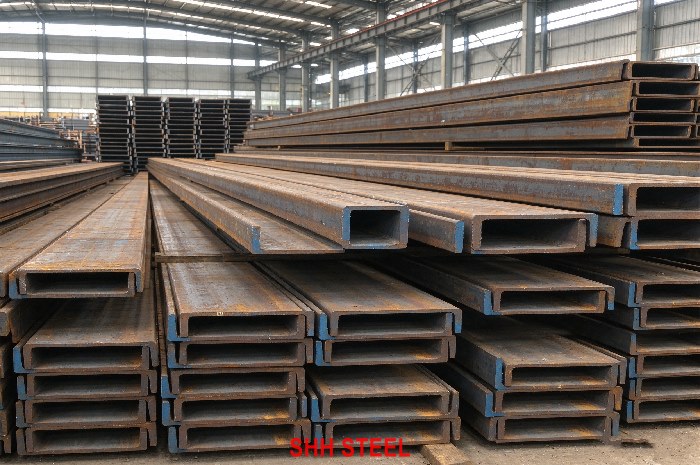
ASTM A529 Grade 50 C and MC Steel Channels
What are ASTM A529 Grade 50 C and MC Steel Channels?
ASTM A529 Grade 50 C and MC steel channels are hot-rolled C-shapes or MC-shapes in high-strength carbon-manganese structural steel Grade 50 [345]. The material standard is ASTM A529/A529M. Dimensions, mass and general requirements for the rolled section are those of ASTM A6/A6M. SHH STEEL supplies these channels to the grade, C or MC designation, edition and certificate named on the order.
This page is written for Grade 50 channels. It is not a Grade 55 data sheet, not a plate page, and not a substitute for ASTM A36 steel channel or for ASTM A572 Grade 50 steel channel. American Standard channels are designated C, for example C 6×8.2 or C 15×50. Miscellaneous channels are designated MC, for example MC 12×10.6 or MC 18×58. An MC is not a C of the same depth. Neither series is a European UPN or UPE, and neither is a Chinese or Japanese channel of a similar millimetre depth.
The specification covers carbon-manganese steel shapes, plates and bars of structural quality for riveted, bolted or welded construction of buildings and for general structural purposes. For Grade 50, shapes are limited to a flange or leg thickness of 1-1/2 in [40 mm] inclusive. Every standard C and MC row tabulated on this page is inside that limit. These channels are filed under ASTM A529 steel channel profiles in the steel channel profiles category of steel structural profiles.
This page covers C and MC Steel Channels in ASTM A529 Grade 50. The American Standard (C) and miscellaneous (MC) series follow ASTM A6/A6M; the material standard does not by itself define the dimensions.
Material, Dimensions and Tolerances for A529 Grade 50 Channels
Keep the material specification and the dimensional standard distinct:
ASTM A529/A529M is the material standard. This article uses the Grade 50 shapes chemistry and tensile figures consistent with the A529/A529M-19 tables and with the publicly posted scope of the current ASTM listing, A529/A529M-26 (shapes with flange or leg thickness to 1-1/2 in inclusive). The edition named on the order governs acceptance.
ASTM A6/A6M is the general-requirements and dimensional standard for these rolled C and MC channels. The size tables below are the standard C and MC series used as a reference, not a mill rolling list. The edition of A6/A6M named on the order governs dimensional acceptance.
A documented special combination is valid only if every requirement of each named standard is met. Matching a nominal 6 in or 150 mm depth is not a substitution method, and an A36 or A572 Grade 50 certificate is not an A529 Grade 50 certificate.
A529 Grade 50 Channel Sizes: Standard C and MC Series
The tables list designation, depth, flange width, web and flange thickness, and theoretical mass, in inch-pound and SI units, for the standard American Standard (C) and miscellaneous (MC) series under ASTM A6/A6M. Use them to identify and estimate, not as a rolling programme for A529 Grade 50. Mid-range C 6 to C 12 sizes are the usual enquiry core; the lightest C 3 rows and the MC 18 range should be confirmed size by size.
C 6×8.2 and C 6×13 share a 6 in depth but not a web or a mass. MC 12×10.6 is a miscellaneous 12 in channel, not a C 12×20.7. Grade 50 shapes are limited to a flange or leg thickness of 1-1/2 in [40 mm] inclusive. The heaviest standard C flange in these tables is 0.65 in (C 15×50) and the heaviest standard MC flange is 0.70 in, so every tabulated row is inside that Grade 50 limit.
American Standard channels (C series)
32 sizes, from C 3×3.5 to C 15×50.
Swipe horizontally to view all dimensions.
Miscellaneous channels (MC series)
40 sizes, from MC 3×7.1 to MC 18×58.
Swipe horizontally to view all dimensions.
S-shapes and other bar-size or special channels can be reviewed when they are named on the enquiry. Complete tables for those series are not reproduced here. European UPN or UPE, and Chinese or Japanese channel designations, belong to their own dimensional standards, not to these C and MC rows.
A529 Grade 50 Chemical Composition for Channels
The figures below are heat-analysis limits for Grades 50 and 55 from Table 1 of ASTM A529/A529M, as commonly tabulated. They are limits, not typical heat results. Product analysis, when required, shall conform to those same heat-analysis limits, subject to the numeric permitted variations below, taken from Table A of ASTM A6/A6M-19. Where Table A shows no under-minimum or over-maximum figure, none is applied on this page.
The following product-analysis variations apply to those heat-analysis limits.
Table A footnote A gives a different manganese variation for bars and bar-size shapes: ±0.03% up to 0.90% inclusive, and ±0.06% over 0.90% to 2.20% inclusive. Where a heat-analysis limit is a maximum only, the over-maximum variation is the figure that raises the product-analysis ceiling. The A6/A6M edition named on the order governs.
In addition to the Table 1 elements, the test report is required to include, for information, the chemical analysis for copper, columbium (niobium), chromium, nickel, molybdenum and vanadium. Those entries are reporting requirements, not invented composition maxima on this page. When the amount of copper, chromium, nickel, molybdenum or silicon is less than 0.02%, the analysis may be reported as “<0.02%.” When the amount of columbium or vanadium is less than 0.008%, the analysis may be reported as “<0.008%.”
A529 Grade 50 Channel Mechanical Properties: Yield, Tensile and Elongation
Tensile properties of these Grade 50 channels follow Table 2 of ASTM A529/A529M, including the shapes footnote. For Grade 50 shapes with flange or leg thickness to 1-1/2 in [40 mm] inclusive, the minimum tensile strength is 65 ksi [450 MPa], not the 70 ksi [485 MPa] minimum that applies to other Grade 50 product forms. All of the standard C or MC rows tabulated here are inside that 1-1/2 in limit, so 65–100 ksi is the tensile band that belongs on this page.
Grade 55 has a 55 ksi [380 MPa] minimum yield and different elongation minima. It is not this page. Charpy testing is not a default A529 requirement; supplementary requirements such as S5 apply only when they are named on the order. Tension-test orientation follows A6/A6M.
Delivery, Inspection and Identification of A529 Grade 50 Channels
The steel shall be killed. That has to be confirmed by a statement of killed steel on the test report, or by a report of a sufficient quantity of a strong deoxidizing element, such as silicon at 0.10% or higher, or aluminum at 0.015% or higher.
A529 Grade 50 channels are commonly supplied as-rolled. The inspection document should identify ASTM A529/A529M and its edition, Grade 50, the A6/A6M C or MC designation, the heat number, the heat analysis (including the information elements required to be reported), the killed-steel confirmation, and the tensile results. If copper steel, a Charpy supplementary, or single-heat bundling is required, that must appear on the order and on the certificate. An EN 10204 type 3.1 document, or the mill’s equivalent inspection certificate, is the usual export request. Length is a matter for the rolling programme and the order, often in the region of 20–40 ft or 6–12 m; those lengths are enquiry ranges, not a stock list.
Weldability and Surface Condition of A529 Grade 50 Channels
A529 Grade 50 is a weldable carbon-manganese structural steel when thickness, joint design and hydrogen control are taken into account. The specification presupposes a welding procedure suitable for the grade and the intended use or service, and points to Appendix X3 of A6/A6M for weldability information. This page does not table a carbon-equivalent limit as a default requirement and does not prescribe a preheat chart. Procedure should be set from the certificate analysis and the applicable welding specification.
The as-rolled surface is mill scale. Blast, paint or galvanizing is an order option. Cutting, punching, forming or coating can be reviewed when that specification is sent with the enquiry.
A6/A6M Shape Tolerances and Theoretical Mass
Dimensional and mass tolerances for these C or MC shapes are those of ASTM A6/A6M, not of A529/A529M itself. This article does not reproduce the inch or millimetre tolerance tables; acceptance is against the edition of A6/A6M named on the order. Out-of-square at the heel and variation of the two legs matter for connections. Settlement on theoretical or weighed mass should follow the contract.
Applications and Service Limits
A529 Grade 50 steel channels are used where a 50 ksi carbon-manganese C-shape or MC-shape is specified for buildings and general structural work: bracing, frames, clips, trusses and fabrications that name this grade rather than A36 or a weathering grade. The 50 ksi yield is the same figure used for A572 Grade 50 steel channel, but the chemistry tables are not the same, and the two certificates are not interchangeable.
The grade is not specified here as a pressure-vessel or nuclear-safety material, and it is not a substitute for A588 when atmospheric corrosion resistance is what the order requires. Durability comes from the coating or fire-protection system named on the order, not from the A529 designation itself.
A529 Grade 50 Channel Compared with A36 and A572 Grade 50
ASTM A36 C and MC steel channels use the same A6/A6M C and MC series at a lower 36 ksi yield and a different chemistry table. An A36 certificate is not an A529 Grade 50 certificate.
ASTM A572 Grade 50 C and MC steel channels also have a 50 ksi minimum yield and can be furnished as C or MC shapes, but they are a different specification with a different chemistry table. An A572 Grade 50 certificate is not an A529 Grade 50 certificate.
Grade 55 is a related A529 grade, not this data sheet. A thicker special above the 1-1/2 in Grade 50 shape limit is outside the scope of this page.
Near-Equivalents: Not Automatic Substitutes
Published sister pages in other systems include GB/T 706 Q355B, EN 10025-2 S355JR and JIS G 3101 SS400 (a lower-tensile JIS grade). Use those pages for their own standards.
Stock and Supply of A529 Grade 50 C and MC Steel Channels from SHH STEEL
SHH STEEL supplies ASTM A529 Grade 50 C and MC steel channels as an export trading house, coordinating mill production and project procurement. The useful work on this product is to keep Grade 50 distinct from Grade 55 and from A572 Grade 50, to apply the 65–100 ksi tensile band that the specification gives for Grade 50 shapes to 1-1/2 in inclusive, to select the correct C or MC designation, and to show killed-steel confirmation on the test report.
Sizes, lengths and certificates are confirmed per enquiry. The tables are the standard A6/A6M C and MC series, not a list of pieces on the floor. Mid-range C 6 to C 12 sizes are the usual core; the lightest C 3 rows and the MC 18 range are confirmed per line.
Sections can be sourced from mills that SHH STEEL buys from, including Masteel, Rizhao Steel, Laiwu (Shandong Steel Laiwu) and Tung Ho Steel, among others when the programme matches the order. Those mills do not each roll every C or MC size in A529 Grade 50. If cutting, punching, forming or a coating system is required, include that specification for review. Export packing and container loading can be arranged to the packing list agreed for the shipment.
A529 Grade 50 C and MC Steel Channel FAQs
-
Do these Grade 50 channels use a 70 ksi minimum tensile strength?
- Not on this page. Table 2 of ASTM A529/A529M gives 70 ksi as the ordinary Grade 50 minimum, but a footnote lowers that minimum to 65 ksi [450 MPa] for Grade 50 shapes with flange or leg thickness to 1-1/2 in inclusive. The standard C and MC series tabulated here is inside that limit, so the tensile band is 65–100 ksi. The 70 ksi figure should not be copied onto these channels from a plate or bar row.
-
Is A529 Grade 50 the same as A572 Grade 50?
- No. Both have a 50 ksi minimum yield and both can be furnished as A6/A6M C or MC channels, but they are different specifications with different chemistry tables. An A572 Grade 50 certificate is not an A529 Grade 50 certificate.
-
Can I order a 2 in thick A529 Grade 50 channel?
- Not under Grade 50 as written. The specification limits Grade 50 shapes to a flange or leg thickness of 1-1/2 in [40 mm] inclusive. None of the standard C or MC rows on this page exceed 0.70 in. A thicker special would be outside this grade’s scope.
-
Is a C-shape the same as an MC of the same depth?
- No. C designations are American Standard channels; MC designations are miscellaneous channels. MC 12×10.6 is not a C 12, and the flange, web and mass are those of the MC series. The order should use the designation that the specification actually names.
-
How is killed steel shown on the certificate?
- The steel shall be killed, confirmed by a statement of killed steel on the test report, or by a report of silicon at 0.10% or higher, or aluminum at 0.015% or higher. That confirmation should appear with the heat analysis and the Grade 50 tensile results.
Request a Quotation for ASTM A529 Grade 50 C and MC Steel Channels
ASTM A529 Grade 50 C and MC steel channels are carbon-manganese C-shapes or MC-shapes with a 50 ksi [345 MPa] minimum yield. For the standard C and MC series on this page, the tensile band is 65–100 ksi. Nominate the C or MC size to ASTM A6/A6M and the material to ASTM A529/A529M Grade 50 (or the edition on the order). The tables are reference dimensions, not a rolling list. Send the designation list, edition, certificate type and any processing notes; SHH STEEL will review the package and quote accordingly.
Quality Steel Needed? Inquire for Offers
Related Products

