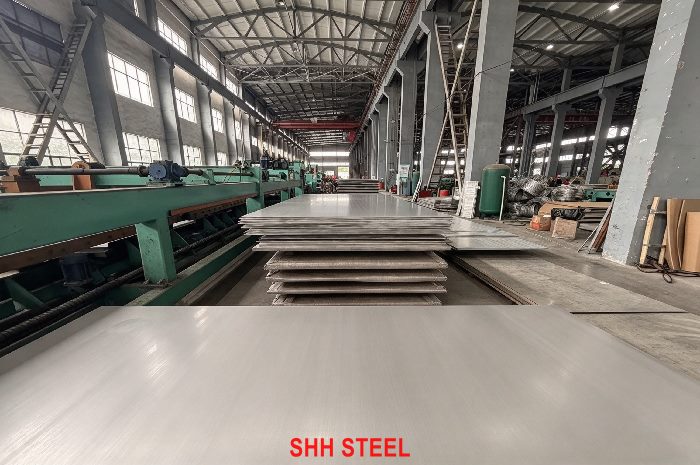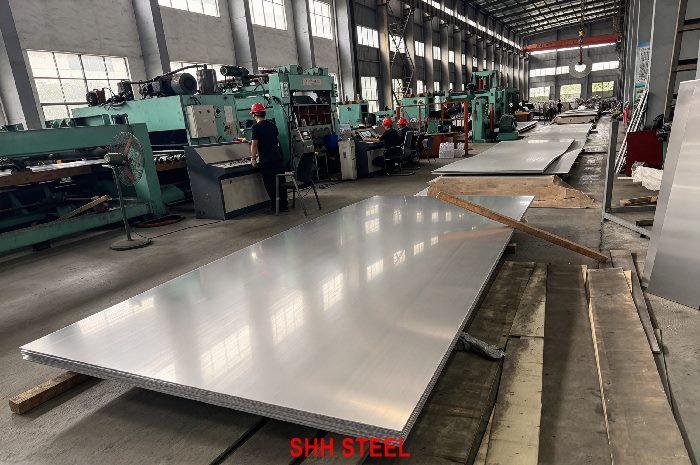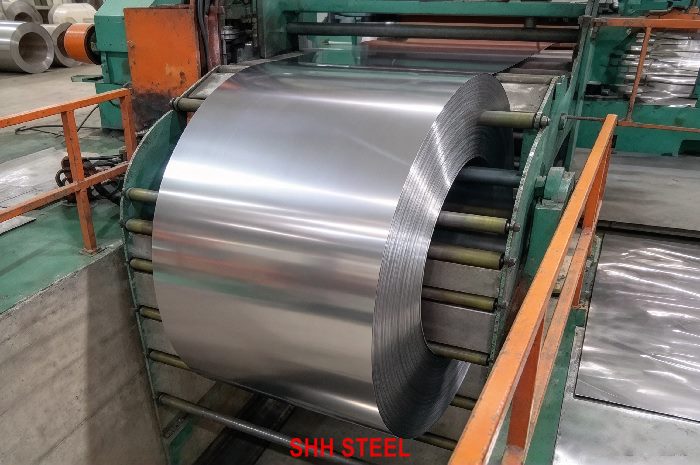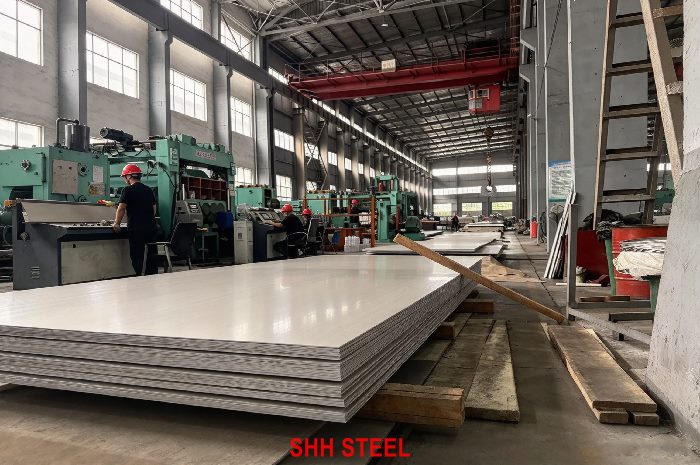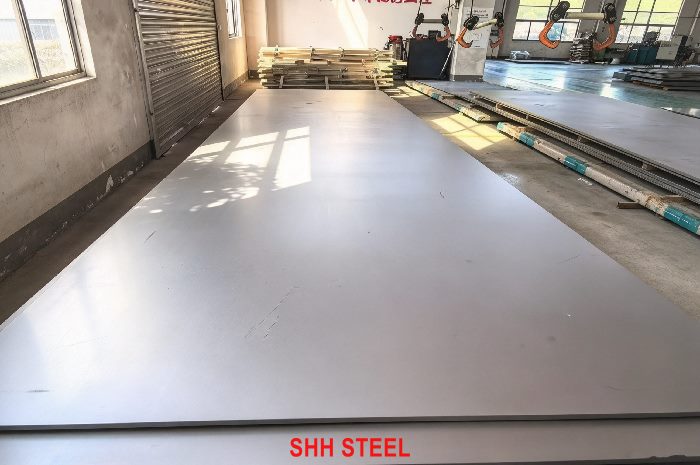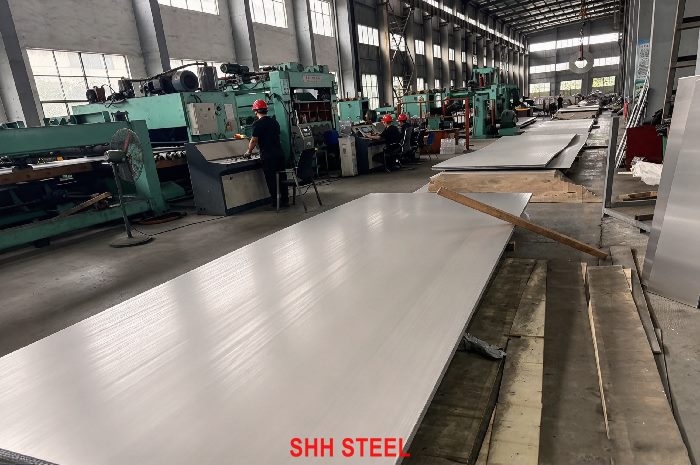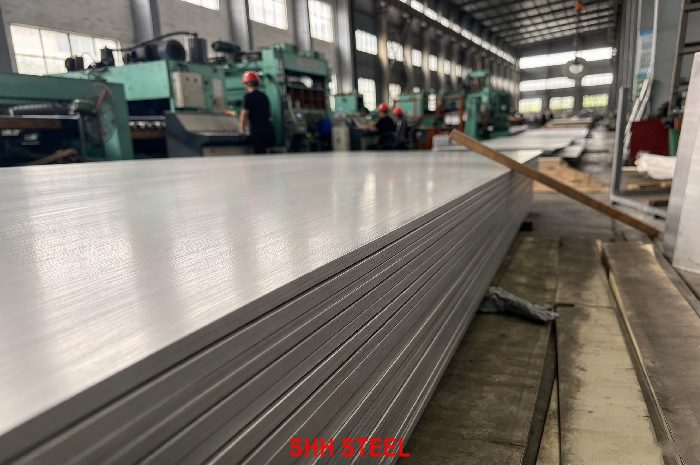
ASTM A240 UNS S31635 Stainless Steel Sheet
What is ASTM A240 UNS S31635 stainless steel sheet?
Type 316Ti is 316 stabilised with titanium of at least 5×(C+N), up to 0.70 %. In sheet form it is specified mainly in European-style designs where a titanium-stabilised molybdenum grade is called for. In cold-rolled sheet, the austenitic structure gives the forming headroom that makes these grades the default for drawn, bent and roll-formed parts. Annealed sheet is essentially non-magnetic, work-hardens as it is formed, and keeps its toughness at sub-zero temperatures. Under ASTM A480, “sheet” means flat material under 5.00 mm thick and at least 600 mm wide, and narrower cold-rolled material is strip. That makes UNS S31635 (Type 316Ti) sheet a cold-rolled or thin hot-rolled product with its own finish, gauge-tolerance and flatness rules, quite different from plate. S31635 sheet is rolled in mill campaigns, so size, finish and lead time are confirmed against the campaign schedule.
This guide covers S31635 sheet from the buyer’s side of the order: the A240 and A480 requirements, heat and product analysis, properties, cold-rolled finishes, gauge and flatness tolerances, coil and cut-length supply, equivalent EN, JIS and GB/T grades, and the certificates to expect. SHH STEEL supplies S31635 sheet and coil mill-direct and can slit, cut and protect it to your drawings.
SHH STEEL quotes every value here from the standard named beside it; where a standard leaves a point to agreement, this page says so.
UNS S31635 (Type 316Ti) sheet: specification summary
ASTM A240/A240M sets the chemistry and properties for UNS S31635 (Type 316Ti), and ASTM A480/A480M supplies the general rules for flat products: definitions, finishes, tolerances, testing and marking. A240 is written for general and pressure applications. Its ASME twin, SA-240, matters only when the sheet goes into ASME Code equipment, so most sheet for appliances, architecture, transport and process equipment is simply ordered to A240.
| Property | A240 sheet data for UNS S31635 |
|---|---|
| Standard | ASTM A240/A240M, chromium and chromium-nickel stainless steel plate, sheet and strip |
| General requirements | ASTM A480/A480M: ordering, finishes, tolerances, product analysis, testing, marking |
| ASME counterpart | ASME SA-240 is the Code adoption; order SA-240 only when the sheet is for ASME Code construction |
| UNS number | UNS S31635 |
| Type name | Type 316Ti |
| Structure | austenitic (face-centred cubic) |
| Sheet (A480 3.2.3) | under 5.00 mm thick and 600 mm and over wide |
| Strip (A480 3.2.4) | cold-rolled, under 5.00 mm thick and under 600 mm wide |
| Typical gauges | Cold-rolled sheet typically about 0.5–3.0 mm and hot-rolled sheet up to 5.00 mm, depending on the mill campaign |
| Typical widths | 1000, 1219, 1250 and 1500 mm; other widths by slitting |
| Supply forms | coil, slit coil, cut-to-length sheet, blanks cut to size |
| Condition | 1040 °C [1900 °F] minimum, then quenched in water or rapidly cooled by other means at a rate sufficient to prevent reprecipitation of carbides, as demonstrable by the capability of passing the intergranular corrosion test of A480 Section 18.2 (A480 Table A1.2, “all Cr-Ni steels”) |
| Cold-rolled finishes | 2D, 2B, BA; No.3, No.4, No.6, No.7, No.8; hairline (HL) by agreement; No.1 for hot-rolled sheet |
| Dimensional tolerances | A480 Annex A2 (inch-pound) or Annex A3 (A480M), e.g. Table A3.5 thickness and A3.8 flatness for cold-rolled wide sheet |
| Required tests | heat analysis; tension test and hardness |
| Optional tests | PMI, Charpy (S1 where applicable), intergranular corrosion (A262 Practice E) |
| Marking | specification, type or UNS, heat/identification number and producer; coils marked near the outside end plus inside tag; sheet under 6.4 mm is not die-stamped |
| Certificates | mill test report per A480 Section 8; EN 10204 3.1 as standard; 3.2 with third-party witness on request |
This grade sits in the ASTM A240 UNS sheet and plate range and the wider ASTM A240/A240M range. Where A480 and A240 conflict, A240 governs, and a stricter purchase-order requirement governs both, but an order cannot waive a required test. Name A240M on the order if you want metric tolerances from A480 Annex A3.
UNS S31635 sheet chemistry: heat analysis vs product analysis
Heat analysis limits for UNS S31635 (Type 316Ti), in percent by mass (maximum unless a range or minimum is shown), from ASTM A240 Table 1:
| Grade | C | Mn | P | S | Si | Cr | Ni | Mo | N | Other |
|---|---|---|---|---|---|---|---|---|---|---|
| UNS S31635 | 0.08 | 2.00 | 0.045 | 0.030 | 0.75 | 16.0–18.0 | 10.0–14.0 | 2.00–3.00 | 0.10 | Ti 5×(C+N) min, 0.70 max |
Two different analyses can appear in a sheet purchase. The heat analysis is the steelmaker’s analysis of the melt, taken during pouring or from in-process product. It is the analysis printed on the mill certificate, and it must sit inside Table 1 (A480 6.2). The product analysis is a check the buyer may make on finished sheet or coil to confirm identity (A480 7.1). Because a thin cold-rolled product can show small local variation, A480 Table A1.1 allows product analysis to fall slightly outside Table 1. The comparison below applies those tolerances to S31635:
| Element | Heat analysis, % (ASTM A240 Table 1) | A480 Table A1.1 tolerance | Product analysis limit, % |
|---|---|---|---|
| Carbon (C) | 0.08 max | 0.01 over max | ≤ 0.09 |
| Manganese (Mn) | 2.00 max | 0.04 over max | ≤ 2.04 |
| Phosphorus (P) | 0.045 max | 0.010 over max | ≤ 0.055 |
| Sulfur (S) | 0.030 max | 0.005 over max | ≤ 0.035 |
| Silicon (Si) | 0.75 max | 0.05 over max | ≤ 0.80 |
| Chromium (Cr) | 16.0–18.0 | 0.20 under min / 0.20 over max | 15.80–18.20 |
| Nickel (Ni) | 10.0–14.0 | 0.15 under min / 0.15 over max | 9.85–14.15 |
| Molybdenum (Mo) | 2.00–3.00 | 0.10 under min / 0.10 over max | 1.90–3.10 |
| Nitrogen (N) | 0.10 max | 0.01 over max | ≤ 0.11 |
| Ti | 5×(C+N) min, 0.70 max | ratio minimum: product analysis ≥ 0.90× the specified ratio (A480 A1.1); Ti 0.05 over max | ≥ 4.5×(C+N); ≤ 0.75 |
The tolerance band is picked by the specified limit, or by the top of a range, and applies below a minimum and above a maximum. Results for one element across several samples of a heat must not straddle the range, falling both above and below it (A480 7.2). For ratio requirements such as Ti ≥ 5×(C+N), product analysis must reach at least 0.90× the ratio (A480 A1.1). Limits on unspecified Cu, Mo, Ti and Nb (0.75, 0.75, 0.10 and 0.10 %) stop sheet of one grade being certified when it actually matches another (A480 6.3.1).
A practical note for receiving inspection: handheld XRF identifies the alloy family but cannot measure carbon or nitrogen. So it cannot tell 304 from 304L, or a standard grade from an H or N grade. Use spark-OES or a laboratory analysis when those elements decide acceptance.
Role of the main elements in S31635 sheet:
- Carbon ≤ 0.08 %: a standard carbon level. Keep holding time in the sensitising range short when corrosion resistance after welding matters.
- Chromium 16.0–18.0 %: forms the passive film that makes the steel stainless; higher chromium improves resistance to corrosion and oxidation.
- Nickel 10.0–14.0 %: stabilises the austenite and improves toughness and ductility.
- Molybdenum 2.00–3.00 %: improves resistance to pitting and crevice corrosion in chloride media.
- Titanium: combines with carbon and nitrogen to stabilise the steel against intergranular corrosion.
For comparison only, PREN (Cr + 3.3 Mo + 16 N) calculated by SHH STEEL from the Table 1 minimums is about 22.6. Each heat’s own analysis gives its real value, which is normally higher; PREN is not an A240 acceptance criterion for this grade.
Mechanical properties of S31635 sheet
Annealed room-temperature requirements from ASTM A240 Table 2:
| Condition / thickness | Tensile strength, min | Yield strength 0.2 %, min | Elongation in 50 mm, min | Hardness, max | Cold bend |
|---|---|---|---|---|---|
| All thicknesses | 515 MPa [75 ksi] | 205 MPa [30 ksi] | 40 % | 217 HBW / 95 HRBW | not required |
For coil product, A480 16.1.1 requires at least two hardness tests (one from each end), one bend test when required, and one or more tension tests from each coil. If the hardness at the two ends differs by more than 5 HRB, or the coil is temper rolled, tensile properties are determined at both ends. Cut-length sheet is tested per lot of 100 pieces or fewer of the same heat, thickness and heat-treatment run (16.1.2).
Hardness on thin sheet may be measured by an alternative method suited to the gauge, with conversions per A370. When sheet is too thin for any Rockwell superficial test, the hardness requirement is waived (A480 17.2.1).
Cold-rolled finishes for S31635 sheet: 2B, BA, No.4, HL and more
For sheet, finish often matters as much as chemistry because it decides appearance, cleanability and how the part forms. A480 Section 11 lists the sheet finishes below, and all are available on S31635 subject to the mill route:
| Finish | Description (A480 Section 11 and Note 3) | Typical sheet use |
|---|---|---|
| No. 1 | Hot-rolled, annealed and descaled; dull and non-reflective | Hot-rolled sheet, heat-resisting and industrial parts |
| No. 2D | Cold-rolled, dull; smooth, non-reflective and non-directional, holds lubricant in deep drawing | Deep-drawn and severely formed parts |
| No. 2B | Cold-rolled, bright; smooth, moderately reflective, from a final light pass on polished rolls; polishes more readily than No. 1 or 2D | General-purpose sheet; the standard mill finish |
| BA (bright annealed) | Smooth, bright, reflective; cold rolled then annealed in a protective atmosphere to prevent scaling | Appliance panels, reflectors, hygienic and decorative parts |
| No. 3 | Intermediate polish, linear texture; Ra generally up to 40 µin (about 1.0 µm) | Pre-polished sheet for further finishing |
| No. 4 | General-purpose polish, linear texture; Ra generally up to 25 µin (about 0.6 µm) | Kitchen, architectural and elevator panels |
| No. 6 | Dull satin, produced by Tampico brushing a No. 4 finish | Architectural and decorative work |
| No. 7 | High lustre, buffed from a finely ground surface with grit lines still present | Ornamental and architectural parts |
| No. 8 | Mirror; polished with successively finer abrasives and buffed | Mirrors, reflectors, signage |
| TR | Cold-worked to obtain specified properties | Springs and high-strength formed parts |
| HL (hairline) | Commercial long-line brushed finish; not defined in A480, so it is agreed by description or sample | Elevators, doors, interior panels |
Polished sheet can be ordered polished on one side or both; when only one side is polished, the other side may be rough ground to get flatness (A480 11.1.12). Architectural finishes, sometimes called No. 5, and special textures are negotiated between buyer and seller. A480 Note 3 is guidance, not a basis for rejection, so agree a reference sample for any decorative finish. Laser-grade PVC film, paper interleaving and grain direction should be stated on the order when the face side matters.
Gauge, width, length and flatness tolerances for S31635 sheet
Gauge and flatness tolerances come from A480 Annex A3 for A480M (metric) orders and Annex A2 for inch-pound orders. For cold-rolled wide coil and cut lengths, Table A3.5 gives these thickness tolerances, over and under:
| Specified thickness, mm | w ≤ 1000 mm | 1000 < w ≤ 1300 mm | 1300 < w ≤ 2100 mm |
|---|---|---|---|
| 0.30 | ± 0.03 | — | — |
| 0.40 | ± 0.04 | ± 0.04 | — |
| 0.50 | ± 0.045 | ± 0.05 | — |
| 0.60 | ± 0.05 | ± 0.05 | — |
| 0.80 | ± 0.05 | ± 0.05 | — |
| 1.00 | ± 0.055 | ± 0.06 | ± 0.07 |
| 1.20 | ± 0.08 | ± 0.08 | ± 0.08 |
| 1.50 | ± 0.08 | ± 0.08 | ± 0.10 |
| 2.00 | ± 0.10 | ± 0.10 | ± 0.11 |
| 2.50 | ± 0.10 | ± 0.11 | ± 0.13 |
| 3.00 | ± 0.13 | ± 0.13 | ± 0.15 |
| 4.00 | ± 0.17 | ± 0.17 | ± 0.17 |
Thickness is measured at least 15 mm from a slit edge or 25 mm from a mill edge. For a thickness between two rows, the next higher row applies. Some mills roll tighter than the table, and a tighter tolerance can be agreed on the order. Order thickness as a decimal or fraction, not a gauge number; under A480 4.1.7 the gauge number is not a basis for rejection.
Width tolerance for cut lengths and coil is plus-only (Table A3.6, selected rows):
| Specified thickness, mm | 600 < w ≤ 1000 mm | 1000 < w ≤ 2100 mm |
|---|---|---|
| 1.00 | +1.5 / −0 | +2.0 / −0 |
| 1.50 | +1.5 / −0 | +2.0 / −0 |
| 2.50 | +2.0 / −0 | +2.5 / −0 |
| 3.50 | +3.0 / −0 | +3.0 / −0 |
Length tolerance for cut lengths (not resquared) is +5 / −0 mm up to 2000 mm and +0.0025 × L / −0 above 2000 mm (Table A3.7). Flatness is the maximum deviation from a horizontal flat surface (Table A3.8):
| Flatness standard | Thickness / width / length | Max. deviation from a flat surface |
|---|---|---|
| Not stretcher-levelled | width under 1500 mm (any thickness) | 10 mm |
| Not stretcher-levelled | width 1500 mm and over | 12 mm |
| Stretcher-levelled | t ≤ 4.99 mm, w < 1200 mm, L < 2400 mm | 4 mm |
| Stretcher-levelled | t ≤ 4.99 mm, other width/length combinations | 7 mm |
The Table A3.8 values exclude hard tempers of 2xx and 3xx grades, dead-soft and deep-drawing sheet, which have their own rules. If panels will be laser cut, bonded or used as visible cladding, order stretcher-levelled flatness or a tighter flatness by agreement.
S31635 coil, slit coil and cut-to-length sheet supply
S31635 is supplied in four forms. Coil is the mill product, supplied at full width. Slit coil is cut to narrower widths; under 600 mm wide it becomes strip, ordered with edge No. 1 (rolled), No. 3 (slit) or No. 5 (square after slitting) per A480 Section 14. Cut-to-length sheet is levelled and sheared to length, and blanks are cut to drawing.
For coils, state the inside diameter your decoiler takes (often 508 or 610 mm) and the maximum coil weight. Coils are marked near the outside end, with an inside tag carrying the same data (A480 25.1.1.3), and packaging follows ASTM A700 unless the order says otherwise (A480 25.1.2).
SHH STEEL can slit, cut to length, level, apply protective film and pack S31635 sheet in its own workshop, so you receive sizes ready for your laser, press brake or production line.
Annealing and heat treatment of S31635 sheet
A480 condition for UNS S31635 (Type 316Ti): 1040 °C [1900 °F] minimum, then quenched in water or rapidly cooled by other means at a rate sufficient to prevent reprecipitation of carbides, as demonstrable by the capability of passing the intergranular corrosion test of A480 Section 18.2 (A480 Table A1.2, “all Cr-Ni steels”).
Sheet is annealed on continuous annealing and pickling lines, or in a protective-atmosphere line for BA finish. The heat treatment must be a separate cycle and cannot be replaced by an in-process thermal cycle (A480 15.1). Material that fails a test may be re-heat-treated and retested (A480 20.5).
A480 Note 5: for titanium- and niobium-stabilised types, annealing above 1066 °C can reduce intergranular corrosion resistance after later sensitising exposure. When this matters, order the A480 18.2 corrosion test on sensitised specimens.
How S31635 sheet performs in service
Thin austenitic sheet resists general corrosion through a chromium-rich passive layer. Chromium, molybdenum and nitrogen strengthen that layer against pitting. Sheet has a large surface area relative to its thickness, so surface condition matters: a clean 2B, BA or polished finish free of embedded iron performs noticeably better than a scratched or contaminated one. The usual weak points are chloride pitting, crevice attack under gaskets or deposits, and chloride stress-corrosion cracking in warm wet service, generally above about 60 °C.
S31635 sheet equivalents: ASTM, EN, JIS and GB/T compared
Buyers often send drawings that name an EN, JIS or GB grade rather than UNS S31635 (Type 316Ti). The table shows the nearest cross-references for sheet. “Nearest” means the grades share the same metallurgical concept, not that they are interchangeable on a certificate. SHH STEEL checks each element and each property against every standard named on the enquiry before offering dual certification.
| System | Sheet standard | Grade | How close | Notes for sheet buyers |
|---|---|---|---|---|
| ASTM | A240 with A480 | UNS S31635 (Type 316Ti) | reference | State the edition and A240 or A240M |
| EN | EN 10088-2 (also EN 10088-4, EN 10028-7) | 1.4571 X6CrNiMoTi17-12-2 | nearest; check each limit | Proof strengths depend on product form (C = cold-rolled strip, H = hot-rolled strip, P = plate); elongation uses A80 or A gauge lengths |
| JIS | JIS G4305 (cold-rolled) / G4304 (hot-rolled) | SUS316Ti | nearest; check each limit | SUS grade with its own ranges; compare C, N and Ni with A240 |
| GB/T | GB/T 3280 (cold-rolled) / GB/T 4237 (hot-rolled) | 06Cr17Ni12Mo2Ti (S31668) | nearest; check each limit | GB/T 20878 name and code; the S-code is not a UNS number |
EN. EN 10088-2 is the main European standard for corrosion-resisting sheet, strip and plate for general purposes. Its property tables are split by product form: cold-rolled strip (C), hot-rolled strip (H) and hot-rolled plate (P). A thin cold-rolled sheet is therefore checked against the C-row values for its thickness. EN 10088-4 covers sheet and strip for construction, and EN 10028-7 covers flat stainless products for pressure equipment. EN tensile tests report 0.2 % and 1 % proof strength, and thin-sheet elongation is measured on an 80 mm gauge length, so the numbers do not convert one-for-one to the A240 50 mm elongation. See the EN 10088-2 stainless range for related steel numbers.
JIS. JIS G4305 covers cold-rolled stainless plate, sheet and strip, which includes most thin sheet, and JIS G4304 covers the hot-rolled product. SUS grades follow the AISI-type concept but their ranges are set independently. Japanese-specified sheet should be checked for carbon, nitrogen and nickel against the A240 row. The JIS G4305 range lists the SUS sheet grades.
GB/T. Chinese cold-rolled sheet is ordered to GB/T 3280 and hot-rolled sheet to GB/T 4237, with grade names and numeric codes from GB/T 20878. A code such as S30408 is a Chinese designation, not a UNS number, so certificates must state which standard the code belongs to. See the GB/T 4237 range for related Chinese grades.
Other ASTM and ASME specifications. A480 supplies the general rules for A240 sheet. A666 covers annealed and cold-worked austenitic sheet, strip, plate and flat bar, including tempers above annealed, for structural and architectural uses; check whether the grade is listed. SA-240 is the ASME Code adoption of A240 and is needed only for ASME Code equipment. Other product forms in the same UNS grade, such as pipe, tube and bar, have their own ASTM specifications, so check each one when you need a matching set.
Other A240 sheet grades related to S31635
Sheet buyers comparing S31635 usually look at these grades in the same A240 sheet series:
- ASTM A240 UNS S31603 stainless steel sheet
- ASTM A240 UNS S32100 stainless steel sheet
- ASTM A240 UNS S31600 stainless steel sheet
For the same material in other product forms and designations, see ASME SA240 UNS S31635 stainless steel plate, ASTM A240 Type 316Ti sheet and plate, AISI 316Ti stainless steel. Those pages cover plate or type-designation ordering, while this page covers thin sheet and coil.
More grades and standards are listed in the stainless steel sheets and plates pages.
S31635 sheet applications, forming and welding
Typical uses of S31635 sheet and coil:
- Exhaust and flue-gas components
- Heat exchangers and boiler parts
- Chemical equipment exposed to sensitising temperatures
- Flexible hoses and bellows
Austenitic sheet bends tightly, stretches well and deep-draws better than any other stainless family. It springs back more than carbon steel and hardens quickly, so multi-stage draws may need intermediate annealing. Thin-gauge TIG, plasma and laser welding are routine; keep heat input low to limit distortion and heat tint.
Keep the protective film on during laser cutting and forming. Keep sheet away from carbon-steel dust and tools, because embedded iron rusts and spoils the finish, and pickle or passivate welds where appearance or corrosion resistance matters.
Certificates, testing and receiving inspection for S31635 sheet
Every S31635 sheet delivery from SHH STEEL comes with the original mill test report. Under A480 8.1, it names the specification and year, the grade or grades, the heat analysis and the required test results. A supplier that is not the mill must pass on a copy of the original manufacturer’s report (A480 8.4). EN 10204 3.1 is standard, and 3.2 with witness by TUV, ABS, CCS, BV, DNV, LR or your own inspector can be arranged.
On receipt, match the marking to the certificate, measure thickness at the A480 positions, check flatness and finish, and run PMI where required. Test-based rejections must be reported within 60 working days of receipt (A480 23.1).
The A262 Practice E intergranular corrosion test is run only when the order asks for it, although non-H chromium-nickel types are expected to pass it (A480 18.2.1).
Sourcing S31635 sheet: buyer concerns and SHH STEEL solutions
These are the questions sheet buyers ask SHH STEEL most often, and how we handle each one:
| Buyer Concern | SHH STEEL Solution |
|---|---|
| Fake material or certificates | Coils and sheet lots can be witnessed by TUV, ABS, CCS or another class society, and partner laboratories run PMI, chemistry and tensile checks against the order. Third-party witness and EN 10204 3.2 certificates available. |
| Unsafe deposit | TT and LC are accepted, including TT + LC splits. For large projects you can sign directly with the mill, with SHH STEEL coordinating documents and follow-up for a small service fee. |
| Small orders below mill MOQ | Small sheet quantities are consolidated with other customers’ orders of the same grade, thickness and finish, so lots below the mill MOQ still come from genuine mill coils with full traceability. |
| Slow delivery | Dedicated staff chase the mill schedule through cold rolling, annealing, finishing and slitting, and report progress at each stage. |
| Processing needs | Our own workshop handles cutting to size, bevelling, machining to drawings and surface pretreatment such as film protection, so sheets arrive ready to fabricate. |
How to order UNS S31635 sheet from SHH STEEL
A480 4.1 puts the responsibility for a complete order on the buyer. For S31635 sheet, include:
- Quantity by weight and number of sheets or coils.
- Specification and edition: ASTM A240 or A240M, plus any second standard for dual certification.
- Grade: UNS S31635 (Type 316Ti).
- Condition and finish, for example annealed 2B, BA, or No.4 on one side with film.
- Form and dimensions: thickness, width and length in the same units, or coil ID, OD and weight; strip edge type if slit.
- Tolerances or flatness tighter than A480, if needed.
- Tests and documents: PMI, corrosion or phase tests, EN 10204 3.1 or 3.2, inspector, marking and packing.
SHH STEEL combines mill-direct sourcing with its own processing workshop. We check your grade and finish choice, offer dual certification when a heat qualifies, consolidate small quantities, follow the mill schedule and cut or slit before shipment. TT and LC payment are accepted.
Send your S31635 sheet enquiry with sizes, finish and quantity. The SHH STEEL team will reply with a quotation, lead time and inspection plan.
FAQ
-
What is the difference between 316Ti and 316L sheet?
- Both resist intergranular attack after welding: 316L does it with low carbon, 316Ti by titanium stabilisation. 316Ti keeps that resistance better during long exposure in the sensitising range.
-
Is 316Ti sheet the same as EN 1.4571?
- EN 1.4571 is the nearest European grade. The composition limits are close but not identical, so dual certification needs a heat that meets both.
-
Can 316Ti sheet be polished to a bright finish?
- Titanium nitride and carbide particles can cause small surface defects on highly polished finishes. For mirror-polished parts, 316L is usually preferred.
-
Can I buy S31635 stainless steel sheet cut to size in small quantities?
- Yes. SHH STEEL consolidates small S31635 sheet orders with other customers’ orders of the same grade and finish, and cuts sheets or blanks to size in its own workshop. That way small lots still come from traceable mill coils.
-
What thickness tolerance applies to cold-rolled S31635 sheet?
- For A480M orders, Table A3.5 applies. For example, 1.00 mm sheet up to 1000 mm wide is allowed ±0.055 mm, and 2.00 mm sheet ±0.10 mm. Tighter tolerances can be agreed on the order.
-
Which certificate comes with A240 S31635 sheet?
- Each delivery carries the original mill test report to A240 and A480, normally as EN 10204 3.1. Third-party witness and EN 10204 3.2 certificates can be arranged with TUV, ABS, CCS or another inspector.
Conclusion
ASTM A240 UNS S31635 Stainless Steel Sheet is bought for its combination of chemistry, finish and gauge accuracy, so the order should define all three: the A240 edition and UNS number, the finish and protective film, and the A480 tolerance or flatness level. SHH STEEL supplies S31635 sheet and coil from mill partners, cut or slit to your needs, with certificates you can check line by line.
Quality Steel Needed? Inquire for Offers
Related Products