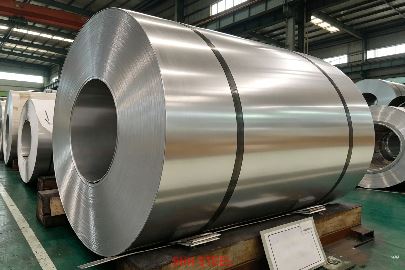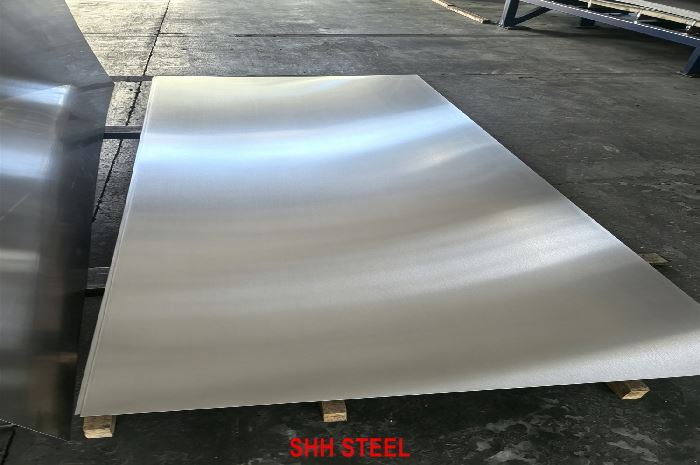

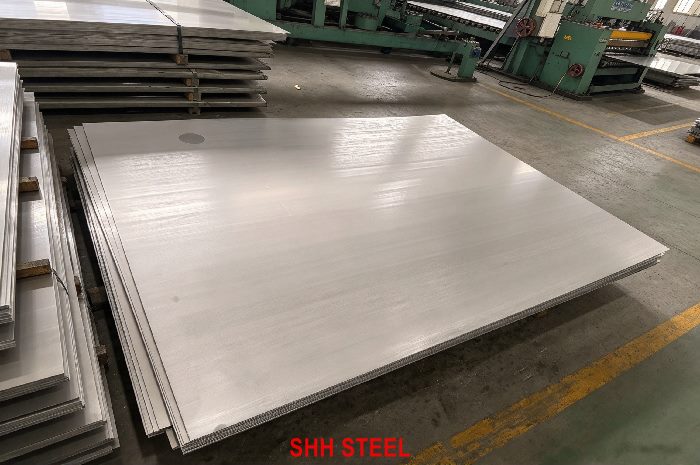
ASTM A240 Type 255 Stainless Steel Sheet & Plate
What is ASTM A240 Type 255 (UNS S32550) Stainless Steel Sheet & Plate?
As a stainless steel supplier and China mill-direct exporter, SHH STEEL supplies ASTM A240 Type 255 (UNS S32550) Stainless Steel Sheet & Plate. Type 255 (UNS S32550) is a copper-bearing 25 % chromium duplex stainless steel listed in ASTM A240 with 24.0 – 27.0 % chromium, 4.5 – 6.5 % nickel, 2.9 – 3.9 % molybdenum, 0.10 – 0.25 % nitrogen and 1.50 – 2.50 % copper.
A240 footnote G describes 255 as a common name, widely used and not associated with any one producer. The IMOA duplex guide places S32550 next to EN 1.4507, supplied as EN 10088-2 1.4507 plate. SHH STEEL supplies the standard grade unless a specific brand is ordered.
This page summarises the requirements for ASTM A240 Type 255 plate and sheet: chemical composition, mechanical properties, heat treatment and the general delivery requirements of ASTM A480/A480M. Values are from ASTM A240/A240M-22; check whether a later edition applies to your order. SHH STEEL confirms the edition named on the drawing before an order is placed.
S32550 material specification and SHH STEEL supply scope
| Item | Requirement | SHH STEEL supply |
|---|---|---|
| Standard | ASTM A240/A240M-22, chromium and chromium-nickel stainless steel plate, sheet and strip for pressure vessels and general applications | Full compliance; edition confirmed at order |
| Grade | Type 255, UNS S32550 | Confirmed by heat analysis on the certificate |
| General requirements | ASTM A480/A480M: dimensions, tolerances, testing and marking | Tolerances checked against ASTM A480/A480M |
| Product forms | Plate, sheet and strip | Plate, sheet, strip and cut-to-size blanks |
| Delivery condition | Annealed (solution annealed) and descaled | Written into the mill order |
| Inspection document | Mill test report per ASTM A480/A480M | EN 10204 3.1 standard; 3.2 with third-party witness on request |
ASTM A240 refers to ASTM A480/A480M for general requirements, including annealing, tolerances, testing and marking. ASTM A923 testing for intermetallic phases is agreed at the order.
Chemical composition of S32550 (ASTM A240/A240M, %)
| Element | Content (%) |
|---|---|
| Carbon (C) | ≤ 0.04 |
| Manganese (Mn) | ≤ 1.50 |
| Phosphorus (P) | ≤ 0.040 |
| Sulphur (S) | ≤ 0.030 |
| Silicon (Si) | ≤ 1.00 |
| Chromium (Cr) | 24.0 – 27.0 |
| Nickel (Ni) | 4.5 – 6.5 |
| Molybdenum (Mo) | 2.9 – 3.9 |
| Nitrogen (N) | 0.10 – 0.25 |
| Copper (Cu) | 1.50 – 2.50 |
Carbon is allowed up to 0.04 %, slightly above the 0.030 % of most modern duplex grades. The IMOA duplex guide gives a PREN range of 38 – 41 for S32550.
Mechanical properties of S32550 (ASTM A240 Table 2)
| Property | Requirement |
|---|---|
| Tensile strength | ≥ 760 MPa |
| Yield strength (0.2 %) | ≥ 550 MPa |
| Elongation in 50 mm | ≥ 15 % |
| Hardness | ≤ 302 HBW or ≤ 32 HRC |
The tensile and yield strength minimums are close to those of the super-duplex grades, with a lower elongation requirement of 15 %.
Heat treatment and delivery condition of S32550
| Item | Value |
|---|---|
| Delivery condition | Annealed, rapid cooling (A480/A480M) |
| Minimum annealing temperature (IMOA Table 11) | 1 040 °C |
Rapid cooling after annealing avoids intermetallic phases; SHH STEEL asks the mill to record the annealing temperature on the certificate.
Lead time from the mill is normally 30 – 40 days after order confirmation, depending on size, finish and rolling schedule. Dimensional tolerances follow ASTM A480/A480M unless the order states otherwise.
Physical properties of S32550
| Property | Value (IMOA Tables 8 and 9) |
|---|---|
| Density | 7.82 g/cm³ |
| Specific heat | 488 J/(kg·K) |
| Electrical resistivity | 0.84 µΩ·m |
| Elastic modulus at 20 °C | 210 GPa |
| Thermal expansion 20 – 100 °C | 12.1 × 10⁻⁶ /K |
| Thermal conductivity at 20 °C | 14.3 W/(m·K) |
These are typical values from producer data quoted by the IMOA guide; they are not requirements of ASTM A240.
Key characteristics of Type 255 duplex
- 25 % chromium duplex with 1.50 – 2.50 % copper.
- PREN 38 – 41 (IMOA duplex guide).
- Tensile strength ≥ 760 MPa, yield strength ≥ 550 MPa.
- 255 is a common name, not associated with any one producer (A240 footnote G).
- Magnetic, like all duplex grades.
S32550 equivalent grades
| System | Grade | Comment |
|---|---|---|
| EN 10088-2 | EN 10088-2 1.4507 (X2CrNiMoCuN25-6-3) | Nearest EN grade; limits differ |
| China | 03Cr25Ni6Mo3Cu2N | Listed in the IMOA guide |
For pressure equipment in Europe, the nearest EN grade is supplied as EN 10028-7 1.4507 pressure vessel plate. See also ASTM A240 Type 2507 sheet and plate.
Applications of ASTM A240 Type 255 (UNS S32550) Stainless Steel Sheet & Plate
The IMOA duplex guide notes that duplex grades are used for process piping and equipment such as separators, scrubbers and pumps, and Euro Inox lists for the nearest EN grade 1.4507:
- Oil and gas industry
- Pulp and paper industries
- Sulphuric and phosphoric acid plants
- Pollution control equipment (scrubbers)
- Geothermal tubes
For lower-alloy needs, ASTM A240 Type 2205 sheet and plate is the usual alternative. SHH STEEL supplies 255 duplex stainless steel for these uses as full plates or cut-to-size blanks.
Type 255 compared with other ASTM A240 duplex grades
The table compares the super-duplex grades of ASTM A240 with the standard duplex grade 2205. Chemistry is from A240-22 Table 1 and the minimum mechanical properties from Table 2; all grades are supplied annealed.
| ASTM A240 grade | Cr % | Ni % | Mo % | N % | Cu / W % | Tensile min, MPa | Yield min, MPa | El. min, % | Hardness max |
|---|---|---|---|---|---|---|---|---|---|
| ASTM A240 Type 2205 (S32205) | 22.0 – 23.0 | 4.5 – 6.5 | 3.0 – 3.5 | 0.14 – 0.20 | – | 655 | 450 | 25 | 293 HBW |
| ASTM A240 Type 2507 (S32750) | 24.0 – 26.0 | 6.0 – 8.0 | 3.0 – 5.0 | 0.24 – 0.32 | Cu ≤ 0.50 | 795 | 550 | 15 | 310 HBW |
| S32520 | 24.0 – 26.0 | 5.5 – 8.0 | 3.0 – 4.0 | 0.20 – 0.35 | Cu 0.50 – 2.00 | 770 | 550 | 25 | 310 HBW |
| S32550 (255) | 24.0 – 27.0 | 4.5 – 6.5 | 2.9 – 3.9 | 0.10 – 0.25 | Cu 1.50 – 2.50 | 760 | 550 | 15 | 302 HBW |
| S32760 | 24.0 – 26.0 | 6.0 – 8.0 | 3.0 – 4.0 | 0.20 – 0.30 | Cu 0.50 – 1.00, W 0.50 – 1.00 | 750 | 550 | 25 | 270 HBW |
All four 25 % chromium grades reach 550 MPa minimum yield strength, about 100 MPa more than 2205. They differ mainly in copper and tungsten, and in elongation: ASTM A240 S32520 and ASTM A240 S32760 require 25 %, S32750 and S32550 15 %. In EN terms, 2205 corresponds to EN 10088-2 1.4462 and 2507 to EN 10088-2 1.4410. SHH STEEL can quote these grades side by side when a buyer is still choosing.
Corrosion resistance of Type 255
Using PREN = %Cr + 3.3 × %Mo + 16 × %N, the A240 limits give Type 255 a PREN of about 35.2 at the minimum of every range and 43.9 at the maximum; the IMOA duplex guide quotes 38 – 41 for this grade and classifies super-duplex steels as having a PREN of 40 to 45. PREN ranks resistance to pitting; it does not replace testing in the actual environment. With 1.50 – 2.50 % copper, the highest of the A240 super-duplex grades, Type 255 is often considered where sulphuric acid or other reducing conditions are present. The IMOA guide lists Alloy 255 with an ASME upper temperature limit of 315 °C, welded or unwelded.
The IMOA guide reports that duplex grades resist chloride stress corrosion cracking much better than Type 304L and 316L in accelerated laboratory tests. Their corrosion resistance depends on correct annealing: intermetallic phases formed by slow cooling or by holding in the critical temperature range lower both toughness and pitting resistance.
ASTM A923 is used to detect detrimental intermetallic phases in duplex steels. In Method C, a ferric chloride corrosion test, the IMOA guide lists a test temperature of 40 °C with a maximum acceptable corrosion rate of 10 mg/dm² per day. SHH STEEL can add A923 testing to the mill order and report the results with the certificate.
Service temperature and phase stability of Type 255
| Reaction (IMOA Table 3, 2507 type) | Temperature range |
|---|---|
| Sigma phase formation | 700 – 1 000 °C |
| Nitride and carbide precipitation | 450 – 800 °C |
| 475 °C embrittlement | 300 – 525 °C |
| Scaling temperature in air | 1 000 °C |
Because the ferrite of duplex steels embrittles after long exposure around 475 °C, the IMOA guide advises that duplex steels should not be used for prolonged periods above the temperature allowed by the applicable pressure-vessel design code; it quotes 315 °C as the ASME upper limit for common duplex grades. Super-duplex grades also lose toughness at very low temperatures more than austenitic grades, so impact requirements should be set where low-temperature service is expected; ASTM A240 Supplementary Requirement S1 allows Charpy impact testing to be specified.
Welding, forming and machining Type 255
The IMOA duplex guide notes that duplex weld metal is much more resistant to hot cracking than austenitic weld metal, but that the procedure must let the heat-affected zone cool quickly. For super-duplex grades it limits the interpass temperature to 100 °C, and lists E2594 type filler metal for joining super-duplex to super-duplex or to standard duplex. Modern duplex base metal is balanced to about 40 – 50 % ferrite; the guide considers 25 – 75 % ferrite (FN 30 – 90) acceptable in welds when toughness and corrosion tests such as ASTM A923 are satisfactory.
In cold forming, super-duplex plate needs more force than 316L and shows more springback because of its higher yield strength. Duplex steels are also more difficult to machine than 300-series grades of similar corrosion resistance. The IMOA guide recommends:
- Powerful, rigid machines and strong, rigid tool mounting.
- Short tool extension to minimise vibration, and a nose radius no larger than necessary.
- Sharp carbide edges, and a depth of cut below the work-hardened layer of the previous pass.
- Adequate but not excessive cutting speed, scheduled insert changes, and generous coolant.
SHH STEEL can supply Type 255 cut to size by plasma or waterjet, with bevels prepared for welding.
Testing and inspection of Type 255
ASTM A240 refers to ASTM A480/A480M for sampling, tension and hardness testing, retests and certification. Beyond these standard tests, buyers of super-duplex plate often add:
- Charpy impact testing under A240 Supplementary Requirement S1, at the temperature set by the design.
- ASTM A923 testing for intermetallic phases (Methods A, B or C).
- Ferrite measurement of base metal or welds; the IMOA guide cites AWS A4.2 and EN ISO 8249 for calibrating magnetic instruments.
- Positive material identification (PMI) of every plate before shipment.
- Third-party witness of tests and an EN 10204 3.2 certificate.
The IMOA guide notes that requiring phase-balance tests on material already in stock is more expensive and slower than specifying them when the plate is made, so these requirements should be on the original order. SHH STEEL writes them into the mill order and checks them on the certificate.
How to order Type 255 plate
- Specification and edition: ASTM A240/A240M-22 (or ASME SA-240), UNS S32550.
- Product form and dimensions: plate, sheet or strip; thickness, width, length and quantity.
- Finish (for example No.1 for hot-rolled plate, 2B for cold-rolled sheet) and any protective film.
- Supplementary requirements: S1 Charpy test, ASTM A923 method, ferrite measurement.
- Inspection document type (3.1 or 3.2) and any third-party inspector.
- Dual certification to EN 10088-2 or EN 10028-7 if needed.
- Marking, packing and destination.
SHH STEEL confirms in writing any point the mill cannot meet before the order is placed, so that Type 255 arrives exactly as specified.
Hot forming and annealing of super-duplex plate
| Grade (IMOA Tables 10 and 11) | Hot-forming range | Minimum soaking temperature | Minimum annealing temperature |
|---|---|---|---|
| S32205 (2205) | 1 230 – 950 °C | 1 040 °C | 1 040 °C |
| S32750 (2507) | 1 230 – 1 025 °C | 1 050 °C | 1 025 – 1 125 °C |
| S32520 | 1 230 – 1 000 °C | 1 080 °C | 1 080 – 1 120 °C |
| S32760 | 1 230 – 1 000 °C | 1 100 °C | 1 100 °C |
| S32550 (255) | not listed | not listed | 1 040 °C |
Hot forming of duplex steel should be done within these ranges and followed by a full solution anneal and rapid cooling, because the slow cooling that follows hot work can leave intermetallic phases. Where Type 255 is hot formed by a fabricator, SHH STEEL recommends that the annealing procedure be agreed and recorded as part of the fabrication plan.
IMOA Table 10 does not list a hot-forming range for 255; the producer’s recommendation should be used, followed by solution annealing at no less than the 1 040 °C given in Table 11.
Elevated temperature physical properties of Type 255
| Temperature | 20 °C | 100 °C | 200 °C | 300 °C | 400 °C | 500 °C |
|---|---|---|---|---|---|---|
| Modulus of elasticity, GPa | 210 | 200 | 198 | 192 | 182 | 170 |
| Thermal expansion from 20 °C, 10⁻⁶/K | – | 12.1 | 12.6 | 13.0 | 13.3 | 13.6 |
| Thermal conductivity, W/(m·K) | 14.3 | 16.4 | 18.6 | 19.1 | 20.9 | 22.5 |
Values are typical producer data from IMOA duplex guide Table 9 and are for design guidance only. The higher thermal conductivity and lower thermal expansion of duplex steels compared with austenitic grades reduce distortion in welding and thermal cycling. SHH STEEL can provide mill data sheets for Type 255 on request.
Cleaning Type 255 after fabrication
The IMOA duplex guide devotes a chapter to post-fabrication clean-up, because surface condition decides how well the steel performs in service. Iron transferred from carbon-steel tools or shop dust must be removed before the equipment is put into service, by mechanical cleaning, chemical cleaning or both; ASTM A380 describes cleaning methods and ASTM A967 covers chemical passivation treatments and how to verify them.
Weld spatter, heat tint, flux, slag and arc strikes can act as crevices and start crevice corrosion in chloride service, so they should be avoided or removed. The guide notes that the heat tint on duplex steel tends to be thin, adherent and harder to remove chemically than on austenitic steel of similar corrosion resistance; for 2205 it gives a pickling solution of 20 % nitric acid and 5 % hydrofluoric acid, with pickling pastes as an easier option for large pieces. Fine grinding can also be used, but coarse grinding marks can themselves trap deposits. Research cited by the guide shows that chemical cleaning after welding gives the best corrosion resistance.
SHH STEEL supplies Type 255 plate pickled from the mill and can advise on surface protection during transport and fabrication.
Type 255 designations
ASTM A240 footnote G describes 255 as a common name, widely used and not associated with any one producer, so Type 255 and UNS S32550 can be ordered from any mill that makes the grade. The IMOA cross-reference table lists the Chinese designation 03Cr25Ni6Mo3Cu2N against S32550. The IMOA table of ASME upper temperature limits names Alloy 255 at 315 °C, welded or unwelded. SHH STEEL supplies Type 255 to A240 and names a brand only when the customer asks for it.
How to calculate the weight of S32550 plate
Plate weight is calculated from the dimensions and the density. Using 7.82 g/cm³ (IMOA duplex guide, S32550), one square metre of S32550 plate 1 mm thick weighs 7.82 kg, so the mass of a plate is density × thickness (mm) × width (m) × length (m).
| Example | Calculation | Theoretical mass |
|---|---|---|
| S32550 plate 10 × 2 000 × 6 000 mm | 7.82 × 10 × 2.0 × 6.0 | about 938 kg |
| S32550 sheet 3 × 1 219 × 2 438 mm | 7.82 × 3 × 1.219 × 2.438 | about 69.7 kg |
Actual weight differs from theoretical weight because of thickness tolerance; whether the invoice uses theoretical or actual weight should be agreed at the order. SHH STEEL shows both on the packing list.
Why choose SHH STEEL for S32550
As an experienced Type 255 supplier, we find that buyers usually worry less about price than about getting the right material on time. The table below lists the concerns we hear most often and how SHH STEEL deals with each one.
| Buyer concern | Risk | How SHH STEEL handles it |
|---|---|---|
| Wrong duplex grade | 2205 or another 25 % chromium grade is supplied against a Type 255 order. | UNS number and full chemistry are checked on the certificate and by PMI before shipment. |
| Phase balance | Slow cooling after annealing forms brittle phases. | Annealing temperature and rapid cooling are recorded on the certificate; ASTM A923 testing can be ordered. |
| Trade name confusion | A branded product is quoted when the drawing names only the UNS grade, or the reverse. | Orders name ASTM A240 and the UNS number; a specific mill brand is supplied only when the customer asks for it. |
| Minimum order | Mills set high minimums for less common grades. | Orders are consolidated so smaller lots can join a mill rolling where the mill makes the grade. |
| Delivery tracking | Delays at rolling, heat treatment or testing are found too late. | A dedicated person follows the schedule and reports progress at each stage. |
SHH STEEL also offers steel cutting services, bending and forming services, a third-party testing service with partner laboratories, and a worldwide shipping service. See our full range of stainless steel sheets and plates.
FAQ
- What is Type 255 equivalent to?
- ASTM A240 lists Type 255 as UNS S32550 and notes that 255 is a common name, not associated with any one producer. The IMOA duplex guide lists the Chinese grade 03Cr25Ni6Mo3Cu2N against S32550, and EN 1.4507 as the nearest European grade. The EN and ASTM limits are not identical, so dual certification is possible only when a heat meets both. Purchase orders should name ASTM A240 and S32550. SHH STEEL compares the limits for each order. Where a project names more than one standard, SHH STEEL lists every applicable limit on the quotation so that the buyer can approve the material before production starts. Purchase orders should name ASTM A240, its edition, the grade, the thickness and the inspection document required, so the certificate can be checked against the same tables.
- What is the chemical composition of S32550?
- ASTM A240/A240M sets the following limits for S32550, in percent: Carbon (C) ≤ 0.04; Manganese (Mn) ≤ 1.50; Phosphorus (P) ≤ 0.040; Sulphur (S) ≤ 0.030; Silicon (Si) ≤ 1.00; Chromium (Cr) 24.0 – 27.0; Nickel (Ni) 4.5 – 6.5; Molybdenum (Mo) 2.9 – 3.9; Nitrogen (N) 0.10 – 0.25; Copper (Cu) 1.50 – 2.50. Its 1.50 – 2.50 % copper is higher than in S32520. SHH STEEL checks every certificate against these limits before shipment and can arrange an independent check analysis by a partner laboratory. Product (check) analysis tolerances follow ASTM A480/A480M when a check analysis is ordered. Where a project specification adds requirements beyond ASTM A240, they should be written into the enquiry so the mill can confirm them before rolling.
- What are the mechanical properties of Type 255 plate?
- ASTM A240 Table 2 requires S32550 to have a tensile strength of at least 760 MPa, a 0.2 % yield strength of at least 550 MPa and an elongation of at least 15 % in 50 mm, with hardness not above 302 HBW or 32 HRC. The strength is close to the super-duplex grades and well above 2205 (655 MPa tensile, 450 MPa yield). SHH STEEL checks tensile and hardness results on the 3.1 certificate for every heat before release, and can arrange third-party witness testing when a project specification asks for it. Test frequency and specimen location follow ASTM A480/A480M, and results are reported for each heat and heat-treatment lot. Any supplementary test, such as a product analysis or a corrosion test, has to be agreed at the enquiry stage because it cannot be added after delivery.
- How is Type 255 heat treated?
- ASTM A240 requires duplex grades to be annealed according to ASTM A480/A480M with rapid cooling. The IMOA duplex guide lists a minimum annealing temperature of 1 040 °C for S32550. Rapid cooling matters because duplex steel held at intermediate temperatures can form intermetallic phases that lower toughness and corrosion resistance. SHH STEEL supplies Type 255 in the annealed condition, asks the mill to record the annealing temperature, and can add ASTM A923 testing to the order when required. Any post-fabrication heat treatment should be agreed between the purchaser and the fabricator before work starts. If a drawing names more than one standard, the material must meet each of them, and the certificate should state every standard it claims. The figures quoted are the limits of ASTM A240; the actual values for a given heat are those reported on the mill test certificate.
- What sizes of S32550 can SHH STEEL supply?
- ASTM A240 covers plate, sheet and strip, and A480/A480M defines the dimensional terms: sheet and strip under 4.76 mm (3/16 in.) thick, and plate 4.76 mm and over. Dimensional and flatness tolerances follow ASTM A480/A480M unless the order specifies tighter values. SHH STEEL confirms with the mill which thicknesses and widths it can roll in S32550, then offers full plates, cut-to-size blanks or slit strip, with cutting and testing services available. Typical S32550 plate orders range from single cut pieces to full mill lots. Lead time is normally 30 – 40 days after order confirmation, depending on size and the mill rolling schedule. Any supplementary test, such as a product analysis or a corrosion test, has to be agreed at the enquiry stage because it cannot be added after delivery.
- Is Type 255 magnetic?
- Yes. Type 255 is a duplex (austenitic-ferritic) stainless steel, and the ferrite in its two-phase structure makes it magnetic, unlike solution-annealed 300-series austenitic grades. This is normal and does not indicate a wrong grade or a defect. Because the response depends on the ferrite content, a magnet cannot be used to tell Type 255 from other duplex or ferritic steels, so grade checks should rely on the certificate and positive material identification (PMI). Its copper addition does not change this. SHH STEEL carries out PMI on request before shipment, and can arrange ferrite measurement when a project specification asks for phase balance to be confirmed. The figures quoted are the limits of ASTM A240; the actual values for a given heat are those reported on the mill test certificate.
Conclusion
ASTM A240 Type 255 (UNS S32550) Stainless Steel Sheet & Plate is a copper-bearing 25 % chromium duplex grade with 550 MPa minimum yield strength; 255 is a common name used by ASTM A240. SHH STEEL supplies it with full ASTM A240/A240M compliance, 3.1 inspection certificates and optional third-party testing, with a normal lead time of 30 – 40 days. Contact SHH STEEL for availability, sizes and a quotation for your S32550 requirement.
Quality Steel Needed? Inquire for Offers
Related Products