

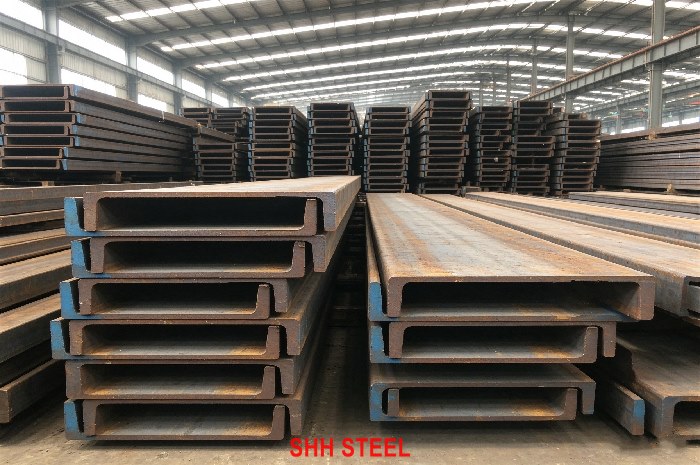
ASME SA-36 C and MC Steel Channels
What are ASME SA-36 C and MC Steel Channels?
ASME SA-36 C and MC steel channels are hot-rolled C-shapes or MC-shapes furnished to the ASME specification SA-36/SA-36M, Carbon Structural Steel. In ASME BPVC Section II, Part A, 2023 edition, SA-36/SA-36M is printed as identical with ASTM A36/A36M-19. The Code edition named on the purchase order is the one that governs acceptance, not a later ASTM year taken on its own.
SHH STEEL supplies these channels for orders that actually name SA-36/SA-36M, the A6/A6M C or MC designation, and the certificate data required for that edition. This page is written for the channel. It is not a data sheet for ASME SA-36 steel plate, for A36 wide-flange beams, or for an angle, and it is not a substitute for the ASTM A36 steel channel page when the order only asks for ASTM A36.
American Standard channels are designated C, for example C 6×8.2 or C 15×50, where the second number is theoretical mass in pounds per foot. Miscellaneous channels are designated MC, for example MC 12×10.6 or MC 18×58. An MC is not a C of the same depth: the flange width, web thickness and mass are those of the MC series, not a substitute C 12 or C 18. Neither series is a European UPN or UPE, and neither is a Chinese or Japanese channel of a similar millimetre depth.
The specification’s own scope covers carbon steel shapes, plates and bars of structural quality for riveted, bolted or welded construction of bridges and buildings, and for general structural purposes. These channels are filed under ASME SA-36 steel channel profiles in the steel channel profiles category of steel structural profiles. The same specification in plate form is listed separately as ASME SA36 Steel Plate. Do not use the plate page as a channel data sheet.
This page covers C and MC Steel Channels in ASME SA-36/SA-36M. The American Standard (C) and miscellaneous (MC) series follow ASTM A6/A6M; the material specification does not by itself define the dimensions.
Code Edition, Certification and What SA-36 Is Not
Ordering “SA-36” means ordering the ASME adopted specification as it appears in Section II, Part A of a named Boiler and Pressure Vessel Code edition. This article follows the 2023 Section II, Part A text, which states that SA-36/SA-36M is identical with ASTM A36/A36M-19. If the construction project is under a different Code year, the SA-36 text in that year’s Section II, Part A is the one that applies. A later ASTM A36 revision is not, by itself, the SA specification in a 2023 book.
An ordinary ASTM A36 certificate does not make the piece SA-36. Material made and documented only to ASTM A36/A36M can be used where the contract calls for A36; it is not SA-36 until it is produced and certified to SA-36/SA-36M as adopted in the named Code edition. Dual marking or a combined A36/SA-36 certificate is legitimate only when every requirement of each named specification is met and the inspection document actually says so. The names are not interchangeable, and a shop should not restamp A36 as SA-36 after the fact.
Listing in Section II, Part A makes the specification available for use where a construction Code — for example Section I, Section III or Section VIII, as the project requires — permits SA-36 for the part in question. That listing is not a blanket approval for every pressure part, every temperature, or every service. SA-36 is a carbon structural steel specification. It is not a pressure-vessel plate specification such as SA-516, and it is not a nuclear-safety default material. Whether an SA-36 channel may be used around a vessel, in a support, or in any other Code-stamped item is decided by the applicable construction Code, the part, the design temperature and the permitted material tables — not by this product page.
The steel shall be killed. Supplementary requirements printed with SA-36/SA-36M — S5 Charpy V-notch, S30 Charpy V-notch for structural shapes with alternate core location, and S32 single-heat bundles — apply only when they are named on the order. They are not default tests for every SA-36 channel.
Material, Dimensions and Tolerances for SA-36 Channels
The order and the inspection certificate should keep material, dimensions, tolerances and the Code edition distinct:
- ASME SA-36/SA-36M is the material specification as adopted in a named Section II, Part A edition. This article follows the 2023 book, which states that SA-36/SA-36M is identical with ASTM A36/A36M-19. Chemistry and tensile values for shapes are those of that text. If the construction project is under a different Code year, the SA-36 text in that year’s Section II, Part A is the one that applies.
- ASTM A6/A6M is the general-requirements and dimensional standard for these rolled channels. The size tables below are reference dimensions and theoretical masses for the standard C and MC series, not a mill rolling list. The edition of A6/A6M named on the order governs dimensional acceptance.
A documented special combination — for example SA-36 on a UPN, or a C-shape certified only to ASTM A36 — is only valid if every requirement of each named standard is met and the inspection document actually says so. Matching a nominal 6 in or 150 mm depth is not a substitution, and an ASTM A36 certificate is not an SA-36 certificate.
SA-36 Channel Sizes: Standard C and MC Series
The tables list designation, depth, flange width, web and flange thickness, and theoretical mass, in inch-pound and SI units, for the standard American Standard (C) and miscellaneous (MC) series under ASTM A6/A6M. Use them to identify and estimate, not as a rolling programme for SA-36. Mid-range C 6 to C 12 sizes are the usual enquiry core; the lightest C 3 rows and the MC 18 range should be confirmed size by size.
C 6×8.2 and C 6×13 share a 6 in depth but not a web or a mass: 8.2 lb/ft is the light web in that group, 13 lb/ft the heavy one. MC 12×10.6 is a miscellaneous 12 in channel, not a C 12×20.7. C 15×50, the heaviest standard C, has a 0.65 in flange, still far below the 3 in flange thickness at which SA-36 (identical with ASTM A36/A36M-19 in the 2023 Section II, Part A book) changes its manganese and silicon rule.
American Standard channels (C series)
32 sizes, from C 3×3.5 to C 15×50.
Swipe horizontally to view all dimensions.
Miscellaneous channels (MC series)
40 sizes, from MC 3×7.1 to MC 18×58.
Swipe horizontally to view all dimensions.
S-shapes and other bar-size or special channels can be reviewed when they are named on the enquiry. Complete tables for those series are not reproduced here. European UPN or UPE, and Chinese or Japanese channel designations, belong to their own dimensional standards, not to these C and MC rows.
SA-36 Chemical Composition for Channels (Shapes Column)
The figures below are heat-analysis limits for SA-36 shapes from Table 3 of SA-36/SA-36M as printed in ASME BPVC Section II, Part A, 2023 (identical with ASTM A36/A36M-19). They are the shapes column for all thicknesses, not a plate-width column, and they are limits, not typical heat results. Product analysis shall conform to the same Table 3 limits, subject to the numeric permitted variations below, taken from Table A of ASTM A6/A6M-19, the general-requirements edition identified with A36/A36M-19 and with this SA-36/SA-36M printing. The A6/A6M edition named on the order governs. Where Table A shows no under-minimum or over-maximum figure, none is applied on this page.
The following product-analysis variations apply to the shapes-column heat-analysis limits above. Manganese has no specified heat-analysis requirement in that column, so no manganese product-analysis limit is invented here.
Do not copy a plate-width chemistry column onto a channel. The plate columns in the same table use different carbon, manganese, phosphorus, sulfur and silicon limits, and they are written for plates, not for C or MC shapes.
SA-36 Channel Mechanical Properties: Yield, Tensile and Elongation
Tensile properties of SA-36 channels follow the shapes requirements in Table 2 of SA-36/SA-36M as printed in ASME BPVC Section II, Part A, 2023 (identical with ASTM A36/A36M-19), not the plates-and-bars elongation column. The 32 ksi [220 MPa] yield that applies to plates over 8 in does not apply to these sections. The footnote that removes the 80 ksi tensile maximum and lowers the 2 in elongation to 19% applies only to wide-flange shapes with flange thickness over 3 in, not to C or MC shapes.
For shapes with a cross-sectional area less than 1 in² [645 mm²], clause 8.2 of the specification provides that the manufacturer need not tension-test the product if the chemistry used is appropriate for obtaining the tensile properties in Table 2. Clause 8.2 is about cross-sectional area, not about a copied angle size list. Confirm it against the actual C or MC designation and its tabulated area. For reference, the following angle sizes are the ones listed in the sister SA-36 channel article and are not used as a channel list: L 2×2×1/8, L 2×2×3/16, L 2×2×1/4, L 2-1/2×1-1/2×3/16, L 2-1/2×1-1/2×1/4, L 2-1/2×2×3/16, L 2-1/2×2-1/2×3/16 and L 3×2×3/16. Larger channels in the tables remain subject to the ordinary tensile test. The rule does not replace Table 2, and this page does not invent a substitute test method.
Charpy V-notch testing is not a default SA-36 requirement. S5 or S30 applies only when it is named on the order. Bearing-plate rules in Section 5 of the specification concern plates, not these C or MC shapes.
Delivery, Inspection and Identification of SA-36 Channels
SA-36 channels are commonly supplied as-rolled. The inspection document should identify ASME SA-36/SA-36M and the Code edition when the order requires it, the A6/A6M C or MC designation, the heat number, the heat analysis (including reported manganese), and the tensile results where a test is required. If copper steel, a Charpy supplementary, single-heat bundling, or a particular A6/A6M finish is required, that must appear on the order and on the certificate.
An ASTM A36-only mill certificate is not an SA-36 document, even when the chemistry and tensile figures would have satisfied A36-19. An SA-36 plate certificate, or a certificate for an SA-36 W-shape or channel, does not by itself identify an C-shape or MC-shape. An EN 10204 type 3.1 document, or the mill’s equivalent inspection certificate, is the usual export request; type 3.2 or nominated third-party attendance can be added when the specification or the construction Code requires it. Identification follows the mill’s marking practice under A6/A6M and the SA specification. Length is a matter for the rolling programme and the order, often in the region of 20–40 ft or 6–12 m; those lengths are enquiry ranges, not a stock list.
Weldability and Surface Condition of SA-36 Channels
SA-36 is a weldable carbon structural steel when thickness, joint design and hydrogen control are taken into account. The specification points to Appendix X3 of A6/A6M for weldability information and requires a welding procedure suitable for the grade and the intended use or service. It does not table a carbon-equivalent limit for the grade. Procedure should be set from the certificate analysis and the applicable welding specification, not from an invented CEV figure. This page does not prescribe a procedure or a preheat chart.
Fillet welds along the web-to-flange fillets, and connections at the toes, need the detailing that the design actually requires. The as-rolled surface is mill scale. Blast, paint or galvanizing is an order option. Cutting, punching, forming or coating can be reviewed when that specification is sent with the enquiry. They are not assumed for every size, and they do not turn an A36 bar or plate offcut into an SA-36 channel.
A6/A6M Shape Tolerances and Theoretical Mass
Dimensional and mass tolerances for these C or MC shapes are those of ASTM A6/A6M, not of SA-36/SA-36M itself. This article does not reproduce the inch or millimetre tolerance tables; acceptance is against the edition of A6/A6M named on the order. A delivered L 4×4×1/2 will measure close to the tabulated legs and thickness within those tolerances, not as a set of exact advertised inches. Out-of-square at the heel and variation of the two legs matter for connections. Settlement on theoretical or weighed mass should follow the contract.
Applications and Service Limits
SA-36 steel channels are used where the specification names this carbon structural grade as a C-shape or MC-shape, and where the purchaser needs the material certified to the ASME adopted specification:
Bracing, frames, lintels, clips, ledgers, walkway supports and general fabrications whose purchase order names SA-36/SA-36M rather than ASTM A36 alone, or rather than a higher-strength grade such as ASTM A572 Grade 50 steel channel.
Supporting or attached steel around Code-stamped equipment, but only when the applicable construction Code actually permits SA-36 for that part. This page does not confer that permission, and it does not treat SA-36 channel as a universal pressure-vessel or boiler material.
It is not specified here as a substitute for SA-516 or other pressure-vessel quality plates, for nuclear safety-related components unless the construction Code and the contract expressly accept SA-36 for that use, or for members that actually require a 50 ksi yield or a tabulated impact test. Durability comes from the coating or fire-protection system named on the order, not from the SA-36 designation itself.
SA-36 Channel Compared with A36 Channel, SA-36 Plate and Grade 50
An ASTM A36 C or MC steel channel uses the same C and MC series and, in the 2023 Section II, Part A book, the same chemistry and tensile figures as SA-36/SA-36M (identical with A36/A36M-19). It is still not SA-36 until it is produced and certified to SA-36/SA-36M as adopted in the named Code edition.
ASME SA-36 steel plate is the same specification in a different product form. Plate chemistry columns and plate elongation or thickness rules are not the shapes requirements, and a plate certificate does not identify a C or MC channel.
ASTM A572 Grade 50 C and MC steel channels also follow the A6/A6M C and MC series, but they are a 50 ksi yield grade under a different specification. An SA-36 certificate is not an A572 Grade 50 certificate.
Near-Equivalents: Not Automatic Substitutes
The comparisons below are for orientation. They are not a licence to substitute one grade, one certificate or one shape for another on a contract or an inspection document.
Published sister pages for the comparison grades in channel form include GB/T 706 Q235B, JIS G 3101 SS400 and EN 10025-2 S235JR. Use those pages for their own standards; do not treat them as SA-36 equivalents.
Stock and Supply of ASME SA-36 C and MC Steel Channels from SHH STEEL
SHH STEEL supplies ASME SA-36 C and MC steel channels as an export trading house, coordinating mill production and project procurement. The useful work on this product is to keep SA-36 distinct from an ordinary ASTM A36 certificate, to name the Code edition that actually governs, to select the correct C or MC designation, and to align the inspection document with that edition before a rolling programme is committed.
Sizes, lengths and certificates are confirmed per enquiry. The tables are the standard A6/A6M C and MC series, not a list of pieces on the floor. Mid-range C 6 to C 12 sizes are the usual core; the lightest C 3 rows and the MC 18 range are confirmed per line.
Sections can be sourced from mills that SHH STEEL buys from, including Masteel, Rizhao Steel, Laiwu (Shandong Steel Laiwu) and Tung Ho Steel, among others when the programme matches the order. Those mills do not each roll every C or MC size in SA-36. If cutting, punching, forming or a coating system is required, include that specification for review. Export packing and container loading can be arranged to the packing list agreed for the shipment.
SA-36 C and MC Steel Channel FAQs
-
Is an ASTM A36 channel automatically certified to ASME SA-36?
- No. In the 2023 Section II, Part A book, SA-36/SA-36M is identical with ASTM A36/A36M-19, but an ordinary ASTM A36 certificate does not make the piece SA-36. Material made and documented only to ASTM A36/A36M can be used where the contract calls for A36; it is not SA-36 until it is produced and certified to SA-36/SA-36M as adopted in the named Code edition. Dual marking is legitimate only when every requirement of each named specification is met and the inspection document actually says so.
-
Is a C-shape the same as an MC of the same depth?
- No. C designations are American Standard channels; MC designations are miscellaneous channels. MC 12×10.6 is not a C 12, and the flange, web and mass are those of the MC series. The order should use the designation that the specification actually names.
-
Does the 32 ksi yield for thick plate apply to SA-36 channels?
- No. The 32 ksi [220 MPa] yield in A36/A36M (and therefore in the 2023 SA-36 text) is for plates over 8 in thick. SA-36 channels are shapes, with a 36 ksi [250 MPa] minimum yield and a 58–80 ksi tensile range.
-
Can I use an SA-36 plate certificate for a channel?
- No. The plate page and a channel are different product forms. Plate chemistry columns and plate elongation rules are not the shapes requirements. The certificate must identify the C or MC shape actually supplied.
-
Which edition should appear on the inspection document?
- Name ASME SA-36/SA-36M and the Code edition required by the order — this article follows the 2023 Section II, Part A text, identical with ASTM A36/A36M-19 — together with the A6/A6M C or MC designation, the heat number, heat analysis including reported manganese, and tensile results where a test is required. Any copper-steel or impact supplementary should also appear if it was ordered. A later ASTM A36 year on its own is not the SA specification in a 2023 book.
-
Which SA-36 channels may skip a mill tension test?
- Clause 8.2 allows the manufacturer not to tension-test shapes with a cross-sectional area less than 1 in² if the chemistry used is appropriate for Table 2. Confirm that rule against the actual C or MC designation and its tabulated area; do not copy an angle or plate size list onto a channel order. Larger channels remain subject to the ordinary tensile test.
Request a Quotation for ASME SA-36 C and MC Steel Channels
ASME SA-36 C and MC steel channels are carbon structural C-shapes or MC-shapes certified to SA-36/SA-36M as adopted in a named ASME BPVC Section II, Part A edition. In the 2023 book the text is identical with ASTM A36/A36M-19 (36 ksi [250 MPa] minimum yield). Nominate the C or MC size to ASTM A6/A6M, the material as SA-36/SA-36M, and the Code edition that governs. The tables are reference dimensions, not a rolling list. Send the designation list, Code edition, certificate type and any processing notes; SHH STEEL will review the package and quote accordingly.
Quality Steel Needed? Inquire for Offers
Related Products

