

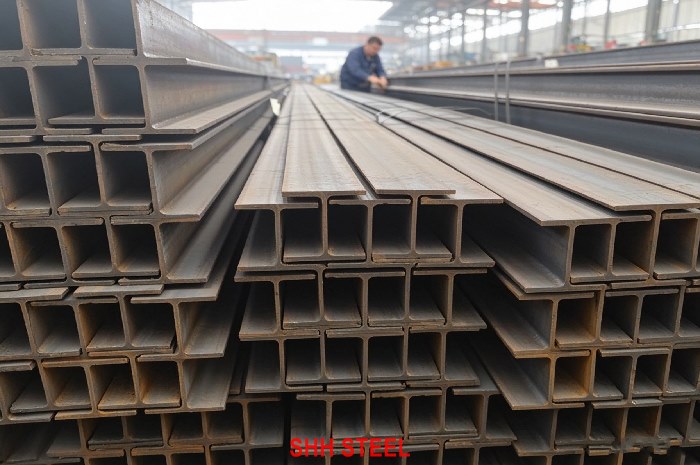
AS/NZS 3679.1 Grade 300 Universal Beam
What is AS/NZS 3679.1 Grade 300 Universal Beam?
AS/NZS 3679.1 Grade 300 universal beam is a hot-rolled structural section specified to the Australian/New Zealand hot-rolled bars and sections standard. Grade 300, also written G300, is the 300 MPa yield class. Grade 350 (G350) is the higher-strength sister and is tabulated on this page for comparison. The letters L0, L15 and S0 are impact options, not separate section shapes. Dimensions belong to the UB (universal beam) and UC (universal column) designations used with that standard, not to EN 10365 HEA or IPE rows of a similar depth, and not to GB/T 11263 Q355B H-beam or ASTM A36 wide-flange beam of a similar nominal size.
These beams are filed under steel beam profiles in the steel structural profiles category. The figures below are typical mill-published values consistent with AS/NZS 3679.1 Grade 300 and Grade 350. They are not presented as a row-by-row extract of the official 2016 annexes. The ordered edition of the standard, the grade and the impact option govern what is certified.
AS/NZS 3679.1 Grade 300 Chemistry (Typical Mill-Published Values)
The following ladle or cast-analysis maxima are commonly published by mills for the Grade 300 and Grade 350 families, including the L0 and S0 options. Finished-product scope in the mill tables used here is flange thickness from 6 mm to 40 mm. Carbon equivalent is the mill-published CE maximum, not a value invented for this page. Additional residual maxima are typical mill-published limits and should be read from the inspection document when they matter to fabrication.
Typical mill-published residual maxima for both families are shown below. Boron is listed only where a mill programme publishes it. Pcm is not tabulated here because it was not published as a numeric limit in the mill tables used for this page.
These figures are not a substitute for the official standard table. If a project names a different edition, a product analysis, or tighter residuals, those limits belong on the order and the certificate.
AS/NZS 3679.1 Grade 300 and Grade 350 Tensile Properties
Tensile properties below are typical mill-published values for sections. Thickness is the nominal thickness of the part sampled, ordinarily the flange for these UB and UC sections. The three yield bands are those on which two mill programmes agree, inside a finished-product flange-thickness scope of 6 mm to less than 40 mm. A fourth column for thickness of 40 mm and above appears in one mill reprint (280 MPa for Grade 300, 330 MPa for Grade 350) but sits at or beyond that finished-product scope; it is not adopted as a default and should be confirmed on the order if a flange of 40 mm or more is required.
The higher elongation shown for the S0 option is a mill-published figure for that impact option, not a second official base-grade table. Elongation gauge length should follow the named specification; one mill programme states 5.65√S0 for these section values.
AS/NZS 3679.1 Grade 300 L0 and S0 Impact Options
The base Grade 300 and Grade 350 designations, as reprinted in the mill tables used here, do not carry a tabulated Charpy requirement. When an impact quality is required, mills commonly offer L0 and, in some programmes, L15 or S0. The values below are typical mill-published options, not a claim that every option is a default of the official standard.
One mill programme states that impact testing does not apply for thickness below 7 mm. Subsize specimen energies, when used, should follow the named specification and the inspection document. If the project needs 70 J, or a −15 °C test, name that option on the order rather than assuming it from the base grade.
AS/NZS 3679.1 Grade 300 UB and UC Sizes (Typical Mill Series)
Typical mill-programme universal beams and universal columns commonly supplied to AS/NZS 3679.1 designations are tabulated below. The rows are a commonly supplied series, not a claim that every official annex size has been reproduced or that any one mill rolls the full list in Grade 300. Masses are theoretical catalogue figures. The lightest 250 UB row is published with a narrower flange (124 mm). Confirm the designation, flange and web thicknesses, and the material grade on the enquiry.
Swipe horizontally to view all dimensions.
Swipe horizontally to view all dimensions.
These designations are not EN 10365 HEA, HEB or IPE sections, and they are not Chinese HW/HM/HN or American W-shapes of a similar depth. A 310 UB is not a 310 UC. Cut lengths, camber, surface class and the inspection document type should be stated on the enquiry together with the grade and impact option.
AS/NZS 3679.1 Grade 300 Universal Beam Applications
Grade 300 UB and UC sections are used in building frames, industrial structures and general fabrication where an Australian or New Zealand 300 MPa section grade is named. Grade 350 is considered when the higher yield table is the one actually specified. These sections are not a silent substitute for EN 10025-2 S355JR H-beam or for EN 10025-2 S275JR H-beam, and a UB designation is not an HEA or a W-shape of similar depth.
Near-Equivalents for AS/NZS 3679.1 Grade 300 Universal Beam
A near-equivalent is a starting point for a discussion, not a licence to swap certificates. If a project names AS/NZS 3679.1 Grade 300, keep that standard, the grade, the impact option and the UB or UC designation on the order.
Sourcing AS/NZS 3679.1 Grade 300 Universal Beams from SHH STEEL
SHH STEEL supplies AS/NZS 3679.1 Grade 300 and Grade 350 universal beams and columns against a named designation list, the impact option (base, L0, L15 or S0), the material edition and the inspection document type. Enquiries should state the UB or UC designations, cut lengths or mill lengths, any processing, and whether a sister grade on the same standard is acceptable on part of the list.
AS/NZS 3679.1 Grade 300 Universal Beam FAQs
-
Is G300 the same as Grade 300?
- Yes. G300 is the usual short writing of AS/NZS 3679.1 Grade 300. G350 is Grade 350. The L0, L15 and S0 suffixes are impact options added to those grades.
-
Does Grade 300 always include a Charpy test?
- No. The base grade, as reprinted in the mill tables used here, has no tabulated Charpy requirement. If 27 J at 0 °C is required, name L0. If 70 J or a −15 °C test is required, name that option on the order.
-
Why is the yield given in three thickness bands?
- Mill programmes publish 320, 300 and 280 MPa for Grade 300 as thickness increases within a finished-product flange scope of 6 mm to less than 40 mm. Thickness is that of the part sampled, usually the flange. A thicker flange should be confirmed on the order.
-
Can an EN 10365 HEA replace a 3679.1 UB of similar depth?
- No. The designation systems, dimensions and material standards are different. State the UB or UC designation and AS/NZS 3679.1 on the enquiry.
-
Is this table the official AS/NZS 3679.1 annex?
- No. The official 2016 size and property annexes were not in hand for this page. The chemistry, tensile, Charpy and size figures are typical mill-published values consistent with Grade 300 and Grade 350, and the ordered edition governs.
Request a Quotation for AS/NZS 3679.1 Grade 300 Universal Beam
Send the UB or UC designation list, the grade (300 or 350), the impact option, the edition and the inspection document type. SHH STEEL will coordinate the mill programme and the certificate against that list.
Quality Steel Needed? Inquire for Offers
Related Products

