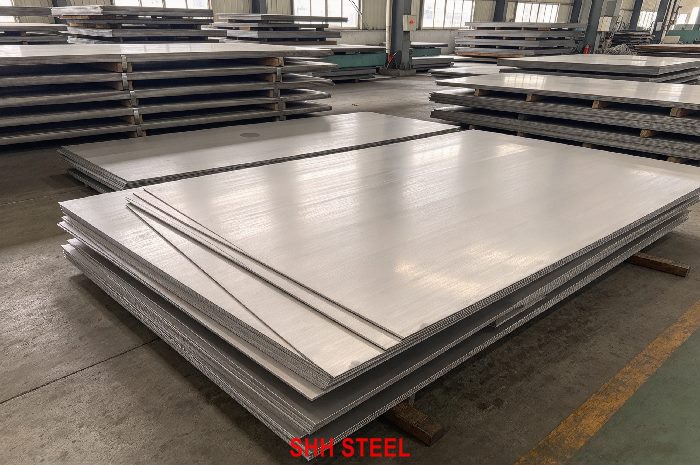
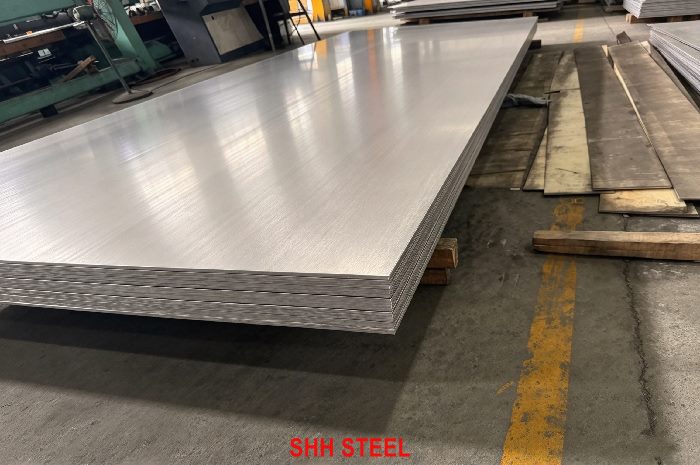
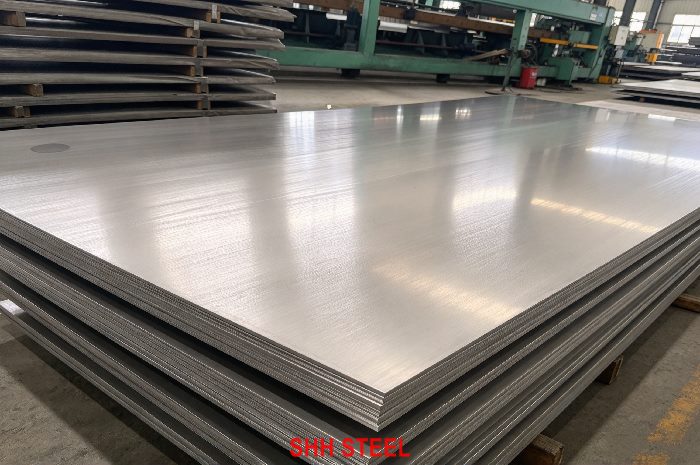
EN 10088-2 X2CrNiMnMoN25-18-6-5 1.4565 Stainless Steel Plate
What is EN 10088-2 X2CrNiMnMoN25-18-6-5 1.4565 Stainless Steel Plate?
Equivalent grades: 1.4565 X2CrNiMnMoN25-18-6-5 ≈ UNS S34565 ≈ GB/T 022Cr24Ni17Mo5Mn6NbN (S34553).
1.4565 X2CrNiMnMoN25-18-6-5 is a super-austenitic grade. 1.4565 is a high-nitrogen super-austenitic steel: about 25 % Cr, 4.5 % Mo and up to 0.6 % N, with manganese to hold the nitrogen in solution. PREN is about 46, and its proof strength is the highest of the austenitic grades in EN 10088-2.
EN 10088-2 is the European standard for stainless steel sheet, plate and strip for general purposes. It defines the chemistry, the mechanical properties for each product form (C = cold-rolled strip, H = hot-rolled strip, P = hot-rolled plate) and the process routes that give each surface finish. Pressure-equipment plate is ordered to EN 10028-7 instead, which adds elevated-temperature properties.
This page sets out the EN 10088-2 requirements for 1.4565 X2CrNiMnMoN25-18-6-5 plate: specification summary, chemistry, mechanical properties, corrosion resistance, heat treatment, finishes and tolerances, current stock, equivalents, fabrication and testing. SHH STEEL supplies it mill-direct from China with EN 10204 3.1 certificates, optional third-party inspection and in-house cutting.
1.4565 X2CrNiMnMoN25-18-6-5 plate: specification summary
| Item | 1.4565 X2CrNiMnMoN25-18-6-5 data |
|---|---|
| Standard | EN 10088-2:2014, stainless steels for general purposes – sheet/plate and strip |
| Product forms | C = cold-rolled strip, H = hot-rolled strip, P = hot-rolled plate |
| Process routes / finishes | 1C, 1E, 1D (hot rolled); 2D, 2B, 2R (cold rolled); special finishes by agreement |
| Typical thickness | 0.5–6 mm cold rolled; 3–100 mm hot-rolled plate depending on grade |
| Dimensions and tolerances | EN 10029 (plate), EN 10051 (hot-rolled strip and sheet), EN ISO 9445-1/-2 (cold rolled) |
| Required tests | cast analysis, tensile test; corrosion test by agreement |
| Inspection documents | EN 10204 3.1 or 3.2 |
| Grade family | super-austenitic |
Size range. Plate is produced on Steckel or reversing mills from about 5 mm up to 80–100 mm depending on grade, with widths of 1500–2500 mm and lengths up to 12 m; thinner plate of 3–12 mm is often cut from hot-rolled coil. Very heavy or wide plates, and plates with tight flatness, should be confirmed before ordering. 1.4565 X2CrNiMnMoN25-18-6-5 is a specialty grade made by a limited number of mills in campaign rolling. Stock covers the common sizes listed below; for project quantities or unusual sizes, plan for a mill campaign and reserve the heat early.
Chemical composition of 1.4565 X2CrNiMnMoN25-18-6-5 (EN 10088-2)
| Element | wt % |
|---|---|
| C | 0.030 max |
| Si | 1.00 max |
| Mn | 5.0–7.0 |
| P | 0.030 max |
| S | 0.015 max |
| Cr | 24.0–26.0 |
| Ni | 16.0–19.0 |
| Mo | 4.0–5.0 |
| N | 0.30–0.60 |
| Nb | 0.15 max |
Single values are maximums unless marked min. Ranges are heat (cast) analysis limits.
PREN check (Cr + 3.3 Mo + 16 N): about 42.0 at the specification minimums and about 47.0 at mid-range. Where corrosion resistance is critical, write a minimum PREN on the order and ask for the calculated value from the heat analysis on the certificate.
Mechanical properties of 1.4565 X2CrNiMnMoN25-18-6-5 plate
| Product form / thickness | Rp0.2 min, MPa | Rm, MPa | A min, % (transverse) |
|---|---|---|---|
| P, hot-rolled plate ≤ 30 mm | 420 | 800–950 | 30 |
The minimum yield strength of 420 MPa is about 2.5 times the 170 MPa minimum of ASTM 316L. The nitrogen addition is responsible for most of the extra strength; it also increases forming loads compared with 316L. Tension tests are taken in the direction stated in the standard; where a hardness limit is given, it is a maximum that confirms correct annealing.
Corrosion resistance of 1.4565 X2CrNiMnMoN25-18-6-5: PREN and limits
Super-austenitic grades are bought for one reason: chloride resistance. The pitting resistance equivalent number (PREN = Cr + 3.3 Mo + 16 N) at the specification minimum is about 42.0, and a mid-range heat is about 47.0. In practice this means resistance to pitting and crevice attack in seawater and chloride process streams where 316L and 904L fail, and a critical pitting temperature (ASTM G48 Method C/E) that is usually well above 50 °C for good mill product.
Because the structure is fully austenitic, these steels are also immune to the 300 °C service limit that applies to duplex, they stay tough at cryogenic temperatures, and they do not need ferrite control. The trade-off is segregation: high molybdenum segregates during solidification and can form sigma and chi phases if plate is cooled slowly after solution annealing. Good practice is to specify an ASTM G48 or A262-type acceptance test on the actual heat and to ask for the solution-anneal temperature on the mill certificate.
How 1.4565 X2CrNiMnMoN25-18-6-5 compares with related grades
| Grade | Cr | Ni | Mo | N | PREN (min) | YS / Rp0.2 min, MPa |
|---|---|---|---|---|---|---|
| 1.4565 X2CrNiMnMoN25-18-6-5 | 24.0–26.0 | 16.0–19.0 | 4.0–5.0 | 0.30–0.60 | 42.0 | 420 |
| UNS S31254 | 19.5–20.5 | 17.5–18.5 | 6.0–6.5 | 0.18–0.25 | 42.2 | 310 |
| UNS N08367 | 20.0–22.0 | 23.5–25.5 | 6.0–7.0 | 0.18–0.25 | 42.7 | 310 |
| UNS S34565 | 23.0–25.0 | 16.0–18.0 | 4.0–5.0 | 0.40–0.60 | 42.6 | 415 |
| UNS S32654 | 24.0–25.0 | 21.0–23.0 | 7.0–8.0 | 0.45–0.55 | 54.3 | 430 |
Choose 1.4565 X2CrNiMnMoN25-18-6-5 for warm seawater, chloride process streams and acidic chloride service where a fully austenitic, tough and non-magnetic structure is preferred. It costs more than super duplex in most markets, so it is usually chosen where low-temperature toughness, formability or service above 300 °C rules duplex out.
The table uses specification limits, not typical mill values, so it shows the guaranteed position of each grade. Final selection should also consider product availability in the thickness you need, welding consumables, and the inspection requirements of your project.
Heat treatment and delivery condition of 1.4565 X2CrNiMnMoN25-18-6-5
Heat treatment: 1120–1170 °C, water or air (rapid).
A high solution-anneal temperature dissolves sigma and chi phases and evens out molybdenum segregation; water quenching is used for plate. Hot forming should finish above about 1000 °C and be followed by a solution anneal.
Surface finishes for 1.4565 X2CrNiMnMoN25-18-6-5 plate
EN 10088-2 identifies finishes by process route. 1D (hot rolled, heat treated, pickled) is the normal plate finish; 1E is mechanically descaled. Cold-rolled material is supplied as 2D (dull), 2B (skin passed) or 2R (bright annealed). Ground, brushed and polished finishes (1G, 2G, 2J, 2K) can be agreed. Specify the route code on the order because it fixes surface condition and the tolerance standard that applies.
Dimensions, tolerances and flatness
Tolerances depend on the product form: EN 10029 for quarto plate (thickness classes A, B, C, D and flatness classes N and S), EN 10051 for hot-rolled wide strip and sheet cut from it, and EN ISO 9445-1/-2 for cold-rolled material. State the tolerance class on the order; class B (all minus tolerance removed) is common for pressure and structural plate.
European ordering practice. An EN order gives the product form (C, H or P), the steel name or number, the process route code, the dimensions and the EN tolerance standard, and the inspection document type. Under the Pressure Equipment Directive, plate for pressure parts is normally ordered to EN 10028-7 or with a particular material appraisal, and the certificate is a 3.1 from a mill with an approved quality system or a 3.2 with third-party witness. Corrosion testing to EN ISO 3651-2 is applied only when ordered. Many buyers also add AD 2000 W2 or project-specific requirements, which should be quoted in full.
1.4565 X2CrNiMnMoN25-18-6-5 plate stock in China
| Thickness (mm) | Width (mm) | Length (mm) | Finish | Approx. quantity | Location |
|---|---|---|---|---|---|
| 6 | 1500 / 2000 | 6000 | 1D | 100+ t | China |
| 8 | 1500 / 2000 | 6000 | 1D | 100+ t | China |
| 10 | 2000 | 6000 | 1D | 100+ t | China |
| 12 | 2000 | 6000 | 1D | 100+ t | China |
| 16 | 2000 / 2500 | 6000 | 1D | 100+ t | China |
| 20 | 2000 / 2500 | 6000 / 8000 | 1D | 100+ t | China |
| 30 | 2000 / 2500 | 6000 | 1D | 100+ t | China |
Quantities are approximate and stock changes daily. Send your size list for current availability; other thicknesses, widths and cut sizes can be supplied from mill production.
Packing and logistics. Plate is bundled on steel or wooden skids with steel bands and edge protection, typically 3–8 t per bundle, and marked with heat and plate numbers. Cut pieces are crated. Heavy and wide plate ships in open-top or flat-rack containers or by break-bulk; we send loading photos with the shipping documents.
1.4565 X2CrNiMnMoN25-18-6-5 equivalents in other standards
| Standard | Designation | Comment |
|---|---|---|
| ASTM / UNS | UNS S34565 | same alloy family and limits closely matched; compare each limit on the certificate |
| GB/T | 022Cr24Ni17Mo5Mn6NbN (S34553) | same alloy family and limits closely matched; compare each limit on the certificate |
Equivalents are close, not identical. When a project names one standard, order to that standard or ask for multiple certification and check every limit on the certificate.
Related grades by alloy family
Super austenitic
6Mo and 7Mo grades for seawater and chloride service; upgrade path from 316L and 904L: A240 N08904, A240 S31726, 1.4547 plate, 1.4529 plate, 1.4539 plate.
Super duplex
PREN 40+ duplex grades for seawater and severe chlorides: A240 S32750, 1.4410 plate, 1.4501 plate, 1.4507 plate.
Austenitic
General-purpose austenitic grades for comparison: A240 S30400.
Same standard
Other grades in this standard: 1.4162 plate, 1.4662 plate, 1.4303 plate.
Applications, forming and welding of 1.4565 X2CrNiMnMoN25-18-6-5
Typical uses: seawater, brine and FGD equipment, offshore process plate, and chemical vessels where high strength and a non-magnetic structure are needed.
In fabrication, plate cuts and forms like heavy austenitic plate but needs higher bending forces because of the nitrogen. Cut by plasma, laser or waterjet and remove heat tint by pickling or grinding. For welding use an over-alloyed nickel-base filler such as ERNiCrMo-3 or ERNiCrMo-13 (AWS A5.14), because a matching filler would lose molybdenum to segregation in the weld. Keep the weld area clean and free of carbon-steel contamination, and pickle and passivate after welding where corrosion resistance matters.
Welding practice. Weld with low to moderate heat input and interpass temperature below about 100 °C. An over-alloyed nickel-base filler compensates for molybdenum segregation in the weld metal; autogenous welds lose much of the base-metal pitting resistance and should be avoided on wetted surfaces unless the weld is solution annealed afterwards. Pickling after welding is essential to restore the passive layer.
Certificates, testing and receiving inspection
Every delivery carries a mill certificate to EN 10088-1 and EN 10088-2 with heat analysis, tensile results and hardness, and the grade and standard as ordered. Supplementary tests we can arrange: ASTM G48 Method A or critical pitting temperature (Method C/E), ASTM A262 practice where specified, microstructure check for sigma/chi, ultrasonic testing of plate, and PMI. Third-party witness by SGS, BV, TÜV, DNV, ABS or LR is available with EN 10204 3.2 certificates.
On receipt, check marking and heat number against the certificate, measure thickness at several points and confirm the finish and edge condition before cutting.
Common mistakes when specifying 1.4565 X2CrNiMnMoN25-18-6-5
- Ordering by trade name instead of the UNS or EN number, which leaves chemistry open.
- Welding with matching filler on seawater-wetted surfaces.
- Skipping a corrosion acceptance test on heavy plate where segregation is most likely.
Each of these can be avoided by writing the requirement into the purchase order and checking it on the certificate before the material is cut.
Sourcing 1.4565 X2CrNiMnMoN25-18-6-5: buyer concerns and SHH STEEL solutions
| Concern | How SHH STEEL handles it |
|---|---|
| Segregation and sigma in thick plate | solution-anneal temperature and quench recorded; G48 or CPT test on the actual heat |
| Long mill lead times | stock plate checked first; heats reserved early for project quantities |
| Small quantities across many sizes | mixed thicknesses and grades combined in one shipment |
| Cutting and edge preparation | in-house shearing, plasma, laser and waterjet cutting, bevelling |
| Delivery delays | weekly production and shipping updates with photos |
How to order 1.4565 X2CrNiMnMoN25-18-6-5 plate
State the standard and edition (EN 10088-2), the grade (1.4565 X2CrNiMnMoN25-18-6-5), thickness, width and length or coil, finish, quantity, tolerance class, any added chemistry limits, the supplementary tests and acceptance values from your specification, the certificate type and inspection agency, and packing. Send the list to SHH STEEL and we will reply with price, available stock and lead time.
FAQ
-
Is 1.4565 plate covered by EN 10088-2 or EN 10028-7?
- EN 10088-2 covers general-purpose plate. For pressure equipment under the PED, order to EN 10028-7 where the grade is listed there, because it adds elevated-temperature proof-strength values.
-
Is 1.4565 X2CrNiMnMoN25-18-6-5 equivalent to UNS S34565?
- They are the same alloy designation in different standards. Limits are closely matched, but always order to the standard named in your specification or ask for multiple certification.
-
Is 1.4565 X2CrNiMnMoN25-18-6-5 better than super duplex in seawater?
- Both are used in seawater. Super-austenitic grades are fully austenitic, tough at low temperature and not limited to about 300 °C, while super duplex has higher strength. The choice depends on temperature, chlorination and design stress.
-
Can I order small quantities or cut sizes?
- Yes. We combine mixed thicknesses and grades into one shipment and cut plate and sheet to size in our workshop.
-
Which certificates and tests can you provide?
- Every order ships with a mill certificate (EN 10204 3.1 type) showing heat analysis and mechanical tests. Supplementary tests and 3.2 certificates with SGS, BV, TÜV or another agency are available by agreement.
Conclusion
1.4565 X2CrNiMnMoN25-18-6-5 plate should be ordered with the points the standard leaves open written into the contract: finish, tolerance class, any extra chemistry limits and the supplementary tests your application needs. With those fixed, stock material from China is a fast and reliable route.
Quality Steel Needed? Inquire for Offers
Related Products