
RINA AH36 Shipbuilding Steel Plate
RINA AH36 shipbuilding steel plate — overview
RINA AH36 is the 0 °C high-tensile hull steel at the 36 strength level in RINA Part D (Materials and Welding) of the Rules for the Classification of Ships. Level 36 is the level most of a modern passenger ship’s hull girder is built from. Cruise and ro-pax designs use 36 plate for strength decks, side shell and bottom, where saved weight buys passenger capacity or stability margin. Minimum yield is 355 N/mm², tensile 490–630 N/mm², elongation 21 %.
Equivalent grades: ASTM A131 Grade AH36 · ABS AH36 · DNV NV A36 · LR AH36 · BV AH36 · CCS A36 / AH36 · NK KA36 · KR RA36 · GB 712 Grade AH36.
In RINA’s high-tensile series the letter sets the Charpy temperature (AH 0 °C, DH −20 °C, EH −40 °C, FH −60 °C) and the number sets the yield (32 → 315, 36 → 355, 40 → 390 N/mm²). AH36 is the A letter at level 36. Typical RINA-classed uses: hull-girder decks and side shell of cruise ships and ro-pax ferries, superyacht hulls, and the strength deck of product tankers and bulk carriers where 0 °C is enough.
RINA is the Genoa-based society that classes much of the Italian fleet and a large share of the world’s cruise ships and ferries, many of them built at Fincantieri and other Italian and Mediterranean yards. That background shows in the steel: passenger ships use large areas of thin plate in decks and superstructure, so flatness, weld distortion and consistent supply count as much as the grade letter.
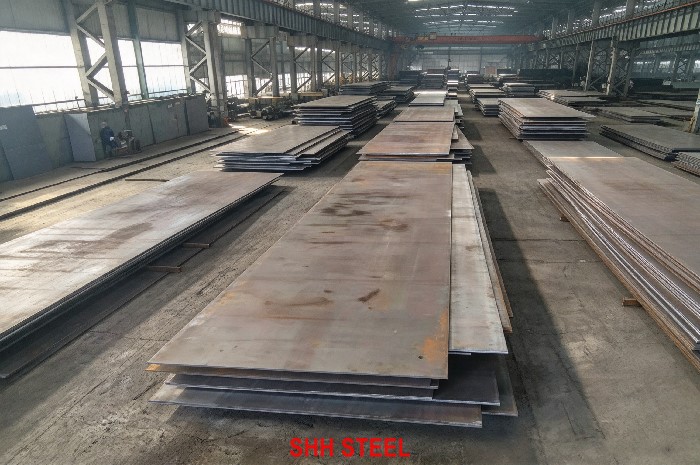
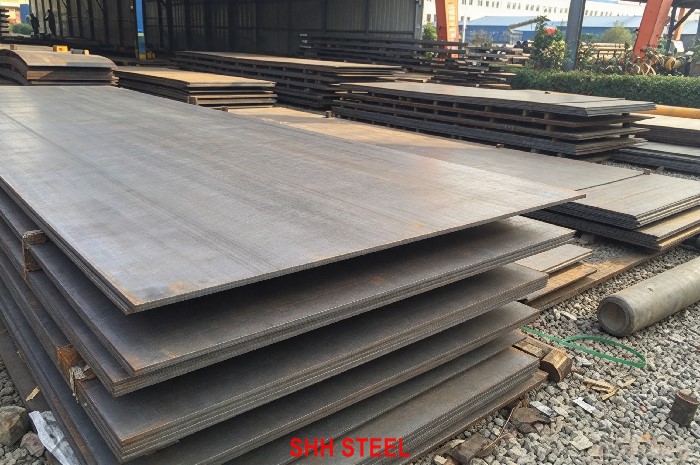
SHH STEEL supplies AH36 from Chinese mills whose RINA approval covers high-tensile hull steel in the ordered condition and thickness, with the RINA survey at the mill. Common 36-level sizes are held in stock; the rest is rolled to order.
How RINA names it. For higher-strength steel RINA uses the IACS form: H for high tensile, the toughness letter in front and the strength level behind, so AH36 = letter A, level 36. Buyers sometimes shorten it to “A36”, but on RINA paperwork the H stays.
Level 36 is the most widely produced high-tensile hull grade in the world, so it has the widest choice of RINA-approved mills, sizes and stock.
RINA AH36: key data at a glance
| Item | RINA AH36 |
|---|---|
| Rule book | RINA Rules for the Classification of Ships, Part D (Materials and Welding), higher-strength hull steel; IACS UR W11 AH36 (RINA numbering not quoted — UNCERTAIN) |
| Designation | AH36: toughness letter AH + strength level 36 |
| Strength | ReH ≥ 355 N/mm², Rm 490–630 N/mm², A ≥ 21 % |
| Charpy V | 0 °C |
| Steelmaking | killed and fine-grain treated (Al, Nb, V or Ti) |
| Condition of supply | AR / CR / N / TM as permitted by thickness and grain refiner; QT where approved |
| TM carbon equivalent | Ceq ≤ 0.38 % (t ≤ 50 mm), ≤ 0.40 % (50–100 mm) — indicative UR W11 practice, confirm on approval |
| Thickness scope | up to 100 mm (UR W11); beyond by agreement with RINA |
| Minus tolerance | IACS UR W13 (confirm class — UNCERTAIN) |
| Certificate | RINA-endorsed mill certificate; EN 10204 3.1 / 3.2 |
Traded AH36 is usually 6–60 mm thick and 2000–3000 mm wide. Passenger-ship hulls use a lot of 8–20 mm plate in this grade, which most RINA-approved mills roll routinely.
RINA AH36 chemistry — full alloy list
| Element | Ladle (heat) analysis, % | Product (check) analysis, % | Comment |
|---|---|---|---|
| C | 0.18 max. | numeric tolerance not tabulated in RINA Rules Part D – agree on order / mill certificate | AH/DH/EH column |
| Si | 0.10–0.50 | numeric tolerance not tabulated in RINA Rules Part D – agree on order / mill certificate | |
| Mn | 0.90–1.60 (AH ≤12.5 mm may be 0.70 min.) | numeric tolerance not tabulated in RINA Rules Part D – agree on order / mill certificate | |
| P | 0.035 max. | numeric tolerance not tabulated in RINA Rules Part D – agree on order / mill certificate | |
| S | 0.035 max. | numeric tolerance not tabulated in RINA Rules Part D – agree on order / mill certificate | |
| Al (acid-soluble) | 0.015 min. acid-soluble (or total Al per UR W11 fine-grain practice) | numeric tolerance not tabulated in RINA Rules Part D – agree on order / mill certificate | grain refiner |
| Nb | 0.02–0.05 when used singly | numeric tolerance not tabulated in RINA Rules Part D – agree on order / mill certificate | grain refiner / strength |
| V | 0.05–0.10 when used singly | numeric tolerance not tabulated in RINA Rules Part D – agree on order / mill certificate | |
| Ti | 0.02 max. | numeric tolerance not tabulated in RINA Rules Part D – agree on order / mill certificate | |
| Cu | 0.35 max. | numeric tolerance not tabulated in RINA Rules Part D – agree on order / mill certificate | |
| Cr | 0.20 max. | numeric tolerance not tabulated in RINA Rules Part D – agree on order / mill certificate | |
| Ni | 0.40 max. | numeric tolerance not tabulated in RINA Rules Part D – agree on order / mill certificate | |
| Mo | 0.08 max. | numeric tolerance not tabulated in RINA Rules Part D – agree on order / mill certificate | |
| N | — | numeric tolerance not tabulated in RINA Rules Part D – agree on order / mill certificate | no cap in A/D/E column |
| Nb+V+Ti | 0.12 max. (combined, when used together) | not applicable (calculated from heat analysis) | combined microalloy cap |
| Ceq (TM plate) | 0.38 / 0.40 max. (calculated) | not applicable (calculated from heat analysis) | t ≤ 50 / 50–100 mm |
Product (check) analysis column: RINA Rules Part D specify heat (ladle) limits; no numeric product-analysis tolerance is tabulated in the rule text reviewed, so product (check) limits are agreed on the order or taken from the approved mill specification and certificate.
Ladle limits are the IACS UR W11 values for higher-strength hull steel, applied by RINA in Part D (not checked against a RINA edition — UNCERTAIN). AH, DH and EH share one chemistry column, so one heat can often be certified to several letters if the Charpy results support it.
For TM plate ask for Ceq on the certificate, and Pcm too if your welding procedure is qualified on it. At level 36, Nb–Ti or Nb–V TM designs are usual. Check-analysis tolerances are agreed case by case.
RINA AH36 tensile requirements
| Property | Requirement |
|---|---|
| ReH | 355 N/mm² min. |
| Rm | 490–630 N/mm² |
| A (5.65√S0) | 21 % min. |
| Charpy test temperature | 0 °C |
Flat 200 mm test pieces — minimum elongation by thickness:
| t (mm) | ≤5 | 5–10 | 10–15 | 15–20 | 20–25 | 25–30 | 30–40 | 40–50 |
|---|---|---|---|---|---|---|---|---|
| A200 min. % | 13 | 15 | 16 | 17 | 18 | 19 | 20 | 21 |
AH36, DH36, EH36 and FH36 share these tensile values; only the Charpy temperature and, for FH, the chemistry differ. Compared with mild steel, AH36 gives 120 N/mm² more yield, which is the margin the designer spends on thinner plate.
Tensile specimens are taken transverse to the rolling direction for plate wider than about 600 mm, as UR W11/W16 practice requires; the certificate should show the specimen orientation. For TM plate, a yield/tensile ratio is often around 0.8–0.9; there is no class limit unless the order adds one (indicative).
RINA AH36: Charpy at 0 °C and condition of supply
| Thickness | Avg. long. (J) | Avg. trans. (J) |
|---|---|---|
| ≤ 50 mm | 34 | 24 |
| 50–70 mm | 41 | 27 |
| 70–100 mm | 50 | 34 |
Required energy rises with thickness: a 70–100 mm AH36 plate must average 50 J longitudinal at 0 °C, against 34 J up to 50 mm. AH plate in moderate thickness is often supplied as-rolled or controlled-rolled; TM is common above 20–25 mm.
Condition of supply sets batch size and test frequency, so it belongs on the order. If the owner’s specification adds strain-aged impact tests or Z-direction properties, those are extra requirements and must be priced and booked in advance.
Thickness tolerance and surface
The minus tolerance follows IACS UR W13 as RINA applies it; plus tolerance, flatness and dimensions follow the agreed standard (EN 10029 or GB/T 709). Weight-optimised high-tensile designs — and passenger ships are among the most weight-sensitive — leave little margin, so measure thickness at several points on receipt. Thin high-tensile deck plate distorts more easily during welding than thicker plate; ordering a tighter flatness class can save fairing work later.
UR W13 also allows local grinding of surface defects and sets how the average thickness of a plate is checked; the measurement points and acceptance method should be agreed at enquiry if the yard has its own procedure. For RINA passenger-ship work we suggest stating both the minus tolerance class and the flatness class on the order for any plate under 10 mm.
RINA AH36 stock and lead time
| Thickness (mm) | Width (mm) | Length (mm) | Condition | Approx. qty |
|---|---|---|---|---|
| 5 | 1500 / 1800 | 6000–12000 | AR / N / TM | 80+ t |
| 6 | 1800 / 2000 | 6000–12000 | AR / N / TM | 100+ t |
| 8 | 2000 | 6000–12000 | AR / N / TM | 150+ t |
| 10 | 2000 / 2200 | 6000–12000 | AR / N / TM | 200+ t |
| 12 | 2000 / 2500 | 6000–12000 | AR / N / TM | 200+ t |
| 16 | 2200 / 2500 | 6000–12000 | AR / N / TM | 150+ t |
| 20 | 2500 | 6000–12000 | AR / N / TM | 120+ t |
| 25 | 2500 | 6000–12000 | AR / N / TM | 100+ t |
| 30 | 2200 / 2500 | 6000–12000 | AR / N / TM | 80+ t |
| 40 | 2200 | 6000–12000 | AR / N / TM | 50+ t |
| 50 | 2200 | 6000–12000 | AR / N / TM | 30+ t |
Quantities change weekly — confirm before booking. Plates are sold as RINA AH36 with the RINA mark and endorsed certificate. Anything outside the stock list goes into the next mill campaign: about 4–6 weeks to certified plate.
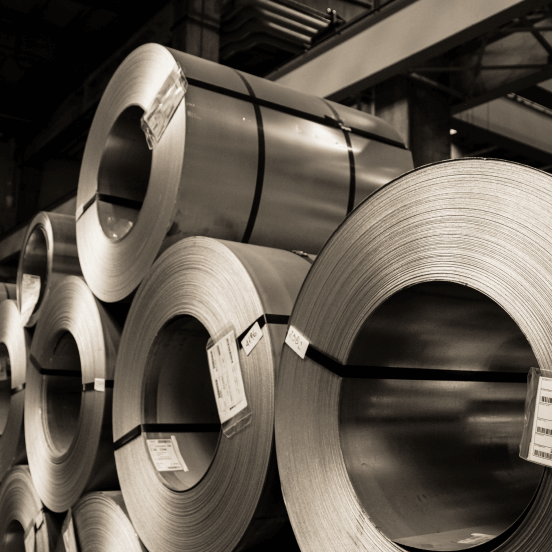
Packing: bundled by size with steel strapping, marked with grade and heat number, shipped in containers (≤ 11.8 m) or break bulk to Mediterranean and other ports.
Processing before shipping. We cut AH36 to drawing by plasma or oxy-fuel, bevel edges for welding, shot-blast and prime with shop primer, and mark each piece with grade, heat number and part number so that RINA traceability survives cutting. Cut parts ship with a cutting list that cross-references every piece to its original plate and certificate.
RINA AH36 against other class societies
| Society / standard | Designation | Remark |
|---|---|---|
| RINA | RINA AH36 | this page — Rules for the Classification of Ships, Part D |
| BV | BV AH36 | closest naming habit (A/B/D/E, AH…, A420…) |
| DNV | DNV VL A36 | VL prefix |
| LR | LR AH36 | |
| ABS | ABS AH36 | |
| CCS | CCS A36 / AH36 | |
| KR | KR RA36 | R-prefix |
| NK | NK KA36 | K-prefix |
| ASTM A131 | ASTM A131/A131M Grade AH36 | product standard, no class stamp |
| GB 712 | GB 712 Grade AH36 | Chinese product standard, no class stamp |
All of these share the UR W11 AH36 requirements. Each society accepts only its own mark, so if you need RINA plus a second society, book both surveyors before the plates are tested.
Where AH36 sits in the RINA AH/DH/EH/FH matrix
Think of the series as a grid: moving right (AH36, DH36, EH36, FH36) lowers the test temperature, moving down (AH32, AH36, AH40) raises the yield. The RINA material class table fixes the letter from structural category and thickness; the scantling calculation fixes the number. Substituting a higher letter at the same number is normally accepted; a lower letter is not.
AH36 is the default for passenger-ship hull girders in mild climates. Where part of a deck goes above the thickness at which AH is permitted, expect the drawing to move to DH there. Above 390 N/mm², RINA’s extra-high-strength series starts at A420 (IACS UR W16). See RINA Steel Plates.
Level 36 is the default for the main hull girder; designers move to level 40 only where deck or coaming thickness would otherwise become awkward to weld.
Welding and forming RINA AH36
Typical uses: hull-girder decks and side shell of cruise ships and ro-pax ferries, superyacht hulls, and the strength deck of product tankers and bulk carriers where 0 °C is enough.
Welding: use RINA-approved high-tensile consumables of grade 2Y or higher (typical UR W17 mapping — confirm in the WPS). Preheat and heat input follow the RINA-approved procedure and the Ceq on the certificate. High-heat-input electrogas or one-side submerged-arc welding of thick AH36 needs a procedure qualified at that heat input.
Forming: TM plate gets part of its strength from controlled rolling and cooling. Keep line heating within the mill’s temperature limit — typically quoted around 650 °C for accelerated-cooled plate (UNCERTAIN, mill-specific).
Why the A letter here. AH36 is tested at 0 °C and is chosen for temperate-water service and members above the waterline in sheltered conditions. An AH plate that tests well at −20 °C is still certified only as AH unless it was ordered and tested as DH. When building blocks mix letters, keep AH36 plates physically separated and colour-marked in the yard so that a lower letter is never fitted by mistake.
RINA survey, certificate and receiving checks
The certificate lists ladle chemistry including microalloys, Ceq for TM plate, tensile results, Charpy results at 0 °C, condition of supply and plate numbers, with the RINA surveyor’s endorsement.
On receipt: check the stamp reads AH36 with the RINA mark, the Charpy temperature and thickness band match the plate, and the endorsement is present. We can add EN 10204 3.2 witness, UT to EN 10160 or ASTM A578, Z-direction tests and dual class with another IACS society.
RINA approval of the manufacturer. A mill is approved by RINA for named grades, steelmaking route, delivery condition and maximum thickness, after approval tests and periodic renewal. Before placing an order for AH36, ask to see that the approval scope actually lists this grade and condition up to the thickness you need — this is the single most useful check a buyer can make (approval document format UNCERTAIN).
Mistakes we see on RINA AH36 orders
- Writing only “AH36” without RINA, so the plate arrives with another society’s mark
- Leaving the letter off (“36 grade”), so toughness is undefined
- Accepting a normal-strength A/B/D/E certificate against a high-tensile order
- No Ceq on the certificate for TM plate
- Substituting DH36 without class approval
- Charpy band for the delivered thickness not checked
A clear order line — grade, rule book, condition, certificate — prevents nearly all of them.
With AH36 the expensive errors are mixed letters within a delivery, missing Ceq for TM plate, and plates whose thickness falls into a higher Charpy band than the test covered.
Buying RINA AH36 from China: concerns and answers
| Concern | Answer |
|---|---|
| Is the RINA mark genuine? | Only mills with RINA approval for RINA AH36; certificate and stamp traceable to the heat; third-party witness on request |
| Can the surveyor at our yard verify it? | Yes — the certificate number and heat can be checked against the mill’s RINA records |
| Payment safety | T/T with balance after inspection, or L/C at sight |
| Small or mixed orders | several sizes and RINA grades in one container |
| Delivery visibility | weekly photos from rolling to loading |
| Ready-to-fit parts | cutting, bevelling and drilling in our own workshop |
If your yard has never bought from a Chinese mill under RINA survey, we can arrange a trial lot, share sample certificates in advance, and let your inspector or the RINA surveyor visit the mill during rolling and testing.
Ordering RINA AH36
State: RINA AH36, condition of supply, sizes and quantities, UT / Z-direction, dual class, certificate type and port, and send to SHH STEEL.
Sample line: “Hull plate to RINA Rules for the Classification of Ships, Part D, grade AH36, TM, 12 × 2500 × 12000 mm, 40 pcs, RINA-endorsed certificate with Ceq, EN 10204 3.2, CFR Monfalcone.”
Order checklist:
- Society and rule book: RINA Rules for the Classification of Ships, Part D
- Grade: AH36
- Condition of supply (AR / N / TM as allowed)
- Sizes and quantity per size; flatness class if tighter than standard
- Certificate: RINA-endorsed, EN 10204 3.1 or 3.2
- Extras: UT, Z-direction, dual class, shot-blast/prime, cutting
- Delivery terms and destination port
FAQ
Conclusion
RINA AH36 is higher-strength hull steel under RINA’s Rules for the Classification of Ships, Part D (Materials and Welding): yield 355 N/mm², tensile 490–630 N/mm², Charpy 0 °C. A RINA-classed ship accepts it only with the RINA mark and an endorsed certificate.
SHH STEEL supplies RINA AH36 from RINA-approved Chinese mills, with cutting, UT and EN 10204 3.2 on request. Send grade, sizes, quantities and port for a quotation.
Quality Steel Needed? Inquire for Offers