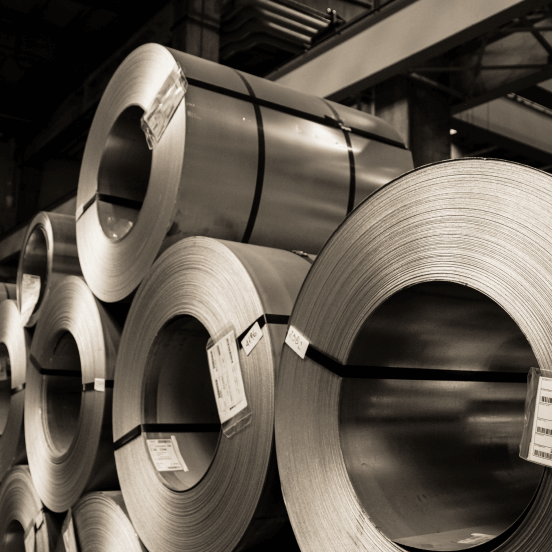

RINA F460 Shipbuilding Steel Plate
RINA F460 extra-high-strength shipbuilding steel plate — overview
RINA F460 is the −60 °C grade at the 460 N/mm² level, aimed at Arctic and polar service. RINA names its extra-high-strength hull steels in the official form without an “H”: toughness letter A, D, E or F followed by the minimum yield in N/mm², so F460 rather than an AH-style name. They are covered in Part D (Materials and Welding) of the Rules for the Classification of Ships on the basis of IACS UR W16. The 460 level is the level that arrived with very large container ships, where upper-deck and coaming plate was approaching the practical limit of welding thickness.
Equivalent grades: ASTM A131 (no direct grade at this strength) · ABS FH46 / FQ47 · DNV NV F460 · LR FH46 · BV F460 · CCS FH460 · NK KF460 · KR RF47 · GB 712 Grade FH460.
UR W16 values: ReH ≥ 460 N/mm², Rm 570–720 N/mm², A ≥ 17 %, Charpy at −60 °C. The F letter is for structures with very low design temperatures — Arctic units, polar ships — and few mills hold approval for it at every level.
F460 is produced TM or QT, and only at a mill whose RINA approval names this grade, condition and thickness range. Approval for AH36 or for a lower EHS level does not extend to it automatically.
Extra-high-strength plate is less common on RINA’s core passenger-ship work than AH/DH36, but it appears on the largest ships, on cranes and lifting gear, and widely on offshore and special units classed by RINA.
F460 is rolled to order, not held as open stock. SHH STEEL places the order with a RINA-approved Chinese mill, books the RINA survey, and adds UT, dual class or 3.2 witness on request. Typical uses: hatch coamings and sheer strakes of very large container ships, heavy-lift cranes and pedestals, and offshore topside nodes.
How RINA names it. For extra-high-strength steel RINA drops the H and writes the yield in full — F460 — which is why the same plate appears as FH460 in IACS UR W16 and some product standards. Both describe the same 460 N/mm² level with −60 °C toughness.
RINA F460: key data at a glance
| Item | RINA F460 |
|---|---|
| Rule book | RINA Rules for the Classification of Ships, Part D (Materials and Welding), extra-high-strength steel; IACS UR W16 (RINA numbering not quoted — UNCERTAIN) |
| Designation | F460: toughness letter F + minimum yield 460 N/mm² (official form, no “H”) |
| Strength | ReH ≥ 460, Rm 570–720 N/mm², A ≥ 17 % |
| Charpy V | −60 °C; average ≥ 46 J L / 31 J T (UR W16-aligned — confirm) |
| Condition of supply | TM or QT within the approved thickness (N only if specifically approved) |
| Steelmaking | killed, fine-grain; vacuum degassing and Ca treatment typical |
| UT | normally specified for this class — agree standard and acceptance level |
| Minus tolerance | IACS UR W13 (confirm class) |
| Certificate | RINA-endorsed certificate including Ceq / CET / Pcm; EN 10204 3.2 on request |
Maximum thickness is set by the mill approval. As a guide, TM F460 is often approved to about 50–80 mm and QT thicker, but the approval certificate is the limit (UNCERTAIN). At 420 and 460, most enquiries are 20–60 mm.
RINA F460 chemistry — full alloy list including B
| Element | Ladle (heat) analysis, % | Product (check) analysis, % | Comment |
|---|---|---|---|
| C | 0.18 max. (often tighter than AH/DH/EH; TM/QT may further tighten) | numeric tolerance not tabulated in RINA Rules Part D – agree on order / mill certificate | |
| Si | 0.55 max. (QT may differ — confirm on mill approval) | numeric tolerance not tabulated in RINA Rules Part D – agree on order / mill certificate | |
| Mn | 1.70 max. (typically 1.00–1.70) | numeric tolerance not tabulated in RINA Rules Part D – agree on order / mill certificate | |
| P | 0.020–0.025 max. (FH-route typically tighter — confirm) | numeric tolerance not tabulated in RINA Rules Part D – agree on order / mill certificate | |
| S | 0.020–0.025 max. (FH-route typically tighter — confirm) | numeric tolerance not tabulated in RINA Rules Part D – agree on order / mill certificate | |
| Al | 0.015 min. acid-soluble / ≈0.020 total Al (fine-grain; Al/N control) | numeric tolerance not tabulated in RINA Rules Part D – agree on order / mill certificate | grain refiner / N binder |
| Nb | 0.05 max. (when used; combined microalloy caps apply) | numeric tolerance not tabulated in RINA Rules Part D – agree on order / mill certificate | |
| V | 0.10 max. (when used; combined caps apply) | numeric tolerance not tabulated in RINA Rules Part D – agree on order / mill certificate | |
| Ti | 0.05 max. (when used; combined caps apply) | numeric tolerance not tabulated in RINA Rules Part D – agree on order / mill certificate | |
| Cu | 0.50 max. (route-dependent) | numeric tolerance not tabulated in RINA Rules Part D – agree on order / mill certificate | |
| Cr | 0.20–0.25 max. (route-dependent) | numeric tolerance not tabulated in RINA Rules Part D – agree on order / mill certificate | |
| Ni | 2.00 max. or per mill approval (FH often allows higher Ni for toughness) | numeric tolerance not tabulated in RINA Rules Part D – agree on order / mill certificate | toughness |
| Mo | 0.08–0.50 (route-dependent) | numeric tolerance not tabulated in RINA Rules Part D – agree on order / mill certificate | hardenability (QT) |
| B | 0.005 max. (when intentionally added) | numeric tolerance not tabulated in RINA Rules Part D – agree on order / mill certificate | hardenability (QT) |
| N | 0.012 max. typical with Al present (tighter FH control — confirm) | numeric tolerance not tabulated in RINA Rules Part D – agree on order / mill certificate | |
| Nb+V+Ti | Nb+V+Ti typically < 0.26 % for N/TM routes (not QT) — confirm UR W16 / mill approval | not applicable (calculated from heat analysis) | combined |
| Ceq / CET / Pcm | Ceq / CET / Pcm maxima by category and condition on mill approval — report on certificate | not applicable (calculated from heat analysis) | calculated |
Product (check) analysis column: RINA Rules Part D specify heat (ladle) limits; no numeric product-analysis tolerance is tabulated in the rule text reviewed, so product (check) limits are agreed on the order or taken from the approved mill specification and certificate.
The table gives the UR W16 envelope. RINA fixes the exact limits for each mill at approval, so the approval document and the order govern (UNCERTAIN against the Part D text). For 460, accelerated-cooled TM plate is the usual product, occasionally with a little Cu or Ni.
The F letter typically brings tighter P, S and N control than A/D/E at the same level, and often more Ni. Every intentionally added element must appear on the certificate together with Ceq, CET or Pcm, because the welding procedure depends on them.
Boron, when added, works in parts per million and is effective only when nitrogen is tied up, usually by titanium; that is why B, Ti and N should be read together on the certificate.
RINA F460 tensile and impact requirements
| Property | Requirement |
|---|---|
| ReH (or Rp0.2) | 460 N/mm² min. |
| Rm | 570–720 N/mm² |
| A | 17 % min. |
| Charpy V | −60 °C, ≥ 46 J L / 31 J T (average) |
| Yield/tensile ratio | report; limit only if specified on the order |
Tests are taken per heat-treatment batch or per rolled length as the approval requires; thick plate may need extra mid-thickness tests. Compared with FH40 the yield rises by 70 N/mm². That gain only pays off if the welded joint keeps up, so check that the qualified procedure reaches matching strength and toughness in weld metal and HAZ, not just in the plate.
Tensile specimens are taken transverse to the rolling direction for plate wider than about 600 mm, as UR W11/W16 practice requires; the certificate should show the specimen orientation. For QT plate, Rp0.2 is often reported instead of ReH because the yield point is not pronounced.
RINA F460: toughness at −60 °C and TM vs QT
Charpy specimens are normally taken at quarter thickness and tested at −60 °C. Delivery is TM or QT; the choice changes mill, price, flatness and welding behaviour, so state it on the order. TM is the usual route at this level and gives the better weldability.
At this toughness level many owners also ask for CTOD or brittle-crack-arrest data. Those are separate requirements (UNCERTAIN), so specify them if you need them.
TM plate gets its strength from controlled rolling and accelerated cooling, so it starts with low carbon and good weldability, but can lose some strength if heated above the mill’s limit. QT plate is austenitised, quenched and tempered, which gives uniform properties in thick sections; the tempering temperature then becomes the ceiling for any later heat treatment.
Thickness tolerance and flatness
Minus tolerance follows IACS UR W13; plus tolerance and flatness follow the agreed standard. QT plate is generally flatter than heavy TM plate but harder to straighten afterwards, so agree the flatness class at enquiry. Do not flame-straighten EHS plate above the mill’s stated temperature without approval — it can undo the TM or tempering treatment.
UR W13 also allows local grinding of surface defects and sets how the average thickness of a plate is checked; the measurement points and acceptance method should be agreed at enquiry if the yard has its own procedure. For EHS plate, thickness is usually measured by ultrasonic gauge at the mill and recorded on request; ask for it if the design relies on the minimum thickness.
RINA F460 mill-rolled supply
| Thickness (mm) | Width (mm) | Condition | Typical lot |
|---|---|---|---|
| 12 | 2000 / 2500 | TM / QT | per heat / rolling |
| 16 | 2200 / 2500 | TM / QT | per heat / rolling |
| 20 | 2500 | TM / QT | per heat / rolling |
| 25 | 2500 | TM / QT | per heat / rolling |
| 30 | 2200 / 2500 | TM / QT | per heat / rolling |
| 40 | 2200 | TM / QT | per heat / rolling |
| 50 | 2200 | TM / QT | per heat / rolling |
RINA F460 is not held as open stock. The table shows the thickness and width combinations we most often book into a mill campaign; expect roughly 6–10 weeks from order to RINA-certified plate (commercial estimate).
Packing: bundled by size with steel strapping, marked with grade and heat number, shipped in containers (≤ 11.8 m) or break bulk to Mediterranean and other ports.
Processing before shipping. We cut F460 to drawing by plasma or oxy-fuel, bevel edges for welding, shot-blast and prime with shop primer, and mark each piece with grade, heat number and part number so that RINA traceability survives cutting. Cut parts ship with a cutting list that cross-references every piece to its original plate and certificate.
RINA F460 against other class societies
| Society / standard | Designation | Remark |
|---|---|---|
| RINA | RINA F460 | this page — Rules for the Classification of Ships, Part D |
| BV | BV F460 | closest naming habit (A/B/D/E, AH…, A420…) |
| DNV | DNV VL F460 | VL prefix |
| LR | LR FH46 | EHS numbered by yield/10 |
| ABS | ABS FH46 / FQ47 | commercial / official |
| CCS | CCS FH460 | |
| KR | KR RF47 | R-prefix |
| NK | NK KF460 | K-prefix |
| ASTM A131 | none | A131 stops at FH40 |
| GB 712 | GB 712 Grade FH460 | Chinese product standard, no class stamp |
All sit in the same UR W16 band. The names differ (with or without “H”, R- or K-prefix, LR yield/10 numbers), and only the RINA mark counts for a RINA-classed structure.
Where F460 sits in the RINA A420–F690 series
Neighbours are F420 below and F500 above. Within level 460 the letter sets the test temperature: A 0 °C, D −20 °C, E −40 °C, F −60 °C. Changing level needs RINA plan approval.
As a rough guide for a yield-governed member, 30 mm of FH40 becomes about 25.4 mm of F460. Buckling, fatigue and corrosion margins often limit the real saving, so the gain is usually smaller (estimate, not a rule value).
Other RINA grades are listed under RINA Steel Plates; offshore-specific grades under offshore platform steel plates.
In RINA practice, EHS grades are usually concentrated in a few highly stressed areas rather than used everywhere. That keeps the number of welding procedures down: the yard only needs F460 procedures for the members where it pays.
Fabricating RINA F460
Typical uses: hatch coamings and sheer strakes of very large container ships, heavy-lift cranes and pedestals, and offshore topside nodes.
The yard welds F460 only under a RINA-approved WPS qualified on this grade, using low-hydrogen consumables that reach matching strength and −60 °C toughness in the weld metal. TM at this level is generally weldable with modest preheat, but the approved procedure governs. Do not hot-form or stress-relieve above the tempering temperature without agreement from the mill and RINA.
Why the F letter here. F460 is tested at −60 °C and is chosen for polar and Arctic service and the coldest design temperatures. FH plate needs the tightest steelmaking control, so certificates should be checked line by line for P, S, N and Ni. When building blocks mix letters, keep F460 plates physically separated and colour-marked in the yard so that a lower letter is never fitted by mistake.
HAZ softening can occur in TM plate under very high heat input, and HAZ hardening in QT plate under very low heat input, so the qualified range in the WPS should be respected on both sides. Hydrogen control — dry consumables, clean joints and controlled preheat — matters more as strength rises.
RINA survey, certificate and receiving checks
The certificate gives full alloy analysis, Ceq/CET/Pcm, tensile results, −60 °C Charpy results, condition of supply, UT result and plate numbers, with the RINA surveyor’s endorsement.
On receipt, check the F460 stamp and RINA mark, impact temperature, UT report and endorsement. Dual class with another IACS society and 3.2 witness are available if booked before testing.
RINA approval of the manufacturer. A mill is approved by RINA for named grades, steelmaking route, delivery condition and maximum thickness, after approval tests and periodic renewal. Before placing an order for F460, ask to see that the approval scope actually lists this grade and condition up to the thickness you need — this is the single most useful check a buyer can make (approval document format UNCERTAIN).
Mistakes we see on RINA F460 orders
- Writing AH460 instead of the official F460, or leaving out RINA
- Leaving TM vs QT open
- No UT requirement
- Ceq/Pcm not requested
- Ordering from a mill whose RINA approval does not cover the grade or thickness
- Expecting an ASTM A131 dual certificate (none exists at this level)
EHS plate is rolled for you, so a wrong order line costs a full rolling cycle. Check it twice.
With EHS plate the expensive errors are the ones that cannot be fixed after rolling: wrong route, wrong thickness range for the mill approval, or missing UT.
Buying RINA F460 from China: concerns and answers
| Concern | Answer |
|---|---|
| Is the RINA mark genuine? | Only mills with RINA approval for RINA F460; certificate and stamp traceable to the heat; third-party witness on request |
| Can the surveyor at our yard verify it? | Yes — the certificate number and heat can be checked against the mill’s RINA records |
| Payment safety | T/T with balance after inspection, or L/C at sight |
| Small or mixed orders | sizes grouped onto one heat where possible |
| Delivery visibility | weekly photos from rolling to loading |
| Ready-to-fit parts | cutting, bevelling and drilling in our own workshop |
If your yard has never bought from a Chinese mill under RINA survey, we can arrange a trial lot, share sample certificates in advance, and let your inspector or the RINA surveyor visit the mill during rolling and testing.
Ordering RINA F460
State RINA F460, TM or QT, sizes and quantities, UT level, dual class, certificate type and port, and send to SHH STEEL.
Sample line: “Plate to RINA Rules for the Classification of Ships, Part D, grade F460, TM, 40 × 2500 × 10000 mm, 8 pcs, UT EN 10160 S1E1, RINA-endorsed certificate with Pcm, EN 10204 3.2.”
Order checklist:
- Society and rule book: RINA Rules for the Classification of Ships, Part D
- Grade: F460
- Condition of supply (TM or QT)
- Sizes and quantity per size; flatness class if tighter than standard
- Certificate: RINA-endorsed, EN 10204 3.1 or 3.2
- Extras: UT, Z-direction, dual class, shot-blast/prime, cutting
- Delivery terms and destination port
FAQ
Conclusion
RINA F460 is extra-high-strength hull steel under RINA’s Rules for the Classification of Ships, Part D (Materials and Welding): yield 460 N/mm², tensile 570–720 N/mm², Charpy −60 °C. A RINA-classed ship accepts it only with the RINA mark and an endorsed certificate.
SHH STEEL supplies RINA F460 from RINA-approved Chinese mills, with cutting, UT and EN 10204 3.2 on request. Send grade, sizes, quantities and port for a quotation.
Quality Steel Needed? Inquire for Offers
Related Products